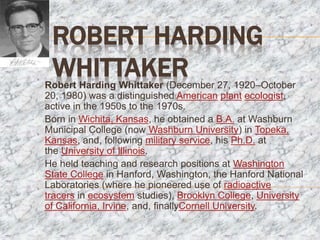
ROBERT HARDING
WHITTAKERRobert Harding Whittaker (December 27, 1920–October
20, 1980) was a distinguished American plant ecologist,
active in the 1950s to the 1970s.
Born in Wichita, Kansas, he obtained a B.A. at Washburn
Municipal College (now Washburn University) in Topeka,
Kansas, and, following military service, his Ph.D. at
the University of Illinois.
He held teaching and research positions at Washington
State College in Hanford, Washington, the Hanford National
Laboratories (where he pioneered use of radioactive
tracers in ecosystem studies), Brooklyn College, University
of California, Irvine, and, finallyCornell University.
INTRODUCTION
 R.H. Whittaker (1969) proposed a Five Kingdom Classification.
The kingdoms defined by him were named Monera, Protista,
Fungi, Plantae and Animalia. The main criteria for classification
used by him include cell structure, thallus organisation, mode of
nutrition, reproduction and phylogenetic relationships. Let us look
at this five kingdom classification to understand the issues and
considerations that influenced the classification system. Earlier
classification systems included bacteria, blue green algae, fungi,
mosses, ferns, gymnosperms and the angiosperms under
‘Plants’. The character that unified this whole kingdom was that all
the organisms included had a cell wall in their cells. This placed
together groups which widely differed in other characteristics. It
brought together the prokaryotic bacteria and the blue green
algae with other groups which were eukaryotic. It also grouped
together the unicellular organisms and the multicellular ones, say,
for example, Chlamydomonas and Spirogyra were placed
together under algae.
 The classification did not differentiate between the
heterotrophic group – fungi, and the autotrophic green plants,
though they also showed a characteristic difference in their
walls composition – the fungi had chitin in their walls while the
green plants had a cellulosic Five Kingdoms Characters Cell
type Cell wall Nuclear membrane Body organisation Mode of
nutrition Monera Prokaryotic Noncellulosic (Polysaccharide +
amino acid) Absent Cellular Autotrophic (chemosynthetic and
photosynthetic) and Heterotrophic Protista Eukaryotic
Present in some Present Cellular Autotrophic and
Heterotrophic Fungi Eukaryotic Present Present Multiceullar/
loose tissue Heterotrophic Plantae Eukaryotic Present
Present Tissue/ organ Autotrophic Animalia Eukaryotic
Absent Present Tissue/organ/ organ system Heterotrophic .
When such characteristics were considered, the fungi were
placed in a separate kingdom – Kingdom Fungi. All
prokaryotic organisms were grouped together under Kingdom
Monera and the unicellular eukaryotic organisms were placed
in Kingdom Protista. Kingdom Protista has brought together
Chlamydomonas, Chlorella with Paramoecium and Amoeba
(which were earlier placed in the animal kingdom which lack
KINGDOM MONERA:-
 Monera is a kingdom that contains unicellular
organisms with a prokaryotic cell organization (having
no nuclear membrane), such as bacteria. the
organisms found in kingdom Monera have been divided
into
two domains, Archaea and Bacteria (with Eukarya as
the third domain). Furthermore, the taxon Monera
is paraphyletic (not all members descended from their
most recent common ancestor),
as Archaea and Eukarya are currently believed to be
more closely related than either is to Bacteria. The term
"moneran" is the informal name of members of this
group and is still sometimes used (as is the term
"prokaryote") to denote a member of either domain
 . Bacteria are grouped under four categories based on
their shape: the spherical Coccus (pl.: cocci), the rod-
shaped Bacillus (pl.: bacilli), the comma-shaped Vibrium
(pl.: vibrio) and the spiral Spirillum (pl.: spirilla)
ARCHAEBACTERIA & EUBACTERIA
 Archae:-These bacteria
are special since they live
in some of the most harsh
habitats such as extreme
salty areas (halophiles),
hot springs
(thermoacidophiles) and
marshy areas
(methanogens).
Archaebacteria differ from
other bacteria in having a
different cell wall structure
and this feature is
responsible for their
survival in extreme
conditions.
 Eubacteria:-There are thousands of
different eubacteria or ‘true
bacteria’. They are characterised
by the presence of a rigid cell wall,
and if motile, a flagellum. The
cyanobacteria (also referred to as
blue-green algae) have chlorophyll
a similar to green plants and are
photosynthetic autotrophs . The
cyanobacteria are unicellular,
colonial or filamentous,
freshwater/marine or terrestrial
algae. Heterotrophic bacteria are
the most abundant in nature. The
majority are important
decomposers.
KINGDOM PROTISTA :-
 Some members of Kingdom Protista are unicellular, others are
colonial, and yet others are multicellular. Note that in the colonial
forms, all the cells are similar with similar, generalized functions,
whereas in the truly multicellular species, the “body” of the
organism consists of a variety of types of cells, each type with its
own specialized function. These organisms are all eukaryotes
(they have a true nucleus). They all need some kind of a water-
based environment — which can be fresh or marine water, snow,
damp soil, polar bear hairs — in which to live. All are aerobic and
have mitochondria to do cellular respiration, and some have
chloroplasts and can do photosynthesis. Most of them reproduce
or grow by mitosis, and some reproduce by meiosis and
fertilization. Many can form cysts in adverse conditions. Protists
are a major component of plankton.
CHRYSOPHYTES
 This group includes diatoms and golden algae
(desmids). They are found in fresh water as well as in
marine environments. They are microscopic and float
passively in water currents (plankton). Most of them
are photosynthetic. In diatoms the cell walls form two
thin overlapping shells, which fit together as in a soap
box. The walls are embedded with silica and thus the
walls are indestructible. Thus, diatoms have left
behind large amount of cell wall deposits in their
habitat; this accumulation over billions of years is
referred to as ‘diatomaceous earth’. Being gritty this
soil is used in polishing, filtration of oils and syrups.
Diatoms are the chief ‘producers’ in the oceans.
DINOFLAGELLATES
 These organisms are mostly marine and
photosynthetic. They appear yellow, green,
brown, blue or red depending on the main
pigments present in their cells. The cell wall has
stiff cellulose plates on the outer surface. Most
of them have two flagella; one lies longitudinally
and the other transversely in a furrow between
the wall plates. Very often, red dinoflagellates
(Example: Gonyaulax) undergo such rapid
multiplication that they make the sea appear red
(red tides). Toxins released by such large
numbers may even kill other marine animals
such as fishes.
EUGLENOIDS
 Majority of them are fresh water organisms
found in stagnant water. Instead of a cell wall,
they have a protein rich layer called pellicle
which makes their body flexible. They have two
flagella, a short and a long one. Though they
are photosynthetic in the presence of sunlight,
when deprived of sunlight they behave like
heterotrophs by predating on other smaller
organisms. Interestingly, the pigments of
euglenoids are identical to those present in
higher plants. Example: Euglena
SLIME MOULDS
 Slime moulds are saprophytic protists. The body
moves along decaying twigs and leaves
engulfing organic material. Under suitable
conditions, they form an aggregation called
plasmodium which may grow and spread over
several feet. During unfavourable conditions,
the plasmodium differentiates and forms fruiting
bodies bearing spores at their tips. The spores
possess true walls. They are extremely resistant
and survive for many years, even under adverse
conditions. The spores are dispersed by air
currents.
PROTOZOANS
 All protozoans are heterotrophs and live as predators or parasites. They are
believed to be primitive relatives of animals. There are four major groups of
protozoans.
 Amoeboid protozoans: These organisms live in fresh water, sea water or moist
soil. They move and capture Euglena Paramoecium their prey by putting out
pseudopodia (false feet) as in Amoeba. Marine forms have silica shells on their
surface. Some of them such as Entamoeba are parasites.
 Flagellated protozoans: The members of this group are either free-living or
parasitic. They have flagella. The parasitic forms cause diaseases such as
sleeping sickness. Example: Trypanosoma.
 Ciliated protozoans: These are aquatic, actively moving organisms because of
the presence of thousands of cilia. They have a cavity (gullet) that opens to the
outside of the cell surface. The coordinated movement of rows of cilia causes
the water laden with food to be steered into the gullet. Example: Paramoecium.
 Sporozoans: This includes diverse organisms that have an infectious spore-like
stage in their life cycle. The most notorious is Plasmodium (malarial parasite)
which causes malaria, a disease which has a staggering effect on human
population.
KINGDOM FUNGI
 The fungi constitute a unique kingdom of heterotrophic organisms. They
show a great diversity in morphology and habitat. When your bread
develops a mould or your orange rots it is because of fungi. The
common mushroom you eat and toadstools are also fungi. White spots
seen on mustard leaves are due to a parasitic fungus. Some unicellular
fungi, e.g., yeast are used to make bread and beer. Other fungi cause
diseases in plants and animals; wheat rust-causing Puccinia is an
important example. Some are the source of antibiotics, e.g., Penicillium.
Fungi are cosmopolitan and occur in air, water, soil and on animals and
plants Most fungi are heterotrophic and absorb soluble organic matter
from dead substrates and hence are called saprophytes. Those that
depend on living plants and animals are called parasites. They can also
live as symbionts – in association with algae as lichens and with roots of
higher plants as mycorrhiza. Reproduction in fungi can take place by
vegetative means – fragmentation, fission and budding. Asexual
reproduction is by spores called conidia or sporangiospores or
zoospores, and sexual reproduction is by oospores, ascospores and
basidiospores
PHYCOMYCETES
 Members of phycomycetes are found in
aquatic habitats and on decaying wood in
moist and damp places or as obligate
parasites on plants. The mycelium is aseptate
and coenocytic. Asexual reproduction takes
place by zoospores or by aplanospores .
These spores are endogenously produced in
sporangium. A zygospore is formed by fusion
of two gametes. These gametes are similar in
morphology or dissimilar . Some common
examples are Mucor , Rhizopus and Albugo
(the parasitic fungi on mustard).
ASCOMYCETES
 Commonly known as sac-fungi, the as comycetes are mostly
multicellular, e.g., Penicillium, or rarely unicellular, e.g., yeast .
They are saprophytic, decomposers, parasitic or coprophilous .
Mucor Aspergillus Agaricus is branched and septate. The
asexual spores are conidia produced exogenously on the
special mycelium called conidiophores. Conidia on germination
produce mycelium. Sexual spores are called ascospores which
are produced endogenously in sac like asci (singular ascus).
These asci are arranged in different types of fruiting bodies
called ascocarps. Some examples are Aspergillus , Claviceps
and Neurospora. Neurospora is used extensively in
biochemical and genetic work. Many members like morels and
truffles are edible and are considered delicacies.
BASIDIOMYCETES
 Commonly known forms of basidiomycetes are
mushrooms, bracket fungi or puffballs. They grow in
soil, on logs and tree stumps and in living plant
bodies as parasites, e.g., rusts and smuts. The
mycelium is branched and septate. The asexual
spores are generally not found, but vegetative
reproduction by fragmentation is common. The sex
organs are absent, but plasmogamy is brought about
by fusion of two vegetative or somatic cells of
different strains or genotypes. The resultant structure
is dikaryotic which ultimately gives rise to basidium.
Karyogamy and meiosis take place in the basidium
producing four basidiospores.
DEUTEROMYCETES
 Commonly known as imperfect fungi because only the
asexual or vegetative phases of these fungi are known.
When the sexual forms of these fungi were discovered
they were moved into classes they rightly belong to. It is
also possible that the asexual and vegetative stage have
been given one name (and placed under deuteromycetes)
and the sexual stage another (and placed under another
class). Later when the linkages were established, the
fungi were correctly identified and moved out of
deuteromycetes. Once perfect (sexual) stages of
members of dueteromycetes were discovered they were
often moved to ascomycetes and basidiomycetes. The
deuteromycetes reproduce only by asexual spores known
as conidia. The mycelium is septate and branched
KINGDOM PLANTAE
 Kingdom Plantae includes all eukaryotic
chlorophyll-containing organisms commonly
called plants. A few members are partially
heterotrophic such as the insectivorous plants
or parasites. Bladderwort and Venus fly trap are
examples of insectivorous plants and Cuscuta is
a parasite. The plant cells have an eukaryotic
structure with prominent chloroplasts and cell
wall mainly made of cellulose. Plantae includes
algae, bryophytes, pteridophytes, gymnosperms
and angiosperms.
KINGDOM ANIMALIA
 This kingdom is characterised by heterotrophic
eukaryotic organisms that are multicellular and their
cells lack cell walls. They directly or indirectly depend
on plants for food. They digest their food in an
internal cavity and store food reserves as glycogen or
fat. Their mode of nutrition is holozoic – by ingestion
of food. They follow a definite growth pattern and
grow into adults that have a definite shape and size.
Higher forms show elaborate sensory and
neuromotor mechanism. Most of them are capable of
locomotion. The sexual reproduction is by copulation
of male and female followed by embryological
development.
R.H.wittaker 5 kingom of classification

R.H.wittaker 5 kingom of classification

  • 1.
    ROBERT HARDING WHITTAKERRobert HardingWhittaker (December 27, 1920–October 20, 1980) was a distinguished American plant ecologist, active in the 1950s to the 1970s. Born in Wichita, Kansas, he obtained a B.A. at Washburn Municipal College (now Washburn University) in Topeka, Kansas, and, following military service, his Ph.D. at the University of Illinois. He held teaching and research positions at Washington State College in Hanford, Washington, the Hanford National Laboratories (where he pioneered use of radioactive tracers in ecosystem studies), Brooklyn College, University of California, Irvine, and, finallyCornell University.
  • 3.
    INTRODUCTION  R.H. Whittaker(1969) proposed a Five Kingdom Classification. The kingdoms defined by him were named Monera, Protista, Fungi, Plantae and Animalia. The main criteria for classification used by him include cell structure, thallus organisation, mode of nutrition, reproduction and phylogenetic relationships. Let us look at this five kingdom classification to understand the issues and considerations that influenced the classification system. Earlier classification systems included bacteria, blue green algae, fungi, mosses, ferns, gymnosperms and the angiosperms under ‘Plants’. The character that unified this whole kingdom was that all the organisms included had a cell wall in their cells. This placed together groups which widely differed in other characteristics. It brought together the prokaryotic bacteria and the blue green algae with other groups which were eukaryotic. It also grouped together the unicellular organisms and the multicellular ones, say, for example, Chlamydomonas and Spirogyra were placed together under algae.
  • 4.
     The classificationdid not differentiate between the heterotrophic group – fungi, and the autotrophic green plants, though they also showed a characteristic difference in their walls composition – the fungi had chitin in their walls while the green plants had a cellulosic Five Kingdoms Characters Cell type Cell wall Nuclear membrane Body organisation Mode of nutrition Monera Prokaryotic Noncellulosic (Polysaccharide + amino acid) Absent Cellular Autotrophic (chemosynthetic and photosynthetic) and Heterotrophic Protista Eukaryotic Present in some Present Cellular Autotrophic and Heterotrophic Fungi Eukaryotic Present Present Multiceullar/ loose tissue Heterotrophic Plantae Eukaryotic Present Present Tissue/ organ Autotrophic Animalia Eukaryotic Absent Present Tissue/organ/ organ system Heterotrophic . When such characteristics were considered, the fungi were placed in a separate kingdom – Kingdom Fungi. All prokaryotic organisms were grouped together under Kingdom Monera and the unicellular eukaryotic organisms were placed in Kingdom Protista. Kingdom Protista has brought together Chlamydomonas, Chlorella with Paramoecium and Amoeba (which were earlier placed in the animal kingdom which lack
  • 6.
    KINGDOM MONERA:-  Monerais a kingdom that contains unicellular organisms with a prokaryotic cell organization (having no nuclear membrane), such as bacteria. the organisms found in kingdom Monera have been divided into two domains, Archaea and Bacteria (with Eukarya as the third domain). Furthermore, the taxon Monera is paraphyletic (not all members descended from their most recent common ancestor), as Archaea and Eukarya are currently believed to be more closely related than either is to Bacteria. The term "moneran" is the informal name of members of this group and is still sometimes used (as is the term "prokaryote") to denote a member of either domain  . Bacteria are grouped under four categories based on their shape: the spherical Coccus (pl.: cocci), the rod- shaped Bacillus (pl.: bacilli), the comma-shaped Vibrium (pl.: vibrio) and the spiral Spirillum (pl.: spirilla)
  • 7.
    ARCHAEBACTERIA & EUBACTERIA Archae:-These bacteria are special since they live in some of the most harsh habitats such as extreme salty areas (halophiles), hot springs (thermoacidophiles) and marshy areas (methanogens). Archaebacteria differ from other bacteria in having a different cell wall structure and this feature is responsible for their survival in extreme conditions.  Eubacteria:-There are thousands of different eubacteria or ‘true bacteria’. They are characterised by the presence of a rigid cell wall, and if motile, a flagellum. The cyanobacteria (also referred to as blue-green algae) have chlorophyll a similar to green plants and are photosynthetic autotrophs . The cyanobacteria are unicellular, colonial or filamentous, freshwater/marine or terrestrial algae. Heterotrophic bacteria are the most abundant in nature. The majority are important decomposers.
  • 9.
    KINGDOM PROTISTA :- Some members of Kingdom Protista are unicellular, others are colonial, and yet others are multicellular. Note that in the colonial forms, all the cells are similar with similar, generalized functions, whereas in the truly multicellular species, the “body” of the organism consists of a variety of types of cells, each type with its own specialized function. These organisms are all eukaryotes (they have a true nucleus). They all need some kind of a water- based environment — which can be fresh or marine water, snow, damp soil, polar bear hairs — in which to live. All are aerobic and have mitochondria to do cellular respiration, and some have chloroplasts and can do photosynthesis. Most of them reproduce or grow by mitosis, and some reproduce by meiosis and fertilization. Many can form cysts in adverse conditions. Protists are a major component of plankton.
  • 10.
    CHRYSOPHYTES  This groupincludes diatoms and golden algae (desmids). They are found in fresh water as well as in marine environments. They are microscopic and float passively in water currents (plankton). Most of them are photosynthetic. In diatoms the cell walls form two thin overlapping shells, which fit together as in a soap box. The walls are embedded with silica and thus the walls are indestructible. Thus, diatoms have left behind large amount of cell wall deposits in their habitat; this accumulation over billions of years is referred to as ‘diatomaceous earth’. Being gritty this soil is used in polishing, filtration of oils and syrups. Diatoms are the chief ‘producers’ in the oceans.
  • 11.
    DINOFLAGELLATES  These organismsare mostly marine and photosynthetic. They appear yellow, green, brown, blue or red depending on the main pigments present in their cells. The cell wall has stiff cellulose plates on the outer surface. Most of them have two flagella; one lies longitudinally and the other transversely in a furrow between the wall plates. Very often, red dinoflagellates (Example: Gonyaulax) undergo such rapid multiplication that they make the sea appear red (red tides). Toxins released by such large numbers may even kill other marine animals such as fishes.
  • 12.
    EUGLENOIDS  Majority ofthem are fresh water organisms found in stagnant water. Instead of a cell wall, they have a protein rich layer called pellicle which makes their body flexible. They have two flagella, a short and a long one. Though they are photosynthetic in the presence of sunlight, when deprived of sunlight they behave like heterotrophs by predating on other smaller organisms. Interestingly, the pigments of euglenoids are identical to those present in higher plants. Example: Euglena
  • 13.
    SLIME MOULDS  Slimemoulds are saprophytic protists. The body moves along decaying twigs and leaves engulfing organic material. Under suitable conditions, they form an aggregation called plasmodium which may grow and spread over several feet. During unfavourable conditions, the plasmodium differentiates and forms fruiting bodies bearing spores at their tips. The spores possess true walls. They are extremely resistant and survive for many years, even under adverse conditions. The spores are dispersed by air currents.
  • 14.
    PROTOZOANS  All protozoansare heterotrophs and live as predators or parasites. They are believed to be primitive relatives of animals. There are four major groups of protozoans.  Amoeboid protozoans: These organisms live in fresh water, sea water or moist soil. They move and capture Euglena Paramoecium their prey by putting out pseudopodia (false feet) as in Amoeba. Marine forms have silica shells on their surface. Some of them such as Entamoeba are parasites.  Flagellated protozoans: The members of this group are either free-living or parasitic. They have flagella. The parasitic forms cause diaseases such as sleeping sickness. Example: Trypanosoma.  Ciliated protozoans: These are aquatic, actively moving organisms because of the presence of thousands of cilia. They have a cavity (gullet) that opens to the outside of the cell surface. The coordinated movement of rows of cilia causes the water laden with food to be steered into the gullet. Example: Paramoecium.  Sporozoans: This includes diverse organisms that have an infectious spore-like stage in their life cycle. The most notorious is Plasmodium (malarial parasite) which causes malaria, a disease which has a staggering effect on human population.
  • 16.
    KINGDOM FUNGI  Thefungi constitute a unique kingdom of heterotrophic organisms. They show a great diversity in morphology and habitat. When your bread develops a mould or your orange rots it is because of fungi. The common mushroom you eat and toadstools are also fungi. White spots seen on mustard leaves are due to a parasitic fungus. Some unicellular fungi, e.g., yeast are used to make bread and beer. Other fungi cause diseases in plants and animals; wheat rust-causing Puccinia is an important example. Some are the source of antibiotics, e.g., Penicillium. Fungi are cosmopolitan and occur in air, water, soil and on animals and plants Most fungi are heterotrophic and absorb soluble organic matter from dead substrates and hence are called saprophytes. Those that depend on living plants and animals are called parasites. They can also live as symbionts – in association with algae as lichens and with roots of higher plants as mycorrhiza. Reproduction in fungi can take place by vegetative means – fragmentation, fission and budding. Asexual reproduction is by spores called conidia or sporangiospores or zoospores, and sexual reproduction is by oospores, ascospores and basidiospores
  • 17.
    PHYCOMYCETES  Members ofphycomycetes are found in aquatic habitats and on decaying wood in moist and damp places or as obligate parasites on plants. The mycelium is aseptate and coenocytic. Asexual reproduction takes place by zoospores or by aplanospores . These spores are endogenously produced in sporangium. A zygospore is formed by fusion of two gametes. These gametes are similar in morphology or dissimilar . Some common examples are Mucor , Rhizopus and Albugo (the parasitic fungi on mustard).
  • 18.
    ASCOMYCETES  Commonly knownas sac-fungi, the as comycetes are mostly multicellular, e.g., Penicillium, or rarely unicellular, e.g., yeast . They are saprophytic, decomposers, parasitic or coprophilous . Mucor Aspergillus Agaricus is branched and septate. The asexual spores are conidia produced exogenously on the special mycelium called conidiophores. Conidia on germination produce mycelium. Sexual spores are called ascospores which are produced endogenously in sac like asci (singular ascus). These asci are arranged in different types of fruiting bodies called ascocarps. Some examples are Aspergillus , Claviceps and Neurospora. Neurospora is used extensively in biochemical and genetic work. Many members like morels and truffles are edible and are considered delicacies.
  • 19.
    BASIDIOMYCETES  Commonly knownforms of basidiomycetes are mushrooms, bracket fungi or puffballs. They grow in soil, on logs and tree stumps and in living plant bodies as parasites, e.g., rusts and smuts. The mycelium is branched and septate. The asexual spores are generally not found, but vegetative reproduction by fragmentation is common. The sex organs are absent, but plasmogamy is brought about by fusion of two vegetative or somatic cells of different strains or genotypes. The resultant structure is dikaryotic which ultimately gives rise to basidium. Karyogamy and meiosis take place in the basidium producing four basidiospores.
  • 20.
    DEUTEROMYCETES  Commonly knownas imperfect fungi because only the asexual or vegetative phases of these fungi are known. When the sexual forms of these fungi were discovered they were moved into classes they rightly belong to. It is also possible that the asexual and vegetative stage have been given one name (and placed under deuteromycetes) and the sexual stage another (and placed under another class). Later when the linkages were established, the fungi were correctly identified and moved out of deuteromycetes. Once perfect (sexual) stages of members of dueteromycetes were discovered they were often moved to ascomycetes and basidiomycetes. The deuteromycetes reproduce only by asexual spores known as conidia. The mycelium is septate and branched
  • 22.
    KINGDOM PLANTAE  KingdomPlantae includes all eukaryotic chlorophyll-containing organisms commonly called plants. A few members are partially heterotrophic such as the insectivorous plants or parasites. Bladderwort and Venus fly trap are examples of insectivorous plants and Cuscuta is a parasite. The plant cells have an eukaryotic structure with prominent chloroplasts and cell wall mainly made of cellulose. Plantae includes algae, bryophytes, pteridophytes, gymnosperms and angiosperms.
  • 24.
    KINGDOM ANIMALIA  Thiskingdom is characterised by heterotrophic eukaryotic organisms that are multicellular and their cells lack cell walls. They directly or indirectly depend on plants for food. They digest their food in an internal cavity and store food reserves as glycogen or fat. Their mode of nutrition is holozoic – by ingestion of food. They follow a definite growth pattern and grow into adults that have a definite shape and size. Higher forms show elaborate sensory and neuromotor mechanism. Most of them are capable of locomotion. The sexual reproduction is by copulation of male and female followed by embryological development.