CERAMIC
Atheer ahmed 1330129
Dental Materials
The university of gerogia
DEFINITIONS
• Ceramic –
• An inorganic compound w/ non metallic
properties typically composed of metallic and
non metallic elements
• Dental ceramic –
• An inorganic compound w/ non metallic
properties typically composed of O2 and 1 or
more metallic or semi metallic elements that is
formulated to produce the whole part of a
ceramic based dental prosthesis
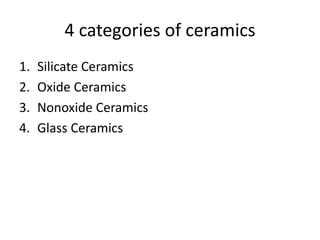
4 categories of ceramics
1. Silicate Ceramics
2. Oxide Ceramics
3. Nonoxide Ceramics
4. Glass Ceramics
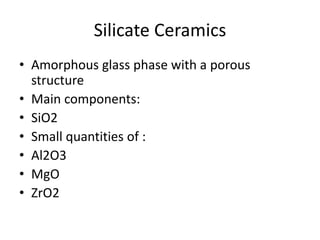
Silicate Ceramics
• Amorphous glass phase with a porous
structure
• Main components:
• SiO2
• Small quantities of :
• Al2O3
• MgO
• ZrO2
Oxide Ceramics
• Principally contains:
• Al2O3,MgO,ZrO2 with either no glass phase or
small content.
Non oxide Ceramics
Impractical for dental use
High sintering temp
Unesthetic color
opacity
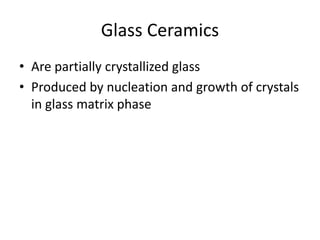
Glass Ceramics
• Are partially crystallized glass
• Produced by nucleation and growth of crystals
in glass matrix phase
Dental ceramics
• May consist primarily of :
• Glasses , glass ceramics or highly crystalline
structures
• Ceramics are more resistant to corrosion than
plastic
• Remain stable for a long period of time
• Do not react with most liquids, gases
• Excellent – fair fracture toughness
• Zirconium dioxide
> Flexural strength similar to steel
Dental ceramics can be classified
according to :
• Use or Indication
- Anterior
- Posterior
- Crowns
- Veneers
- Post and cores
- Stain ceramics
- Glaze ceramics
Metal Ceramic Prosthesis
• COMPOSITION OF DENTAL PORCELAINS
• Most dental porcelains consist of
• Kaolin
• Silica
• Feldspar
• Glasses
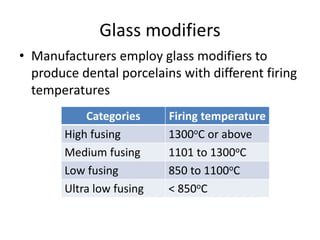
Glass modifiers
• Manufacturers employ glass modifiers to
produce dental porcelains with different firing
temperatures
Categories Firing temperature
High fusing 1300oC or above
Medium fusing 1101 to 1300oC
Low fusing 850 to 1100oC
Ultra low fusing < 850oC
Feldspathic Porcelains
• Feldspar- main ingredient of classical metal
ceramic porcelain. ( crystalline and opaque)
• Chemically designated as K2O.Al2O3.6SiO2
• These ceramics are called porcelains because
they contain a glass matrix and one or more
crystal phases.
Esthetic potetial
Metal ceramic
• 70% of all fixed restorations
• Not the best esthetic choice
• Dark line at facial margin
All Ceramic
• Matches appearance of
adjacent natural tooth
• More susceptible to
fracture
• Ceramic margin
Porcelain Condensation
• Supplied as a fine powder to be mixed with water
or another vehicle and condensed into desired
form
• Dense packing has 2 benefits:
1. Lower firing range
2. Less porosity
• Packing may be achieved through
1. Vibration
2. Spatulation
3. Brush technique
Drying
• The restoration is placed in an open furnace to
be dried.
• Until 480 deg C is reached
• Drying stage – 5- 8 minutes
• Ensures the remaining water is removed
• Dries too quickly – spontaneous breakage
• If wet structure is placed onto firing in hot
furnace – steam-crumble-explode
Sintering of porcelain
• The purpose of firing :
• To sinter the particles of powder together
properly to form the prosthesis.
• Sintering – process of heating closely packed
particles to a specified temp to densify and
strengthen a structure
• After porcelain is preheated, firing cycle is
initiated.
Overglazing and shading
• Natural glazed porcelain is much stronger than
ground, rough, non glazed porcelain.
• Glaze – effective in reducing crack propagation
within the outer surface.
• Stains and glazes
Cooling of metal-ceramic prosthesis
• Sudden changes in temperature – fracture
• Slow cooling followed by slow opening of
furnace door
Benefits and drawbacks of metla
ceramics
• Stronger and more durable than all ceramic
crowns
• Permanent aesthetic quality
• Fracture resistance
• No abrasion wear
• No staining along metal and veneer interface
• Less tooth structure is removed to provide
proper bulk for the crown.
Ceramics for Ceramic Metal
Restorations
• 5 requirements:
1. Must simulate appearance of tooth
2. Fuse at low temp
3. Must have compatible thermal expansion
with metals
4. Must withstand oral environment
5. Must not abrade opposing teeth
Ceramics for ceramic metal
restorations
• Ceramics are composed of crystalline phases
in an amorphous , glassy vitreous matrix.
• Glass
• They fuse at a lower temp , to prevent metal
from distorting
All ceramic prosthesis
• Castable and machinable glass ceramics
• Pressable glass ceramics
• Slip cast All ceramic ceramics
• Procera Allceram
• CAD CAM ceramics
General applications of ceramics in
dentistry
• Ceramics are the best materials to match
esthetic complexity of human teeth
• Used for ceramic metal crown
• All ceramic resto
• To fabricate denture teeth
Ceramic metal crowns
• ADVANTAGE:
• Better abrasion resistance
• More durable
• Better adhesion with resin cements
• DISADVANTAGES:
• Occlusal adjustment is more difficult
• Not for high stress areas
All Ceramic Crowns, inlays , veneers
• Ceramic veneer – layer of ceramic bonded to
the facial surface of a prepared tooth to cover
any defaults.
• Custom made , fabricated in lab.
Thank you
www.wikipedia.com
www.sliedshar.com

DENTAL MATERIALS

  • 1.
    CERAMIC Atheer ahmed 1330129 DentalMaterials The university of gerogia
  • 2.
    DEFINITIONS • Ceramic – •An inorganic compound w/ non metallic properties typically composed of metallic and non metallic elements • Dental ceramic – • An inorganic compound w/ non metallic properties typically composed of O2 and 1 or more metallic or semi metallic elements that is formulated to produce the whole part of a ceramic based dental prosthesis
  • 3.
    4 categories ofceramics 1. Silicate Ceramics 2. Oxide Ceramics 3. Nonoxide Ceramics 4. Glass Ceramics
  • 4.
    Silicate Ceramics • Amorphousglass phase with a porous structure • Main components: • SiO2 • Small quantities of : • Al2O3 • MgO • ZrO2
  • 5.
    Oxide Ceramics • Principallycontains: • Al2O3,MgO,ZrO2 with either no glass phase or small content. Non oxide Ceramics Impractical for dental use High sintering temp Unesthetic color opacity
  • 6.
    Glass Ceramics • Arepartially crystallized glass • Produced by nucleation and growth of crystals in glass matrix phase
  • 7.
    Dental ceramics • Mayconsist primarily of : • Glasses , glass ceramics or highly crystalline structures • Ceramics are more resistant to corrosion than plastic • Remain stable for a long period of time • Do not react with most liquids, gases • Excellent – fair fracture toughness • Zirconium dioxide > Flexural strength similar to steel
  • 8.
    Dental ceramics canbe classified according to : • Use or Indication - Anterior - Posterior - Crowns - Veneers - Post and cores - Stain ceramics - Glaze ceramics
  • 9.
    Metal Ceramic Prosthesis •COMPOSITION OF DENTAL PORCELAINS • Most dental porcelains consist of • Kaolin • Silica • Feldspar • Glasses
  • 10.
    Glass modifiers • Manufacturersemploy glass modifiers to produce dental porcelains with different firing temperatures Categories Firing temperature High fusing 1300oC or above Medium fusing 1101 to 1300oC Low fusing 850 to 1100oC Ultra low fusing < 850oC
  • 11.
    Feldspathic Porcelains • Feldspar-main ingredient of classical metal ceramic porcelain. ( crystalline and opaque) • Chemically designated as K2O.Al2O3.6SiO2 • These ceramics are called porcelains because they contain a glass matrix and one or more crystal phases.
  • 12.
    Esthetic potetial Metal ceramic •70% of all fixed restorations • Not the best esthetic choice • Dark line at facial margin All Ceramic • Matches appearance of adjacent natural tooth • More susceptible to fracture • Ceramic margin
  • 13.
    Porcelain Condensation • Suppliedas a fine powder to be mixed with water or another vehicle and condensed into desired form • Dense packing has 2 benefits: 1. Lower firing range 2. Less porosity • Packing may be achieved through 1. Vibration 2. Spatulation 3. Brush technique
  • 14.
    Drying • The restorationis placed in an open furnace to be dried. • Until 480 deg C is reached • Drying stage – 5- 8 minutes • Ensures the remaining water is removed • Dries too quickly – spontaneous breakage • If wet structure is placed onto firing in hot furnace – steam-crumble-explode
  • 15.
    Sintering of porcelain •The purpose of firing : • To sinter the particles of powder together properly to form the prosthesis. • Sintering – process of heating closely packed particles to a specified temp to densify and strengthen a structure • After porcelain is preheated, firing cycle is initiated.
  • 16.
    Overglazing and shading •Natural glazed porcelain is much stronger than ground, rough, non glazed porcelain. • Glaze – effective in reducing crack propagation within the outer surface. • Stains and glazes
  • 17.
    Cooling of metal-ceramicprosthesis • Sudden changes in temperature – fracture • Slow cooling followed by slow opening of furnace door
  • 18.
    Benefits and drawbacksof metla ceramics • Stronger and more durable than all ceramic crowns • Permanent aesthetic quality • Fracture resistance • No abrasion wear • No staining along metal and veneer interface • Less tooth structure is removed to provide proper bulk for the crown.
  • 19.
    Ceramics for CeramicMetal Restorations • 5 requirements: 1. Must simulate appearance of tooth 2. Fuse at low temp 3. Must have compatible thermal expansion with metals 4. Must withstand oral environment 5. Must not abrade opposing teeth
  • 20.
    Ceramics for ceramicmetal restorations • Ceramics are composed of crystalline phases in an amorphous , glassy vitreous matrix. • Glass • They fuse at a lower temp , to prevent metal from distorting
  • 21.
    All ceramic prosthesis •Castable and machinable glass ceramics • Pressable glass ceramics • Slip cast All ceramic ceramics • Procera Allceram • CAD CAM ceramics
  • 22.
    General applications ofceramics in dentistry • Ceramics are the best materials to match esthetic complexity of human teeth • Used for ceramic metal crown • All ceramic resto • To fabricate denture teeth
  • 23.
    Ceramic metal crowns •ADVANTAGE: • Better abrasion resistance • More durable • Better adhesion with resin cements • DISADVANTAGES: • Occlusal adjustment is more difficult • Not for high stress areas
  • 24.
    All Ceramic Crowns,inlays , veneers • Ceramic veneer – layer of ceramic bonded to the facial surface of a prepared tooth to cover any defaults. • Custom made , fabricated in lab.
  • 25.
  • 26.

Editor's Notes

  • #3 Or semi metallic Semi( aluminum, ca, zirco,titanium, Na, Tin, silicon)
  • #4 Ceramics can be classified onto 4 categories
  • #5 Silicone dioxide Aluminum Oxide Magnesium Oxide Zirconium Dioxide ( zirconia)
  • #7 Dicor Glass ceramic
  • #8 Liquids, gases and ACIDS zrO2 – one of the strongest ceramics Steel gretaer fracture toughness than zirconia
  • #11 Firing- process of sintering and fusing the particles of the condensed mass Med & high – denture tth Low&ultra- crown and bridge
  • #12 In the mineral state.. Potassium aluminum silicate
  • #13 MC - Not for max ant tth - Concern when ging recession occurs C – fracture posterior
  • #14 MC or all ceramic are supplied as Less prorsity in fired porcelain Pic- condensation of por slurry on metal framewirk for 4 unit FPD
  • #15 After porcelain has been applied and condensed Dries too quikcly – faster evap rate than diffusion
  • #16 . specified temp – below melting pt of the main component
  • #17 Autoglazed or self glazed Stains- more life like
  • #21 Because of this composition, it may be considered as glass
  • #22 Comp aided design and comp aided manufacturing
  • #24 Widely used