DNA Microarray Technology
Under the guidance of
Dr .Manjunath

Ankitha Hirematha
3rd sem, MSc.,
Dept. of Biotechnology
Kuvempu university.
CONTENTS

• Introduction
• Historical Background
• Principle
• Overview steps
• Preparation of slide
• Microarray scanning
• Data analysis and normalization
DNA Microarray Technology
To analyze the expression of thousands of genes in
single reaction, very quickly and in an efficient manner.


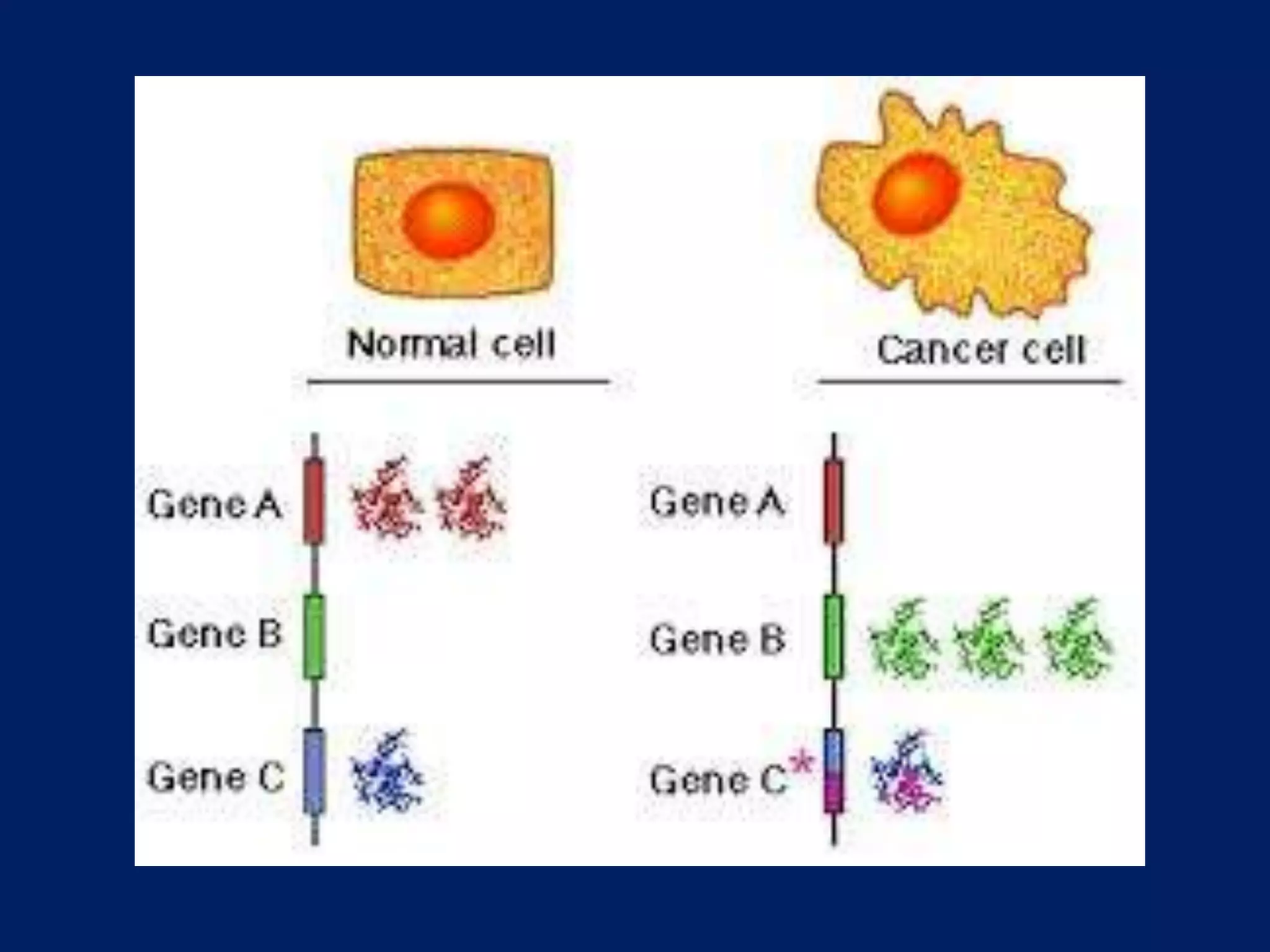
 To understand the genetic causes for the abnormal
functioning of the human body.

To understand which genes are active and which genes
are inactive in different cell types.
What is DNA Microarray Technology ?

It is “an orderly arrangement of thousands of
identified sequenced genes printed on an
impermeable solid support , usually glass, silicon
chips or nylon membrane”.

 DNA microarray chips are also known as DNA chips, DNA
arrays, or biochips.
Historical background :

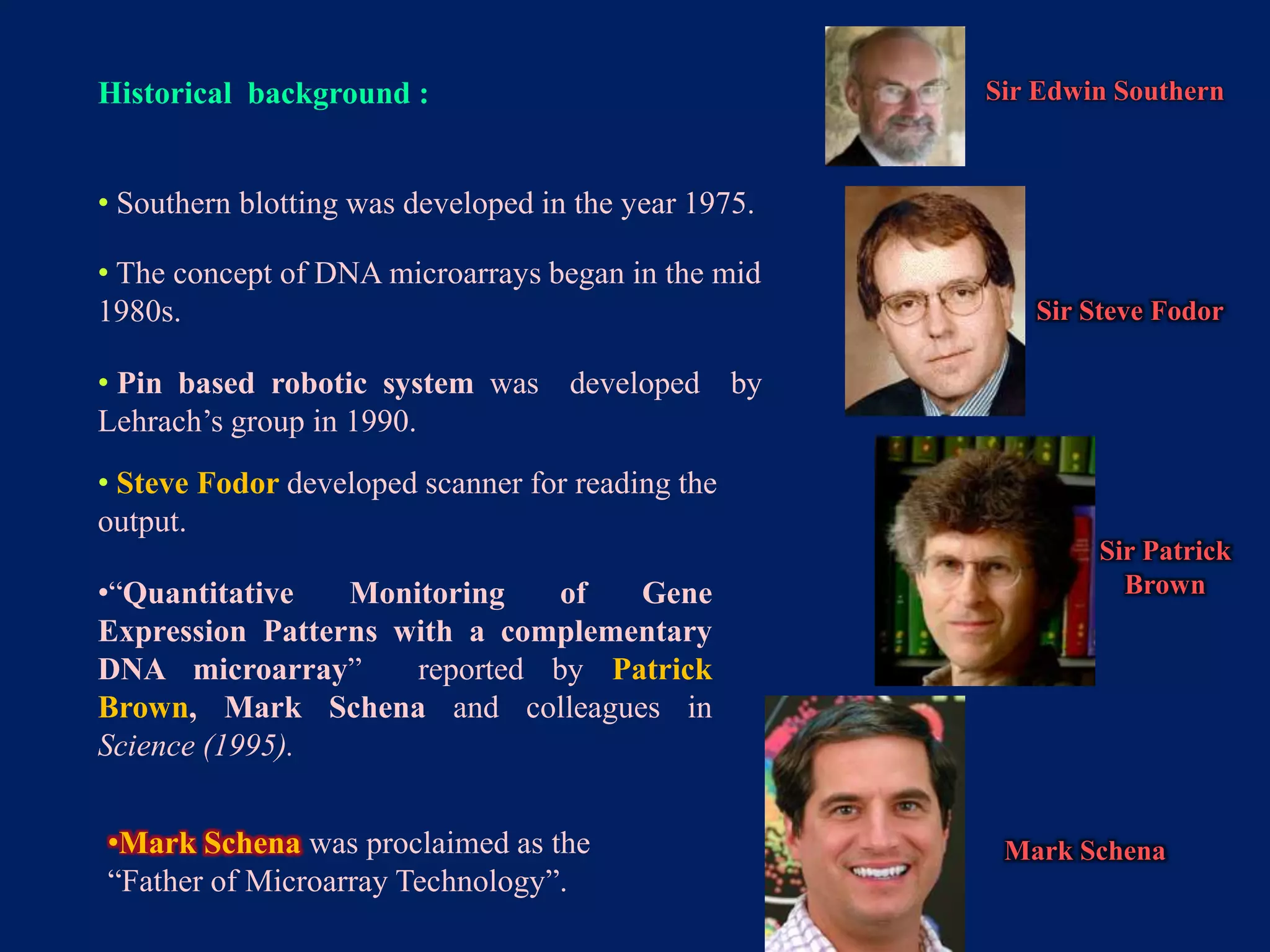
Sir Edwin Southern

• Southern blotting was developed in the year 1975.
• The concept of DNA microarrays began in the mid
1980s.

Sir Steve Fodor

• Pin based robotic system was developed by
Lehrach’s group in 1990.
• Steve Fodor developed scanner for reading the
output.
•“Quantitative
Monitoring
of
Gene
Expression Patterns with a complementary
DNA microarray”
reported by Patrick
Brown, Mark Schena and colleagues in
Science (1995).
•Mark Schena was proclaimed as the
“Father of Microarray Technology”.

Sir Patrick
Brown

Mark Schena
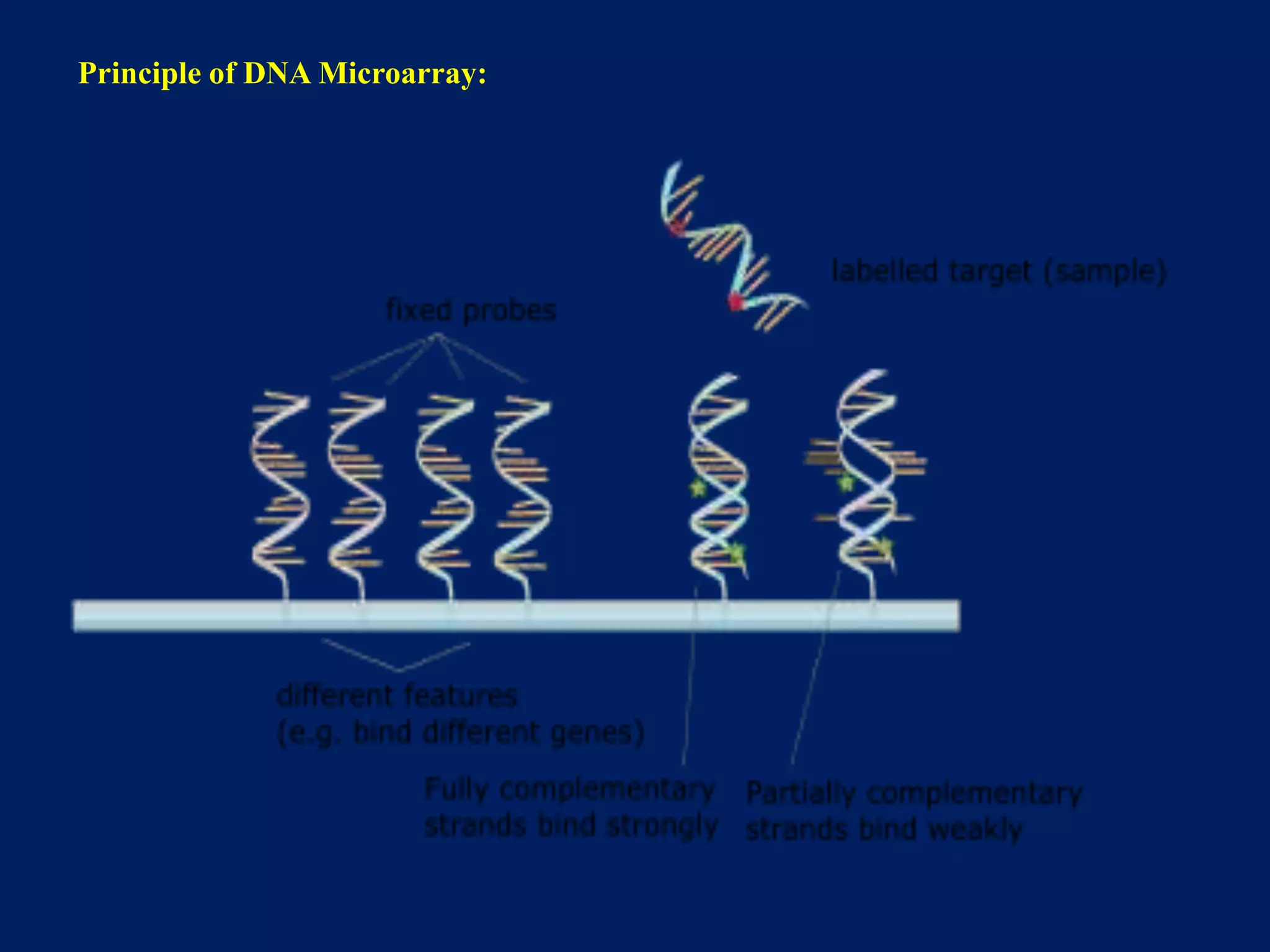
Principle of DNA Microarray:
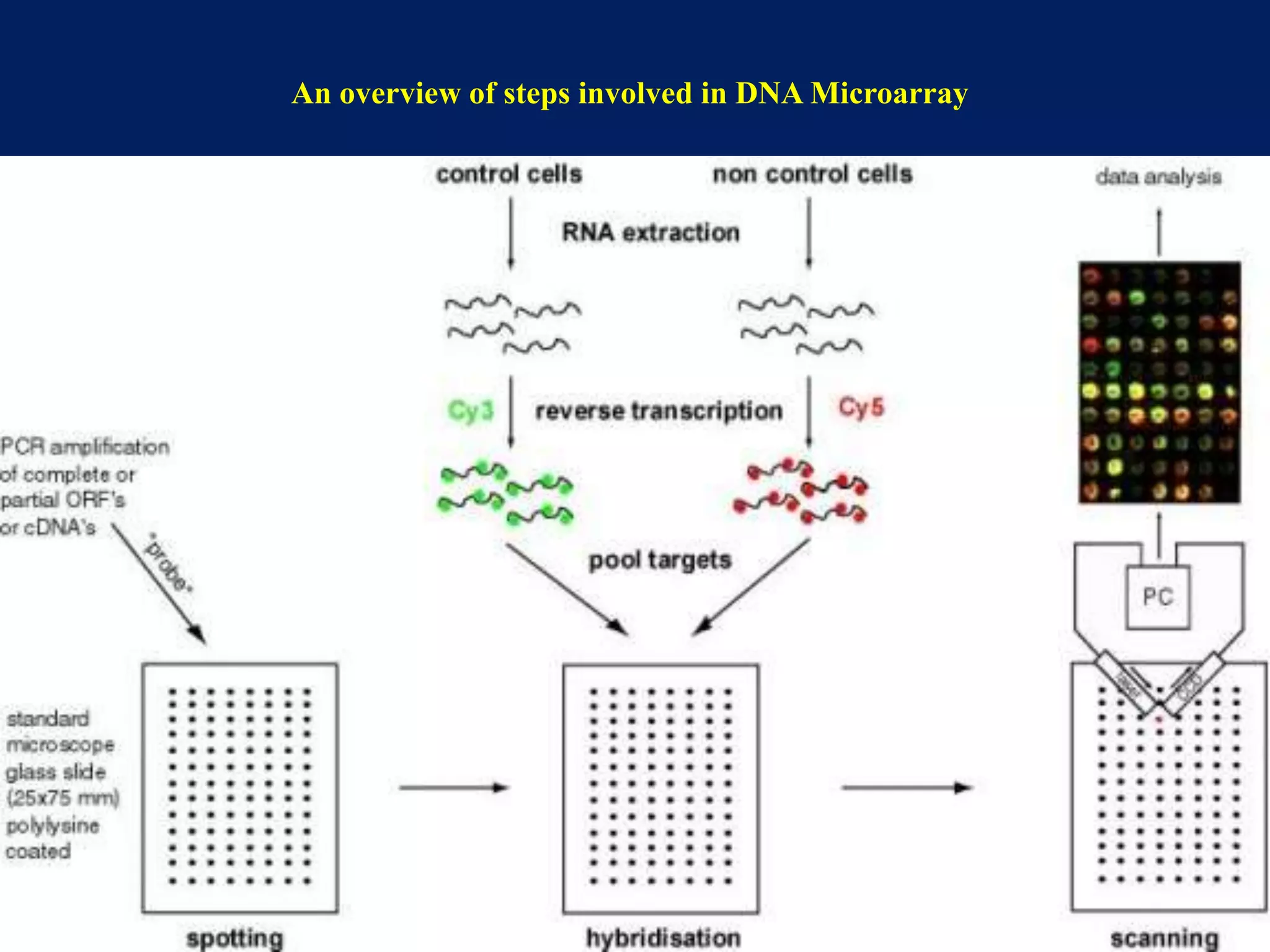
An overview of steps involved in DNA Microarray
Preparation of DNA Microarray Slide :
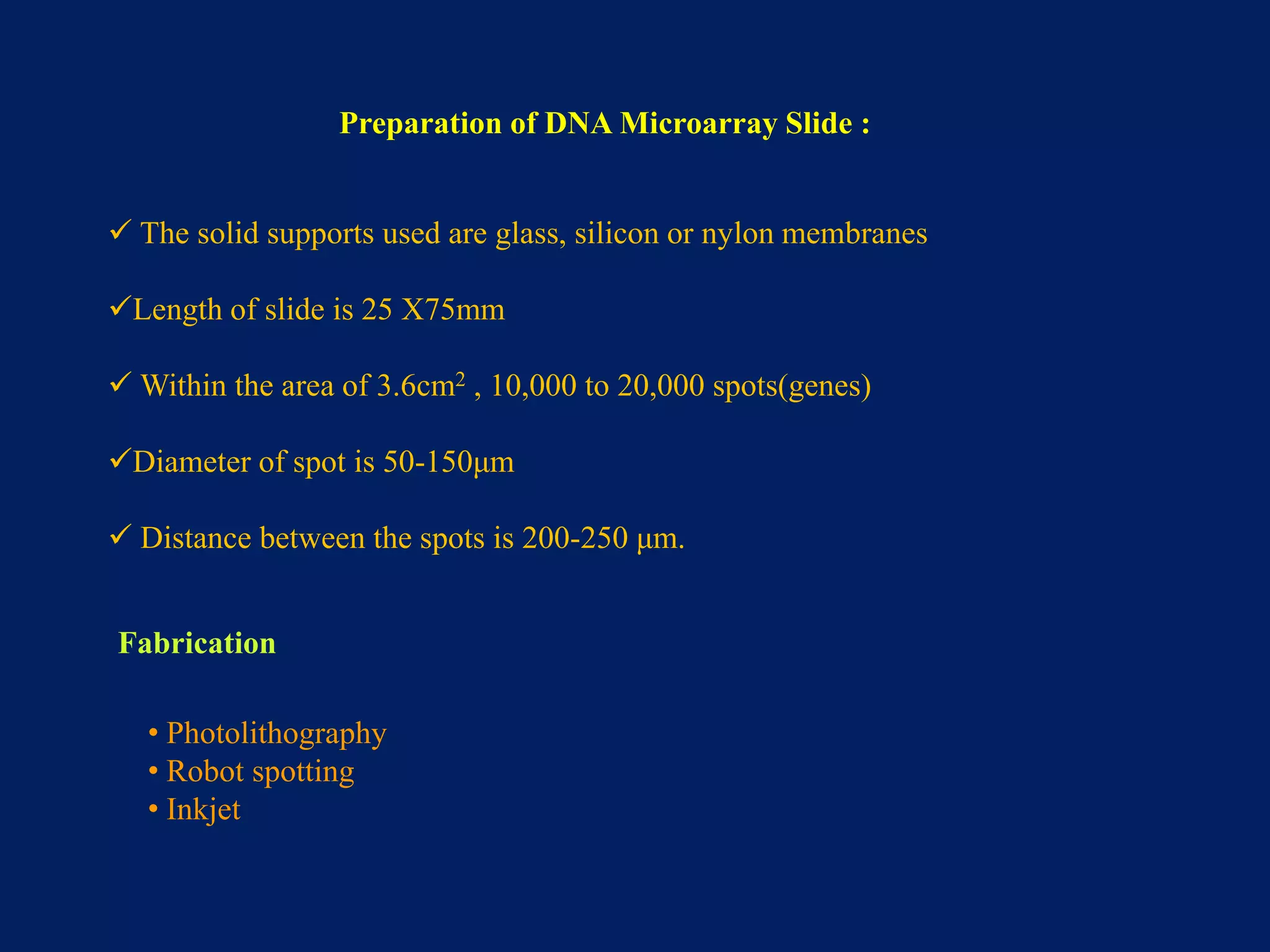
 The solid supports used are glass, silicon or nylon membranes
Length of slide is 25 X75mm
 Within the area of 3.6cm2 , 10,000 to 20,000 spots(genes)

Diameter of spot is 50-150μm
 Distance between the spots is 200-250 μm.
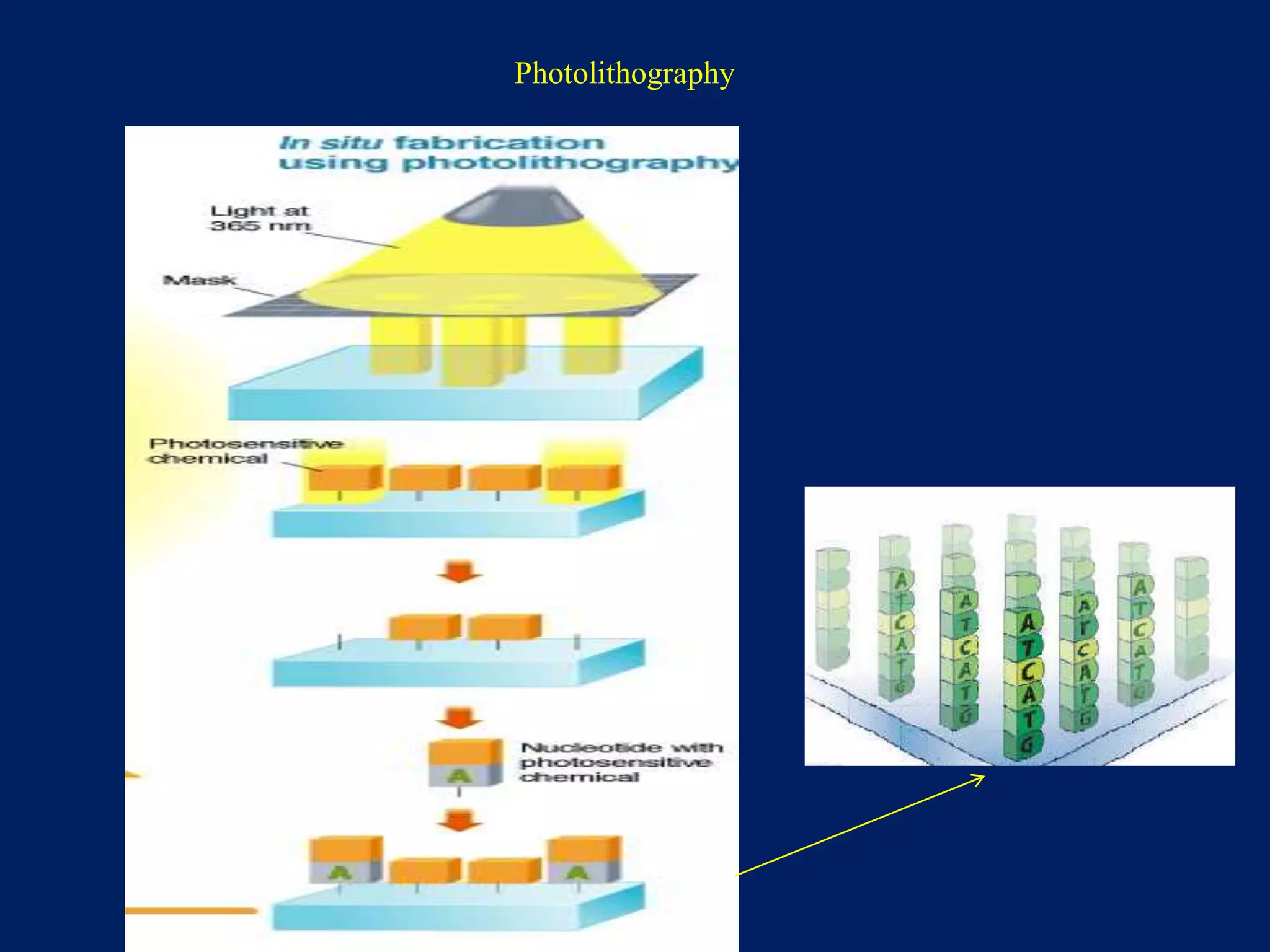
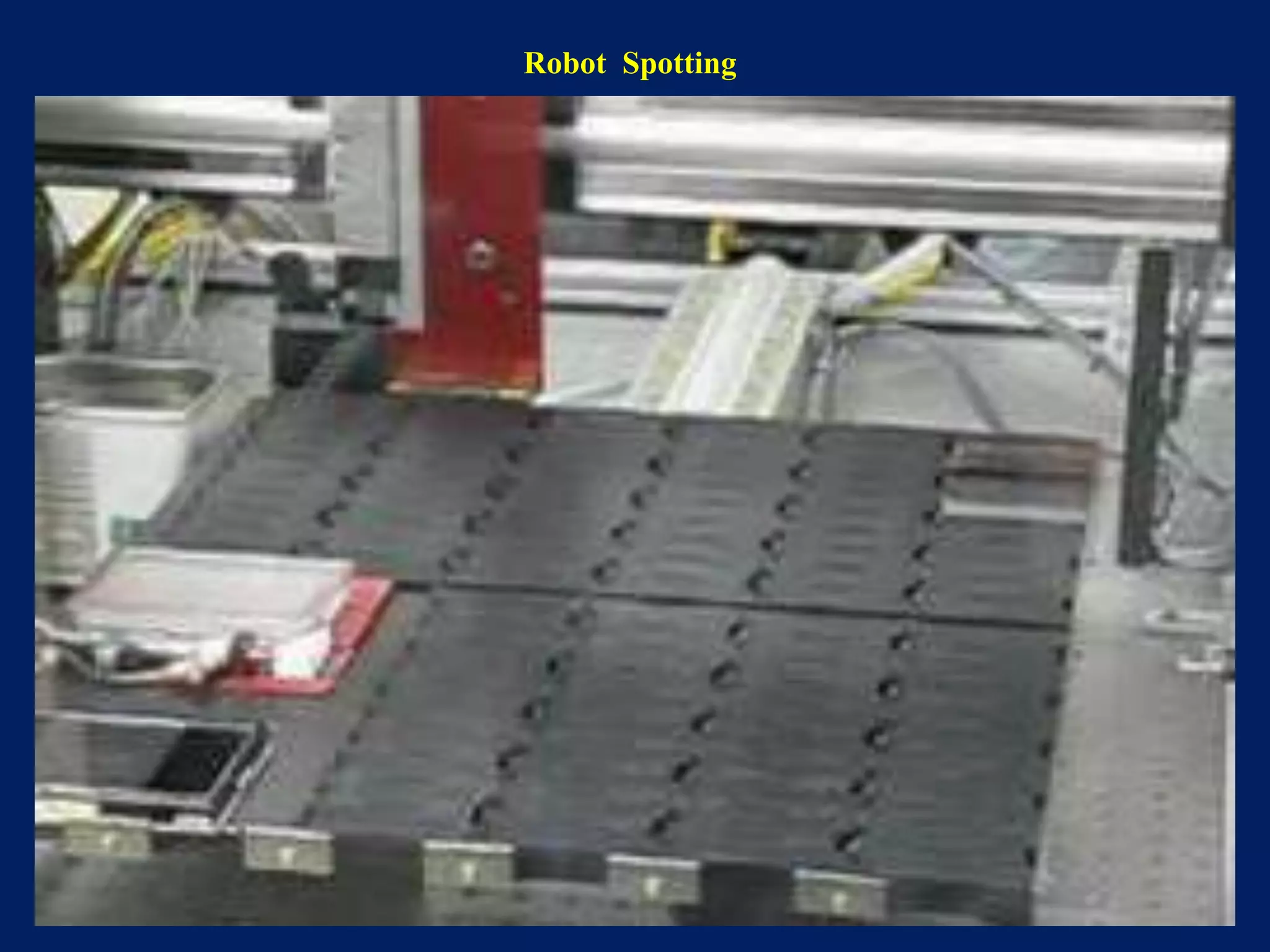
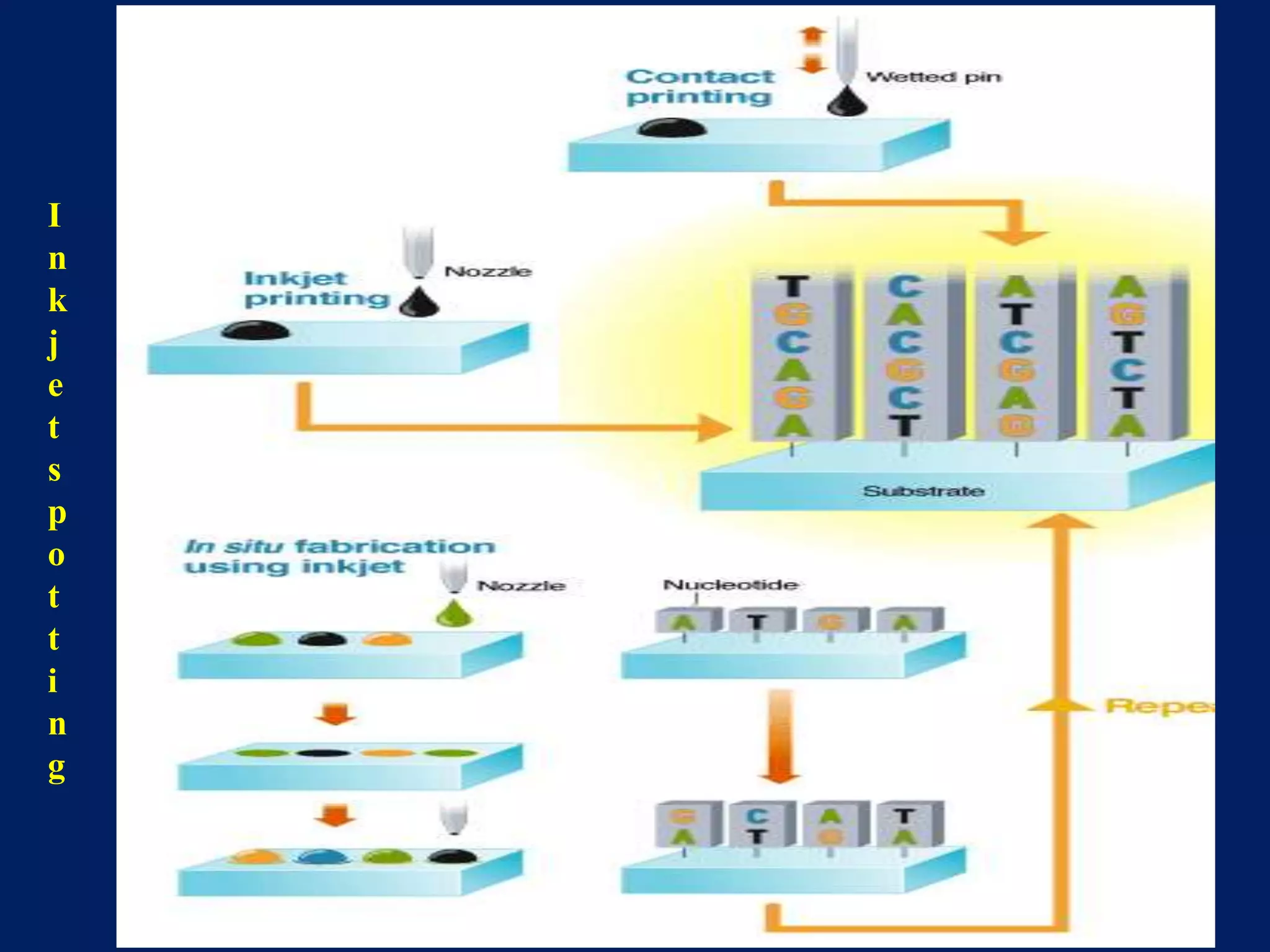
Fabrication
• Photolithography
• Robot spotting
• Inkjet
Photolithography
Robot Spotting
I
n
k
j
e
t
s
p
o
t
t
i
n
g
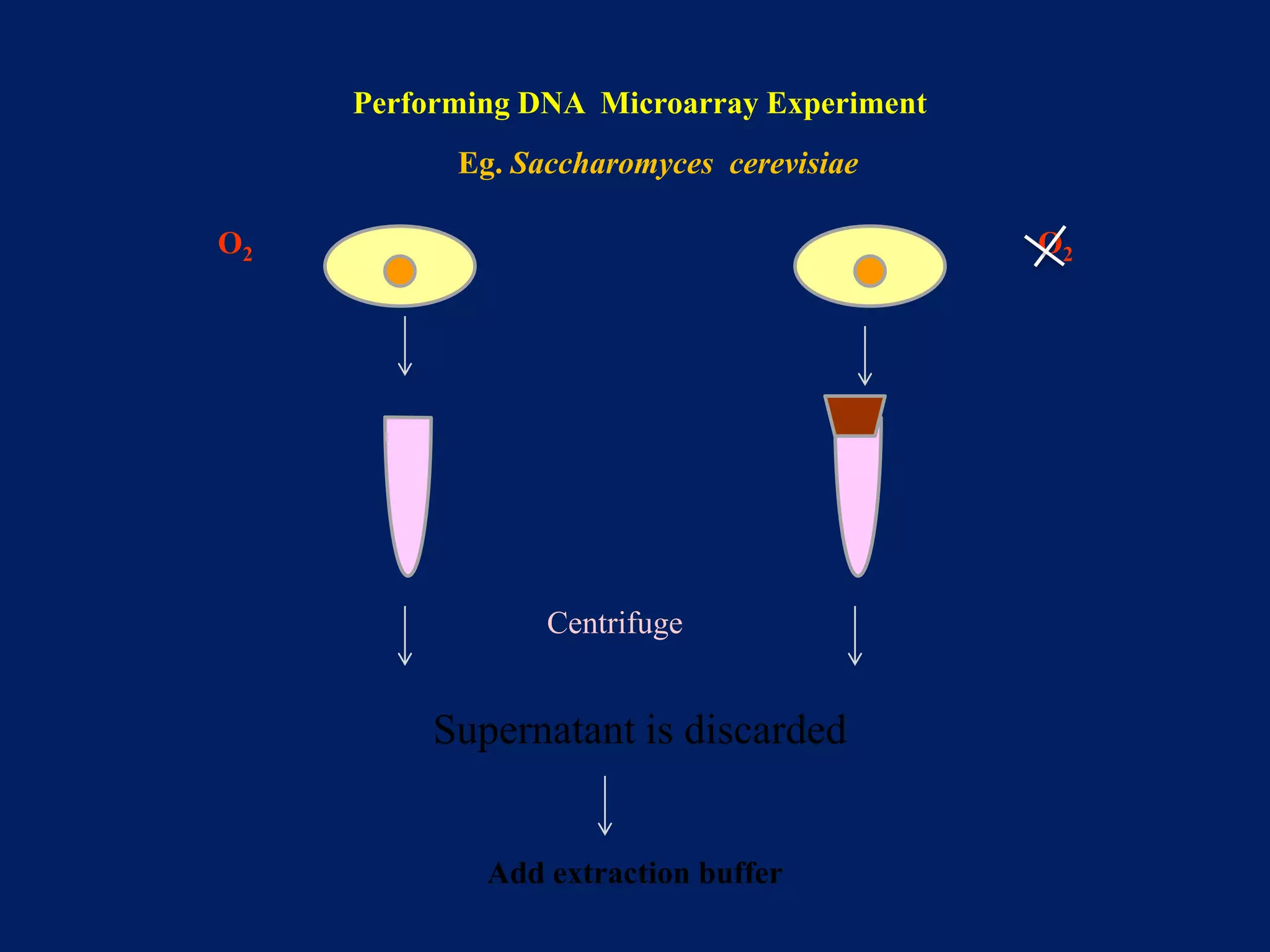
Performing DNA Microarray Experiment
Eg. Saccharomyces cerevisiae
O2

O2

Centrifuge

Supernatant is discarded

Add extraction buffer
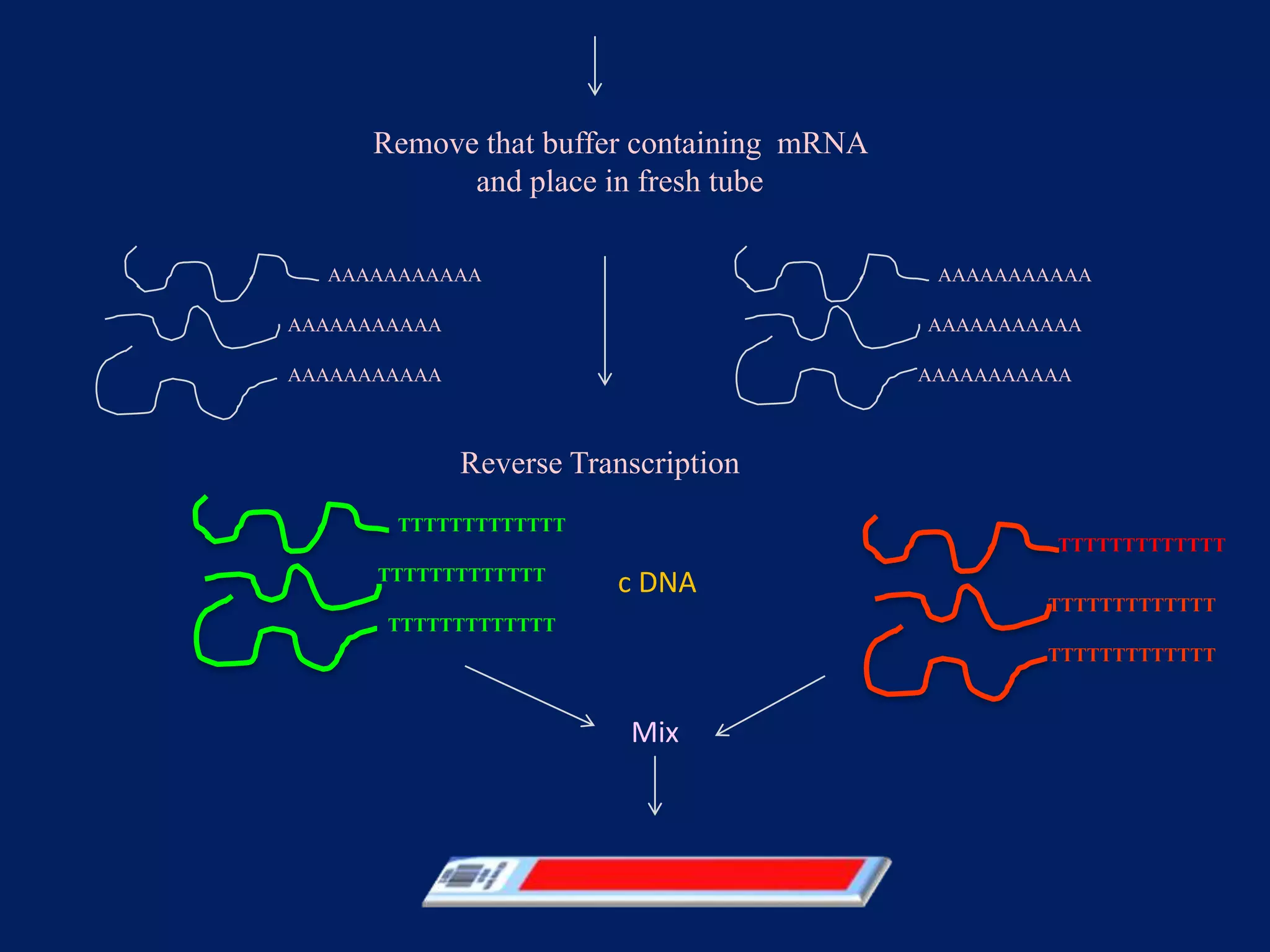
Remove that buffer containing mRNA
and place in fresh tube
AAAAAAAAAAA

AAAAAAAAAAA

AAAAAAAAAAA

AAAAAAAAAAA

AAAAAAAAAAA

AAAAAAAAAAA

Reverse Transcription
TTTTTTTTTTTTT
TTTTTTTTTTTTT
TTTTTTTTTTTTT

c DNA

TTTTTTTTTTTTT

TTTTTTTTTTTTT
TTTTTTTTTTTTT

Mix
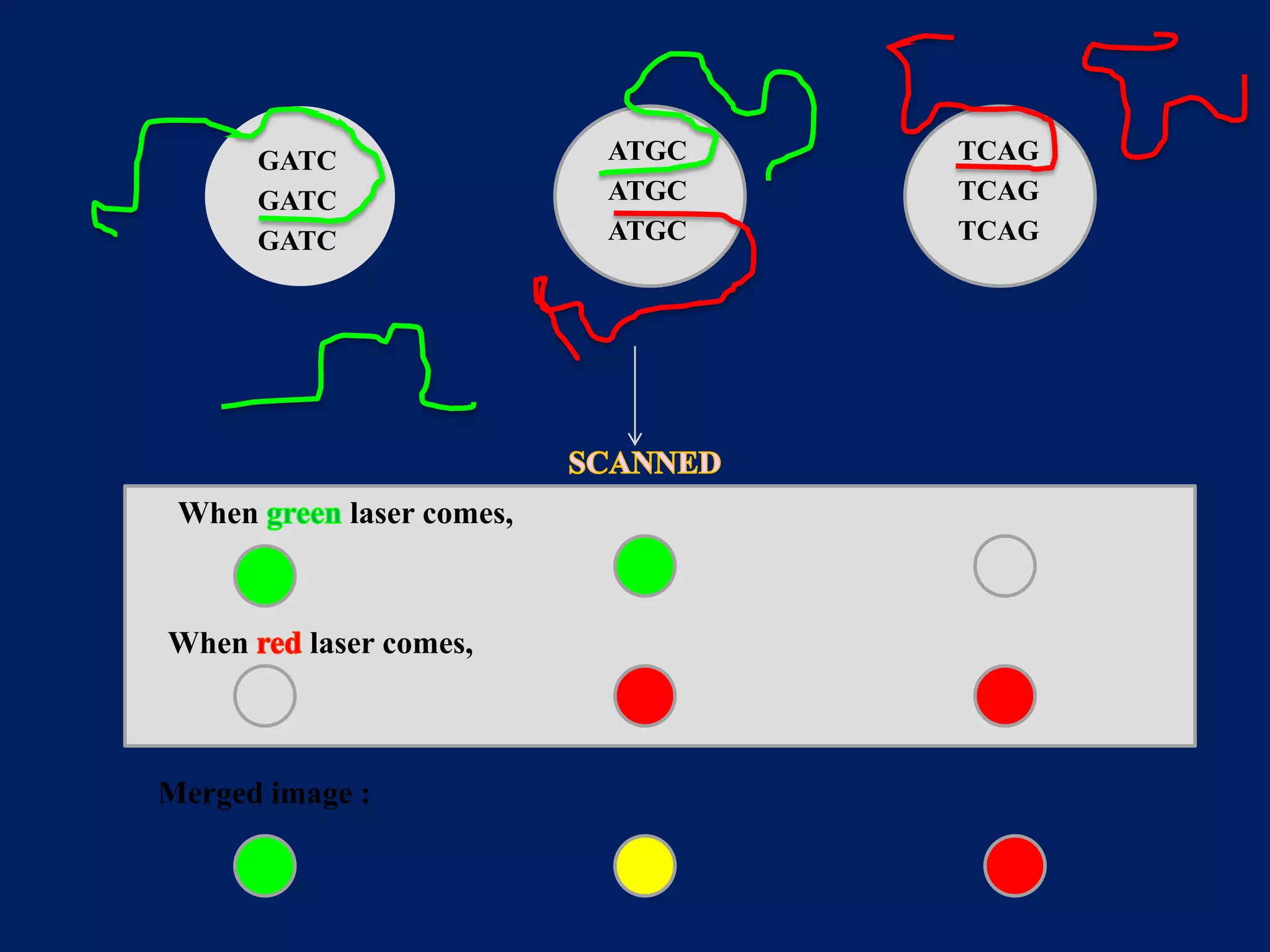
ATGC
ATGC
ATGC

GATC
GATC
GATC

When

When

laser comes,

laser comes,

Merged image :

TCAG
TCAG
TCAG
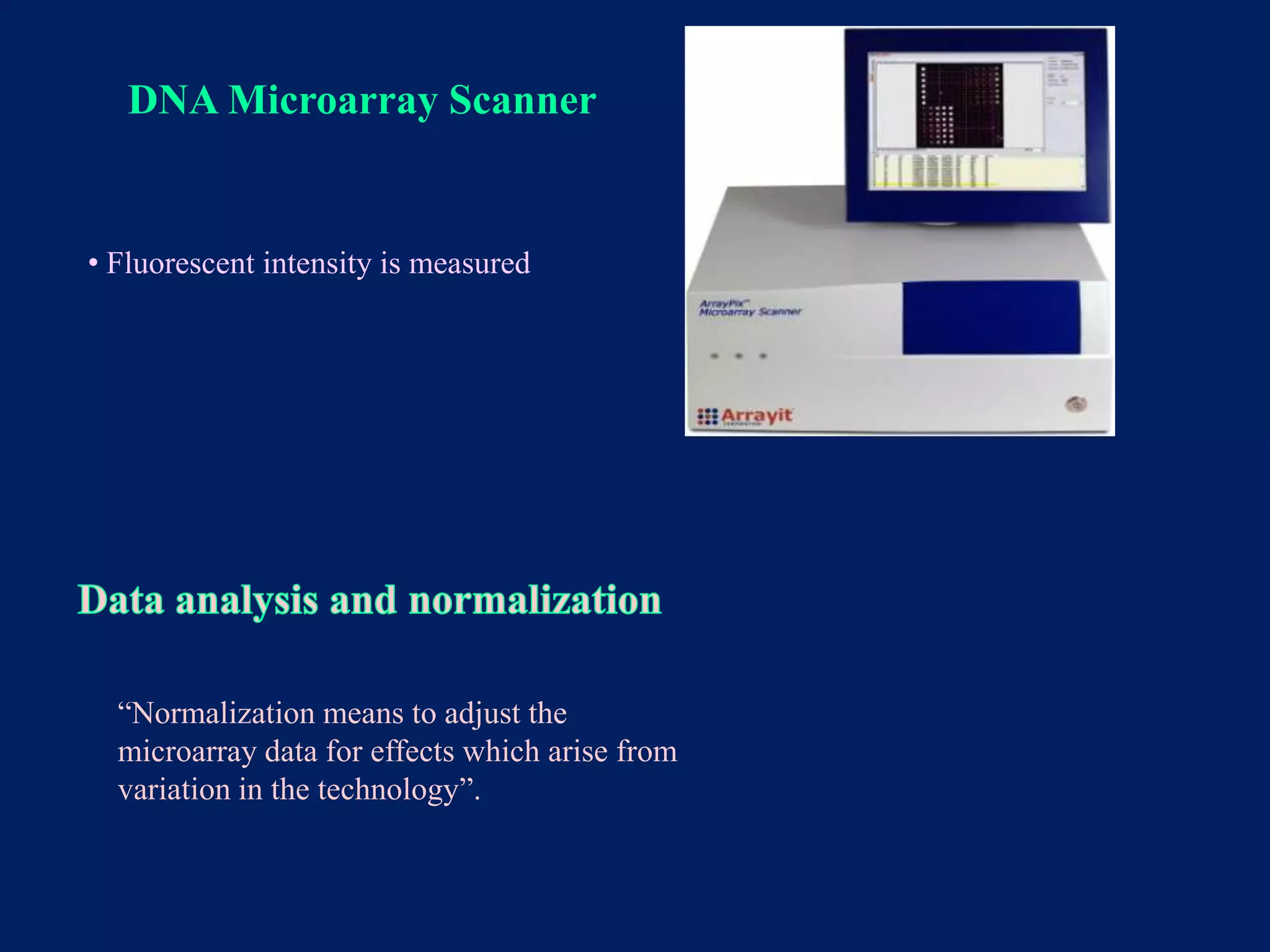
DNA Microarray Scanner

• Fluorescent intensity is measured

“Normalization means to adjust the
microarray data for effects which arise from
variation in the technology”.
Applications

• Gene expresion profiling, SNP detection, human diseases etc..

• IPSC (Induced Pleuripotent Stem Cell) cell lines are validated and
monitored.

• Toxic studies
CONCLUSION

Since this DNA microarray technology is used for
the analysis of expression of thousands of genes at
once, and has wide applications in in analyzing
various diseases. It is one of the smartest technique.
REFERENCES
•Tim Lenoir ,Eric Giannella (2006) The emergence and diffusion of DNA microarray
technology. Journal of Biomedical Discovery and Collaboration(JBDC). 1:11
•Samuel K. Moore (2001) Biochips are now a critical tool for analyzing the human
genome--and a lucrative product attracting technology giants. IEEE spectrum
• http://www.premierbiosoft.com/tech_notes/microarray.html
•http://www.genome.gov/10000533
•http://www.ncbi.nlm.nih.gov/pmc/articles/PMC1590052/
•http://www.medscape.com/viewarticle/543871_2
•http://en.wikipedia.org/wiki/DNA_microarray#History
•http://grf.lshtm.ac.uk/microarrayoverview.htm#m1
•http://www.ncbi.nlm.nih.gov/About/primer/microarrays.html
•http://www.digizyme.com/portfolio/microarraysfab/photolith.html
Thank You

Microarray

  • 1.
    DNA Microarray Technology Underthe guidance of Dr .Manjunath Ankitha Hirematha 3rd sem, MSc., Dept. of Biotechnology Kuvempu university.
  • 2.
    CONTENTS • Introduction • HistoricalBackground • Principle • Overview steps • Preparation of slide • Microarray scanning • Data analysis and normalization
  • 3.
    DNA Microarray Technology Toanalyze the expression of thousands of genes in single reaction, very quickly and in an efficient manner.   To understand the genetic causes for the abnormal functioning of the human body. To understand which genes are active and which genes are inactive in different cell types.
  • 5.
    What is DNAMicroarray Technology ? It is “an orderly arrangement of thousands of identified sequenced genes printed on an impermeable solid support , usually glass, silicon chips or nylon membrane”.  DNA microarray chips are also known as DNA chips, DNA arrays, or biochips.
  • 6.
    Historical background : SirEdwin Southern • Southern blotting was developed in the year 1975. • The concept of DNA microarrays began in the mid 1980s. Sir Steve Fodor • Pin based robotic system was developed by Lehrach’s group in 1990. • Steve Fodor developed scanner for reading the output. •“Quantitative Monitoring of Gene Expression Patterns with a complementary DNA microarray” reported by Patrick Brown, Mark Schena and colleagues in Science (1995). •Mark Schena was proclaimed as the “Father of Microarray Technology”. Sir Patrick Brown Mark Schena
  • 7.
    Principle of DNAMicroarray:
  • 8.
    An overview ofsteps involved in DNA Microarray
  • 9.
    Preparation of DNAMicroarray Slide :  The solid supports used are glass, silicon or nylon membranes Length of slide is 25 X75mm  Within the area of 3.6cm2 , 10,000 to 20,000 spots(genes) Diameter of spot is 50-150μm  Distance between the spots is 200-250 μm. Fabrication • Photolithography • Robot spotting • Inkjet
  • 10.
  • 11.
  • 12.
  • 13.
    Performing DNA MicroarrayExperiment Eg. Saccharomyces cerevisiae O2 O2 Centrifuge Supernatant is discarded Add extraction buffer
  • 14.
    Remove that buffercontaining mRNA and place in fresh tube AAAAAAAAAAA AAAAAAAAAAA AAAAAAAAAAA AAAAAAAAAAA AAAAAAAAAAA AAAAAAAAAAA Reverse Transcription TTTTTTTTTTTTT TTTTTTTTTTTTT TTTTTTTTTTTTT c DNA TTTTTTTTTTTTT TTTTTTTTTTTTT TTTTTTTTTTTTT Mix
  • 15.
  • 16.
    DNA Microarray Scanner •Fluorescent intensity is measured “Normalization means to adjust the microarray data for effects which arise from variation in the technology”.
  • 17.
    Applications • Gene expresionprofiling, SNP detection, human diseases etc.. • IPSC (Induced Pleuripotent Stem Cell) cell lines are validated and monitored. • Toxic studies
  • 18.
    CONCLUSION Since this DNAmicroarray technology is used for the analysis of expression of thousands of genes at once, and has wide applications in in analyzing various diseases. It is one of the smartest technique.
  • 19.
    REFERENCES •Tim Lenoir ,EricGiannella (2006) The emergence and diffusion of DNA microarray technology. Journal of Biomedical Discovery and Collaboration(JBDC). 1:11 •Samuel K. Moore (2001) Biochips are now a critical tool for analyzing the human genome--and a lucrative product attracting technology giants. IEEE spectrum • http://www.premierbiosoft.com/tech_notes/microarray.html •http://www.genome.gov/10000533 •http://www.ncbi.nlm.nih.gov/pmc/articles/PMC1590052/ •http://www.medscape.com/viewarticle/543871_2 •http://en.wikipedia.org/wiki/DNA_microarray#History •http://grf.lshtm.ac.uk/microarrayoverview.htm#m1 •http://www.ncbi.nlm.nih.gov/About/primer/microarrays.html •http://www.digizyme.com/portfolio/microarraysfab/photolith.html
  • 20.