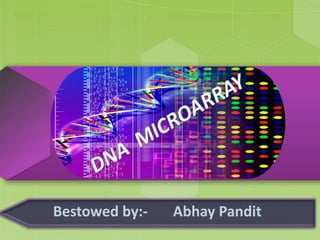
Bestowed by:- Abhay Pandit
 Also known as DNA arrays / DNA chips / biochips.
 DNA microarray is an orderly arrangement of thousands
of identified sequenced genes printed on an
impermeable solid support.
 Solid support may be of glass, silicon chips or nylon
membrane.
 Each identified sequenced gene on the support
corresponds to a fragment of genomic DNA, cDNA, PCR
products represents a single gene.
DNA microarray Technology?
 DNA microarray technology gave a
major breakthrough in experimental
molecular biology.
 First, article describing the
application of DNA microarray
technology was published in the
scientific literature by Patrick Brown
and his colleageus at Stanford
University.
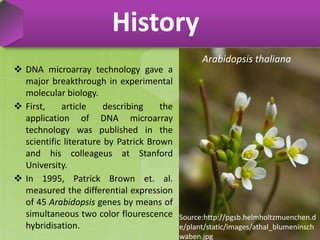
 In 1995, Patrick Brown et. al.
measured the differential expression
of 45 Arabidopsis genes by means of
simultaneous two color flourescence
hybridisation.
History
Source:http://pgsb.helmholtzmuenchen.d
e/plant/static/images/athal_blumeninsch
waben.jpg
Arabidopsis thaliana
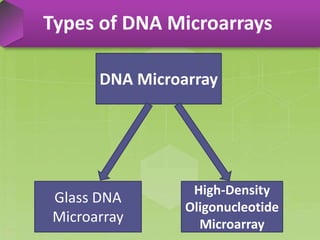
DNA Microarray
Glass DNA
Microarray
High-Density
Oligonucleotide
Microarray
Types of DNA Microarrays
Glass DNA Microarrays
Glass DNA microarray was the first type of DNA microarray
technology developed.
Pioneered by Patrick Brown and his colleagues at Stanford
University.
cDNA or oligonucleotide are applied to a glass microscope
slide by a robotic device and amplified by PCR, which
deposits nanoliter quantities of cDNA solution.
Glass slide usually have excellent chemical resistance against
solvents and with low intrinsic fluorescence properties.
Moderate sized glass cDNA microarray bears about 10,000
or more spots on an area of 3.6cm2.
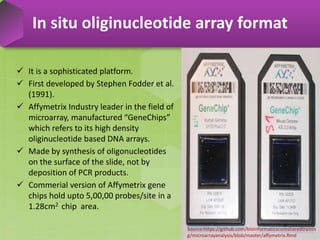
 It is a sophisticated platform.
 First developed by Stephen Fodder et al.
(1991).
 Affymetrix Industry leader in the field of
microarray, manufactured “GeneChips”
which refers to its high density
oliginucleotide based DNA arrays.
 Made by synthesis of oligonucleotides
on the surface of the slide, not by
deposition of PCR products.
 Commerial version of Affymetrix gene
chips hold upto 5,00,00 probes/site in a
1.28cm2 chip area.
In situ oliginucleotide array format
Source:https://github.com/bioinformaticscoresharedtrainin
g/microarrayanalysis/blob/master/affymetrix.Rmd
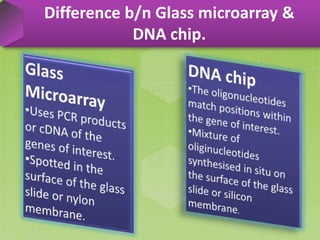
Difference b/n Glass microarray &
DNA chip.
 Based on the fact that complementary sequences of DNA can be used
to hybridize immobilized DNA molecules.
 A microarray experiment involves the comparision of a query or
experimental sample representing the expression pattern of genes in a
specific set of conditions, with a control sample representing all the
genes that are expressed in the cells/tissues to be analysed.
 This involves 4-major stages;
I. Sample preparation and labelling.
II. Hybidization
III. Washing
IV. Image acquisition and data analysis.
Principle of DNA Microarray
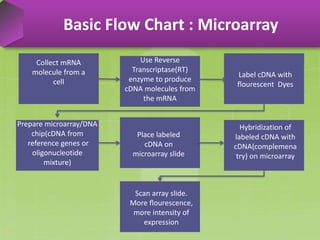
Basic Flow Chart : Microarray
Collect mRNA
molecule from a
cell
Use Reverse
Transcriptase(RT)
enzyme to produce
cDNA molecules from
the mRNA
Label cDNA with
flourescent Dyes
Prepare microarray/DNA
chip(cDNA from
reference genes or
oligonucleotide
mixture)
Place labeled
cDNA on
microarray slide
Hybridization of
labeled cDNA with
cDNA(complemena
try) on microarray
Scan array slide.
More flourescence,
more intensity of
expression
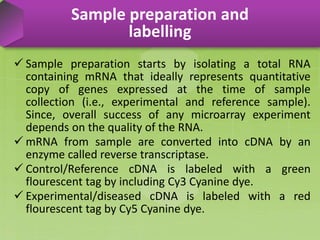
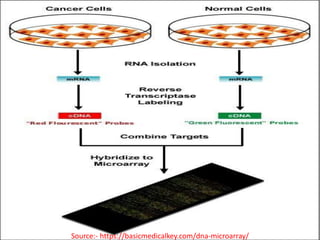
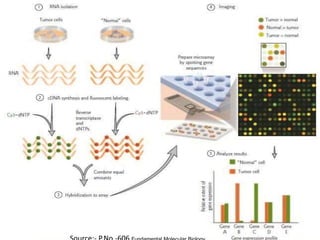
 Sample preparation starts by isolating a total RNA
containing mRNA that ideally represents quantitative
copy of genes expressed at the time of sample
collection (i.e., experimental and reference sample).
Since, overall success of any microarray experiment
depends on the quality of the RNA.
 mRNA from sample are converted into cDNA by an
enzyme called reverse transcriptase.
 Control/Reference cDNA is labeled with a green
flourescent tag by including Cy3 Cyanine dye.
 Experimental/diseased cDNA is labeled with a red
flourescent tag by Cy5 Cyanine dye.
Sample preparation and
labelling
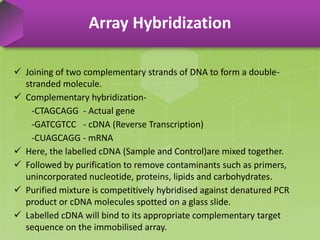
 Joining of two complementary strands of DNA to form a double-
stranded molecule.
 Complementary hybridization-
-CTAGCAGG - Actual gene
-GATCGTCC - cDNA (Reverse Transcription)
-CUAGCAGG - mRNA
 Here, the labelled cDNA (Sample and Control)are mixed together.
 Followed by purification to remove contaminants such as primers,
unincorporated nucleotide, proteins, lipids and carbohydrates.
 Purified mixture is competitively hybridised against denatured PCR
product or cDNA molecules spotted on a glass slide.
 Labelled cDNA will bind to its appropriate complementary target
sequence on the immobilised array.
Array Hybridization
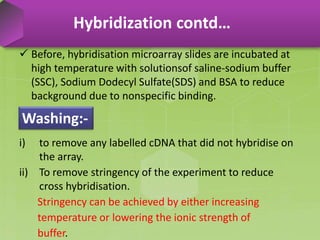
 Before, hybridisation microarray slides are incubated at
high temperature with solutionsof saline-sodium buffer
(SSC), Sodium Dodecyl Sulfate(SDS) and BSA to reduce
background due to nonspecific binding.
i) to remove any labelled cDNA that did not hybridise on
the array.
ii) To remove stringency of the experiment to reduce
cross hybridisation.
Stringency can be achieved by either increasing
temperature or lowering the ionic strength of
buffer.
Hybridization contd…
Washing:-
Source:- https://basicmedicalkey.com/dna-microarray/
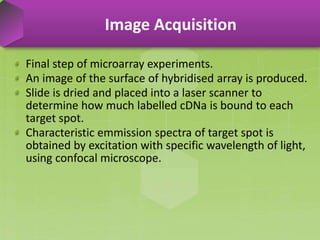
Final step of microarray experiments.
An image of the surface of hybridised array is produced.
Slide is dried and placed into a laser scanner to
determine how much labelled cDNa is bound to each
target spot.
Characteristic emmission spectra of target spot is
obtained by excitation with specific wavelength of light,
using confocal microscope.
Image Acquisition
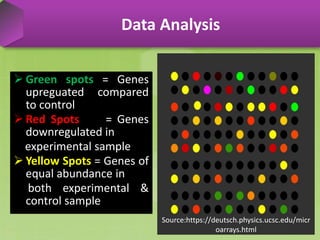
 Green spots = Genes
upreguated compared
to control
 Red Spots = Genes
downregulated in
experimental sample
 Yellow Spots = Genes of
equal abundance in
both experimental &
control sample
Data Analysis
Source:http://libertgen564s15.weebly.com/microarray.html
Source:https://deutsch.physics.ucsc.edu/micr
oarrays.html
To answer some of fundamental questions in
biology such as “when, where and to what
magnitude genes of interest are expressed.”
Measuring transcript abundance (cDNA arrays)
Genotyping
Estimating DNA copy number (CGH)
Wide spread use in gene mutation analysis to
analyze genomic alteration.
Application
Dna microarray

Dna microarray

  • 1.
  • 2.
     Also knownas DNA arrays / DNA chips / biochips.  DNA microarray is an orderly arrangement of thousands of identified sequenced genes printed on an impermeable solid support.  Solid support may be of glass, silicon chips or nylon membrane.  Each identified sequenced gene on the support corresponds to a fragment of genomic DNA, cDNA, PCR products represents a single gene. DNA microarray Technology?
  • 3.
     DNA microarraytechnology gave a major breakthrough in experimental molecular biology.  First, article describing the application of DNA microarray technology was published in the scientific literature by Patrick Brown and his colleageus at Stanford University.  In 1995, Patrick Brown et. al. measured the differential expression of 45 Arabidopsis genes by means of simultaneous two color flourescence hybridisation. History Source:http://pgsb.helmholtzmuenchen.d e/plant/static/images/athal_blumeninsch waben.jpg Arabidopsis thaliana
  • 4.
  • 5.
    Glass DNA Microarrays GlassDNA microarray was the first type of DNA microarray technology developed. Pioneered by Patrick Brown and his colleagues at Stanford University. cDNA or oligonucleotide are applied to a glass microscope slide by a robotic device and amplified by PCR, which deposits nanoliter quantities of cDNA solution. Glass slide usually have excellent chemical resistance against solvents and with low intrinsic fluorescence properties. Moderate sized glass cDNA microarray bears about 10,000 or more spots on an area of 3.6cm2.
  • 6.
     It isa sophisticated platform.  First developed by Stephen Fodder et al. (1991).  Affymetrix Industry leader in the field of microarray, manufactured “GeneChips” which refers to its high density oliginucleotide based DNA arrays.  Made by synthesis of oligonucleotides on the surface of the slide, not by deposition of PCR products.  Commerial version of Affymetrix gene chips hold upto 5,00,00 probes/site in a 1.28cm2 chip area. In situ oliginucleotide array format Source:https://github.com/bioinformaticscoresharedtrainin g/microarrayanalysis/blob/master/affymetrix.Rmd
  • 7.
    Difference b/n Glassmicroarray & DNA chip.
  • 8.
     Based onthe fact that complementary sequences of DNA can be used to hybridize immobilized DNA molecules.  A microarray experiment involves the comparision of a query or experimental sample representing the expression pattern of genes in a specific set of conditions, with a control sample representing all the genes that are expressed in the cells/tissues to be analysed.  This involves 4-major stages; I. Sample preparation and labelling. II. Hybidization III. Washing IV. Image acquisition and data analysis. Principle of DNA Microarray
  • 9.
    Basic Flow Chart: Microarray Collect mRNA molecule from a cell Use Reverse Transcriptase(RT) enzyme to produce cDNA molecules from the mRNA Label cDNA with flourescent Dyes Prepare microarray/DNA chip(cDNA from reference genes or oligonucleotide mixture) Place labeled cDNA on microarray slide Hybridization of labeled cDNA with cDNA(complemena try) on microarray Scan array slide. More flourescence, more intensity of expression
  • 10.
     Sample preparationstarts by isolating a total RNA containing mRNA that ideally represents quantitative copy of genes expressed at the time of sample collection (i.e., experimental and reference sample). Since, overall success of any microarray experiment depends on the quality of the RNA.  mRNA from sample are converted into cDNA by an enzyme called reverse transcriptase.  Control/Reference cDNA is labeled with a green flourescent tag by including Cy3 Cyanine dye.  Experimental/diseased cDNA is labeled with a red flourescent tag by Cy5 Cyanine dye. Sample preparation and labelling
  • 11.
     Joining oftwo complementary strands of DNA to form a double- stranded molecule.  Complementary hybridization- -CTAGCAGG - Actual gene -GATCGTCC - cDNA (Reverse Transcription) -CUAGCAGG - mRNA  Here, the labelled cDNA (Sample and Control)are mixed together.  Followed by purification to remove contaminants such as primers, unincorporated nucleotide, proteins, lipids and carbohydrates.  Purified mixture is competitively hybridised against denatured PCR product or cDNA molecules spotted on a glass slide.  Labelled cDNA will bind to its appropriate complementary target sequence on the immobilised array. Array Hybridization
  • 12.
     Before, hybridisationmicroarray slides are incubated at high temperature with solutionsof saline-sodium buffer (SSC), Sodium Dodecyl Sulfate(SDS) and BSA to reduce background due to nonspecific binding. i) to remove any labelled cDNA that did not hybridise on the array. ii) To remove stringency of the experiment to reduce cross hybridisation. Stringency can be achieved by either increasing temperature or lowering the ionic strength of buffer. Hybridization contd… Washing:-
  • 13.
  • 14.
    Final step ofmicroarray experiments. An image of the surface of hybridised array is produced. Slide is dried and placed into a laser scanner to determine how much labelled cDNa is bound to each target spot. Characteristic emmission spectra of target spot is obtained by excitation with specific wavelength of light, using confocal microscope. Image Acquisition
  • 15.
     Green spots= Genes upreguated compared to control  Red Spots = Genes downregulated in experimental sample  Yellow Spots = Genes of equal abundance in both experimental & control sample Data Analysis Source:http://libertgen564s15.weebly.com/microarray.html Source:https://deutsch.physics.ucsc.edu/micr oarrays.html
  • 17.
    To answer someof fundamental questions in biology such as “when, where and to what magnitude genes of interest are expressed.” Measuring transcript abundance (cDNA arrays) Genotyping Estimating DNA copy number (CGH) Wide spread use in gene mutation analysis to analyze genomic alteration. Application