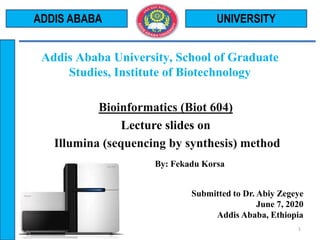
Bioinformatics (Biot 604)
Lecture slides on
Illumina (sequencing by synthesis) method
By: Fekadu Korsa
Submitted to Dr. Abiy Zegeye
June 7, 2020
Addis Ababa, Ethiopia
UNIVERSITY
1
ADDIS ABABA
Addis Ababa University, School of Graduate
Studies, Institute of Biotechnology
Outline of the Presentation
 Definition
 steps of Sequencing by synthesis
 Analytic procedures performed on the out put
UNIVERSITY
2
ADDIS ABABA
Definition
 What is Sequencing-by-Synthesis?
 is the most widely used NGS technology in the world.
 developed by Illumina.
 generates > 90% of the sequencing data of the world .
 generates many millions of highly accurate reads making
 much faster and cheaper than other sequencing methods.
UNIVERSITY
3
ADDIS ABABA
Steps of Sequencing by synthesis
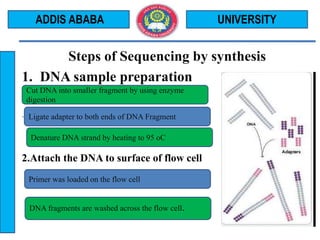
1. DNA sample preparation
.
2.Attach the DNA to surface of flow cell
UNIVERSITYADDIS ABABA
Cut DNA into smaller fragment by using enzyme
digestion
Ligate adapter to both ends of DNA Fragment
Primer was loaded on the flow cell
DNA fragments are washed across the flow cell.
Denature DNA strand by heating to 95 oC
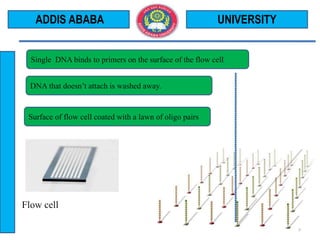
Flow cell
UNIVERSITY
5
ADDIS ABABA
Surface of flow cell coated with a lawn of oligo pairs
DNA that doesn’t attach is washed away.
Single DNA binds to primers on the surface of the flow cell
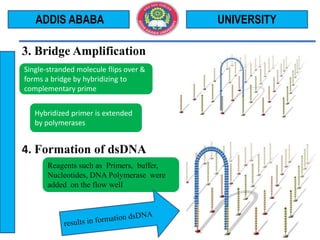
3. Bridge Amplification
4. Formation of dsDNA
UNIVERSITYADDIS ABABA
Single-stranded molecule flips over &
forms a bridge by hybridizing to
complementary prime
Hybridized primer is extended
by polymerases
Reagents such as Primers, buffer,
Nucleotides, DNA Polymerase were
added on the flow well
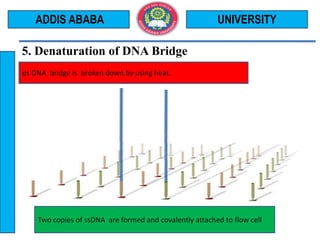
5. Denaturation of DNA Bridge
UNIVERSITYADDIS ABABA
ds DNA bridge is broken down by using heat.
Two copies of ssDNA are formed and covalently attached to flow cell
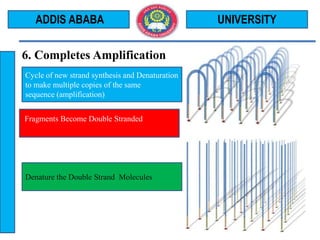
6. Completes Amplification
UNIVERSITY
8
ADDIS ABABA
Cycle of new strand synthesis and Denaturation
to make multiple copies of the same
sequence (amplification)
Fragments Become Double Stranded
Denature the Double Strand Molecules
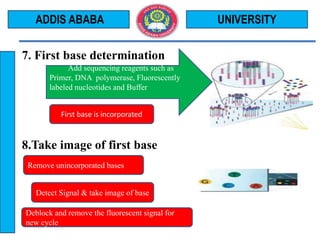
7. First base determination
8.Take image of first base
UNIVERSITYADDIS ABABA
Add sequencing reagents such as
Primer, DNA polymerase, Fluorescently
labeled nucleotides and Buffer
First base is incorporated
Remove unincorporated bases
Detect Signal & take image of base
Deblock and remove the fluorescent signal for
new cycle
9. Determine second base
10.Take image of second base
UNIVERSITYADDIS ABABA
Add sequencing reagents
Primer,DNA polymerase, Fluorescently
labeled nucleotides and Buffer
Second base is incorporated
Remove unincorporated bases
Detect Signal & take image of base
Deblock and remove the fluorescent signal for
new cycle
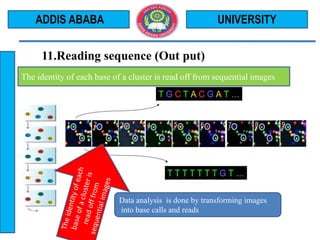
11.Reading sequence (Out put)
UNIVERSITYADDIS ABABA
The identity of each base of a cluster is read off from sequential images
Data analysis is done by transforming images
into base calls and reads
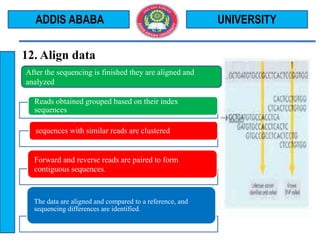
12. Align data
UNIVERSITYADDIS ABABA
After the sequencing is finished they are aligned and
analyzed
Reads obtained grouped based on their index
sequences
sequences with similar reads are clustered
Forward and reverse reads are paired to form
contiguous sequences.
The data are aligned and compared to a reference, and
sequencing differences are identified.
Data Analysis
UNIVERSITY
13
ADDIS ABABA
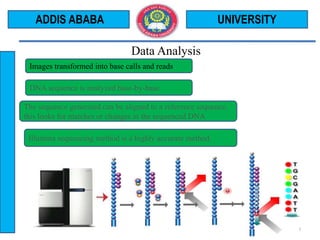
.Images transformed into base calls and reads
DNA sequence is analyzed base-by-base
The sequence generated can be aligned to a reference sequence,
this looks for matches or changes in the sequenced DNA
Illumina sequencing method is a highly accurate method.
THANK YOU
UNIVERSITY
14
ADDIS ABABA

Illumina (sequencing by synthesis) method

  • 1.
    Bioinformatics (Biot 604) Lectureslides on Illumina (sequencing by synthesis) method By: Fekadu Korsa Submitted to Dr. Abiy Zegeye June 7, 2020 Addis Ababa, Ethiopia UNIVERSITY 1 ADDIS ABABA Addis Ababa University, School of Graduate Studies, Institute of Biotechnology
  • 2.
    Outline of thePresentation  Definition  steps of Sequencing by synthesis  Analytic procedures performed on the out put UNIVERSITY 2 ADDIS ABABA
  • 3.
    Definition  What isSequencing-by-Synthesis?  is the most widely used NGS technology in the world.  developed by Illumina.  generates > 90% of the sequencing data of the world .  generates many millions of highly accurate reads making  much faster and cheaper than other sequencing methods. UNIVERSITY 3 ADDIS ABABA
  • 4.
    Steps of Sequencingby synthesis 1. DNA sample preparation . 2.Attach the DNA to surface of flow cell UNIVERSITYADDIS ABABA Cut DNA into smaller fragment by using enzyme digestion Ligate adapter to both ends of DNA Fragment Primer was loaded on the flow cell DNA fragments are washed across the flow cell. Denature DNA strand by heating to 95 oC
  • 5.
    Flow cell UNIVERSITY 5 ADDIS ABABA Surfaceof flow cell coated with a lawn of oligo pairs DNA that doesn’t attach is washed away. Single DNA binds to primers on the surface of the flow cell
  • 6.
    3. Bridge Amplification 4.Formation of dsDNA UNIVERSITYADDIS ABABA Single-stranded molecule flips over & forms a bridge by hybridizing to complementary prime Hybridized primer is extended by polymerases Reagents such as Primers, buffer, Nucleotides, DNA Polymerase were added on the flow well
  • 7.
    5. Denaturation ofDNA Bridge UNIVERSITYADDIS ABABA ds DNA bridge is broken down by using heat. Two copies of ssDNA are formed and covalently attached to flow cell
  • 8.
    6. Completes Amplification UNIVERSITY 8 ADDISABABA Cycle of new strand synthesis and Denaturation to make multiple copies of the same sequence (amplification) Fragments Become Double Stranded Denature the Double Strand Molecules
  • 9.
    7. First basedetermination 8.Take image of first base UNIVERSITYADDIS ABABA Add sequencing reagents such as Primer, DNA polymerase, Fluorescently labeled nucleotides and Buffer First base is incorporated Remove unincorporated bases Detect Signal & take image of base Deblock and remove the fluorescent signal for new cycle
  • 10.
    9. Determine secondbase 10.Take image of second base UNIVERSITYADDIS ABABA Add sequencing reagents Primer,DNA polymerase, Fluorescently labeled nucleotides and Buffer Second base is incorporated Remove unincorporated bases Detect Signal & take image of base Deblock and remove the fluorescent signal for new cycle
  • 11.
    11.Reading sequence (Output) UNIVERSITYADDIS ABABA The identity of each base of a cluster is read off from sequential images Data analysis is done by transforming images into base calls and reads
  • 12.
    12. Align data UNIVERSITYADDISABABA After the sequencing is finished they are aligned and analyzed Reads obtained grouped based on their index sequences sequences with similar reads are clustered Forward and reverse reads are paired to form contiguous sequences. The data are aligned and compared to a reference, and sequencing differences are identified.
  • 13.
    Data Analysis UNIVERSITY 13 ADDIS ABABA .Imagestransformed into base calls and reads DNA sequence is analyzed base-by-base The sequence generated can be aligned to a reference sequence, this looks for matches or changes in the sequenced DNA Illumina sequencing method is a highly accurate method.
  • 14.