Microarray
Technology
Reporter: Dulnuan, Wency H.
Introduction
• It is not possible to research on a large number of genes using
traditional methods.
• DNA Microarray is one such technology which enables the
researchers to investigate and address issues which were once
thought to be non traceable.
• DNA Microarray technology has empowered the scientific
community to understand the fundamental aspects underlining the
growth and development of life as well as to explore the genetic
causes of anomalies occurring in the functioning of the human body.
Technique
1. An array is an orderly arrangement of samples where matching of
known and unknown DNA samples is done based on base pairing
rules.
2. The sample spot sizes are typically less than 200 microns in
diameter usually contain thousands of spots.
4. Thousands of spotted samples known as probes (with known
identity) are immobilized on a solid support (a microscope glass
slides or silicon chips or nylon membrane).
5. An experiment with a single DNA chip can
provide information on thousands of genes
simultaneously.
6. An orderly arrangement of the probes on the
support is important as the location of each spot
on the array is used for the identification of a gene.
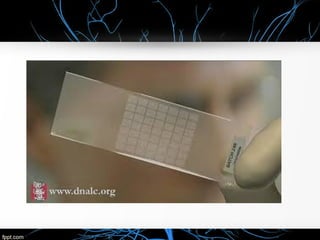
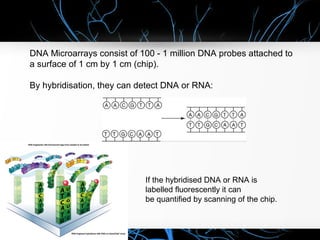
DNA Microarrays consist of 100 - 1 million DNA probes attached to
a surface of 1 cm by 1 cm (chip).
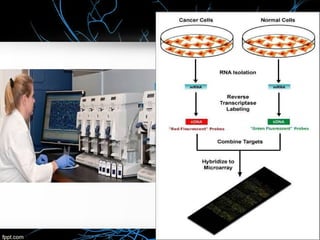
By hybridisation, they can detect DNA or RNA:
If the hybridised DNA or RNA is
labelled fluorescently it can
be quantified by scanning of the chip.
DNA microarrays can be manufactured
by:
• Photolitography (Affymetrix, Febit,
Nimblegen)
• Inkjet (Agilent, Canon)
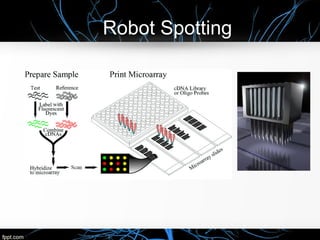
• Robot spotting (many providers)
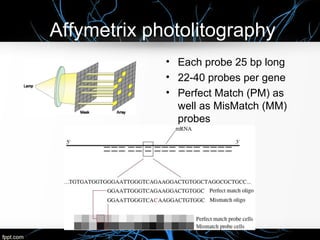
Affymetrix photolitography
• Each probe 25 bp long
• 22-40 probes per gene
• Perfect Match (PM) as
well as MisMatch (MM)
probes
Febit/NimbleGen photolitography
Robot Spotting
InkJet technology
Types of Microarray
1. Microarray Expression Analysis: In this experimental
setup, the cDNA derived from the mRNA of known genes is
immobilized. The sample has genes from both the normal
as well as the diseased tissues. Spots with more intensity
are obtained for diseased tissue gene if the gene is over
expressed in the diseased condition. This expression
pattern is then compared to the expression pattern of a
gene responsible for a disease.
2. Microarray for Mutation Analysis: For
this analysis, the researchers use gDNA.
The genes might differ from each other by
as less as a single nucleotide base. A single
base difference between two sequences is
known as Single Nucleotide Polymorphism
(SNP) and detecting them is known as SNP
detection.
3. Comparative Genomic Hybridization: It
is used for the identification in the increase
or decrease of the important chromosomal
fragments harboring genes involved in a
disease.
Applications of Microarrays
• Gene Discovery: DNA Microarray
technology helps in the identification of
new genes, know about their functioning
and expression levels under different
conditions.
Applications of Microarrays
• Disease Diagnosis: DNA Microarray
technology helps researchers learn more
about different diseases such as heart
diseases, mental illness, infectious
disease and especially the study of
cancer.
Applications of Microarrays
• Drug Discovery: Microarray technology
has extensive application
in Pharmacogenomics. Pharmacogenomic
s is the study of correlations between
therapeutic responses to drugs and the
genetic profiles of the patients.
Applications of Microarrays
• Toxicological Research: Microarray
technology provides a robust platform for
the research of the impact of toxins on the
cells and their passing on to the progeny.
Toxicogenomics establishes correlation
between responses to toxicants and the
changes in the genetic profiles of the cells
exposed to such toxicants.

Microarray(cell biology)

  • 1.
  • 2.
    Introduction • It isnot possible to research on a large number of genes using traditional methods. • DNA Microarray is one such technology which enables the researchers to investigate and address issues which were once thought to be non traceable. • DNA Microarray technology has empowered the scientific community to understand the fundamental aspects underlining the growth and development of life as well as to explore the genetic causes of anomalies occurring in the functioning of the human body.
  • 4.
    Technique 1. An arrayis an orderly arrangement of samples where matching of known and unknown DNA samples is done based on base pairing rules. 2. The sample spot sizes are typically less than 200 microns in diameter usually contain thousands of spots. 4. Thousands of spotted samples known as probes (with known identity) are immobilized on a solid support (a microscope glass slides or silicon chips or nylon membrane).
  • 6.
    5. An experimentwith a single DNA chip can provide information on thousands of genes simultaneously. 6. An orderly arrangement of the probes on the support is important as the location of each spot on the array is used for the identification of a gene.
  • 7.
    DNA Microarrays consistof 100 - 1 million DNA probes attached to a surface of 1 cm by 1 cm (chip). By hybridisation, they can detect DNA or RNA: If the hybridised DNA or RNA is labelled fluorescently it can be quantified by scanning of the chip.
  • 8.
    DNA microarrays canbe manufactured by: • Photolitography (Affymetrix, Febit, Nimblegen) • Inkjet (Agilent, Canon) • Robot spotting (many providers)
  • 9.
    Affymetrix photolitography • Eachprobe 25 bp long • 22-40 probes per gene • Perfect Match (PM) as well as MisMatch (MM) probes
  • 10.
  • 11.
  • 12.
  • 13.
    Types of Microarray 1.Microarray Expression Analysis: In this experimental setup, the cDNA derived from the mRNA of known genes is immobilized. The sample has genes from both the normal as well as the diseased tissues. Spots with more intensity are obtained for diseased tissue gene if the gene is over expressed in the diseased condition. This expression pattern is then compared to the expression pattern of a gene responsible for a disease.
  • 14.
    2. Microarray forMutation Analysis: For this analysis, the researchers use gDNA. The genes might differ from each other by as less as a single nucleotide base. A single base difference between two sequences is known as Single Nucleotide Polymorphism (SNP) and detecting them is known as SNP detection.
  • 15.
    3. Comparative GenomicHybridization: It is used for the identification in the increase or decrease of the important chromosomal fragments harboring genes involved in a disease.
  • 16.
    Applications of Microarrays •Gene Discovery: DNA Microarray technology helps in the identification of new genes, know about their functioning and expression levels under different conditions.
  • 17.
    Applications of Microarrays •Disease Diagnosis: DNA Microarray technology helps researchers learn more about different diseases such as heart diseases, mental illness, infectious disease and especially the study of cancer.
  • 18.
    Applications of Microarrays •Drug Discovery: Microarray technology has extensive application in Pharmacogenomics. Pharmacogenomic s is the study of correlations between therapeutic responses to drugs and the genetic profiles of the patients.
  • 19.
    Applications of Microarrays •Toxicological Research: Microarray technology provides a robust platform for the research of the impact of toxins on the cells and their passing on to the progeny. Toxicogenomics establishes correlation between responses to toxicants and the changes in the genetic profiles of the cells exposed to such toxicants.