The document discusses microarray technology, specifically DNA microarrays, which use an organized grid of DNA probes to analyze genetic information based on hybridization principles. It covers various types of microarrays, the steps involved in DNA chip manufacturing, and their applications in gene expression profiling, disease diagnosis, and drug discovery. Additionally, it highlights the advantages and disadvantages of microarrays, including the high cost and complexity of data analysis.
2
• Introduction
•Types ofMicroarray
•DNA Microarray
• Principle
Steps involved in DNA microarray
• Types of DNA Chips
cDNA - based chips
Oligonucleotide - based chips
• Applications
• Advantages and disadvantages
• SNP Array
CONTENTS
3.
3
Introduction
An array isan orderly arrangement of samples where
matching of known and unknown DNA samples is done
based on base pairing rules.
A microarray is a pattern of ssDNA probes which are
immobilized on a surface called a chip or a slide.
Microarray technology evolved from Southern blotting
The concept of microarrays was first proposed in the
late 1980s by Augenlicht and his colleagues.
4.
4
Types of Microarray
•DNA microarrays
• Protein microarrays
• Antibody microarray
• Tissue microarray
• Chemical compound microarray
5.
5
DNA Microarray
• DNAmicroarrays are solid supports, usually of glass or
silicon, upon which DNA is attached in an organized grid
fashion.
• Each spot of DNA, called a probe, represents a single
gene.
• There are several synonyms of DNA microarrays such as
DNA chips, gene chips, DNA arrays, gene arrays and
biochips.
6.
6
Principle
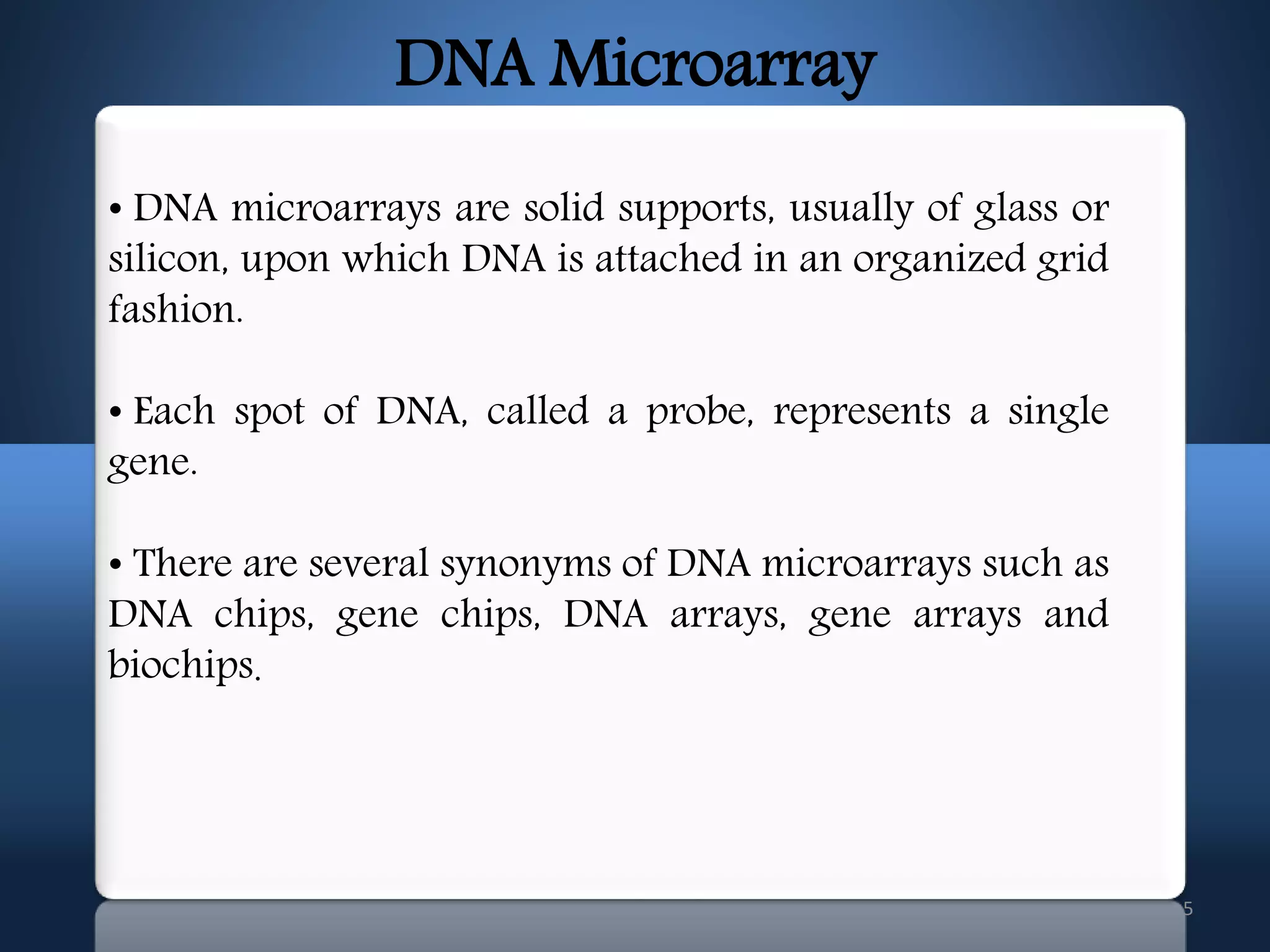
• The principleof DNA
microarrays lies on the
hybridization between the
nucleotide.
• Using this technology the
presence of one genomic or
cDNA sequence in 1,00,000
or more sequences can
be screened in a single
hybridization.
7.
7
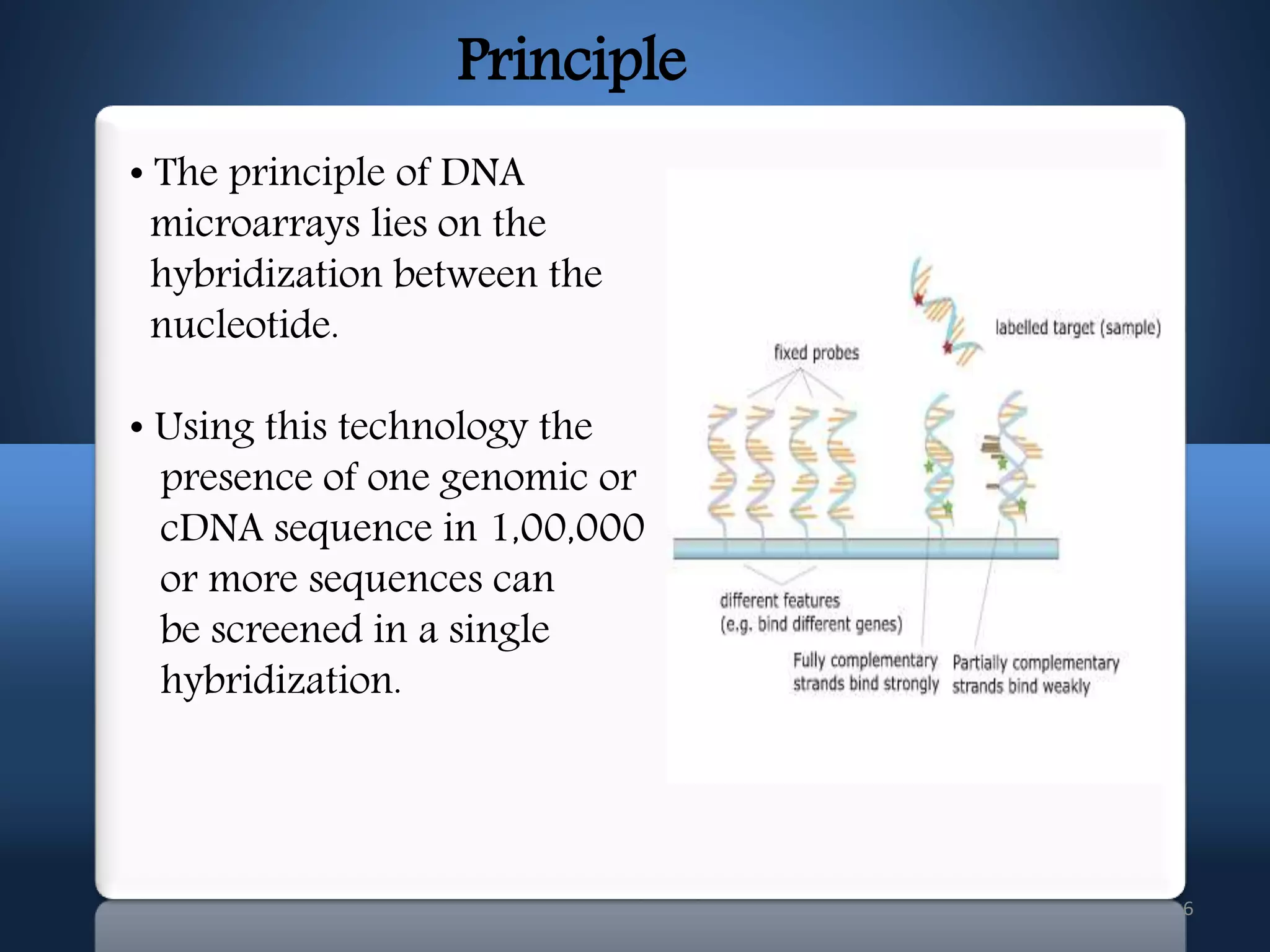
a) A DNAchip can be
manufactured to contain
hundreds of thousands of
synthetic single-stranded DNA
sequences.
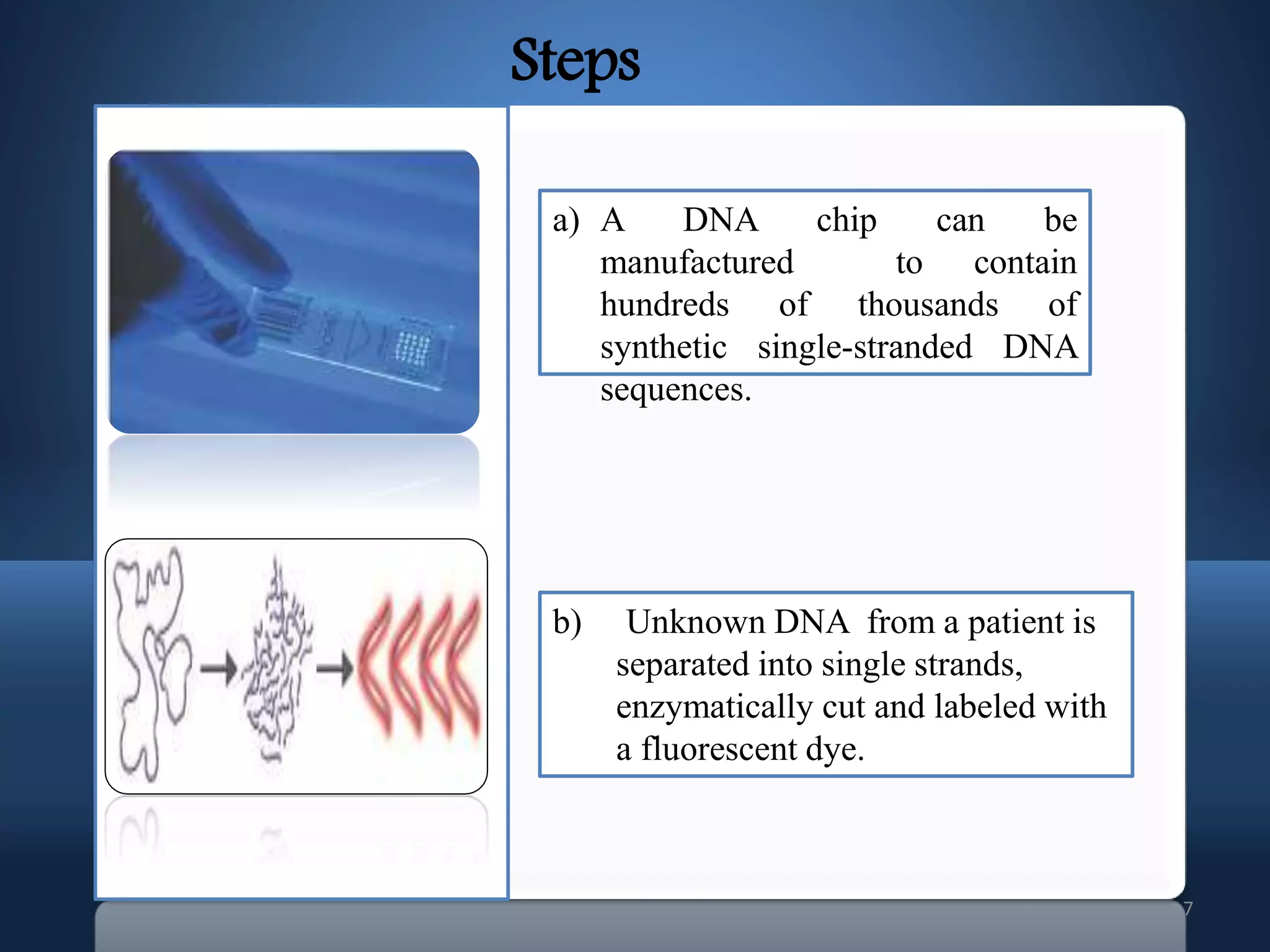
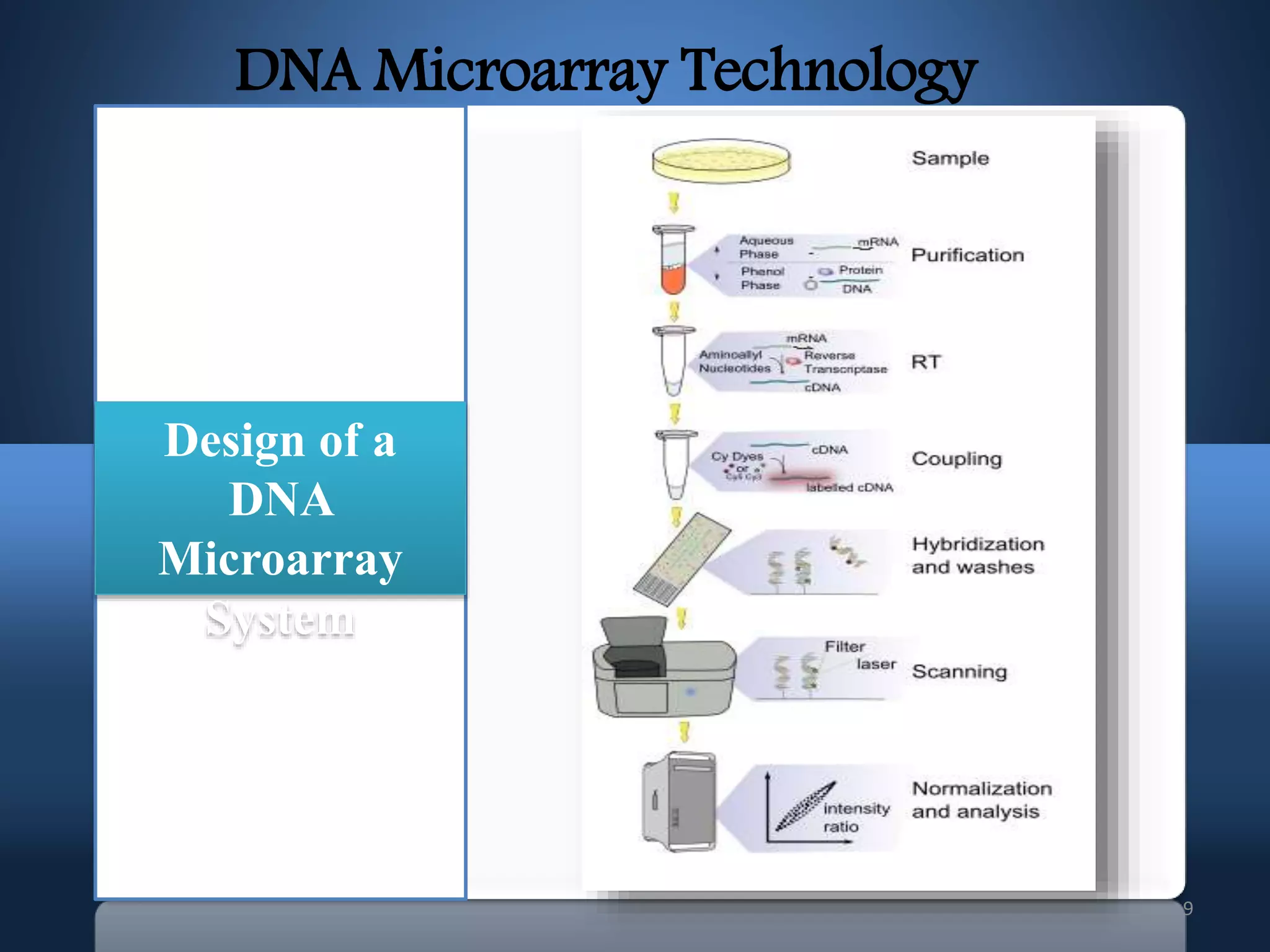
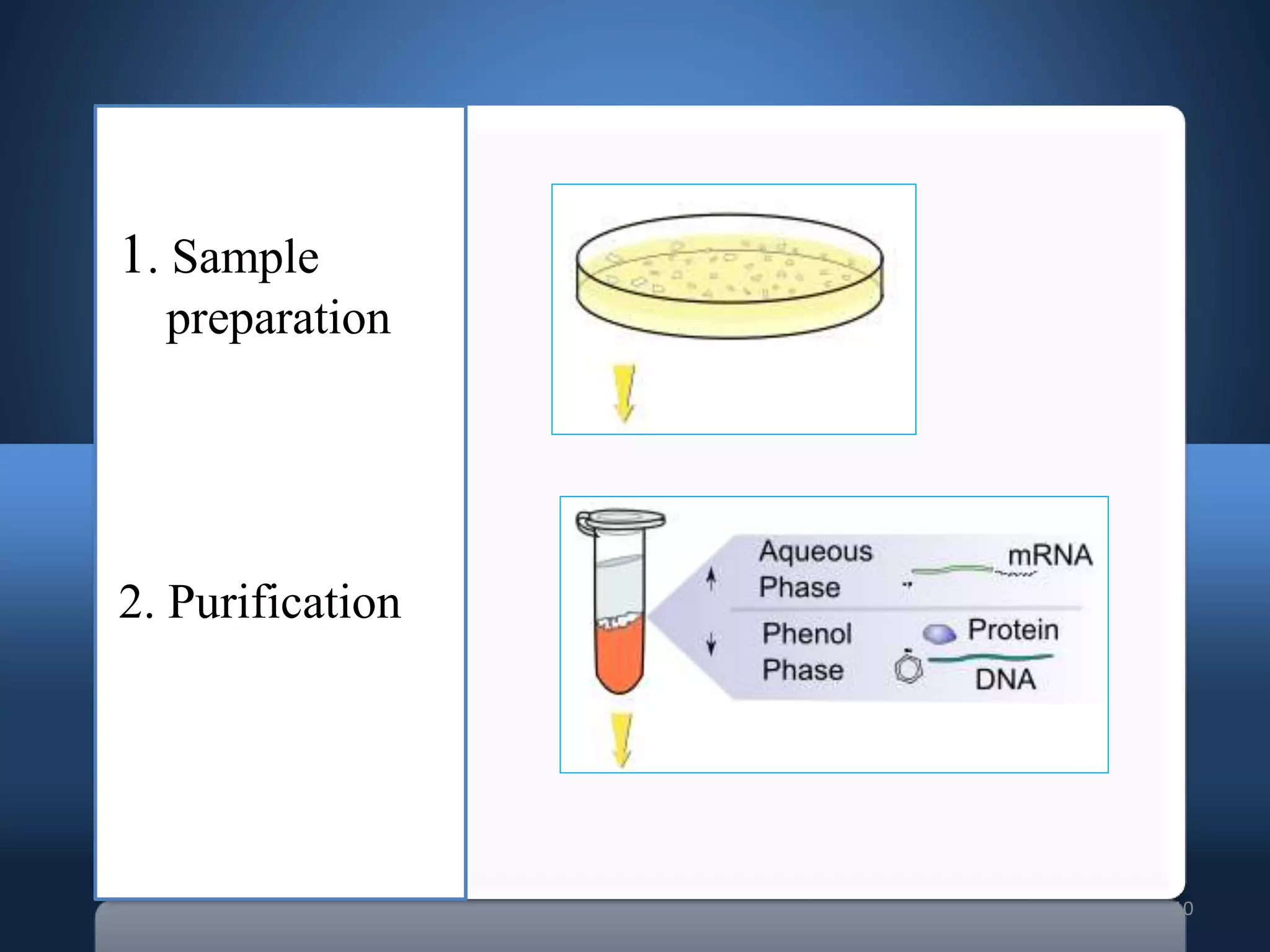
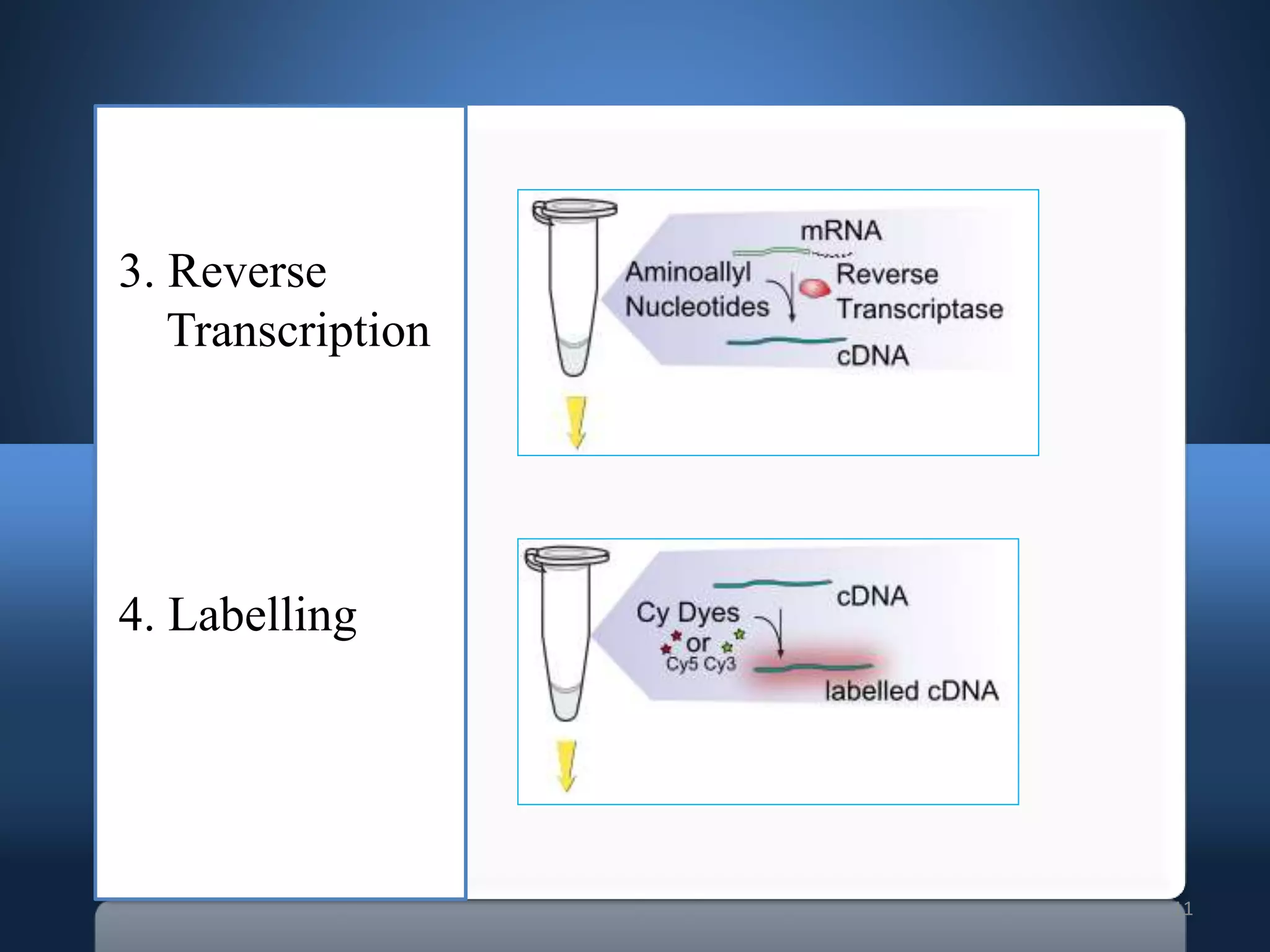
b) Unknown DNA from a patient is
separated into single strands,
enzymatically cut and labeled with
a fluorescent dye.
Steps
8.
8
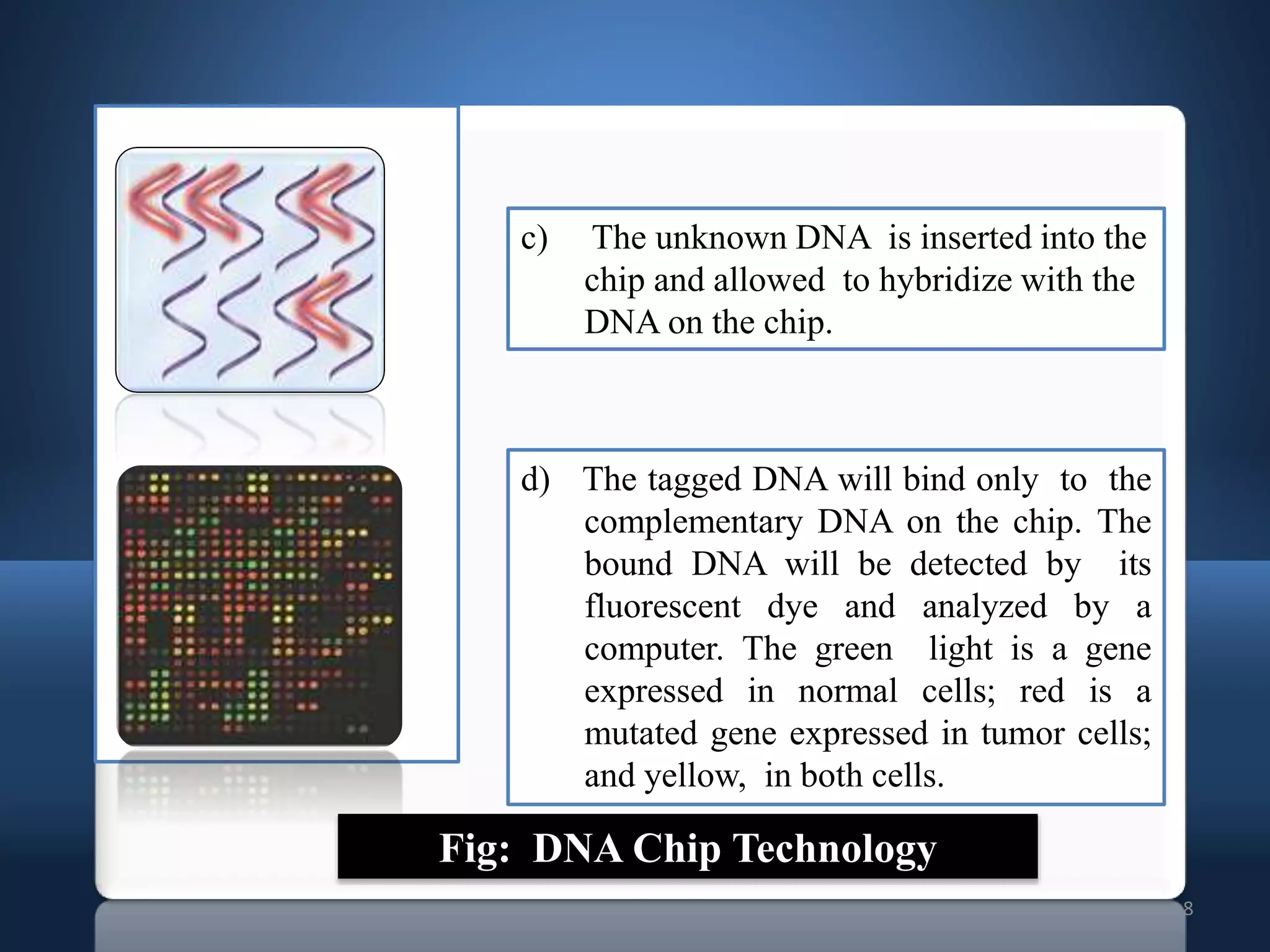
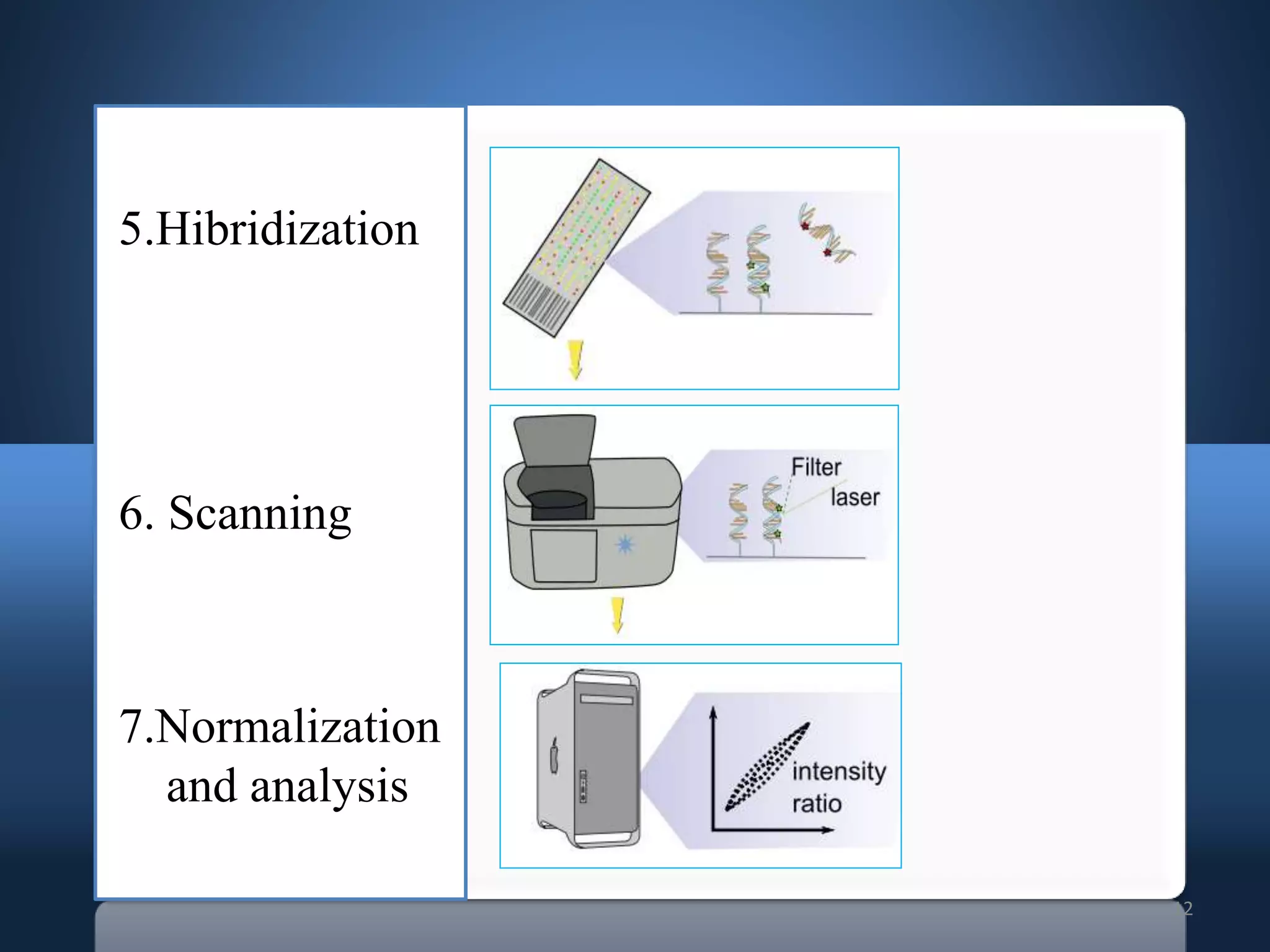
c) The unknownDNA is inserted into the
chip and allowed to hybridize with the
DNA on the chip.
d) The tagged DNA will bind only to the
complementary DNA on the chip. The
bound DNA will be detected by its
fluorescent dye and analyzed by a
computer. The green light is a gene
expressed in normal cells; red is a
mutated gene expressed in tumor cells;
and yellow, in both cells.
Fig: DNA Chip Technology
13
There are 2types of DNA Chips/Microarrays:
Types of DNA Chips
1. cDNA based microarray
2. Oligonucleotide based
microaaray
14.
14
•This type ofchips are prepared by using cDNA, it is called
cDNA chips or cDNA microarray or probe DNA. The cDNAs
are amplified by using PCR. Then these immobilized on a
solid support made up of nylon filter of glass slide.
• Small volume of this DNA preparation is spotted on solid
surface making physical contact between these two. DNA is
delivered mechanically or in a robotic manner.
•When one DNA spotting is done, the pin is washed and
loaded with fresh DNA to Start the second cycle.
cDNA Based Chips
15.
15
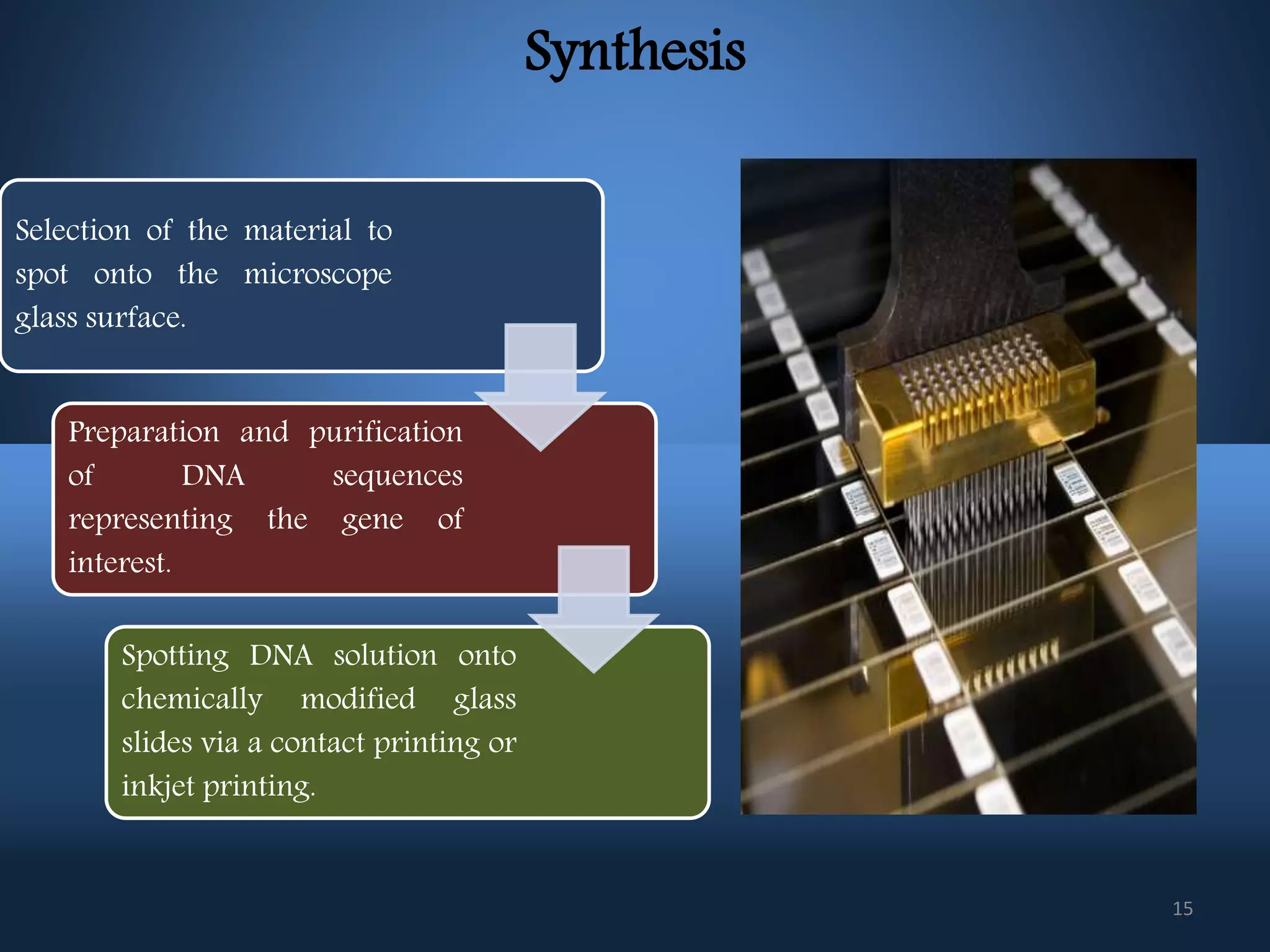
Synthesis
Selection of thematerial to
spot onto the microscope
glass surface.
Preparation and purification
of DNA sequences
representing the gene of
interest.
Spotting DNA solution onto
chemically modified glass
slides via a contact printing or
inkjet printing.
16.
16
Oligonucleotide Microarray
• Inoligonucleotide microarrays, the probes are
short sequences designed to match parts of the
sequence of interest.
• Oligonucleotide arrays are produced by printing
short oligonucleotide sequences designed to
represent a single gene by synthesizing this sequence
directly onto the array surface instead of depositing
intact sequences.
17.
17
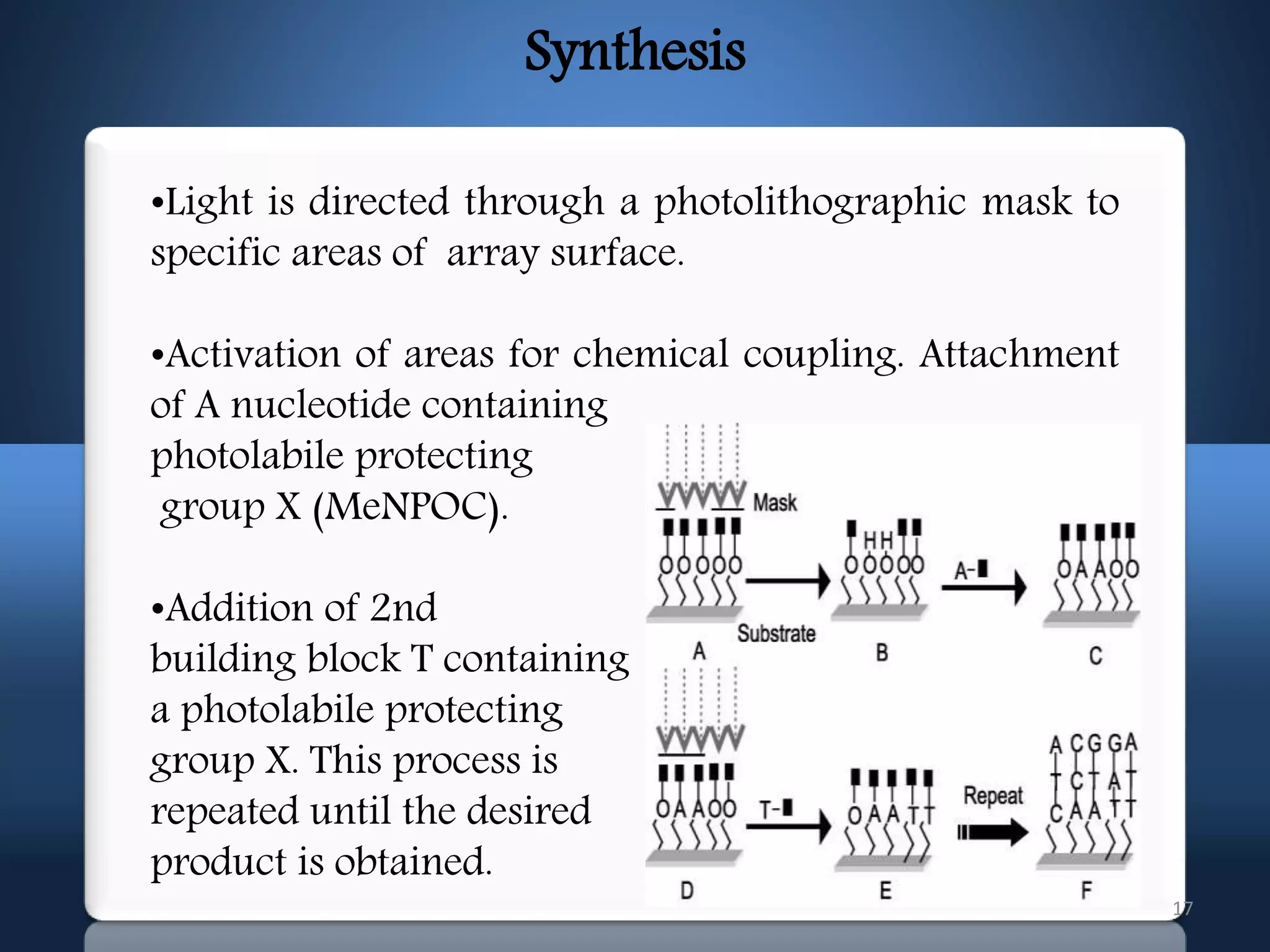
Synthesis
•Light is directedthrough a photolithographic mask to
specific areas of array surface.
•Activation of areas for chemical coupling. Attachment
of A nucleotide containing
photolabile protecting
group X (MeNPOC).
•Addition of 2nd
building block T containing
a photolabile protecting
group X. This process is
repeated until the desired
product is obtained.
19
• Provides datafor thousands of genes.
• One experiment instead of many.
• Fast and easy to obtain results.
• Huge step closer to discovering cures for diseases
and cancer.
• Different parts of DNA can be used to study gene
expression.
Advantages
20.
20
Disadvantages
• The biggestdisadvantage of DNA chips is that
they are expensive to create.
• The production of too many results at a time
requires long time for analysis, which is quite
complex in nature.
• The DNA chips do not have very long shelf life,
which proves to be another major disadvantage of
the technology.
21.
21
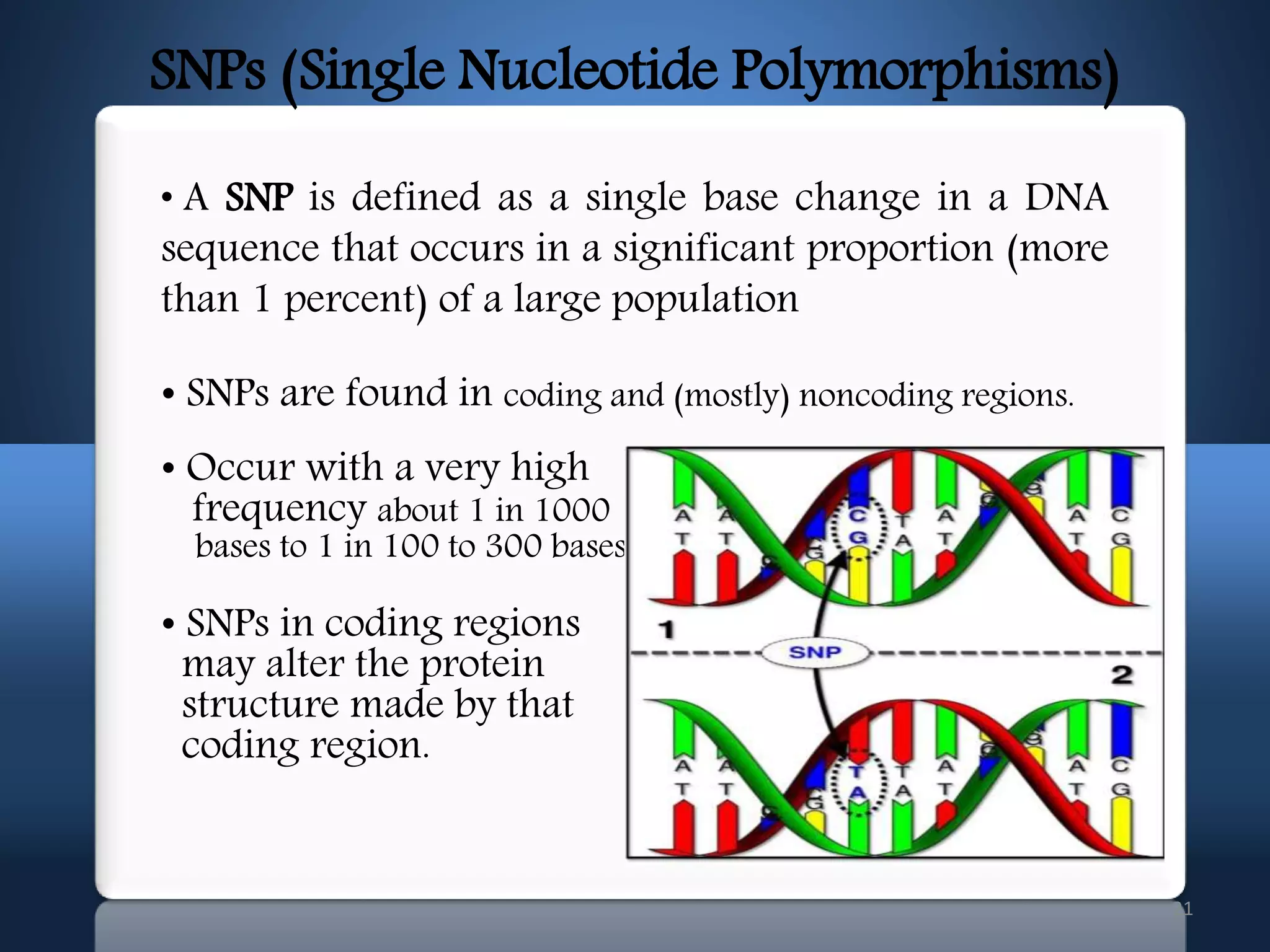
• A SNPis defined as a single base change in a DNA
sequence that occurs in a significant proportion (more
than 1 percent) of a large population
• SNPs are found in coding and (mostly) noncoding regions.
• Occur with a very high
frequency about 1 in 1000
bases to 1 in 100 to 300 bases.
• SNPs in coding regions
may alter the protein
structure made by that
coding region.
SNPs (Single Nucleotide Polymorphisms)
22.
22
SNP Array
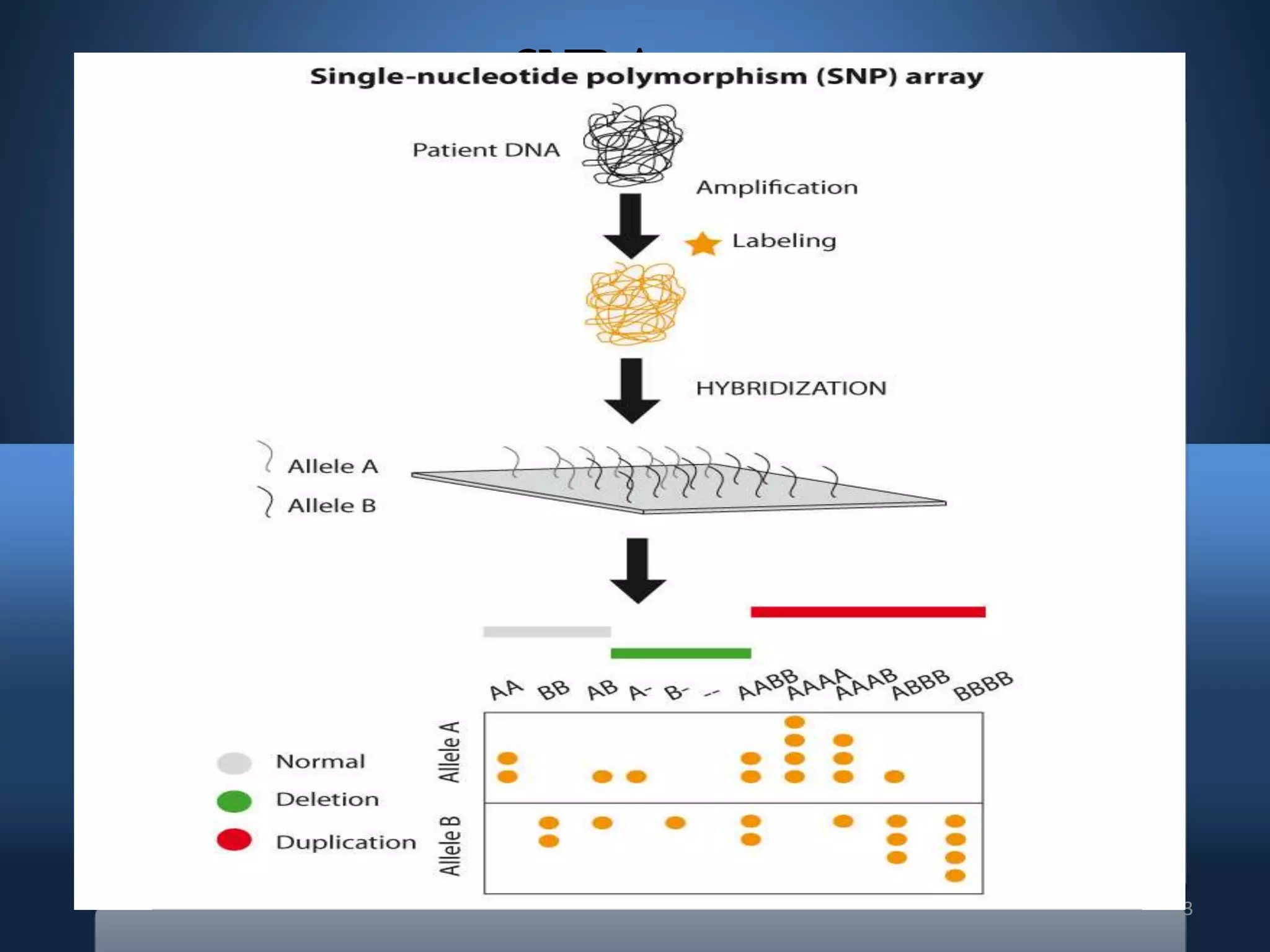
• SNParray is a type of DNA Microarray which is
used to detect polymorphism within a population
• The basic principles of SNP array are the same as
the DNA microarray
• The three mandatory components of the SNP
arrays are:
• An array containing immobilized allele-
specific oligonucleotide (ASO) probes.
•Fragmented nucleic acid sequences of target,
labeled with fluorescent dyes.
•A detection system that records and interprets
the hybridization signal.