DNA & RNA
ISOLATION
Technique, Methodology and application
By Geetika Gupta
B.Sc (H) Medical Biotechnology
8th Semester
Amity Institute of Biotechnology.
Definition
 DNA isolation is extraction/purification of
DNA from different sources through
physical and chemical reactions.
 RNA isolation is extraction/purification of
RNA from various sources through
physical and chemical reactions.
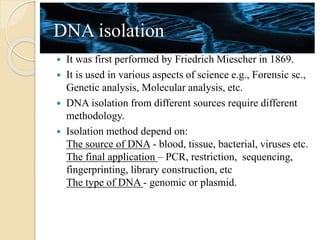
DNA isolation
 It was first performed by Friedrich Miescher in 1869.
 It is used in various aspects of science e.g., Forensic sc.,
Genetic analysis, Molecular analysis, etc.
 DNA isolation from different sources require different
methodology.
 Isolation method depend on:
The source of DNA - blood, tissue, bacterial, viruses etc.
The final application – PCR, restriction, sequencing,
fingerprinting, library construction, etc
The type of DNA - genomic or plasmid.
DNA isolation Kit
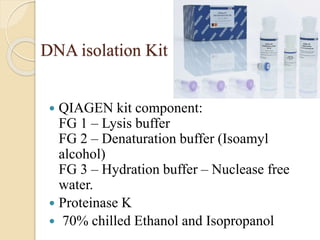
 QIAGEN kit component:
FG 1 – Lysis buffer
FG 2 – Denaturation buffer (Isoamyl
alcohol)
FG 3 – Hydration buffer – Nuclease free
water.
 Proteinase K
 70% chilled Ethanol and Isopropanol
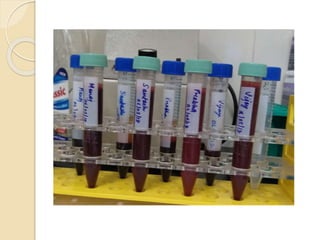
Procedure of DNA isolation
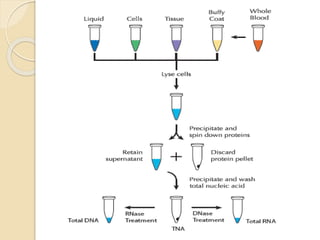
 Extraction of DNA involves 4 basic steps :
i) Preparation of cell extract from whole
blood
ii) Purification of DNA from cell extract.
iii) Concentration of DNA samples
iv) Measurement of purity of DNA
concentration
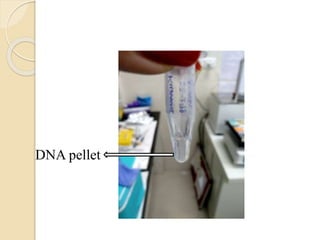
DNA pellet
Quantification
 Quantification is performed by
NanoDrop, a machine used to quantify
DNA, RNA, Protein amount in sample
and assess purity of the product.
 Earlier spectrophotometer was used to
quantify isolated DNA.
DNA Quantification
Sample DNA yield 260/280 260/230
C1 1154.3 1.83 1.88
C2 510.7 1.77 1.82
C3 582.8 1.78 2.12
DNA storage
 DNA isolation kit Qiagen and Proteinase
K is stored in 4°C.
 Whole blood (DNA sample) is stored at- -
20°C or -80°C.
 70% Ethanol and isopropanol is also
stored at 4°C.
DNA Check Run
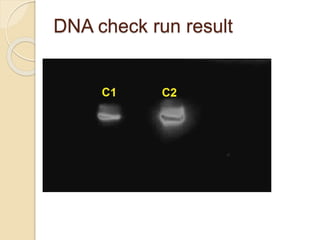
 DNA check run is performed by in
0.8% of Agrose Gel Electrophoresis.
 Components of Agrose:
0.8% Agrose (0.8g Agrose in 1ml TAE)
TAE buffer
DNA check run result
Application of DNA isolation
 Used to gather evidence in a crime
investigation ( Forensic science)
 Used in genetic modification of plants
 In fingerprinting/ genetic identification
 Molecular biology investigations
 Introduction of DNA into cells of
animals and plants
 Diagnostic Purpose
RNA isolation
 Main purpose of RNA purification is to
isolate intact RNA for techniques like
cDNA library construction, RT-PCR, etc.
 Isolation of RNA is very sensitive and
specific process that has to be performed
with utmost precautions and care.
Reagents used in RNA
isolation
 RBCL – Red Blood Cell Lysis Buffer
 PBS – Phosphate Buffer saline
 TriZol – Acid Guanidinium Thiocynate
Phenol Chloroform Solution
 Chloroform
 Isopropanol
 70% Ethanol
 Nuclease free Water
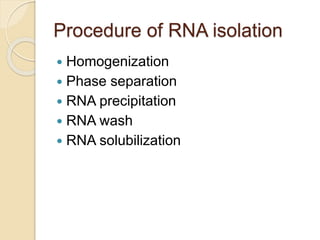
Procedure of RNA isolation
 Homogenization
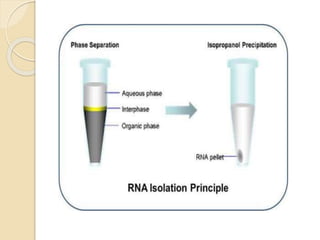
 Phase separation
 RNA precipitation
 RNA wash
 RNA solubilization
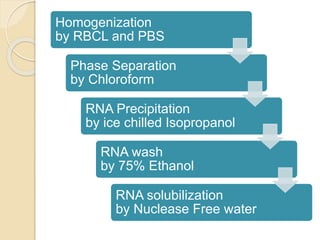
Homogenization
by RBCL and PBS
Phase Separation
by Chloroform
RNA Precipitation
by ice chilled Isopropanol
RNA wash
by 75% Ethanol
RNA solubilization
by Nuclease Free water
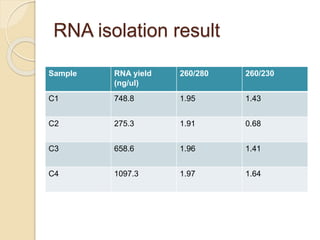
RNA isolation result
Sample RNA yield
(ng/ul)
260/280 260/230
C1 748.8 1.95 1.43
C2 275.3 1.91 0.68
C3 658.6 1.96 1.41
C4 1097.3 1.97 1.64
RNA storage
 RNA isolation reagents TriZol,
Chloroform, Isopropanol, 70%
Ethanol, Nuclease Free Water are
stored at 4°C
 Total RNA extracted stored in -20°C
 PBS and RBCL Buffer is stored at
room temperature.
Application of RNA isolation
Total RNA isolated can be used in:
 Northern analysis
 In-vitro translation
 Poly-A selection
 RNase protection assay
 Molecular cloning
Reference
 https://www.slideshare.net/AsmaAshraf7/dna-isolation-
73144905
 DNA Extraction Created by George Rice, Montana State
University
 Alaska BioPREP Virtual Textbook
 http://www.nbpgr.ernet.in/Portals/6/DMX/GENOMIC_RESO
URCES/DNA%20extraction-
Comparison%20of%20methodologies.pdf
 Rumaizah Muhamad, “RNA extraction” presentation
http://www.ukm.my/umbi/wp-
content/uploads/techrevision/RNA%20EXTRACTION.pdf
 Chomczynski P, Sacchi N. Single-step method of RNA
isolation by acid guanidinium thiocyanate-phenol-chloroform
extraction. Anal Biochem. 1987 Apr;162(1):156-9.
 Chomczynski, P. (1993) Biotechniques 15, 532.

DNA & RNA isolation

  • 1.
    DNA & RNA ISOLATION Technique,Methodology and application By Geetika Gupta B.Sc (H) Medical Biotechnology 8th Semester Amity Institute of Biotechnology.
  • 2.
    Definition  DNA isolationis extraction/purification of DNA from different sources through physical and chemical reactions.  RNA isolation is extraction/purification of RNA from various sources through physical and chemical reactions.
  • 3.
    DNA isolation  Itwas first performed by Friedrich Miescher in 1869.  It is used in various aspects of science e.g., Forensic sc., Genetic analysis, Molecular analysis, etc.  DNA isolation from different sources require different methodology.  Isolation method depend on: The source of DNA - blood, tissue, bacterial, viruses etc. The final application – PCR, restriction, sequencing, fingerprinting, library construction, etc The type of DNA - genomic or plasmid.
  • 4.
    DNA isolation Kit QIAGEN kit component: FG 1 – Lysis buffer FG 2 – Denaturation buffer (Isoamyl alcohol) FG 3 – Hydration buffer – Nuclease free water.  Proteinase K  70% chilled Ethanol and Isopropanol
  • 5.
    Procedure of DNAisolation  Extraction of DNA involves 4 basic steps : i) Preparation of cell extract from whole blood ii) Purification of DNA from cell extract. iii) Concentration of DNA samples iv) Measurement of purity of DNA concentration
  • 7.
  • 8.
    Quantification  Quantification isperformed by NanoDrop, a machine used to quantify DNA, RNA, Protein amount in sample and assess purity of the product.  Earlier spectrophotometer was used to quantify isolated DNA.
  • 9.
    DNA Quantification Sample DNAyield 260/280 260/230 C1 1154.3 1.83 1.88 C2 510.7 1.77 1.82 C3 582.8 1.78 2.12
  • 10.
    DNA storage  DNAisolation kit Qiagen and Proteinase K is stored in 4°C.  Whole blood (DNA sample) is stored at- - 20°C or -80°C.  70% Ethanol and isopropanol is also stored at 4°C.
  • 11.
    DNA Check Run DNA check run is performed by in 0.8% of Agrose Gel Electrophoresis.  Components of Agrose: 0.8% Agrose (0.8g Agrose in 1ml TAE) TAE buffer
  • 12.
  • 13.
    Application of DNAisolation  Used to gather evidence in a crime investigation ( Forensic science)  Used in genetic modification of plants  In fingerprinting/ genetic identification  Molecular biology investigations  Introduction of DNA into cells of animals and plants  Diagnostic Purpose
  • 15.
    RNA isolation  Mainpurpose of RNA purification is to isolate intact RNA for techniques like cDNA library construction, RT-PCR, etc.  Isolation of RNA is very sensitive and specific process that has to be performed with utmost precautions and care.
  • 16.
    Reagents used inRNA isolation  RBCL – Red Blood Cell Lysis Buffer  PBS – Phosphate Buffer saline  TriZol – Acid Guanidinium Thiocynate Phenol Chloroform Solution  Chloroform  Isopropanol  70% Ethanol  Nuclease free Water
  • 17.
    Procedure of RNAisolation  Homogenization  Phase separation  RNA precipitation  RNA wash  RNA solubilization
  • 18.
    Homogenization by RBCL andPBS Phase Separation by Chloroform RNA Precipitation by ice chilled Isopropanol RNA wash by 75% Ethanol RNA solubilization by Nuclease Free water
  • 20.
    RNA isolation result SampleRNA yield (ng/ul) 260/280 260/230 C1 748.8 1.95 1.43 C2 275.3 1.91 0.68 C3 658.6 1.96 1.41 C4 1097.3 1.97 1.64
  • 21.
    RNA storage  RNAisolation reagents TriZol, Chloroform, Isopropanol, 70% Ethanol, Nuclease Free Water are stored at 4°C  Total RNA extracted stored in -20°C  PBS and RBCL Buffer is stored at room temperature.
  • 22.
    Application of RNAisolation Total RNA isolated can be used in:  Northern analysis  In-vitro translation  Poly-A selection  RNase protection assay  Molecular cloning
  • 23.
    Reference  https://www.slideshare.net/AsmaAshraf7/dna-isolation- 73144905  DNAExtraction Created by George Rice, Montana State University  Alaska BioPREP Virtual Textbook  http://www.nbpgr.ernet.in/Portals/6/DMX/GENOMIC_RESO URCES/DNA%20extraction- Comparison%20of%20methodologies.pdf  Rumaizah Muhamad, “RNA extraction” presentation http://www.ukm.my/umbi/wp- content/uploads/techrevision/RNA%20EXTRACTION.pdf  Chomczynski P, Sacchi N. Single-step method of RNA isolation by acid guanidinium thiocyanate-phenol-chloroform extraction. Anal Biochem. 1987 Apr;162(1):156-9.  Chomczynski, P. (1993) Biotechniques 15, 532.

Editor's Notes

  • #23 2 - generating rna into protein in vitro 3 – to remove massive amt of rRNA from the sample 4 – detect and measure abundance of mRNA in total rna