mRNA Enrichment
Basic Molecular Biology
BIO-NIIST-2-4104
Jasmin G. Russel
10BB15A39017
RNA Extraction
• Purification of RNA from biological samples
• Acid Guanidinium thiocyanate-Phenol-
Chloroform extraction (AGPC)
• CsCl gradient purification
Total RNA
80-85% rRNA
15-20% tRNA
1-5% mRNA
– Variable size
– 3’ polyadenylation
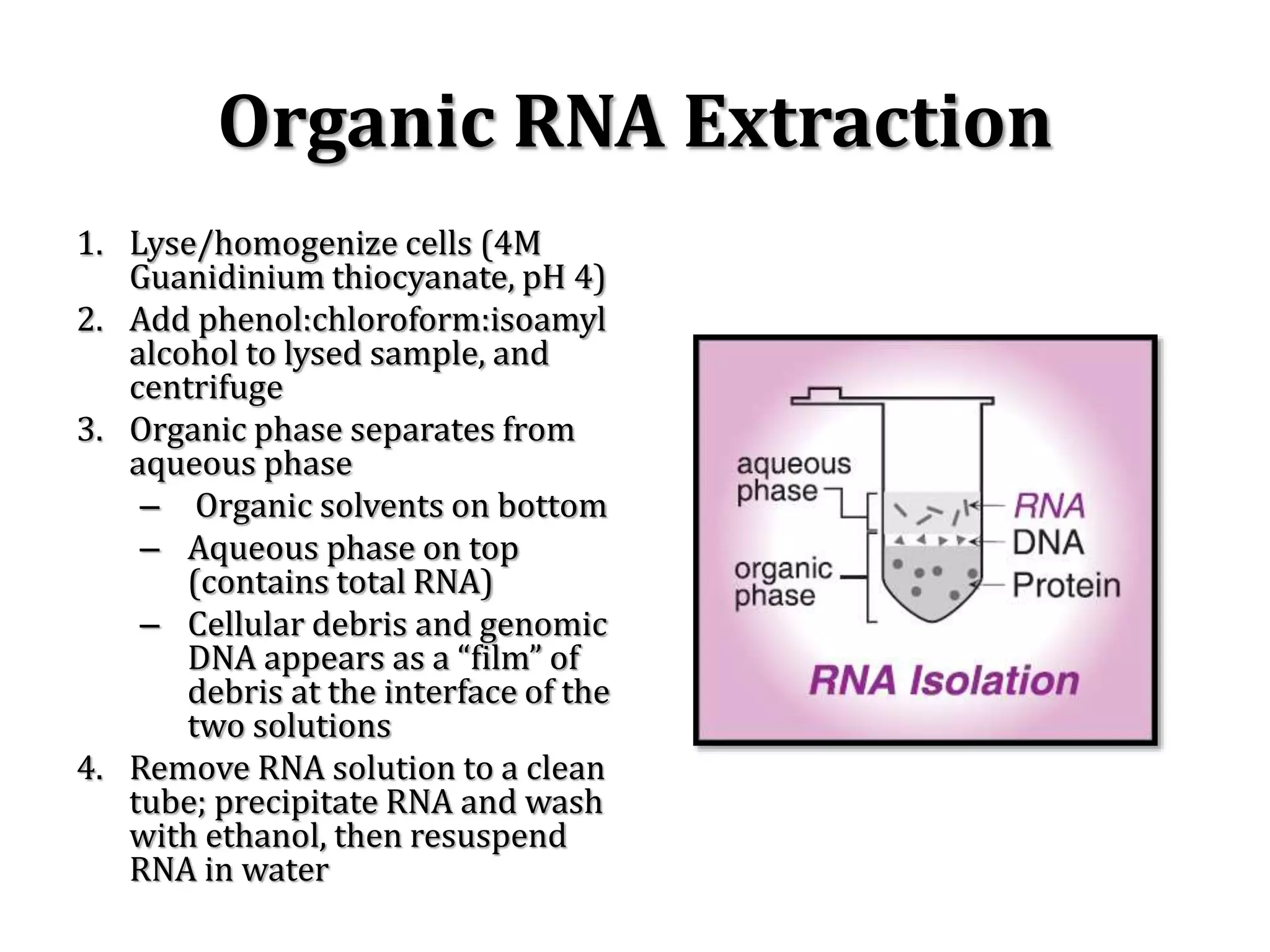
Organic RNA Extraction
1. Lyse/homogenize cells (4M
Guanidinium thiocyanate, pH 4)
2. Add phenol:chloroform:isoamyl
alcohol to lysed sample, and
centrifuge
3. Organic phase separates from
aqueous phase
– Organic solvents on bottom
– Aqueous phase on top
(contains total RNA)
– Cellular debris and genomic
DNA appears as a “film” of
debris at the interface of the
two solutions
4. Remove RNA solution to a clean
tube; precipitate RNA and wash
with ethanol, then resuspend
RNA in water
Affinity Purification of RNA
1. Lyse cells, and spin to remove large particulates/cell
debris
2. Apply lysate (containing nucleic acids and cellular
contaminants) to column with glass membrane
3. Wash with alcohol to remove contaminants; nucleic
acids stick to glass membrane while contaminants
wash through. Treat with DNase enzyme to remove
contaminating DNA.
4. Apply water to the column; purified RNA washes off the
glass and is collected
Determining Purity
• Ratio of the readings : O.D.260/O.D.280 is a
measure of purity.
• If the 260nm/280nm ratio is less than 2.0-
2.3 for RNA this indicates contamination,
usually with protein.
• Pure preparations of DNA and RNA have O.D
260/280 of 1.8 and 2.0 respectively.
mRNA Enrichment - Eukaryotes
• Poly A tail
• 30-200 nt long
• Hybridisation of Poly A tail containing RNAs
to oligo dT molecules connected to a carrier
– Cellulose matrix
– Biotinylated oligo dT
• Washing of nucleic acids which do not bind
to oligo dT
• Elution of Poly A RNA from carrier
mRNA Enrichment Prokaryotes
• Lack long 3’poly A tail
Methods
• rRNA Capture
• Degradation of already processed RNA
• Polyadenylation of mRNA
• Antibody capture of specific RNAs
Ribosomal RNA Capture
• Probes correspond to the conserved regions
of 16S and 23S regions
• Probes attached to metallic beads are
removed with rRNA
• Specific for an organism
• Probes differ from organism to organism
• MICROBExpress Kit by Ambion
Degradation of processed RNA
• mRNA have 5’triphosphate (5’PPP)
• rRNA and tRNA have 5’monophosphate (5’P)
• Exonuclease – breaks down 5’P RNA
molecules only
• mRNA only prokaryotic mRNA isolation kit
by Epicentre
Selective polyadenylation of mRNA
• E. coli poly (A) polymerase to poly adenylate
the mRNA
• After polyadenylation oligo dT probes are
used for capturing
• Message AMP II bacteria kit by Ambion
Antibody Capture
• Immunoprecipitation of mRNAs associted
with certain protein
– Hfq, associated with rRNA and tRNA
– Hfq Co-IP
Applications
• Transcriptome sequencing
• Gene expression profiling.
• RNA profiling techniques such as
• Real Time RT-PCR
• Microarray analysis
• Northern blotting
Thank you

Messenger RNA (mRNA) enrichment

  • 1.
    mRNA Enrichment Basic MolecularBiology BIO-NIIST-2-4104 Jasmin G. Russel 10BB15A39017
  • 2.
    RNA Extraction • Purificationof RNA from biological samples • Acid Guanidinium thiocyanate-Phenol- Chloroform extraction (AGPC) • CsCl gradient purification Total RNA 80-85% rRNA 15-20% tRNA 1-5% mRNA – Variable size – 3’ polyadenylation
  • 3.
    Organic RNA Extraction 1.Lyse/homogenize cells (4M Guanidinium thiocyanate, pH 4) 2. Add phenol:chloroform:isoamyl alcohol to lysed sample, and centrifuge 3. Organic phase separates from aqueous phase – Organic solvents on bottom – Aqueous phase on top (contains total RNA) – Cellular debris and genomic DNA appears as a “film” of debris at the interface of the two solutions 4. Remove RNA solution to a clean tube; precipitate RNA and wash with ethanol, then resuspend RNA in water
  • 4.
    Affinity Purification ofRNA 1. Lyse cells, and spin to remove large particulates/cell debris 2. Apply lysate (containing nucleic acids and cellular contaminants) to column with glass membrane 3. Wash with alcohol to remove contaminants; nucleic acids stick to glass membrane while contaminants wash through. Treat with DNase enzyme to remove contaminating DNA. 4. Apply water to the column; purified RNA washes off the glass and is collected
  • 5.
    Determining Purity • Ratioof the readings : O.D.260/O.D.280 is a measure of purity. • If the 260nm/280nm ratio is less than 2.0- 2.3 for RNA this indicates contamination, usually with protein. • Pure preparations of DNA and RNA have O.D 260/280 of 1.8 and 2.0 respectively.
  • 6.
    mRNA Enrichment -Eukaryotes • Poly A tail • 30-200 nt long • Hybridisation of Poly A tail containing RNAs to oligo dT molecules connected to a carrier – Cellulose matrix – Biotinylated oligo dT • Washing of nucleic acids which do not bind to oligo dT • Elution of Poly A RNA from carrier
  • 8.
    mRNA Enrichment Prokaryotes •Lack long 3’poly A tail Methods • rRNA Capture • Degradation of already processed RNA • Polyadenylation of mRNA • Antibody capture of specific RNAs
  • 9.
    Ribosomal RNA Capture •Probes correspond to the conserved regions of 16S and 23S regions • Probes attached to metallic beads are removed with rRNA • Specific for an organism • Probes differ from organism to organism • MICROBExpress Kit by Ambion
  • 11.
    Degradation of processedRNA • mRNA have 5’triphosphate (5’PPP) • rRNA and tRNA have 5’monophosphate (5’P) • Exonuclease – breaks down 5’P RNA molecules only • mRNA only prokaryotic mRNA isolation kit by Epicentre
  • 13.
    Selective polyadenylation ofmRNA • E. coli poly (A) polymerase to poly adenylate the mRNA • After polyadenylation oligo dT probes are used for capturing • Message AMP II bacteria kit by Ambion
  • 15.
    Antibody Capture • Immunoprecipitationof mRNAs associted with certain protein – Hfq, associated with rRNA and tRNA – Hfq Co-IP
  • 16.
    Applications • Transcriptome sequencing •Gene expression profiling. • RNA profiling techniques such as • Real Time RT-PCR • Microarray analysis • Northern blotting
  • 17.

Editor's Notes

  • #9 The 3'-ends of both prokaryotic and eukaryotic mRNA are polyadenylated, but the poly(A) tracts of prokaryotic mRNA are generally shorter, 
  • #16 Hfq co-immunoprecipitation (co-IP) is one of the most common methods used to identify Hfq binding RNAs. The co-IP step can be performed by isolating Hfq bound transcripts using an Hfq specific antibody, an epitope tagged Hfq, or by incubating cellular extracts or purified RNA pools with an affinity tagged Hfq. Once the binding partners have been isolated there are several methods for determining which RNAs have been pulled down. Early work used microarrays, shot gun cloning, and enzymatic sequencing. More recently, the advent of inexpensive high-throughput sequencing (HTS) has altered the experimental landscape and is now the most common approach to deconvolute the pull-down [36, 38, 52, 53]. One of the best features of co-IP is the ability to directly identify Hfq-RNA interactions in a high-throughput fashion, but some limitations occur due to the potential for non-specific interactions. Another drawback is that the lengthy protocol can result in degradation of large mRNA transcripts.