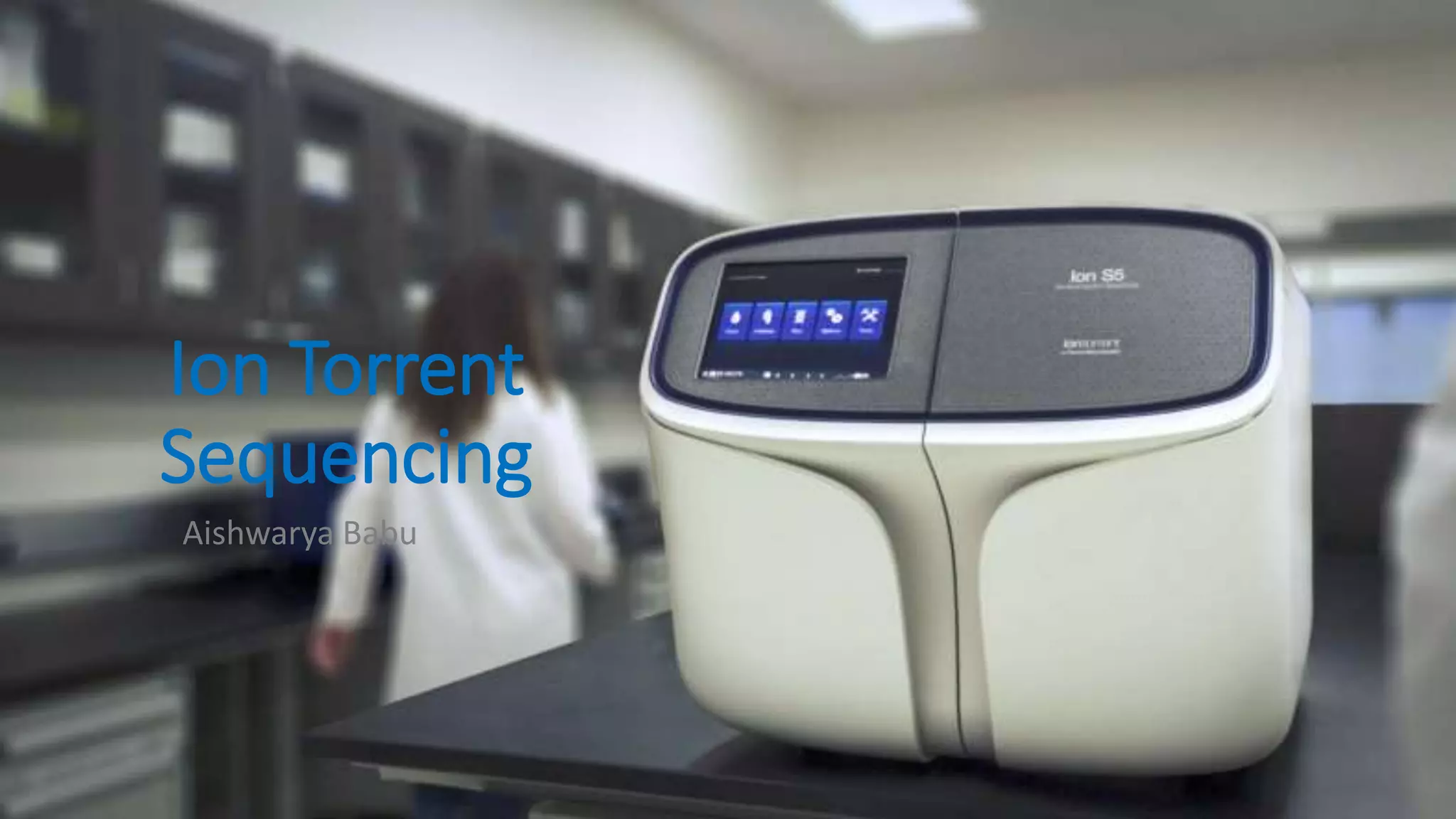
Ion Torrent
Sequencing
Aishwarya Babu
Introduction
• Continuation of the original pyrosequencing technique.
• The current Ion Torrent system detects H+ ions, another product released during
DNA polymerization.
• The basic principle, the detection of H+ ions, has been licensed from DNA
Electronics in London.
• Technology combines semiconductor sequencing technology with biochemistry,
enabling the direct translation of chemical information into digital sequence data.
• Eliminates the need for expensive optics, lasers, and complex sequencing
chemistries with fluorescently labelled nucleotides.
• More affordable and cost-effective, faster, scalable, and relatively simple to
operate.
Principle
• Detection of hydrogen ion release
during incorporation of new
nucleotides into the growing DNA
template.
• In nature, when a nucleotide is
incorporated into a strand of DNA by
a polymerase, a hydrogen ion is
released as a by-product.
4
• Ion Torrent, with its Ion Personal Genome
Machine (PGM™) sequencer
• Uses a high-density array of micro-machined
wells to perform nucleotide incorporation in a
massively parallel manner.
• Each well holds a different DNA template.
• Beneath the wells is an ion-sensitive layer
followed by a proprietary ion-sensor.
• The ion changes the pH of the solution, which is
detected by an ion sensor.
6
• If there are two identical bases on the
DNA strand, the output voltage is
doubled, and the chip records two
identical bases.
• Instead of detecting light as in 454
pyrosequencing, Ion Torrent technology
creates a direct connection between
the chemical and digital events.
7
• Hydrogen ions are detected on ion-semiconductor sequencing chips.
• These ion semiconductor chips are designed and manufactured like any
other semiconductor chips used in electronic devices.
• These are cut in the form of wafers from a silicon boule.
• The transistors and circuits are then pattern-transferred and subsequently
etched onto the wafers using photolithography.
• This process is repeated 20 times or more creating a multi-layer system of
circuits.
Instrumentation
• Ion Torrent’s first instrument, the Ion
Personal Genome Machine (PGM) - least
expensive next generation sequencer on the
market.
• Run up to 5.5 million reads, with an output
reaching 2 Gb, a reading length up to 400
bases, and a run time between 2 and 7 h.
• Targeted towards smaller genomes and
targeted sequencing.
• It uses disposable chips which come in three
varieties of increasing output.
•Ion Proton :
• Allows for larger chips with higher densities needed for exome and whole
genome sequencing.
• Substantially more expensive.
• Capable of generating much larger outputs.
• The first chip, the PI, is able to generate ~10Gb per run.
• The number of reads is up to 80 million, the read length is 200 bases, and the run
time is 2–4 h.
Technology
Description
The workflow
consists of four
major steps:
library construction,
template prep,
sequencing and
analysis.
1. Library Construction
• The first step in the workflow is library construction.
• Involves taking DNA (or RNA converted to DNA).
• Fragmenting it to a uniform size (generally 200-400b).
• Then adding sequencing adapters.
2. Template Prep/Amplification
• The fragments generated during the library prep are attached to beads and amplified
using emulsion PCR (emPCR).
• Beads coated with complementary primers are mixed with a dilute aqueous solution
containing the fragments to be sequenced along with the necessary PCR reagents.
• This solution is then mixed with oil to form an emulsion of microdroplets.
• The concentration of beads and fragments is kept low enough such that each
microdroplet contains only one of each.
• Clonal amplification of each fragment is then performed within the
microdroplets.
• Following amplification the emulsion is ‘broken’ - by organic extraction and
centrifugation.
• The amplified beads are enriched in a glycerol gradient with unamplified beads
pelleting at the bottom.
• While the emulsion PCR process is effective, it is slow and complicated.
3. Sequencing
• Based on the standard pyrosequencing chemistry, a form of ‘sequencing by
synthesis’.
• Individual bases are introduced one at a time and incorporated by DNA
polymerase.
• Ion Torrent system measures the direct release of H+ from the reaction.
• Relatively inexpensive instruments coupled with disposable chips, which
essentially act as pH meters.
• Sequencing reactions are relatively fast, with 200b reads taking about 2 hours.
• System can use unmodified nucleotides, which are cheaper and better tolerated
by DNA polymerase.
• Each bead is placed into a single well of a slide.
• Like 454, the slide is flooded with a single species of dNTP, along with buffers and
polymerase, one NTP at a time.
• The pH is detected in each of the wells, as each H+ ion released will decrease the pH.
• The changes in pH allow us to determine if that base, and how many thereof, was
added to the sequence read.
• The dNTPs are washed away, and the process is repeated cycling through the
different dNTP species.
• The pH change, if any, is used to
determine how many bases (if any)
were added with each cycle.
4. Data analysis
• Generate standard output files like FASTQ, data analysis is generally
straightforward.
• Ion Torrent offers the ‘Torrent Browser’ software, which acts as the primary
interface for a number of basic functions.
Technique Features
1. Simple: Simple sequencing chemistry based on semi-conductor technology,
without optical detection. Low sample requirement.
2. Fast: Sequencing within 2-3 hours, rapid turnaround time (~2 days) from sample
to DNA sequences.
3. Flexible: Flexible scaled chips on PGM and Proton systems for different
throughput needs.
4. High Accuracy: 99.97%.
Applications
1. Small genome sequencing (eg:
Microbial de-novo & resequencing;
Mitochondrial sequencing)
2. Amplicon sequencing (eg: 16S meta
genome sequencing)
3. Targeted resequencing
4. Transcriptome and whole exon
sequencing (Ion Proton)
Limitations:
• The read length of 200 bp lies in between short and long read length NGS
technologies.
• Whereas short read technologies are facilitated by huge data generation, Ion lags
behind in total data output.
• In this way, Ion Torrent has to prove itself as a standalone sequencing technique
for de novo sequencing projects of big genomes.
21
Improvements on the previous technology
The four main advantages of NGS over classical Sanger sequencing are:
Speed Cost
Sample
size
Accuracy
23
Thank you

Ion torrent

  • 1.
  • 2.
    Introduction • Continuation ofthe original pyrosequencing technique. • The current Ion Torrent system detects H+ ions, another product released during DNA polymerization. • The basic principle, the detection of H+ ions, has been licensed from DNA Electronics in London.
  • 3.
    • Technology combinessemiconductor sequencing technology with biochemistry, enabling the direct translation of chemical information into digital sequence data. • Eliminates the need for expensive optics, lasers, and complex sequencing chemistries with fluorescently labelled nucleotides. • More affordable and cost-effective, faster, scalable, and relatively simple to operate.
  • 4.
    Principle • Detection ofhydrogen ion release during incorporation of new nucleotides into the growing DNA template. • In nature, when a nucleotide is incorporated into a strand of DNA by a polymerase, a hydrogen ion is released as a by-product. 4
  • 5.
    • Ion Torrent,with its Ion Personal Genome Machine (PGM™) sequencer • Uses a high-density array of micro-machined wells to perform nucleotide incorporation in a massively parallel manner. • Each well holds a different DNA template. • Beneath the wells is an ion-sensitive layer followed by a proprietary ion-sensor. • The ion changes the pH of the solution, which is detected by an ion sensor.
  • 6.
    6 • If thereare two identical bases on the DNA strand, the output voltage is doubled, and the chip records two identical bases. • Instead of detecting light as in 454 pyrosequencing, Ion Torrent technology creates a direct connection between the chemical and digital events.
  • 7.
    7 • Hydrogen ionsare detected on ion-semiconductor sequencing chips. • These ion semiconductor chips are designed and manufactured like any other semiconductor chips used in electronic devices. • These are cut in the form of wafers from a silicon boule. • The transistors and circuits are then pattern-transferred and subsequently etched onto the wafers using photolithography. • This process is repeated 20 times or more creating a multi-layer system of circuits.
  • 8.
    Instrumentation • Ion Torrent’sfirst instrument, the Ion Personal Genome Machine (PGM) - least expensive next generation sequencer on the market. • Run up to 5.5 million reads, with an output reaching 2 Gb, a reading length up to 400 bases, and a run time between 2 and 7 h. • Targeted towards smaller genomes and targeted sequencing. • It uses disposable chips which come in three varieties of increasing output.
  • 9.
    •Ion Proton : •Allows for larger chips with higher densities needed for exome and whole genome sequencing. • Substantially more expensive. • Capable of generating much larger outputs. • The first chip, the PI, is able to generate ~10Gb per run. • The number of reads is up to 80 million, the read length is 200 bases, and the run time is 2–4 h.
  • 10.
    Technology Description The workflow consists offour major steps: library construction, template prep, sequencing and analysis.
  • 11.
    1. Library Construction •The first step in the workflow is library construction. • Involves taking DNA (or RNA converted to DNA). • Fragmenting it to a uniform size (generally 200-400b). • Then adding sequencing adapters.
  • 13.
    2. Template Prep/Amplification •The fragments generated during the library prep are attached to beads and amplified using emulsion PCR (emPCR). • Beads coated with complementary primers are mixed with a dilute aqueous solution containing the fragments to be sequenced along with the necessary PCR reagents. • This solution is then mixed with oil to form an emulsion of microdroplets. • The concentration of beads and fragments is kept low enough such that each microdroplet contains only one of each.
  • 14.
    • Clonal amplificationof each fragment is then performed within the microdroplets. • Following amplification the emulsion is ‘broken’ - by organic extraction and centrifugation. • The amplified beads are enriched in a glycerol gradient with unamplified beads pelleting at the bottom. • While the emulsion PCR process is effective, it is slow and complicated.
  • 15.
    3. Sequencing • Basedon the standard pyrosequencing chemistry, a form of ‘sequencing by synthesis’. • Individual bases are introduced one at a time and incorporated by DNA polymerase. • Ion Torrent system measures the direct release of H+ from the reaction. • Relatively inexpensive instruments coupled with disposable chips, which essentially act as pH meters. • Sequencing reactions are relatively fast, with 200b reads taking about 2 hours. • System can use unmodified nucleotides, which are cheaper and better tolerated by DNA polymerase.
  • 16.
    • Each beadis placed into a single well of a slide. • Like 454, the slide is flooded with a single species of dNTP, along with buffers and polymerase, one NTP at a time. • The pH is detected in each of the wells, as each H+ ion released will decrease the pH. • The changes in pH allow us to determine if that base, and how many thereof, was added to the sequence read. • The dNTPs are washed away, and the process is repeated cycling through the different dNTP species.
  • 17.
    • The pHchange, if any, is used to determine how many bases (if any) were added with each cycle.
  • 18.
    4. Data analysis •Generate standard output files like FASTQ, data analysis is generally straightforward. • Ion Torrent offers the ‘Torrent Browser’ software, which acts as the primary interface for a number of basic functions.
  • 19.
    Technique Features 1. Simple:Simple sequencing chemistry based on semi-conductor technology, without optical detection. Low sample requirement. 2. Fast: Sequencing within 2-3 hours, rapid turnaround time (~2 days) from sample to DNA sequences. 3. Flexible: Flexible scaled chips on PGM and Proton systems for different throughput needs. 4. High Accuracy: 99.97%.
  • 20.
    Applications 1. Small genomesequencing (eg: Microbial de-novo & resequencing; Mitochondrial sequencing) 2. Amplicon sequencing (eg: 16S meta genome sequencing) 3. Targeted resequencing 4. Transcriptome and whole exon sequencing (Ion Proton)
  • 21.
    Limitations: • The readlength of 200 bp lies in between short and long read length NGS technologies. • Whereas short read technologies are facilitated by huge data generation, Ion lags behind in total data output. • In this way, Ion Torrent has to prove itself as a standalone sequencing technique for de novo sequencing projects of big genomes. 21
  • 22.
    Improvements on theprevious technology The four main advantages of NGS over classical Sanger sequencing are: Speed Cost Sample size Accuracy
  • 23.
  • 24.

Editor's Notes

  • #3 In its original design, the 454 company detected the pyrophosphate group released during the incorporation of a nucleotide in the complementary strand during the DNA polymerization process.
  • #7  Because this is direct detection—no scanning, no cameras, no light—each nucleotide incorporation is recorded in seconds. The Ion Personal Genome Machine™ (PGM™) sequencer then sequentially floods the chip with one nucleotide after another. If the next nucleotide that floods the chip is not a match, no voltage change will be recorded and no base will be called.
  • #10 It has applications in the sequencing of genes, human genomes, de novo sequencing, chromatin immunoprecipitation technique, whole transcriptomes, exomes, methylation analysis, gene expression by sequencing, small genomes, and small RNAs.
  • #14 Emulsion PCR (EmPCR) is a commonly employed method for template amplification in multiple NGS-based sequencing platforms. The basic principle of emPCR is dilution and compartmentalization of template molecules in water droplets in a water-in-oil emulsion.
  • #15 Ion Torrent is working to improve emPCR, first through the release of the Ion Xpress™ kit, which reduced the overall time from 6 hours to 3.5 hours. They have also launched their “Ion OneTouch” system, which automates much of the process, reducing hands on time to a few minutes per sample. Ion Torrent has also announced improved template prep machines for the first half of 2013, the OneTouch 2 and the Ion Chef. Further out, they have promised the Avalanche system, an emulsion PCR-free isothermal amplification system, slated to be ready in early 2014 with the PIII chip.
  • #16 While the error rates are generally pretty good (~1%), pyrosequencing chemistry has trouble with long homopolymers (stretches of the same base, e.g., AAAAAA). Because the chemistry doesn’t pause after each base incorporation, stretches of the same base will result in a single, albeit stronger, signal. While short stretches can be differentiated, it becomes increasingly difficult with longer stretches.