MEANING & DEFINITION
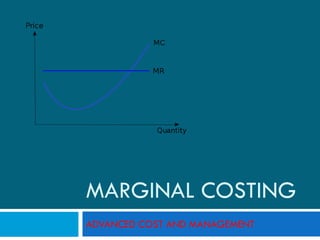
 It is the additional cost of producing an additional
unit of a product.
Marginal cost= prime cost + total variable
overheads
J. BATTY: ‘ a technique of cost accounting which pays
special attention to the behavior of costs with changes
in the volume of output’.
MARGINAL COSTING
ADVANCED COST AND MANAGEMENT
FEATURES OF MARGINAL COSTING
1) Control or decision making
2) Classification
3) Fixed cost
4) Variable cost
5) Contribution
6) Profitability
7) Ascertain profit
8) Cost-volume-profit relationship
ADVANTAGES
1. Simplicity
2. Stock valuation
3. Meaningful reporting
4. Effect of fixed costs
5. Profit planning
6. Cost control and cost reduction
7. Pricing Policy
8. Helpful to Management
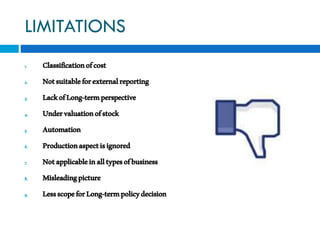
LIMITATIONS
1. Classificationofcost
2. Notsuitableforexternalreporting
3. LackofLong-termperspective
4. Undervaluationofstock
5. Automation
6. Productionaspectisignored
7. Notapplicableinalltypesofbusiness
8. Misleadingpicture
9. LessscopeforLong-termpolicydecision
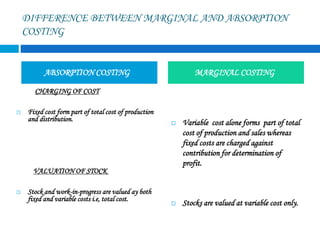
DIFFERENCE BETWEEN MARGINAL AND ABSORPTION
COSTING
CHARGING OF COST
 Fixed cost form part of total cost of production
and distribution.
VALUATION OF STOCK
 Stock and work-in-progress are valued ay both
fixed and variable costs i.e, total cost.
 Variable cost alone forms part of total
cost of production and sales whereas
fixed costs are charged against
contribution for determination of
profit.
 Stocks are valued at variable cost only.
ABSORPTION COSTING MARGINAL COSTING
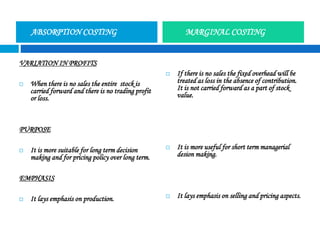
VARIATION IN PROFITS
 When there is no sales the entire stock is
carried forward and there is no trading profit
or loss.
PURPOSE
 It is more suitable for long term decision
making and for pricing policy over long term.
EMPHASIS
 It lays emphasis on production.
 If there is no sales the fixed overhead will be
treated as loss in the absence of contribution.
It is not carried forward as a part of stock
value.
 It is more useful for short term managerial
desion making.
 It lays emphasis on selling and pricing aspects.
ABSORPTION COSTING MARGINAL COSTING
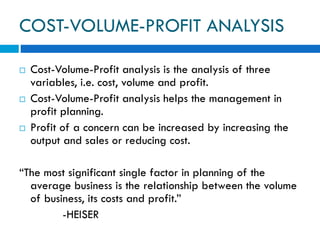
COST-VOLUME-PROFIT ANALYSIS
 Cost-Volume-Profit analysis is the analysis of three
variables, i.e. cost, volume and profit.
 Cost-Volume-Profit analysis helps the management in
profit planning.
 Profit of a concern can be increased by increasing the
output and sales or reducing cost.
“The most significant single factor in planning of the
average business is the relationship between the volume
of business, its costs and profit.”
-HEISER
OBJECTIVES
Cost-Volume-Profit analysis is made with the objective
of ascertaining the following:
 The cost for various levels of production
 The desirable volume of production
 The profit at various levels of production
 The difference between sales revenue and variable
cost.
CONCEPTS AND TERMS
1. FIXED COST
2. VARIABLE COST
3. CONTRIBUTION
4. CONTRIBUTION TO SALES/ PRROFIT VOLUME
RATIO
5. BREAK EVEN ANALYSIS
6. MARGIN OF SAFETY
7. ANGLE OF INCIDENCE
8. BREAK EVEN CHARTS
FIXED COST
 Total of cost like “period cost” or “time costs”
 Does not depend on volume of production and sales
 Fixed costs remain constant
 Fixed cost are fixed in total but variable in unit.
 Eg: salary rent, manager’s salary etc known as
fixed overheads
VARIABLE COST
 Increase or decrease in proportion to sales and
output.
 Called as ‘product costs’ or ‘marginal costs’
 Vary in direct proportion to output.
 Variable costs vary in total but they remain constant
per unit.
 Eg: direct material, direct wages etc
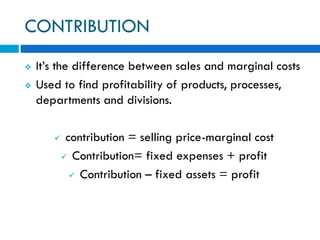
CONTRIBUTION
 It’s the difference between sales and marginal costs
 Used to find profitability of products, processes,
departments and divisions.
 contribution = selling price-marginal cost
 Contribution= fixed expenses + profit
 Contribution – fixed assets = profit
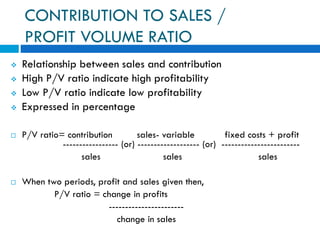
CONTRIBUTION TO SALES /
PROFIT VOLUME RATIO
 Relationship between sales and contribution
 High P/V ratio indicate high profitability
 Low P/V ratio indicate low profitability
 Expressed in percentage
 P/V ratio= contribution sales- variable fixed costs + profit
----------------- (or) ------------------- (or) ------------------------
sales sales sales
 When two periods, profit and sales given then,
P/V ratio = change in profits
-----------------------
change in sales
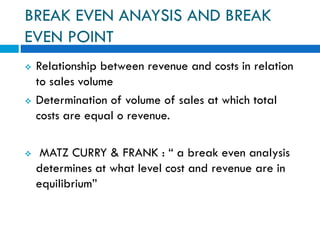
BREAK EVEN ANAYSIS AND BREAK
EVEN POINT
 Relationship between revenue and costs in relation
to sales volume
 Determination of volume of sales at which total
costs are equal o revenue.
 MATZ CURRY & FRANK : “ a break even analysis
determines at what level cost and revenue are in
equilibrium”
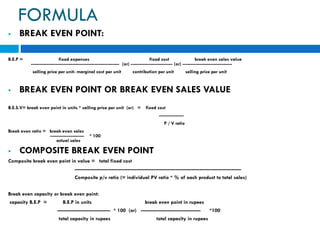
FORMULA
 BREAK EVEN POINT:
B.E.P = fixed expenses fixed cost break even sales value
--------------------------------------------------------- (or) --------------------------- (or) --------------------------------
selling price per unit- marginal cost per unit contribution per unit selling price per unit
 BREAK EVEN POINT OR BREAK EVEN SALES VALUE
B.E.S.V= break even point in units * salling price per unit (or) = fixed cost
----------------
P / V ratio
Break even ratio = break even sales
---------------------- * 100
actual sales
 COMPOSITE BREAK EVEN POINT
Composite break even point in value = total fixed cost
----------------------------------------------------------------------------------------------------
Composite p/v ratio (= individual PV ratio * % of each product to total sales)
Break even capacity or break even point:
capacity B.E.P = B.E.P in units break even point in rupees
-------------------------------- * 100 (or) ------------------------------------ *100
total capacity in rupees total capacity in rupees
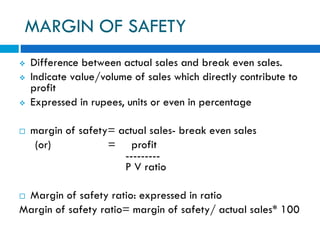
MARGIN OF SAFETY
 Difference between actual sales and break even sales.
 Indicate value/volume of sales which directly contribute to
profit
 Expressed in rupees, units or even in percentage
 margin of safety= actual sales- break even sales
(or) = profit
---------
P V ratio
 Margin of safety ratio: expressed in ratio
Margin of safety ratio= margin of safety/ actual sales* 100
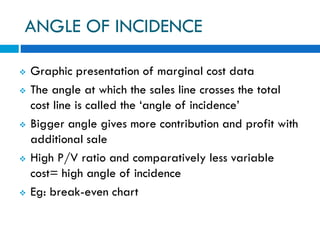
ANGLE OF INCIDENCE
 Graphic presentation of marginal cost data
 The angle at which the sales line crosses the total
cost line is called the ‘angle of incidence’
 Bigger angle gives more contribution and profit with
additional sale
 High P/V ratio and comparatively less variable
cost= high angle of incidence
 Eg: break-even chart
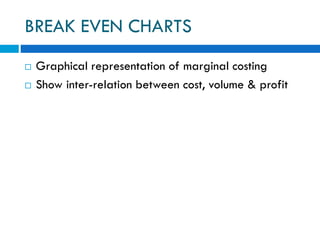
BREAK EVEN CHARTS
 Graphical representation of marginal costing
 Show inter-relation between cost, volume & profit
Thank u……..

Marginal costing

  • 1.
    MEANING & DEFINITION It is the additional cost of producing an additional unit of a product. Marginal cost= prime cost + total variable overheads J. BATTY: ‘ a technique of cost accounting which pays special attention to the behavior of costs with changes in the volume of output’.
  • 2.
  • 3.
    FEATURES OF MARGINALCOSTING 1) Control or decision making 2) Classification 3) Fixed cost 4) Variable cost 5) Contribution 6) Profitability 7) Ascertain profit 8) Cost-volume-profit relationship
  • 4.
    ADVANTAGES 1. Simplicity 2. Stockvaluation 3. Meaningful reporting 4. Effect of fixed costs 5. Profit planning 6. Cost control and cost reduction 7. Pricing Policy 8. Helpful to Management
  • 5.
    LIMITATIONS 1. Classificationofcost 2. Notsuitableforexternalreporting 3.LackofLong-termperspective 4. Undervaluationofstock 5. Automation 6. Productionaspectisignored 7. Notapplicableinalltypesofbusiness 8. Misleadingpicture 9. LessscopeforLong-termpolicydecision
  • 6.
    DIFFERENCE BETWEEN MARGINALAND ABSORPTION COSTING CHARGING OF COST  Fixed cost form part of total cost of production and distribution. VALUATION OF STOCK  Stock and work-in-progress are valued ay both fixed and variable costs i.e, total cost.  Variable cost alone forms part of total cost of production and sales whereas fixed costs are charged against contribution for determination of profit.  Stocks are valued at variable cost only. ABSORPTION COSTING MARGINAL COSTING
  • 7.
    VARIATION IN PROFITS When there is no sales the entire stock is carried forward and there is no trading profit or loss. PURPOSE  It is more suitable for long term decision making and for pricing policy over long term. EMPHASIS  It lays emphasis on production.  If there is no sales the fixed overhead will be treated as loss in the absence of contribution. It is not carried forward as a part of stock value.  It is more useful for short term managerial desion making.  It lays emphasis on selling and pricing aspects. ABSORPTION COSTING MARGINAL COSTING
  • 8.
    COST-VOLUME-PROFIT ANALYSIS  Cost-Volume-Profitanalysis is the analysis of three variables, i.e. cost, volume and profit.  Cost-Volume-Profit analysis helps the management in profit planning.  Profit of a concern can be increased by increasing the output and sales or reducing cost. “The most significant single factor in planning of the average business is the relationship between the volume of business, its costs and profit.” -HEISER
  • 9.
    OBJECTIVES Cost-Volume-Profit analysis ismade with the objective of ascertaining the following:  The cost for various levels of production  The desirable volume of production  The profit at various levels of production  The difference between sales revenue and variable cost.
  • 10.
    CONCEPTS AND TERMS 1.FIXED COST 2. VARIABLE COST 3. CONTRIBUTION 4. CONTRIBUTION TO SALES/ PRROFIT VOLUME RATIO 5. BREAK EVEN ANALYSIS 6. MARGIN OF SAFETY 7. ANGLE OF INCIDENCE 8. BREAK EVEN CHARTS
  • 11.
    FIXED COST  Totalof cost like “period cost” or “time costs”  Does not depend on volume of production and sales  Fixed costs remain constant  Fixed cost are fixed in total but variable in unit.  Eg: salary rent, manager’s salary etc known as fixed overheads
  • 12.
    VARIABLE COST  Increaseor decrease in proportion to sales and output.  Called as ‘product costs’ or ‘marginal costs’  Vary in direct proportion to output.  Variable costs vary in total but they remain constant per unit.  Eg: direct material, direct wages etc
  • 13.
    CONTRIBUTION  It’s thedifference between sales and marginal costs  Used to find profitability of products, processes, departments and divisions.  contribution = selling price-marginal cost  Contribution= fixed expenses + profit  Contribution – fixed assets = profit
  • 14.
    CONTRIBUTION TO SALES/ PROFIT VOLUME RATIO  Relationship between sales and contribution  High P/V ratio indicate high profitability  Low P/V ratio indicate low profitability  Expressed in percentage  P/V ratio= contribution sales- variable fixed costs + profit ----------------- (or) ------------------- (or) ------------------------ sales sales sales  When two periods, profit and sales given then, P/V ratio = change in profits ----------------------- change in sales
  • 15.
    BREAK EVEN ANAYSISAND BREAK EVEN POINT  Relationship between revenue and costs in relation to sales volume  Determination of volume of sales at which total costs are equal o revenue.  MATZ CURRY & FRANK : “ a break even analysis determines at what level cost and revenue are in equilibrium”
  • 16.
    FORMULA  BREAK EVENPOINT: B.E.P = fixed expenses fixed cost break even sales value --------------------------------------------------------- (or) --------------------------- (or) -------------------------------- selling price per unit- marginal cost per unit contribution per unit selling price per unit  BREAK EVEN POINT OR BREAK EVEN SALES VALUE B.E.S.V= break even point in units * salling price per unit (or) = fixed cost ---------------- P / V ratio Break even ratio = break even sales ---------------------- * 100 actual sales  COMPOSITE BREAK EVEN POINT Composite break even point in value = total fixed cost ---------------------------------------------------------------------------------------------------- Composite p/v ratio (= individual PV ratio * % of each product to total sales) Break even capacity or break even point: capacity B.E.P = B.E.P in units break even point in rupees -------------------------------- * 100 (or) ------------------------------------ *100 total capacity in rupees total capacity in rupees
  • 17.
    MARGIN OF SAFETY Difference between actual sales and break even sales.  Indicate value/volume of sales which directly contribute to profit  Expressed in rupees, units or even in percentage  margin of safety= actual sales- break even sales (or) = profit --------- P V ratio  Margin of safety ratio: expressed in ratio Margin of safety ratio= margin of safety/ actual sales* 100
  • 18.
    ANGLE OF INCIDENCE Graphic presentation of marginal cost data  The angle at which the sales line crosses the total cost line is called the ‘angle of incidence’  Bigger angle gives more contribution and profit with additional sale  High P/V ratio and comparatively less variable cost= high angle of incidence  Eg: break-even chart
  • 19.
    BREAK EVEN CHARTS Graphical representation of marginal costing  Show inter-relation between cost, volume & profit
  • 20.