MARGINAL COSTING
Costing:
❖ Methods, Techniques, and Principles used to ascertain cost is known as
costing.
Absorption costing:
❖ Technique in which entire cost is taken into account while calculating cost
of the product, service, process, job etc.,
❖ Cost is classified as direct cost and indirect cost.
❖ Direct cost can be allocated on the other hand indirect cost cannot be
allocated but it can be apportioned or absorbed.
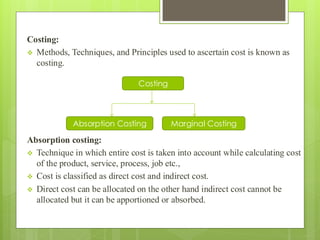
Costing
Absorption Costing Marginal Costing
Marginal Cost
❖ According to economist point of view the term marginal cost, is the cost of
producing an extra unit of output.
❖ In other words, it is the amount by which total cost increases when one extra
unit is produced.
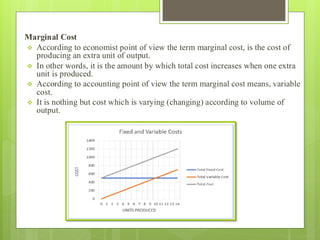
❖ According to accounting point of view the term marginal cost means, variable
cost.
❖ It is nothing but cost which is varying (changing) according to volume of
output.
Marginal Costing:
❖ Marginal costing is a cost accounting technique of product costing
and decision making.
❖ In the case of marginal costing, cost is ascertained by differentiating
between fixed and variable costs, and charging cost units only with
variable costs.
Definition:
❖ According to the ICMA, London, Marginal cost represents “the
amount of any given volume of output by which aggregate costs are
changed if the volume of output is increased by one unit”.
Features of Marginal Costing:
❖ It is a cost accounting system.
❖ It is evolved to ascertain the cost of products, services or activities.
❖ It distinguishes clearly between fixed costs and variable costs.
❖ Under this system only variable costs are charged to cost units.
❖ Fixed costs, which are treated as period costs, are written off in full against the
aggregate contribution.
❖ Work-in-progress and finished goods inventories are valued at variable cost.
❖ Sales minus variable cost are contribution, which is the index of profitability of
each product line.
❖ Contribution minus fixed cost gives us net profit.
❖ Besides being a technique of product costing, it is also a tool of decision
making.
Cost-Volume-Profit Analysis
Meaning:
 Cost-Volume-Profit analysis is the analysis of three variables Viz., Cost,
Volume and Profit.
 This analysis measures variations of costs and volumes and their impact
on profit.
 Profit is affected by several internal and external factors which influence
sales revenue and costs.
 Its helps the management in profit planning.
 Profit of a concern can be increased by increasing the output and sales or
reducing cost.
 If a concern produces to the maximum capacity and sell, contribution is
also increased to the maximum level.
Definition:
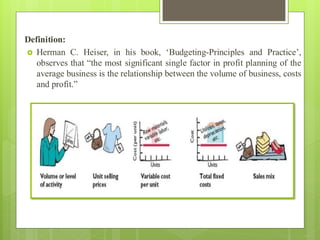
 Herman C. Heiser, in his book, ‘Budgeting-Principles and Practice’,
observes that “the most significant single factor in profit planning of the
average business is the relationship between the volume of business, costs
and profit.”
Assumptions Underlying CVPAnalysis:
 CVP analysis, which is an important tool of profit planning, is based on
the following assumptions:
 Costs can be segregated into their fixed and variable components;
 Variable cost per unit is constant;
 The analysis is restricted to a short period of one year or less;
 Total fixed cost is constant up to the existing capacity;
 Selling price per unit is also constant;
 Costs and revenue are influenced by the volume of output and sales;
 Production efficiency remains the same;
 Stocks are valued at variable cost; and
 Overheads are treated as period costs.
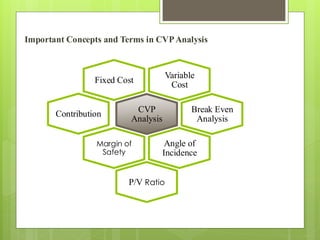
Important Concepts and Terms in CVPAnalysis
Variable
Cost
Fixed Cost
CVP
Analysis
Break Even
Analysis
Angle of
Incidence
Margin of
Safety
P/V Ratio
Contribution
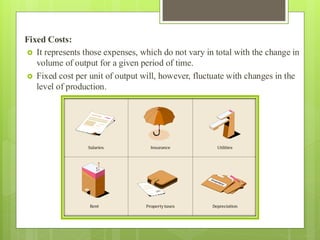
Fixed Costs:
 It represents those expenses, which do not vary in total with the change in
volume of output for a given period of time.
 Fixed cost per unit of output will, however, fluctuate with changes in the
level of production.
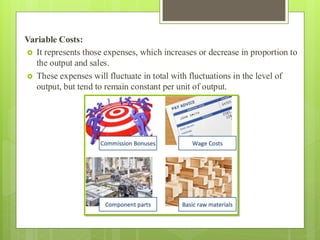
Variable Costs:
 It represents those expenses, which increases or decrease in proportion to
the output and sales.
 These expenses will fluctuate in total with fluctuations in the level of
output, but tend to remain constant per unit of output.
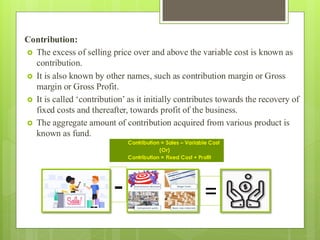
Contribution:
 The excess of selling price over and above the variable cost is known as
contribution.
 It is also known by other names, such as contribution margin or Gross
margin or Gross Profit.
 It is called ‘contribution’ as it initially contributes towards the recovery of
fixed costs and thereafter, towards profit of the business.
 The aggregate amount of contribution acquired from various product is
known as fund.
Contribution = Sales – Variable Cost
(Or)
Contribution = Fixed Cost + Profit
- =
Break even Analysis:
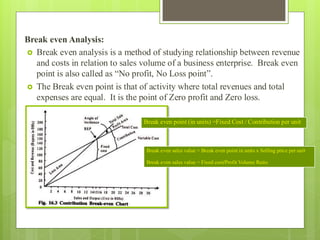
 Break even analysis is a method of studying relationship between revenue
and costs in relation to sales volume of a business enterprise. Break even
point is also called as “No profit, No Loss point”.
 The Break even point is that of activity where total revenues and total
expenses are equal. It is the point of Zero profit and Zero loss.
Break even point (in units) =Fixed Cost / Contribution per unit
Break even sales value = Break even point in units x Selling price per unit
Break even sales value = Fixed cost/Profit Volume Ratio
Margin of safety:
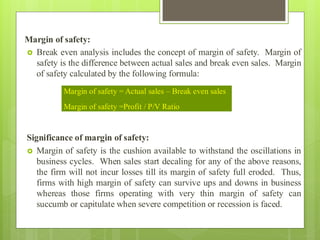
 Break even analysis includes the concept of margin of safety. Margin of
safety is the difference between actual sales and break even sales. Margin
of safety calculated by the following formula:
Significance of margin of safety:
 Margin of safety is the cushion available to withstand the oscillations in
business cycles. When sales start decaling for any of the above reasons,
the firm will not incur losses till its margin of safety full eroded. Thus,
firms with high margin of safety can survive ups and downs in business
whereas those firms operating with very thin margin of safety can
succumb or capitulate when severe competition or recession is faced.
Margin of safety = Actual sales – Break even sales
Margin of safety =Profit / P/V Ratio
Angle of Incidence:
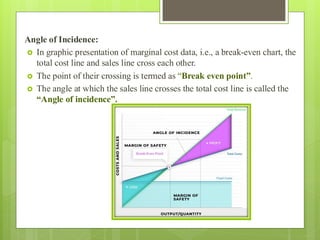
 In graphic presentation of marginal cost data, i.e., a break-even chart, the
total cost line and sales line cross each other.
 The point of their crossing is termed as “Break even point”.
 The angle at which the sales line crosses the total cost line is called the
“Angle of incidence”.
Profit/Volume ratio:
❖ P/V ratio is the ratio or percentage of contribution
margin to sales.
❖ P/V ratio is also known as marginal income ratio,
contribution to sales ratio or variable profit ratio.
❖ The profit volume ratio usually expressed in percentage
is the rate at which profit increases with the increase in the volume.
P/V ratio = Contribution/Sales*100
P/V ratio = Changes in Profit/Changes in sales *100
Marginal Costing - Meaning, Features, Important Concepts

Marginal Costing - Meaning, Features, Important Concepts

  • 1.
  • 2.
    Costing: ❖ Methods, Techniques,and Principles used to ascertain cost is known as costing. Absorption costing: ❖ Technique in which entire cost is taken into account while calculating cost of the product, service, process, job etc., ❖ Cost is classified as direct cost and indirect cost. ❖ Direct cost can be allocated on the other hand indirect cost cannot be allocated but it can be apportioned or absorbed. Costing Absorption Costing Marginal Costing
  • 3.
    Marginal Cost ❖ Accordingto economist point of view the term marginal cost, is the cost of producing an extra unit of output. ❖ In other words, it is the amount by which total cost increases when one extra unit is produced. ❖ According to accounting point of view the term marginal cost means, variable cost. ❖ It is nothing but cost which is varying (changing) according to volume of output.
  • 4.
    Marginal Costing: ❖ Marginalcosting is a cost accounting technique of product costing and decision making. ❖ In the case of marginal costing, cost is ascertained by differentiating between fixed and variable costs, and charging cost units only with variable costs. Definition: ❖ According to the ICMA, London, Marginal cost represents “the amount of any given volume of output by which aggregate costs are changed if the volume of output is increased by one unit”.
  • 5.
    Features of MarginalCosting: ❖ It is a cost accounting system. ❖ It is evolved to ascertain the cost of products, services or activities. ❖ It distinguishes clearly between fixed costs and variable costs. ❖ Under this system only variable costs are charged to cost units. ❖ Fixed costs, which are treated as period costs, are written off in full against the aggregate contribution. ❖ Work-in-progress and finished goods inventories are valued at variable cost. ❖ Sales minus variable cost are contribution, which is the index of profitability of each product line. ❖ Contribution minus fixed cost gives us net profit. ❖ Besides being a technique of product costing, it is also a tool of decision making.
  • 6.
    Cost-Volume-Profit Analysis Meaning:  Cost-Volume-Profitanalysis is the analysis of three variables Viz., Cost, Volume and Profit.  This analysis measures variations of costs and volumes and their impact on profit.  Profit is affected by several internal and external factors which influence sales revenue and costs.  Its helps the management in profit planning.  Profit of a concern can be increased by increasing the output and sales or reducing cost.  If a concern produces to the maximum capacity and sell, contribution is also increased to the maximum level.
  • 7.
    Definition:  Herman C.Heiser, in his book, ‘Budgeting-Principles and Practice’, observes that “the most significant single factor in profit planning of the average business is the relationship between the volume of business, costs and profit.”
  • 8.
    Assumptions Underlying CVPAnalysis: CVP analysis, which is an important tool of profit planning, is based on the following assumptions:  Costs can be segregated into their fixed and variable components;  Variable cost per unit is constant;  The analysis is restricted to a short period of one year or less;  Total fixed cost is constant up to the existing capacity;  Selling price per unit is also constant;  Costs and revenue are influenced by the volume of output and sales;  Production efficiency remains the same;  Stocks are valued at variable cost; and  Overheads are treated as period costs.
  • 9.
    Important Concepts andTerms in CVPAnalysis Variable Cost Fixed Cost CVP Analysis Break Even Analysis Angle of Incidence Margin of Safety P/V Ratio Contribution
  • 10.
    Fixed Costs:  Itrepresents those expenses, which do not vary in total with the change in volume of output for a given period of time.  Fixed cost per unit of output will, however, fluctuate with changes in the level of production.
  • 11.
    Variable Costs:  Itrepresents those expenses, which increases or decrease in proportion to the output and sales.  These expenses will fluctuate in total with fluctuations in the level of output, but tend to remain constant per unit of output.
  • 12.
    Contribution:  The excessof selling price over and above the variable cost is known as contribution.  It is also known by other names, such as contribution margin or Gross margin or Gross Profit.  It is called ‘contribution’ as it initially contributes towards the recovery of fixed costs and thereafter, towards profit of the business.  The aggregate amount of contribution acquired from various product is known as fund. Contribution = Sales – Variable Cost (Or) Contribution = Fixed Cost + Profit - =
  • 13.
    Break even Analysis: Break even analysis is a method of studying relationship between revenue and costs in relation to sales volume of a business enterprise. Break even point is also called as “No profit, No Loss point”.  The Break even point is that of activity where total revenues and total expenses are equal. It is the point of Zero profit and Zero loss. Break even point (in units) =Fixed Cost / Contribution per unit Break even sales value = Break even point in units x Selling price per unit Break even sales value = Fixed cost/Profit Volume Ratio
  • 14.
    Margin of safety: Break even analysis includes the concept of margin of safety. Margin of safety is the difference between actual sales and break even sales. Margin of safety calculated by the following formula: Significance of margin of safety:  Margin of safety is the cushion available to withstand the oscillations in business cycles. When sales start decaling for any of the above reasons, the firm will not incur losses till its margin of safety full eroded. Thus, firms with high margin of safety can survive ups and downs in business whereas those firms operating with very thin margin of safety can succumb or capitulate when severe competition or recession is faced. Margin of safety = Actual sales – Break even sales Margin of safety =Profit / P/V Ratio
  • 15.
    Angle of Incidence: In graphic presentation of marginal cost data, i.e., a break-even chart, the total cost line and sales line cross each other.  The point of their crossing is termed as “Break even point”.  The angle at which the sales line crosses the total cost line is called the “Angle of incidence”.
  • 16.
    Profit/Volume ratio: ❖ P/Vratio is the ratio or percentage of contribution margin to sales. ❖ P/V ratio is also known as marginal income ratio, contribution to sales ratio or variable profit ratio. ❖ The profit volume ratio usually expressed in percentage is the rate at which profit increases with the increase in the volume. P/V ratio = Contribution/Sales*100 P/V ratio = Changes in Profit/Changes in sales *100