Presented by
B.Sai kiran
(12NA1E0036)
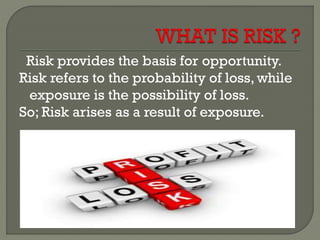
Risk provides the basis for opportunity.
Risk refers to the probability of loss, while
exposure is the possibility of loss.
So; Risk arises as a result of exposure.
In a global market place, there are many
opportunities for risk.
Losses may not be limited to one
geographical or domestic market.
4
 A risk is a potential problem – it might happen and it
might not
 Conceptual definition of risk
• Risk concerns future happenings
• Risk involves change in mind, opinion, actions, places,
etc.
• Risk involves choice and the uncertainty that choice
entails
 Two characteristics of risk
• Uncertainty – the risk may or may not happen, that is,
there are no 100% risks (those, instead, are called
constraints)
• Loss – the risk becomes a reality and unwanted
consequences or losses occur
Many risk management initiatives such as
credit risk, settlement and payment
system initiatives have been introduced
by or for financial institutions.
Several major international initiatives
have been undertaken to reduce
financial risk and systemic risk.
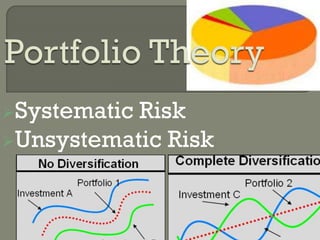
Systematic Risk
Unsystematic Risk
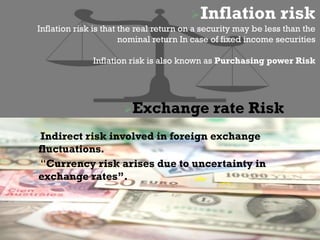
Inflation risk
Inflation risk is that the real return on a security may be less than the
nominal return In case of fixed income securities
Inflation risk is also known as Purchasing power Risk
Exchange rate Risk
Indirect risk involved in foreign exchange
fluctuations.
“Currency risk arises due to uncertainty in
exchange rates”.
Business Risk
As a holder of corporate securities (shares
and debentures), large population is
exposed to the risk of poor partners
performance.
Political Risk
Political risk may be defined as the probability
that a political event will impact adversely on a
firm’s profit
 Sub-categories of Business risks
• Market risk – building an excellent product or
system that no one really wants
• Strategic risk – building a product that no longer fits
into the overall business strategy for the company
• Sales risk – building a product that the sales force
doesn't understand how to sell
• Management risk – losing the support of senior
management due to a change in focus or a change in
people
• Budget risk – losing budgetary or personnel
commitment
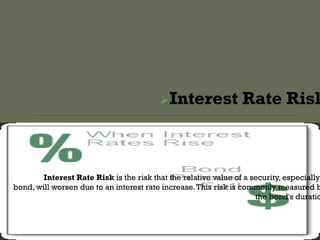
Interest Rate Risk
Interest Rate Risk is the risk that the relative value of a security, especially
bond, will worsen due to an interest rate increase.This risk is commonly measured b
the bond's duratio
Liquidity Risk
1.A temporary inability to convert assets to cash
2.Operational difficulties of various kinds
3.The inability of correspondents to perform settlement
functions
Maturity Risk:
IT IS TOTALLY DEPEND ON MATURITY PERIOD RELATED TO ANY
TRANSACTION:
Credit exposure exists within most
organizations, but it is especially
significant major financial institutions.
One of the most fundemental aspect of
credit risk management is the careful
selection of counterparty.
13
1) Identify possible risks; recognize what can go
wrong
2) Analyze each risk to estimate the probability
that it will occur and the impact (i.e.,
damage) that it will do if it does occur
3) Rank the risks by probability and impact
- Impact may be negligible, marginal,
critical, and catastrophic
4) Develop a contingency plan to manage those
risks having high probability and high
impact
I CONCLUDE THAT RISK IS ALWAYS A
DANDEROUS FACTOR IN BUSINESS BUT
AT SOME TIMES BY TAKING RISK LEADS
TO SUCCESS ALSO ALL WOULD HAPPEN
BASING ON EXPERIENCE.
Risk  types

Risk types

  • 1.
  • 2.
    Risk provides thebasis for opportunity. Risk refers to the probability of loss, while exposure is the possibility of loss. So; Risk arises as a result of exposure.
  • 3.
    In a globalmarket place, there are many opportunities for risk. Losses may not be limited to one geographical or domestic market.
  • 4.
    4  A riskis a potential problem – it might happen and it might not  Conceptual definition of risk • Risk concerns future happenings • Risk involves change in mind, opinion, actions, places, etc. • Risk involves choice and the uncertainty that choice entails  Two characteristics of risk • Uncertainty – the risk may or may not happen, that is, there are no 100% risks (those, instead, are called constraints) • Loss – the risk becomes a reality and unwanted consequences or losses occur
  • 5.
    Many risk managementinitiatives such as credit risk, settlement and payment system initiatives have been introduced by or for financial institutions. Several major international initiatives have been undertaken to reduce financial risk and systemic risk.
  • 6.
  • 7.
    Inflation risk Inflation riskis that the real return on a security may be less than the nominal return In case of fixed income securities Inflation risk is also known as Purchasing power Risk Exchange rate Risk Indirect risk involved in foreign exchange fluctuations. “Currency risk arises due to uncertainty in exchange rates”.
  • 8.
    Business Risk As aholder of corporate securities (shares and debentures), large population is exposed to the risk of poor partners performance. Political Risk Political risk may be defined as the probability that a political event will impact adversely on a firm’s profit
  • 9.
     Sub-categories ofBusiness risks • Market risk – building an excellent product or system that no one really wants • Strategic risk – building a product that no longer fits into the overall business strategy for the company • Sales risk – building a product that the sales force doesn't understand how to sell • Management risk – losing the support of senior management due to a change in focus or a change in people • Budget risk – losing budgetary or personnel commitment
  • 10.
    Interest Rate Risk InterestRate Risk is the risk that the relative value of a security, especially bond, will worsen due to an interest rate increase.This risk is commonly measured b the bond's duratio
  • 11.
    Liquidity Risk 1.A temporaryinability to convert assets to cash 2.Operational difficulties of various kinds 3.The inability of correspondents to perform settlement functions Maturity Risk: IT IS TOTALLY DEPEND ON MATURITY PERIOD RELATED TO ANY TRANSACTION:
  • 12.
    Credit exposure existswithin most organizations, but it is especially significant major financial institutions. One of the most fundemental aspect of credit risk management is the careful selection of counterparty.
  • 13.
    13 1) Identify possiblerisks; recognize what can go wrong 2) Analyze each risk to estimate the probability that it will occur and the impact (i.e., damage) that it will do if it does occur 3) Rank the risks by probability and impact - Impact may be negligible, marginal, critical, and catastrophic 4) Develop a contingency plan to manage those risks having high probability and high impact
  • 14.
    I CONCLUDE THATRISK IS ALWAYS A DANDEROUS FACTOR IN BUSINESS BUT AT SOME TIMES BY TAKING RISK LEADS TO SUCCESS ALSO ALL WOULD HAPPEN BASING ON EXPERIENCE.