FOREIGN 
MANUFACTURING 
STRATEGIES WITHOUT 
DIRECT INVESTMENT 
PRESENTED BY 
B.SAI KIRAN 
(12NA1E0036)
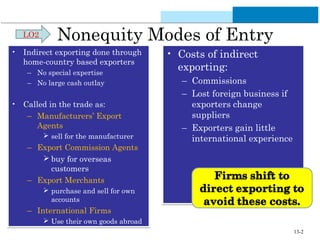
Nonequity Modes of Entry 
• Indirect exporting done through 
home-country based exporters 
– No special expertise 
– No large cash outlay 
• Called in the trade as: 
– Manufacturers’ Export 
Agents 
 sell for the manufacturer 
– Export Commission Agents 
 buy for overseas 
customers 
– Export Merchants 
 purchase and sell for own 
accounts 
– International Firms 
 Use their own goods abroad 
• Costs of indirect 
exporting: 
– Commissions 
– Lost foreign business if 
exporters change 
suppliers 
– Exporters gain little 
international experience 
LO2 
13-2
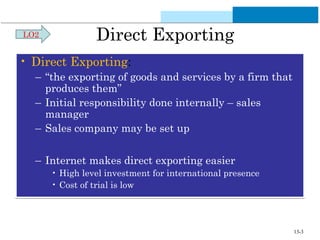
Direct Exporting 
• Direct Exporting: 
– “the exporting of goods and services by a firm that 
produces them” 
– Initial responsibility done internally – sales 
manager 
– Sales company may be set up 
– Internet makes direct exporting easier 
• High level investment for international presence 
• Cost of trial is low 
LO2 
13-3
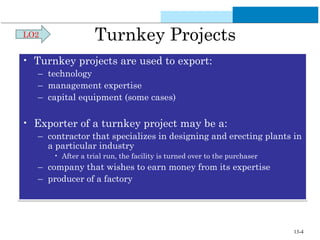
Turnkey Projects 
LO2 
• Turnkey projects are used to export: 
– technology 
– management expertise 
– capital equipment (some cases) 
• Exporter of a turnkey project may be a: 
– contractor that specializes in designing and erecting plants in 
a particular industry 
• After a trial run, the facility is turned over to the purchaser 
– company that wishes to earn money from its expertise 
– producer of a factory 
13-4
Licensing 
LO2 
• Licensing 
– “a contractual arrangement in which one firm (licensor) grants 
access to its patents, trade secrets, or technology to another (licensee) 
for a fee” 
– Licensee pays fixed sum and sales royalties (2%-5%) over life of 
contract with renewal option 
• Anything can be licensed – technology, brand & 
manufacturer names, logos, symbols, colors 
• Licensing is attractive because: 
– courts have begun upholding patent infringement claims 
– patent holders have started suing violators 
– foreign governments have begun enforcement of their patent laws 
• A Licensee may become a competitor! 
13-5
Piracy 
• Patent Infringement 
• Intellectual property 
protection: 
– courts have begun 
upholding patent 
infringement claims 
– patent holders have 
started suing violators 
– foreign governments have 
begun enforcement of 
their patent laws 
• Traditional Piracy 
– Attack on defenseless sailing 
vessels, theft of cargo and/or 
ship on the high seas 
• Pirates can be: 
– International terrorists 
– Organized crime 
– Poor local fisherman 
• Locations: 
– Waters around Indonesia, 
Nigeria, Somalia, 
Bangladesh & Caribbean 
LO3 
13-6
Franchising 
• Franchising: 
– “a form of licensing in which one firm contracts 
with another to operate a business under an 
established name according to specific rules” 
• The franchisee gets: 
– Publicized brand name 
– Well-known set of procedures 
– carefully developed & controlled controlled 
marketing plan 
LO2 
13-7
Management Contract 
LO2 
• Management Contract 
– “An arrangement by which one firm provides 
management in all or specific areas to another firm” 
– Typical fee is 2-5% of annual sales and tax 
deductable 
• MNCs make contracts with: 
– Other firms with no ownership interest 
– Joint venture partners 
– Wholly owned subsidiaries 
13-8
Contract Manufacturing 
• Contract Manufacturing 
– “An arrangement in which one firm contracts with 
another to produce products to its specifications but 
assumes responsibility for marketing” 
• Other types of: 
– Subcontract assembly or parts production 
– Lend capital to 3rd party foreign contractor 
•Called “foreign direct investment without 
investment” 
LO2 
13-9
Equity-Based Modes of Entry 
1. Wholly Owned 
Subsidiary 
2. Joint Venture 
3. Strategic Alliances 
• Wholly Owned 
Subsidiary 
1. Start from the ground up by 
building a new plant 
(greenfield investment) 
2. Acquire a going concern 
3. Purchase its distributor to 
obtain a distribution network 
familiar with its products 
LO2 
13-10
Joint Venture 
1. Joint Venture 
– “A cooperative effort 
among two or more 
organizations that 
share a common 
interest in a business 
enterprise or 
undertaking” 
1. A corporate entity formed by 
an international company 
and local owners; 
2. A corporate entity formed by 
two international companies 
for the purpose of doing 
business in a third market; 
3. A corporate entity formed by 
a government agency 
(usually in the country of 
investment) and an 
international firm; or 
4. A cooperative undertaking 
between two or more firms 
of a limited-duration project. 
LO2 
13-11
Issues with Venture Ventures 
• Strong nationalism 
• Expertise, tax & other benefits 
• Disadvantages: 
– Shared profits 
– Minority ownership position 
– Difficulty in share distribution to allow minority 
owner to be largest stockholder 
– Lack of control 
– Local law requiring local majority ownership 
– Joint venture control through management 
contracts 
LO2 
13-12
Strategic Alliances 
• Strategic Alliances 
– “partnerships between or 
among competitors, 
customers, or suppliers that 
may take one or more various 
forms, both equity and 
nonequity” 
• Goals of Strategic 
Alliances: 
– Faster market entry and 
start-up 
– Access to new products, 
technologies, and markets 
– Cost-savings by sharing 
costs, resources, and risks 
• Issues with Strategic 
Alliances: 
– Alliances may be Joint 
Ventures 
– Pooling versus Trading 
Alliances 
– Alliances versus Mergers 
and Acquisitions 
– Future of Alliances 
LO2 
13-13
Issues with Strategic Alliances 
• Strategic Alliances may be Joint Ventures 
– In manufacturing and marketing 
• Pooling versus Trading Alliances 
– Pooling Alliances – driven by similarity and integration 
– Trading Alliances –driven by the logic of contributing dissimilar resources 
– Fundamental differences: 
• Goals (common vs. compatible) 
• Optimal resources (many vs. few partners) 
• Managerial challenges (low vs. high coordination needs) 
• Alliances versus Mergers and Acquisitions 
– Mergers and acquisitions not considered alliances, but ways to access new 
technology 
• Future of Alliances 
– Many fail or are taken over by a partner 
– Difficult to manage due to different strategies, operating practices, and 
organizational cultures 
– Partner may acquire technological or other competencies and become 
competitor 
LO2 
13-14
Reasons to Export 
LO4 
• To serve markets where the firm has no or limited production 
facilities. 
• To satisfy a host government’s requirements that the local 
subsidiary have exports. 
• To remain price competitive in the home market. 
• To test foreign markets and foreign competition inexpensively. 
• To meet actual or prospective customer requests for the firm to 
export. 
• To offset cyclical sales in the domestic market. 
13-15
CONCLUSION: 
• FINALLY I CONCLUDE THAT 
FOREIGN MANUFACTURING 
STRATEGIES WITHOUT DIRECT 
INVESTMENT LEADS TO HAVE 
IMPACT ON OUR OWN COUNTRY 
RESOURCES AND NON-DEVELOPMENT.

foreign manufacturing stratagies

  • 1.
    FOREIGN MANUFACTURING STRATEGIESWITHOUT DIRECT INVESTMENT PRESENTED BY B.SAI KIRAN (12NA1E0036)
  • 2.
    Nonequity Modes ofEntry • Indirect exporting done through home-country based exporters – No special expertise – No large cash outlay • Called in the trade as: – Manufacturers’ Export Agents  sell for the manufacturer – Export Commission Agents  buy for overseas customers – Export Merchants  purchase and sell for own accounts – International Firms  Use their own goods abroad • Costs of indirect exporting: – Commissions – Lost foreign business if exporters change suppliers – Exporters gain little international experience LO2 13-2
  • 3.
    Direct Exporting •Direct Exporting: – “the exporting of goods and services by a firm that produces them” – Initial responsibility done internally – sales manager – Sales company may be set up – Internet makes direct exporting easier • High level investment for international presence • Cost of trial is low LO2 13-3
  • 4.
    Turnkey Projects LO2 • Turnkey projects are used to export: – technology – management expertise – capital equipment (some cases) • Exporter of a turnkey project may be a: – contractor that specializes in designing and erecting plants in a particular industry • After a trial run, the facility is turned over to the purchaser – company that wishes to earn money from its expertise – producer of a factory 13-4
  • 5.
    Licensing LO2 •Licensing – “a contractual arrangement in which one firm (licensor) grants access to its patents, trade secrets, or technology to another (licensee) for a fee” – Licensee pays fixed sum and sales royalties (2%-5%) over life of contract with renewal option • Anything can be licensed – technology, brand & manufacturer names, logos, symbols, colors • Licensing is attractive because: – courts have begun upholding patent infringement claims – patent holders have started suing violators – foreign governments have begun enforcement of their patent laws • A Licensee may become a competitor! 13-5
  • 6.
    Piracy • PatentInfringement • Intellectual property protection: – courts have begun upholding patent infringement claims – patent holders have started suing violators – foreign governments have begun enforcement of their patent laws • Traditional Piracy – Attack on defenseless sailing vessels, theft of cargo and/or ship on the high seas • Pirates can be: – International terrorists – Organized crime – Poor local fisherman • Locations: – Waters around Indonesia, Nigeria, Somalia, Bangladesh & Caribbean LO3 13-6
  • 7.
    Franchising • Franchising: – “a form of licensing in which one firm contracts with another to operate a business under an established name according to specific rules” • The franchisee gets: – Publicized brand name – Well-known set of procedures – carefully developed & controlled controlled marketing plan LO2 13-7
  • 8.
    Management Contract LO2 • Management Contract – “An arrangement by which one firm provides management in all or specific areas to another firm” – Typical fee is 2-5% of annual sales and tax deductable • MNCs make contracts with: – Other firms with no ownership interest – Joint venture partners – Wholly owned subsidiaries 13-8
  • 9.
    Contract Manufacturing •Contract Manufacturing – “An arrangement in which one firm contracts with another to produce products to its specifications but assumes responsibility for marketing” • Other types of: – Subcontract assembly or parts production – Lend capital to 3rd party foreign contractor •Called “foreign direct investment without investment” LO2 13-9
  • 10.
    Equity-Based Modes ofEntry 1. Wholly Owned Subsidiary 2. Joint Venture 3. Strategic Alliances • Wholly Owned Subsidiary 1. Start from the ground up by building a new plant (greenfield investment) 2. Acquire a going concern 3. Purchase its distributor to obtain a distribution network familiar with its products LO2 13-10
  • 11.
    Joint Venture 1.Joint Venture – “A cooperative effort among two or more organizations that share a common interest in a business enterprise or undertaking” 1. A corporate entity formed by an international company and local owners; 2. A corporate entity formed by two international companies for the purpose of doing business in a third market; 3. A corporate entity formed by a government agency (usually in the country of investment) and an international firm; or 4. A cooperative undertaking between two or more firms of a limited-duration project. LO2 13-11
  • 12.
    Issues with VentureVentures • Strong nationalism • Expertise, tax & other benefits • Disadvantages: – Shared profits – Minority ownership position – Difficulty in share distribution to allow minority owner to be largest stockholder – Lack of control – Local law requiring local majority ownership – Joint venture control through management contracts LO2 13-12
  • 13.
    Strategic Alliances •Strategic Alliances – “partnerships between or among competitors, customers, or suppliers that may take one or more various forms, both equity and nonequity” • Goals of Strategic Alliances: – Faster market entry and start-up – Access to new products, technologies, and markets – Cost-savings by sharing costs, resources, and risks • Issues with Strategic Alliances: – Alliances may be Joint Ventures – Pooling versus Trading Alliances – Alliances versus Mergers and Acquisitions – Future of Alliances LO2 13-13
  • 14.
    Issues with StrategicAlliances • Strategic Alliances may be Joint Ventures – In manufacturing and marketing • Pooling versus Trading Alliances – Pooling Alliances – driven by similarity and integration – Trading Alliances –driven by the logic of contributing dissimilar resources – Fundamental differences: • Goals (common vs. compatible) • Optimal resources (many vs. few partners) • Managerial challenges (low vs. high coordination needs) • Alliances versus Mergers and Acquisitions – Mergers and acquisitions not considered alliances, but ways to access new technology • Future of Alliances – Many fail or are taken over by a partner – Difficult to manage due to different strategies, operating practices, and organizational cultures – Partner may acquire technological or other competencies and become competitor LO2 13-14
  • 15.
    Reasons to Export LO4 • To serve markets where the firm has no or limited production facilities. • To satisfy a host government’s requirements that the local subsidiary have exports. • To remain price competitive in the home market. • To test foreign markets and foreign competition inexpensively. • To meet actual or prospective customer requests for the firm to export. • To offset cyclical sales in the domestic market. 13-15
  • 16.
    CONCLUSION: • FINALLYI CONCLUDE THAT FOREIGN MANUFACTURING STRATEGIES WITHOUT DIRECT INVESTMENT LEADS TO HAVE IMPACT ON OUR OWN COUNTRY RESOURCES AND NON-DEVELOPMENT.