BAL BHARTHI’s M J PANCHOLIA COLLEGE OF COMMERECE
SUBMITTED TO:- PROF. AARTI CHIKALTOPIC:- MARGINAL COSTING
NAME					ROLLNOZEEL MATHKIYA 				13DHARMIK MEHTA  				14SEJAL MEHTA 				15HIRNI MEWADA  				16VARUN MODI				17SIDDHI NALAWADE 				18MEMBERS PRESENTING
Introduction				Definition					Features					Advantages				Disadvantages				Break Even Point				Profit Volume Ratio				CONTENTS
NHC Food Ltd.				Practical BEP Example			Practical PV Ratio Example		Conclusion				CONTI….
 It divides the cost
 The costs are Fixed & VariableINTRODUCTON
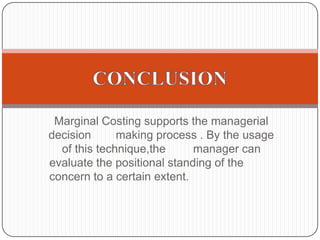
     Marginal costing distinguishes between fixed costs and variable costs as convention ally classified        Marginal costing is formally defined as:‘the accounting system in which variable costs are charged to cost units and the fixed costs of the period are written-off in full against the aggregate contribution. Its special value is in decision making’.DEFINITION
The term ‘contribution’ mentioned in the formal definition is the term given to the difference between Sales and Marginal cost. Thus MARGINAL COST =VARIABLE COST DIRECT LABOUR+DIRECT MATERIAL+DIRECT EXPENSE+VARIABLE OVERHEADS CONTI…..
 Cost Classification
 Stock Valuation
Marginal Contribution				FEATURES
 Cost Control
 Simplicity
 Short – Term Profit Planning
 Maximum Return To Business		ADVANTAGES
 Misleading Results
 Avoids Semi – Variable Costs
 Distorted Picture Of Profits
 Ignorance Of Time Factor			DISADVANTAGES
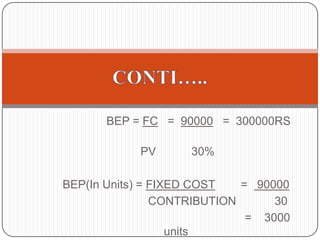
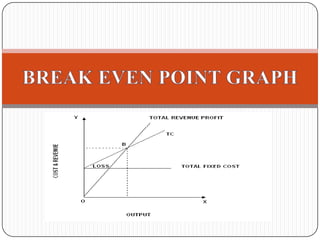
The break even point for a business firm shows the                             volume of sales at which the firm just breaks–even, with total revenue equal to total cost.	Break even point shows the price at which the firm makes zero profits, with revenues just covering the costs. 								BREAK EVEN POINT
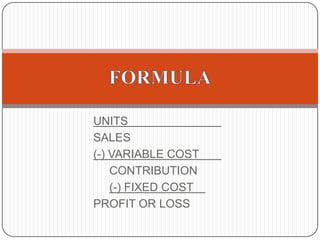
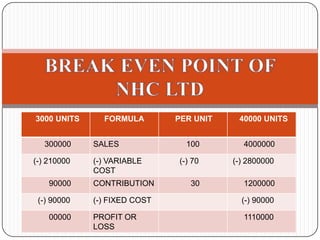
UNITS			SALES			(-) VARIABLE COST	CONTRIBUTION	(-) FIXED COST	PROFIT OR LOSS	FORMULA
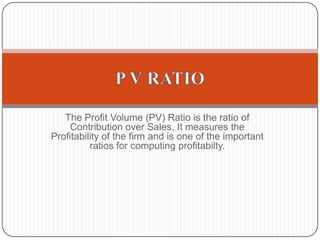
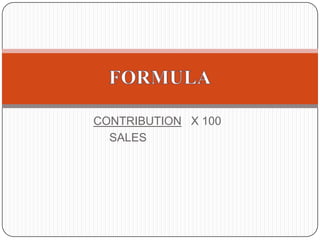
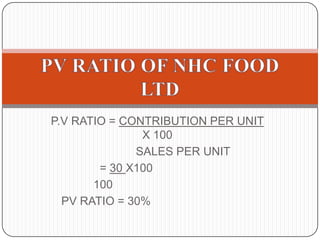
The Profit Volume (PV) Ratio is the ratio of Contribution over Sales. It measures the Profitability of the firm and is one of the important ratios for computing profitabilty.P V RATIO

Marginal costing