Marginal Cost
 Marginal cost is amount at any given volume of out put by which
aggregate costs are changed…..if volume of output is increased or
decreased by one unit.
 Marginal cost is amount at any given volume of out put by which
aggregate costs are changed if volume of output is increased or
decreased by one unit.
 marginal costing is ascertainment of marginal cost by differentiating
between fixed and variable costs and of the effect of changes in
volume or type of output”
1
Features Of Marginal Costing
 Semi-variable costs are included in comparison of cost
 Only variable costs are considered
 Fixed costs are written off
 Prices are based on variable and marginal contribution
2
Application of marginal costing or managerial
uses of marginal costing
 1. Fixation of selling price.
 2. Accepting of bulk order/foreign orders.
 3. Make or buy decision
 4. Preserve of a key factor
 5. Selection of a product mix.
 6. Alternative methods of production
 7. Profit planning
 8. Performance evaluation
 9. Giving offers and Quotations
 10. Expansion or Contraction activities
3
Advantages of marginal costing
 Marginal costing is simple to understand and easy to operate
because of the exclusion of fixed cost and its arbitrary
apportionment.
 Fixed costs are not carried forward to the subsequent years. So
cost comparisons become meaningful.
 There is no problem of over absorption or under absorption of
overhead
 This technique points out clearly the exact relationship between
cost, selling price and volume
 It shows more clearly the impact on profit of fluctuations in the
volume of sales
 It shows clearly the relative contributions and profitability of different
products
 It helps the management in taking decisions connected with profit4
Limitations Of Marginal Costing
 To segregate the total cost into fixed and variable components is a
difficult task
 Under marginal costing, the fixed costs are eliminated for the
valuation of inventory , in spite of the fact that they might have been
actually incurred.
 In the age of increased automation and technological development,
the component of fixed costs in the overall cost structure may be
sizeable.
 Marginal costing technique does not provide any standard for the
evaluation of performance.
 Fixation of selling price on marginal cost basis may be useful for
short term only.5
Absorption Costing
 “Absorption cost is a total cost technique Under which total cost ie
fixed & variable is charged to production. Inventory is also valued at
total cost. The term cost can be viewed from two angles basically.
 – Direct Cost and Indirect Cost
 – Fixed Cost and Variable Cost
 If fixed cost is included in the total cost, the per-unit cost varies
from one cost period to another with the fluctuations in level of
activities in two cost periods.
 Thus, per unit cost becomes incomparable between two periods.
To avoid this, it will be necessary to eliminate the fixed costs from
the determination of total cost.
This has resulted into concept of Marginal Costing6
Basic equation of Marginal Costing
 Profit = Sales – Total cost
 Profit = Sales – (Variable cost + Fixed cost)
 Profit + Fixed cost = Sales – Variable cost
 Sales – Variable cost = Contribution =Fixed cost + Profit
 Contribution – Fixed cost = Profit
7
CVP Analysis
 The intention of every business activity is to earn profit and
maximize it.
 CVP analysis, also known as CVP relationship aims at studying the
relationships existing among following factors and its impact on the
amount of profits:
 – Selling price per unit and total sales amount
 – Total cost, which may be fixed or variable, and
 – Volume of sales
8
Uses Of CVP Analysis
 It enables the prediction of costs and profits for different volumes of
activity.
 It is useful in setting up flexible budgets.
 It helps in performance evaluation for the purpose of control.
 It helps in formulating price policies by projecting the effect on
costs and profits.
 The study of CVP analysis is necessary to know the amount of
overhead costs, which could be charged to products costs at
various levels of operation
9
Relationship Of Costs
And Profits With Volume
 Assumptions for linear
relationships
 – Every cost can be classified as fixed or
variable
– Selling price remains same
– There is only one product and in case of
more than one product, product mix is
assumed tobe same.10
Limitations Of CVP Analysis
 Variable cost per unit may not be constant.
 Fixed costs may stabilize at higher levels as volume increases.
 Selling prices may be lower at high volumes because of sales
discounts allowed.
 Changes in efficiency will affect the CVP relationship.
11
Concept Of Contribution
 Contribution is the difference between sales And the marginal
(Variable) cost
 Contribution =sales-variable cost
 C= S-V
 Contribution = Fixed Cost+ Profit
 C= F+P
 Therefore
 S-V = F+P
12
(Expresses the relation of Contribution to
sales)
P/V ratio is the ratio of contribution to sales. It can also be
expressed in percentage. P/V ratio is an indicator of the profitability of
the concern. A higher P/V ratio indicates greater profitability and a
lower P/V ratio indicates lower profitability. P/V ratio is calculated as;
PV ratio = Contribution/Sales* 100
P/V ratio can be improved by-
a) Increasing the selling price
b) Reducing direct and variable cost
c) Changing over to more profitable products.
13
Limiting Or Key Factor
 a factor in the activities of an undertaking which at a point of time or
over a period
will limit the volume of out put
14
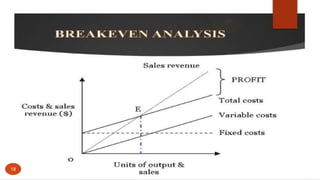
Break-even Point (BEP)
 This is a situation of no profit and no loss It means that at this
stage, contribution is just enough to cover the fixed costs.
 Break even point is that point of output or sales at which the firm
neither profit nor loss. At this point total sales will be equal to total
cost and contribution will be equal to fixed cost. B. E. P is
calculated as follows;
 B E P (in units) = Total fixed expenses/ Contribution per unit
 B E P (in value) = fixed expenses/P/V ratio
15
Break –even analysis is based on the
following assumptions
 1) Fixed costs remain unchanged at all levels of
activity.
 2) Variable costs change in direct proportion to the
volume of output.
 3) All indirect costs can be bifurcated into fixed and
variable elements
 4) Selling price remains constant irrespective of
volume of production or sales changes
 5) Price of raw-materials, labour rate etc remains
constant16
Advantages of break –even chart.
1) Presents the information in a simple form.
2) Indicate true profitability of products and plants.
3) Provide good insight of the changes in profit factors.
4) Serves as a tool of cost control.
5) It helps in ascertaining the strength of the business and the profit earning
capacity by studying margin of safety and angle of incidence together.
6) It helps in selecting the most profitable product mix. Thus it helps in
maximization of profit.
7) Break-even-chart provides such information which can be used with
advantage in forecasting and long-range planning
17
18
Margin Of Safety
 These are the sales beyond the breakeven point.A business will
like to have a high margin of safety because this is the amount of
sales which generates profits.Margin of safety is the excess of
actual sales or output over the break even sales or output. It is
calculated as Margin of safety ( m/s) = Actual sales – Breakeven
Sales OR Margin of safety = Profit/P/V ratio
 A large margin of safety is an indicator of the strength of the
business. Marginal safety can be increased by taking the following
steps;
 a) Increase the level of production
 b) Increase the selling price
 c) Reduce the cost19

Marginal cost

  • 1.
    Marginal Cost  Marginalcost is amount at any given volume of out put by which aggregate costs are changed…..if volume of output is increased or decreased by one unit.  Marginal cost is amount at any given volume of out put by which aggregate costs are changed if volume of output is increased or decreased by one unit.  marginal costing is ascertainment of marginal cost by differentiating between fixed and variable costs and of the effect of changes in volume or type of output” 1
  • 2.
    Features Of MarginalCosting  Semi-variable costs are included in comparison of cost  Only variable costs are considered  Fixed costs are written off  Prices are based on variable and marginal contribution 2
  • 3.
    Application of marginalcosting or managerial uses of marginal costing  1. Fixation of selling price.  2. Accepting of bulk order/foreign orders.  3. Make or buy decision  4. Preserve of a key factor  5. Selection of a product mix.  6. Alternative methods of production  7. Profit planning  8. Performance evaluation  9. Giving offers and Quotations  10. Expansion or Contraction activities 3
  • 4.
    Advantages of marginalcosting  Marginal costing is simple to understand and easy to operate because of the exclusion of fixed cost and its arbitrary apportionment.  Fixed costs are not carried forward to the subsequent years. So cost comparisons become meaningful.  There is no problem of over absorption or under absorption of overhead  This technique points out clearly the exact relationship between cost, selling price and volume  It shows more clearly the impact on profit of fluctuations in the volume of sales  It shows clearly the relative contributions and profitability of different products  It helps the management in taking decisions connected with profit4
  • 5.
    Limitations Of MarginalCosting  To segregate the total cost into fixed and variable components is a difficult task  Under marginal costing, the fixed costs are eliminated for the valuation of inventory , in spite of the fact that they might have been actually incurred.  In the age of increased automation and technological development, the component of fixed costs in the overall cost structure may be sizeable.  Marginal costing technique does not provide any standard for the evaluation of performance.  Fixation of selling price on marginal cost basis may be useful for short term only.5
  • 6.
    Absorption Costing  “Absorptioncost is a total cost technique Under which total cost ie fixed & variable is charged to production. Inventory is also valued at total cost. The term cost can be viewed from two angles basically.  – Direct Cost and Indirect Cost  – Fixed Cost and Variable Cost  If fixed cost is included in the total cost, the per-unit cost varies from one cost period to another with the fluctuations in level of activities in two cost periods.  Thus, per unit cost becomes incomparable between two periods. To avoid this, it will be necessary to eliminate the fixed costs from the determination of total cost. This has resulted into concept of Marginal Costing6
  • 7.
    Basic equation ofMarginal Costing  Profit = Sales – Total cost  Profit = Sales – (Variable cost + Fixed cost)  Profit + Fixed cost = Sales – Variable cost  Sales – Variable cost = Contribution =Fixed cost + Profit  Contribution – Fixed cost = Profit 7
  • 8.
    CVP Analysis  Theintention of every business activity is to earn profit and maximize it.  CVP analysis, also known as CVP relationship aims at studying the relationships existing among following factors and its impact on the amount of profits:  – Selling price per unit and total sales amount  – Total cost, which may be fixed or variable, and  – Volume of sales 8
  • 9.
    Uses Of CVPAnalysis  It enables the prediction of costs and profits for different volumes of activity.  It is useful in setting up flexible budgets.  It helps in performance evaluation for the purpose of control.  It helps in formulating price policies by projecting the effect on costs and profits.  The study of CVP analysis is necessary to know the amount of overhead costs, which could be charged to products costs at various levels of operation 9
  • 10.
    Relationship Of Costs AndProfits With Volume  Assumptions for linear relationships  – Every cost can be classified as fixed or variable – Selling price remains same – There is only one product and in case of more than one product, product mix is assumed tobe same.10
  • 11.
    Limitations Of CVPAnalysis  Variable cost per unit may not be constant.  Fixed costs may stabilize at higher levels as volume increases.  Selling prices may be lower at high volumes because of sales discounts allowed.  Changes in efficiency will affect the CVP relationship. 11
  • 12.
    Concept Of Contribution Contribution is the difference between sales And the marginal (Variable) cost  Contribution =sales-variable cost  C= S-V  Contribution = Fixed Cost+ Profit  C= F+P  Therefore  S-V = F+P 12
  • 13.
    (Expresses the relationof Contribution to sales) P/V ratio is the ratio of contribution to sales. It can also be expressed in percentage. P/V ratio is an indicator of the profitability of the concern. A higher P/V ratio indicates greater profitability and a lower P/V ratio indicates lower profitability. P/V ratio is calculated as; PV ratio = Contribution/Sales* 100 P/V ratio can be improved by- a) Increasing the selling price b) Reducing direct and variable cost c) Changing over to more profitable products. 13
  • 14.
    Limiting Or KeyFactor  a factor in the activities of an undertaking which at a point of time or over a period will limit the volume of out put 14
  • 15.
    Break-even Point (BEP) This is a situation of no profit and no loss It means that at this stage, contribution is just enough to cover the fixed costs.  Break even point is that point of output or sales at which the firm neither profit nor loss. At this point total sales will be equal to total cost and contribution will be equal to fixed cost. B. E. P is calculated as follows;  B E P (in units) = Total fixed expenses/ Contribution per unit  B E P (in value) = fixed expenses/P/V ratio 15
  • 16.
    Break –even analysisis based on the following assumptions  1) Fixed costs remain unchanged at all levels of activity.  2) Variable costs change in direct proportion to the volume of output.  3) All indirect costs can be bifurcated into fixed and variable elements  4) Selling price remains constant irrespective of volume of production or sales changes  5) Price of raw-materials, labour rate etc remains constant16
  • 17.
    Advantages of break–even chart. 1) Presents the information in a simple form. 2) Indicate true profitability of products and plants. 3) Provide good insight of the changes in profit factors. 4) Serves as a tool of cost control. 5) It helps in ascertaining the strength of the business and the profit earning capacity by studying margin of safety and angle of incidence together. 6) It helps in selecting the most profitable product mix. Thus it helps in maximization of profit. 7) Break-even-chart provides such information which can be used with advantage in forecasting and long-range planning 17
  • 18.
  • 19.
    Margin Of Safety These are the sales beyond the breakeven point.A business will like to have a high margin of safety because this is the amount of sales which generates profits.Margin of safety is the excess of actual sales or output over the break even sales or output. It is calculated as Margin of safety ( m/s) = Actual sales – Breakeven Sales OR Margin of safety = Profit/P/V ratio  A large margin of safety is an indicator of the strength of the business. Marginal safety can be increased by taking the following steps;  a) Increase the level of production  b) Increase the selling price  c) Reduce the cost19