CVP Analysis, Break Even Point & Applications Of Marginal Costing Presented By:- Leena Kakkar Manjot Singh Vijay Mehta
Definition Cost Volume Profit Analysis (CVP Analysis)  is one of the most powerful tools that managers have at their command. It helps them to understand the relationship between cost, volume, and profit in an organization by focusing on interactions among the different elements.
These five elements are:- Price of products Volume or Level of activity Per unit variable cost Total fixed cost Mix of product sold
CVP Analysis help managers to take various decisions regarding business  i.e : What product to manufacture or sell What pricing policy to follow What marketing strategy to employ What type of productive facilities to acquire
Components of CVP Analysis are:- Level or volume of activity Unit selling prices Variable cost per unit Total fixed cost Sales Mix
Assumptions CVP assumes the following: Constant sales price; Constant variable cost per unit; Constant total fixed cost; Constant sales mix; Units sold equal units produced.
Limitations CVP is a short run, marginal analysis  It assumes that unit variable costs and unit revenues are constant, which is appropriate for small deviations from current production and sales. Assumes a neat division between fixed costs and variable costs, though in the long run all costs are variable.  For longer-term analysis that considers the entire life-cycle of a product, one therefore often prefers activity-based costing or throughput accounting.
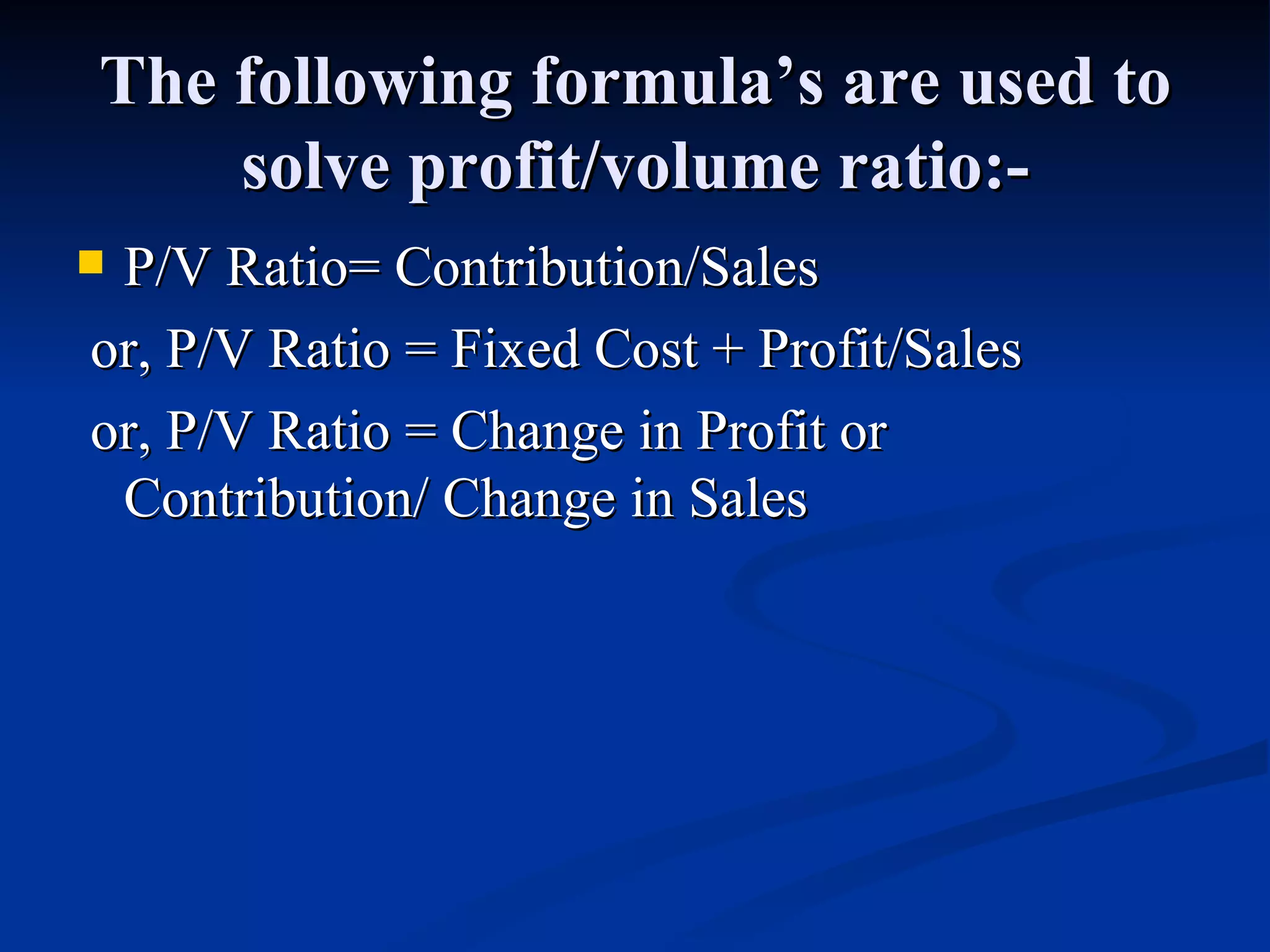
The following formula’s are used to solve profit/volume ratio:- P/V Ratio= Contribution/Sales or, P/V Ratio = Fixed Cost + Profit/Sales or, P/V Ratio = Change in Profit or Contribution/ Change in Sales
Example Sales  Rs. 1,00,000 Profit  Rs. 10,000 Variable cost  70% Find out (i) P/V Ratio, (ii) Fixed Cost, (iii) Sales volume to earn a profit of Rs. 40,000
Break Even Point The break even point (BEP) is the point at which cost or expenses and revenue are equal: there is no net loss or gain, and one has “broken even”. A profit or a loss has not been made, although opportunity costs have been paid, and capital has received the risk-adjusted.
Methods of computing BEP Equation Approach Contribution approach Graphical Approach
Applications The break even point is one of the simplest yet least used analytical tools in management. It helps to provide a dynamic view of the relationships, between sales, cost and profit.
Limitations Break Even analysis is only a supply side (i.e costs only) analysis, as it tells you nothing about what sales are actually likely to be for the product at these various prices. It assumes that fixed cost (FC) are constant .Although this is true in short run, an increase in the scale of production is likely to cause fixed cost to rise. In multi-product companies. It assumes that the relative proportions of each product sold and produced are constant (ie.,the sales mix is constant).
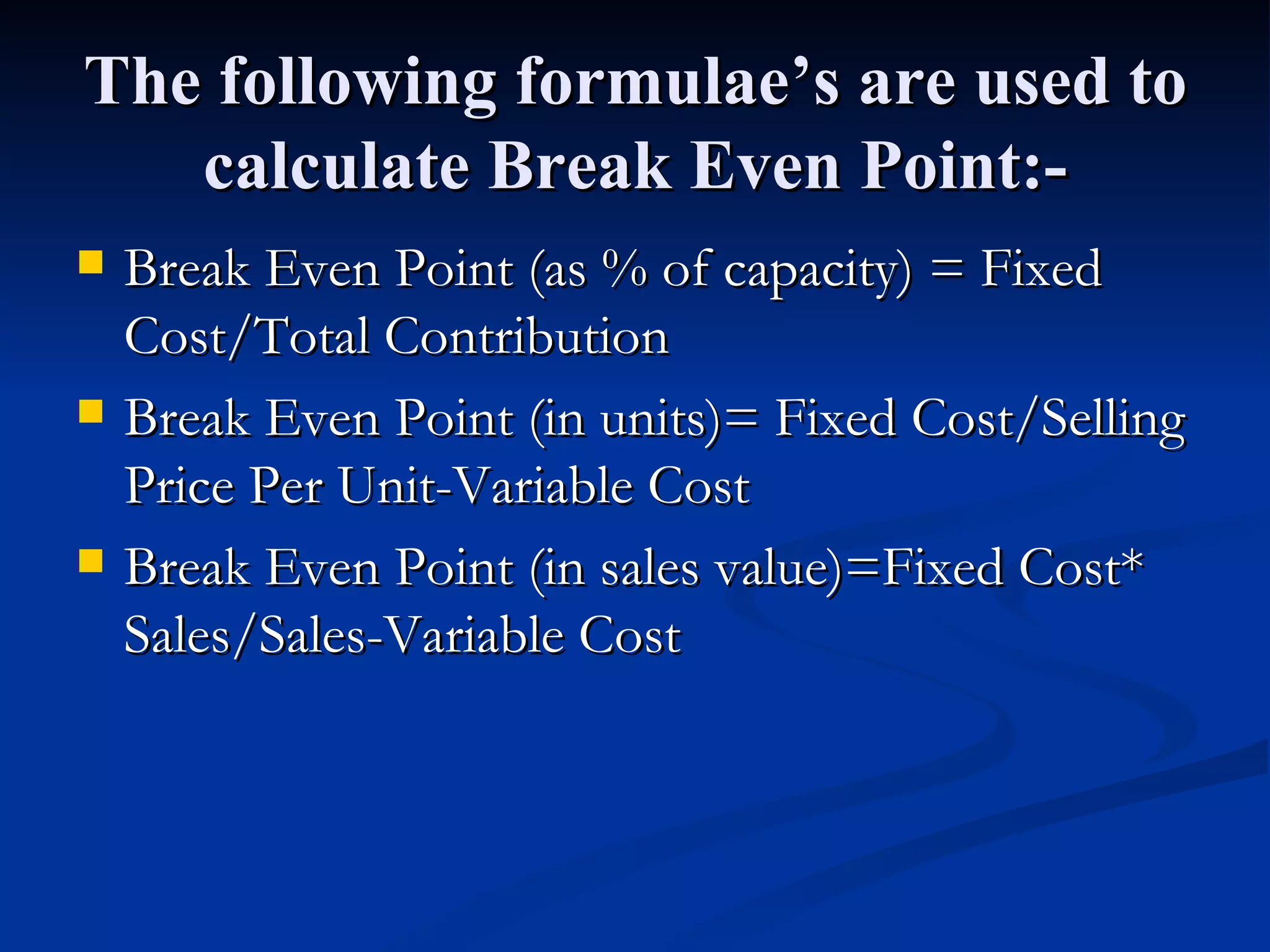
The following formulae’s are used to calculate Break Even Point:- Break Even Point (as % of capacity) = Fixed Cost/Total Contribution Break Even Point (in units)= Fixed Cost/Selling Price Per Unit-Variable Cost Break Even Point (in sales value)=Fixed Cost* Sales/Sales-Variable Cost
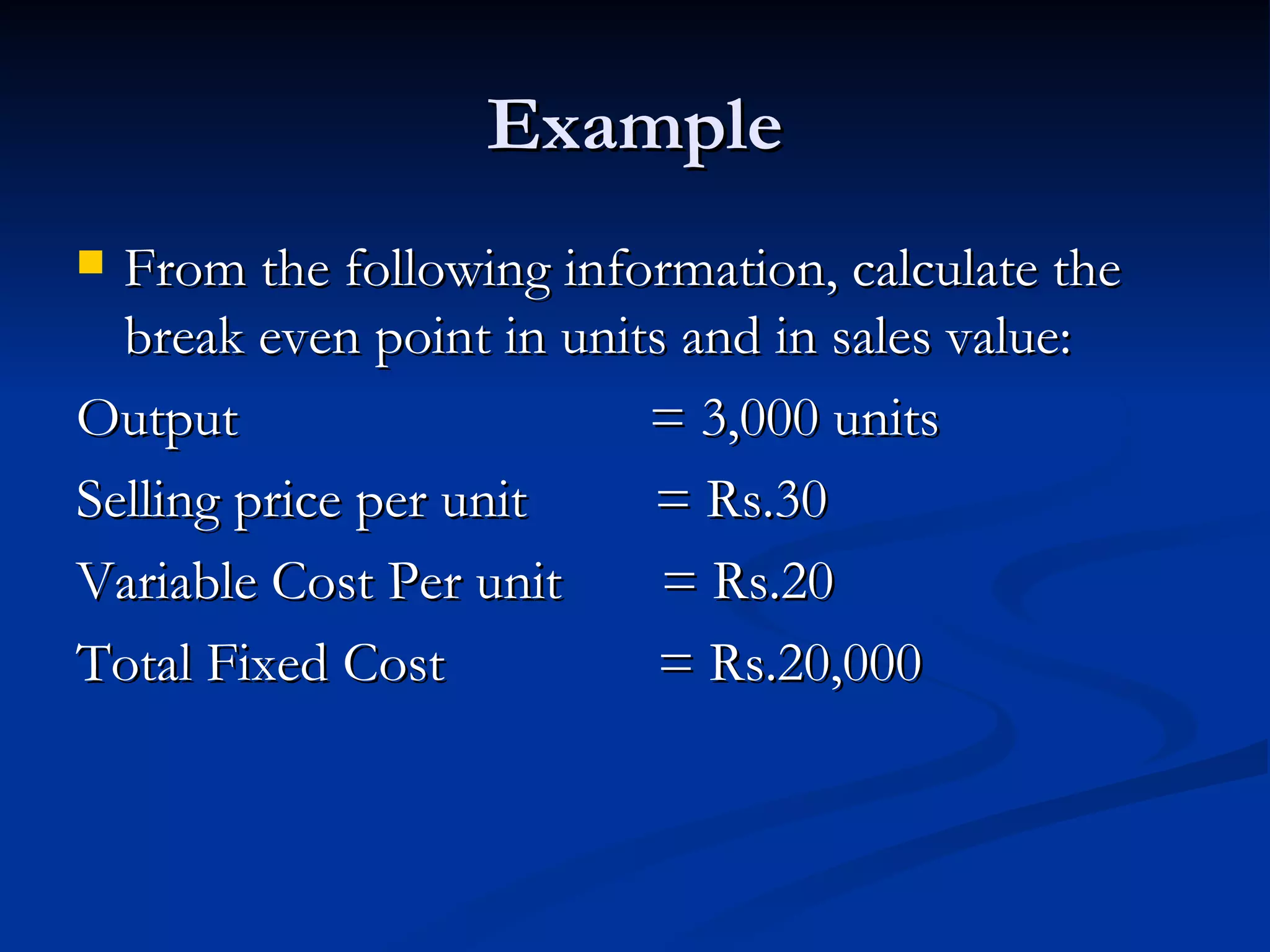
Example From the following information, calculate the break even point in units and in sales value: Output  = 3,000 units Selling price per unit  = Rs.30 Variable Cost Per unit  = Rs.20 Total Fixed Cost  = Rs.20,000
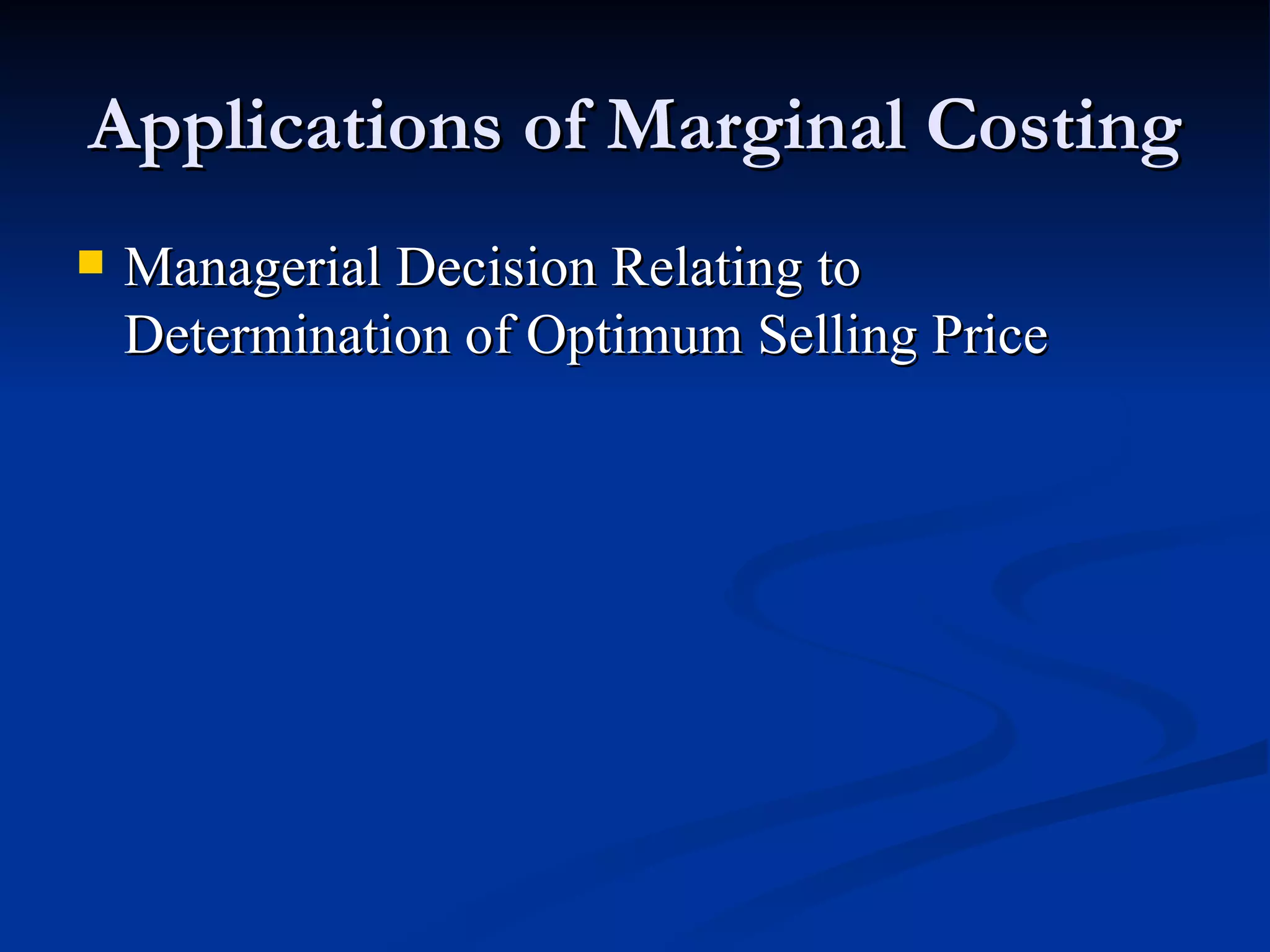
Applications of Marginal Costing Managerial Decision Relating to Determination of Optimum Selling Price
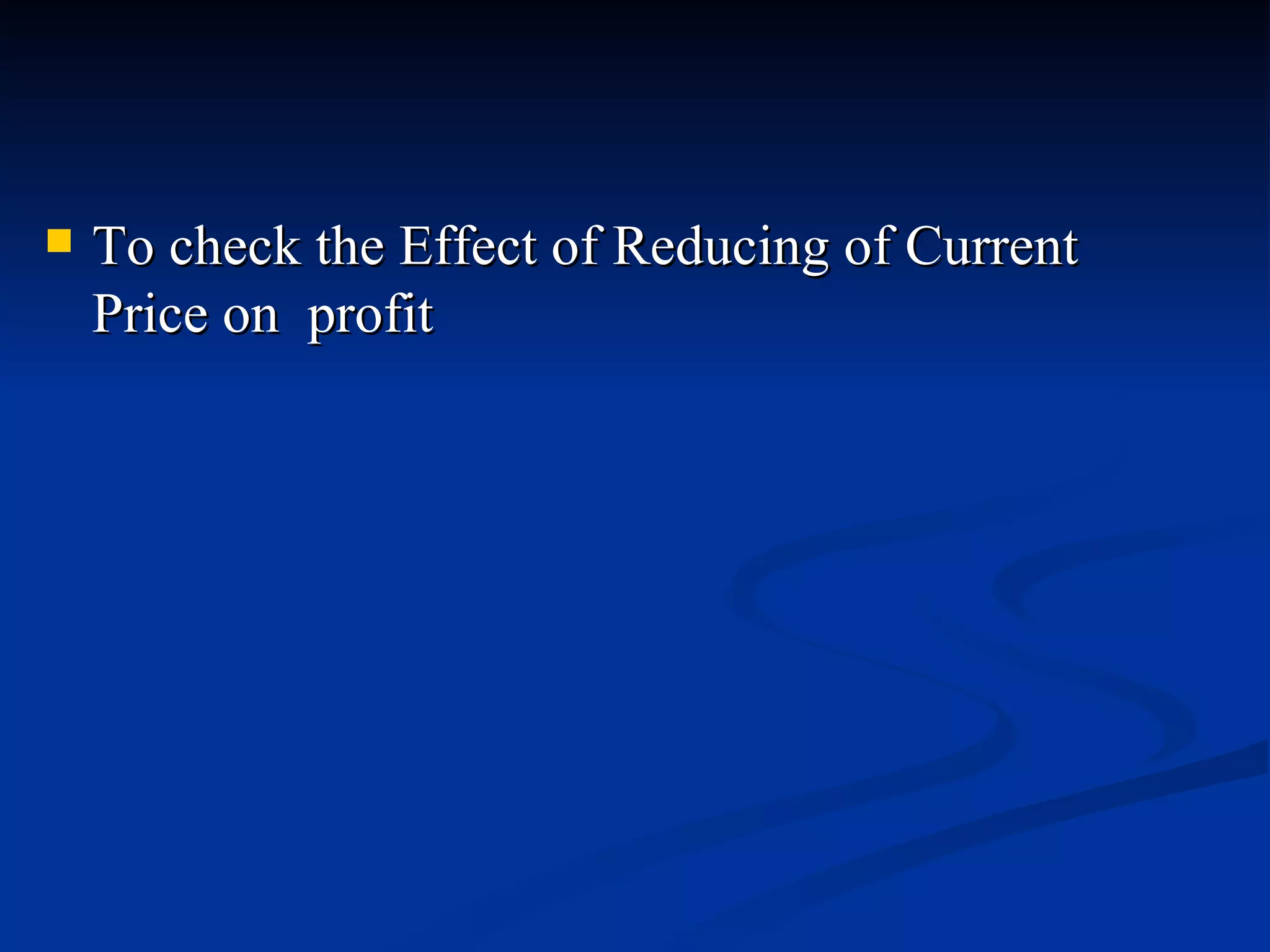
To check the Effect of Reducing of Current Price on  profit
Choose of Good Product Mix  Calculation of Margin of Safety  Decision Regarding to Sell goods at Different Prices to Different Customers
THANKYOU

Presentation on CVP Analysis, Break Even Point & Applications of Marginal Costing

  • 1.
    CVP Analysis, BreakEven Point & Applications Of Marginal Costing Presented By:- Leena Kakkar Manjot Singh Vijay Mehta
  • 2.
    Definition Cost VolumeProfit Analysis (CVP Analysis) is one of the most powerful tools that managers have at their command. It helps them to understand the relationship between cost, volume, and profit in an organization by focusing on interactions among the different elements.
  • 3.
    These five elementsare:- Price of products Volume or Level of activity Per unit variable cost Total fixed cost Mix of product sold
  • 4.
    CVP Analysis helpmanagers to take various decisions regarding business i.e : What product to manufacture or sell What pricing policy to follow What marketing strategy to employ What type of productive facilities to acquire
  • 5.
    Components of CVPAnalysis are:- Level or volume of activity Unit selling prices Variable cost per unit Total fixed cost Sales Mix
  • 6.
    Assumptions CVP assumesthe following: Constant sales price; Constant variable cost per unit; Constant total fixed cost; Constant sales mix; Units sold equal units produced.
  • 7.
    Limitations CVP isa short run, marginal analysis It assumes that unit variable costs and unit revenues are constant, which is appropriate for small deviations from current production and sales. Assumes a neat division between fixed costs and variable costs, though in the long run all costs are variable. For longer-term analysis that considers the entire life-cycle of a product, one therefore often prefers activity-based costing or throughput accounting.
  • 8.
    The following formula’sare used to solve profit/volume ratio:- P/V Ratio= Contribution/Sales or, P/V Ratio = Fixed Cost + Profit/Sales or, P/V Ratio = Change in Profit or Contribution/ Change in Sales
  • 9.
    Example Sales Rs. 1,00,000 Profit Rs. 10,000 Variable cost 70% Find out (i) P/V Ratio, (ii) Fixed Cost, (iii) Sales volume to earn a profit of Rs. 40,000
  • 10.
    Break Even PointThe break even point (BEP) is the point at which cost or expenses and revenue are equal: there is no net loss or gain, and one has “broken even”. A profit or a loss has not been made, although opportunity costs have been paid, and capital has received the risk-adjusted.
  • 11.
    Methods of computingBEP Equation Approach Contribution approach Graphical Approach
  • 12.
    Applications The breakeven point is one of the simplest yet least used analytical tools in management. It helps to provide a dynamic view of the relationships, between sales, cost and profit.
  • 13.
    Limitations Break Evenanalysis is only a supply side (i.e costs only) analysis, as it tells you nothing about what sales are actually likely to be for the product at these various prices. It assumes that fixed cost (FC) are constant .Although this is true in short run, an increase in the scale of production is likely to cause fixed cost to rise. In multi-product companies. It assumes that the relative proportions of each product sold and produced are constant (ie.,the sales mix is constant).
  • 14.
    The following formulae’sare used to calculate Break Even Point:- Break Even Point (as % of capacity) = Fixed Cost/Total Contribution Break Even Point (in units)= Fixed Cost/Selling Price Per Unit-Variable Cost Break Even Point (in sales value)=Fixed Cost* Sales/Sales-Variable Cost
  • 15.
    Example From thefollowing information, calculate the break even point in units and in sales value: Output = 3,000 units Selling price per unit = Rs.30 Variable Cost Per unit = Rs.20 Total Fixed Cost = Rs.20,000
  • 16.
    Applications of MarginalCosting Managerial Decision Relating to Determination of Optimum Selling Price
  • 17.
    To check theEffect of Reducing of Current Price on profit
  • 18.
    Choose of GoodProduct Mix Calculation of Margin of Safety Decision Regarding to Sell goods at Different Prices to Different Customers
  • 19.