CHAPTER 07:
INTRODUCTION TO MARGINALCOSTING
CONDUCTED BY:
P. Ayanthi Madumali
Intended Learning Outcomes
• At the end of the chapter, you will able to
1. To understand the basic concepts of marginal cost and marginal
costing.
2. To understand the difference between the Absorption costing and
Marginal Costing.
3. To learn the practical applications of Marginal costing.
4. To understand Breakeven charts & Limitation
Techniques of Costing
1. Marginal Costing
2. Absorption Costing / Traditional Costing
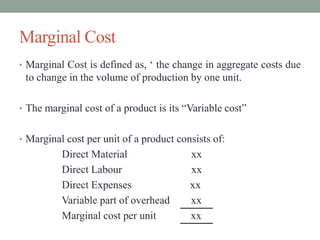
Marginal Cost
• Marginal Cost is defined as, ‘ the change in aggregate costs due
to change in the volume of production by one unit.
• The marginal cost of a product is its “Variable cost”
• Marginal cost per unit of a product consists of:
Direct Material xx
Direct Labour xx
Direct Expenses xx
Variable part of overhead xx
Marginal cost per unit xx
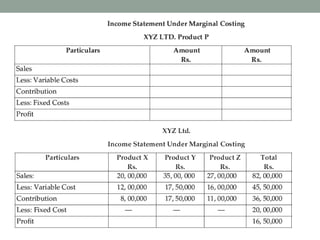
Marginal Costing
• Marginal Costing has been defined as, ‘Ascertainment of cost
and measuring the impact on profits of the change in the volume
of output or type of output.
• Marginal costing is a very useful technique of costing for
decision-making.
• In marginal costing, costs are segregated into fixed and variable
Marginal Costing is formally defined as:
• The accounting system in which variable cost
are charged to cost units and the fixed costs of
the period are written- off in full against the
aggregate contribution.(Terminology)
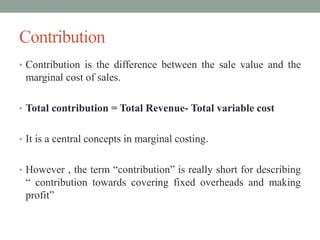
Contribution
• Contribution is the difference between the sale value and the
marginal cost of sales.
• Total contribution = Total Revenue- Total variable cost
• It is a central concepts in marginal costing.
• However , the term “contribution” is really short for describing
“ contribution towards covering fixed overheads and making
profit”
• Example 01.:
• Selling price per unit Rs.200. Direct material per unit
Rs.20 , Direct labour per unit Rs.30 , Variable
overhead per unit Rs.20. Fixed overhead per unit
Rs.50.Production units 1,000.Other fixed overhead per
unit Rs.15.
• Calculate contribution per unit & Total profit.
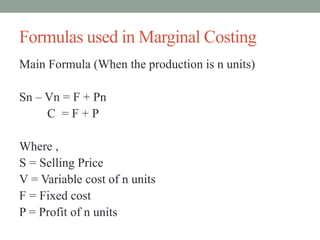
Formulas used in Marginal Costing
Main Formula (When the production is n units)
Sn – Vn = F + Pn
C = F + P
Where ,
S = Selling Price
V = Variable cost of n units
F = Fixed cost
P = Profit of n units
• Total contribution > Fixed cost = …………
• Total contribution = Fixed cost = …………
• Total contribution < Fixed cost = …………
Contribution Sales Ratio
• The contribution margin per unit expressed as a percentage of
the selling price per unit.
• Contribution to sales ration ( C/S Ration , P/V Ratio)
• Contribution *100
sales
• Changes in contribution/ profit or loss * 100
Changes in Sales
Contribution Sales Ratio
• This ration shows the relationship between sales and
contribution.
• E.g 02.: Selling price Rs.200 , Variable cost Rs.60 . Calculate
C/S ratio.
• E.g : Sales Profit
• First year Rs. 100,00 Rs. 10,000
• Second year Rs. 150,000 Rs. 12,000
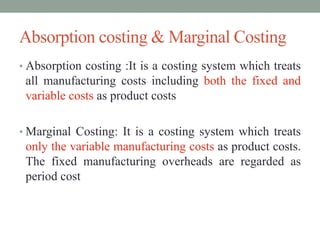
Absorption costing & Marginal Costing
• Absorption costing :It is a costing system which treats
all manufacturing costs including both the fixed and
variable costs as product costs
• Marginal Costing: It is a costing system which treats
only the variable manufacturing costs as product costs.
The fixed manufacturing overheads are regarded as
period cost
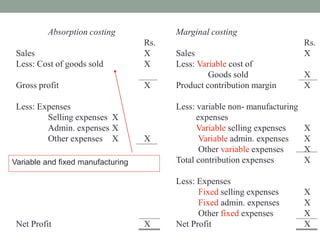
Absorption costing Marginal costing
Rs. Rs.
Sales X Sales X
Less: Cost of goods sold X Less: Variable cost of
Goods sold X
Gross profit X Product contribution margin X
Less: Expenses Less: variable non- manufacturing
Selling expenses X expenses
Admin. expenses X Variable selling expenses X
Other expenses X X Variable admin. expenses X
Other variable expenses X
Total contribution expenses X
Less: Expenses
Fixed selling expenses X
Fixed admin. expenses X
Other fixed expenses X
Net Profit X Net Profit X
Variable and fixed manufacturing
• Example 03:
• Budgeted activity was expected to be 20,000 units per
year.
• Sales Rs.100,000
• Manufacturing cost - Fixed cost Rs.15,000
- Variable cost Rs.35,000
Administration & Selling Expenses Rs. 25,000
• Required:
• Prepare absorption and marginal costing statements
Marginal Costing Absorption Costing
Costs are classified as fixed
& variable
Costs are classified as
direct & indirect
The year end inventory is
valued at variable cost
only.
The year end inventory of
finished goods valued at
total cost.
The fixed overheads are
charged directly to the
costing profit loss account
and not absorbed in the
product units.
The fixed overheads are
not charged directly to the
costing profit loss account
and absorbed in the
product units.
Break EvenAnalysis / CVPAnalysis
• Breakeven analysis is the study of the relationship
between selling prices, sales volumes, fixed costs,
variable costs and profits at various levels of activity
• The Break Even Point is a level of production where
the total costs are equal to the total revenue. Thus at
the break even level, there is neither profit nor loss
• The point where total contribution margin equals total
fixed costs.
FoundationalAssumption in CVP
1. All costs can be classified into fixed & variable
elements.
2. Fixed cost will remain constant & the variable cost vary
with production levels
3. Selling price, variable cost per unit & fixed costs are all
known & constant
4. Over the activity range being considered costs &
revenue behaved in a liner fashion
5. The technology, production &efficiency remain
unchanged
6. The time value of money is ignored.
7. There is no change in stock level.
Break EvenAnalysis can be done in two ways:
1. Equation approach
2. Graphical approach
Equation approach to Break EvenAnalysis
• Break Even Points = Fixed Cost
(Units) Contribution per unit
Break Even Points( Rs.) = Fixed Costs
C/S Ratio
= BEP Unit * Selling price
Level of sales to achieve a target profit = profit + Fixed cost
Contribution
• E.g. 04: Selling price per unit Rs.100
Variable cost per unit Rs.60
Fixed cost Rs.60,000
No of units sales per year 8000 units.
1. Calculate Profit
2. Calculate level of sales to achieve Rs.400,000 profit
Margin of safety
• Margin of safety (MOS) measures the distance
between budgeted sales and breakeven sales.
• MOS = Budgeted Sales – BE Sales
• E.g 05: Selling price per unit Rs.20
Variable cost per unit Rs.10
Fixed cost Rs.60,000
If sale are expected to be 8000 units calculate margin of
safety in units & rupee value.
Graphical approach to Break EvenAnalysis
• The graphical approach may be prefer when a simple
overview is sufficient or when greater visual impact is
required .e.g. A report given for a manager.
• The basic chart is known as a break even and can be
drawn in two ways.
1. Traditional approach
2. Contribution approach
Traditional Break Even Chart
• This is prepared by drawing the following
curves.
I. Fixed cost
II. Total cost
III. Total Revenue
Traditional Break Even Chart
Contribution Break Even Chart
• In order to prepare the contribution chart following
curves should be drawn
1. Total cost curve
2. Variable cost curve
3. Total revenue curve
Alternative form of contribution break even
chart
• Following alternative curves can be drawn to
illustrate break even pint using contribution
chart.
1. Contribution curve
2. Fixed cost curve
Profit Chart
• Under this method of CVP analysis, only profit
or loss curve is drawn in order to identify the
break even level.
• Profit graph that focuses more directly on how
profits change with changes in volume.
E.g.06:
• A company makes a single product where the total
capacity of 4000 liters per annum. Costa and sales data
are as follows:
Selling price Rs. 100 per liter
Marginal cost Rs.50 per liter
Fixed cost Rs.100,000
Draw Tradition , contribution , alternative form of
contribution and profit chart.
Multi- Product Break Even Chart
• When a company deals in a number of products, it is
possible , to draw break even chart for the as a whole.
• In such a case , the break even point is where the
average contribution line cuts the fixed cost line ,
assuming proportions of sales – mix remain
unchanged.
The procedure for drawing up a multi break
even chart
1. Calculate P/V ratio for each product and arrange the products
in descending order on the basis of P/V ratio.
2. “ X “ axis would represent sales value & “Y” axis would
represent contribution & fixed cost.
3. Draw the total fixed cost line
4. Take the product having the highest P/V ratio & plot its
contribution against sales: then take the product having
second highest P/V ration & plot cumulative contribution
against cumulative sales , the process will end with plotting
by the product having the lowest P/V ratio.
5. Obtain the average contribution slope by joining the origin to
the last line plotted.
Illustration
• ABC Co . Ltd produce and sells three products – Y , X and Z .
From the following information relating to these a period , draw
up a break even chart to determine the break even point.
X Y Z Total
Sales 25,000 40,000 35,000 100,000
Variable costs 15,000 20,000 28,000 63,000
Fixed costs 18,500
Limitation of Break Even Chart
• A liner relationship does not always exist.
• We assume that a company manufactures only
one product . In reality, a company may
produce two or more product.
• We focus on short period where the fixed cost is
fixed. However , in the long run fixed cost
varies.
• We assume that technology and other factors
does not change.
Marginal Costing & Management Decision
In Short Run
Tutorial No: 07 ( Q: 2 - 7 )
Management Decision In Short Run
• Concept of Marginal costing is very useful in making
management decision in short run ,
1. When a limiting factors exits
2. Acceptance of special order
3. Dropping a loss Making product
4. Make or buy Decision
When a limiting factors exits
• Factors which limits indefinite expansion of an
organization or earning of profit are called limiting
factor.
• E.g.; Finance , sales, Raw materials , Skilled labour
Steps:
1. Ascertain the contribution per each good
2. Ascertain the contribution per limiting factor
3. List the order of preferences.
Acceptance of special order
• Special order is an order , it different from terms for
normal sales.
• Such an order can be considered only if the
organization has not utilized its capacity to the fullest
extent.
• In this decision the fundamental criteria whether to
accept or not , is based on the comparison of the
variable cost with the price in the special offer.
Dropping a loss Making product
• When a company is producing a range of products,
which include a product incurring losses, business will
have to decide whether such product to be
discontinued
• The decision can also be based on by comparing
variable cost and selling price. In other words, by
determine whether the product is having a
contribution..
Make or buy Decision
• Frequently the management is faced with the decision
whether to make a particular product or component or
whether to buy it from outside.
• Apart from over riding the technical reason the
decision is usually based on an analysis of the cost
indicators.
• Under these type of decisions the most important
factor is that the costs are divided into fixed and
variable cost.
Thank You…

Chapter 07 Marginal Costing

  • 1.
    CHAPTER 07: INTRODUCTION TOMARGINALCOSTING CONDUCTED BY: P. Ayanthi Madumali
  • 2.
    Intended Learning Outcomes •At the end of the chapter, you will able to 1. To understand the basic concepts of marginal cost and marginal costing. 2. To understand the difference between the Absorption costing and Marginal Costing. 3. To learn the practical applications of Marginal costing. 4. To understand Breakeven charts & Limitation
  • 3.
    Techniques of Costing 1.Marginal Costing 2. Absorption Costing / Traditional Costing
  • 4.
    Marginal Cost • MarginalCost is defined as, ‘ the change in aggregate costs due to change in the volume of production by one unit. • The marginal cost of a product is its “Variable cost” • Marginal cost per unit of a product consists of: Direct Material xx Direct Labour xx Direct Expenses xx Variable part of overhead xx Marginal cost per unit xx
  • 5.
    Marginal Costing • MarginalCosting has been defined as, ‘Ascertainment of cost and measuring the impact on profits of the change in the volume of output or type of output. • Marginal costing is a very useful technique of costing for decision-making. • In marginal costing, costs are segregated into fixed and variable
  • 6.
    Marginal Costing isformally defined as: • The accounting system in which variable cost are charged to cost units and the fixed costs of the period are written- off in full against the aggregate contribution.(Terminology)
  • 8.
    Contribution • Contribution isthe difference between the sale value and the marginal cost of sales. • Total contribution = Total Revenue- Total variable cost • It is a central concepts in marginal costing. • However , the term “contribution” is really short for describing “ contribution towards covering fixed overheads and making profit”
  • 9.
    • Example 01.: •Selling price per unit Rs.200. Direct material per unit Rs.20 , Direct labour per unit Rs.30 , Variable overhead per unit Rs.20. Fixed overhead per unit Rs.50.Production units 1,000.Other fixed overhead per unit Rs.15. • Calculate contribution per unit & Total profit.
  • 10.
    Formulas used inMarginal Costing Main Formula (When the production is n units) Sn – Vn = F + Pn C = F + P Where , S = Selling Price V = Variable cost of n units F = Fixed cost P = Profit of n units
  • 11.
    • Total contribution> Fixed cost = ………… • Total contribution = Fixed cost = ………… • Total contribution < Fixed cost = …………
  • 12.
    Contribution Sales Ratio •The contribution margin per unit expressed as a percentage of the selling price per unit. • Contribution to sales ration ( C/S Ration , P/V Ratio) • Contribution *100 sales • Changes in contribution/ profit or loss * 100 Changes in Sales
  • 13.
    Contribution Sales Ratio •This ration shows the relationship between sales and contribution. • E.g 02.: Selling price Rs.200 , Variable cost Rs.60 . Calculate C/S ratio. • E.g : Sales Profit • First year Rs. 100,00 Rs. 10,000 • Second year Rs. 150,000 Rs. 12,000
  • 14.
    Absorption costing &Marginal Costing • Absorption costing :It is a costing system which treats all manufacturing costs including both the fixed and variable costs as product costs • Marginal Costing: It is a costing system which treats only the variable manufacturing costs as product costs. The fixed manufacturing overheads are regarded as period cost
  • 15.
    Absorption costing Marginalcosting Rs. Rs. Sales X Sales X Less: Cost of goods sold X Less: Variable cost of Goods sold X Gross profit X Product contribution margin X Less: Expenses Less: variable non- manufacturing Selling expenses X expenses Admin. expenses X Variable selling expenses X Other expenses X X Variable admin. expenses X Other variable expenses X Total contribution expenses X Less: Expenses Fixed selling expenses X Fixed admin. expenses X Other fixed expenses X Net Profit X Net Profit X Variable and fixed manufacturing
  • 16.
    • Example 03: •Budgeted activity was expected to be 20,000 units per year. • Sales Rs.100,000 • Manufacturing cost - Fixed cost Rs.15,000 - Variable cost Rs.35,000 Administration & Selling Expenses Rs. 25,000 • Required: • Prepare absorption and marginal costing statements
  • 17.
    Marginal Costing AbsorptionCosting Costs are classified as fixed & variable Costs are classified as direct & indirect The year end inventory is valued at variable cost only. The year end inventory of finished goods valued at total cost. The fixed overheads are charged directly to the costing profit loss account and not absorbed in the product units. The fixed overheads are not charged directly to the costing profit loss account and absorbed in the product units.
  • 18.
    Break EvenAnalysis /CVPAnalysis • Breakeven analysis is the study of the relationship between selling prices, sales volumes, fixed costs, variable costs and profits at various levels of activity • The Break Even Point is a level of production where the total costs are equal to the total revenue. Thus at the break even level, there is neither profit nor loss • The point where total contribution margin equals total fixed costs.
  • 19.
    FoundationalAssumption in CVP 1.All costs can be classified into fixed & variable elements. 2. Fixed cost will remain constant & the variable cost vary with production levels 3. Selling price, variable cost per unit & fixed costs are all known & constant 4. Over the activity range being considered costs & revenue behaved in a liner fashion 5. The technology, production &efficiency remain unchanged 6. The time value of money is ignored. 7. There is no change in stock level.
  • 20.
    Break EvenAnalysis canbe done in two ways: 1. Equation approach 2. Graphical approach
  • 21.
    Equation approach toBreak EvenAnalysis • Break Even Points = Fixed Cost (Units) Contribution per unit Break Even Points( Rs.) = Fixed Costs C/S Ratio = BEP Unit * Selling price Level of sales to achieve a target profit = profit + Fixed cost Contribution
  • 22.
    • E.g. 04:Selling price per unit Rs.100 Variable cost per unit Rs.60 Fixed cost Rs.60,000 No of units sales per year 8000 units. 1. Calculate Profit 2. Calculate level of sales to achieve Rs.400,000 profit
  • 23.
    Margin of safety •Margin of safety (MOS) measures the distance between budgeted sales and breakeven sales. • MOS = Budgeted Sales – BE Sales • E.g 05: Selling price per unit Rs.20 Variable cost per unit Rs.10 Fixed cost Rs.60,000 If sale are expected to be 8000 units calculate margin of safety in units & rupee value.
  • 24.
    Graphical approach toBreak EvenAnalysis • The graphical approach may be prefer when a simple overview is sufficient or when greater visual impact is required .e.g. A report given for a manager. • The basic chart is known as a break even and can be drawn in two ways. 1. Traditional approach 2. Contribution approach
  • 25.
    Traditional Break EvenChart • This is prepared by drawing the following curves. I. Fixed cost II. Total cost III. Total Revenue
  • 26.
  • 27.
    Contribution Break EvenChart • In order to prepare the contribution chart following curves should be drawn 1. Total cost curve 2. Variable cost curve 3. Total revenue curve
  • 28.
    Alternative form ofcontribution break even chart • Following alternative curves can be drawn to illustrate break even pint using contribution chart. 1. Contribution curve 2. Fixed cost curve
  • 29.
    Profit Chart • Underthis method of CVP analysis, only profit or loss curve is drawn in order to identify the break even level. • Profit graph that focuses more directly on how profits change with changes in volume.
  • 30.
    E.g.06: • A companymakes a single product where the total capacity of 4000 liters per annum. Costa and sales data are as follows: Selling price Rs. 100 per liter Marginal cost Rs.50 per liter Fixed cost Rs.100,000 Draw Tradition , contribution , alternative form of contribution and profit chart.
  • 31.
    Multi- Product BreakEven Chart • When a company deals in a number of products, it is possible , to draw break even chart for the as a whole. • In such a case , the break even point is where the average contribution line cuts the fixed cost line , assuming proportions of sales – mix remain unchanged.
  • 32.
    The procedure fordrawing up a multi break even chart 1. Calculate P/V ratio for each product and arrange the products in descending order on the basis of P/V ratio. 2. “ X “ axis would represent sales value & “Y” axis would represent contribution & fixed cost. 3. Draw the total fixed cost line 4. Take the product having the highest P/V ratio & plot its contribution against sales: then take the product having second highest P/V ration & plot cumulative contribution against cumulative sales , the process will end with plotting by the product having the lowest P/V ratio. 5. Obtain the average contribution slope by joining the origin to the last line plotted.
  • 33.
    Illustration • ABC Co. Ltd produce and sells three products – Y , X and Z . From the following information relating to these a period , draw up a break even chart to determine the break even point. X Y Z Total Sales 25,000 40,000 35,000 100,000 Variable costs 15,000 20,000 28,000 63,000 Fixed costs 18,500
  • 34.
    Limitation of BreakEven Chart • A liner relationship does not always exist. • We assume that a company manufactures only one product . In reality, a company may produce two or more product. • We focus on short period where the fixed cost is fixed. However , in the long run fixed cost varies. • We assume that technology and other factors does not change.
  • 35.
    Marginal Costing &Management Decision In Short Run Tutorial No: 07 ( Q: 2 - 7 )
  • 36.
    Management Decision InShort Run • Concept of Marginal costing is very useful in making management decision in short run , 1. When a limiting factors exits 2. Acceptance of special order 3. Dropping a loss Making product 4. Make or buy Decision
  • 37.
    When a limitingfactors exits • Factors which limits indefinite expansion of an organization or earning of profit are called limiting factor. • E.g.; Finance , sales, Raw materials , Skilled labour Steps: 1. Ascertain the contribution per each good 2. Ascertain the contribution per limiting factor 3. List the order of preferences.
  • 38.
    Acceptance of specialorder • Special order is an order , it different from terms for normal sales. • Such an order can be considered only if the organization has not utilized its capacity to the fullest extent. • In this decision the fundamental criteria whether to accept or not , is based on the comparison of the variable cost with the price in the special offer.
  • 39.
    Dropping a lossMaking product • When a company is producing a range of products, which include a product incurring losses, business will have to decide whether such product to be discontinued • The decision can also be based on by comparing variable cost and selling price. In other words, by determine whether the product is having a contribution..
  • 40.
    Make or buyDecision • Frequently the management is faced with the decision whether to make a particular product or component or whether to buy it from outside. • Apart from over riding the technical reason the decision is usually based on an analysis of the cost indicators. • Under these type of decisions the most important factor is that the costs are divided into fixed and variable cost.
  • 41.