JOB COSTING &
PROCESS COSTING
Presented By
SRIMANT KUMAR MOHARANA
JOB COSTING
Job costing is that form of specific order costing
which applies where work is under taken to
customer’s special requirements and each order
is comparatively short duration . The work is
usually carried out within a factory or workshop and
moved through processes and operations as
constantly identifiable units.
Ex: Engineering jobs, construction jobs, printing
jobs, furniture making, fabrication jobs etc.
FEATURES
 It is a specific order costing.
 The job is carried out or the product is produced to meet the
specific requirement of the order.
 It is concerned with the cost of an individual job or batch
regardless of the time taken to produce it , but normally
short duration of time.
 Cost are collected to each job at the end of it’s completion.
 The cost of job is ascertained by adding material, labour
and overheads
 Work in progress may or may not exist at the end of the
accounting years.
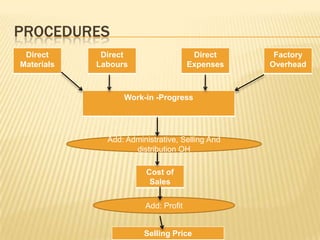
PROCEDURES
Direct
Labours
Direct
Materials
Direct
Expenses
Factory
Overhead
Work-in -Progress
Add: Administrative, Selling And
distribution OH
Cost of
Sales
Add: Profit
Selling Price
ADVANTAGES
 The profit or loss made on each job can be
measured.
 It generates the cost data which is useful for the
analysis and control by management.
 It highlights whether the job is profitable or not.
 Job costing enable a comparison to be made with
performance on other job so that inefficiencies are
identified and rectified.
DISADVANTAGES
 Time consuming process
 Expensive
PROCESS COSTING
It is the costing method applicable where
goods or services results from a sequence of
continuous or repetitive operations or
processes, costs are averaged over the unit
produced during the period.
Ex: Chemicals and Drugs, Oil refining, food
processing, textiles and papers etc.
FEATURES
 The process cost centers are clearly defined and all costs relating to
each process cost centre are accumulated.
 The cost and stock records for each process cost centre are maintained
accurately.
 The total cost of each process are average over the total production of
that process.
 The charging of cost of the out put of one process as the raw materials
input cost of the next process.
 Appropriate method is used in calculation of overheads to the process
cost centers.
 The process loss may arise due to wastage, spoilage, evaporations etc.
 Since the production is continuous in nature, there will be closing work-
in-progress.
PROCESS LOSSES
It is usual that certain amount of material
introduced into the production process are
lost, scrapped or wasted. e.g., evaporation,
breakages, spoilages for various reasons.
There is two types of process losses are
there:
1.Normal loss
2. Abnormal loss
1.NORMAL LOSS
The loss expected during the normal course
of operations, for unavoidable reasons is
called Normal loss.
Ex: Input 100kg
Output 95kg
______
Normal Loss 5kg
2.ABNORMAL LOSS
Abnormal loss are those losses above the level
deemed to be the normal loss rate for the
production process.
Ex: Input 100kg
Less: Normal loss 5kg
________
Expected output 95kg
Actual output 92kg
________
Abnormal Loss 3kg
ABNORMAL GAIN
If the loss is less than the normal expected
loss, then the difference between actual
output and expected output is called
Abnormal gain.
Ex: Actual output 98kg
Expected output 95kg
_____
Abnormal gain 3kg
Job costing

Job costing

  • 1.
    JOB COSTING & PROCESSCOSTING Presented By SRIMANT KUMAR MOHARANA
  • 2.
    JOB COSTING Job costingis that form of specific order costing which applies where work is under taken to customer’s special requirements and each order is comparatively short duration . The work is usually carried out within a factory or workshop and moved through processes and operations as constantly identifiable units. Ex: Engineering jobs, construction jobs, printing jobs, furniture making, fabrication jobs etc.
  • 3.
    FEATURES  It isa specific order costing.  The job is carried out or the product is produced to meet the specific requirement of the order.  It is concerned with the cost of an individual job or batch regardless of the time taken to produce it , but normally short duration of time.  Cost are collected to each job at the end of it’s completion.  The cost of job is ascertained by adding material, labour and overheads  Work in progress may or may not exist at the end of the accounting years.
  • 4.
  • 5.
    ADVANTAGES  The profitor loss made on each job can be measured.  It generates the cost data which is useful for the analysis and control by management.  It highlights whether the job is profitable or not.  Job costing enable a comparison to be made with performance on other job so that inefficiencies are identified and rectified.
  • 6.
    DISADVANTAGES  Time consumingprocess  Expensive
  • 7.
    PROCESS COSTING It isthe costing method applicable where goods or services results from a sequence of continuous or repetitive operations or processes, costs are averaged over the unit produced during the period. Ex: Chemicals and Drugs, Oil refining, food processing, textiles and papers etc.
  • 8.
    FEATURES  The processcost centers are clearly defined and all costs relating to each process cost centre are accumulated.  The cost and stock records for each process cost centre are maintained accurately.  The total cost of each process are average over the total production of that process.  The charging of cost of the out put of one process as the raw materials input cost of the next process.  Appropriate method is used in calculation of overheads to the process cost centers.  The process loss may arise due to wastage, spoilage, evaporations etc.  Since the production is continuous in nature, there will be closing work- in-progress.
  • 9.
    PROCESS LOSSES It isusual that certain amount of material introduced into the production process are lost, scrapped or wasted. e.g., evaporation, breakages, spoilages for various reasons. There is two types of process losses are there: 1.Normal loss 2. Abnormal loss
  • 10.
    1.NORMAL LOSS The lossexpected during the normal course of operations, for unavoidable reasons is called Normal loss. Ex: Input 100kg Output 95kg ______ Normal Loss 5kg
  • 11.
    2.ABNORMAL LOSS Abnormal lossare those losses above the level deemed to be the normal loss rate for the production process. Ex: Input 100kg Less: Normal loss 5kg ________ Expected output 95kg Actual output 92kg ________ Abnormal Loss 3kg
  • 12.
    ABNORMAL GAIN If theloss is less than the normal expected loss, then the difference between actual output and expected output is called Abnormal gain. Ex: Actual output 98kg Expected output 95kg _____ Abnormal gain 3kg