Presented by:
B.SAI KIRAN
(12NA1E0036)
BRANDING
 A brand is any name, design, style, words or symbols,
singly or in combination that distinguish one product from
another in the eyes of the customer.
 Brands are used by people to establish their status far
more than religion or political party.
• An important element of the tangible product.
• In consumer markets can link items within a product line.
• Can help in the development of a new product.
• Creates and communicates a three dimensional
character of a product that is not easily duplicated by
competitors.
Branding
Role and Significance of Brands
 A major asset of the Firm
They are valuable, renewable and lasting assets, capable of
working for their firms for generations.
Example Coca Cola, Microsoft, IBM, Mc Donalds….
 Brand Represents the value Delivered to the customers
Brand is a valuable asset to the firm
Builds customer patronage and trust
Secures customers life time loyalty
It becomes his sole choice
 Brand offers Strategic Leverage to the firm
Characteristics of Strong. Successful
Brands
 The brand drives shareholders value
 It is fully integrated part of the organization as a whole,
aligned around multiple touch points
 It can be valued in financial terms
 It can be bought and sold as an asset
 Customers are willing to pay a substantial and consistent
price premium for it
 Customers associate strongly with a brand
 Customers are loyal to a brand
 It is fiercely and proactively protected by the company
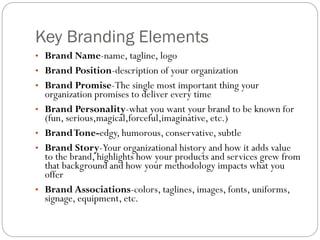
Key Branding Elements
• Brand Name-name, tagline, logo
• Brand Position-description of your organization
• Brand Promise-The single most important thing your
organization promises to deliver every time
• Brand Personality-what you want your brand to be known for
(fun, serious,magical,forceful,imaginative, etc.)
• BrandTone-edgy, humorous, conservative, subtle
• Brand Story-Your organizational history and how it adds value
to the brand, highlights how your products and services grew from
that background and how your methodology impacts what you
offer
• Brand Associations-colors, taglines, images, fonts, uniforms,
signage, equipment, etc.
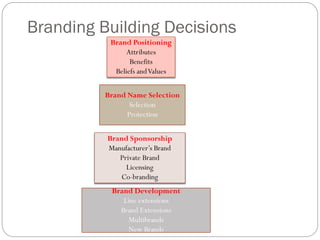
Branding Building Decisions
Brand Positioning
Attributes
Benefits
Beliefs andValues
Brand Name Selection
Selection
Protection
Brand Sponsorship
Manufacturer’s Brand
Private Brand
Licensing
Co-branding
Brand Development
Line extensions
Brand Extensions
Multibrands
New Brands
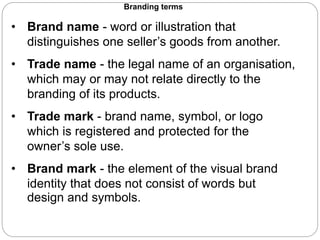
Branding terms
• Brand name - word or illustration that
distinguishes one seller’s goods from another.
• Trade name - the legal name of an organisation,
which may or may not relate directly to the
branding of its products.
• Trade mark - brand name, symbol, or logo
which is registered and protected for the
owner’s sole use.
• Brand mark - the element of the visual brand
identity that does not consist of words but
design and symbols.
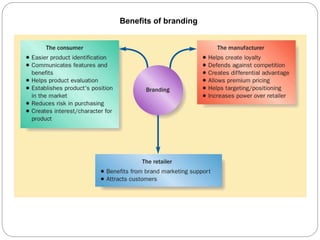
Benefits of branding
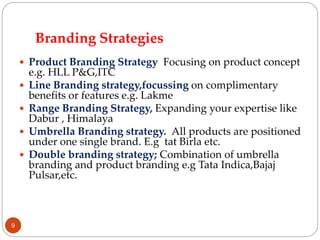
Branding Strategies
 Product Branding Strategy Focusing on product concept
e.g. HLL P&G,ITC
 Line Branding strategy,focussing on complimentary
benefits or features e.g. Lakme
 Range Branding Strategy, Expanding your expertise like
Dabur , Himalaya
 Umbrella Branding strategy. All products are positioned
under one single brand. E.g tat Birla etc.
 Double branding strategy; Combination of umbrella
branding and product branding e.g Tata Indica,Bajaj
Pulsar,etc.
9
Brand Management
 Brand management is the act of designing and
implementing marketing programs to build and
maintain brand equity.
 Product
 Price
 Distribution
 Communications
The Role of a Brand or Product
Manager
 Prepare Marketing Plan
 Develop Copy, Programs, and Campaigns
 Stimulate Sales and Distribution
 Market Intelligence
 Product Improvements
12
New Branding Challenges
 Brands are important as ever
 Consumer need for simplification
 Consumer need for risk reduction
 Brand management is as difficult as ever
 consumers
 Increased competition
 Decreased effectiveness of traditional marketing
tools and emergence of new marketing tools
 Complex brand and product portfolios
CONCLUSION:
 I CONCLUDETHAT THIS BRANDING IS ALSO A
IMPORTANT FACTORTOA COMPANY FORTHEIR
PRODUCT IDENTIFICATIONANDTO SHOW UNIQUE
NESS FROM COMPETATOR PRODUCTS.
THANK YOU

Branding

  • 1.
  • 2.
     A brandis any name, design, style, words or symbols, singly or in combination that distinguish one product from another in the eyes of the customer.  Brands are used by people to establish their status far more than religion or political party. • An important element of the tangible product. • In consumer markets can link items within a product line. • Can help in the development of a new product. • Creates and communicates a three dimensional character of a product that is not easily duplicated by competitors. Branding
  • 3.
    Role and Significanceof Brands  A major asset of the Firm They are valuable, renewable and lasting assets, capable of working for their firms for generations. Example Coca Cola, Microsoft, IBM, Mc Donalds….  Brand Represents the value Delivered to the customers Brand is a valuable asset to the firm Builds customer patronage and trust Secures customers life time loyalty It becomes his sole choice  Brand offers Strategic Leverage to the firm
  • 4.
    Characteristics of Strong.Successful Brands  The brand drives shareholders value  It is fully integrated part of the organization as a whole, aligned around multiple touch points  It can be valued in financial terms  It can be bought and sold as an asset  Customers are willing to pay a substantial and consistent price premium for it  Customers associate strongly with a brand  Customers are loyal to a brand  It is fiercely and proactively protected by the company
  • 5.
    Key Branding Elements •Brand Name-name, tagline, logo • Brand Position-description of your organization • Brand Promise-The single most important thing your organization promises to deliver every time • Brand Personality-what you want your brand to be known for (fun, serious,magical,forceful,imaginative, etc.) • BrandTone-edgy, humorous, conservative, subtle • Brand Story-Your organizational history and how it adds value to the brand, highlights how your products and services grew from that background and how your methodology impacts what you offer • Brand Associations-colors, taglines, images, fonts, uniforms, signage, equipment, etc.
  • 6.
    Branding Building Decisions BrandPositioning Attributes Benefits Beliefs andValues Brand Name Selection Selection Protection Brand Sponsorship Manufacturer’s Brand Private Brand Licensing Co-branding Brand Development Line extensions Brand Extensions Multibrands New Brands
  • 7.
    Branding terms • Brandname - word or illustration that distinguishes one seller’s goods from another. • Trade name - the legal name of an organisation, which may or may not relate directly to the branding of its products. • Trade mark - brand name, symbol, or logo which is registered and protected for the owner’s sole use. • Brand mark - the element of the visual brand identity that does not consist of words but design and symbols.
  • 8.
  • 9.
    Branding Strategies  ProductBranding Strategy Focusing on product concept e.g. HLL P&G,ITC  Line Branding strategy,focussing on complimentary benefits or features e.g. Lakme  Range Branding Strategy, Expanding your expertise like Dabur , Himalaya  Umbrella Branding strategy. All products are positioned under one single brand. E.g tat Birla etc.  Double branding strategy; Combination of umbrella branding and product branding e.g Tata Indica,Bajaj Pulsar,etc. 9
  • 10.
    Brand Management  Brandmanagement is the act of designing and implementing marketing programs to build and maintain brand equity.  Product  Price  Distribution  Communications
  • 11.
    The Role ofa Brand or Product Manager  Prepare Marketing Plan  Develop Copy, Programs, and Campaigns  Stimulate Sales and Distribution  Market Intelligence  Product Improvements
  • 12.
    12 New Branding Challenges Brands are important as ever  Consumer need for simplification  Consumer need for risk reduction  Brand management is as difficult as ever  consumers  Increased competition  Decreased effectiveness of traditional marketing tools and emergence of new marketing tools  Complex brand and product portfolios
  • 13.
    CONCLUSION:  I CONCLUDETHATTHIS BRANDING IS ALSO A IMPORTANT FACTORTOA COMPANY FORTHEIR PRODUCT IDENTIFICATIONANDTO SHOW UNIQUE NESS FROM COMPETATOR PRODUCTS.
  • 14.