
LALITH
CRM …..
Any application or initiative designed
to help an organization optimize
interactions with customers,
suppliers, or prospects via one or
more touch points for the purpose of
acquiring, retaining customers.
Introduction of e-CRM
 eCRM is the application of CRM to an e-business’
strategy
 Personalization/customization of customers’ experiences
and interactions with the e-business
 Recall:
 Relationship between merchant and customers is distant
 Less expensive to keep customers than to acquire new ones
 Repeat customers have higher lifetime value than one-time
buyers
How? Track and Analyze Data
 Employ tracking devices
 Personalize each visitor’s experience
 Find trends in customer use
 Measure effectiveness of a Web site over time
 ID cards
 An ID card enables information to be sent to a Web site
such as your IP address, your browser, or your operating
system
 Click-through banner advertisements
 Click-through ads enable visitors to view a service or
product by clicking the ad
 Advertisers can learn what sites generate sales
Tracking: Web Bugs
Web Bugs
 A type of image file embedded in an image on the screen
 Site owners allow companies, especially advertising
companies, to hide these information-collecting
programs on various parts of their sites
 Every time a user requests a page with a Web bug on it,
the Web bug sends a request to the Web bug’s
company’s server, which then tracks where the user goes
on the Web.
Tracking: Log-File Analysis
 When visiting a site, you are submitting a request
and this is recorded in a log file
 Log files consist of data generated by site visits,
including each visitor’s location, IP address, time of
visit, frequency of visits, etc.
 Log-file analysis organizes and summarizes the
information contained in the log files
 Can be used to determine the number of unique visitors
 Can show the Web-site traffic effects of changing a Web site
or advertising campaign
 E.g. WebTrends.com
Tracking: Data Mining
 Data mining (building on a data warehouse)
 Uses algorithms and statistical tools to find patterns in
data gathered from customer visits
 Costly and time consuming to go through large amounts
of data manually
 Use data-mining to analyze trends within their
companies or in the marketplace
 Uncovered patterns can improve CRM and marketing
campaigns
 Discover a need for new or improved services or
products by studying the patterns of customers’
purchases
Tracking: Customer Registration
Customer registration
 Requiring visitors to fill out a form with personal
information that is then used to create a profile
 Only works when it will provide a benefit to the customer
 When customers log on using usernames and passwords,
their actions can be tracked and stored in a database
 Require only minimum information
 Need to give customers an incentive to register
Tracking: Cookies
 Cookie
 A text file stored by a Web site on an individual’s
personal computer that allows a site to track the actions
of a customer
 Information collected is intended to be an anonymous
account of log-on times, the length of stay at the site,
purchases made on the site, the site previously visited,
the site visited next
 Does not interact with other information stored on the
system
 Can only be read by the host that sets them on a person’s
computer
Personalization
 Uses information from tracking, mining and data
analysis to customize a person’s interactions with a
company’s products, services, Web site and
employees
 Establish relationships that improve each time
visitors return to site
 Customers may enjoy individual attention and
become more loyal, e.g.
http://www.moneycontrol.com
Contact Centers
 Traditional call centers house customer-service
representatives
 e-contact center
 Purpose is the same—to provide a personal customer
service experience
 Allow customers with Internet access to contact
customer service representatives through e-mail, online
text chatting or real-time voice communications
 Integration of all customer service functions
E-Contact Centers Can change the culture of customer service
representatives:
 More technically knowledgeable to handle all forms
of contact
 Provide a highly personalized experience that
satisfies customers
 New forms of contact can decrease costs
 Outsource contact center services
 May be appropriate if a company cannot afford to
implement a contact center due to the costs of
equipment, office space, service representatives and
technical support.
Frequently Asked Questions
(FAQs)
 A Frequently Asked Questions (FAQ) section on the
site
 Will help customers find answers to some of their
questions
 Frees up time to handle questions that can not be
answered without human interaction
 Typically accompanied by phone numbers, e-mail
addresses, and a search engine
E-Marketing Management
E-mail Marketing: Alerts, E-Newsletter
Management
E-Surveying: Progressive Profiling
Management
Viral Marketing: Tell-a-Friend
Management
Web Design: Registration, Subscription,
VIP Management
Online Community / E-Suggestion Box /
Blog Management
E-Commerce: Memberships, Event
Registration Management
Affiliate Management: Sponsorship
Management (Boston Symphony)
Reporting / Analysis: Profiles,
Behaviors
TRADITIONAL FORM OF CRM
The existing CRM solution are not capable
enough to satisfy and retaining customers and
also there is no integrated tool which connect
the Central sales management, regional sales
office, customers care, sales, sales distribution,
regional sales team in effective manner.
A 360 view requires the automation to bring
together all the data concerning a customer.
This implies that organizations have to change
the form :
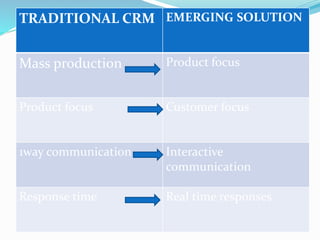
TRADITIONAL CRM EMERGING SOLUTION
Mass production Product focus
Product focus Customer focus
1way communication Interactive
communication
Response time Real time responses
Present CRM alternatives
 Present CRM solutions are offered by the host of
vendors that are to a great extent not industry
specific. While some vendors, who have come up
with industry specific solutions, the broad model
around which the CRM solutions are built, remain
the same. A typical offerings of the current CRM
solution (such as Siebel, oracle apps or Mysap.com
etc.) vary form solution to solution.
Present CRM alternatives
A typical offerings of the current CRM solutions
offerings comprise of :
 Customer developments
 Service center
 Sales management & support
 Market Analysis
 Internet, telemarketing product & brand management
Present CRM alternatives
 Field sales , Tele sales,
 internet sales
 Call centers
 Field service
 Internet customer service
 Service interaction center(call centers)
 Business partners collaborations
Technology impact on CRM
Technology is touching the way, we live our lives,
expectations of individuals is changing
continuously and PCs and internet revolutionizing
our lives in 21st century . Some clear trends that can
be clearly seen are :
 More and more individual will like to be treated as
one single person rather then as among the masses
.
 People wish products and services round the
clock.
EMERGING IMAPCT OF E-COMMERCE
ON CRM
In a fast changing internet world there are very clear trends
that are emerging :
 Speed: people expect service at fast speed
 Increase of global market place: more more people ,
communities across the globe are able to build
relationships.
 Around the clock availability
 expansion of partners : internet offers the ability for the
organizations and people alike to partner with suppliers
and customers alike across the globe.
EMERGING IMAPCT OF E-
COMMERCE ON CRM
 In global market place the channels of marketing
are already causing an impact on the buying
behavior of individuals as well as organizations
alike. Some of the trends are :
1. VERTICAL E-MARKET PLACE :industry specific
market place such as being formed by auto giants
where organized buyers and sellers can meet,
list, negotiate, make orders and track delivery.
EMERGING IMAPCT OF E-COMMERCE
ON CRM
 BUY SITE AND SELL SITE: where consumers and
organization are alike can buy or sell online through online
shopping mart concept.
 HORIZONTAL MARKET PLACE: service that run across
the different vertical e-market places or business to
customers (B2C) buy and sell sites. Such sites should be
delivery sites , insurance etc.
 Use of internet to optimize supply chain
management(SCM) : earlier organizations use to use EDI
rather than the expensive preposition for limited numbers
of partners but now organizations are implementing new
ERP systems to optimize its SCM.
e-CRM
 With the abundance of product and services
offerings, consumer`s loyalty can only be
commanded by providing better portfolio of
services.
 speed of response and understanding each
individual one of the major key issues CRM has
become the central focus area around which the
entire gamut of organizational activity has to
revolve round.
What is e-CRM ?
In simplest terms e-crm provides company to conduct
interactive, personalized and relevant communications
across the globe with their customers by utilizing the
traditional and electronic channels both.
It adheres to permission based practices, respecting
individual's preferences regarding how and whether they
wish to communicate with you and it focuses on the
understanding how the economics of the customers
relationships affects the business.
What is e-CRM ?e- CRM is the electronic based version of CRM. The
user of the a e- CRM solution uses the sources of the
internet to increase the relationship with the
customer.
web based CRM can easily handle the
relationships between Central sales management,
regional sales office, customers care, sales, sales
distribution, regional sales team.
Why employ e-CRM ?
 To optimize the value of the interactive relationships
 Enable the business to extends its personalized reach in the
hand of customers
 Co-ordinating marketing initiatives across the all
customers channels
 Leverage the customer`s information for more effective e-
marketing and e-business
 Focus the business on improving the customers
relationship and earning a greater share of each
customer`s business through consistent measurement,
assessment and actionable customer strategy.
The six “E`s” of e-CRM
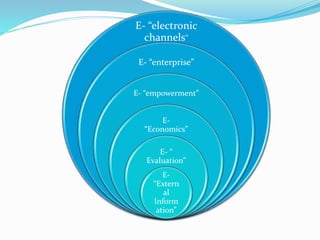
 The ‘e’ not only stands for “electronic” but also
perceived to have many other connotations. Through
the core of CRM remains to be cross channel
integration and optimization. The six “E” of e-CRM are
briefly explained in the next slides.
E- “electronic
channels”
E- “enterprise”
E- “empowerment”
E-
“Economics”
E- “
Evaluation”
E-
“Extern
al
Inform
ation”
The six “E`s” of e-CRM
1) Electronic channels: new electronic channels such as
web and personalized e- messaging have become a
medium for fast and interactive , economic
communication , challenging company to keep pace with
the increased velocity. E – crm thrives on these electronic
channels.
2) Enterprise : through e- CRM the company gains the
mean to touch and shape a customers experience through
sales, services and corners offices whose occupants need
to understand and assess the customers behavior.
The six “E`s” of e-CRM
3. Empowerment: it must be structured to
accommodate consumers who now have the power to
decide when and how to communicate with the
company. Through ,which channel , at what frequency.
An e- CRM must be structured to deliver timely
pertinent, valuable information that consumers
accepts in exchange of his/her attention.
The six “E`s” of e-CRM
4. Economics : an e-CRM strategy ideally should
concentrate on the consumer economics, which
drives smart asset allocation decisions, directing
efforts at individuals likely to provide the greatest
return on customer- communication initiatives.
The six “E`s” of e-CRM
5.Evaluation: understanding the customers relies on a
company`s ability to attribute customers behavior to
market programs, evaluate customer interactions
along various customers touch points channels and
compare anticipate ROI against actual returns through
analytic reporting.
The six “E`s” of e-CRM
6. EXTERNAL INFORMATION : the e-CRM solution should
be able to gain and leverage information from such sources
as third party information networks and webpage profiler
application.
 Acquisition (increasing the no. of customers)
 Expansion (increasing the profitability by encouraging
customers to purchase more products and services)
 Retention (increase the amount of time in which the
customers stays with company, making a long-term
relationship)
KEY FEATURES OF e-CRM
 Regardless of an company objectives e-CRM
solution must posses certain key characteristics. It
must be:
 driven by a DATA WAREHOUSE
 Focused on the consistent metrics to asses
customers actions across the channels
 Structured to identify a customer profitability or
profit potential
KEY FEATURES OF e-CRM
 To determine the effective allocation decisions accordingly,
so that most profitable customers could be indentified and
retained and the resource could be invested in the
relationships, which are more profitable.
EVOLVING TO e-CRM
 In nutshell company a company evolving to e-CRM should be:
 Define its business objective. This would be specific and different for
different businesses
 Assess its current position with respect to the environment and
determine its current level of “sophistication” along the e-CRM
continuum ( e-CRM assessment)
 Define new business processes and align its existing business strategy
and existing processes in line with the new realities (e-CRM Strategy
alignment)
 Define a technical architecture and the criteria`s associated with this
architecture and the important criteria associated with this
architecture. (e-CRM)
E – CRM ASSESSMENT
Before the implementation of a particular strategy into any business
scenario, it is worthwhile to know the current state of the business with
respect to prevailing competition. It is vary important to develop a
numerical measure of how a company measures up in the eye of the
customers with respect to its competitors.
in this particular case of e- CRM ,an e- CRM capability index would
be devised , which provide a benchmark for cross company comparison
based on these results, a company identifies quick hits based upon e-
CRM gap which can which can be immediately implemented to
improve the business processes ,impact the bottom line and further
enhanced its understanding of its customers` view of the company. E-
CRM stage would be the diagnostic stage , followed by e-CRM strategy
alignment and e-CRM architecture model.
E- CRM STRATEGY ALIGNMENT
Every company moving in to e- CRM must make a key
decisions on a number of significant customers related
factors. Each company must indentify, measure and align
to the gaps that exist between customer expectations
already measured in the e-CRM assessment stage and the
internal capabilities that these customers expectations.
Ideally in this module a company should try to build up the
consensus across the functions , which the company need
to take to satisfy the customer expectations.
E-CRM architecture
The primary input to this module are mainly from the e-CRM assessment
and strategy alignment modules. during this stage the company will try
and develop a connected enterprise architecture(CEA) within the
context of the companies' own customers relationship management
strategy. The following is set of technical e-CRM capabilities and
applications that collectively and ideally comprise a full e-CRM
solutions :
 Customers analytic soft wares
 Data mining soft wares
 Campaign management soft wares
 Business simulation
 A real time decision engines
E-CRM architecture
 Customer analytic software : predicts ,measures and interprets the
customers behavior allowing companies to understands the
effectiveness of e-CRM efforts across both inbound and outbound
channels. Most importantly, customers analysis should integrate with
customers communication software to enable the company to
transform customer findings into ROI- producing initiatives.
 Data mining software :it builds the predictive models to identify
customers most likely to perform a particular behaviors such as
purchase an upgrade or churn from the company. Modeling must be
tightly integrated with the campaign management software to keep the
pace with the multiple campaign running daily or- weekly.
E-CRM architecture
 Campaign management soft wares : leverages the data wares
house to plan and execute multiple, highly targeted campaigns
overtimes, using triggers that respond timed events and
customers behavior. Campaign management software test
various offers against controls groups, capture promotion history
for each customers and prospect and produces output virtually
any online or offline customers touch point channel.
 Business simulation : it is used with conjunction with
campaign management software optimize offer, messaging and
channel delivery prior to the execution of campaigns and
compare planned cost and ROI projection with actual cost.
 A real time decision engine : coordinate and
synchronizes communications across various
customers touch point systems. It contains the
business intelligence to determine and communicate
the most appropriate message ,offer, and channel
delivery in real time and support two way dialogue
with the customers
MOBILE CRM
One subset of Electronic CRM is Mobile CRM (m-
CRM). This is defined as “services that aim at
nurturing customer relationships, acquiring or
maintaining customers, support marketing, sales
or services processes, and use wireless networks as
the medium of delivery to the customers. However,
since communications is the central aspect of
customer relations activities, many opt for the
following definition of m-CRM:
MOBILE CRM
“communication, either one-way or interactive, which is
related to sales, marketing and customer service
activities conducted through mobile medium for the
purpose of building and maintaining customer
relationships between a company and its customer(s)”
MOBILE CRM
E-CRM allows customers to access company services
from more and more places, since the Internet
access points are increasing by the day. M-CRM
however, takes this one step further and allows
customers or managers to access the systems for
instance from a mobile phone or PDA with
internet access, resulting in high flexibility.
MOBILE CRM
 An example of a company that implemented m-CRM
is Finn-air, who made it possible for their customers to
check in for their flights by SMS. Since m-CRM is not
able to provide a complete range of customer
relationship activities it should be integrated in the
complete CRM system.

C.r.m & e --c.r.m

  • 1.
  • 2.
    CRM ….. Any applicationor initiative designed to help an organization optimize interactions with customers, suppliers, or prospects via one or more touch points for the purpose of acquiring, retaining customers.
  • 3.
    Introduction of e-CRM eCRM is the application of CRM to an e-business’ strategy  Personalization/customization of customers’ experiences and interactions with the e-business  Recall:  Relationship between merchant and customers is distant  Less expensive to keep customers than to acquire new ones  Repeat customers have higher lifetime value than one-time buyers
  • 4.
    How? Track andAnalyze Data  Employ tracking devices  Personalize each visitor’s experience  Find trends in customer use  Measure effectiveness of a Web site over time  ID cards  An ID card enables information to be sent to a Web site such as your IP address, your browser, or your operating system  Click-through banner advertisements  Click-through ads enable visitors to view a service or product by clicking the ad  Advertisers can learn what sites generate sales
  • 5.
    Tracking: Web Bugs WebBugs  A type of image file embedded in an image on the screen  Site owners allow companies, especially advertising companies, to hide these information-collecting programs on various parts of their sites  Every time a user requests a page with a Web bug on it, the Web bug sends a request to the Web bug’s company’s server, which then tracks where the user goes on the Web.
  • 6.
    Tracking: Log-File Analysis When visiting a site, you are submitting a request and this is recorded in a log file  Log files consist of data generated by site visits, including each visitor’s location, IP address, time of visit, frequency of visits, etc.  Log-file analysis organizes and summarizes the information contained in the log files  Can be used to determine the number of unique visitors  Can show the Web-site traffic effects of changing a Web site or advertising campaign  E.g. WebTrends.com
  • 7.
    Tracking: Data Mining Data mining (building on a data warehouse)  Uses algorithms and statistical tools to find patterns in data gathered from customer visits  Costly and time consuming to go through large amounts of data manually  Use data-mining to analyze trends within their companies or in the marketplace  Uncovered patterns can improve CRM and marketing campaigns  Discover a need for new or improved services or products by studying the patterns of customers’ purchases
  • 8.
    Tracking: Customer Registration Customerregistration  Requiring visitors to fill out a form with personal information that is then used to create a profile  Only works when it will provide a benefit to the customer  When customers log on using usernames and passwords, their actions can be tracked and stored in a database  Require only minimum information  Need to give customers an incentive to register
  • 9.
    Tracking: Cookies  Cookie A text file stored by a Web site on an individual’s personal computer that allows a site to track the actions of a customer  Information collected is intended to be an anonymous account of log-on times, the length of stay at the site, purchases made on the site, the site previously visited, the site visited next  Does not interact with other information stored on the system  Can only be read by the host that sets them on a person’s computer
  • 10.
    Personalization  Uses informationfrom tracking, mining and data analysis to customize a person’s interactions with a company’s products, services, Web site and employees  Establish relationships that improve each time visitors return to site  Customers may enjoy individual attention and become more loyal, e.g. http://www.moneycontrol.com
  • 11.
    Contact Centers  Traditionalcall centers house customer-service representatives  e-contact center  Purpose is the same—to provide a personal customer service experience  Allow customers with Internet access to contact customer service representatives through e-mail, online text chatting or real-time voice communications  Integration of all customer service functions
  • 12.
    E-Contact Centers Canchange the culture of customer service representatives:  More technically knowledgeable to handle all forms of contact  Provide a highly personalized experience that satisfies customers  New forms of contact can decrease costs  Outsource contact center services  May be appropriate if a company cannot afford to implement a contact center due to the costs of equipment, office space, service representatives and technical support.
  • 13.
    Frequently Asked Questions (FAQs) A Frequently Asked Questions (FAQ) section on the site  Will help customers find answers to some of their questions  Frees up time to handle questions that can not be answered without human interaction  Typically accompanied by phone numbers, e-mail addresses, and a search engine
  • 14.
    E-Marketing Management E-mail Marketing:Alerts, E-Newsletter Management E-Surveying: Progressive Profiling Management Viral Marketing: Tell-a-Friend Management Web Design: Registration, Subscription, VIP Management Online Community / E-Suggestion Box / Blog Management E-Commerce: Memberships, Event Registration Management Affiliate Management: Sponsorship Management (Boston Symphony) Reporting / Analysis: Profiles, Behaviors
  • 15.
    TRADITIONAL FORM OFCRM The existing CRM solution are not capable enough to satisfy and retaining customers and also there is no integrated tool which connect the Central sales management, regional sales office, customers care, sales, sales distribution, regional sales team in effective manner. A 360 view requires the automation to bring together all the data concerning a customer. This implies that organizations have to change the form :
  • 16.
    TRADITIONAL CRM EMERGINGSOLUTION Mass production Product focus Product focus Customer focus 1way communication Interactive communication Response time Real time responses
  • 17.
    Present CRM alternatives Present CRM solutions are offered by the host of vendors that are to a great extent not industry specific. While some vendors, who have come up with industry specific solutions, the broad model around which the CRM solutions are built, remain the same. A typical offerings of the current CRM solution (such as Siebel, oracle apps or Mysap.com etc.) vary form solution to solution.
  • 18.
    Present CRM alternatives Atypical offerings of the current CRM solutions offerings comprise of :  Customer developments  Service center  Sales management & support  Market Analysis  Internet, telemarketing product & brand management
  • 19.
    Present CRM alternatives Field sales , Tele sales,  internet sales  Call centers  Field service  Internet customer service  Service interaction center(call centers)  Business partners collaborations
  • 20.
    Technology impact onCRM Technology is touching the way, we live our lives, expectations of individuals is changing continuously and PCs and internet revolutionizing our lives in 21st century . Some clear trends that can be clearly seen are :  More and more individual will like to be treated as one single person rather then as among the masses .  People wish products and services round the clock.
  • 21.
    EMERGING IMAPCT OFE-COMMERCE ON CRM In a fast changing internet world there are very clear trends that are emerging :  Speed: people expect service at fast speed  Increase of global market place: more more people , communities across the globe are able to build relationships.  Around the clock availability  expansion of partners : internet offers the ability for the organizations and people alike to partner with suppliers and customers alike across the globe.
  • 22.
    EMERGING IMAPCT OFE- COMMERCE ON CRM  In global market place the channels of marketing are already causing an impact on the buying behavior of individuals as well as organizations alike. Some of the trends are : 1. VERTICAL E-MARKET PLACE :industry specific market place such as being formed by auto giants where organized buyers and sellers can meet, list, negotiate, make orders and track delivery.
  • 23.
    EMERGING IMAPCT OFE-COMMERCE ON CRM  BUY SITE AND SELL SITE: where consumers and organization are alike can buy or sell online through online shopping mart concept.  HORIZONTAL MARKET PLACE: service that run across the different vertical e-market places or business to customers (B2C) buy and sell sites. Such sites should be delivery sites , insurance etc.  Use of internet to optimize supply chain management(SCM) : earlier organizations use to use EDI rather than the expensive preposition for limited numbers of partners but now organizations are implementing new ERP systems to optimize its SCM.
  • 24.
    e-CRM  With theabundance of product and services offerings, consumer`s loyalty can only be commanded by providing better portfolio of services.  speed of response and understanding each individual one of the major key issues CRM has become the central focus area around which the entire gamut of organizational activity has to revolve round.
  • 25.
    What is e-CRM? In simplest terms e-crm provides company to conduct interactive, personalized and relevant communications across the globe with their customers by utilizing the traditional and electronic channels both. It adheres to permission based practices, respecting individual's preferences regarding how and whether they wish to communicate with you and it focuses on the understanding how the economics of the customers relationships affects the business.
  • 26.
    What is e-CRM?e- CRM is the electronic based version of CRM. The user of the a e- CRM solution uses the sources of the internet to increase the relationship with the customer. web based CRM can easily handle the relationships between Central sales management, regional sales office, customers care, sales, sales distribution, regional sales team.
  • 27.
    Why employ e-CRM?  To optimize the value of the interactive relationships  Enable the business to extends its personalized reach in the hand of customers  Co-ordinating marketing initiatives across the all customers channels  Leverage the customer`s information for more effective e- marketing and e-business  Focus the business on improving the customers relationship and earning a greater share of each customer`s business through consistent measurement, assessment and actionable customer strategy.
  • 28.
    The six “E`s”of e-CRM  The ‘e’ not only stands for “electronic” but also perceived to have many other connotations. Through the core of CRM remains to be cross channel integration and optimization. The six “E” of e-CRM are briefly explained in the next slides.
  • 29.
    E- “electronic channels” E- “enterprise” E-“empowerment” E- “Economics” E- “ Evaluation” E- “Extern al Inform ation”
  • 30.
    The six “E`s”of e-CRM 1) Electronic channels: new electronic channels such as web and personalized e- messaging have become a medium for fast and interactive , economic communication , challenging company to keep pace with the increased velocity. E – crm thrives on these electronic channels. 2) Enterprise : through e- CRM the company gains the mean to touch and shape a customers experience through sales, services and corners offices whose occupants need to understand and assess the customers behavior.
  • 31.
    The six “E`s”of e-CRM 3. Empowerment: it must be structured to accommodate consumers who now have the power to decide when and how to communicate with the company. Through ,which channel , at what frequency. An e- CRM must be structured to deliver timely pertinent, valuable information that consumers accepts in exchange of his/her attention.
  • 32.
    The six “E`s”of e-CRM 4. Economics : an e-CRM strategy ideally should concentrate on the consumer economics, which drives smart asset allocation decisions, directing efforts at individuals likely to provide the greatest return on customer- communication initiatives.
  • 33.
    The six “E`s”of e-CRM 5.Evaluation: understanding the customers relies on a company`s ability to attribute customers behavior to market programs, evaluate customer interactions along various customers touch points channels and compare anticipate ROI against actual returns through analytic reporting.
  • 34.
    The six “E`s”of e-CRM 6. EXTERNAL INFORMATION : the e-CRM solution should be able to gain and leverage information from such sources as third party information networks and webpage profiler application.  Acquisition (increasing the no. of customers)  Expansion (increasing the profitability by encouraging customers to purchase more products and services)  Retention (increase the amount of time in which the customers stays with company, making a long-term relationship)
  • 35.
    KEY FEATURES OFe-CRM  Regardless of an company objectives e-CRM solution must posses certain key characteristics. It must be:  driven by a DATA WAREHOUSE  Focused on the consistent metrics to asses customers actions across the channels  Structured to identify a customer profitability or profit potential
  • 36.
    KEY FEATURES OFe-CRM  To determine the effective allocation decisions accordingly, so that most profitable customers could be indentified and retained and the resource could be invested in the relationships, which are more profitable.
  • 37.
    EVOLVING TO e-CRM In nutshell company a company evolving to e-CRM should be:  Define its business objective. This would be specific and different for different businesses  Assess its current position with respect to the environment and determine its current level of “sophistication” along the e-CRM continuum ( e-CRM assessment)  Define new business processes and align its existing business strategy and existing processes in line with the new realities (e-CRM Strategy alignment)  Define a technical architecture and the criteria`s associated with this architecture and the important criteria associated with this architecture. (e-CRM)
  • 38.
    E – CRMASSESSMENT Before the implementation of a particular strategy into any business scenario, it is worthwhile to know the current state of the business with respect to prevailing competition. It is vary important to develop a numerical measure of how a company measures up in the eye of the customers with respect to its competitors. in this particular case of e- CRM ,an e- CRM capability index would be devised , which provide a benchmark for cross company comparison based on these results, a company identifies quick hits based upon e- CRM gap which can which can be immediately implemented to improve the business processes ,impact the bottom line and further enhanced its understanding of its customers` view of the company. E- CRM stage would be the diagnostic stage , followed by e-CRM strategy alignment and e-CRM architecture model.
  • 39.
    E- CRM STRATEGYALIGNMENT Every company moving in to e- CRM must make a key decisions on a number of significant customers related factors. Each company must indentify, measure and align to the gaps that exist between customer expectations already measured in the e-CRM assessment stage and the internal capabilities that these customers expectations. Ideally in this module a company should try to build up the consensus across the functions , which the company need to take to satisfy the customer expectations.
  • 40.
    E-CRM architecture The primaryinput to this module are mainly from the e-CRM assessment and strategy alignment modules. during this stage the company will try and develop a connected enterprise architecture(CEA) within the context of the companies' own customers relationship management strategy. The following is set of technical e-CRM capabilities and applications that collectively and ideally comprise a full e-CRM solutions :  Customers analytic soft wares  Data mining soft wares  Campaign management soft wares  Business simulation  A real time decision engines
  • 41.
    E-CRM architecture  Customeranalytic software : predicts ,measures and interprets the customers behavior allowing companies to understands the effectiveness of e-CRM efforts across both inbound and outbound channels. Most importantly, customers analysis should integrate with customers communication software to enable the company to transform customer findings into ROI- producing initiatives.  Data mining software :it builds the predictive models to identify customers most likely to perform a particular behaviors such as purchase an upgrade or churn from the company. Modeling must be tightly integrated with the campaign management software to keep the pace with the multiple campaign running daily or- weekly.
  • 42.
    E-CRM architecture  Campaignmanagement soft wares : leverages the data wares house to plan and execute multiple, highly targeted campaigns overtimes, using triggers that respond timed events and customers behavior. Campaign management software test various offers against controls groups, capture promotion history for each customers and prospect and produces output virtually any online or offline customers touch point channel.  Business simulation : it is used with conjunction with campaign management software optimize offer, messaging and channel delivery prior to the execution of campaigns and compare planned cost and ROI projection with actual cost.
  • 43.
     A realtime decision engine : coordinate and synchronizes communications across various customers touch point systems. It contains the business intelligence to determine and communicate the most appropriate message ,offer, and channel delivery in real time and support two way dialogue with the customers
  • 44.
    MOBILE CRM One subsetof Electronic CRM is Mobile CRM (m- CRM). This is defined as “services that aim at nurturing customer relationships, acquiring or maintaining customers, support marketing, sales or services processes, and use wireless networks as the medium of delivery to the customers. However, since communications is the central aspect of customer relations activities, many opt for the following definition of m-CRM:
  • 45.
    MOBILE CRM “communication, eitherone-way or interactive, which is related to sales, marketing and customer service activities conducted through mobile medium for the purpose of building and maintaining customer relationships between a company and its customer(s)”
  • 46.
    MOBILE CRM E-CRM allowscustomers to access company services from more and more places, since the Internet access points are increasing by the day. M-CRM however, takes this one step further and allows customers or managers to access the systems for instance from a mobile phone or PDA with internet access, resulting in high flexibility.
  • 47.
    MOBILE CRM  Anexample of a company that implemented m-CRM is Finn-air, who made it possible for their customers to check in for their flights by SMS. Since m-CRM is not able to provide a complete range of customer relationship activities it should be integrated in the complete CRM system.