Cost Accounting & its Classification
Presented By:
Susheel Kumar Tiwari
MBA (General) Ist sem.
Presented To:
Dr. Rachna Jaiswal
 Cost accounting is the process of recording, classifying, analyzing,
summarizing, and allocating costs associated with a process, and then
developing various courses of action to control the costs.
 Cost accounting provides the detailed cost information that
management needs to control current operations and plan for the future.
What is Cost Accounting?
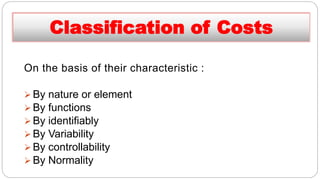
Classification of Costs
On the basis of their characteristic :
 By nature or element
 By functions
 By identifiably
 By Variability
 By controllability
 By Normality
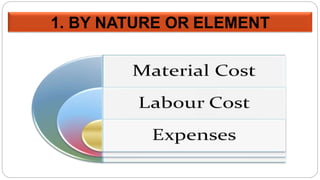
1. BY NATURE OR ELEMENT
MATERIAL COST
Cost of materials used for the manufacture of a product, a particular work
order, or provision of a service.
Example: Cloth for making a dress, stores used for maintaining machines
and buildings such as lubricants, cotton waste, bricks etc.
LABOUR COST
The cost of labour is the sum of all wages paid to employees, as well as the
cost of employee benefits and payroll taxes Paid by an employer.
Example : The cost of labor to run the machinery is a variable cost, which
varies with the firm's level of production. The contract with an outside
vendor to perform repair and maintenance on the equipment, and that is
a fixed cost.
EXPENSES
Expense is defined as money expended or cost incurred in a firm's efforts to
generate revenue, representing cost of doing business. They may be in the
form of actual cash payments (such as wages and salaries), a computed
'expired' portion (depreciation) of an asset, or an amount taken out of the
firm's earnings (such as bad debts).
Whereas all expenses are costs, not all costs (such as those incurred in
acquisition of income generating assets) are expenses.
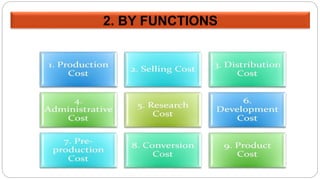
2. BY FUNCTIONS
PRODUCTION COST
Production costs refer to the costs incurred by a business when
manufacturing a good or providing a service. Production costs include a
variety of expenses, such as labor, raw materials, consumable manufacturing
supplies, and general overhead.
SELLING COST
Expenses incurred in the marketing and distribution of a product.
These costs include the following:
1. Salespersons’ salaries and wages
2. Commissions
3. Showroom rent
4. Advertising
5. Promotional expense
DISTRIBUTION COST
• The cost of the sequence of operations which begins with making the packed
product available for dispatch and ends with making the reconditioned
returned empty package, if any available for re-use.
• It also includes expenditure incurred in transporting articles to central or local
storage as well as in moving articles to and from prospective customers as in
case of goods on sale or return basis. In gas, electricity and water industry
distribution means pipes, mains and services which may be regarded as the
equivalent of packing and transportation.
ADMINISTRATIVE COST
• The salaries of senior executives and costs of general services (such
as accounting, contracting, and industrial relations) is comes
under this heading.
• It is not related directly to a production , selling & distribution,
research or development activity or function.
Example: Supplies such as paper and software, as well as rent,
utilities, professional memberships and recurring service fees,
licensing fees etc.
RESEARCH COST
The cost of researching for new or improved products, new applications of
materials, or improved methods.
The main items of expenditure are salaries and wages of the research and
testing staff, materials and facilities used in laboratory and research
departments and payment to outside research agencies.
DEVELOPMENT COST
• Development cost is the cost of the process which begins with
the implementation of the decision to produce a new or
improved product or to employ a new or improved method and
ends with the commencement of formal production of that
product or by that method’.
• Development is the next stage when a small unit of production is
made on a trial or pilot run under practical conditions of
production.
CONVERSION COST
• Conversion costs are those production costs required to convert raw
materials into completed products.
• This is the amount of direct labor and overhead costs that are
required to turn raw materials into an actual product.
• Conversion costs are all manufacturing costs except for the cost of
raw materials.
PRODUCT COST
Product cost refers to the costs used to create a product. These costs include
direct labor, direct materials, consumable production supplies, and factory
overhead.
Product cost can also be considered the cost of the labor required to deliver
a service to a customer.
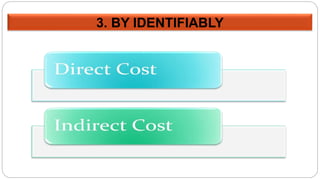
3. BY IDENTIFIABLY
DIRECT COST
• Direct costs are variable costs associated with the inputs and labor
required to produce a good or service. It includes direct labor, direct
materials, commissions, piece rate wages, and manufacturing supplies.
• they are clearly traceable to the production department and to each item
produced
For example, if a company produces furniture, the cost of the wood and the
cost of the craftsperson are direct costs.
INDIRECT COST
The expenses incurred on those items which are not directly chargeable to
production are known as indirect costs.
Example: In production, salaries of timekeepers, storekeepers, foremen are
paid, quality control costs, insurance, and depreciation
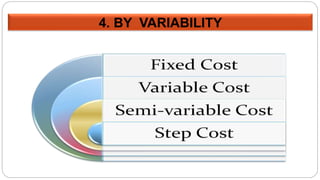
4. BY VARIABILITY
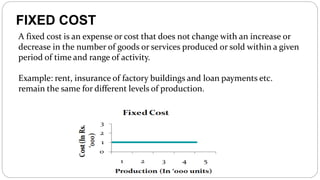
FIXED COST
A fixed cost is an expense or cost that does not change with an increase or
decrease in the number of goods or services produced or sold within a given
period of time and range of activity.
Example: rent, insurance of factory buildings and loan payments etc.
remain the same for different levels of production.
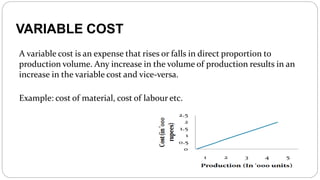
VARIABLE COST
A variable cost is an expense that rises or falls in direct proportion to
production volume. Any increase in the volume of production results in an
increase in the variable cost and vice-versa.
Example: cost of material, cost of labour etc.
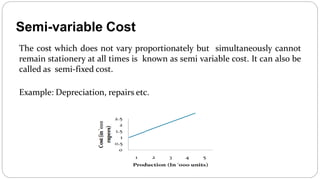
Semi-variable Cost
The cost which does not vary proportionately but simultaneously cannot
remain stationery at all times is known as semi variable cost. It can also be
called as semi-fixed cost.
Example: Depreciation, repairs etc.
5. BY CONTROLLABILITY
CONTROLLABLE COSTS
Controllable costs are costs that can be influenced or regulated by the
manager or head responsible for it.
For example: direct materials, direct labor, and certain factory overhead
costs are controlled by the production manager.
UNCONTROLLABLE COSTS
An uncontrollable cost is an expense over which a person has no direct
control. It cannot be influenced by the action of a specified member of an
undertaking.
Examples of uncontrollable costs are:
• Rent expense
• Corporate overhead allocation
• Administrative overhead allocation
• Depreciation expense
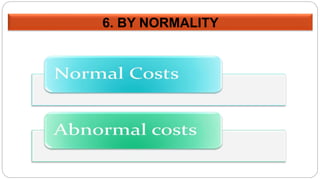
6. BY NORMALITY
ABNORMAL COSTS
Abnormal cost is a cost which is not normally incurred at a given level of
output in the conditions in which that level of output is normally obtained.
Example: destruction due to fire; lockout; shut down of machinery etc
NORMAL COSTS
Normal Cost are the costs which are incurred in the normal conditions
during the normal operations of the organization. They are the sum of
actual direct materials cost, actual labour cost and other direct expense.
Example: repairs, maintenance, salaries paid to employees.
THANK YOU

Ppt on Cost accounting and its classifications

  • 1.
    Cost Accounting &its Classification Presented By: Susheel Kumar Tiwari MBA (General) Ist sem. Presented To: Dr. Rachna Jaiswal
  • 2.
     Cost accountingis the process of recording, classifying, analyzing, summarizing, and allocating costs associated with a process, and then developing various courses of action to control the costs.  Cost accounting provides the detailed cost information that management needs to control current operations and plan for the future. What is Cost Accounting?
  • 3.
    Classification of Costs Onthe basis of their characteristic :  By nature or element  By functions  By identifiably  By Variability  By controllability  By Normality
  • 4.
    1. BY NATUREOR ELEMENT
  • 5.
    MATERIAL COST Cost ofmaterials used for the manufacture of a product, a particular work order, or provision of a service. Example: Cloth for making a dress, stores used for maintaining machines and buildings such as lubricants, cotton waste, bricks etc.
  • 6.
    LABOUR COST The costof labour is the sum of all wages paid to employees, as well as the cost of employee benefits and payroll taxes Paid by an employer. Example : The cost of labor to run the machinery is a variable cost, which varies with the firm's level of production. The contract with an outside vendor to perform repair and maintenance on the equipment, and that is a fixed cost.
  • 7.
    EXPENSES Expense is definedas money expended or cost incurred in a firm's efforts to generate revenue, representing cost of doing business. They may be in the form of actual cash payments (such as wages and salaries), a computed 'expired' portion (depreciation) of an asset, or an amount taken out of the firm's earnings (such as bad debts). Whereas all expenses are costs, not all costs (such as those incurred in acquisition of income generating assets) are expenses.
  • 8.
  • 9.
    PRODUCTION COST Production costsrefer to the costs incurred by a business when manufacturing a good or providing a service. Production costs include a variety of expenses, such as labor, raw materials, consumable manufacturing supplies, and general overhead.
  • 10.
    SELLING COST Expenses incurredin the marketing and distribution of a product. These costs include the following: 1. Salespersons’ salaries and wages 2. Commissions 3. Showroom rent 4. Advertising 5. Promotional expense
  • 11.
    DISTRIBUTION COST • Thecost of the sequence of operations which begins with making the packed product available for dispatch and ends with making the reconditioned returned empty package, if any available for re-use. • It also includes expenditure incurred in transporting articles to central or local storage as well as in moving articles to and from prospective customers as in case of goods on sale or return basis. In gas, electricity and water industry distribution means pipes, mains and services which may be regarded as the equivalent of packing and transportation.
  • 12.
    ADMINISTRATIVE COST • Thesalaries of senior executives and costs of general services (such as accounting, contracting, and industrial relations) is comes under this heading. • It is not related directly to a production , selling & distribution, research or development activity or function. Example: Supplies such as paper and software, as well as rent, utilities, professional memberships and recurring service fees, licensing fees etc.
  • 13.
    RESEARCH COST The costof researching for new or improved products, new applications of materials, or improved methods. The main items of expenditure are salaries and wages of the research and testing staff, materials and facilities used in laboratory and research departments and payment to outside research agencies.
  • 14.
    DEVELOPMENT COST • Developmentcost is the cost of the process which begins with the implementation of the decision to produce a new or improved product or to employ a new or improved method and ends with the commencement of formal production of that product or by that method’. • Development is the next stage when a small unit of production is made on a trial or pilot run under practical conditions of production.
  • 15.
    CONVERSION COST • Conversioncosts are those production costs required to convert raw materials into completed products. • This is the amount of direct labor and overhead costs that are required to turn raw materials into an actual product. • Conversion costs are all manufacturing costs except for the cost of raw materials.
  • 16.
    PRODUCT COST Product costrefers to the costs used to create a product. These costs include direct labor, direct materials, consumable production supplies, and factory overhead. Product cost can also be considered the cost of the labor required to deliver a service to a customer.
  • 17.
  • 18.
    DIRECT COST • Directcosts are variable costs associated with the inputs and labor required to produce a good or service. It includes direct labor, direct materials, commissions, piece rate wages, and manufacturing supplies. • they are clearly traceable to the production department and to each item produced For example, if a company produces furniture, the cost of the wood and the cost of the craftsperson are direct costs.
  • 19.
    INDIRECT COST The expensesincurred on those items which are not directly chargeable to production are known as indirect costs. Example: In production, salaries of timekeepers, storekeepers, foremen are paid, quality control costs, insurance, and depreciation
  • 20.
  • 21.
    FIXED COST A fixedcost is an expense or cost that does not change with an increase or decrease in the number of goods or services produced or sold within a given period of time and range of activity. Example: rent, insurance of factory buildings and loan payments etc. remain the same for different levels of production.
  • 22.
    VARIABLE COST A variablecost is an expense that rises or falls in direct proportion to production volume. Any increase in the volume of production results in an increase in the variable cost and vice-versa. Example: cost of material, cost of labour etc.
  • 23.
    Semi-variable Cost The costwhich does not vary proportionately but simultaneously cannot remain stationery at all times is known as semi variable cost. It can also be called as semi-fixed cost. Example: Depreciation, repairs etc.
  • 24.
  • 25.
    CONTROLLABLE COSTS Controllable costsare costs that can be influenced or regulated by the manager or head responsible for it. For example: direct materials, direct labor, and certain factory overhead costs are controlled by the production manager.
  • 26.
    UNCONTROLLABLE COSTS An uncontrollablecost is an expense over which a person has no direct control. It cannot be influenced by the action of a specified member of an undertaking. Examples of uncontrollable costs are: • Rent expense • Corporate overhead allocation • Administrative overhead allocation • Depreciation expense
  • 27.
  • 28.
    ABNORMAL COSTS Abnormal costis a cost which is not normally incurred at a given level of output in the conditions in which that level of output is normally obtained. Example: destruction due to fire; lockout; shut down of machinery etc NORMAL COSTS Normal Cost are the costs which are incurred in the normal conditions during the normal operations of the organization. They are the sum of actual direct materials cost, actual labour cost and other direct expense. Example: repairs, maintenance, salaries paid to employees.
  • 29.