Global
Marketing
 The coordinated performance of marketing activities to
create exchanges across countries that satisfy individual,
organizational , and societal objectives
 Global marketing is conducted across countries (not
domestic or foreign)
 Global marketing coordinates activities across different
country markets
 Global marketing should be motivated by individual,
organizational and societal goals
Global Marketing
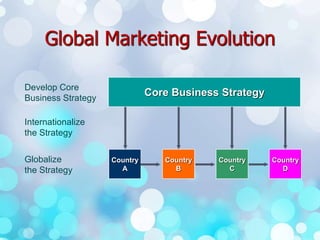
Core Business Strategy
Country
A
Country
B
Country
C
Country
D
Develop Core
Business Strategy
Internationalize
the Strategy
Globalize
the Strategy
Global Marketing Evolution
What is Internationalization ?
• As the process of increasing involvement in
international operations.
Why consider going international ?
• To increase overall customer base.
• To offset seasonal fluctuations in local markets
• To minimize risk of losing market share to clients who
themselves use internet to find goods / services in
overseas markets
• To offset increasing costs of doing business at home
• To gain prestige with customers at home .
Internationalization
Advantage
• Spreading business risk
• Opportunity to exploit an existing
competitive edge in new markets
• Expansion of brand awareness to
new audiences
• Increased revenue generation
• Possibility of accessing new
technologies / information
• Business can be conducted via the
internet thus shortening the
communication channels between
customers and markets
Disadvantage
• cultural and language
barriers
• exchange rate fluctuations
• religious beliefs
• government regulations /
policy on profit repatriation
• political instability
• economic downturn.
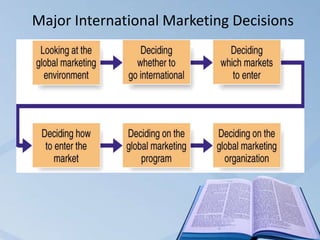
Major International Marketing Decisions
Strategy to enter into International Market.
• Export
• Involves using domestic plants as a production base for exporting to
foreign markets.
• Licensing
• Has valuable technical know-how or a patented product but does not have
international capabilities or resources to enter foreign markets
• Franchise
• Often is better suited to global expansion efforts of service and retailing
enterprise by establishing franchise in particular country.
• Strategic alliance
• Through strategic alliance you can enter into international market.
• Global strategy
• Pursue basic strategy world wide.
• Sell the same products under the same brand
• Production plants located local efficiencies
• Best suppliers from anywhere
• Coordinated marketing and distribution worldwide
• Multi country strategy
• Production plants in each country
– Producing products for that country
– Using local suppliers where possible
• Strategic alliance
• Through strategic alliance you can enter into international market.
• Global strategy
• Pursue basic strategy world wide.
• Sell the same products under the same brand
• Production plants located local efficiencies
• Best suppliers from anywhere
• Coordinated marketing and distribution worldwide
• Multi country strategy
• Production plants in each country
– Producing products for that country
– Using local suppliers where possible
CHALLENGES to enter International
market
 While choosing new markets, MNCs
need to consider several factors:
1) Micro factor
2) Macro factor
Micro factor
• Political/regulatory environment.
Tariff barriers - taxes on imports paid
to customs officials - include
Nontariff barriers
• Financial/economic environment.
Exchange rate - price of one currency in relation to
another
Fiscal policies
Monetary policy
• Socio cultural issues and technological infrastructure.
Understanding the local culture is the most profitable way
of marketing product and services.
Macro factor
• Competitive considerations.
• Local infrastructure such as
transportation & logistics network.
• Availability of mass media for
advertising is important.
Implementing Global Marketing
 Success will come from a balance between local and
regional / global concerns.
 “Think globally, act locally” is the operative phrase
for global marketers competing in country markets.
 Product choices should consider individual markets
as well as transfer products from one region to
another.
Localizing Global Marketing
 Management processes
- Enhance the global transfer of communications
- Interchange personnel to gain experience
abroad
 Headquarters should coordinate and leverage resources
 Permit local managers to develop their own programs within
defined parameters
 CONCLUSION:
 I conclude that when firm goes to globalization it
has a lot of growth & development which leads
always in good profit motive.
Global marketing

Global marketing

  • 1.
  • 2.
     The coordinatedperformance of marketing activities to create exchanges across countries that satisfy individual, organizational , and societal objectives  Global marketing is conducted across countries (not domestic or foreign)  Global marketing coordinates activities across different country markets  Global marketing should be motivated by individual, organizational and societal goals Global Marketing
  • 3.
    Core Business Strategy Country A Country B Country C Country D DevelopCore Business Strategy Internationalize the Strategy Globalize the Strategy Global Marketing Evolution
  • 4.
    What is Internationalization? • As the process of increasing involvement in international operations. Why consider going international ? • To increase overall customer base. • To offset seasonal fluctuations in local markets • To minimize risk of losing market share to clients who themselves use internet to find goods / services in overseas markets • To offset increasing costs of doing business at home • To gain prestige with customers at home .
  • 5.
    Internationalization Advantage • Spreading businessrisk • Opportunity to exploit an existing competitive edge in new markets • Expansion of brand awareness to new audiences • Increased revenue generation • Possibility of accessing new technologies / information • Business can be conducted via the internet thus shortening the communication channels between customers and markets Disadvantage • cultural and language barriers • exchange rate fluctuations • religious beliefs • government regulations / policy on profit repatriation • political instability • economic downturn.
  • 6.
  • 7.
    Strategy to enterinto International Market. • Export • Involves using domestic plants as a production base for exporting to foreign markets. • Licensing • Has valuable technical know-how or a patented product but does not have international capabilities or resources to enter foreign markets • Franchise • Often is better suited to global expansion efforts of service and retailing enterprise by establishing franchise in particular country.
  • 8.
    • Strategic alliance •Through strategic alliance you can enter into international market. • Global strategy • Pursue basic strategy world wide. • Sell the same products under the same brand • Production plants located local efficiencies • Best suppliers from anywhere • Coordinated marketing and distribution worldwide • Multi country strategy • Production plants in each country – Producing products for that country – Using local suppliers where possible
  • 9.
    • Strategic alliance •Through strategic alliance you can enter into international market. • Global strategy • Pursue basic strategy world wide. • Sell the same products under the same brand • Production plants located local efficiencies • Best suppliers from anywhere • Coordinated marketing and distribution worldwide • Multi country strategy • Production plants in each country – Producing products for that country – Using local suppliers where possible
  • 10.
    CHALLENGES to enterInternational market  While choosing new markets, MNCs need to consider several factors: 1) Micro factor 2) Macro factor
  • 11.
    Micro factor • Political/regulatoryenvironment. Tariff barriers - taxes on imports paid to customs officials - include Nontariff barriers • Financial/economic environment. Exchange rate - price of one currency in relation to another Fiscal policies Monetary policy • Socio cultural issues and technological infrastructure. Understanding the local culture is the most profitable way of marketing product and services.
  • 12.
    Macro factor • Competitiveconsiderations. • Local infrastructure such as transportation & logistics network. • Availability of mass media for advertising is important.
  • 13.
    Implementing Global Marketing Success will come from a balance between local and regional / global concerns.  “Think globally, act locally” is the operative phrase for global marketers competing in country markets.  Product choices should consider individual markets as well as transfer products from one region to another.
  • 14.
    Localizing Global Marketing Management processes - Enhance the global transfer of communications - Interchange personnel to gain experience abroad  Headquarters should coordinate and leverage resources  Permit local managers to develop their own programs within defined parameters
  • 15.
     CONCLUSION:  Iconclude that when firm goes to globalization it has a lot of growth & development which leads always in good profit motive.