MMAATTEERRIIAALLSS 
By: 
Achal Singhal (052)
IInnttrroodduuccttiioonn 
The term materials refers to raw materials used 
for production, sub-assemblies and fabricated 
parts. 
Inventory means the raw materials, work-in-process 
goods and completely finished goods that 
are considered to be the portion of a business’ 
assets that are ready or will be ready for sale.
MMaatteerriiaall CCoonnttrrooll 
• Material Control aims at efficient purchasing of materials, their 
efficient storing and efficient use or consumption. 
Objectives in a good system of material control can be: 
• Materials of desired quality available when needed for efficient and 
uninterrupted production. 
• Material to be purchased only when need exists and in economic 
quantities. 
• Purchase of materials to be made at the most favorable prices under 
the best possible terms. 
• Materials are protected against loss by fire, theft, etc. 
• Materials should be stored in such a way that they provide minimum 
of handling and cost.
PPrriicciinngg iissssuueess ooff mmaatteerriiaall 
Pricing of materials may change from time to 
time. 
Materials are usually acquired by several deliveries 
at different prices. 
Actual costs can then take on several different 
values. 
Therefore, the materials pricing system adopted 
should be the simplest and the most effective one.
MMeetthhooddss ooff ssttoocckk vvaalluuaattiioonn 
First-in-first-out(FIFO) 
Last-in-first-out(LIFO) 
Weight average cost (WAVCO) 
Specific identification/unit cost method
FFiirrsstt--iinn--ffiirrsstt--oouutt 
This method assumes that the first stock to be 
received is the first to be sold. 
The cost of materials used is based on the oldest 
prices. 
The closing stock is valued at the most recent 
prices.
LLaasstt--iinn--ffiirrsstt--oouutt ((LLIIFFOO)) 
This method assumes that the last stock to be 
received is the first to be sold. 
Therefore, the cost of materials used is based on 
the most recent prices. 
The closing stock is valued at the oldest prices.
Weight aavveerraaggee ccoosstt ((WWAAVVCCOO)) 
This method assumes that the cost of 
materials used and closing stock are valued at 
the weighted average cost.
SSppeecciiffiicc iiddeennttiiffiiccaattiioonn//uunniitt ccoosstt 
mmeetthhoodd 
This method assumes that each item of the stock 
has its own identity. 
The costs of materials used and closing stock are 
determined by associating the units of stock with 
their specific unit cost.
EEccoonnoommiicc OOrrddeerr QQuuaannttiittyy ((EEOOQQ)) 
EOQ is the order quantity that minimizes total inventory 
carrying costs and ordering costs. 
Ordering costs are costs that are incurred on obtaining 
additional inventories. They include costs incurred on 
communicating the order, transportation cost, etc. 
 Carrying costs represent the costs incurred on holding 
inventory in hand. They include the opportunity cost of 
money held up in inventories, storage costs, spoilage costs, 
etc. 
EOQ = 2*O*Q 
C 
Where EOQ = Economic Order Quantity 
O= order cost per order 
Q = Annual quantity required in units 
C =Carrying cost per unit per annum
EExxaammppllee 
The annual consumption of a part “X” is 5000 
units. The procurement cost per order is $10 and 
the cost per unit is $0.5. The storage and carrying 
cost is 10% of the material unit cost. 
Required: 
Calculate the EOQ
SSoolluuttiioonn 
O= $10 Q=5000, C= $0.5*10% 
EOQ = 2 O Q 
C 
EOQ = 2 * 5000 *10 
0.5*10% 
= 1414 units
LLeevveell sseettttiinngg 
It is to determine the correct or most optimal 
stock level so as to avoid overstocking or under-stocking 
of materials. 
These levels are known as the Maximum, 
Minimum and Re-order levels.
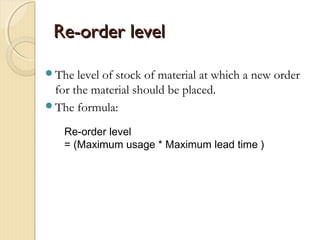
RRee--oorrddeerr lleevveell 
The level of stock of material at which a new order 
for the material should be placed. 
The formula: 
Re-order level 
= (Maximum usage * Maximum lead time )
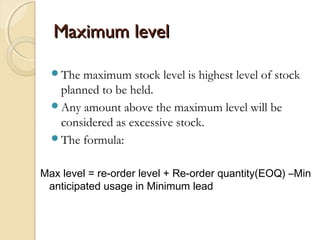
MMaaxxiimmuumm lleevveell 
The maximum stock level is highest level of stock 
planned to be held. 
Any amount above the maximum level will be 
considered as excessive stock. 
The formula: 
Max level = re-order level + Re-order quantity(EOQ) –Min 
anticipated usage in Minimum lead
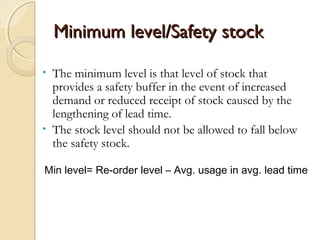
MMiinniimmuumm lleevveell//SSaaffeettyy ssttoocckk 
• The minimum level is that level of stock that 
provides a safety buffer in the event of increased 
demand or reduced receipt of stock caused by the 
lengthening of lead time. 
• The stock level should not be allowed to fall below 
the safety stock. 
Min level= Re-order level – Avg. usage in avg. lead time
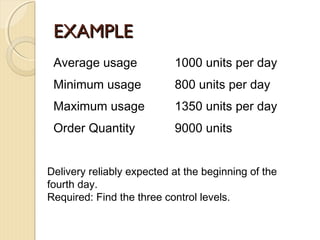
EEXXAAMMPPLLEE 
Average usage 1000 units per day 
Minimum usage 800 units per day 
Maximum usage 1350 units per day 
Order Quantity 9000 units 
Delivery reliably expected at the beginning of the 
fourth day. 
Required: Find the three control levels.
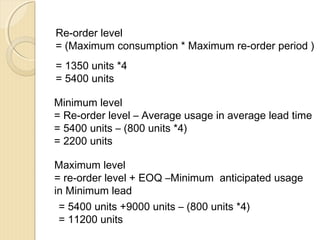
Re-order level 
= (Maximum consumption * Maximum re-order period ) 
= 1350 units *4 
= 5400 units 
Minimum level 
= Re-order level – Average usage in average lead time 
= 5400 units – (800 units *4) 
= 2200 units 
Maximum level 
= re-order level + EOQ –Minimum anticipated usage 
in Minimum lead 
= 5400 units +9000 units – (800 units *4) 
= 11200 units
TTHHAANNKK YYOOUU

Materials cost accounting

  • 1.
  • 2.
    IInnttrroodduuccttiioonn The termmaterials refers to raw materials used for production, sub-assemblies and fabricated parts. Inventory means the raw materials, work-in-process goods and completely finished goods that are considered to be the portion of a business’ assets that are ready or will be ready for sale.
  • 3.
    MMaatteerriiaall CCoonnttrrooll •Material Control aims at efficient purchasing of materials, their efficient storing and efficient use or consumption. Objectives in a good system of material control can be: • Materials of desired quality available when needed for efficient and uninterrupted production. • Material to be purchased only when need exists and in economic quantities. • Purchase of materials to be made at the most favorable prices under the best possible terms. • Materials are protected against loss by fire, theft, etc. • Materials should be stored in such a way that they provide minimum of handling and cost.
  • 4.
    PPrriicciinngg iissssuueess ooffmmaatteerriiaall Pricing of materials may change from time to time. Materials are usually acquired by several deliveries at different prices. Actual costs can then take on several different values. Therefore, the materials pricing system adopted should be the simplest and the most effective one.
  • 5.
    MMeetthhooddss ooff ssttoocckkvvaalluuaattiioonn First-in-first-out(FIFO) Last-in-first-out(LIFO) Weight average cost (WAVCO) Specific identification/unit cost method
  • 6.
    FFiirrsstt--iinn--ffiirrsstt--oouutt This methodassumes that the first stock to be received is the first to be sold. The cost of materials used is based on the oldest prices. The closing stock is valued at the most recent prices.
  • 7.
    LLaasstt--iinn--ffiirrsstt--oouutt ((LLIIFFOO)) Thismethod assumes that the last stock to be received is the first to be sold. Therefore, the cost of materials used is based on the most recent prices. The closing stock is valued at the oldest prices.
  • 8.
    Weight aavveerraaggee ccoosstt((WWAAVVCCOO)) This method assumes that the cost of materials used and closing stock are valued at the weighted average cost.
  • 9.
    SSppeecciiffiicc iiddeennttiiffiiccaattiioonn//uunniitt ccoosstt mmeetthhoodd This method assumes that each item of the stock has its own identity. The costs of materials used and closing stock are determined by associating the units of stock with their specific unit cost.
  • 10.
    EEccoonnoommiicc OOrrddeerr QQuuaannttiittyy((EEOOQQ)) EOQ is the order quantity that minimizes total inventory carrying costs and ordering costs. Ordering costs are costs that are incurred on obtaining additional inventories. They include costs incurred on communicating the order, transportation cost, etc.  Carrying costs represent the costs incurred on holding inventory in hand. They include the opportunity cost of money held up in inventories, storage costs, spoilage costs, etc. EOQ = 2*O*Q C Where EOQ = Economic Order Quantity O= order cost per order Q = Annual quantity required in units C =Carrying cost per unit per annum
  • 11.
    EExxaammppllee The annualconsumption of a part “X” is 5000 units. The procurement cost per order is $10 and the cost per unit is $0.5. The storage and carrying cost is 10% of the material unit cost. Required: Calculate the EOQ
  • 12.
    SSoolluuttiioonn O= $10Q=5000, C= $0.5*10% EOQ = 2 O Q C EOQ = 2 * 5000 *10 0.5*10% = 1414 units
  • 13.
    LLeevveell sseettttiinngg Itis to determine the correct or most optimal stock level so as to avoid overstocking or under-stocking of materials. These levels are known as the Maximum, Minimum and Re-order levels.
  • 14.
    RRee--oorrddeerr lleevveell Thelevel of stock of material at which a new order for the material should be placed. The formula: Re-order level = (Maximum usage * Maximum lead time )
  • 15.
    MMaaxxiimmuumm lleevveell Themaximum stock level is highest level of stock planned to be held. Any amount above the maximum level will be considered as excessive stock. The formula: Max level = re-order level + Re-order quantity(EOQ) –Min anticipated usage in Minimum lead
  • 16.
    MMiinniimmuumm lleevveell//SSaaffeettyy ssttoocckk • The minimum level is that level of stock that provides a safety buffer in the event of increased demand or reduced receipt of stock caused by the lengthening of lead time. • The stock level should not be allowed to fall below the safety stock. Min level= Re-order level – Avg. usage in avg. lead time
  • 17.
    EEXXAAMMPPLLEE Average usage1000 units per day Minimum usage 800 units per day Maximum usage 1350 units per day Order Quantity 9000 units Delivery reliably expected at the beginning of the fourth day. Required: Find the three control levels.
  • 18.
    Re-order level =(Maximum consumption * Maximum re-order period ) = 1350 units *4 = 5400 units Minimum level = Re-order level – Average usage in average lead time = 5400 units – (800 units *4) = 2200 units Maximum level = re-order level + EOQ –Minimum anticipated usage in Minimum lead = 5400 units +9000 units – (800 units *4) = 11200 units
  • 19.