
1
Submitted by:
B.SAI KIRAN
(12NA1E0036)
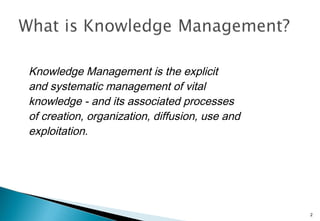
Knowledge Management is the explicit
and systematic management of vital
knowledge - and its associated processes
of creation, organization, diffusion, use and
exploitation.
2
3
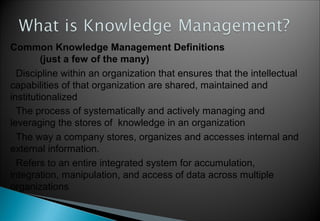
Common Knowledge Management Definitions
(just a few of the many)
Discipline within an organization that ensures that the intellectual
capabilities of that organization are shared, maintained and
institutionalized
The process of systematically and actively managing and
leveraging the stores of knowledge in an organization
The way a company stores, organizes and accesses internal and
external information.
Refers to an entire integrated system for accumulation,
integration, manipulation, and access of data across multiple
organizations
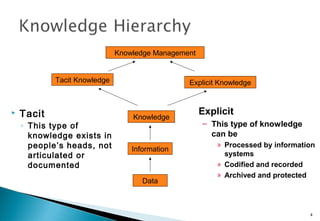
 Tacit
◦ This type of
knowledge exists in
people’s heads, not
articulated or
documented
4
Knowledge Management
Tacit Knowledge Explicit Knowledge
Knowledge
Information
Data
Explicit
– This type of knowledge
can be
» Processed by information
systems
» Codified and recorded
» Archived and protected
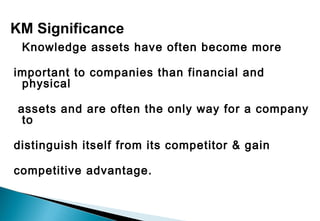
Knowledge assets have often become more
important to companies than financial and
physical
assets and are often the only way for a company
to
distinguish itself from its competitor & gain
competitive advantage.
KM Significance
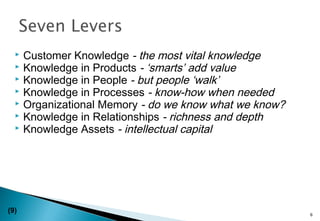
 Customer Knowledge - the most vital knowledge
 Knowledge in Products - ‘smarts’ add value
 Knowledge in People - but people ‘walk’
 Knowledge in Processes - know-how when needed
 Organizational Memory - do we know what we know?
 Knowledge in Relationships - richness and depth
 Knowledge Assets - intellectual capital
6
(9)
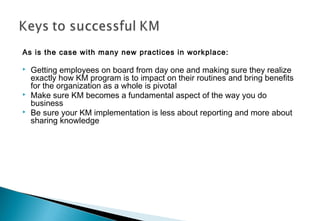
As is the case with many new practices in workplace:
 Getting employees on board from day one and making sure they realize
exactly how KM program is to impact on their routines and bring benefits
for the organization as a whole is pivotal
 Make sure KM becomes a fundamental aspect of the way you do
business
 Be sure your KM implementation is less about reporting and more about
sharing knowledge
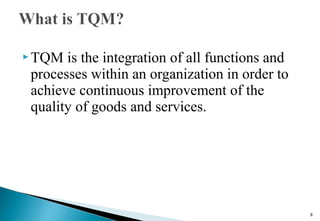
 TQM is the integration of all functions and
processes within an organization in order to
achieve continuous improvement of the
quality of goods and services.
8
Types of Quality Costs in km:
The cost of quality is generally classified into four
categories
1. Cost of Prevention
2. Cost of Appraisal
3. Cost of Internal Failure
4. Cost of External Failure
Internal Failure
 Those incurred during the production process.
 Include such items as machine downtime, poor quality materials,
scrap, and rework.
External Failure
 Those incurred after the product is shipped.
 External failure costs include returns and allowances, warranty
costs, and hidden costs of customer dissatisfaction and lost
market share.
 Greater customer loyalty
 Market share improvement
 Higher stock prices
 Reduced service calls
 Higher prices
 Greater productivity
 Knowledge is a company asset, hidden, until the
knowledge worker releases it. The key to generating
the best returns from your KM Program is to
implement a well-planned methodology and ensure
that your organization facilitates this release of
information.
12
13

K.m in t.q.m

  • 1.
  • 2.
    Knowledge Management isthe explicit and systematic management of vital knowledge - and its associated processes of creation, organization, diffusion, use and exploitation. 2
  • 3.
    3 Common Knowledge ManagementDefinitions (just a few of the many) Discipline within an organization that ensures that the intellectual capabilities of that organization are shared, maintained and institutionalized The process of systematically and actively managing and leveraging the stores of knowledge in an organization The way a company stores, organizes and accesses internal and external information. Refers to an entire integrated system for accumulation, integration, manipulation, and access of data across multiple organizations
  • 4.
     Tacit ◦ Thistype of knowledge exists in people’s heads, not articulated or documented 4 Knowledge Management Tacit Knowledge Explicit Knowledge Knowledge Information Data Explicit – This type of knowledge can be » Processed by information systems » Codified and recorded » Archived and protected
  • 5.
    Knowledge assets haveoften become more important to companies than financial and physical assets and are often the only way for a company to distinguish itself from its competitor & gain competitive advantage. KM Significance
  • 6.
     Customer Knowledge- the most vital knowledge  Knowledge in Products - ‘smarts’ add value  Knowledge in People - but people ‘walk’  Knowledge in Processes - know-how when needed  Organizational Memory - do we know what we know?  Knowledge in Relationships - richness and depth  Knowledge Assets - intellectual capital 6 (9)
  • 7.
    As is thecase with many new practices in workplace:  Getting employees on board from day one and making sure they realize exactly how KM program is to impact on their routines and bring benefits for the organization as a whole is pivotal  Make sure KM becomes a fundamental aspect of the way you do business  Be sure your KM implementation is less about reporting and more about sharing knowledge
  • 8.
     TQM isthe integration of all functions and processes within an organization in order to achieve continuous improvement of the quality of goods and services. 8
  • 9.
    Types of QualityCosts in km: The cost of quality is generally classified into four categories 1. Cost of Prevention 2. Cost of Appraisal 3. Cost of Internal Failure 4. Cost of External Failure
  • 10.
    Internal Failure  Thoseincurred during the production process.  Include such items as machine downtime, poor quality materials, scrap, and rework. External Failure  Those incurred after the product is shipped.  External failure costs include returns and allowances, warranty costs, and hidden costs of customer dissatisfaction and lost market share.
  • 11.
     Greater customerloyalty  Market share improvement  Higher stock prices  Reduced service calls  Higher prices  Greater productivity
  • 12.
     Knowledge isa company asset, hidden, until the knowledge worker releases it. The key to generating the best returns from your KM Program is to implement a well-planned methodology and ensure that your organization facilitates this release of information. 12
  • 13.