
WORKING CAPITAL MANAGEMENT
P r e s e n t e d B y : -
V i k a s h B a r n w a l
INTRODUCTION OF WORKING CAPITAL
 Working Capital :-working capital means this is the
amount of cash which help to run the business.
 It is capital refers to firm `investment in short term
assets , viz cash short-term securities ,debtors, and
inventories of raw material ,work and process and
finished goods
 Its can also regarded as that portion of the firm`s
total capital, which is employed in short term
operation.
 Simply we can say that working capital is the
investment needed for carrying out day to day
operations of the business smoothly.
CONCEPT OF WORKING CAPITAL
 There are two concept of working capital.
 Gross working capital.(quantitative concept)
 Net working capital.(qualitative concept)
GROSS WORKING CAPITAL
 Total Current assets
 Where Current assets are the assets that can be
converted into cash within an accounting year &
include cash , debtors etc.
 Referred as “Economics Concept” since assets are
employed to derive a rate of return.
CURRENT ASSETS :
 Current assets are the assets that can be converted into cash within an
accounting year .
Current Assets are:-
 Cash in hand and bank balances.
 Sundry debtors
 Short term loans and Advances
 Bills Receivables
 Inventories of stocks
a) Raw material
b) Work in progress
c) Stores and spares
d) Finished Goods
 Temporary investment of surplus goods
 Prepaid expenses
 Accrued incomes
CURRENT LIABILITIES
Current liabilities which is intended to be Paid in the
ordinary course of business withinn a short period
of normally one accounting year .
Current liabilities are :-
 Bills recievable
 Sundry creaditors
 Accrued and o/s expenses
 Short term loan and advances
 Dividend payable
 Bank o/d
 Provision of taxation
DEFINATION OF GROSS WORKING CAPITAL
“Working capital is the total of current assets”
 Working capital means current Assets
:- Meed, Mallot , Field
o Any acquisition of funds which increase the
current assets are known as Gross working capital.
:- Bonneville, Baker
NET WORKING CAPITAL
Net working capital is the deference
between the current assets to current
liabilities.
Working capital = C.A-C.L
DEFINATION OF NET WORKING CAPITAL
 “The excess of the current assets over the liabilities
are called” , Net working capital or Qualitative
method
:- Lincon and sayors
NEEDS OF WORKING CAPITAL
 For the purchase of raw material
 To pay wages and salaries
 To incur day to day expenses and over head
cost(fuel charges, power and office expenses)
 To provide credit facility to the customer
 To meet the selling costs and as packaging cost
 To maintain the inventories.
IMPORTANCE OF WORKING CAPITAL
 Solvency of the business
 Raise the goodwill
 Easy loan
 Cash discounts
 Regular supply of raw material
 Regular payment of wages , salaries, and day to
day expenses.
 Regular return on Investment
KINDS OF WORKING CAPITAL
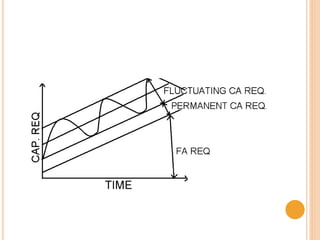
 Fixed working capital(permanent working capital)
 Flactuating working capital( temporary working
capital)
FIXED WORKING CAPITAL
 Is the amount that remains more and less
permanently invested as working capital in
business.
FLACTUATING WORKING CAPITAL
Is the amount of working capital over and above the
fixed minimum amount of working capital. it may
fluctuating from time to time.
IF A FIRM FINANCES A LONG TERM ASSET(LIKE
MACHINERY) WITH A S-T DEBT THEN IT
WILL HAVE TO BE PERIODICALLY FINANCE
THE ASSET WHICH WILL BE RISKY AS
WELL AS INCONVENIENT.
I.E. MATURITY OF SOURCES OF FINANCING
SHOULD BE PROPERLY MATCHED WITH
MATURITY OF ASSETS BEING FINANCED.
THUS FIXED ASSETS & PERMANENT CA
SHOULD BE SUPPORTED WITH L-T SOURCES
OF FINANCE & FLUCTUATING CA BY S-T
SOURCES
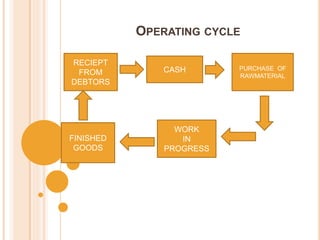
OPERATING CYCLE
CASH PURCHASE OF
RAWMATERIAL
RECIEPT
FROM
DEBTORS
WORK
IN
PROGRESS
FINISHED
GOODS
TO BE CONTINUE………
 Conversion of cash into raw materials
 Conversion of raw material into work in process
 Conversion of work in process into finished goods
 Conversion of finished goods into sundry debtors
 Conversion sundry debtors into cash
DETERMINANTS OF WORKING CAPITAL
NEEDS
Nature and size of business
Manufacturing cycle
Business fluctuation
Credit terms
Growth and expansion activity
Production policy
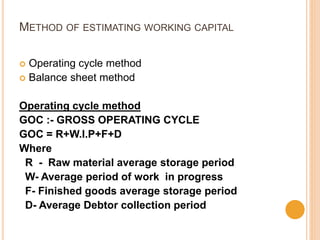
METHOD OF ESTIMATING WORKING CAPITAL
 Operating cycle method
 Balance sheet method
Operating cycle method
GOC :- GROSS OPERATING CYCLE
GOC = R+W.I.P+F+D
Where
R - Raw material average storage period
W- Average period of work in progress
F- Finished goods average storage period
D- Average Debtor collection period
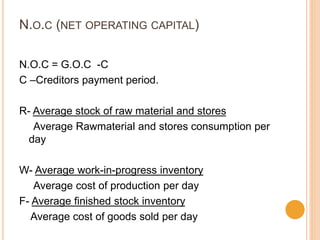
N.O.C (NET OPERATING CAPITAL)
N.O.C = G.O.C -C
C –Creditors payment period.
R- Average stock of raw material and stores
Average Rawmaterial and stores consumption per
day
W- Average work-in-progress inventory
Average cost of production per day
F- Average finished stock inventory
Average cost of goods sold per day
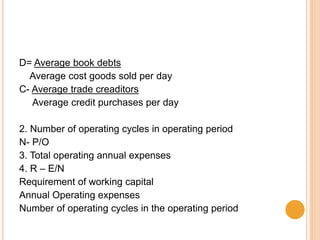
D= Average book debts
Average cost goods sold per day
C- Average trade creaditors
Average credit purchases per day
2. Number of operating cycles in operating period
N- P/O
3. Total operating annual expenses
4. R – E/N
Requirement of working capital
Annual Operating expenses
Number of operating cycles in the operating period
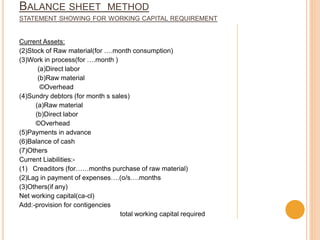
BALANCE SHEET METHOD
STATEMENT SHOWING FOR WORKING CAPITAL REQUIREMENT
Current Assets:
(2)Stock of Raw material(for ….month consumption)
(3)Work in process(for ….month )
(a)Direct labor
(b)Raw material
©Overhead
(4)Sundry debtors (for month s sales)
(a)Raw material
(b)Direct labor
©Overhead
(5)Payments in advance
(6)Balance of cash
(7)Others
Current Liabilities:-
(1) Creaditors (for……months purchase of raw material)
(2)Lag in payment of expenses….(o/s….months
(3)Others(if any)
Net working capital(ca-cl)
Add:-provision for contigencies
total working capital required
THANK YOU

WORKING CAPITAL MANAGEMENT.pptx

  • 1.
    WORKING CAPITAL MANAGEMENT Pr e s e n t e d B y : - V i k a s h B a r n w a l
  • 2.
    INTRODUCTION OF WORKINGCAPITAL  Working Capital :-working capital means this is the amount of cash which help to run the business.  It is capital refers to firm `investment in short term assets , viz cash short-term securities ,debtors, and inventories of raw material ,work and process and finished goods  Its can also regarded as that portion of the firm`s total capital, which is employed in short term operation.  Simply we can say that working capital is the investment needed for carrying out day to day operations of the business smoothly.
  • 3.
    CONCEPT OF WORKINGCAPITAL  There are two concept of working capital.  Gross working capital.(quantitative concept)  Net working capital.(qualitative concept)
  • 4.
    GROSS WORKING CAPITAL Total Current assets  Where Current assets are the assets that can be converted into cash within an accounting year & include cash , debtors etc.  Referred as “Economics Concept” since assets are employed to derive a rate of return.
  • 5.
    CURRENT ASSETS : Current assets are the assets that can be converted into cash within an accounting year . Current Assets are:-  Cash in hand and bank balances.  Sundry debtors  Short term loans and Advances  Bills Receivables  Inventories of stocks a) Raw material b) Work in progress c) Stores and spares d) Finished Goods  Temporary investment of surplus goods  Prepaid expenses  Accrued incomes
  • 6.
    CURRENT LIABILITIES Current liabilitieswhich is intended to be Paid in the ordinary course of business withinn a short period of normally one accounting year . Current liabilities are :-  Bills recievable  Sundry creaditors  Accrued and o/s expenses  Short term loan and advances  Dividend payable  Bank o/d  Provision of taxation
  • 7.
    DEFINATION OF GROSSWORKING CAPITAL “Working capital is the total of current assets”  Working capital means current Assets :- Meed, Mallot , Field o Any acquisition of funds which increase the current assets are known as Gross working capital. :- Bonneville, Baker
  • 8.
    NET WORKING CAPITAL Networking capital is the deference between the current assets to current liabilities. Working capital = C.A-C.L
  • 9.
    DEFINATION OF NETWORKING CAPITAL  “The excess of the current assets over the liabilities are called” , Net working capital or Qualitative method :- Lincon and sayors
  • 10.
    NEEDS OF WORKINGCAPITAL  For the purchase of raw material  To pay wages and salaries  To incur day to day expenses and over head cost(fuel charges, power and office expenses)  To provide credit facility to the customer  To meet the selling costs and as packaging cost  To maintain the inventories.
  • 11.
    IMPORTANCE OF WORKINGCAPITAL  Solvency of the business  Raise the goodwill  Easy loan  Cash discounts  Regular supply of raw material  Regular payment of wages , salaries, and day to day expenses.  Regular return on Investment
  • 12.
    KINDS OF WORKINGCAPITAL  Fixed working capital(permanent working capital)  Flactuating working capital( temporary working capital)
  • 13.
    FIXED WORKING CAPITAL Is the amount that remains more and less permanently invested as working capital in business. FLACTUATING WORKING CAPITAL Is the amount of working capital over and above the fixed minimum amount of working capital. it may fluctuating from time to time.
  • 15.
    IF A FIRMFINANCES A LONG TERM ASSET(LIKE MACHINERY) WITH A S-T DEBT THEN IT WILL HAVE TO BE PERIODICALLY FINANCE THE ASSET WHICH WILL BE RISKY AS WELL AS INCONVENIENT. I.E. MATURITY OF SOURCES OF FINANCING SHOULD BE PROPERLY MATCHED WITH MATURITY OF ASSETS BEING FINANCED. THUS FIXED ASSETS & PERMANENT CA SHOULD BE SUPPORTED WITH L-T SOURCES OF FINANCE & FLUCTUATING CA BY S-T SOURCES
  • 16.
    OPERATING CYCLE CASH PURCHASEOF RAWMATERIAL RECIEPT FROM DEBTORS WORK IN PROGRESS FINISHED GOODS
  • 17.
    TO BE CONTINUE……… Conversion of cash into raw materials  Conversion of raw material into work in process  Conversion of work in process into finished goods  Conversion of finished goods into sundry debtors  Conversion sundry debtors into cash
  • 18.
    DETERMINANTS OF WORKINGCAPITAL NEEDS Nature and size of business Manufacturing cycle Business fluctuation Credit terms Growth and expansion activity Production policy
  • 19.
    METHOD OF ESTIMATINGWORKING CAPITAL  Operating cycle method  Balance sheet method Operating cycle method GOC :- GROSS OPERATING CYCLE GOC = R+W.I.P+F+D Where R - Raw material average storage period W- Average period of work in progress F- Finished goods average storage period D- Average Debtor collection period
  • 20.
    N.O.C (NET OPERATINGCAPITAL) N.O.C = G.O.C -C C –Creditors payment period. R- Average stock of raw material and stores Average Rawmaterial and stores consumption per day W- Average work-in-progress inventory Average cost of production per day F- Average finished stock inventory Average cost of goods sold per day
  • 21.
    D= Average bookdebts Average cost goods sold per day C- Average trade creaditors Average credit purchases per day 2. Number of operating cycles in operating period N- P/O 3. Total operating annual expenses 4. R – E/N Requirement of working capital Annual Operating expenses Number of operating cycles in the operating period
  • 22.
    BALANCE SHEET METHOD STATEMENTSHOWING FOR WORKING CAPITAL REQUIREMENT Current Assets: (2)Stock of Raw material(for ….month consumption) (3)Work in process(for ….month ) (a)Direct labor (b)Raw material ©Overhead (4)Sundry debtors (for month s sales) (a)Raw material (b)Direct labor ©Overhead (5)Payments in advance (6)Balance of cash (7)Others Current Liabilities:- (1) Creaditors (for……months purchase of raw material) (2)Lag in payment of expenses….(o/s….months (3)Others(if any) Net working capital(ca-cl) Add:-provision for contigencies total working capital required
  • 23.