Malignant Glaucoma 
Presenter: Dr.Niket Gandhi 
Moderator: Dr.Vijay Shetty
Introduction 
 Albrecht von Graefe in 1869 
 It is characterized by normal or increased IOP associated with axial 
shallowing of the entire anterior chamber in the presence of a patent 
peripheral iridotomy 
 After surgery in patients with primary angle closure and primary 
angle-closure glaucoma 
 Synonyms: 
1. Ciliary block glaucoma 
2. Aqueous misdirection syndrome 
3. Direct lens-block glaucoma
Prevalence 
 2% to 4% - h/o of acute or chronic angle-closure glaucoma that have 
undergone filtration surgery 
 1.3 % - glaucoma surgery alone or combined with cataracts 
 2.3%- Penetrating surgery 
 Women are three times more likely than men
Predisposing Factors 
 Axial hyperopia 
 Nanophthalmos 
 Disorders of anatomical proportions in the anterior chamber 
 chronic angle closure with plateau iris configuration 
 History of malignant glaucoma in the fellow eye.
Risk Factors 
 Filtration surgeries: Trabeculectomy 
 Penetrating Keratoplasty 
 Laser treatment : 
1. Peripheral laser iridotomy 
2. trabeculectomy scleral flap suture lysis 
3. cyclophotocoagulation 
 use of miotics 
 trabeculectomy bleb needling 
 Infection 
 Retinopathy of prematurity 
 Retinal detachment 
 retinal vein occlusion 
 trauma
 Preoperative IOP is not a good indicator 
 Unlike in pupillary block angle closure, miotics can 
exacerbate malignant glaucoma.
Theories 
Theories 
Shaffer 
and 
Hoskins 
Epstein et 
all 
Chandler 
et all 
Quigley et 
all
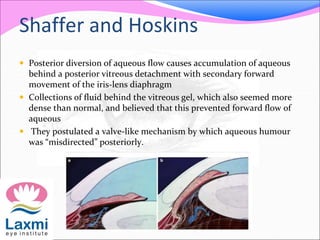
Shaffer and Hoskins 
 Posterior diversion of aqueous flow causes accumulation of aqueous 
behind a posterior vitreous detachment with secondary forward 
movement of the iris-lens diaphragm 
 Collections of fluid behind the vitreous gel, which also seemed more 
dense than normal, and believed that this prevented forward flow of 
aqueous 
 They postulated a valve-like mechanism by which aqueous humour 
was “misdirected” posteriorly.
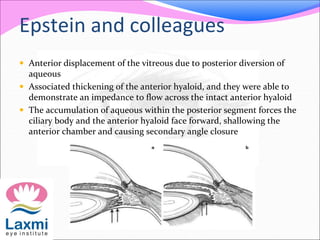
Epstein and colleagues 
 Anterior displacement of the vitreous due to posterior diversion of 
aqueous 
 Associated thickening of the anterior hyaloid, and they were able to 
demonstrate an impedance to flow across the intact anterior hyaloid 
 The accumulation of aqueous within the posterior segment forces the 
ciliary body and the anterior hyaloid face forward, shallowing the 
anterior chamber and causing secondary angle closure
Chandler et all 
 Laxity of lens zonules coupled with pressure from the vitreous leads to 
forward lens movement 
 A vicious circle is set up in that the higher the pressure in the 
posterior segment, the more firmly the lens is held forward
Quigley et al. 
 Proposed that the precipitating event which increases vitreous 
pressure is choroidal expansion 
 Initial compensatory outflow of aqueous along the posteroanterior 
pressure gradient causes shallowing of the anterior chamber. 
 Choroidal expansion has been detected on UBM in eyes with 
malignant glaucoma, and choroidal effusion secondary to angio-oedema 
has also been reported to result in malignant glaucoma
Predisposing Anatomical features 
 Incorrect anatomical relationships lead to disruptions in the direction 
of aqueous humour flow 
 The place of increased resistance may be located at the level of the 
iris-lens, ciliary-lens, iris-hyaloid, and ciliary-hyaloid block 
 Structures that are particularly related to the development of 
malignant glaucoma and its clinical picture: 
1. Sclera 
2. Lens 
3. Choroid 
4. Vitreous body
 Sclera– a thick sclera may lead to partial stenosis of the vortex veins, 
impairing normal venous outflow and causing overfilling of the 
choroid 
 Lens –Disproportions between its volume and the volume of the 
entire eyeball 
 Choroid – the choroid has a lobular structure with a tendency for 
accumulation of blood and thickening when outflow is impaired. 
 Secondary, ciliary body and iris rotate to the front in patients with 
malignant glaucoma closing access to the filtration angle from the 
back.
 Vitreous body –optically clear areas within the vitreous body – 
reservoirs of aqueous humour trapped in its gel structure 
 In aphakic eyes, the anterior surface of the vitreous body may directly 
adhere to the ciliary processes 
 Highly resistant anterior hyaloid membrane may be observed in 
aphakic and pseudophakic eyes
Clinical Features 
 Myopic shift - Anterior dislocation of the iris-lens diaphragm with secondary 
improvement of near vision 
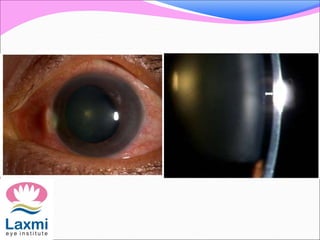
 Narrowing or shallowing of the circumferential and central part of the 
anterior chamber even if patent iridotomy or iridectomy is present. 
 Persistent symptoms - Anterior adhesions due to the long-lasting shallowing 
of the anterior chamber 
 Increased IOP 
 No decrease of IOP in response to conventional antiglaucoma treatment
Examination 
 Medical history 
1. Determination of predisposing factors 
2. Symptoms 
 Slit lamp examination 
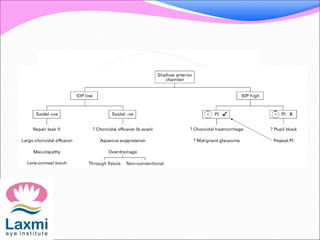
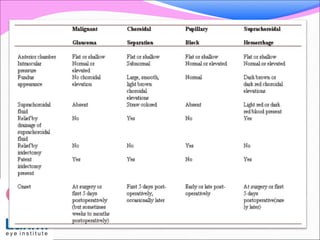
1. ACD - axial (central and peripheral) shallowing of the anterior chamber 
2. Patency of the iridotomy 
3. Seidel test should be performed to exclude filtering bleb leaking after 
filtration surgery. 
4. Posterior segment : Ruling out choroidal detachment or suprachoroidal 
hemorrhage 
 Tonometry – usually reveals increased IOP
DDx 
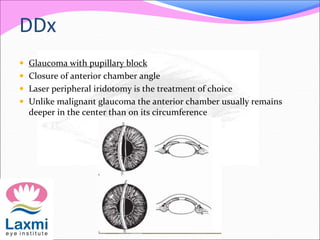
 Glaucoma with pupillary block 
 Closure of anterior chamber angle 
 Laser peripheral iridotomy is the treatment of choice 
 Unlike malignant glaucoma the anterior chamber usually remains 
deeper in the center than on its circumference
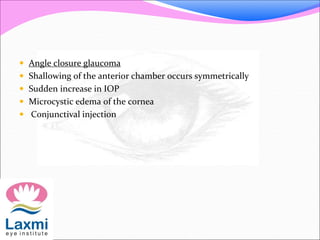
 Angle closure glaucoma 
 Shallowing of the anterior chamber occurs symmetrically 
 Sudden increase in IOP 
 Microcystic edema of the cornea 
 Conjunctival injection
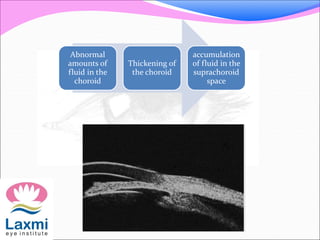
Choroidal effusion 
 Cause: 
1. inflammatory (trauma and intraocular surgery, scleritis, following 
cryocoagulation and photocoagulation, chronic uveitis, Vogt-Koyanagi- 
Harada disease) 
2. Hydrostatic causes (hypotony and wound leak, dural arteriovenous 
fistula, abnormally thick sclera in nanophthalmos) 
 IOP may be normal but is often reduced in uveal effusion secondary to 
inflammatory factors.
Abnormal 
amounts of 
fluid in the 
choroid 
Thickening of 
the choroid 
accumulation 
of fluid in the 
suprachoroid 
space
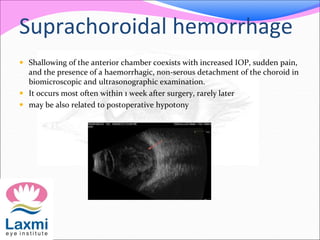
Suprachoroidal hemorrhage 
 Shallowing of the anterior chamber coexists with increased IOP, sudden pain, 
and the presence of a haemorrhagic, non-serous detachment of the choroid in 
biomicroscopic and ultrasonographic examination. 
 It occurs most often within 1 week after surgery, rarely later 
 may be also related to postoperative hypotony
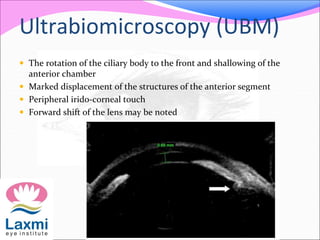
Ultrabiomicroscopy (UBM) 
 The rotation of the ciliary body to the front and shallowing of the 
anterior chamber 
 Marked displacement of the structures of the anterior segment 
 Peripheral irido-corneal touch 
 Forward shift of the lens may be noted
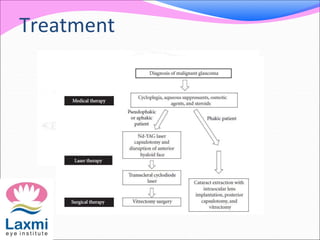
Treatment
Medical 
 Cycloplegia 
 Mydriatics (atropine and phenylephrine) should be given immediately in 
order to tighten the lens zonules and pull the anteriorly displaced 
lens backwards 
 In some cases, Atropine is needed upto one year to avoid 
recurrence. 
 MIOTICS – CONTRAINDICATED promoting zonular relaxation 
and encourage forward lens movement. 
 Anti-Inflammatory Medication : 
 Topical steroids can help to reduce inflammation
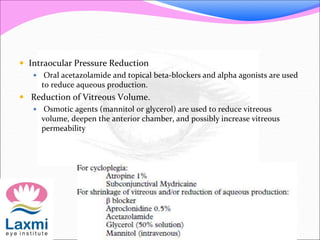
 Intraocular Pressure Reduction 
 Oral acetazolamide and topical beta-blockers and alpha agonists are used 
to reduce aqueous production. 
 Reduction of Vitreous Volume. 
 Osmotic agents (mannitol or glycerol) are used to reduce vitreous 
volume, deepen the anterior chamber, and possibly increase vitreous 
permeability
Laser 
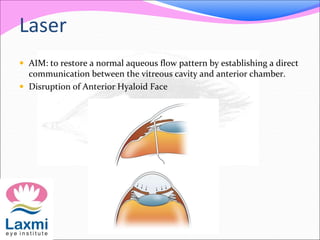
 AIM: to restore a normal aqueous flow pattern by establishing a direct 
communication between the vitreous cavity and anterior chamber. 
 Disruption of Anterior Hyaloid Face
 Laser of Ciliary Processes. 
 The successful use of transscleral cyclodiode laser photocoagulation in 
pseudophakic patients can help eliminate an abnormal vitreociliary 
relationship by posterior rotation of the ciliary processes secondary to 
coagulative shrinkage 
 Often a single session of therapy is sufficient over 1-2 quadrants 
 Cyclocryotherapy has been used in the past but no longer has a place 
in modern management
Surgical 
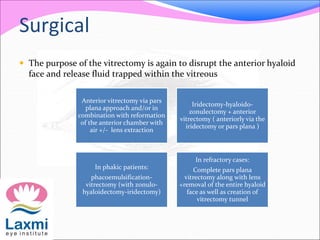
 The purpose of the vitrectomy is again to disrupt the anterior hyaloid 
face and release fluid trapped within the vitreous 
Anterior vitrectomy via pars 
plana approach and/or in 
combination with reformation 
of the anterior chamber with 
air +/- lens extraction 
Iridectomy-hyaloido-zonulectomy 
+ anterior 
vitrectomy ( anteriorly via the 
iridectomy or pars plana ) 
In phakic patients: 
phacoemulsification-vitrectomy 
(with zonulo-hyaloidectomy- 
iridectomy) 
In refractory cases: 
Complete pars plana 
vitrectomy along with lens 
+removal of the entire hyaloid 
face as well as creation of 
vitrectomy tunnel
Conclusion 
 Malignant glaucoma – Therapeutic challenge 
 Patients with h/o MG in fellow and PACG should be closely followed 
in after glaucoma filtration surgeries 
 Good prognosis with current treatment modalities
Thank You

Malignant glaucoma

  • 1.
    Malignant Glaucoma Presenter:Dr.Niket Gandhi Moderator: Dr.Vijay Shetty
  • 2.
    Introduction  Albrechtvon Graefe in 1869  It is characterized by normal or increased IOP associated with axial shallowing of the entire anterior chamber in the presence of a patent peripheral iridotomy  After surgery in patients with primary angle closure and primary angle-closure glaucoma  Synonyms: 1. Ciliary block glaucoma 2. Aqueous misdirection syndrome 3. Direct lens-block glaucoma
  • 3.
    Prevalence  2%to 4% - h/o of acute or chronic angle-closure glaucoma that have undergone filtration surgery  1.3 % - glaucoma surgery alone or combined with cataracts  2.3%- Penetrating surgery  Women are three times more likely than men

  • 4.
    Predisposing Factors Axial hyperopia  Nanophthalmos  Disorders of anatomical proportions in the anterior chamber  chronic angle closure with plateau iris configuration  History of malignant glaucoma in the fellow eye.
  • 5.
    Risk Factors Filtration surgeries: Trabeculectomy  Penetrating Keratoplasty  Laser treatment : 1. Peripheral laser iridotomy 2. trabeculectomy scleral flap suture lysis 3. cyclophotocoagulation  use of miotics  trabeculectomy bleb needling  Infection  Retinopathy of prematurity  Retinal detachment  retinal vein occlusion  trauma
  • 6.
     Preoperative IOPis not a good indicator  Unlike in pupillary block angle closure, miotics can exacerbate malignant glaucoma.
  • 7.
    Theories Theories Shaffer and Hoskins Epstein et all Chandler et all Quigley et all
  • 8.
    Shaffer and Hoskins  Posterior diversion of aqueous flow causes accumulation of aqueous behind a posterior vitreous detachment with secondary forward movement of the iris-lens diaphragm  Collections of fluid behind the vitreous gel, which also seemed more dense than normal, and believed that this prevented forward flow of aqueous  They postulated a valve-like mechanism by which aqueous humour was “misdirected” posteriorly.
  • 9.
    Epstein and colleagues  Anterior displacement of the vitreous due to posterior diversion of aqueous  Associated thickening of the anterior hyaloid, and they were able to demonstrate an impedance to flow across the intact anterior hyaloid  The accumulation of aqueous within the posterior segment forces the ciliary body and the anterior hyaloid face forward, shallowing the anterior chamber and causing secondary angle closure
  • 10.
    Chandler et all  Laxity of lens zonules coupled with pressure from the vitreous leads to forward lens movement  A vicious circle is set up in that the higher the pressure in the posterior segment, the more firmly the lens is held forward
  • 11.
    Quigley et al.  Proposed that the precipitating event which increases vitreous pressure is choroidal expansion  Initial compensatory outflow of aqueous along the posteroanterior pressure gradient causes shallowing of the anterior chamber.  Choroidal expansion has been detected on UBM in eyes with malignant glaucoma, and choroidal effusion secondary to angio-oedema has also been reported to result in malignant glaucoma
  • 12.
    Predisposing Anatomical features  Incorrect anatomical relationships lead to disruptions in the direction of aqueous humour flow  The place of increased resistance may be located at the level of the iris-lens, ciliary-lens, iris-hyaloid, and ciliary-hyaloid block  Structures that are particularly related to the development of malignant glaucoma and its clinical picture: 1. Sclera 2. Lens 3. Choroid 4. Vitreous body
  • 13.
     Sclera– athick sclera may lead to partial stenosis of the vortex veins, impairing normal venous outflow and causing overfilling of the choroid  Lens –Disproportions between its volume and the volume of the entire eyeball  Choroid – the choroid has a lobular structure with a tendency for accumulation of blood and thickening when outflow is impaired.  Secondary, ciliary body and iris rotate to the front in patients with malignant glaucoma closing access to the filtration angle from the back.
  • 14.
     Vitreous body–optically clear areas within the vitreous body – reservoirs of aqueous humour trapped in its gel structure  In aphakic eyes, the anterior surface of the vitreous body may directly adhere to the ciliary processes  Highly resistant anterior hyaloid membrane may be observed in aphakic and pseudophakic eyes
  • 15.
    Clinical Features Myopic shift - Anterior dislocation of the iris-lens diaphragm with secondary improvement of near vision  Narrowing or shallowing of the circumferential and central part of the anterior chamber even if patent iridotomy or iridectomy is present.  Persistent symptoms - Anterior adhesions due to the long-lasting shallowing of the anterior chamber  Increased IOP  No decrease of IOP in response to conventional antiglaucoma treatment
  • 17.
    Examination  Medicalhistory 1. Determination of predisposing factors 2. Symptoms  Slit lamp examination 1. ACD - axial (central and peripheral) shallowing of the anterior chamber 2. Patency of the iridotomy 3. Seidel test should be performed to exclude filtering bleb leaking after filtration surgery. 4. Posterior segment : Ruling out choroidal detachment or suprachoroidal hemorrhage  Tonometry – usually reveals increased IOP
  • 20.
    DDx  Glaucomawith pupillary block  Closure of anterior chamber angle  Laser peripheral iridotomy is the treatment of choice  Unlike malignant glaucoma the anterior chamber usually remains deeper in the center than on its circumference
  • 21.
     Angle closureglaucoma  Shallowing of the anterior chamber occurs symmetrically  Sudden increase in IOP  Microcystic edema of the cornea  Conjunctival injection
  • 22.
    Choroidal effusion Cause: 1. inflammatory (trauma and intraocular surgery, scleritis, following cryocoagulation and photocoagulation, chronic uveitis, Vogt-Koyanagi- Harada disease) 2. Hydrostatic causes (hypotony and wound leak, dural arteriovenous fistula, abnormally thick sclera in nanophthalmos)  IOP may be normal but is often reduced in uveal effusion secondary to inflammatory factors.
  • 23.
    Abnormal amounts of fluid in the choroid Thickening of the choroid accumulation of fluid in the suprachoroid space
  • 24.
    Suprachoroidal hemorrhage Shallowing of the anterior chamber coexists with increased IOP, sudden pain, and the presence of a haemorrhagic, non-serous detachment of the choroid in biomicroscopic and ultrasonographic examination.  It occurs most often within 1 week after surgery, rarely later  may be also related to postoperative hypotony
  • 25.
    Ultrabiomicroscopy (UBM) The rotation of the ciliary body to the front and shallowing of the anterior chamber  Marked displacement of the structures of the anterior segment  Peripheral irido-corneal touch  Forward shift of the lens may be noted
  • 26.
  • 27.
    Medical  Cycloplegia  Mydriatics (atropine and phenylephrine) should be given immediately in order to tighten the lens zonules and pull the anteriorly displaced lens backwards  In some cases, Atropine is needed upto one year to avoid recurrence.  MIOTICS – CONTRAINDICATED promoting zonular relaxation and encourage forward lens movement.  Anti-Inflammatory Medication :  Topical steroids can help to reduce inflammation
  • 28.
     Intraocular PressureReduction  Oral acetazolamide and topical beta-blockers and alpha agonists are used to reduce aqueous production.  Reduction of Vitreous Volume.  Osmotic agents (mannitol or glycerol) are used to reduce vitreous volume, deepen the anterior chamber, and possibly increase vitreous permeability
  • 29.
    Laser  AIM:to restore a normal aqueous flow pattern by establishing a direct communication between the vitreous cavity and anterior chamber.  Disruption of Anterior Hyaloid Face
  • 30.
     Laser ofCiliary Processes.  The successful use of transscleral cyclodiode laser photocoagulation in pseudophakic patients can help eliminate an abnormal vitreociliary relationship by posterior rotation of the ciliary processes secondary to coagulative shrinkage  Often a single session of therapy is sufficient over 1-2 quadrants  Cyclocryotherapy has been used in the past but no longer has a place in modern management
  • 31.
    Surgical  Thepurpose of the vitrectomy is again to disrupt the anterior hyaloid face and release fluid trapped within the vitreous Anterior vitrectomy via pars plana approach and/or in combination with reformation of the anterior chamber with air +/- lens extraction Iridectomy-hyaloido-zonulectomy + anterior vitrectomy ( anteriorly via the iridectomy or pars plana ) In phakic patients: phacoemulsification-vitrectomy (with zonulo-hyaloidectomy- iridectomy) In refractory cases: Complete pars plana vitrectomy along with lens +removal of the entire hyaloid face as well as creation of vitrectomy tunnel
  • 33.
    Conclusion  Malignantglaucoma – Therapeutic challenge  Patients with h/o MG in fellow and PACG should be closely followed in after glaucoma filtration surgeries  Good prognosis with current treatment modalities
  • 34.

Editor's Notes

  • #21 The posterior surface of the iris, in the pupillary margin, comes in contact with the lens The increased pupillary block obstructs the flow of the aqueous humour from the posterior chamber to the anterior chamber, resulting in increased pressure in the posterior chamber and forward bowing of the peripheral iris
  • #34 Whatever the true mechanism, the fact that it is relieved when a direct communication is made between the anterior chamber and vitreous cavity supports the theory that the lens, anterior vitreous, and ciliary processes are intimately involved in the pathogenesis