SUPRANUCLEAR PATHWAYS
AND LESIONS
Moderator: Dr. Seema Bhosale
Presenter : Shruti Chandra Jain
Overview of the Presentation
A. Fundamentals of Extra-ocular movements
B. Anatomy of cortical and brainstem centers
C. Basic binocular eye movements and their pathways
D. Step-wise evaluation of EOMs
E. Lesions of Supranuclear Pathways
FUNDAMENTALS OF EXTRA-OCULAR
MOVEMENTS
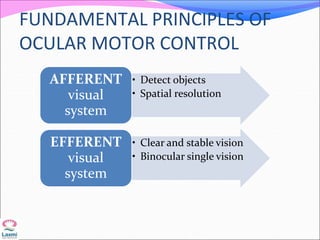
FUNDAMENTAL PRINCIPLES OF
OCULAR MOTOR CONTROL
โ€ข Detect objects
โ€ข Spatial resolution
AFFERENT
visual
system
โ€ข Clear and stable vision
โ€ข Binocular single vision
EFFERENT
visual
system
FUNDAMENTAL PRINCIPLES OF
OCULAR MOTOR CONTROL
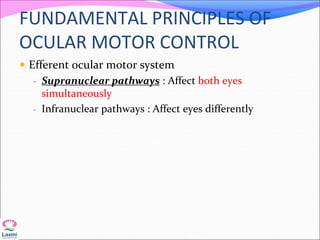
๏‚— Efferent ocular motor system
- Supranuclear pathways : Affect both eyes

simultaneously
- Infranuclear pathways : Affect eyes differently
FUNDAMENTAL PRINCIPLES OF
OCULAR MOTOR CONTROL
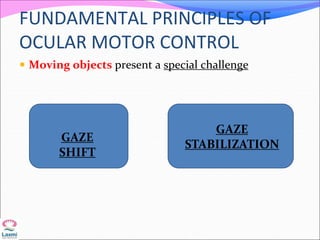
๏‚— Moving objects present a special challenge
GAZE
SHIFT
GAZE
STABILIZATION
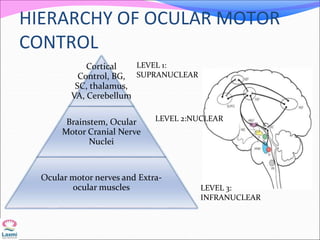
HIERARCHY OF OCULAR MOTOR
CONTROL
Cortical
Control, BG,
SC, thalamus,
VA, Cerebellum
Brainstem, Ocular
Motor Cranial Nerve
Nuclei
Ocular motor nerves and Extra-
ocular muscles
LEVEL 1:
SUPRANUCLEAR
LEVEL 2:NUCLEAR
LEVEL 3:
INFRANUCLEAR
ANATOMY OF CORTICAL AND
BRAINSTEM CENTERS
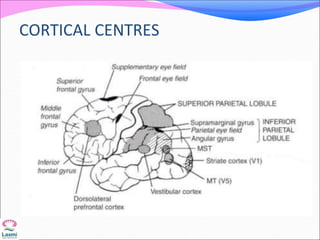
CORTICAL CENTRES
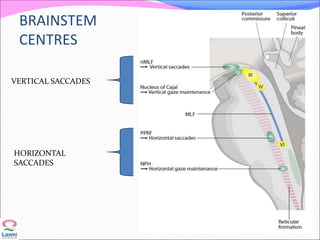
BRAINSTEM
CENTRES
VERTICAL SACCADES
HORIZONTAL
SACCADES
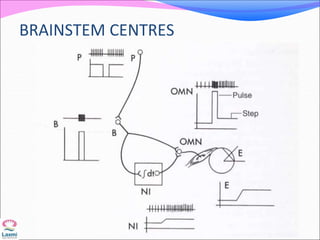
BRAINSTEM CENTRES
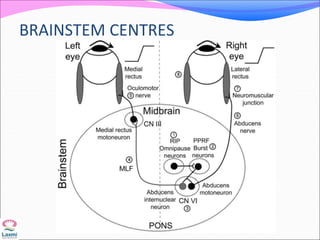
BRAINSTEM CENTRES
ROLE OF CEREBELLUM
๏‚— Cerebellum plays an important role in fine tuning all
eye movements, including modulation and adaptation
of vestibulo-ocular responses, saccades, pursuit, and
vergence.
ROLE OF CEREBELLUM
๏‚— Two distinct parts of the cerebellum contribute to
ocular motor control:
๏‚— (1) the vestibulocerebellum (flocculus, paraflocculus,
nodulus, and ventral uvula) and
๏‚— (2) the dorsal vermis of the posterior lobe and fastigial
nuclei. The vestibulocerebellum deals with
stabilization of sight during motion, whereas the
dorsal vermis and fastigial nuclei influence voluntary
gaze-shifting (i.e., saccades, pursuit and vergence).
BASIC BINOCULAR EYE MOVEMENTS
AND THEIR PATHWAYS
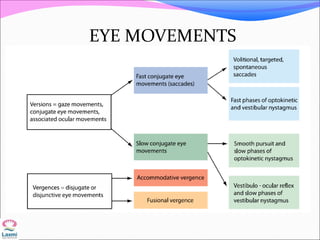
EYE MOVEMENTS
EYE MOVEMENTS
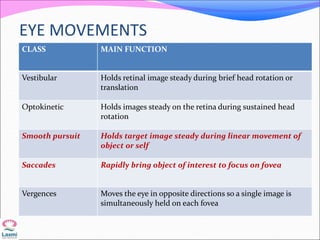
CLASS MAIN FUNCTION
Vestibular Holds retinal image steady during brief head rotation or
translation
Optokinetic Holds images steady on the retina during sustained head
rotation
Smooth pursuit Holds target image steady during linear movement of
object or self
Saccades Rapidly bring object of interest to focus on fovea
Vergences Moves the eye in opposite directions so a single image is
simultaneously held on each fovea
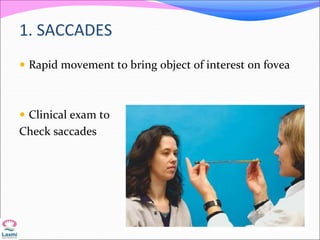
1. SACCADES
๏‚— Rapid movement to bring object of interest on fovea
๏‚— Clinical exam to
Check saccades
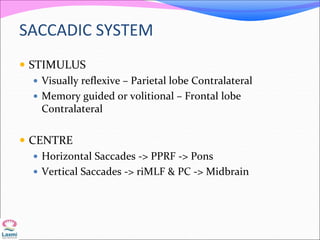
SACCADIC SYSTEM
๏‚— STIMULUS
๏‚— Visually reflexive โ€“ Parietal lobe Contralateral
๏‚— Memory guided or volitional โ€“ Frontal lobe
Contralateral
๏‚— CENTRE
๏‚— Horizontal Saccades -> PPRF -> Pons
๏‚— Vertical Saccades -> riMLF & PC -> Midbrain
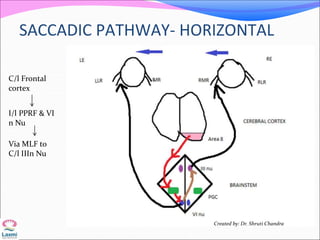
SACCADIC PATHWAY- HORIZONTAL
C/l Frontal
cortex
I/l PPRF & VI
n Nu
Via MLF to
C/l IIIn Nu
Created by: Dr. Shruti Chandra
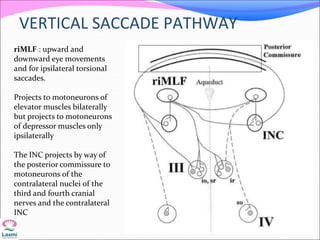
VERTICAL SACCADE PATHWAY
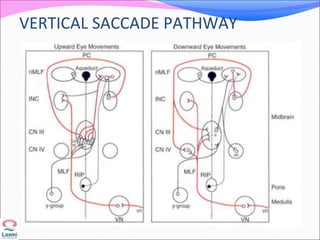
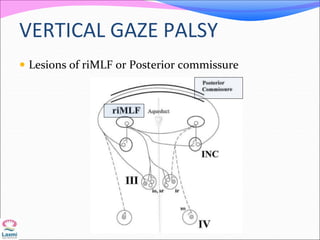
riMLF : upward and
downward eye movements
and for ipsilateral torsional
saccades.
Projects to motoneurons of
elevator muscles bilaterally
but projects to motoneurons
of depressor muscles only
ipsilaterally
The INC projects by way of
the posterior commissure to
motoneurons of the
contralateral nuclei of the
third and fourth cranial
nerves and the contralateral
INC
VERTICAL SACCADE PATHWAY
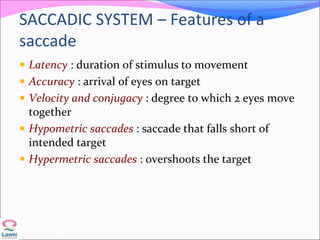
SACCADIC SYSTEM โ€“ Features of a
saccade
๏‚— Latency : duration of stimulus to movement
๏‚— Accuracy : arrival of eyes on target
๏‚— Velocity and conjugacy : degree to which 2 eyes move
together
๏‚— Hypometric saccades : saccade that falls short of
intended target
๏‚— Hypermetric saccades : overshoots the target
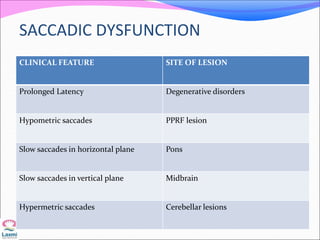
SACCADIC DYSFUNCTION
CLINICAL FEATURE SITE OF LESION
Prolonged Latency Degenerative disorders
Hypometric saccades PPRF lesion
Slow saccades in horizontal plane Pons
Slow saccades in vertical plane Midbrain
Hypermetric saccades Cerebellar lesions
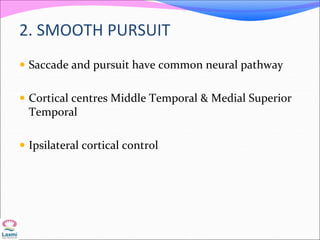
2. SMOOTH PURSUIT
๏‚— Saccade and pursuit have common neural pathway
๏‚— Cortical centres Middle Temporal & Medial Superior
Temporal
๏‚— Ipsilateral cortical control
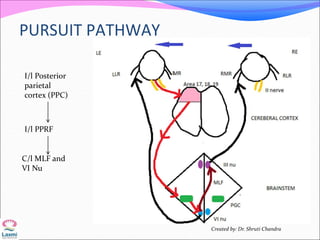
PURSUIT PATHWAY
I/l Posterior
parietal
cortex (PPC)
I/l PPRF
C/l MLF and
VI Nu
Created by: Dr. Shruti Chandra
PURSUIT SYSTEM
๏‚— Relatively slow moving target <30 degress per second
๏‚— Initiation of pursuit - latency
๏‚— Gain of eye movements = output/input
PURSUIT DYSFUNCTION
๏‚— Low gain -> saccadic pursuit
๏‚— Poor initiation -> Frontal / parietal lobe lesions
๏‚— Deficits found usually in both vertical and horizontal
planes
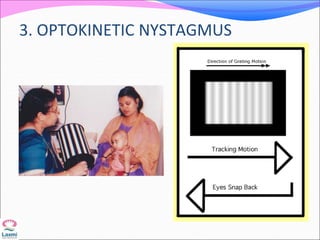
3. OPTOKINETIC NYSTAGMUS
OKN DYSFUNCTION
๏‚— Parietal or temporal lobe lesions -> abnormal OKN
towards the side of lesion
๏‚— Locate and define extent of cerebral lesions
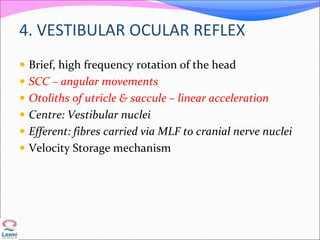
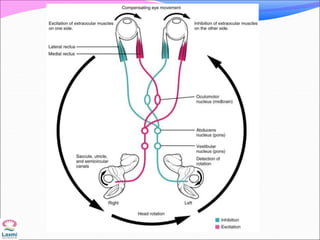
4. VESTIBULAR OCULAR REFLEX
๏‚— Brief, high frequency rotation of the head
๏‚— SCC โ€“ angular movements
๏‚— Otoliths of utricle & saccule โ€“ linear acceleration
๏‚— Centre: Vestibular nuclei
๏‚— Efferent: fibres carried via MLF to cranial nerve nuclei
๏‚— Velocity Storage mechanism
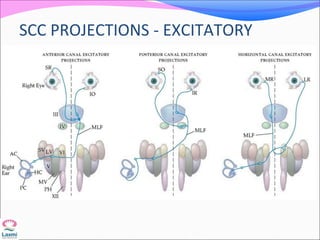
SCC PROJECTIONS - EXCITATORY
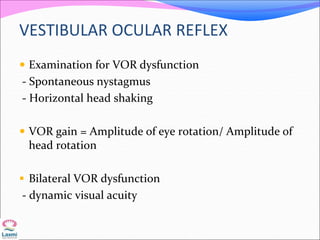
VESTIBULAR OCULAR REFLEX
๏‚— Examination for VOR dysfunction
- Spontaneous nystagmus
- Horizontal head shaking
๏‚— VOR gain = Amplitude of eye rotation/ Amplitude of
head rotation
๏‚ง Bilateral VOR dysfunction
- dynamic visual acuity
5. VERGENCES
๏‚— Vergence eye movements drive the eyes in
opposite directions to maintain the image of an
object on the fovea of both eyes as the object moves
toward or away from the observer.
๏‚— Vergence eye movements are driven primarily by
a disparity in the relative location of imยท ages on
the retinas.
5. VERGENCES
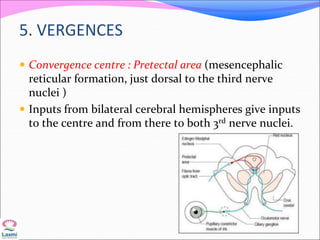
๏‚— Convergence centre : Pretectal area (mesencephalic
reticular formation, just dorsal to the third nerve
nuclei )
๏‚— Inputs from bilateral cerebral hemispheres give inputs
to the centre and from there to both 3rd nerve nuclei.
STEP WISE EVALUATION OF EOMS
EVALUATION OF EOMs
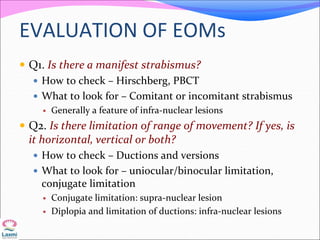
๏‚— Q1. Is there a manifest strabismus?
๏‚— How to check โ€“ Hirschberg, PBCT
๏‚— What to look for โ€“ Comitant or incomitant strabismus
๏‚— Generally a feature of infra-nuclear lesions
๏‚— Q2. Is there limitation of range of movement? If yes, is
it horizontal, vertical or both?
๏‚— How to check โ€“ Ductions and versions
๏‚— What to look for โ€“ uniocular/binocular limitation,
conjugate limitation
๏‚— Conjugate limitation: supra-nuclear lesion
๏‚— Diplopia and limitation of ductions: infra-nuclear lesions
EVALUATION OF EOMs
๏‚— Q3. Is there impairment of latency, accuracy or velocity
of voluntary saccade?
๏‚— How to check - saccades 20 - 30ยฐ on either side of
primary position
๏‚— What to look for โ€“
๏‚— Full range of movement with slow saccades: supra-nuclear
lesion
๏‚— Limited range of movement with slow saccades: infra-nuclear
lesions
๏‚— Limited range of movement with normal saccades in the
movement range allowed: myasthenia gravis
๏‚— Difference in saccadic velocity of both eyes
EVALUATION OF EOMs
๏‚— Q4. Is their impairment of latency or velocity of
smooth pursuit?
๏‚— How to check โ€“ Follow a small target smoothly 20ยฐ on
either side of primary position
๏‚— What to look for โ€“ Catch up saccades
๏‚— Cortical lesions causing latency in pursuits: patient has catch
up saccades for foveation
๏‚— Q5. Is their impairment of OKN?
๏‚— How to check โ€“ OKN drum or scanning a newspaper in
front of the patientโ€™s eye
๏‚— What to look for โ€“ impaired or absent OKN
๏‚— Localises lesion to the cortex. OKN is also a good method for
checking visual acuity in children
EVALUATION OF EOMs
๏‚— Q6. Is there impairment of VOR?
๏‚— How to check โ€“ dollโ€™s head or oculocephalic maneuvers
๏‚— What to look for โ€“ Corrective saccades, jerk nystagmus
on rapid head movement
๏‚— Spontaneous jerk nystagmus on head shaking: VOR
dysfunction
๏‚— Corrective saccades after head rotation: due loss of velocity
storage mechanism of VOR
๏‚— Q7. Is there impairment of VOR suppression?
๏‚— How to check - watching if the patient can keep their
gaze fixed on the thumb of their outstretched hand
while oscillating or being oscillated en bloc.
๏‚— What to look for โ€“ quick phases in direction of head
EVALUATION OF EOMs
๏‚— Q7. Is there impairment of VOR suppression?
๏‚— How to check - watching if the patient can keep their
gaze fixed on the thumb of their outstretched hand
while oscillating or being oscillated en bloc.
๏‚— What to look for โ€“ quick phases in direction of head
movement
๏‚— Normally the patient should be able to maintain gaze on the
thumb of outstretched hand when swilled in a chair
๏‚— Spontaneous nystagmus indicates a VOR dysfunction
EVALUATION OF EOMs
๏‚— Q8. Is there impairment of vergence?
๏‚— How to check โ€“ Moving object towards bridge of the
nose
๏‚— What to look for โ€“ pupillary constriction present or not,
adduction present or not
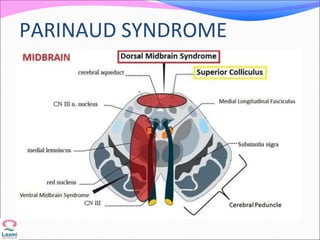
๏‚— Light near dissociation is a feature of dorsal midbrain
syndrome: Here the pretectal area is affected leading to
damage of pupillary light reflex centres. But since the
convergence centre lies ventral to it, accomodation reflex is
spared leading to miosis on convergence.
๏‚— In cases of horizontal gaze palsy, there is limitation of
adduction due to MLF lesion. But the convergence centre
remains intact in midbrain, hence the patient can have
adduction on convergence.
EVALUATION OF EOMs
๏‚— Q9. Is there involvement of other cranial nerves?
๏‚— How to check โ€“ Cranial nerve examination
๏‚— What to look for โ€“ 2nd nerve important, other CN
involvement helps in localisation
๏‚— Other cranial nerve involvement can help localise the site of
lesion
๏‚— Eg: PPRF lesion and VI n Nu. Lesion present with similar gaze
palsy. If there is associated VII n palsy, that helps localising
the lesion to VI n as the VII nerve fibres loop around the VI n
nucleas forming the facial colliculus.
EVALUATION OF EOMs
๏‚— Q10. Is the limitation mechanical?
๏‚— How to check โ€“ FDT, FGT
๏‚— What to look for โ€“ Restriction vs Paralytic
๏‚— Q11. Is there any spontaneous or inducible involuntary
eye movement, ocular oscillation, or nystagmus?
SUMMARY
๏‚— Supranuclear lesions- BE involvement
๏‚— Saccade โ€“ Contralateral frontal lobe control
๏‚— Pursuit โ€“ Ipsilateral parietal control
๏‚— Horizontal movements โ€“ PPRF, MLF โ€“ Pons
๏‚— Vertical movements โ€“ riMLF & PC โ€“ midbrain
๏‚— VOR โ€“ Brief, high frequency rotations
๏‚— Ocular stability dysfunction โ€“ Saccadic intrusions
LESIONS OF SUPRANUCLEAR
PATHWAYS
GAZE PALSY
๏‚— Symmetric limitation of movement of both eyes in the
same direction.
๏‚— Conjugate ophthalmoplegia
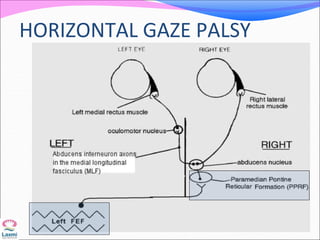
HORIZONTAL GAZE PALSY
๏‚— Congenital โ€“ Mobius Syndrome
๏‚— Acquired โ€“ Pontine lesions
- Disrupt eye movements towards the side of the
lesion.
๏‚— Acquired โ€“ FEF lesions
- Disrupt eye movements towards side of lesion
HORIZONTAL GAZE PALSY
VERTICAL GAZE PALSY
๏‚— Lesions of riMLF or Posterior commissure
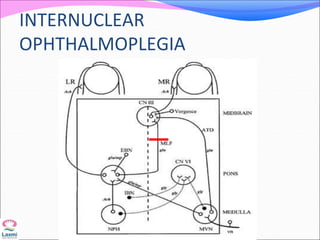
INTERNUCLEAR
OPHTHALMOPLEGIA
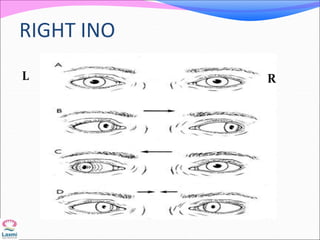
RIGHT INO
RL
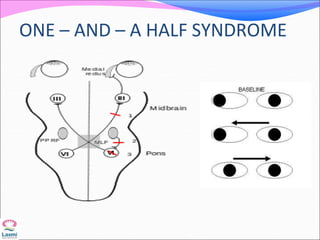
ONE โ€“ AND โ€“ A HALF SYNDROME
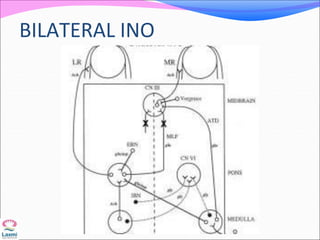
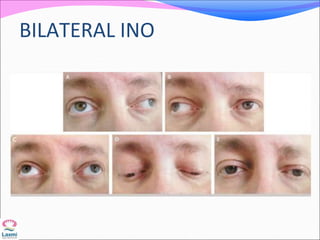
BILATERAL INO
BILATERAL INO
ETIOLOGY OF INO
๏‚— - Multiple sclerosis (commonly bilateral): Young
patients
- Brain stem infarction (commonly unilateral): Elderly
patients
PARINAUD SYNDROME
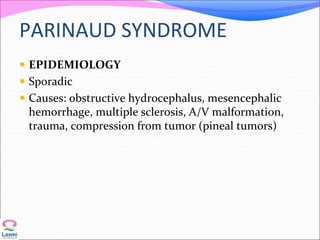
๏‚— EPIDEMIOLOGY
๏‚— Sporadic
๏‚— Causes: obstructive hydrocephalus, mesencephalic
hemorrhage, multiple sclerosis, A/V malformation,
trauma, compression from tumor (pineal tumors)
PARINAUD SYNDROME
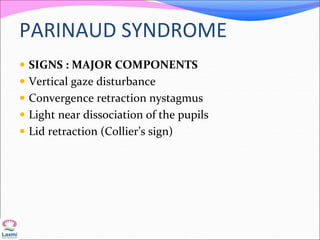
๏‚— SIGNS : MAJOR COMPONENTS
๏‚— Vertical gaze disturbance
๏‚— Convergence retraction nystagmus
๏‚— Light near dissociation of the pupils
๏‚— Lid retraction (Collierโ€™s sign)
PARINAUD SYNDROME
PARINAUD SYNDROME
๏‚— Differential Diagnoses for Dorsal Midbrain
Syndrome
๏‚— Light-near dissociation
๏‚— Vertical Gaze Palsy
References
๏‚— Neuro- Ophthalmology, American Academy of Ophthalmology,
2010-2011. 5th edition.
๏‚— Walsh & Hoytโ€™s. Clinical Neuro- ophthalmology. 6th edition
๏‚— Khurana AK. Anatomy and Physiology of eye. 2nd edition
๏‚— Kanski. Clinical Ophthalmology, 7th edition
๏‚— Yanoff and Duker. 6th edition
๏‚— Peter Their, Uwe J. The neural basis of smooth pursuit eye
movements. Current opinion in neurology 2005,15:645-652
๏‚— David L sparks, Ellen J Barton. Neural control of saccadic eye
movements. Current opinion in neurobiology 1993,3:966-972
๏‚— Chen,Chien Ming, Lin, Sung Hsuing. Wall eyed bilateral
internuclear ophthalmoplegia. Journal of Neuroophthalmology
2007,1:9-15
THANK YOU

Supranuclear pathways and lesions

  • 1.
    SUPRANUCLEAR PATHWAYS AND LESIONS Moderator:Dr. Seema Bhosale Presenter : Shruti Chandra Jain
  • 2.
    Overview of thePresentation A. Fundamentals of Extra-ocular movements B. Anatomy of cortical and brainstem centers C. Basic binocular eye movements and their pathways D. Step-wise evaluation of EOMs E. Lesions of Supranuclear Pathways
  • 3.
  • 4.
    FUNDAMENTAL PRINCIPLES OF OCULARMOTOR CONTROL โ€ข Detect objects โ€ข Spatial resolution AFFERENT visual system โ€ข Clear and stable vision โ€ข Binocular single vision EFFERENT visual system
  • 5.
    FUNDAMENTAL PRINCIPLES OF OCULARMOTOR CONTROL ๏‚— Efferent ocular motor system - Supranuclear pathways : Affect both eyes simultaneously - Infranuclear pathways : Affect eyes differently
  • 6.
    FUNDAMENTAL PRINCIPLES OF OCULARMOTOR CONTROL ๏‚— Moving objects present a special challenge GAZE SHIFT GAZE STABILIZATION
  • 7.
    HIERARCHY OF OCULARMOTOR CONTROL Cortical Control, BG, SC, thalamus, VA, Cerebellum Brainstem, Ocular Motor Cranial Nerve Nuclei Ocular motor nerves and Extra- ocular muscles LEVEL 1: SUPRANUCLEAR LEVEL 2:NUCLEAR LEVEL 3: INFRANUCLEAR
  • 8.
    ANATOMY OF CORTICALAND BRAINSTEM CENTERS
  • 9.
  • 10.
  • 11.
  • 12.
  • 13.
    ROLE OF CEREBELLUM ๏‚—Cerebellum plays an important role in fine tuning all eye movements, including modulation and adaptation of vestibulo-ocular responses, saccades, pursuit, and vergence.
  • 14.
    ROLE OF CEREBELLUM ๏‚—Two distinct parts of the cerebellum contribute to ocular motor control: ๏‚— (1) the vestibulocerebellum (flocculus, paraflocculus, nodulus, and ventral uvula) and ๏‚— (2) the dorsal vermis of the posterior lobe and fastigial nuclei. The vestibulocerebellum deals with stabilization of sight during motion, whereas the dorsal vermis and fastigial nuclei influence voluntary gaze-shifting (i.e., saccades, pursuit and vergence).
  • 15.
    BASIC BINOCULAR EYEMOVEMENTS AND THEIR PATHWAYS
  • 16.
  • 17.
    EYE MOVEMENTS CLASS MAINFUNCTION Vestibular Holds retinal image steady during brief head rotation or translation Optokinetic Holds images steady on the retina during sustained head rotation Smooth pursuit Holds target image steady during linear movement of object or self Saccades Rapidly bring object of interest to focus on fovea Vergences Moves the eye in opposite directions so a single image is simultaneously held on each fovea
  • 18.
    1. SACCADES ๏‚— Rapidmovement to bring object of interest on fovea ๏‚— Clinical exam to Check saccades
  • 19.
    SACCADIC SYSTEM ๏‚— STIMULUS ๏‚—Visually reflexive โ€“ Parietal lobe Contralateral ๏‚— Memory guided or volitional โ€“ Frontal lobe Contralateral ๏‚— CENTRE ๏‚— Horizontal Saccades -> PPRF -> Pons ๏‚— Vertical Saccades -> riMLF & PC -> Midbrain
  • 20.
    SACCADIC PATHWAY- HORIZONTAL C/lFrontal cortex I/l PPRF & VI n Nu Via MLF to C/l IIIn Nu Created by: Dr. Shruti Chandra
  • 21.
    VERTICAL SACCADE PATHWAY riMLF: upward and downward eye movements and for ipsilateral torsional saccades. Projects to motoneurons of elevator muscles bilaterally but projects to motoneurons of depressor muscles only ipsilaterally The INC projects by way of the posterior commissure to motoneurons of the contralateral nuclei of the third and fourth cranial nerves and the contralateral INC
  • 22.
  • 23.
    SACCADIC SYSTEM โ€“Features of a saccade ๏‚— Latency : duration of stimulus to movement ๏‚— Accuracy : arrival of eyes on target ๏‚— Velocity and conjugacy : degree to which 2 eyes move together ๏‚— Hypometric saccades : saccade that falls short of intended target ๏‚— Hypermetric saccades : overshoots the target
  • 24.
    SACCADIC DYSFUNCTION CLINICAL FEATURESITE OF LESION Prolonged Latency Degenerative disorders Hypometric saccades PPRF lesion Slow saccades in horizontal plane Pons Slow saccades in vertical plane Midbrain Hypermetric saccades Cerebellar lesions
  • 25.
    2. SMOOTH PURSUIT ๏‚—Saccade and pursuit have common neural pathway ๏‚— Cortical centres Middle Temporal & Medial Superior Temporal ๏‚— Ipsilateral cortical control
  • 26.
    PURSUIT PATHWAY I/l Posterior parietal cortex(PPC) I/l PPRF C/l MLF and VI Nu Created by: Dr. Shruti Chandra
  • 27.
    PURSUIT SYSTEM ๏‚— Relativelyslow moving target <30 degress per second ๏‚— Initiation of pursuit - latency ๏‚— Gain of eye movements = output/input
  • 28.
    PURSUIT DYSFUNCTION ๏‚— Lowgain -> saccadic pursuit ๏‚— Poor initiation -> Frontal / parietal lobe lesions ๏‚— Deficits found usually in both vertical and horizontal planes
  • 29.
  • 30.
    OKN DYSFUNCTION ๏‚— Parietalor temporal lobe lesions -> abnormal OKN towards the side of lesion ๏‚— Locate and define extent of cerebral lesions
  • 31.
    4. VESTIBULAR OCULARREFLEX ๏‚— Brief, high frequency rotation of the head ๏‚— SCC โ€“ angular movements ๏‚— Otoliths of utricle & saccule โ€“ linear acceleration ๏‚— Centre: Vestibular nuclei ๏‚— Efferent: fibres carried via MLF to cranial nerve nuclei ๏‚— Velocity Storage mechanism
  • 33.
  • 34.
    VESTIBULAR OCULAR REFLEX ๏‚—Examination for VOR dysfunction - Spontaneous nystagmus - Horizontal head shaking ๏‚— VOR gain = Amplitude of eye rotation/ Amplitude of head rotation ๏‚ง Bilateral VOR dysfunction - dynamic visual acuity
  • 35.
    5. VERGENCES ๏‚— Vergenceeye movements drive the eyes in opposite directions to maintain the image of an object on the fovea of both eyes as the object moves toward or away from the observer. ๏‚— Vergence eye movements are driven primarily by a disparity in the relative location of imยท ages on the retinas.
  • 36.
    5. VERGENCES ๏‚— Convergencecentre : Pretectal area (mesencephalic reticular formation, just dorsal to the third nerve nuclei ) ๏‚— Inputs from bilateral cerebral hemispheres give inputs to the centre and from there to both 3rd nerve nuclei.
  • 37.
  • 38.
    EVALUATION OF EOMs ๏‚—Q1. Is there a manifest strabismus? ๏‚— How to check โ€“ Hirschberg, PBCT ๏‚— What to look for โ€“ Comitant or incomitant strabismus ๏‚— Generally a feature of infra-nuclear lesions ๏‚— Q2. Is there limitation of range of movement? If yes, is it horizontal, vertical or both? ๏‚— How to check โ€“ Ductions and versions ๏‚— What to look for โ€“ uniocular/binocular limitation, conjugate limitation ๏‚— Conjugate limitation: supra-nuclear lesion ๏‚— Diplopia and limitation of ductions: infra-nuclear lesions
  • 39.
    EVALUATION OF EOMs ๏‚—Q3. Is there impairment of latency, accuracy or velocity of voluntary saccade? ๏‚— How to check - saccades 20 - 30ยฐ on either side of primary position ๏‚— What to look for โ€“ ๏‚— Full range of movement with slow saccades: supra-nuclear lesion ๏‚— Limited range of movement with slow saccades: infra-nuclear lesions ๏‚— Limited range of movement with normal saccades in the movement range allowed: myasthenia gravis ๏‚— Difference in saccadic velocity of both eyes
  • 40.
    EVALUATION OF EOMs ๏‚—Q4. Is their impairment of latency or velocity of smooth pursuit? ๏‚— How to check โ€“ Follow a small target smoothly 20ยฐ on either side of primary position ๏‚— What to look for โ€“ Catch up saccades ๏‚— Cortical lesions causing latency in pursuits: patient has catch up saccades for foveation ๏‚— Q5. Is their impairment of OKN? ๏‚— How to check โ€“ OKN drum or scanning a newspaper in front of the patientโ€™s eye ๏‚— What to look for โ€“ impaired or absent OKN ๏‚— Localises lesion to the cortex. OKN is also a good method for checking visual acuity in children
  • 41.
    EVALUATION OF EOMs ๏‚—Q6. Is there impairment of VOR? ๏‚— How to check โ€“ dollโ€™s head or oculocephalic maneuvers ๏‚— What to look for โ€“ Corrective saccades, jerk nystagmus on rapid head movement ๏‚— Spontaneous jerk nystagmus on head shaking: VOR dysfunction ๏‚— Corrective saccades after head rotation: due loss of velocity storage mechanism of VOR ๏‚— Q7. Is there impairment of VOR suppression? ๏‚— How to check - watching if the patient can keep their gaze fixed on the thumb of their outstretched hand while oscillating or being oscillated en bloc. ๏‚— What to look for โ€“ quick phases in direction of head
  • 42.
    EVALUATION OF EOMs ๏‚—Q7. Is there impairment of VOR suppression? ๏‚— How to check - watching if the patient can keep their gaze fixed on the thumb of their outstretched hand while oscillating or being oscillated en bloc. ๏‚— What to look for โ€“ quick phases in direction of head movement ๏‚— Normally the patient should be able to maintain gaze on the thumb of outstretched hand when swilled in a chair ๏‚— Spontaneous nystagmus indicates a VOR dysfunction
  • 43.
    EVALUATION OF EOMs ๏‚—Q8. Is there impairment of vergence? ๏‚— How to check โ€“ Moving object towards bridge of the nose ๏‚— What to look for โ€“ pupillary constriction present or not, adduction present or not ๏‚— Light near dissociation is a feature of dorsal midbrain syndrome: Here the pretectal area is affected leading to damage of pupillary light reflex centres. But since the convergence centre lies ventral to it, accomodation reflex is spared leading to miosis on convergence. ๏‚— In cases of horizontal gaze palsy, there is limitation of adduction due to MLF lesion. But the convergence centre remains intact in midbrain, hence the patient can have adduction on convergence.
  • 44.
    EVALUATION OF EOMs ๏‚—Q9. Is there involvement of other cranial nerves? ๏‚— How to check โ€“ Cranial nerve examination ๏‚— What to look for โ€“ 2nd nerve important, other CN involvement helps in localisation ๏‚— Other cranial nerve involvement can help localise the site of lesion ๏‚— Eg: PPRF lesion and VI n Nu. Lesion present with similar gaze palsy. If there is associated VII n palsy, that helps localising the lesion to VI n as the VII nerve fibres loop around the VI n nucleas forming the facial colliculus.
  • 45.
    EVALUATION OF EOMs ๏‚—Q10. Is the limitation mechanical? ๏‚— How to check โ€“ FDT, FGT ๏‚— What to look for โ€“ Restriction vs Paralytic ๏‚— Q11. Is there any spontaneous or inducible involuntary eye movement, ocular oscillation, or nystagmus?
  • 46.
    SUMMARY ๏‚— Supranuclear lesions-BE involvement ๏‚— Saccade โ€“ Contralateral frontal lobe control ๏‚— Pursuit โ€“ Ipsilateral parietal control ๏‚— Horizontal movements โ€“ PPRF, MLF โ€“ Pons ๏‚— Vertical movements โ€“ riMLF & PC โ€“ midbrain ๏‚— VOR โ€“ Brief, high frequency rotations ๏‚— Ocular stability dysfunction โ€“ Saccadic intrusions
  • 47.
  • 48.
    GAZE PALSY ๏‚— Symmetriclimitation of movement of both eyes in the same direction. ๏‚— Conjugate ophthalmoplegia
  • 49.
    HORIZONTAL GAZE PALSY ๏‚—Congenital โ€“ Mobius Syndrome ๏‚— Acquired โ€“ Pontine lesions - Disrupt eye movements towards the side of the lesion. ๏‚— Acquired โ€“ FEF lesions - Disrupt eye movements towards side of lesion
  • 50.
  • 51.
    VERTICAL GAZE PALSY ๏‚—Lesions of riMLF or Posterior commissure
  • 52.
  • 53.
  • 54.
    ONE โ€“ ANDโ€“ A HALF SYNDROME
  • 55.
  • 56.
  • 57.
    ETIOLOGY OF INO ๏‚—- Multiple sclerosis (commonly bilateral): Young patients - Brain stem infarction (commonly unilateral): Elderly patients
  • 58.
    PARINAUD SYNDROME ๏‚— EPIDEMIOLOGY ๏‚—Sporadic ๏‚— Causes: obstructive hydrocephalus, mesencephalic hemorrhage, multiple sclerosis, A/V malformation, trauma, compression from tumor (pineal tumors)
  • 59.
    PARINAUD SYNDROME ๏‚— SIGNS: MAJOR COMPONENTS ๏‚— Vertical gaze disturbance ๏‚— Convergence retraction nystagmus ๏‚— Light near dissociation of the pupils ๏‚— Lid retraction (Collierโ€™s sign)
  • 60.
  • 62.
    PARINAUD SYNDROME ๏‚— DifferentialDiagnoses for Dorsal Midbrain Syndrome ๏‚— Light-near dissociation ๏‚— Vertical Gaze Palsy
  • 63.
    References ๏‚— Neuro- Ophthalmology,American Academy of Ophthalmology, 2010-2011. 5th edition. ๏‚— Walsh & Hoytโ€™s. Clinical Neuro- ophthalmology. 6th edition ๏‚— Khurana AK. Anatomy and Physiology of eye. 2nd edition ๏‚— Kanski. Clinical Ophthalmology, 7th edition ๏‚— Yanoff and Duker. 6th edition ๏‚— Peter Their, Uwe J. The neural basis of smooth pursuit eye movements. Current opinion in neurology 2005,15:645-652 ๏‚— David L sparks, Ellen J Barton. Neural control of saccadic eye movements. Current opinion in neurobiology 1993,3:966-972 ๏‚— Chen,Chien Ming, Lin, Sung Hsuing. Wall eyed bilateral internuclear ophthalmoplegia. Journal of Neuroophthalmology 2007,1:9-15
  • 64.

Editor's Notes

  • #12ย The combined influence of the pulse and step signal that contributes to the genera- tion of a saccadic eye movement. This schematic shows the coordination among omnipause cells (P), burst cells (B), and the cells of the neural integrator (N/) in the generation of a sac- cade. The NI performs an integration of the amount of neural activity required to execute an eye movement over the duration of time ddt). The omnipause cells cease their discharge just before the onset of a saccade. At the same time, the burst ce lls create the pu lse that initiates the saccade. This pulse is received by the NI, which determines the appropriate step needed to maintain the eccentric position of the eyes. The pulse and step alter the firing of the ocular motoneurons (OMN) that activate an extraocular muscle to execute an eye movement. The lower right trace (E) represents the shift in eye position from baseline to a sustained eccentric position. Vertical lines represent individual discharges of neurons. Underneath each schema- tized neural (spike) discharge are plots of discharge rate versus time. (Reproduced with permission from Leigh RJ, Zee DS. The Neurology of Eye Movements. 3rd ed Concemporary Neurology Series. New York: Oxford University Press; 1999.)
  • #22ย Brainstem control of vertical gaze. The rostral interstitial nucleus of the LF (riMLF) on each side contains excitatory burst neurons for upward and downward saccades and ipsitorsional saccades. Projections from riMLF onto motoneurons of the depressor muscles subnucleiโ€” inferior rectus (ir) and superior oblique (so)โ€”are mainly ipsilateral, whereas projections onto the elevator muscles subnuclei are bilateral. Note that the interstitial nucleus of Cajal (INC) decussates extensively in the posterior commissure, whereas riMLF decussates ventrally to the aqueduct. For details, see text. III = the oculomotor nucleus; IV = the trochlear nucleus; sr = superior rectus; io = inferior oblique; dotted line = midline.
  • #32ย Longer period of influence over longer periods of head rotation
  • #60ย MINOR COMPONENTS Spasm/paresis of convergence Spasm/paresis of accomodation Pseudoabducens palsy (thalamic esotropia) Associated Ocular Motility Deficits Skew deviation Third nerve palsy Internuclear ophthalmoplegia See-saw nystagmus
  • #61ย MINOR COMPONENTS Spasm/paresis of convergence Spasm/paresis of accomodation Pseudoabducens palsy (thalamic esotropia) Associated Ocular Motility Deficits Skew deviation Third nerve palsy Internuclear ophthalmoplegia See-saw nystagmus
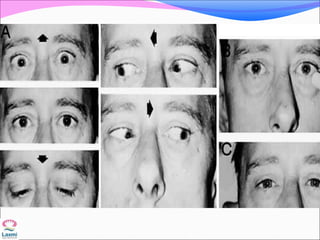
  • #62ย Dorsal midbrain (Parinaud) syndrome. Upgaze palsy (A) with normal downgaze and horizontal movement. Pupils mid-dilated and fixed to light (B) but react to near-effort (C).
  • #63ย Argyll Robertson pupils Aberrant regeneration of the third nerve Diabetes Tonic pupil Deafferention Argyll Robertson pupils Aberrant regeneration of the third nerve Diabetes Tonic pupil Deafferention Limited upgaze in elderly patients Progressive supranuclear palsy Niemann-pick disease Whippleโ€™s disease