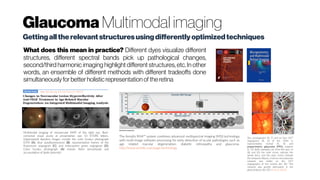
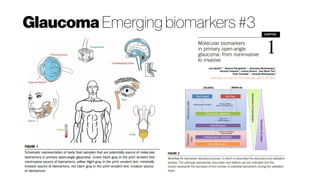
"DuchampDictionary",collage
fromThomasGirst'sbook
Petteri Teikari, PhD
http://petteri-teikari.com/
version Sun 28 May 2017
Glaucoma
Engineering perspective for
diagnosis and disease
management
Introduction
In future we will see how ‘big data’ and multimodal inference is
making ophthalmologic diagnostics, disease management and
personalized treatment more objective and of higher quality.
The highly complex and nonlinear interactions between
measurable variables will eventually replace strict diagnosis
codes and ‘hero researcher’ single metrics with automated analysis
pipelines.
Successful clinicians will embrace machine learning augmented
workflows and healthcare will follow other professions in this “AI
transition”
PathologyOverview
Glaucoma Overview of the pathology
Symptoms ofglaucoma
Glaucoma doesn't usually have any
symptoms to begin with and is often
only picked up during a routine eye
test.
Many people don't realise they
have it because it develops slowly
over many years and tends to cause a
loss of peripheral vision (the edge of
your vision) at first. Without
treatment, it can eventually lead to 
blindness
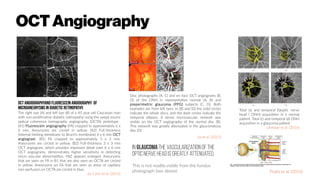
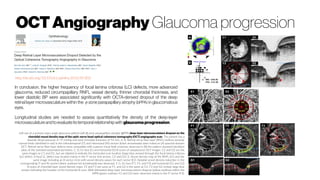
In glaucoma the vascularization of the
optic nerve head is greatly attenuated.
This is not readily visible from the fundus
photograph (left), whereas the OCT
angiography is a lot more expressive in
terms of distinguishing diseased retina
(PPG) from normal healthy retina
Jia et al. (2012).PPG-Pre-perimetricglaucoma
GlaucomaStatistics
UK
In England, about 480,000
people have chronic open-angle
glaucoma. [NERC]
USA
Over 4 million Americans have
glaucoma but only half of those
know they have it. [GRF]
WORLD
As the second most common cause of
blindness worldwide, Quigley and Broman
estimate that by 2020, 79.6 million people will
be inflicted with glaucoma worldwide, of
which 11.2 million will be predicted to be blind
bilaterally.2 There is no cost-effective
population-based screening program
available at present for detection of
glaucoma.1,4 
GlaucomaCosts
UK
In 2008 sight loss cost at least £6.5 billion
[RNIB]
Eye health now accounts for 4.5m GP
consultations and costs the UK economy
£22bneach year. [gponline]
The mean cost of glaucoma treatment
over the lifetime of the patients was
£3001, with an annual mean cost per
patient of£475.[Rahmanet al. 2013]
USA
Glaucoma accounts for over 7 million
visitstophysicianseach year.
The cost to the U.S. government is
estimated to be over $1.5 billion annually.
[GRF]
In the USA, there is a fourfold increase in
average direct costs per patient (pp), with
the earliest stage of glaucoma costing US
$623pp (AUD $667/€482) and end stage
glaucoma/blindness costing US $2511pp
(AUD $2410/€1740). [Scheetz et al. 2016]
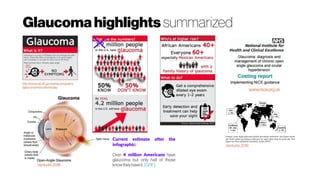
Glaucoma highlights summarized
www.nice.org.uk
Venturini,2016
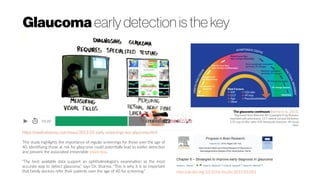
Glaucoma early detection is the key
This study highlights the importance of regular screenings for those over the age of
40. Identifying those at risk for glaucoma could potentially lead to earlier detection
and prevent the associated irreversible vision loss.
"The best available data support an ophthalmologist's examination as the most
accurate way to detect glaucoma," says Dr. Sharma. "This is why it is so important
that family doctors refer their patients over the age of 40 for screening." http://dx.doi.org/10.1016/bs.pbr.2015.03.001
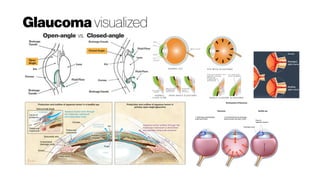
Glaucoma visualized
Glaucoma
Pathophysiology
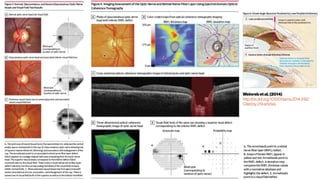
Weinreb et al. (2014) http://dx.doi.org/10.1001/jama.2014.3192, Cited by 219articles
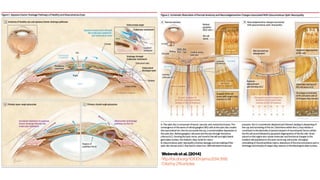
The biological basis of glaucoma is poorly understood and the factors contributing to its
progression have not been fully characterized (Nickellsetal. 2012). Although the pathogenesis of glaucoma
is not fully understood, the level of intraocular pressure is related to retinal ganglion cell death. The
balance between secretion of aqueous humor by the ciliary body and its drainage through 2 independent
pathways—the trabecular meshwork and uveoscleral outflow pathway—determines the intraocular
pressure. In patients with open-angle glaucoma, there is increased resistance to aqueous outflow
through the trabecular meshwork. In contrast, the access to the drainage pathways is obstructed typically
bythe irisin patientswith angle-closure glaucoma(Figure1,nextslide).
Intraocular pressure can cause mechanical stress and strain on the posterior structures of the eye,
notably the lamina cribrosa and adjacent tissues (Figure 2, next slide).The sclera is perforated at the lamina
where the optic nerve fibers (retinal ganglion cell axons) exit the eye. The lamina is the weakest point in
the wall of the pressurized eye. Intraocular pressure–induced stress and strain may result in compression,
deformation, and remodeling of the lamina cribrosa with consequent mechanical axonal damage and
disruption of axonal transport that interrupts retrograde delivery of essential trophic factors to retinal
ganglion cellsfrom their brainstem target (relayneuronsof the lateralgeniculatenucleus).
Population-level surveys suggest that only 10% to 50% of people with glaucoma are aware they have it.
Glaucomas can be classified into 2 broad categories: open-angle glaucoma and angle-closure
glaucoma. In the United States, more than 80% cases are open-angle glaucoma; however, angle-
closureglaucomaisresponsible for adisproportionatenumber ofpatientswith severe vision loss.
Although elevated intraocular pressure is a very consistent risk factor for the presence of glaucoma,
several population-based studies found intraocular pressure was lower than 22 mm Hg in 25% to 50% of
individuals with glaucoma. (Weinreb and Khaw, 2004; Fechtner and Weinreb 1994) Despite the strong
association between elevated intraocular pressure and glaucoma, substantial numbers of people with
elevated intraocular pressure never develop glaucoma even during lengthy follow-up. (
Weinreb and Khaw, 2004)
Because there is no single perfect reference standard for establishing the diagnosis
of glaucoma, early diagnosis can be challenging. Although examination of the optic
nerve head can reveal signs of neuronal loss, wide variability of its appearance in the healthy
population makes identification of early damage challenging. Presence of characteristic
visual field defects can confirm the diagnosis, but asmany as 30% to 50% of retinal ganglion
cells may be lost before defects are detectable by standard visual field testing. (
Quigleyet al.1981; Harwerthetal.2010) Longitudinal evaluation and documentation of
structural damage to the optic nerve is, therefore, a critical component of the
diagnosis of thedisease.(Medeirosetal.2009)
However, subjective identificationof optic disc damage from glaucoma can be challenging,
with large disagreement in grading observed even among glaucoma
specialists.(Jampeletal. 2009)
Slowing disease progression and preservation of quality of life are the main goals for
glaucoma treatment. The decrease in quality of life associated with glaucoma may occur
earlier than previously thought, underscoring the importance of early diagnosis and
treatment. (McKean-Cowdin etal.2008) Reduction of intraocular pressure isthe only
proven method to treat glaucoma. (Bolandet al.2013) Results from several multicenter
clinical trials have demonstrated the benefit of lowering intraocular pressure in preventing
thedevelopmentandslowingthedisease’sprogression.
Considerable efforts have been made to develop neuroprotective glaucoma
treatments that prevent optic nerve damage. Unfortunately, no good evidence exists that
theseagentscan preventdiseaseprogression in patientswithglaucoma
Weinrebetal.(2014)
http://dx.doi.org/10.1001/jama.2014.3192
Citedby219articles
GlaucomaTypes
Open-AngleGlaucoma(OAG)the“silentkiller”
Whatabout primary angle-closure glaucoma(PACG) and normal-tensionglaucoma (NTG)
2016/17 ICD-10-CM Diagnosis Codes > Diseases of the eye
and adnexa H00-H59 > Glaucoma H40-H42 >
http://www.icd10data.com/ICD10CM/Codes/H00-H59/H40-H42/H40-
http://dx.doi.org/10.1016/j.preteyeres.2016.12.003
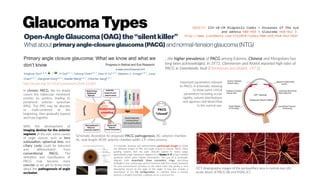
...the higher prevalence of PACG among Eskimos, Chinese and Mongolians has
long been acknowledged. In 1971, Clemmesen and Alsbirk reported high rates of
PACG in Greenlandic Inuit (Clemmesen and Alsbirk, 1971).
In chronic PACG, the iris slowly
covers the trabecular meshwork
portion by portion, leading to
peripheral anterior synechiae
(PAS). The PAS may be discrete
or multi-centered at the
beginning, then gradually expand
and fuse together
With the development of
imaging devices for the anterior
segment of the eye, some causes
of angle closure, such as lens
subluxation, spherical lens, and
ciliary cysts could be detected
and differentiated from
conventional PACG. The
definition and classification of
PACG may become more
concise as we get to know more
about the pathogenesis of angle
occlusion.
Schematic illustration for proposed PACG pathogenesis. AC: anterior chamber;
AL: axial length; ACW: anterior chamber width; CP: ciliary process.
A schematic drawing and representative gonioscopic images to show
the different shapes of PAS and angle closure in chronic PACG. Most
grading systems that are used clinically appear to simply judge
approximate angle opening in degrees or in Grades 1–4 in four cardinal
positions which gives limited information. The use of a schematic
diagram with essentially three concentric rings describing
Schwalbe's line, scleral spur and iris insertion with the contact between
iris and corneoscleral junction in the black hash line giving a nice
descriptive record of the state of the angle. It may also include a
description of the iris configuration, i.e. whether there is bombe
present, a straight insertion, a plateau iris or a concave iris.
Important parameters relevant
to PACG. A schematic drawing
to show some critical
parameters including ocular
rigidity, volume distributions
and aqueous and blood flow
in the normal eye.
OCT-Angiography images of the peripapillary area in normal eyes (A),
acute attack of PACG (B) and POAG (C).
GlaucomaTypes
Open-AngleGlaucoma(OAG)the“silentkiller”
Whatabout angle-closureglaucoma (ACG) and normal-tension glaucoma (NTG)
http://dx.doi.org/10.1097/APO.0000000000000177
2016/17 ICD-10-CM Diagnosis Codes > Diseases of the eye
and adnexa H00-H59 > Glaucoma H40-H42 >
http://www.icd10data.com/ICD10CM/Codes/H00-H59/H40-H42/H40-
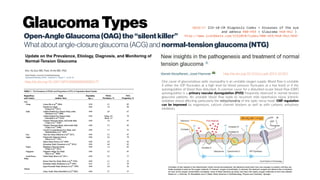
One cause of glaucomatous optic neuropathy is an unstable oxygen supply. Blood flow is unstable
if either the IOP fluctuates at a high level (or blood pressure fluctuates at a low level) or if the
autoregulation of blood flow disturbed. A common cause for a disturbed ocular blood flow (OBF)
autoregulation is a primary vascular dysregulation (PVD) frequently observed in normal tension
glaucoma patients. An unstable blood flow leads to recurrent mild reperfusion injury (chronic
oxidative stress) affecting particularly the mitochondria of the optic nerve head. OBF regulation
can be improved by magnesium, calcium channel blockers as well as with carbonic anhydrase
inhibitors.
http://dx.doi.org/10.1016/j.coph.2012.10.001
Glaucoma
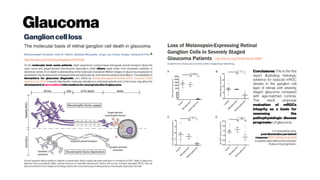
Ganglioncellloss
http://dx.doi.org/10.1016/j.preteyeres.2011.11.002 http://dx.doi.org/10.1167/iovs.16-19997
Axonal transport failure leading to deficits in neurotrophic factor supply has been proposed to contribute to RGC death in glaucoma.
Neurons that successfully obtain optimal amounts of essential neurotrophic factors will survive, whereas damaged RGCs that are
disconnected fromtheirtargets and undergo obstructionof axonal transport will experience neurotrophic deprivationand die.
At the molecular level, some patients might experience compromised retrograde axonal transport along the
optic nerve and target-derived neurotrophin deprivation, while others might suffer from increased oxidative or
excitotoxic stress. An in-depth understanding of the molecular changesat differentstagesof glaucoma progression is
essential for the development of therapies that are highly specificand minimize adversesideeffects. Theavailability of
biomarkers for glaucoma diagnostic and follow-up (Golubnitschaja and Flammer, 2007; Grusetal., 2008;
Joachimetal.,2007a) should help identify molecular alterations in individual patients and, in the future, may allow the
developmentofpersonalized interventionsfor neuroprotection inglaucoma
Conclusions: This is the first
report illustrating histologic
evidence for reduced mRGC
density in the ganglion cell
layer of retinas with severely
staged glaucoma compared
with age-matched controls.
This result proposes
evaluation of mRGCs
integrity as a basis for
assessing the
pathophysiologic disease
progression of glaucoma.
For examplebyusing
post-illuminationpersistent
response(PIPR; Adhikarietal. 2016)
inpupillarylightreflex astheindication
of glaucoma progression.
Glaucoma
Mitochondria
* Professor ofOcular Neurobiology, Nuffield Dept.Clinical Neurosciences, Oxford University
http://dx.doi.org/10.1016/j.mito.2016.11.009
Glaucoma is an age-related disease and
it is known that transmission of visible
light onto the retina is significantly
reduced in older lenses, especially for the
blue region of the spectrum.
Nevertheless, it is worth recognising that
people are now exposedtomore blue
light (310–450 nm) than ever before.
Such blue light is derived from the sun,
digital screens (from TVs, computers,
laptops, smart phones and tablets),
electronic devices, and from fluorescent
and LED lighting.
Petteri:Notethat 315-400nm is
defined as theUV-A range rather than
visible bluelight. Seee.g.
http://www.skincancer.org/prevention
/uva-and-uvb
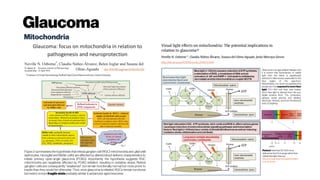
Figure 2 summarises the hypothesis that retinal ganglion cell (RGC) mitochondria and glial cells
(astrocytes, microglial and Müller cells) are affected by altered blood delivery characteristics to
initiate primary open-angle glaucoma (POAG). Importantly, the hypothesis suggests RGC
mitochondria are negatively affected by POAG initiation, resulting in oxidative stress. Retinal
ganglion cells are consequently “weakened”, but remain functionally normal but more prone to
insults than they would be otherwise. Thus, once glaucoma is initiated, RGCs remain functional
but exist in amore fragilestate probably similar to advanced-aged neurones.
Glaucoma
Geneticphenotype
Venturini, C; (2016)  Doctoral thesis, UCL (University College
London).http://discovery.ucl.ac.uk/1474473/
Weinreb et al.(2014): Several genes—including myocilin (MYOC, GLC1A)
(CCDS1297.1), optineurin (OPTN, GLC1E) (CCDS7094.1) and WD repeat domain
(GLC1G) (CCDS4102.1) —are associated with a monogenic, autosomal dominant trait;
however, these genes account for less than 10% of all glaucoma cases. (
Kwon etal.2009) A growing number of studies use genome-wide scans to look for
glaucoma susceptibility loci. The CAV1/CAV2 (HGNC:1527/HGNC: 1528) locus on
7q34 may be associated with primary open-angle glaucoma in European-derived
populations. This finding has been replicated by independent studies. These genes
encode proteins (caveolins) involved in the generation and function of caveola, which
are invaginations of the cell membrane involved in cell signaling and endocytosis. The
CDKN2BAS(HGNC:34341)locus on 9p21was shown toberelatedtoglaucomariskin
multiplecohorts. (Wiggsetal.2012)
Retinal nerve fibre layer (RNFL)evaluation is a useful tool in early glaucoma diagnosis. Family history of
glaucoma is a risk factor for thinner RNFL. RNFL thickness has also been investigated as a possible bio-
marker in variousneurological conditions.
Interestingly, visual impairment is one of the earliest complaints in AD (Alzheimer’s Disease)
patients (Valenti 2010). Visual functions such as contrast sensitivity in lower spatial frequency, motion
perception, visual field and colour discrimination decreased in AD, showing a similarity with the visual deficits
in glaucoma. Patients with AD and glaucoma show a more rapid and aggressive glaucomatous visual field
loss (Bayer & Ferrari 2002). Both AD and glaucoma affect the visual pathway, but start in different
region along the neural pathway. AD might start in the visual association area (McKee et al. 2006) whereas
glaucoma has its initial damage in the optic nerve. In addition, AD treatments have been shown to have
animpact on glaucoma.
ChEI (cholinesterase inhibitors) treatment, commonly prescribed for AD, lowers IOP and seems to be
protective for retinal ganglion cells (Estermann et al. 20066). Memantine is a neuroprotective drug for AD
and also have implications for the visual system. Memantine has been investigated also for the treatment of
glaucoma and in monkeys with glaucoma and it slows down the progression of cell loss in lateral geniculate
nucleus(LGN)compared withthose animalsnot treated (Yücel et al. 2006).
Epidemiological studies have shown the link between the two diseases. Two groups whose 112 with AD
and 774 without have been compared and 25.9% of the people with AD developed also glaucoma, but only
5.2% of the group without AD (Bayer et al. 2002). Loss of nerve fibre layer tissue in the retina and optic nerve
may be an early biomarker for AD and may appear even before any hippocampus damage, which
isthe brainstructurethat impacts memory(Valenti2011).
A study funded by the National Eye Institute (NEI) has discovered 3
more genes associated with primary open-angle glaucoma (POAG),
the most common type of glaucoma and a leading cause of blindness
worldwide (Bailey JC et al. Nature Gen. doi:10.1038/ng.3482
[published online January 11, 2016]). Previously, 12 genes have been
linked to glaucoma, which damages the optic nerve due to the
buildup of fluid and pressure in the eye.
http://dx.doi.org/10.1001/jama.2016.0559
Glaucoma
Fromgeneticsto proteomics
Published Online:December 15, 2016- http://dx.doi.org/10.1016/j.cels.2016.11.006
Network analysis revealed 16 modules of co-expressed proteins, 10 of which correlated with AD
phenotypes This multi-network analysis reveals protein- and disease-specific pathways
involved in theetiology, initiation, and progression of AD.
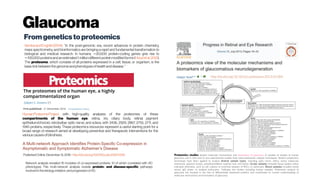
SembaandEnghild(2014): “In the post-genomic era, recent advances in protein chemistry,
mass spectrometry, and bioinformatics are bringing a rapid and fundamental transformation to
biological and medical research. In humans, 20,000 protein-coding genes give rise to∼
100,000proteinsandanestimated1million differentprotein modifiedforms(∼ Hood etal.2012).
The proteome, which consists of all proteins expressed in a cell, tissue, or organism, is the
basic link between thegenomeandphenotypesofhealthanddisease. “
Human ProteomeProject with high-quality analyses of the proteomes of these
compartments of the human eye: retina, iris, ciliary body, retinal pigment
epithelium/choroid, retrobulbar optic nerve, and sclera, with 3436, 2929, 2867, 2755, 2711, and
1945 proteins, respectively. These proteomics resources represent a useful starting point for a
broad range of research aimed at developing preventive and therapeutic interventions for the
variouscausesofblindness.
Proteomics studies toward molecular mechanisms and biomarkers of glaucoma. A number of studies of human
glaucoma and in vitro and in vivo experimental models have used proteomics analysis techniques. Distinct proteomics
techniques have been applied to analyze diverse sample types, including optic nerve, retina, sclera, trabecular
meshwork, aqueous humor, pseudoexfoliative material, tear, and blood. Ocular samples included tissue lysates unless
indicated otherwise, such as cell cultures or enriched samples of RGCs or astrocytes. Blood samples included whole
serum, IgG elutes, or isolated leukocytes. *indicates the studies including human samples. Proteomics analysis of
glaucoma has resulted in the lists of differentially expressed proteins and contributed to current understanding of
molecular mechanisms and biomarkers of glaucoma.
Glaucoma
DataminingElectronicMedicalRecords(EMR)
http://dx.doi.org/10.1371/journal.pone.0127817
Here we develop and deploy an algorithm utilizing data mining techniques to identify
primary open-angle glaucoma (POAG) in African Americans from EAGLE BioVU for genetic
association studies. The algorithm described here was designed using a combination of
diagnostic codes, current procedural terminology billing codes, and free text searches to
identify POAG status in situations where gold-standard digital photography cannot be
accessed. The case algorithm identified 267 potential POAG subjects but underperformed
after manual review with a positive predictive value of 51.6% and an accuracy of
76.3%. The control algorithm identified controls with a negative predictive value of 98.3%.
Although the case algorithm requires more downstream manual review for use in large-
scale studies, it provides a basis by which to extract a specific clinical subtype of glaucoma
from EMRs in the absence of digital photographs.
https://www.ncbi.nlm.nih.gov/pmc/articles/PMC5001772/
The Precision Medicine Initiative (PMI)(1) promises resources and much needed
epidemiologic and clinical data designed to provide a better understanding of the factors
underlying the known inter-individual differences in susceptibility, onset, prognosis, and
treatment of disease(2).
Published index variants for the CDKN2B-AS1 region associated with POAG or POAG
associated trait and availability of these variants on the Metabochip.
The increasing cost of health care has motivated the drive towards preventive medicine,
where the primary concern is recognizing disease risk and taking action at the earliest stage.
We present an application of deep learning to derive robust patient representations from the
electronic health records and to predict future diseases. Experiments showed promising
results in different clinical domains, with the best performances for liver cancer, diabetes, and
heart failure.
http://dx.doi.org/10.1007/978-3-319-30671-1_66
Glaucoma
Modeling
http://dx.doi.org/10.1159/000448480
http://dx.doi.org/10.1007/s13721-016-0136-3
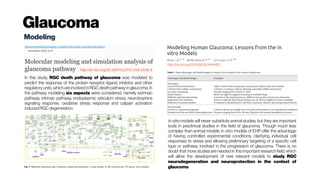
In this study, RGC death pathway of glaucoma was modeled to
predict the response of the protein receptor, ligand, inhibitor and other
regulatory units, which are involved in RGC death pathway in glaucoma. In
the pathway modeling six aspects were considered, namely extrinsic
pathway, intrinsic pathway, endoplasmic reticulum stress, neurotrophins
signaling response, oxidative stress response and calpain activation
induced RGCdegeneration.
In vitro models will never substitute animal studies, but they are important
tools in preclinical studies in the field of glaucoma. Though much less
complex than animal models, in vitro models of EHP offer the advantage
of having controlled experimental conditions, clarifying individual cell
responses to stress and allowing preliminary targeting of a specific cell
type or pathway involved in the progression of glaucoma. There is no
doubt that more studies are needed in this important research field, which
will allow the development of new relevant models to study RGC
neurodegeneration and neuroprotection in the context of
glaucoma.
Glaucoma
Autoimmuneinvolvement
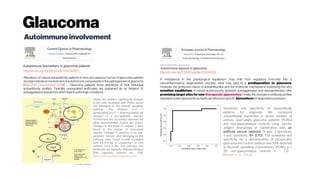
http://dx.doi.org/10.1016/j.coph.2012.09.005 http://dx.doi.org/10.1016/j.ejphar.2016.04.031
Alterations of natural autoantibody patterns in sera and aqueous humor of glaucoma patients
strongly indicate an involvement of autoimmune components in the pathogenesis of glaucoma
(Wax2011; Grusand Sun2008). … Glaucoma patients show alterations of their individual
autoantibody profiles. Typically, upregulated antibodies are explained as an initiation of
autoaggressive sequenceswhichlead topathologic conditions.
A misbalance in the physiological equilibrium may shift from regulatory immunity into a
neuroinflammatory degenerative process, what may lead to a predisposition to glaucoma.
However, the protective nature of autoantibodies and the molecular mechanisms underlying the very
sensitive equilibrium of natural autoimmunity between autoaggression and neuroprotection offer
promising target sitesfor new therapeutic approaches. Finally, the changes in antibody profiles
represent anew opportunityashighlysensitive and specific biomarkersfor diagnosticspurposes.
Sensitivity and specificity of autoantibody
patterns for diagnosis. We compared
autoantibody reactivities in serum samples of
primary open-angle glaucoma patients (POAG)
and non-glaucomatous controls using specific
antigen microarrays in combination with an
artificial neural network (X-axis: 1-specificity,
Y-axis: sensitivity, R= 0.93). The sensitivity and
specificity for a discrimination of prospective
glaucoma and control subjects was 93% depicted
as Receiver operating characteristic. (POAG: n =
20; non-glaucomatous controls: n = 13).
(Boehm et al., 2012).
Shows the proteins significantly changes
in the cells incubated with POAG serum
and belonging to the intrinsic apoptotic
pathway. The Proteins (red =
upregulated; green = downregulated) are
changed in a pro-apoptotic manner.
Furthermore the cut surface between the
other demonstrated studies are shown.
Changes in the levels of caspase 3 were
found in the retinae of immunized
animals. Changes in proteins in an anti-
apoptotic manner, also belonging to this
pathway, were found in cells incubated
with 14-3-3 Ab in comparison to cells
without 14-3-3 Ab. The pathway was
performed by Ingenuity Pathway Analysis
(IPA; Ingenuity Systems Inc., USA,
https://www.analysis.ingenuity.com).
Glaucoma
Amyloid-binvolvementandconnectiontootherneurodegenerativediseases#1
http://dx.doi.org/10.1007/s00018-016-2348-1
http://dx.doi.org/10.1007/s00018-016-2295-x
The retina arises as a neuro-ectodermal derivative of the forebrain duringdevelopment
and delineates several physiological, cellular and biochemical similarities with the brain
tissue. With the advancement in technology, subtle changes in both human and animal
retinas can be directly imaged and assessed in vivo and as such the retina is being
increasingly used as a model to study the neurodegenerative disorders of brain
particularly Alzheimer’s disease (AD, Guptaet al. 2016). Additionally, retinal
disorders such as age-related macular degeneration (AMD) and glaucoma
are chronic neurodegenerative conditions that affect vari- ous retinal neurons and lead
toprogressive and irreversible lossofthe vision.
All three diseases are multifactorial with distinct pathological and clinical
manifestations even though age remains the common primary risk factor and
people with family history are at higher risk. Although AMD and glaucoma are not
classified as amyloidogenic diseases, the last decade has seen many animal and
human studies featuring evidence of progressive accumulation of amyloid beta
fragments in the retina (Guptaet al. 2014). Therefore, retinal Ab accumulation can be
regarded asacommon feature ofthese three separatedisorders
Analysing Ab characteristics including fragment size, oligomerisation and anatomical distribution within the retina holds ‘‘reasonable promise’’ to
provide unique retinal signatures and differentiate between various Ab associated disease conditions. For instance, AMD-associated Ab
deposition is more restricted to RPE and likely to be identified as complex with drusen (Anderson etal. 2004). In glaucoma, expression of Ab
could be found in the inner retina (Guo etal. 2007; Guptaetal. 2014)[5, 39] along with ON excavation. Retinal Ab deposition in AD is
geographically more wide spread and again associated with degenerative changes in the inner retina and ON (Gupta etal. 2016). Successful
identification of differences and similarities will drive drug development and mechanism based pathophysiological research.Imaging patterns of Ab
deposition in the eye could be of diagnostic and prognostic value when considered with other ocular or biochemical markers and play imperative
role in disease monitoring. Development of newer Ab imaging technologies will greatly accelerate research into mechanism based therapies
for these neurodegenerative disorders. Longitudinal studies in larger cohorts and rescue experiments will support the hypothesis that Ab
deposition does exert neurotoxic effects on the retina. Concluding, the significance of Ab depostion in mechanistic understanding of retinal
pathology, diseasediagnosis, prognosis or as a treatment target is highly relevant considering its known neurotoxic effects and the high incidenceof
thesediseasesinageing populations.
PhD Project: Multi-
spectral imaging for in
vivo imaging of oxygen
tension and β-amyloid
University Eye Clinic Maastricht
Glaucoma
Amyloid-binvolvementandconnectiontootherneurodegenerativediseases#2
http://dx.doi.org/10.1523/JNEUROSCI.3986-15.2016
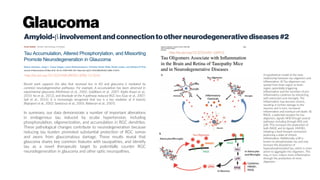
Recent work supports the idea that neuronal loss in AD and glaucoma is mediated by
common neurodegenerative pathways. For example, A accumulation has been observed in
experimental glaucoma (McKinnon et al., 2002; Goldblum et al., 2007; Kipfer-Kauer et al.,
2010; Ito et al., 2012), and blockade of the A pathway reduced RGC loss (Guo et al., 2007;
Salt et al., 2014). It is increasingly recognized that tau is a key mediator of A toxicity
(Rapoport et al., 2002; Santacruz et al., 2005; Roberson et al., 2007).
In summary, our data demonstrate a number of important alterations
in endogenous tau induced by ocular hypertension, including
phosphorylation, oligomerization, and accumulation in RGC dendrites.
These pathological changes contribute to neurodegeneration because
reducing tau burden promoted substantial protection of RGC somas
and axons from glaucomatous damage. These results reveal that
glaucoma shares key common features with tauopathies, and identify
tau as a novel therapeutic target to potentially counter RGC
neurodegeneration in glaucoma and other optic neuropathies.
Eyeasamarker for neurological and psychiatric diseases
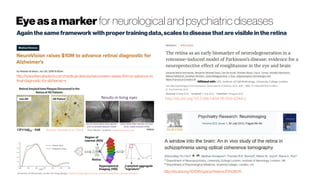
Again thesameframework withproper trainingdata,scalesto diseasethatarevisiblein theretina
http://www.fiercebiotech.com/medical-devices/neurovision-raises-10m-to-advance-re
tinal-diagnostic-for-alzheimer-s
http://dx.doi.org/10.1186/s40478-016-0346-z
Affiliated with: UCL Institute of Ophthalmology, University College London
http://dx.doi.org/10.1016/j.pscychresns.2011.08.011
Koronyo-Hamaoui et al. (2012) Prof Melanie Campbell motherboard.vice.com
University of Minnesota: Center for Drug Design | https://drugdesign.umn.edu/research/alzheimers-disease-research
Glaucoma
Statistics#1
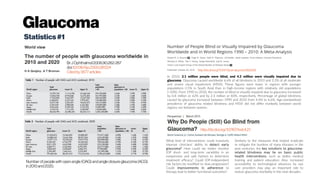
Br JOphthalmol 2006;90:262-267 
doi:10.1136/bjo.2005.081224
Citedby3677articles
Number of people with open angle (OAG) and angle closure glaucoma(ACG)
in2010and2020.
http://dx.doi.org/10.1371/journal.pone.0162229
In 2010, 2.1 million people were blind, and 4.2 million were visually impaired due to
glaucoma. Glaucoma caused worldwide 6.6% of all blindness in 2010 and 2.2% of all moderate
and severe visual impairment (MSVI). These figures were lower in regions with younger
populations (<5% in South Asia) than in high-income regions with relatively old populations
(>10%). From 1990 to 2010, the number of blind or visually impaired due to glaucoma increased
by 0.8 million or 62% and by 2.3 million or 83%, respectively. Percentage of global blindness
caused by glaucoma increased between 1990 and 2010 from 4.4% to 6.6%. Age-standardized
prevalence of glaucoma related blindness and MSVI did not differ markedly between world
regions nor between women.
http://dx.doi.org/10.1167/tvst.4.2.1
What kind of interventions could massively
improve clinicians' ability to detect early
glaucoma? How could we better monitor
IOP short- and long-term variability in an
inexpensive and safe fashion to determine
treatment efficacy? Could IOP-independent
risk factors be modified to slow progression?
Could improvements in adherence to
therapy lead to better functional outcomes?
Similarly to the measures that helped eradicate
or mitigate the burdens of many diseases in the
past centuries, the key solutions to glaucoma-
related blindness may lie on basic public
health interventions, such as better medical
training and patient education. Also, increased
accessibility to technological advances by eye
care providers may play an important role to
reduce glaucoma morbidity in the next decades.
Glaucoma
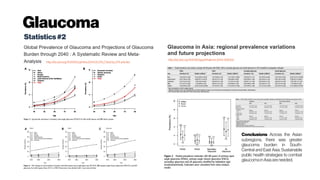
Statistics#2
http://dx.doi.org/10.1016/j.ophtha.2014.05.013, Cited by274 articles
http://dx.doi.org/10.1136/bjophthalmol-2014-306102
Conclusions Across the Asian
subregions, there was greater
glaucoma burden in South-
Central and East Asia. Sustainable
public health strategies to combat
glaucoma in Asia are needed.
Glaucoma
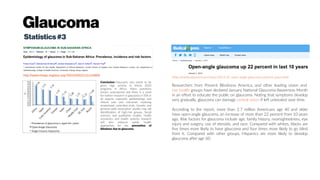
Statistics#3
Conclusion: Glaucoma care needs to be
given high priority in Vision 2020
programs in Africa. Many questions
remain unanswered and there is a need
for further research in glaucoma in SSA in
all aspects especially epidemiology and
clinical care and outcomes involving
randomized controlled trials. Genetic and
genome-wide association studies may aid
identification of high-risk groups. Social
sciences and qualitative studies, health
economics and health systems research
will also enhance public health
approaches for the prevention of
blindness due to glaucoma.
http://www.meajo.org/text.asp?2013/20/2/111/110605
Researchers from Prevent Blindness America, and other leading vision and
eye health groups have declared January National Glaucoma Awareness Month
in an effort to educate the public on glaucoma. Noting that symptoms develop
very gradually, glaucoma can damage central vision if left untreated over time.
According to the report, more than 2.7 million Americans age 40 and older
have open-angle glaucoma, an increase of more than 22 percent from 10 years
ago. Risk factors for glaucoma include age, family history, nearsightedness, eye
injury and surgery, use of steroids, and race. Compared with whites, blacks are
five times more likely to have glaucoma and four times more likely to go blind
from it. Compared with other groups, Hispanics are more likely to develop
glaucoma after age 60.
https://medicalxpress.com/news/2013-01-open-angle-glaucoma-percent-years.html
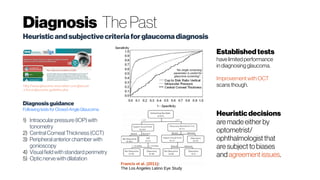
Diagnosis The Past
Heuristicandsubjectivecriteriaforglaucomadiagnosis
http://www.glaucoma-association.com/glaucom
a-focus/glaucoma_guideline.php
Diagnosisguidance
Following testsforClosed-Angle Glaucoma
1) Intraocular pressure(IOP) with
tonometry
2) CentralCorneal Thickness (CCT)
3) Peripheral anteriorchamber with
gonioscopy
4) Visual fieldwith standard perimetry
5) Optic nervewith dilatation
Establishedtests
havelimited performance
in diagnosing glaucoma.
Improvement with OCT
scans though.
“No single screening
parameter is useful for
glaucoma screening”.
Heuristicdecisions
are made either by
optometrist/
ophthalmologistthat
are subjectto biases
and agreement issues.
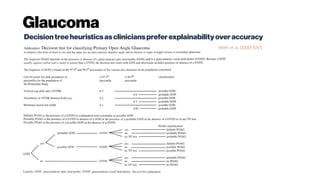
Glaucoma
Decisiontreeheuristicsasclinicianspreferexplainabilityoveraccuracy
Glaucomadetection current markers
OCTbecomingcommon,seelaterdetailsonbiomarkers
SS-OCTofferfasterscanning(lessmotion
artifacts, andnicerfor thepatient),anddeeper
retinallayerimages(longerwavelengths
attenuateless) -Spaideet al.(2013)
*OCTOpticalCoherenceTomography
*SD-OCT SpectralDomanOCT
*SS-OCTSwept-SourceOCT
See more on the
technology
differences in:
(Slide 12 ->)
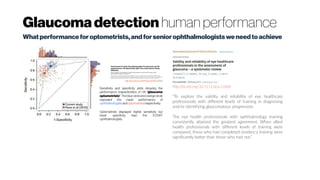
Glaucoma detection human performance
Whatperformanceforoptometrists,andforseniorophthalmologistsweneedtoachieve
Sensitivity and specificity plots showing the
performance characteristics of UK 'glaucoma
optometrists'. The blue circle and orange circle
represent the mean performance of
ophthalmologists and optometrists respectively.
Optometrists displayed higher sensitivity but
lower specificity than the EODAT
ophthalmologists.
http://dx.doi.org/10.1111/opo.12066 (2013)
http://dx.doi.org/10.1111/ijcp.12600
“To explore the validity and reliability of eye healthcare
professionals with different levels of training in diagnosing
and/or identifying glaucomatous progression.
The eye health professionals with ophthalmology training
consistently attained the greatest agreement. When allied
health professionals with different levels of training were
compared, those who had completed residency training were
significantly better than those who had not.”
UKHealthcareSystem
NHSOphthalmology
Provisionandreferralpathways#1
NHSOphthalmologycareprovisionandreferralpathways
Recent guidance to the commissioners of eye care from the Royal College of Ophthalmologists has
outlined the need for improved non-specialist and out of hospital facilities for ophthalmology, as part
of aRight Care/QIPP vision of ‘hospital without walls’for ophthalmic care.1
Eye care flows from primary care (first presentation and basic conditions) to secondary care
(emergency or serious conditions requiring expert care). The primary care to specialist interface is a
keyorganisational taskfor manyhealth care systems.2
In the UK, Primary Care Ophthalmology is largely provided by optometrists 57% and GPs 43%.3 In
addition, the service is supported by GPs with special interest in ophthalmology (GPSI), a few
Ophthalmic Medical Practitioners (OMPs), Nurses and Nurse Practitioners and Orthoptists as well as
Ophthalmologists. Compared with other specialties, more primarycare in ophthalmology happensin
hospital rather than in general practice because of the lack of equipment, particularly slit lamps, and
lackof ophthalmicskillsand knowledge.4,5,6,7
Demand for ophthalmic services is increasing. From 2009 to 2010, there were 1.69 million first
attendances at English NHS ophthalmology departments, representing 28% of the total of 5.95
million ophthalmology attendances. [NHS information centre]. There has been a rise of 25% in
ophthalmology outpatients over 7 years and ophthalmology outpatients constitute 9% of all NHS
outpatientappointments(the second highest demand specialty).
Increasing detection and more expensive treatment of eye disease is stretching the NHS
ophthalmology budget and secondary care capacity is increasingly strained. To deal with this, the
RCO have proposed an emphasis on non-specialist, primary care ophthalmology to manage patient
flow and free capacity in the Hospital EyeService(HES).1,2
1) Stella Hornby.PrimaryCareOphthalmology –theRoyal CollegeofOphthalmologists. June2013.
2) Malik AN, Cassels-Brown A, Wormald R, Gray JM. Better valueeyecareforthe21stcentury: the population
approach. BritishJournal of Ophthalmology. 2013 Jan15:bjophthalmol-2012.
3) Pierscionek TJ, Moore JE, Pierscionek BK. Referralsto ophthalmology: optometric and general practice
comparison. Ophthalmicand Physiological Optics. 2009 Jan1;29(1):32-40.
4) Featherstone PI, James C, Hall MS, Williams A.General practitioners'confidenceindiagnosing and managing
eyeconditions: a surveyin south Devon.BrJGenPractice1992:42:21-
Summaryof reportfindingsfromRoyal Collegeof Ophthalmologists2013:
● Demographic changes and new treatments and investigations have caused
acute pressures and lack of capacity in secondary care (Hospital Eye Service
or HES).
● Managing the flow of new (as yet undiagnosed) patients to a department to
maximise potential to prevent sight loss but also to get maximum value for
money will become increasingly important in terms of the annual report and
budgetallocations.
● Many patients can be seen in the community if the necessary equipment is
available and increased value could be obtained by using community
optometrists to triage and manage GP referrals for external inflammatory
conditions.
● IT investment linking primary ophthalmic care and HES is key to achieving the
bestvaluemodelforophthalmiccare.
● Opportunistic surveillance for eye diseases such as glaucoma by optometrists
will prevent sight loss but the current provision does not provide equitable
access for everyone and poorer communities have lower take up of sight tests
andhigher ratesofvisualimpairment.
5) McDonnell PJ. Howdo general practitionersmanageeyediseaseinthecommunity? Br J Ophthalmol. 1988
Oct;72(10):733-6.
6) Sheldrick JH, Vernon SA, Wilson A, Read SJ. Demand incidenceand episoderatesof ophthalmicdisease in a
defined urban population. BrMedJ. 1992Oct17;305(6859):933-6.
7) Sheldrick JH, Wilson AD, Vernon SA, Sheldrick CM. Managementof ophthalmic diseaseingeneralpractice.. Br J
GenPract.1993 Nov;43(376):459-62.
NHSOphthalmology
Provisionandreferralpathways#2
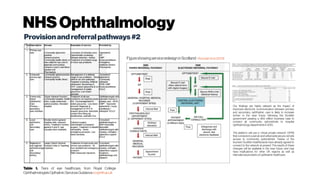
Table 1. Tiers of eye healthcare, from Royal College
OphthalmologistsOpthalmicServicesGuidance rcophth.ac.uk
FigureshowingserviceredesigninScotland-Borooah et al. (2013)
Our findings are highly relevant as the impact of
improved electronic communication between primary
and secondary ophthalmic care is likely to increase
further in the near future, following the Scottish
government passing a d6.6 million business case to
connect all community optometrists to hospital
ophthalmologydepartmentsin 2010.
The platform will use a ‘virtual private network’ (VPN)
that connectsto a server and willprovidesecure,remote
access to community optometrists. Twelve of the
fourteen Scottish healthboards have already agreed to
connect to the network at present. The results of these
changes will be available in the near future, and may
have implications for other UK regions as well as
international providersof ophthalmichealthcare.
Glaucoma
UKCommissioningGuide
https://www.rcophth.ac.uk/wp-content/upload
s/2016/06/Glaucoma-Commissioning-Guide-Long
-June-2016-Final.pdf
Glaucoma
FurtherUKResources
BasicUKReferrals Retinal diseases
TraditionalNHSreferralpathwaysforretinaldiseases
Optician GP→ GP Ophthalmologists→
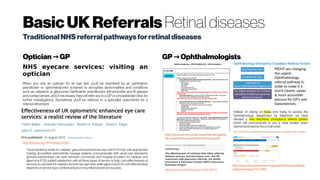
NHS eyecare services: visiting an
optician
When you visit an optician for an eye test, you'll be examined by an ophthalmic
practitioner or optometrist who is trained to recognise abnormalities and conditions
such as cataracts or glaucoma. Ophthalmic practitioners will prescribe and fit glasses
and contact lenses, and, if necessary, they will refer you to a GP or a hospital eye clinic for
further investigations. Sometimes you'll be referred to a specialist optometrist for a
referralrefinement.
/defaultview.aspx?id=1986http://dx.doi.org/10.1136/bmjopen-2013-002715
http://dx.doi.org/10.1111/opo.12312
“Good evidence exists for cataract, glaucoma and primary eye care EOS that: with appropriate
training, accredited optometrists manage patients commensurate with usual care standards;
genuine partnerships can exist between community and hospital providers for cataract and
glaucoma EOS; patient satisfaction with all three types of service is high; cost-effectiveness of
services is unproven for cataract and primary eye care, while glaucoma EOS cost-effectiveness
dependson service type;contextual factorsmayinfluence servicesuccess.
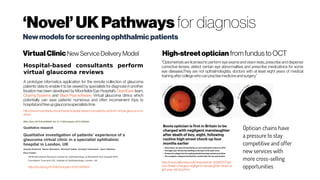
‘Novel’UKPathways for diagnosis
VirtualClinic New ServiceDeliveryModel High-streetoptician from fundus toOCT
Hospital-based consultants perform
virtual glaucoma reviews
A prototype informatics application for the remote collection of glaucoma
patients’ data to enable it to be viewed by specialists for diagnosis in another
location has been developed by Moorfields Eye Hospital‘s OpenEyes team,
Charing Systems and BlackPear software. Virtual glaucoma clinics which
potentially can save patients’ numerous and often inconvenient trips to
hospitalandfreeupglaucomaspecialiststime
http://www.moorfields.nhs.uk/news/hospital-based-consultants-perform-virtual-glaucoma-re
views
http://dx.doi.org/10.1136/bmjopen-2015-009463
Newmodelsforscreeningophthalmicpatients
http://www.dailymail.co.uk/news/article-3228075/Opti
cian-Britain-charged-negligent-manslaughter-death-ei
ght-year-old-boy.html
“Optometrists are licensed to perform eye exams and vision tests, prescribe and dispense
corrective lenses, detect certain eye abnormalities and prescribe medications for some
eye diseases.They are not opthalmologists, doctors with at least eight years of medical
trainingafter collegewhocanpractisemedicineandsurgery.”
Optician chains have
a pressure to stay
competitive and offer
new services with
more cross-selling
opportunities
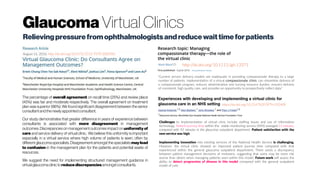
Glaucoma Virtual Clinics
Relievingpressurefromophthalmologistsandreducewait timeforpatients
August 16, 2016; http://dx.doi.org/10.4172/2155-9570.1000585
The percentage of overall agreement on recall time (25%) and review place
(45%) was fair and moderate respectively. The overall agreement on treatment
plan was superior (86%). We found significant disagreement between the senior
consultantandthenewlyappointedconsultant.
Our study demonstrates that greater difference in years of experience between
consultants is associated with more disagreement in management
outcomes. Discrepancies on management outcomes impact on uniformity of
care and service delivery of virtual clinic. We believe this uniformity is important
especially in a virtual service where high volume of patients is seen, often by
differentglaucomaspecialists.Disagreementamongstthe specialists may lead
to confusion in the management plan for the patients and potential waste of
resources.
We suggest the need for implementing structured management guidance in
virtualglaucomaclinictoreducediscrepanciesamongstconsultants.
http://dx.doi.org/10.1111/jgh.13371
“Current service delivery models are inadequate in providing compassionate therapy to a large
number of patients. Implementation of a virtual compassionate clinic can streamline delivery of
a compassionate program, reduces administration and nursing resource burden, ensures delivery
of consistent, high quality care, and provides an opportunity to prospectively collect data.”
https://dx.doi.org/10.2147%2FOPTH.S92409
Challenges to implementation of virtual clinic include staffing issues and use of information
technology. Patient journey time within the stable monitoring service (SMS) averaged 51 minutes,
compared with 92 minutes in the glaucoma outpatient department. Patient satisfaction with the
new service was high.
Implementing innovation into existing services of the National Health Service is challenging.
However, the virtual clinic showed an improved patient journey time compared with that
experienced within the general glaucoma outpatient department. There exists a discrepancy
between patient management decisions of reviewers, suggesting that some may be more risk
averse than others when managing patients seen within this model. Future work will assess the
ability to detect progression of disease in this model compared with the general outpatient
model of care.
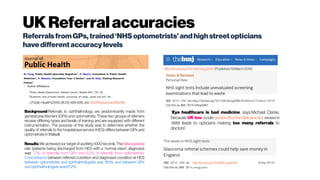
UKReferralaccuracies
ReferralsfromGPs,trained‘NHS optometrists’andhighstreet opticians
havedifferentaccuracylevels
J PublicHealth (2016)38 (3): 599-606.doi: 10.1093/pubmed/fdv081
Background Referrals to ophthalmology are predominantly made from
general practitioners (GPs) and optometrists. These two groups of referrers
receive differing types and levels of training and are equipped with different
instrumentation. The purpose of this study was to determine whether the
quality of referrals to the hospital eye service (HES) differs between GPs and
optometristsinWalsall.
Results We achieved our target of auditing 1000 records. The false-positive
rate (patients being discharged from HES with a ‘normal vision’ diagnosis)
was 7.7% of referrals from GPs and 6.2% of referrals from optometrists.
Concordance between referred condition and diagnosed condition at HES
between optometrists and ophthalmologists was 76.1%, and between GPs
andophthalmologistswas67.2%.
“Eye healthcare is bad medicine, says Michael Clarke,
because UK law (under section26oftheOpticiansAct, revised in
1989) leads to opticians making too many referrals to
doctors”
http://dx.doi.org/10.1136/bmj.g2084 (Published19 March2014)
http://dx.doi.org/10.1136/bmj.g3040
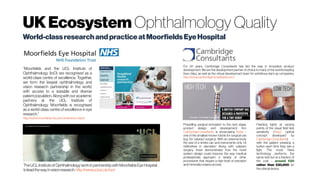
UKEcosystem Ophthalmology Quality
World-classresearchandpracticeatMoorfieldsEyeHospital
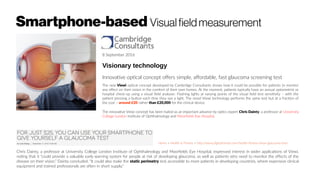
Flashing lights at varying
points of the visual field test
sensitivity (Viewi optical
concept developed by
Cambridge Consultants) –
with the patient pressing a
button each time they see a
light. The novel Viewi
technology performs the
same test but at a fraction of
the cost – around £20
rather than £20,000 for
the clinical device.
Propelling surgical innovation to the next stage,
product design and development firm
CambridgeConsultants is showcasing Axsis –
one of the smallest known robots for surgical use
(e.g. for cataract surgery). With an external body
the size of a drinks can and instruments only 1.8
millimetres in diameter/ Along with cataract
surgery, Axsis demonstrates how the novel
system design could improve the way medical
professionals approach a variety of other
procedures that require a high level of precision
and minimallyinvasive access.
HIGH TECH LOW TECH
The UCL Institute of Ophthalmology work in partnership with Moorfields Eye Hospital
toleadthewayinvisionresearch.http://www.ucl.ac.uk/ioo/
“Moorfields and the UCL Institute of
Ophthalmology (IoO) are recognised as a
world-class centre of excellence. Together,
we form the largest ophthalmology and
vision research partnership in the world,
with access to a sizeable and diverse
patientpopulation.Along with our academic
partners at the UCL Institute of
Ophthalmology, Moorfields is recognised
as a world-class centre of excellence in eye
research.”
http://www.moorfields.nhs.uk/content/our-vision
For 50 years, Cambridge Consultants has led the way in innovative product
development. We are the development partner of choice to many of the world’s leading
blue chips, as well as the virtual development team for ambitious start-up companies.
http://www.cambridgeconsultants.com/
GlaucomaHealthEconomics
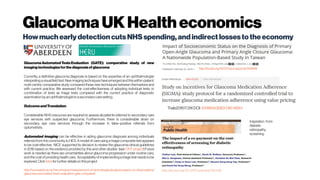
GlaucomaUKHealtheconomics
HowmuchearlydetectioncutsNHS spending,andindirect lossestotheeconomy
Glaucoma Automated Tests Evaluation (GATE): comparative study of new
imagingtechnologiesforthediagnosisof glaucoma
Currently, a definitive glaucoma diagnosis is based on the expertise of an ophthalmologist
interpreting avisualfield test. New imagingtechniques haveemergedandthiswithin-patient,
multi-centre, comparative study compared these new techniques between themselves and
with current practice. We assessed the cost-effectiveness of adopting individual tests or
combination of tests as triage tests compared with the current practice of diagnostic
examination by an ophthalmologistin asecondary caresetting.
OutcomeandTranslation
Considerable NHS resources are required to assess all patients referred to secondary care
eye services with suspected glaucoma. Furthermore, there is considerable strain on
secondary eye care services through the increase in false–positive referrals from
optometrists.
Automated imaging can be effective in aiding glaucoma diagnosis among individuals
referred from the community to HES. A model of care using a triage composite test appears
to be cost-effective.  NICE supported its decision to review the glaucoma clinical guidelines
in 2016 based on the evidence provided by this and other studies  (see OHTproject).Future
work is needed as there are uncertainties about glaucoma progression under routine care,
and the cost of providing health care. Acceptability of implementinga triagetest needs to be
explored.Click here forfurtherdetailson thisproject
http://www.abdn.ac.uk/heru/research/assessment-of-technologies/projects-based-on-observationa/
glaucoma-automated-tests-evaluation-gate-comparati/
http://dx.doi.org/10.1371/journal.pone.0149698
Trials201617:316DOI: 10.1186/s13063-016-1459-1
http://dx.doi.org/10.1093/pubmed/fdv168
Inspiration from
diabetic
retinopathy
screening
Glaucoma Quality of Life
The quality-adjusted life year or quality-adjusted life-
year (QALY) is a generic measure of diseaseburden, including
both the quality and the quantity of life lived.[1][2] It is used in 
economic evaluation to assess the value for money of medical
 interventions. One QALY equates to one year in perfect health. If
an individual's health is below this maximum, QALYs are accrued
at a rate of less than 1 per year. To be dead is associated with 0
QALYs, and in some circumstances it is possible to accrue
negative QALYs to reflect health states deemed 'worse than
dead'.
The QALY is often used in cost-utilityanalysis in order to estimate the
cost-per-QALY associated with a health care intervention. This 
incremental cost-effectivenessratio (ICER) can then be used toallocate 
healthcare resources, often using a threshold approach.[3] In the 
United Kingdom, the , which advises on the use of health technologies
within the National Health Service, has since at least 2013 used "£ per
QALY"toevaluate their utility.[4][5]
https://en.wikipedia.org/wiki/Quality-adjusted_life_year
http://dx.doi.org/10.1167/iovs.07-0559
Assessments of quality of life using different methodologies have been shown to produce different outcomes with low
intercorrelations between them. Only aminorityof patientswere prepared to trade time for areturn to normal vision. Conjoint
analysisshowed twosubgroupswith different priorities. Severityofglaucomainfluenced the relative importance of priorities.
http://dx.doi.org/10.1007/s12325-016-0333-6
The ultimate goal of glaucoma management is the preservation of patients’ visual function and quality of life
(QoL). The disease itself as well as the medical or surgical treatment can have an enormous impact on a
patient’s QoL. A better understanding of patient-reported QoL can improve patient–physician
interaction and enhance treatment adherence by customizing treatment options based on individual
patientprofile,thusoptimizing long-termprognosis.
Assessment of QoL with a questionnaire has several limitations. QoL assessment is subjective: patients with
similar disability may rate their QoL differently. An inherent limitation of QoL assessment is that self-reported
visual ability evaluated by any questionnaire can be impaired, at least to some extent, by other visual and
systemic morbidity or psychosocial constraints. Conceivably, even when perimetric indices such as MD are
comparable, different determinants such as spatial distribution and depth of VF scotomas or speed of
perimetricdeteriorationmayaffectpatientswithdissimilarlifestylesandexpectations
Glaucoma Health Economics UK#1
http://dx.doi.org/10.1136/bjo.87.10.1201
http://dx.doi.org/10.1038/eye.2015.288
The proportion of certificates without a single main cause has fallen slightly (16.6 to 14%). The proportion of
certificates with a main cause of degeneration of the macula and posterior pole (mostly age-related macular
degeneration (AMD)) decreased from 58.6 to 50% SSI and from 57.2 to 52.5% SI. Glaucoma remains the
second most common cause (11% SSI; 7.6% SI) but hereditary retinal disorders overtook diabetes as third
leading cause of SSI.
Glaucoma Health Economics UK#2
http://dx.doi.org/10.1186/s12913-016-1849-9
An incremental cost-effectiveness ratio (ICER) of £21,392 per quality
adjusted life year (QALY) was derived for proposed practice improving to a
value of £11,382 once savings for prevented visual impairment was added
to the model. Proposed practice was more cost-effective in younger
patients. Proposed practice for patients with advanced disease at diagnosis
generated ICERs > £60,000 per QALY; these cases would likely be on the
most intensive treatment pathway making clinical information on speed of
VF loss redundant. Sensitivity analysis indicated results to be robust in
relation to hypothetical willingness to pay threshold identified by national
guidelines, although greatest uncertainty was allied to estimates of
implementation and visual impairment costs.
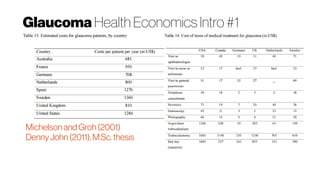
Glaucoma Health Economics Intro #1
MichelsonandGroh(2001)
DennyJohn(2011),M.Sc.thesis
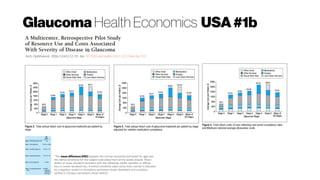
Glaucoma Health Economics USA#1b
Arch Ophthalmol. 2006;124(1):12-19. doi: 10.1001/archopht.124.1.12 | Cited by 153
*The mean difference (MD) between the normal sensitivity (corrected for age) and
the retinal sensitivity for the subject (calculated from all the points tested). Mean
defect or mean deviation increases with the following: media opacities or diffuse
loss or severe localized loss. A retinal sensitivity value worse than normal is indicated
by a negative symbol in Humphrey perimeters (mean deviation) and a positive
symbol in Octopus perimeters (mean defect).
Glaucoma Health Economics Intro #2
[Scheetz et al. 2016]: The burden of glaucoma increases as disease severity
worsens; especially the financial burden. In the USA, there is a fourfold
increase in average direct costs per patient (pp), with the earliest stage of
glaucoma costing US $623pp and end stage glaucoma/blindness costing
US $2511pp (Lee et al. 2006). There have been similar findings in Europe with
early stages of glaucoma having direct costs of US $588pp and end stage
costing US $1253 per person per year (Traverso et al. 2005).
The indirect costs of glaucoma can be difficult to quantify. In Australia, the
prevalence of POAG in 2005 was 208,000 and is expected to rise to 379,000
by 2025 (Dirani et al. 2011). This increase will see the total estimated costs of
treating those with POAG (healthcare costs, indirect costs such as loss of
productivity and loss of well-being measured as disability adjusted life years
rise from US $1.77 billion in 2005 to US $4.01 billion in 2025 (
Dirani et al. 2011).
A European study by Poulsen estimates the average cost per person for
community services (including equipment, residential care, household and
guide dogs) to be US $7885 and patient and family (household and
transportation) to be US $11,149 annually (Poulsen et al. 2005).
These increases in prevalence pose a significant burden on eye healthcare
professionals; especially ophthalmologists as a large number of patients are
unable to be discharged as the condition will require lifelong monitoring and
treatment (Spry et al. 1999).
Blindness Health Economics Ireland
http://dx.doi.org/10.1155/2016/4691276
The direct costs of visual impairment and blindness in the Republic of Ireland have
previously been calculated by Deloitte Access Economics (DAE) [3]. It was estimated that in
2010 the total direct costs (hospital, prescription, general ophthalmic services, and capital and
noncapital expenditure costs) of treating visual impairment as a whole were 116,754,168. This
was projected to increase to 127.4 million in 2015 and reach 136.8 million in 2020. The
proportion of these costs that could be attributed specifically to blindness was not analysed.
Sensitivity analysis 2010–
2020. The table illustrates the
upper (+20%) and lower (−20%)
limits around each point
estimate. For informal care
costs, 21.79 (average hourly
wage in 2010) is used as the
higher estimate and 8.65
(minimum hourly wage in 2010)
is used as the lower estimate of
the cost per hour of informal
care provided. The effect of
reducing deadweight welfare
losses to 9% gives the lower
estimate for this parameter. This
table thus provides a range and
a mean or “likely” figure for the
costs associated with blindness.
Glaucoma Health Economics CentralEurope#1
http://dx.doi.org/10.1007/s00417-013-2354-z
 Average total annual direct costs per patient for OHT were 226€ (± 117), for early POAG 423€ (± 647),
moderate 493€ (± 385) and advanced POAG 809€ (± 877). Glaucoma-related medications and
hospitalisation represented the two major components of direct costs, increasing with the progression
of glaucoma. Additional treatment changes are major contributing factors to the increased treatment
costs of glaucoma. If intraocular pressure can be controlled over the long term, progression to
moderateandadvancedstatesavoided,and patients remainoninitialtreatments,treatment costs
coulddecline duetoreducedandlessexpensivehealthcareresourceutilisation.
The Salzburg-Moorfields Collaborative Glaucoma Study performed a complete ophthalmologic
examination on a total of 4864 subjects within a study period of approximately 8 years (98
months).
Direct costs per visit were considerably higher than those reported in the Netherlands or the
United Kingdom. If a health care provider decides to perform a glaucoma screening within
this setting, the costs for the detection of a new case are 7250€ for definite POAG. 4250€
for early POAG, 1450€ for POAG suspect, 5600€ for ocular hypertension (OHT), 2100€ for
glaucomaartefact case, and 156€ for anormal case.
Within our screening setting, the total amount of time per individual spent by an
ophthalmologist and two medical assistants (including administrative work) is 3.1 hours at the
initial examination, 0.7 hours for a second check, and 2.4 hours at each follow-up examination.
The direct costs per visit are EUR 123 at the initial examination, EUR 98 for second checks, and
EUR 95 for a follow-up examination. Although the total direct costs for various screening modes
are reported, it is impossible to give a well-founded decision between different screening
modesat this point. A cost-benefit analysis isnecessary to assess the benefit of screening and to
setup aglaucomascreeningprogram with ahigh cost-benefitratio.
https://www.ncbi.nlm.nih.gov/pubmed/16496251
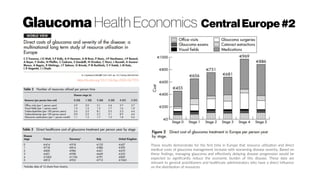
Glaucoma Health Economics CentralEurope#2
These results demonstrate for the first time in Europe that resource utilisation and direct
medical costs of glaucoma management increase with worsening disease severity. Based on
these findings, managing glaucoma and effectively delaying disease progression would be
expected to significantly reduce the economic burden of this disease. These data are
relevant to general practitioners and healthcare administrators who have a direct influence
on the distribution of resources.
http://dx.doi.org/10.1136/bjo.2005.067355
Glaucoma Health Economics Central/NorthernEurope
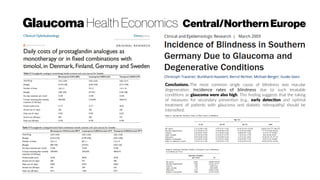
Conclusions. The most common single cause of blindness was macular
degeneration. Incidence rates of blindness due to such treatable
conditions as glaucoma were also high. This finding suggests that the taking
of measures for secondary prevention (e.g., early detection and optimal
treatment of patients with glaucoma and diabetic retinopathy) should be
intensified.
Glaucoma Health Economics Finland #1
http://dx.doi.org/10.1111/j.1755-3768.2009.01532.x
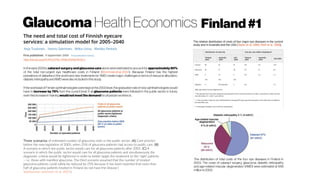
In the early2000s, cataract surgery and glaucoma care alone were estimated to account for approximately 80%
of the total non-urgent eye healthcare costs in Finland (Brommelset al. 2004). Because Finland has the highest
prevalence of diabetes in the world and new treatments for AMD create major challenges in terms of resource allocation,
diabetic retinopathyand AMD werealsoincluded in thisstudy.
If the workload ofFinnish ophthalmologistswere keptat the 2003level, the graduation rateof new ophthalmologistswould
have to increase by 75% from the current level. If all glaucoma patients were followed in the public sector in future,
even thisincrease in training would notmeet the demand for physician workforce.
Three scenarios of estimated number of glaucoma visits in the public sector. (A) Care practice
before the new legislation of 2005, when 25% of glaucoma patients had access to public care. (B)
A scenario in which the public sector would care for all glaucoma patients after 2005. (C) A
scenario in which the public sector would care for all glaucoma patients and simultaneously the
diagnostic criteria would be tightened in order to better target the treatment to the ‘right’ patients
– i.e. those with manifest glaucoma. The third scenario assumed that the number of treated
glaucoma patients could safely be reduced by 25% because it has been reported that more than
half of glaucoma patients treated in Finland do not have the disease (
Vaahtoranta-Lehtonen et al. 2007).
The relative distribution of costs of four major eye diseases in the current
study and in Australia and the USA (Taylor et al. 2006; Rein et al. 2006).
The distribution of total costs of the four eye diseases in Finland in
2003. The costs of cataract surgery, glaucoma, diabetic retinopathy
and age-related macular degeneration (AMD) were estimated at €89
million in 2003. 
Glaucoma Health Economics Finland #2
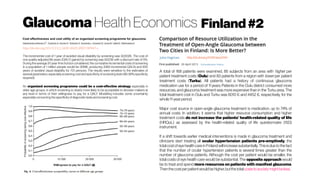
The incremental cost of 1 year of avoided visual disability by screening was 32,602€. The cost of
one quality-adjusted life years (QALY) gained by screening was 9,023€ with a discount rate of 5%.
During the average 20 year time horizon considered, the cumulative incremental costs of screening
in a population of 1 million people would be 30M€, producing 3360 incremental QALYs and 930
years of avoided visual disability for 701 persons. The results were sensitive to the estimates of
several parameters, especiallyscreeningcost and specificityof screening tests(96-99% specificity
required).
An organized screening programme could be a cost-effective strategy especially in
older age groups, in which screening is clearly more likely to be acceptable to decision makers at
any level in terms of their willingness to pay for a QALY. Modelling includes some uncertainty
especiallyconcerningthe specificityofdiagnostic testsand screeningcost.
http://dx.doi.org/10.1111/j.1600-0420.2007.00947.x
http://dx.doi.org/10.1111/aos.12141
A total of 168 patients were examined, 85 subjects from an area with higher per
patient treatment costs (Oulu) and 83 patients from a region with lower per patient
treatment costs (Turku). All patients had a history of continuous glaucoma
medication use for a period of 11 years. Patients in the Oulu district consumed more
resources, and glaucoma treatment was more expensive than in the Turku area. The
total treatment cost in Oulu and Turku was 6010 € and 4452 €, respectively, for the
whole11-yearperiod.
Major cost source in open-angle glaucoma treatment is medication, up to 74% of
annual costs. In addition, it seems that higher resource consumption and higher
treatment costs do not increase the patients’ health-related quality of life
(HRQoL) as assessed by the health-related quality of life questionnaire (15D)
instrument.
If a shift towards earlier medical interventions is made in glaucoma treatment and
clinicians start treating all ocular hypertension patients pre-emptively, the
total costofeye health care in Finland will increase substantially.Thisisdue tothe fact
that the number of ocular hypertension patients is several times greater than the
number of glaucoma patients. Although the cost per patient would be smaller, the
total costs of eye health care would be substantial. The opposite approach would
be to treat and spend more resources on patients with manifest glaucoma.
Thenthecostperpatientwouldbehigher,butthetotalcoststosocietymightbeless.
Glaucoma Health Economics China#1
Department of Epidemiology and International Eye Health, Institute
of Ophthalmology, University College London
http://dx.doi.org/10.1136/bjo.85.11.1277
However, the authors believe the visual morbidity from
glaucoma in China is considerable. Primary Angle Closure
Glaucoma (PACG) is probably the leading cause of
glaucoma blindness in both eyes, and warrants detailed
investigation of strategies for prevention.
http://dx.doi.org/10.1097/IJG.0b013e318064c818
The daily cost of glaucoma medications in China ranged much more wildly than developed countries. These data
may be useful in selecting medications for glaucoma therapy. The ophthalmic solution of prostaglandins is
powerful in reducing intraocular pressure. However, its high price should be considered when selecting glaucoma
medications in China.
“Nowadays, prostaglandins have become a first-line
therapeuticoption in developed countries because of
its effective intraocular pressure-lowering ability,
minimal risk ofsystemic side effects, and once-daily
administration.
https://doi.org/10.2147/DDDT.S80338
http://dx.doi.org/10.1097/IJG.0b013e31824083ca
Glaucoma Health Economics Singapore
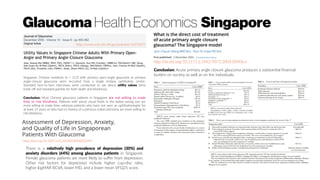
Singapore Chinese residents (n = 213) with primary open-angle glaucoma or primary
angle-closure glaucoma were recruited from a single tertiary ophthalmic center.
Standard face-to-face interviews were conducted to ask about utility values (time
trade-off and standard gamble for both death and blindness).
Conclusion: Most Chinese glaucoma patients in Singapore are not willing to trade
time or risk blindness. Patients with worse visual fields in the better-seeing eye are
more willing to trade time; whereas patients who have not seen an ophthalmologist for
at least 15 years or who had no history of a previous trabeculectomy are more willing to
risk blindness.
https://www.ncbi.nlm.nih.gov/pubmed/16276277
http://dx.doi.org/10.1111/j.1442-9071.2004.00906.x
Conclusion: Acute primary angle closure glaucoma produces a substantial financial
burden on society as well as on the individuals.
There is a relatively high prevalence of depression (30%) and
anxiety disorders (64%) among glaucoma patients in Singapore.
Female glaucoma patients are more likely to suffer from depression.
Other risk factors for depression include higher cup-disc ratio,
higher logMAR BCVA, lower MD, and a lower mean VFQ25 score.
https://doi.org/10.1097/IJG.0000000000000393
Glaucoma Health Economics India#1
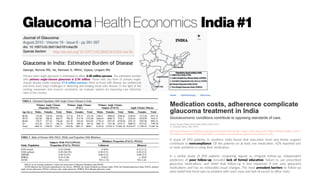
A study of 243 patients in southern India found that education level and family support
contribute to noncompliance. Of the patients on at least one medication, 42% reported one
or more problems in using their medication.
In a similar study of 300 patients comparing regular vs. irregular follow-up, independent
predictors of poor follow-up included lack of formal education, failure to use prescribed
glaucoma medications, and belief that follow-up is less important if one uses glaucoma
medications and has no noticeable visual changes. The most prevalent barriers to follow-up
were belief that there was no problem with one’s eyes and lack of escort to office visits.
http://www.healio.com/ophthalmology/glaucoma/news/print/ocular-surgery-news-asia-pacific-edition/%7B32cda806-5a39-4
5fc-bc8b-11a19ef6dd1f%7D/medication-costs-adherence-complicate-glaucoma-treatment-in-india
Glaucoma Health Economics India#2
DennyJohn(2011),M.Sc.thesis
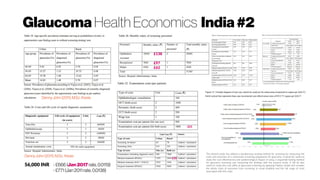
56,000 INR - £666(Jan2017 rate, 0.0119)
- £771(Jan 2011 rate,0.0138)
£138
£97
£62
£21
The present study has utilized a simultaneous testing method for screening for measuring the
costs and outcomes of a community screening programme for glaucoma. It would be useful to
study the cost effectiveness and epidemiological impact of using a sequential testing method
for glaucoma screening and comparing the findings with the present study. It will be also
useful to study the cost utility of glaucoma screening by applying Markov model and consider
the whole chain of outcomes from screening to visual disability and the full range of costs
associated with this chain
Glaucoma Health Economics USA#1a
http://dx.doi.org/10.1001/archopht.124.1.12
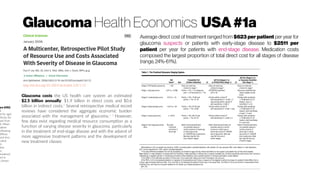
Average direct cost of treatment ranged from $623 per patient per year for
glaucoma suspects or patients with early-stage disease to $2511 per
patient per year for patients with end-stage disease. Medication costs
composed the largest proportion of total direct cost for all stages of disease
(range,24%-61%).
Glaucoma costs the US health care system an estimated
$2.5 billion annually: $1.9 billion in direct costs and $0.6
billion in indirect costs.3
Several retrospective medical record
reviews have considered the aggregate economic burden
associated with the management of glaucoma.3- 5
However,
few data exist regarding medical resource consumption as a
function of varying disease severity in glaucoma, particularly
in the treatment of end-stage disease and with the advent of
more aggressive treatment patterns and the development of
new treatment classes
nce (MD)
al
ed for age)
sitivity for
ted from
d). Mean
viation
following:
diffuse
zed loss.
value
is
tive
ey
eviation)
bol in
s (mean
Glaucoma Health Economics USA#1b
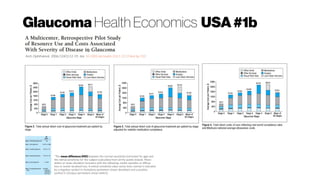
Arch Ophthalmol. 2006;124(1):12-19. doi: 10.1001/archopht.124.1.12 | Cited by 153
*The mean difference (MD) between the normal sensitivity (corrected for age) and
the retinal sensitivity for the subject (calculated from all the points tested). Mean
defect or mean deviation increases with the following: media opacities or diffuse
loss or severe localized loss. A retinal sensitivity value worse than normal is indicated
by a negative symbol in Humphrey perimeters (mean deviation) and a positive
symbol in Octopus perimeters (mean defect).
Glaucoma Health Economics USA#2
JAMAOphthalmol. 2016;134(4):357-365. doi: 10.1001/jamaophthalmol.2015.5479
In the risk-adjusted model, Medicare beneficiaries with glaucoma incurred
an additional $2903 ($2247-$3558) annual total health care costs and
$2599 ($1985-$3212) higher costsfor non-outpatientservicescompared
withMedicarebeneficiarieswithoutglaucoma.
Glaucoma is associated with greater use of inpatient and home health aide
services and with higher annual total and non-outpatient medical costs.
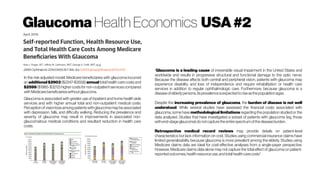
Perception ofvisionlossamong patientswithglaucomamaybeassociated
with depression, falls, and difficulty walking. Reducing the prevalence and
severity of glaucoma may result in improvements in associated non-
glaucomatous medical conditions and resultant reduction in health care
costs.
“Glaucoma is a leading cause of irreversible visual impairment in the United States and
worldwide and results in progressive structural and functional damage to the optic nerve.
Because the disease affects both central and peripheral vision, patients with glaucoma may
experience disability and loss of independence and require rehabilitation or health care
services in addition to regular ophthalmologic care. Furthermore, because glaucoma is a
diseaseofelderlypersons,itsprevalenceisexpectedtoriseasthepopulationages.
Despite the increasing prevalence of glaucoma, the burden of disease is not well
understood. While several studies have assessed the financial costs associated with
glaucoma, some have methodological limitations regarding the population studied or the
data analyzed. Studies that have investigated a subset of patients with glaucoma (eg, those
withend-stageglaucoma)donotcapturetheentirespectrumofthediseaseburden.
Retrospective medical record reviews may provide details on patient-level
characteristics but lack information on cost. Studies using commercial insurance claims have
limited generalizability because glaucoma is more prevalent among the elderly. Studies using
Medicare claims data are ideal for cost-effective analyses from a single-payer perspective.
However, Medicare claims data alone may not capture the total effect of glaucoma on patient-
reportedoutcomes,healthresourceuse,andtotalhealthcarecosts”
Glaucoma Health Economics USA#3
http://dx.doi.org/10.1097/IJG.0b013e3180575202
The highest category of baseline IOP (>35 mm Hg) was
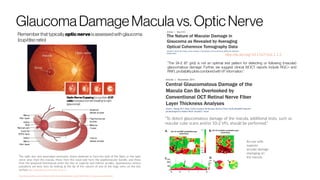
associated with the highest costs, especially in the United
States [US$11,409 in the United States and 3670€ (US$4341)

inEurope].
Although these studies examined cost by stage of disease,
cost per person-year could be estimated in each country as
follows: France 497€ (US$588), Germany 669€ (US$791),
Italy 417€ (US$493), the UK 660€ (US$781), and the US $1659
(1402€). Although a direct comparison of these estimates to
other published studies is not possible due to methodological
differences, several studies have shown the notable impact that
glaucomamanagementcosthasonhealthcareresources.
Glaucoma Health Economics Developingworld
The aim of the study was to disclose a realistic estimate of primary open-angle glaucoma
treatment, follow-up costs, and patients’ monthly glaucoma-economic burden in an
ophthalmologyhospital in Mexico City.
Patients’ monthly average economic burden in glaucoma treatment: low-income patients=61.5%,
moderate-income patients=19.5%, and high-income patients=7.9%. Therefore, screening
plans for earlier diagnosis, and health policies that lessen the cost of disease management
and increase adherence to treatment, and reduce the prevalence of blindness attributed to
glaucoma are essential. These would improve quality of life, reduce personal and national
expenditure, and help increase national economy.
https://dx.doi.org/10.1097%2FMD.0000000000005341
http://dx.doi.org/10.1186/s12913-016-1528-x
Out of 891 POAG cases seen in 2012,351(39.4 %)attended all the required reviewvisits,but
only 84 (9.4%) had fully and continually adhered to all their treatment regimes. The
total estimated cost for the 84 cases in the year was GH¢ 81,237 ($40,619), comprising
GH¢ 72,193 ($36,097) direct medication cost and GH¢9,045 ($4,523) direct non-
medication cost (surgery and test cost), and an average of GH¢ 967 ($484) for a mean visit
of5.6±1.1 in theyear.
CONCLUSIONS:Cost of managing glaucoma constitutes a substantial financial burden
andinfluencedthepattern ofmedication prescription.
https://dx.doi.org/10.7860%2FJCDR%2F2015%2F12491.5966
To analyse economic impact of three commonly used drug combinations in Ahmedabad, India
(Dorzolamide + Timolol = DT; Brimonidine + Timolol = BT; Latanoprost+Timolol = LT) in
primary openangle glaucoma.
Treatment with DT, BT & LT group consumed 8.6%, 4.6% and 7.7% of the per annum income of the
family, respectively. Treatment with BT was found to be most cost-effective among three
groups. Drug therapy takes substantial amount from per annum income of family and was an
important compliance factor in thetreatment ofPOAG.
Glaucoma Health Economics Nigeria
http://dx.doi.org/10.2147/OPTH.S37145
Primary open angle glaucoma is reported to blind 150,000 people in the Nigerian population and over
7000 in Rivers State, and requires constant follow-up. Compliance is a challenge, given that most
inhabitants live below the poverty line. This study was performed to determine how Nigerian patients
are affected economically bythe disease.
Middle-income earners spent over 50% of their monthly income and low-income earners
spend all their monthly earnings on treatment for glaucoma. This situation often resulted in
noncompliance with treatment and hospital follow-up visits. To reduce the economic burden of
glaucoma, trabeculectomy performed by experienced surgeons should be offered as first-line
treatment for glaucomain thiscountry, rather than medical therapy.
http://dx.doi.org/10.1136/bjophthalmol-2016-310040
http://dx.doi.org/10.1136/bmjopen-2016-012230
BIOMARKERS
In Detail
Intraocularpressure (IOP)
Cerebrospinal Fluid Pressure (CSFP)?
IOP
Whatpressuremattersactually?IntraocularPressure(IOP)thestandard#1
Boucard et al. 2016: “The classic view of glaucomab
is that of an eye disease in which elevated intraocular pressure (IOP)
mechanically damages the optic nerve (ON) causing the death of retinal ganglion cells (RGCs). Indeed, in high-pressure glaucoma
(HPG, the most common form of glaucoma), RGC and ON damage are associated with an elevated IOP (>21 mmHg).[1]
However,
this view cannot be complete as glaucoma with normal levels of IOP is commonly reported as well. In such normal-pressure
glaucoma (NPG), damage occurs to the ON without the eye pressure exceeding the normal range. By definition, NPG only differs
from HPG in that the IOP is consistently below 22 mmHG.[1]
Moreover, rather than being a disease restricted to the eye, damage
of the RCGs extends to the axons that form the primary visual pathways.c
https://www.youtube.com/watch?v=sgKeXb3PvBs
https://www.reviewofoptometry.com/article/the-dos-and-donts-of-measuring-iop
Glaucoma
Whatpressuremattersactually?IntraocularPressure(IOP)thestandard#2
http://dx.doi.org/10.1016/S0161-6420(95)31054-8
Systemic blood pressure and hypertension are
associated with IOP and high-tension glaucoma. No
association was found between blood pressure or
hypertension and normal-tension glaucoma.
Nature Genetics 46, 1126–1130
(2014) doi:10.1038/ng.3087
We report the results of a genome-wide association study
meta-analysis of 18 population cohorts from the International
Glaucoma Genetics Consortium (IGGC), comprising 35,296
multi-ancestry participants for IOP. We confirm genetic
association of known loci for IOP and primary open-angle
glaucoma (POAG) and identify four new IOP-associated loci
located on chromosome
https://dx.doi.org/10.2147%2FOPTH.S116859
Short-term IOP fluctuations were found to be associated with long-
term IOP fluctuations. Examination of 24-hour IOP fluctuations with
the Triggerfish® contact lens sensor might be useful for predicting
the long-term IOP fluctuation.
There is very low quality evidence (retrospective studies, patients on
different treatments) for the use of a diurnal tension curve or single
measurements to assess short or long-term IOP fluctuation or mean
as a risk factor for the development or progression of glaucoma. There
is very low quality evidence (expert opinion) whether the use of a
diurnal tension curve is beneficial for glaucoma suspects or
patients with progressive glaucoma, despite normal single office IOP
measurements, and leads to a more effective disease management
strategy.
https://www.ncbi.nlm.nih.gov/pubmed/23074414
http://dx.doi.org/10.1111/aos.12963
There was some regularity in the 24-hr IOP pattern in POAG, but
different severities of glaucomatous optic neuropathy (GON) and
different subtypes might present different characteristics. Other
non-IOP factors may lead to pathological IOP fluctuation and could
be correlated with GON.
http://dx.doi.org/10.1136/bjophthalmol-2015-306861
The significantly higher supine IOP is frequently missed in
routine glaucoma practice. An early morning supine IOP
measurement may reveal a peak IOP hitherto not picked up
during routine office IOP measurements, and may be a useful
measurement in unexplained progressive glaucoma.
First Online: 14 October 2016
http://dx.doi.org/:10.1007/s00417-016-3518-4
Sleeping with the head elevated and avoiding the worst
eye-dependent side during sleep may slightly lower
intraocular pressure and reduce visual field loss. Some
food supplements and moderate aerobic exercise may
also reduce intraocular pressure up to 2.0 and
3.0 mmHg, respectively. Frequency of coffee intake
(coffee elevating IOP) may be associated with disease
progression. Potential negative effects are associated
with weight-lifting and yoga exercises.
Glaucoma
Whatpressuremattersactually?IOP,ICP,TLCPorCSFP?#1
http://dx.doi.org/10.1111/aos.1248
0
In open-angle glaucoma (OAG), but not in angle-
closure glaucoma (ACG), calculated trans-lamina
cribrosa pressure difference (TLCPD) versus
intraocular pressure (IOP) showed a better
association with glaucoma presence and amount of
glaucomatous optic neuropathy. It supports the notion
of a potential role of low Cerebrospinal fluid pressure
(CSFP) in the pathogenesis of OAG.
The present study provides information on the relationship
of translamina pressure difference to the development of
optic nerve damage in what is presently called glaucoma. It
does not provide support of the idea that ocular perfusion
pressure plays a major role in the pathogenesis of optic
neuropathy.
https://www.ncbi.nlm.nih.gov/pmc/articles/PMC4635731/
http://dx.doi.org/10.1016/j.preteyeres.2015.01.002
Scheme Illustrating
the Relationships
between
Cerebrospinal Fluid
Pressure (CSFP),
Intraocular Pressure
(IOP) and Other
Ocular and Systemic
Parameters (Red
arrows: positive
relationship; black
arrows: negative
relationship)
Glaucoma
Whatpressuremattersactually?IOP,ICP,TLCPorCSFP?#2
http://dx.doi.org/10.1016/j.taml.2016.03.002 http://dx.doi.org/10.1097/WNO.0000000000000378
In the course of developing glaucoma, the difference between the
intraocular pressure (IOP) and the intracranial pressure (ICP) plays a key
role. It is this difference that exerts on the primary site of glaucoma—the
lamina cribrosa (LC), then results in the irreversible deformation of LC, and
finally induces the damage of the optic nerves passing through LC, thus
triggers the visual field defect, which is medically considered to be the main
pathological mechanism of glaucoma [2] and [3].
The relations
between IOP and
ICP. Thebroken line
standsfor Eq. (1), the
solid lineexpresses
Eq. (3), and different
figuratepoints
indicate the different
experimental data
from Refs.  [6], [7], [8]
 and [9].
http://dx.doi.org/10.1097/WNO.0000000000000295
The potential relationship between intracranial pressure (ICP) and glaucoma has
raised more questions to be answered. Published data are very suggestive that low
ICP is a risk factor for glaucoma. This may help explain the higher frequency of
glaucoma seen in older populations. Low ICP may, in part, explain normal tension
glaucoma. Low ICP may be responsible for the increased incidence of glaucoma
observed in patients with Normal pressure hydrocephalus (NPH). High ICP may be
protective in some patients with ocular hypertension. Structural alteration of the
lamina cribrosa (LC), has been documented with changes in the TPG. Distortion
and perhaps instability in LC structure may contribute to the development of
glaucoma. Other possible mechanisms include ICP-related alteration in axoplasm
and blood flow, which hypothetically could be primary or secondary to observed
structural changes. An association between ICP and glaucoma seems likely given
the present data, and further investigation of these associations is expected to
enhance our understanding of the pathophysiology of glaucoma.
Glaucoma
Whatpressuremattersactually?IOP,ICP,TLCPorCSFP?#3
http://dx.doi.org/10.1177/2058460116653630http://dx.doi.org/10.1177/2058460115624275
The subarachnoid space (SAS) of the optic nerve (ON) is contiguous with the SAS of the
brain in a normal population. Growing evidence in the literature provides strong support for
the concept that CSF pressure and composition in the SAS surrounding the ON may have
fundamental significance in the pathogenesis of glaucoma (Berdahl and Allingham 2010; Killer et al. 2012)
. As an
extension of the brain, the ON displays remarkable similarities to the brain in terms of
anatomy and functionality (Wostyn et al. 2015)
. Knowledge obtained from brain research could
therefore lead to new insights into the ON and vice versa.
Recently, the ‘‘glymphatic system’’ of the brain has been discovered in rodents by
Iliff et al. (2012). The authors argued that this system was critical to the efficient clearance
of interstitial solutes, including amyloid-b, from the brain Iliff et al. (2012)
. Their findings
suggested a brain-wide paravascular pathway in which CSF flows from the SAS along the
arteries and arterioles into the paravascular Virchow-Robin spaces (VRSs) to exchange with
interstitial fluid (ISF), and ISF is cleared from the brain into the VRSs surrounding the exiting
veins. As ISF exits the brain through the paravenous route, it travels to the lymphatic
vessels in the neck, and eventually returns its contents to the systemic circulation.
Since the ON is a direct extension of the brain, the question is whether there is also
evidence for the existence of a paravascular transport system in the ON. The observation of
such an anatomically distinct clearing system in the ON could also provide new insights
into the pathogenesis of glaucoma. Indeed, if confirmed, one might expect that a
dysfunctional glymphatic system could ultimately result in reduced neurotoxin clearance in
the ON and lead to glaucomatous neurodegeneration (Wostyn et al. 2015)
.
If dilation of VRSs may result from a disturbed interplay between the vascular and
glymphatic system, then preventing arterial stiffness may protect against glaucoma, at
least in part, by promoting solute clearance via the CSF.
Glaucoma Contact lens IOP measurement
MorereliableIOPmeasurement asIOPitselfhasadiurnalpattern
http://dx.doi.org/10.1155/2016/4727423
This review discusses each intraocular pressure (IOP) measuring strategy and focuses on the recently FDA-
approved contact lens sensor (CLS). Using the CLS, IOP-related parameters have been found to be
associated with the rate of visual field progression in primary open-angle glaucoma, disease progression in
primaryangle-closureglaucoma, and variousclinical variables inocular hypertension. TheCLS has been used to
quantify blink rate and limbal strain and measure the circadian rhythm in a variety of diseasestatesincluding
normal-tensionglaucomaand thyroid eyedisease. 
One major limitation of the CLS is that its output cannot be converted to millimeter mercury (mmHg) to allow
for direct clinical interpretation. However, because the ocular pattern recorded by CLS is highly correlated to the
IOP rhythm, the readings obtained from the CLS can be used to guide clinicians to determine the critical
time for IOP measurement during the 24-hour period, as stated by FDA (Mansouri etal. 2014). In addition,
current studies indicate that the IOP- related CLS profile itself can be used as an ocular perimeter for
individualized glaucoma management. More studies are needed to determine which biomechanical
properties determine the CLS output and whether the output is associated with corneoscleral properties, such
ascornealhysteresis.
The patient wears the SENSIMED Triggerfish® system up to 24 hours and assumes
normal activities including sleep periods. The SENSIMED Triggerfish® Sensor is a soft
disposable silicone contact lens embedding amicro-sensor that captures spontaneous
circumferential changes at the corneoscleral area.
http://www.sensimed.ch/
Journal ofGlaucoma. August 22, 2016. doi: 10.1097/IJG.0000000000000517
The range of IOP fluctuation was larger in the eyes with normal-tension glaucoma
(NTG) than in the nonglaucoma eyes. This larger fluctuation might be one of the
reasons underlying the aggravation of the visual field by NTG. Measurements of
24-hour continuous IOP might be one of the useful methods to distinguish NTG
from nonglaucoma eyes.
http://dx.doi.org/10.1001/jama.2016.3600
Functionalresponses
Visual field traditionally
Visualfield Introduction
https://xkcd.com/1080/
Visualfield Measurements
“Patterns of early glaucomatous
visual field loss and their
evolution over time”
http://iovs.arvojournals.org/article.aspx?articleid=23
33021
http://dx.doi.org/10.1016/j.ophtha.2014.08.014
http://dx.doi.org/10.1016/j.ophtha.2015.10.046
http://dx.doi.org/10.1016/j.ophtha.2015.12.014
http://dx.doi.org/10.1016/j.ajo.2015.12.006
Humphrey HFA II-i
Field Analyzer
HumphreyFieldAnalyzerII-i SITA
TestingStrategies
SITA Strategiesarenotonly fastandaccurate,butalso
friendlyon thepatient.Usingtiming techniques,SITA
isextraordinarily responsivetopatient reaction times.
Thepatientruns theperimeter, ratherthan thereverse.
SITA testing strategiesavailableon theHFAII-i:
SITA Standard: Athresholdtestingmethodwhich
collects thesameamountofinformation in halfthe
timeastheoriginalHumphrey® FullThreshold
standardalgorithm, withoutcompromisingtest
reproducibility.
SITA Fast: A thresholdtestingmethodthat collects
thesameamountof information inhalfthetimeas
FastPac,withoutcompromising testreproducibility.
Visualfield Microperimetry
Microperimetry|VisualField
Right eye of a 72-year-old man. Native en-face
image (A) and reticular drusen (RDR) area
highlighted (B). Interpolated test results for both
scotopic (C) and photopic (D) microperimetry.
Numerical values for scotopic (E) and photopic
(F) microperimetry. Steinberg et al. (2015)
http://dx.doi.org/10.1167/iovs.08
-2926
http://dx.doi.org/10.
1167/tvst.3.5.3
(Top) Humphrey Field Analyzer (10-2 pattern, SITA Standard) and (bottom)
MP-1 microperimetry (10-2 pattern, 4-2 strategy) results from a normal
individual (age 29).
In summary there is an increasing amount of evidence supporting the
usefulness of microperimetry both as a clinical instrument and as a
research tool. The clinician should however be aware of the differences
between microperimetry and conventional perimetry, differences in the
manufacturer’s design that may affect testing conditions and therefore,
the interpretation of results. The advantages over conventional perimetry
include fundus tracking features and the co-registration of the perimetric
results with fundus imaging.
Can J Ophthalmol. 2013 Oct; 48(5): 358–363.
doi: 10.1016/j.jcjo.2013.03.021
Visualfield andGlaucoma#1
The CochraneEyesandVisionGroup defines glaucoma as 'a
disease characterized by defects in the visual field, damage to
the nerve at the back of the eye, and usually raised pressure
insidetheeye.'
As we now know, this view of glaucoma as an optic neuropathy with
elevated IOP as a modifiable risk factor rather than as the
causative agent for damage is more correct, although it still does not
take into account the characteristic morphological and functional aspects
of the disease. It is important for clinicians and the research community
alike to view glaucoma as an optic neuropathy, especially as we drive
towarddiscovering better therapeuticstrategies,includingpharmacologic
neuroprotection.
http://dx.doi.org/10.1038/sj.eye.6702880
Glaucoma - Basic and Clinical Concepts, Edited by Shimon Rumelt
ISBN 978-953-307-591-4
http://www.ehu.eus/OftalmoBiologiaExperimental/documentos/adaptive-changes-in-the-retina-and-central-visual-areas-in-glaucoma.pdf
In thepathologyoftheglaucoma, visualfield losses first occurinthe
peripheralretinaandprogressivelyleadtothelossofallvisionandcomplete
blindness. Themain therapyforthetreatmentofglaucomahasbeenthereduction of
IOPthat stabilizesthevision loss.However, incertain population, thevisualloss
continuesin spiteofthereductionofIOP.
Recent advanceoffunctionalmagneticresonanceimaging(fMRI)providefunctional
assessmentofvisualchangesinglaucomapatients,whichcorrelated,wellwith the
lossofvisualfieldintheeye(Guptaet al.2006).
Visualfield andGlaucoma#2
Lakkis(2014): “Approximately 40 per cent of ganglion cells
need to be lost before an early glaucomatous threshold
visual field defect is manifested (Quigleyetal.,1989,
Citedby 1096 ), and the typically slow progression in optic
nerve head changes makes structural glaucoma detection
difficultuntilsignificantrimtissueislost.”
http://dx.doi.org/10.1167/iovs.14-15577
Although previous studies have evaluated rates of change in monocular visual fields for monitoring
glaucoma, very little is known about rates of change in binocular visual fields (BVF). Recent
studies have shown that functional losses measured by BVFs show a better relationship with
patient-reported quality of vision compared with losses measured by monocular
fields. Therefore, evaluation of rates of change using BVFs could provide a better method for
assessmentoftherisk of functionalimpairmentin glaucoma.
In conclusion, our results demonstrated that the rate of change in BVFs was significantly faster
than that in the visual fields of the slower-changing eyes and slower than that in the visual fields of the
faster-changing eyes. Weexpect that our findings will have significant implications for studies related to
qualityoflife,monitoringofglaucoma, andprovidingtherapeutic guidance.
http://dx.doi.org/10.1371/journal.pone.0083595
A novel approach for simulating VFs is introduced. A better understanding
of VF variability will help clinicians to differentiate real VF progression
from measurement variability. Visual field variability leads to false-positive
diagnoses of progression when patients actually have stable glaucoma, which
may lead to needless treatment changes and costs to both patient and
healthcare provider [32]. Conversely, glaucomatous progression may be
missed if clinicians deem any change is due to inherent measurement noise.
This study highlights that, overall, MD variability increases as the level of
damage increases, but variability is highly dependent on the pattern of VF
damage. Future research, using VF simulations, could be employed to
provide benchmarks for measuring the performance of VF progression
detection algorithms and developing new strategies for measuring VF
progression.
http://dx.doi.org/10.1016/j.preteyeres.2016.10.001
Visualfield andGlaucoma#3: Centralvs.Periphery
http://dx.doi.org/10.1167/iovs.16-19868
Patients with similar central visual field loss can have strikingly different
peripheral visual fields, and therefore measuring the peripheral visual field
may add clinically valuable information.
Relationship between global summary measures of
peripheral visual field (MIR) and central visual field
damage (MD). Each data point shows the mean of
the two repeated tests. The Spearman rank order
correlation coefficient was 0.51 (95% CI: 0.18, 0.74).
Central visual field damage test-retest
differences
Peripheral visual field damage test-retest
differences
http://dx.doi.org/10.1167/iovs.15-19053
Central 24-2 testing generally reflects the extent of damage to the more peripheral VF
in glaucoma, although significant disagreement exists for individual eyes. Further work is
needed to determine whether integration of peripheral test points can improve
detection of true VF loss in early glaucoma or be useful in monitoring progressive
glaucomatous damage to areas of preserved VF in advanced glaucoma.
At more advanced stages of disease, we found that
the percentage of abnormal central points exceeded
the percentage of abnormal peripheral points,
suggesting relativeperipheralsparing.
Several practical limitations remain with regard to evaluation of the
peripheral VF. Normal subjects have greater variability at more
peripheral points, likely reflecting variations in the normal hill of vision, and
pointwise variability in the peripheral VF is believed to be greater in the
superior and nasal quadrants, regions frequently affected by early
glaucoma. Additionally, central 24-2 testing takeslesstime, leading
to decreased patient fatigue, and has been shown to pick up a
reasonable amount of early disease by itself. Finally, more false
positives may occur in testing of the far peripheral VF, leading to more
spurious defects. Ideal algorithms to test the far peripheral VF would
initially test only a few peripheral points in eyes with little or no central
defects and then perform further testing of the peripheral VF if abnormal
points are observed. Considerations should also be given to peripheral
testing in patients with advanced central loss in whom standard 24-2 or
10-2testsareunlikelyto detectfurtherprogression.
Visualfield Sensitivityofmethods
https://www.ncbi.nlm.nih.gov/pubmed/10845599
To compare short-wavelength automated perimetry, frequency-doubling
technology perimetry, and motion-automated perimetry, each of which
assesses different aspects of visual function, in eyes with glaucomatous
optic neuropathy and ocular hypertension.
Conclusions. For detection of functional loss standard visual field testing is
not optimum; a combination of two or more tests may improve detection of
functional loss in these eyes; in an individual, the same retinal location is
damaged, regardless of visual function under test; glaucomatous optic
neuropathy identified on stereo photographs may precede currently
measurable function loss in some eyes; conversely, function loss with specific
tests may precede detection of abnormality by stereo photograph review; and
short-wavelength automated perimetry, frequency-doubling perimetry, and
motion-automated perimetry continue to show promise as early indicators
of function loss in glaucoma.
http://dx.doi.org/10.1371/journal.pone.0128681
Tests of temporal contrast sensitivity i.e. flicker perimetry have been used
in a battery of tests for glaucoma [6,19,23–24] and inspired the
development of the frequency doubling technology (FDT) perimeter [25].
Temporal contrast sensitivity is considered more resistant to the effects of
lens opacities [26–28]. Yet, it has been suggested recently that the high
temporal frequency stimuli in FDT render this more susceptible to reduced
retinal illumination when light is attenuated in opacified or older lenses [29].
A lack of spatial frequency dependent selective loss in glaucoma has been
described for gratings presented in the fovea both continuously [8,10] or
transiently [7,10] under both photopic and mesopic conditions [10].
These findings indicate that both spatial and temporal contrast sensitivity
tests are suitable for distinguishing between vision loss as a consequence of
glaucoma and vision loss caused by cataract only. The correlation between
glare factor and GPS suggests that there may be an increase in intraocular
stray light in glaucoma. Glare from excessive light scatter reduces retinal
image quality and manifests as a decrease in contrast sensitivity [68]. A
possible explanation for increased glare in subjects with glaucoma could be
the effect of cell shrinkage that has been found in experimental glaucoma [
69].
Visualfield vsRetinalGanglionCell (RGC)death
Arch Ophthalmol. 2006;124(6):853-859.
doi:10.1001/archopht.124.6.853
Visual field defects based on standard clinical perimetry are
proportionaltoneurallossescausedbyglaucoma.
Clinical Relevance  The evidence for quantitative
structure-function relationships provides a scientific basis for
interpreting glaucomatous neuropathy from visual thresholds
and supports the application of standard perimetry to
establishthestageofthedisease.
http://dx.doi.org/10.1167/iovs.14-15952
BoththeHarwerthetal.nonlinear model(H-NLM) andtheHoodandKardonlinearmodel(HK-LM)wereappliedto
anindependentdatasetoffrequency-domainopticalcoherencetomographyandvisualfields
SeveraloftheassumptionsunderlyingtheH-NLMshouldberevisited.Studiesandmodelsrelying onthe
RGCestimatesoftheH-NLMshouldbe interpretedwithcaution.
http://dx.doi.org/10.1371/journal.pone.0076590
The relationship between VFI and estimated RGC
counts is nonlinear and the index substantially
underestimates the amount of neural loss early
in the disease. Disease severity should be taken into
account when interpreting rates of VFI change over
time.
https://dx.doi.org/10.1016%2Fj.ophtha.2012.09.039
Glaucomatous eyes with the earliest detectable
visual field loss on automated perimetry may
already showsubstantial lossof retinal ganglion
cells. Empirical estimates of RGC counts combining
structural and functional tests agreed closely with
previous histological reports on the number of RGCs
associatedwithearlyvisualfieldsdefectsonSAP.
Significantretinal ganglioncellloss already whenearly visualfieldchangesdetected
Structure-FunctionIndex
http://dx.doi.org/10.1167/iovs.07-1083
To determine whether combining structural (optical coherence
tomography, OCT) and functional (standard automated perimetry,
SAP) measurements as input for machine learning classifiers (MLCs;
relevance vector machine, RVM; and subspace mixture of Gaussians,
SSMoG) improves diagnostic accuracy for detecting
glaucomatous eyes compared with using each measurement method
alone.
RVM and SSMoG Bayesian MLCs trained on OCT and SAP data can
successfully discriminate between healthy and early glaucomatous
eyes. Combining OCT and SAP measurements using RVM and
SSMoG increased diagnostic performance marginally compared
with MLC analysis of data obtained using each technology alone.
http://dx.doi.org/10.1080/02713683.2016.1190848
To evaluate the relationship between functional parameters of repeated flicker-defined form
perimetry (FDF) and structural parameters of spectral-domain optical coherence tomography
(SD-OCT) in glaucoma suspects with normal findings in achromatic standard automated
perimetry(SAP).
In glaucoma suspects with normal SAP, global and sectoral peripapillary RNFL thickness is
correlatedwithsensitivityandVFdefects in FDFperimetry.
Novelportable Visualfieldandfunction measurement
http://dx.doi.org/10.1371/journal.pone.0009710
1
Department of Optometry and Visual Science, City University London, London, United Kingdom, 2
Bradford School of
Optometry and Vision Science, University of Bradford, Bradford, United Kingdom, 3
NIHR Biomedical Research Centre for
Ophthalmology, Moorfields Eye Hospital NHS Foundation Trust and UCL Institute of Ophthalmology, London, United Kingdom
Visual fields, dynamic ‘point of
regard’ and HPT films – example.
HFA grayscales for monocular
(30-2) and binocular integrated
visual fields for one of the
participants with bilateral
glaucoma. The integrated visual
field is scaled and superimposed
on the point of regard HPT film.
https://www.hindawi.com/journals/joph/aip/6425913/
http://dx.doi.org/10.1016/j.ophtha.2015.02.010
The study presented and validated a novel paradigm for evaluation of balance control in patients with glaucoma
on the basis of the assessment of postural reactivity to dynamic visual stimuli using a virtual reality
environment. The newly developed metrics were associated with a history of falls and may help to provide a
better understandingof balance control inpatientswith glaucoma.
https://www.researchgate.net/publication/304348186_Objective_Assessment_of_Activity_Limitation_in_Glaucoma_by_Smart_Ph
one_Virtual_Reality_Goggle
● Convergence and divergent validity suggest measurements from a smartphone virtual reality test (Low-cost Google
Cardboard Project™ Virtual Reality Adaptor with Samsung Note 3 Smartphone linked to laptop computer) have mild to
moderatecorrelation withvisual field MDand measuresof activity limitation.
●
VR gogglemay providenear real-world assessmentofhowglaucomaaffectsactivitiesof daily living.
●
Futureresearch will examinehowVR correspondsto reallifedriving.
“While the patient plays a short videogame (<5 min), objective and fast measurements of most optometric
parameters are obtained. The system generates 3D images on two displays. Vergence is induced through
image disparity and accommodation is stimulated using a varifocal optical system. EVA also incorporates a
Hartmann-Shack autorefractometer and an eye-tracker. 
Optometric parameters related with refraction (objective and subjective), accommodation (amplitude,
accommodative facility) and vergence (cover test, near point of convergence, fusional vergence and vergence
facility) were obtained with EVA and compared toconventional clinical procedures. “
http://dx.doi.org/10.1177/0301006616671273
Glaucoma data for disease management #1
http://dx.doi.org/10.1007/s40135-014-0038-4
A recent systematic review disclosed that in all Cochrane reviews and protocols related to glaucoma
interventions, visual field progression or change was reported in 13 different ways [1]. Moreover, it
is well known that there is only fair agreement among some of the various methods for the
determinationofvisualfieldprogression[2, 3, 4, 5].
Even the best of efforts to detect subtle progression can be confounded by factors including
suboptimal and variable patient reliability, progressive media opacity and the long-term fluctuation that
is an inherent aspect of visual psychophysics. Glaucoma experts themselves often disagree on the
determinationofprogressionwhen presentedwiththesameVFseries[6]..
In thisarticle, wewillreview someofthese majoradvances in ourunderstandingof fluctuationasa
confounding factor in thedetection of visualfield progression, theimportanceofmonitoring thecentral
visual field, the use of the size V stimulus in advanced glaucoma, novel enhancements of pointwise
linear regression analysis, frequency-doubling technology perimetry, the visual field index and the
concept of combining structural and functional assessments in the detection of glaucoma
progression.
In general terms, there are two broad approaches to the analysis
of visual field data that are used to detect progression: (1) event-
basedmethodsand(2)trend-basedmethods
Guided Progression Analysis (GPA; Carl Zeiss Meditec, Inc.,
Dublin, CA) is the most important example of an event-based
system in widespread clinical use. GPA uses essentially the
same criteria used to define progression in the Early Manifest
GlaucomaTrial(EMGT)[11].
Examplesof trend-basedanalyses includelinear regression
of the mean deviation (MD) or visual field index (VFI).
Regression analysis of MD, for example, relates visual function
to time by means of a straight-line equation, but is limited
because it does not distinguish between focal and diffuse
changefromeither glaucomaprogressionormediaopacity.
The detection of visual field progression continues to be a
challenging area of glaucoma management. Increasingly, it is
clear that rates of change are very important; therefore, the use of
trend-based analyses will likely be more heavily utilized in
conjunction with event-based methods. Of equal importance is the
concept that techniques that combine structural and
functional measures of progression are more powerful and yield
more accurate determinations of progression across a spectrum of
diseaseseverity.
Glaucoma data for disease management #2
https://dx.doi.org/10.1016%2Fj.optom.2014.07.009
Brusini and Johnson2 established the features of the ideal system for VF progression
detection, i.e., it should be standardized, objective, reproducible, user friendly, supported by
scientific and clinical evidence, able to analyze data obtained from different models of
perimeters, provide useful information on the characteristics of the VF defects, provide a
classification consistent with structural damage data, widely used and accepted, able to
monitor even relatively small changes in functional loss over time, and available on computer
software for easy day-to-day clinical use. No currently available systems fulfill all these
criteria.
There is no gold standard for glaucomatous functional worsening detection that can be
used to test the different methods currently available to detect glaucomatous progression.3,4
Thus, if we diagnose perimetric progression in an eye using certain method, absence of
progression may be evident in the same eye using another method, and we simply cannot
state which of both methods is correct.5 As in any other field, the lack of an accurate
method to detect VF progression has led to the development of several methods.5,6
Unfortunately, we do not have adequate knowledge of the ability of each of them to provide
useful clinical information.4
Most published studies that have analyzed the ability to detect VF progression arbitrarily
chose one of the available methods to detect VF progression against which the new methods
were compared.3
In conclusion, in the current study, the diagnosis of perimetric progression using the AGIS
score is nearer to the actual functional progression than the diagnosis of perimetric
progression using the VFI. Nevertheless, more studies are needed to increase the level of
certainty when diagnosing glaucomatous progression.
Glaucoma data for disease management #3
Visualfielddatabecomesmoreuseful formanagementratherthanearlydiagnosis
http://dx.doi.org//10.1111/opo.12187
Large archives of visual field (VF) records from automated perimetry
are used to examine severity of vision loss at diagnosis in glaucoma patients
over a13 year period in England.
Severity of vision loss at the point of glaucoma detection, in those patients
diagnosed with a VF defect, is improving over time in England.
Nevertheless, the improvement is modest and large numbers of patients still
present at glaucoma clinics with significant vision loss in at least one eye.
Large scale digital VF data can be used to help monitor and audit health
service deliveryof glaucoma.
http://dx.doi.org/10.1016/j.ophtha.2015.08.005
Cited by 3
In a clinical population of patients with measurable VF loss in both eyes,
superior-only binocular VF loss is more common than inferior-only loss.
These estimates, derived from large collections of electronic medical
records, are useful for interpreting findings about location of binocular VF
loss impacting everyday activities and examining visual disability in
glaucoma
Glaucoma data for disease management #4
MonitoringdiseasewithVF measurements is cost-efficient
http://dx.doi.org/:10.1038/eye.2015.161
To examine changes in rates of visual field (VF)
progression in patients attending a sample of glaucoma
clinics in England between 1999 and 2012.
Conclusions VFs of eyes treated in the first half of the
decade deteriorated more rapidly than those in the
second half. Several factors might explain these
differences but average effects were small and there was
no reduction in the proportion of rapidly progressing
eyes over the decade. Older age and, to a lesser extent,
worse VF damage at diagnosis are indicators for faster
VF loss in clinics, but frequency of VF testing was similar
for all patients.
http://dx.doi.org/10.1111/opo.12328
In many medical conditions ‘late
presentation’ of disease is more of a
problem for men than women.
Risk of sight loss from glaucoma is certainly
greater in those detected with advanced
disease. A large number of patients with
glaucomatous visual field defects are
estimated to have advanced loss in at least
one eye on referral to secondary care in
England; risk for men more likely presenting
with late disease is slightly greater than for
women.
http://dx.doi.org/10.1186/s12913-016-1849-9
An incremental cost-effectiveness ratio (ICER) of £21,392
per quality-adjusted life years (QALY) was derived for
proposed practice improving to a value of £11,382 once
savings for prevented visual impairment was added to the
model. Proposed practice was more cost-effective in
younger patients. Proposed practice for patients with
advanced disease at diagnosis generated ICERs > 
£60,000 per QALY; these cases would likely be on the
most intensive treatment pathway making clinical
information on speed of VF loss redundant. Sensitivity
analysis indicated results to be robust in relation to
hypothetical willingness to pay threshold identified by
national guidelines, although greatest uncertainty was
allied to estimates of implementation and visual
impairment costs.
Increasing VF monitoring at the earliest stages of follow-
up for COAG appears to be cost-effective depending on
reasonable assumptions about implementation costs. Our
health economic model highlights benefits of stratifying
patients to more or less monitoring based on age and
stage of disease at diagnosis; a prospective study is
needed to prove these findings. Further, this works
highlights gaps in knowledge about long term costs of
visual impairment.
Smartphone-based Visualfieldmeasurement
8 September 2016
Visionary technology
Innovative optical concept offers simple, affordable, fast glaucoma screening test
The new Viewi optical concept developed by Cambridge Consultants shows how it could be possible for patients to monitor
any effect on their vision in the comfort of their own homes. At the moment, patients typically have an annual optometrist or
hospital check-up using a visual field analyser. Flashing lights at varying points of the visual field test sensitivity – with the
patient pressing a button each time they see a light. The novel Viewi technology performs the same test but at a fraction of
the cost – around £20 rather than £20,000 for the clinical device.
The innovative Viewi concept has been hailed as an important advance by optics expert Chris Dainty, a professor at University
College London Institute of Ophthalmology and Moorfields Eye Hospital.
Home > Health & Fitness > http://www.digitaltrends.com/health-fitness/viewi-glaucoma-test/
Chris Dainty, a professor at University College London Institute of Ophthalmology and Moorfields Eye Hospital, expressed interest in wider applications of Viewi,
noting that it “could provide a valuable early warning system for people at risk of developing glaucoma, as well as patients who need to monitor the effects of the
disease on their vision.” Dainty concluded, “It could also make the static perimetry test accessible to more patients in developing countries, where expensive clinical
equipment and trained professionals are often in short supply.”
PsychophysicsbeyondVisualField
https://www.ncbi.nlm.nih.gov/pubmed/19920584 Cited by 10
http://dx.doi.org/10.1016/S0042-6989(97)00033-3 Cited by 38
Achromatic losses in glaucoma would be expected to be greater than, or equal to, red-green
chromatic losses if the following assumptions are made:
1) the function of the remaining axons is either unchanged or non-selectively reduced
2) red-green chromatic information is signaled by the midget ganglion cell system; and
3) the function of the magnocellular system is reduced at least as much as that of the midget
ganglion cells.
In conclusion, the selective loss of red-green sensitivity observed in some glaucoma patients
indicates that at least one of the following is true (See the Imaging slides for ganglion cells):
1. The visual characteristics of the remaining ganglion cells are selectively altered.
2. Red-green information is primarily transmitted by bistratified rather than by midget ganglion cells.
3. Loss of midget ganglion cells is greater than the loss of magno (parasol) ganglion cells, at least in some
situations (e.g. foveal vision or acute elevation of intraocular pressure).
Our results also indicate that patients may show different patterns of psychophysical loss, which
may perhaps relate to differences in etiology (e.g. mechanical vs ischemic damage;
Hoskins & Kass, 1989).
This study tested the hypothesis that (a) evidence of
foveal visual dysfunction could be elicited in glaucoma
subjects by measuring flicker sensitivity as a function of
time after onset of an adapting field for a suitably
chosen set of test and adaptation parameters and that
(b) such dysfunction would be related to high blood
pressure.
The dynamic light-adaptation functions of subjects with glaucoma were much
more likely to be unstable than were the corresponding functions of normal
subjects. In addition, the dynamic light-adaptation functions of subjects with
high blood pressure for their pulse rate were significantly less stable than the
corresponding functions of subjects without high blood pressure for their pulse
rate. Moreover, the ratio of mean arterial pressure to pulse rate was
significantly less for normal subjects than for either glaucoma subjects or for
glaucoma-suspect subjects. We infer that among people with primary open-
angle glaucoma but with only minimal field loss, there often is foveal
dysfunction associated with cardiovascular disease. Evidence of such
dysfunction appears to require the use of stimulus conditions that tax the
ability of the visual system to respond appropriately.
Psychophysics TaskPerformance
http://dx.doi.org/10.1167/tvst.5.6.15
“Glaucoma patients have a steeper increase in driving
risk under fog conditions when compared to healthy
subjects, especially when the severity of visual field damage
fallsbelow−9dBof MD in the better eye.”
As a visually intensive task, driving potentially could
be affected by conditions, such as
glaucoma. Although glaucoma seems to be
associated with higher risk for motor vehicle
collisions (MVCs), the specific driving conditions
and disease characteristics that can lead to
increased driving risk have not been well clarified.
Due to the loss of visual sensitivity, it is possible
that glaucoma patients may have an even more
pronounced increase of driving risk under fog
compared to healthy subjects. However, to the
best of our knowledge, this relationship has not
been investigated previously in the literature.
High-fidelity driving simulator (Realtime Technologies,
Inc.) consisting of a B pillar forward full-size Ford
Fusion cab equipped with a realistic motion platform,
Scatterplot with piecewise fitted regression
line illustrating the relationship between
difference in invTLC (s−1
; fog minus nonfog
conditions) and MD of better eye (dB) at fast
speed.
Glaucoma Virtual Reality?
VRallowshomemonitoringofglaucomaprogressionviavisualfieldchanges
http://dx.doi.org/10.1016/j.ophtha.2015.02.010
The study presented and validated a novel paradigm for evaluation of balance control in patients
with glaucoma on the basis of the assessment of postural reactivity to dynamic visual stimuli
using a virtual reality environment. The newly developed metrics were associated with a history of
falls and may help to provide a better understanding of balance control in patients with
glaucoma.
https://www.researchgate.net/publication/304348186_Objective_Assessment_of_Activity_Limitation_in_Glaucoma_by_Smart_Ph
one_Virtual_Reality_Goggle
● Convergenceand divergentvaliditysuggestmeasurementsfromasmartphonevirtual realitytest(Low-
costGoogleCardboardProject™Virtual RealityAdaptorwith Samsung Note3Smartphonelinked to
laptop computer)havemild to moderatecorrelationwithvisual field MD and measuresof activitylimitation.
●
VR gogglemayprovidenearreal-world assessmentof howglaucoma affectsactivitiesof dailyliving.
●
Futureresearch will examinehowVR correspondsto real lifedriving.
http://dx.doi.org/10.1001/jamaophthalmol.2016.1659
http://dx.doi.org/10.1080/17469899.2016.1180246
It is important to consider life expectancy, disease severity and vision-related quality of
life based treatment targets to estimate future prognosis when evaluating whether a rate
of glaucoma progression can be clinically relevant.
“While the patient plays a short videogame (<5 min), objective and fast measurements of most
optometric parameters are obtained. The system generates 3D images on two displays.
Vergence is induced through image disparity and accommodation is stimulated using a varifocal
optical system. EVA also incorporates a Hartmann-Shack autorefractometer and an eye-
tracker. 
Optometric parameters related with refraction (objective and subjective), accommodation
(amplitude, accommodative facility) and vergence (cover test, near point of convergence,
fusional vergence and vergence facility) were obtained with EVA and compared to conventional
clinical procedures. “
http://dx.doi.org/10.1177/0301006616671273
Glaucoma Eye-tracking?
...
http://dx.doi.org/10.1371/journal.pone.0009710
1
Department of Optometry and Visual Science, City University London, London, United Kingdom, 2
Bradford School of
Optometry and Vision Science, University of Bradford, Bradford, United Kingdom, 3
NIHR Biomedical Research Centre for
Ophthalmology, Moorfields Eye Hospital NHS Foundation Trust and UCL Institute of Ophthalmology, London, United Kingdom
https://www.hindawi.com/journals/joph/aip/6425913/
Visual fields, dynamic ‘point of
regard’ and HPT films – example.
HFA grayscales for monocular
(30-2) and binocular integrated
visual fields for one of the
participants with bilateral
glaucoma. The integrated visual
field is scaled and superimposed
on the point of regard HPT film.
A Redwood City, Calif. startup called Neurotrack TechnologiesInc. has created a brain health app that is helping
scientists unravel the mysteries of memory, and work to find a cure for Alzheimer’s. Its simple browser-based
app screens users for signs of cognitive decline based on their eye movement as they watch a few
images presented on their screens. These tests used to take about 30 minutes, and were available only at the
doctor’soffice usinghugelyexpensive equipment.
Neurotrack has raised $9.5 million in equity funding to-date and $1 million in grant funding from NIH,
Johnson & Johnson and the Georgia Research Alliance (GRA) to develop its technology and begin publishing
some ofitsneuroscientific findings.
https://techcrunch.com/2016/12/01/neurotrack-takes-brain-scans-home/
http://thume.ca/2016/03/24/eye-tracker-reviews-pupil-labs-tobii-eyex-eye-tribe-tobii-x2-30/
Glaucoma Eye-tracking? #2
http://dx.doi.org/10.1167/iovs.08-2496
http://dx.doi.org/10.1167/iovs.14-15541
“ Gaze tracking parameters are closely related to the
reproducibility of VF results, and it would be beneficial to
objectively use these parameters when estimating the reliability
of VF tests.”
This study provides evidence that patients with glaucoma exhibit
deficits in eye–hand coordination compared with the age-
matched normally sighted control. Further study is needed to
assess the specific effect of field loss location on prehension
kinematics.
https://www.bloomberg.com/news/articles/2016-12-28/facebook-acquires-e
ye-tribe-for-oculus-eye-tracking-software
Visualfield for disease management #1
Visualfielddatabecomesmoreuseful formanagement
http://dx.doi.org//10.1111/opo.12187
Large archives of visual field (VF) records from automated perimetry
are used to examine severity of vision loss at diagnosis in glaucoma patients
over a13 year period in England.
Severity of vision loss at the point of glaucoma detection, in those patients
diagnosed with a VF defect, is improving over time in England.
Nevertheless, the improvement is modest and large numbers of patients still
present at glaucoma clinics with significant vision loss in at least one eye.
Large scale digital VF data can be used to help monitor and audit health
service deliveryof glaucoma.
http://dx.doi.org/10.1016/j.ophtha.2015.08.005
Cited by 3
In a clinical population of patients with measurable VF loss in both eyes,
superior-only binocular VF loss is more common than inferior-only loss.
These estimates, derived from large collections of electronic medical
records, are useful for interpreting findings about location of binocular VF
loss impacting everyday activities and examining visual disability in
glaucoma
Visualfield for disease management #2
MonitoringdiseasewithVF measurementsiscost-efficient
http://dx.doi.org/:10.1038/eye.2015.161
To examine changes in rates of visual field (VF)
progression in patients attending a sample of glaucoma
clinics in England between 1999 and 2012.
Conclusions VFs of eyes treated in the first half of the
decade deteriorated more rapidly than those in the
second half. Several factors might explain these
differences but average effects were small and there was
no reduction in the proportion of rapidly progressing
eyes over the decade. Older age and, to a lesser extent,
worse VF damage at diagnosis are indicators for faster
VF loss in clinics, but frequency of VF testing was similar
for all patients.
http://dx.doi.org/10.1111/opo.12328
In many medical conditions ‘late
presentation’ of disease is more of a
problem for men than women.
Risk of sight loss from glaucoma is certainly
greater in those detected with advanced
disease. A large number of patients with
glaucomatous visual field defects are
estimated to have advanced loss in at least
one eye on referral to secondary care in
England; risk for men more likely presenting
with late disease is slightly greater than for
women.
http://dx.doi.org/10.1186/s12913-016-1849-9
An incremental cost-effectiveness ratio (ICER) of £21,392
per quality-adjusted life years (QALY) was derived for
proposed practice improving to a value of £11,382 once
savings for prevented visual impairment was added to the
model. Proposed practice was more cost-effective in
younger patients. Proposed practice for patients with
advanced disease at diagnosis generated ICERs > 
£60,000 per QALY; these cases would likely be on the
most intensive treatment pathway making clinical
information on speed of VF loss redundant. Sensitivity
analysis indicated results to be robust in relation to
hypothetical willingness to pay threshold identified by
national guidelines, although greatest uncertainty was
allied to estimates of implementation and visual
impairment costs.
Increasing VF monitoring at the earliest stages of follow-
up for COAG appears to be cost-effective depending on
reasonable assumptions about implementation costs. Our
health economic model highlights benefits of stratifying
patients to more or less monitoring based on age and
stage of disease at diagnosis; a prospective study is
needed to prove these findings. Further, this works
highlights gaps in knowledge about long term costs of
visual impairment.
Imaging Eye as an optical element
Eye&Retina
http://www.rhsmpsychology.com/Handouts/retina.htm
http://www.bio.miami.edu/tom/courses/bil265/bil265goods/11_vision.htm
l
http://antranik.org/the-eye-and-vision/
Image-formingcharacteristicsofthe eye
Artal (2015)
http://dx.doi.org/10.1146/annurev-vision-082114-035905
Spectralcharacteristicsoftheeye
The eye is composed of several layers, each different in structure, absorption
and scattering properties. faculty.cua.edu
Styles et al. (2005)
The Annidis RHA™ system combines advanced
multispectral imaging (MSI) technology with multi-
image software processing for early detection of
ocular pathologies such as age related macular
degeneration, diabetic retinopathy and glaucoma
http://www.annidis.com/page/technology
Ocularmediaproperties
pabloartal.blogspot.co.uk/2009/02
http://dx.doi.org/10.1007/978-94-011-5698-1_36
Lens Absorption Monitor (LAM)
based on Purkinje images
437—A0074 Long-Depth-
Range Swept-Source OCT
Instrument for Imaging
Crystalline Lens Opacities
Purpose: In early cataracts, the crystalline lens presents some subtle opacifications causing an
increase in scattering and a reduction in quality of vision. We have developed a long-range swept
source OCT utilizing short external cavity wavelength tunable laser technology for in vivo three-
dimensional (3-D) imaging of the crystalline lens to detect opacifications.
Methods: A high speed swept-source OCT instrument operating at 1050 nm for long-range
imaging was developed and optimized for full anterior segment visualization. Imaging of the cornea
and the crystalline lens at 50 kHz axial scan rate with 17 mm depth range was performed. OCT
volumetric data sets consisting of 350x350 A-scans and covering 7x7 mm2 area (iris area) were
acquired. 3-D rendering of spatially resolved scattering within the lens were produced.
Conclusions: 3-D long-depth-range Swept-Source OCT enables volumetric visualization in vivo
microstructural changes in the crystalline lens related to opacification. This instrument might be a
useful tool in the evaluation and management of crystalline lens opacities in cataract patients.
http://www.arvo.org/webs/am2016/sectionpdf/MOI/Session_130.pdf
JournaloftheOpticalSocietyofAmericaA
Vol.24,Issue7,p.1842-1857(2007)
https://doi.org/10.1364/JOSAA.24.001842
Birefringentpropertiesofthe eye
http://dx.doi.org/10.1167/iovs.03-1160
http://dx.doi.org/10.1016/j.preteyeres.2011.06.003
Example of tissue discrimination based on PS-OCT. (A) intensity image, (B) pseudo color coded
structural images. The light brown corresponds to conjunctiva, green indicates sclera, dark yellow
indicates trabecular meshwork, blue indicates cornea, and red indicates uvea. (reprinted from
Miyazawa et al. (2009)).
Different performances of RPE detection in a patient with neovascular AMD. (A)
Cirrus OCT (Zeiss Meditec), (B) Spectralis OCT (Heidelberg Engineering), (C) PS-
OCT. (D) Retinal thickness map (inner limiting membrane to RPE) retrieved from
Cirrus OCT, (E) retinal thickness map retrieved from Spectralis OCT, (F) retinal
thickness map obtained with PS-OCT (areas with RPE atrophy are marked in
gray). The arrows in (C) and (F) point to locations with RPE atrophy (reprinted
from Ahlers et al. (2010)).
...differentiation between different highly
backscattering layers is difficult because of the
heavily distorted retinal structure. Therefore, the
automated RPE segmentation provided by
commercial instruments often yields erroneous
results (c.f. bottom red B). Moreover, the
commercially available RPE detection algorithms fail
to detect RPE atrophies. Since RPE segmentation
using PS-OCT data is based on an intrinsic tissue
specific contrast, RPE atrophies can be detected
even in such a case of RPE distortion ©
Note the presence of multiple locations of RPE
atrophy that can only be detected with PS-OCT (c.f.
arrows in F). These atrophies might give an
explanation why in these patients after restoration
of retinal anatomy that is visible in OCT B-scans (e.g.
after antiangiogenic treatment) the visual acuity is
not improved - Ahlers et al., 2010.
Thickness (dotted line) and birefringence (solid line) plots of an area temporal (A) and superior (B) to the ONH.
DPPR data belonging to the RNFL is fit with a least-squares linear fit. The slope in the equation represents the
DPPR/UD or birefringence. The vertical lineindicates the boundary of the RNFL, as determined from the intensity
and DPPR data. In (A), the increase in DPPR at a depth beyond 450 μm is caused by either a relatively low signal-
to-noise ratio, or by the presence of a highly birefringent material—for instance, collagen in the sclera.
Waveguidingpropertiesoftheeye
JournaloftheOpticalSocietyofAmerica
Vol.39,Issue4,pp.324-324(1949)•
https://doi.org/10.1364/JOSA.39.000324
http://dx.doi.org/10.1126/science.133.3461.1353
http://dx.doi.org/10.1080/09500340903023766
The cones are actually directionally sensitive light pipes. Because of their elongated
shape and because the pigment is at the bottom of the cells, they are most responsive
to light coming from the center of the pupil than the periphery (they are pointed towards
the center of the pupil). This is called the Stiles-Crawford effect, and reduces the
detrimental effects ofany light scatter as well as spherical aberration on the retina. Rods
do not share this property as strongly and (fortunately) are more sensitive to all light
hittingthem. http://faculty.virginia.edu/ASTR3130/lectures/humaneye/humaneye.html
NonlinearOpticalSusceptibilityof the Eye
Jablonski diagrams showing linear vs. non-linear fluorescence. In linear single-photon excitation, the
absorption of short wavelength photons results in a longer wavelength fluorescence emission. In non-
linear two-photon excitation (2PE), the absorption of two long wavelength photons results in a shorter
wavelength fluorescence emission. The techniques of second and third harmonic generation fluorescence
microscopy (SHG and THG, respectively) elicit a non-linear optical (NLO) response in molecules that lack a
center of symmetry. When multiple longwave photons are simultaneously absorbed by these molecules,
photons that are ½ or ⅓ of the original wavelength are emitted. alluxa.com/learning-center
http://dx.doi.org/10.1002/lpor.200910024
We are also using two-photon and single harmonic generation with
confocal imaging to investigate the extracellular attachments between
the trabecular meshwork and Schlemm's canal. These recent studies
show a decrease in elastin near the base of Schlemm's canal
glaucoma eyes which may affect the mechano-sensitive environment
and disrupt outflow. In conclusion, we are utilizing multiple imaging
modalities to answer questions regarding fluid flow patterns, local
and global relationships within the eye, and morphological changes
that occur in glaucoma.
https://doi.org/10.1017/S1431927616006814
(a) A typical PFO/DOFA map of a human ONH. (b) A typical SHG image of the same ONH. PFO/DOFA maps were overlaid
and aligned with SHG images to allow identification of the scleral canal margin in PFO/DOFA maps.
(c) The ONH was subdivided into: the LC, terminating at the edge of the scleral canal; an insertion region, defined as an
annular ring extending 150 mm from the scleral canal margin; and a peripapillary scleral region, defined as an annular ring
extending from 150 to 1000 mm from the scleral canal margin. (d) The LC was subdivided into 12 regions for analysis. S,
superior; N, nasal; I, inferior; T, temporal.
BasicImaging OCT and Fundus photography
http://dx.doi.org/10.1146/annurev-vision-082114-035423
The most popular OCT measure for detecting glaucoma is the thickness of the retinal nerve fiber layer
(RNFL). The original, and still popular, method of obtaining this information is the circumpapillary circular disc
scan. It has a scan path around the disc (black circle in Figure 2b) that is typically 3.4 mm in diameter. The
RNFL, which contains the axons of the RGCs, is clearly visible as a hyperreflective region on these scans, as
shown in Figure 2c, which is a portion of the circumpapillary scan of patient P1. The full circle scan of this eye
is shown in Figure 2d (top).
Commercial software marks the borders of the RNFL as illustrated by the green lines in Figure 2d. Because
the computer algorithms are not perfect, the borders are often manually corrected for more accurate
measurements (Hood et al. 2011a). The thickness of the RNFL is taken as the vertical distance between the
green borders. The thickness for this eye is displayed as the black curve in the bottom panel of Figure 2d. The
scan and the RNFL thickness plot are displayed as if the scan was obtained from the nasal (N) to the superior
(S) to the temporal (T) to the inferior (I) and back to the N quadrants of the disc (see Figure 2b).
We prefer this NSTIN plot, as opposed to the more commonly used TSNIT plot, because it places the temporal
half of the disc (the green arc in Figure 2b) in the center of the scan. This is convenient for comparing OCT
results with VFs, as the temporal half of the disc corresponds to the central portion of the VF. For example, on
average, the axons of the RGCs corresponding to the central ±8 deg of the VF project to the RNFL region
within the red lines containing the bidirectional arrow in Figure 2d (bottom).
In Figure 2d, the glaucomatous damage can be seen in the upper panel as a thinning of the RNFL on both
sides of the superior temporal and inferior temporal borders (white arrows). In the lower panel, the RNFL
thickness for this eye (black line) falls within the 1% confidence limits (red region) for the machine norms,
which are based on healthy eyes. The results can be compared with those of a healthy control in Figure 2e.
http://dx.doi.org/10.1146/annurev-vision-082114-035423
Details ofLocalGlaucomatous DamageAreSeenwithAdaptive
Optics-ScanningLaserOphthalmoscopy
Chen et al. (2015)
http://dx.doi.org/10.1167/iovs.14-15936
http://dx.doi.org/10.5772/5831
4
Diffuseillumination
Direct illumination, optic
sectiontechnique.
Direct illumination,
parallelepiped technique
A. Fundusretro
illumination.
Indirectillumination,
scleral scatter
technique Indirect illumination
Conical beam
illuminationB.Iris retro illumination
Fundusphotography Basics #1
Fundusphotography Basics #2
Fundus image is like any other digital image with
consumer camera, and is degraded by
combination of fixed-pattern, random, and
banding noise.
http://www.cambridgeincolour.com/tutorials/image-noise.htm
Mainfundusfeatures
Cup-to-disc ratio (CDR) Almazroa et al. (2015).
doi:10.1155/2015/180972
Hoover and Goldbaum (2003), +
STARE
doi:10.1109/TMI.2003.815900
Abdullah et al. (2016)
https://doi.org/10.7717/peerj.2003
Disc + Macula
Girard et al. (2016)
Additionalfundusfeatures
Annunziata et al. (2015)
In certain pathologies,
the treatmeant itself
may leave features
making automatic
analysis of disease
progression more
difficult
http://www.coatswortheye
clinic.co.uk/photography
/3102576
Vascular enhancement with fluorescein dye
(angiography, emedicine.medscape.com/article/1223882-workup)
Fundusimagingforglaucoma
Whataboutcup-to-discratio(CDR)?
“OCT has great potential for
diagnosing glaucoma and
glaucomatous progression.2 The
level of discrimination (in
micrometers) potentially makes
OCT an objective tool for
diagnosing axonal loss. Optic
disc size may differ by >7-fold
among normal individuals,
ranging from 0.8–6.0
mm2
.Previous histologic studies
showed that the optic nerve fiber
count increases with increasing
ONH size. In some cases, even
experts may have trouble
determining the cup border, due
to the various morphology as well
as the size of the disc. The
calculation is not possible at all if
the disc is tilted.
Progression involving only
deepening of the cup cannot be
detected, as it is not possible to
determine the depth of the cup
from cross-sectional images.
Therefore, these aspects have
been overlooked despite the
importance of ONH assessment.
Thus, new imaging modalities that
can provide a quantitative and
reproducible objective assessment
of the ONH are required.
Cupdepth Cuparea(whitelineplane)
Discarea(whitelineplane)
How to find cup position
1) Find twopointson surface which correspond toRPE ends
2) Move the red line 100 μm tothe exterior of eye (default cup offset) – twowhite
circles
3) Markthe point where the white line cutsthe inner surfaceof retina(green circles)
4) Distance between green circlesisthe local cup width
5) Perform sameanalysisfor all images
How to find disc position
1) Detectplace whereRPE ends
2) Draw line between twoRPE ends
3) Theline correspondstodisc crosssection
4) Length ofline islocal widthof disc at specified crosssection
5) Perform analysisfor all the imagestoobtain 3D structure ofdisc
http://dx.doi.org/10.5772/58314
Three methods that use
low coherence
interferometry to
acquire high resolution
depth information from
the retina. (A) Time
domain OCT. (B)
Spectral or Fourier
domain OCT. (C) Swept
source OCT.
Williams (2011)
http://dx.doi.org/10.1126/science.1957169
Cited by 10,916 articles
OCT
OCTScanTerminology
http://www.slideshare.net/sealdioftal/oct-presentation
http://www.slideshare.net/DrPRATIK189/oct-62435607
by Pratik GandhiA-Scan
Intensity profile, one A-scan
becomes 1D signal then
that is often presented like
on right
OCTScanProcedures
OCT scan settings used for simulation of the repeatability of
different thickness estimates. Oberwahrenbrock et al. (2015)
https://www.youtube.com/watch?v=_4U3QTrDupE
https://www.youtube.com/watch?v=KKqy8mSFSC0
OCTImageModel
OCT images are corrupted by multiplicative speckle noise: “The vast majority of surfaces, synthetic or natural, are extremely
rough on the scale of the wavelength. Images obtained from these surfaces by coherent imaging systems such as laser, SAR, and
ultrasound suffer from a common phenomenon called speckle.” wikipedia.org
Results of applying different speckle
compensation methods
on the human retina imagery.
Cameron et al. (2013)
Comparison of method by Bian et al. (2013) with the other four popular
methods. Input: 8 frames of the pig eye data. (a) is the original image in log
transformed space, while (b) is the averaged image of 455 registered frames. (c)
is the averaged image of the input 8 frames, and (d)-(g) are the recovered
results of four popular methods. The result of our method is shown in (h). The
two clipped patches on the right of each subfigure are closeups of the regions
of interest.
Fourier-domain optical coherence
tomography (FD-OCT) image of
optical nerve head, before (A) and
after (B) curvelet coefficients
shrinkage-based speckle noise
reduction Jian et al. (2009)
OCT “Components”
Kraus et al. (2014)
(a, b) Final segmentation on the original image. (c) Definition of eleven retinal surfaces (surfaces 1 – 11), ILM =
internal limiting membrane, NFL = nerve fiber layer, GCL = ganglion cell layer, IPL = inner plexiform layer, INL = inner
nuclear layer, OPL = outer plexiform layer, ONL = outer nuclear layer, ISP-TI = Inner segment of photoreceptors,
transition to outer part of inner segment, ISP-TO = Inner segment of photoreceptors, start of transition to outer
segment, RPE = retinal pigment epithelium
Kafieh et al. (2013)
Automated segmentation of 7 retinal layers. NFL: Nerve Fiber Layer, GCL + IPL: Ganglion Cell
Layer + Inner Plexiform Layer, INL: Inner Nuclear Layer, OPL: Outer Plexiform Layer, ONL: Outer
Nuclear Layer, OS: Outer Segments, RPE: Retinal Pigment Epithelium. Hendargo et al. (2013)
Drusen
Large soft drusen
Spaide and Curcio (2010)
Cuticular drusen
Spaide and Curcio (2010)
Subretinal drusenoid deposits
Spaide and Curcio (2010)
SpaideandCurcio (2010): “Drusen are focal
deposits of extracellular debris located between
the basal lamina of the retinal pigment epithelium
(RPE) and the inner collagenous layer of Bruch
membrane found in normal aged human eyes and
in eyes with age-related macular degeneration
(AMD).1–3“
Relevance forglaucoma?
“Both retinal nerve fiber layer (RNFL) and
macular ganglion cell–inner plexiform layer
(GCIPL) analysis reveal significant thinning in
eyes with optic nerve head drusen (ONHD)
directly correlated with drusen severity. In
buried ONHD, the abnormality rate was
significantly higher with GCIPL compared to
RNFL evaluation, suggesting that GCIPL
analysis might be an early structural indicator of
neuronal loss in the setting of thickened RNFL.”
http://dx.doi.org/10.1007/s00417-014-2773-5
GlaucomaDamage Whatcanbe seenfromOCT?
http://dx.doi.org/10.1016/j.ajo.2016.11.010
In advanced glaucoma, more ganglion cell-inner
plexiform layer (GC-IPL) tissue remains above the
measurement floor compared to other measurements,
suggesting GC-IPL thickness is the better
candidate for detecting progression. Progression
in spectral-domain optical coherence tomography (SD-
OCT) measurementsisobservable in advanced disease.
Monitoring disease
progression using in
vivo UHR retinal
OCT of the optic
nerve head in a non-
human primate
glaucoma model, the
cynomolgous
monkey.
https://zmpbmt.meduniwien.ac.at/wissenschaft-forschung/optical-imaging/drexler-lab/oct/ultrahigh-resolution-retinal-oct/
GlaucomaDamage Maculavs.OpticNerve
OpticNerveCupping [i.ecup/disk C/D
ratio increasesfromleft(healthy)to right
Rememberthattypically opticnerve isassessedwith glaucoma
(cup/discratio)
http://dx.doi.org/10.1167/tvst.1.1.3
“The 24-2 (6° grid) is not an optimal test pattern for detecting or following (macular)
glaucomatous damage. Further, we suggest clinical fdOCT reports include RGC+ and
RNFL probabilityplotscombinedwithVFinformation.”
“To detect glaucomatous damage of the macula, additional tests, such as
macular cube scans and/or 10-2 VFs, should be performed.”
An eye with
superior
arcuate damage
impinging on
the macula.The optic disc and associated structures. Axons destined to form the bulk of the fibers in the optic
nerve arise from the macula, those from the nasal side form the papillomacular bundle, and those
from the temporal hemimacula enter the disc as superior and inferior arcades. Spontaneous venous
pulsations are best seen by looking at the tip of the column of one of the large veins on the disc
surface.http://neupsykey.com/the-optic-nerve-2/
http://epomedicine.com/medical-students/understanding-visual-field-defects-in-glaucoma-perimetry/
Fundus Image Quality
http://www.imatest.com/support/image-quality/
Imatest Software Suite
used commonly in practice
that was built using Matlab
ImageQuality Quantification
FundusImageQuality
Seeniceliteraturereviewon Dias'Master'sthesis.
Color. Focus. Illumination. Contrast+ Camera artifacts + Noise (~SNR)
COLOR
FOCUS
CONTRAST
ILLUMINATION
CAMERA Artifacts
Domain-specificImageQuality:Fundus
Usher et al. (2003) Maberley et al. (2004)
Fleming et al. (2006)
http://dx.doi.org/10.1016/j.compbiomed.2016.01.027
Wang et al. (2016)
OCT Image Quality
Domain-specificImageQuality: OCT#1
Nawas et al. (2016)
http://dx.doi.org/10.1136/bjo.2004.097022
http://dx.doi.org/10.1080/02713683.20
16.1179332
http://dx.doi.org/10.1111/opo.12289
Domain-specificImageQuality:OCT#2
The left image is blurred due to poor focusing. This results in increased
noise and loss of transversal resolution in the OCT image on the right.
Signal: The signal strength for this image is 13 dB which is lower than the limit
of 15 dB. This results in a more noisy OCT image with a lot of speckling.
Decentration: The ring scan is not correctly centred as can be observed in
the left image. The edge of the optic nerve head crosses more than two
circles. Therefore the ringscan is rejected.
Algorithm failure: The red line in the OCT image right is not clearly at the
border of the RNFL. The location corresponds to inferior of the ONH.
Retinal pathology: There is severe peri-papillary atrophy. It can be seen that this
affects the RNFL enormously.
Illumination: The OCT scan here is badly illuminated. Also here
this results in speckling and decrease of resolution.
Beam placement: the laser beam is not placed centrally. This can be seen
at the outer nuclear layer (ONL). The two arrows point to two regions of
the ONL. The left arrow points to a light gray region whereas the other
points to a darker gray region. If there is too much difference in colour of
the ONL itself a scan is rejected.
The OSCAR-IB Consensus Criteria for Retinal OCT
Quality Assessment
http://dx.doi.org/10.1371/journal.pone.0034823
OCTDeviceComparison
Comparison of images obtained with 3 different
spectral-domain OCT devices (Topcon 3D OCT-
1000, Zeiss Cirrus, Heidelberg Spectralis) of
both eyes of the same patient with early AMD
changes taken just minutes apart.
Comparison of images obtained with 3 different
spectral-domain OCTs (Heidelberg Spectralis,
Optovue RTVue, Topcon 3D OCT-1000) and
with 1 time-domain OCT (Zeiss Stratus) of both
eyes of the same patient with a history of central
serous chorioretinopathy in both eyes.
The same set of images as shown
above in pseudo color.
Comparison of horizontal B-scan images and 3D
images of a patient with neovascular age-related
macular degeneration obtained with Heidelberg
Spectralis, Zeiss Cirrus, Topcon 3D OCT-1000.
Spectral-domain Optical
Coherence Tomography: A Real-
world Comparison
IRENE A. BARBAZETTO, MD · SANDRINE A. ZWEIFEL, MD ·
MICHAEL ENGELBERT, MD, PhD · K. BAILEY FREUND, MD · JASON
S. SLAKTER, MD retinalphysician.com
e.g. from Xie et al. (2015):
“Hyper-class Augmented and Regularized Deep Learning for
Fine-grained Image Classification”
How much inter-device variance, are the
images more or less the same between
images in CNN-sense, and the inter-
individual variance dominate?
http://dx.doi.org/10.1155%2F2015%2F746150
Blinkartifact SmudgedLens
Floatersover
Opticdisk
Patient-DependentFactors
Operator-Dependent Factors
Device-DependentFactors
PupilSize,DryEye,andCataract
FloatersandOtherVitreousOpacities
EpiretinalMembranes
Blinks
MotionArtifacts
SignalStrength
OCTLensOpacities
IncorrectAxialAlignmentoftheOCT image
InaccurateOpticDiscMarginsDelineation
InaccurateRetinalNerveFiberLayerSegmentation
OCT Image Quality and artifacts
RNFLT: retinal nerve fiber layer thickness.
Note: case examples obtained using Cirrus HD-
OCT (Carl Zeiss Meditec, Dublin, CA; software
version 5.0.0.326). The content of this table may
not be applicable to different Cirrus HD-OCT
models or to other Spectral-domain OCT devices.
http://dx.doi.org/10.1155/2015/746150
Factorsaffectingimagequality
SignalStrengthasFactoraswell
http://dx.doi.org/10.1016/j.ophtha.2009.10.029
Recent studies demonstrated a lower frequency of artifacts in SD-OCT
instruments compared with Stratus TD-OCT.2, 3Interestingly, the authors
identified several types of clinically important artifacts generated by SD-OCT,
including those previously seen in TD-OCT and those new with SD-OCT.1
...
Artifacts represent a major concern of every imaging modality. Although SD-OCT
marks a significant advance in the ability to image the retina, artifacts may
still influence clinical decisions. Recognizing the limitations of OCT, as well as the
“new” and “old” misleading image artifacts would help the physicians in every day
clinical practice.
COMMENTARY by Querques et al. 2010
Purpose
To report the frequency of optical coherence tomography (OCT) scan artifacts and to compare macular thickness
measurements, interscan reproducibility, and interdevice agreeability across 3 spectral-domain (SD) OCT (also known as
Fourier domain; Cirrus HD-OCT, RTVue-100, and Topcon 3D-OCT 1000) devices and 1 time-domain (TD) OCT (Stratus
OCT) device.
Results
Time-domain OCT scans contained a significantly higher percentage of clinically significant improper central foveal
thickness (IFT) after manual correction (11-μm change or more) compared with SD OCT scans. Cirrus HD-OCT had a
significantly lower percentage of clinically significant IFT (11.1%) compared with the other SD OCT devices (Topcon 3D,
20.4%; Topcon Radial, 29.6%; RTVue (E)MM5, 42.6%; RTVue MM6, 24.1%; P = 0.001). All 3 SD OCT devices had central
foveal subfield thicknesses that were significantly more than that of TD OCT after manual correction (P<0.0001). All 3 SD
OCT devices demonstrated a high degree of reproducibility in the central foveal region (ICCs, 0.92–0.97). Bland-Altman
plots showed low agreeability between TD and SD OCT scans.
Conclusions
Out of all OCT devices analyzed, cirrus HD-OCT scans exhibited the lowest occurrence of any artifacts (68.5%), IFT
(40.7%), and clinically significant IFT (11.1%), whereas Stratus OCT scans exhibited the highest occurrence of clinically
significant IFT. Further work on improving segmentation algorithm to decrease artifacts is warranted.
http://dx.doi.org/10.1016/j.ophtha.2009.03.034
OCT Artifacts and reproducibility
Conclusions
Retinal thickness and retinal height could be underestimated in patients with central serous
chorioretinopathy (CSC) or neovascular age-related macular degeneration (AMD) after retinal
thickness analysis in Stratus OCT when either automatic measurements or manual caliper–assisted
measurements are performed on the analyzed images. We recommend exporting the original scanned
OCT images for retinal thickness and retinal height measurement in patients with CSC or neovascular
AMD. http://dx.doi.org/10.1016/j.ophtha.2006.06.059
http://dx.doi.org/10.1212/WNL.0000000000002774
Objective: To develop consensus recommendations for reporting of quantitative optical coherence
tomography (OCT) study results.
Methods: A panel of experienced OCT researchers (including 11 neurologists, 2 ophthalmologists,
and 2 neuroscientists) discussed requirements for performing and reporting quantitative analyses of
retinal morphology and developed a list of initial recommendations based on experience and
previous studies. The list of recommendations was subsequently revised during several meetings of
the coordinating group.
Results: We provide a 9-point checklist encompassing aspects deemed relevant when reporting
quantitative OCT studies. The areas covered are study protocol, acquisition device, acquisition
settings, scanning protocol, funduscopic imaging, postacquisition data selection, postacquisition
data analysis, recommended nomenclature, and statistical analysis.
Conclusions: The Advised Protocol for OCT Study Terminology and Elements recommendations
include core items to standardize and improve quality of reporting in quantitative OCT studies.
The recommendations will make reporting of quantitative OCT studies more consistent and in line
with existing standards for reporting research in other biomedical areas. The recommendations
originated from expert consensus and thus represent Class IV evidence. They will need to be
regularly adjusted according to new insights and practices.
http://dx.doi.org/10.1371/journal.pone.0137316
Methods: Studies that used intra-retinal layer segmentation of macular OCT scans in patients with MS were retrieved from
PubMed. To investigate the repeatability of previously applied layer estimation approaches, we generated datasets of repeating
measurements of 15 healthy subjects and 13 multiple sclerosis patients using two OCT devices (Cirrus HD-OCT and Spectralis
SD-OCT). We calculated each thickness estimate in each repeated session and analyzed repeatability using intra-class correlation
coefficients and coefficients of repeatability.
Conclusions: Given the good reliability, the thickness estimate of the 6mm-diameter area around the fovea should be favored
when OCT is used in clinical research. Assessment of the OPL was weak in general and needs further investigation before OPL
thickness can be used as a reliable parameter.
OCT Alignments artifacts and recommendations
OCTRepeatibility
Explanation of different thickness estimates used for the simulation of repeatability. The red areas or points on the fundus
images indicate the values that were averaged to generate the layer thickness estimates.
http://dx.doi.org/10.1371/journal.pone.0137316
Differences in the outer plexiform layer (OPL) in repeated OCT
measurements
The values in the grid are the mean OPL thickness differences for
each sector. The right graph maps the OPL thickness of the B-
scans in (A) (green line) and (B) (blue line), respectively. The red line
indicates the difference between the repeated B-scans
http://dx.doi.org/10.1136/bjophthalmol-2014-305573
Methods: 29 eyes were imaged prospectively with Spectralis (Sp), Cirrus (Ci), 3D-
OCT 2000 (3D) and RS-3000 (RS) OCTs. … Conclusions: By comparison of identical
regions, substantial differences were detected between the tested OCT devices
regarding technical accuracy and clinical impact. Spectralis showed lowest error
incidence but highest error impact.
Purpose: To evaluate and compare the frequency, type and cause of imaging artifacts
incurred when using swept-source optical coherence tomography (SS OCT) and Cirrus
HD OCT in the same patients on the same day.
Conclusions: There was no significant difference in the frequency, type and cause of
artifacts between SS OCT and Cirrus HD OCT. Artifacts in OCT can influence the
interpretation of OCT results. In particular, ERM around the optic disc could contribute
to OCT artifacts and should be considered in glaucoma diagnosis or during patient
follow-up using OCT.
http://dx.doi.org/10.3109/027136
83.2015.1075219
http://dx.doi.org/10.1167/tvst.4.1.5
Conclusions: : RTVue thickness reproducibility appears similar to Stratus.
Conversion equations to transform RTVue measurements to Stratus-equivalent
values within 10% of the observed Stratus RT are feasible. CST changes
greater than 10% when using the same machine or 20% when switching from
Stratus to RTVue, after conversion to Stratus equivalents, are likely due to a
true change beyond measurement error
Translational Relevance: : Conversion equations to translate central retinal
thickness measurements between OCT instruments is critical to clinical trials.
Bland-Altman plots of the differences between values on machines (RTVue
minus Stratus) versus the means of the automated Stratus test–retest values,
for each measurement. CST - Central subfield thickness results
More on Bland-Altman, see for example: McAlinden et al. (2011): “Statistical methods for conducting agreement (comparison of
clinical tests) and precision (repeatability or reproducibility) studies in optometry and ophthalmology” Cited by 108
OCT Inter- and Intra-device repeatibility
http://dx.doi.org/10.1371/journal.pone.0034823
The total number of rejected OCT scans (prospective validation set of 159 OCT
scans from Amsterdam, San Francisco and Calgary.) from the pooled prospective
validation set was high (42%–43%) in each of the readers
OCT OSCAR-IB Consensus Criteria
Image QualityAssessment
For natural images
http://dx.doi.org/10.1109/TNNLS.2014.2336852 For natural images
http://dx.doi.org/10.1016/j.image.2015.10.005
http://dx.doi.org/10.1016/j.cmpb.2016.03.011
For natural images
http://arxiv.org/abs/1602.05531
Automated (blind) assessment with machine (deep) learning
OCT Image Quality Summary
●
Based on the results of the OSCAR-IB study by Tewarieet al.(2012), we can see that
almosthalf oftheOCT imageswererejected!
– This poses challenges for the deep learning framework for the classification as the
badqualitysamplescanbethenmisclassified.
●
Two mutuallynon-exclusive approaches:
– Improvetheimagequalityofthe scans.
● Improve the hardware itself
●
Make the scanning more intelligent with software without having to change
underlyinghardware
– Improve the automated algorithms distinguishing good quality scans from bad
quality.
OCT-specific algorithmiccorrections#1
http://dx.doi.org/10.1109/ISBI.2016.749324
The example of OCT images of the
nerve head (below row) affected by
motion artifact (top row). (a) En face
fundus projection (b) B-scan.
http://dx.doi.org/10.1088/2057-1976/2/3/035012
http://dx.doi.org/10.1016/j.ijleo.2016.05.088
(a-1)–(a-3) are cartoon part u, texture part v and speckle noise part w decomposed of Fig. 1 by variational image
decomposition model TV-G-Curvelet; (b-1)–(b-3) are cartoon part u, texture part v and speckle noise
part w decomposed of Fig. 1 by variational image decomposition model TV-Hilbert-Curvelet.
OCT-specific algorithmiccorrections#2
Optical Coherence Tomography (OCT) is an emerging technique
in the field of biomedical imaging, with applications in
ophthalmology, dermatology, coronary imaging etc. OCT images
usually suffer from a granular pattern, called speckle noise,
which restricts the process of interpretation. Therefore the
need for speckle noise reduction techniques is of high
importance. To the best of our knowledge, use of Independent
Component Analysis (ICA) techniques has never been explored
for speckle reduction of OCT images. Here, a comparative
study of several ICA techniques (InfoMax, JADE, FastICA and
SOBI) is provided for noise reduction of retinal OCT images.
Having multiple B-scans of the same location, the eye
movements are compensated using a rigid registration
technique. Then, different ICA techniques are applied to the
aggregated set of B-scans for extracting the noise-free image.
Signal-to-Noise-Ratio (SNR), Contrast-to-Noise-Ratio (CNR) and
Equivalent-Number-of-Looks (ENL), as well as analysis on the
computational complexity of the methods, are considered as
metrics for comparison. The results show that use of ICA can
be beneficial, especially in case of having fewer number of B-
scans.
Overall, Second Order Blind Identification
(SOBI) is the best among the ICA techniques
considered here in terms of performance based
on SNR, CNR and ENL, while needing less
computational power.
http://dx.doi.org/10.1007/978-3-540-77550-8_13
RetinalLayerSegmentation
https://doi.org/10.1109/TMI.2017.2666045
https://doi.org/10.1364/BOE.8.002732
OCT Retinallayersegmentation#1
http://dx.doi.org/10.1364%2FBOE.5.000348
http://dx.doi.org/10.1117/1.JBO.21.7.076015 http://dx.doi.org/10.1364/AO.55.000454
http://dx.doi.org/10.1142/S
1793545816500085
http://dx.doi.org/10.1364/BOE.7.002888
OCT Retinallayersegmentation#2
http://dx.doi.org/10.1371/journal.pone.0162001
https://doi.org/10.1109/TMI.2017.2666045
https://doi.org/10.1109/TMI.2017.2666044
DrusenSegmentation
Quite challenging inpractice
http://dx.doi.org/10.1167/tvst.6.1.12'
https://doi.org/10.1109/ENBENG.2017.7889444
http://dx.doi.org/10.1016/j.ophtha.2016.08.047
http://dx.doi.org/10.1016/j.ajo.2016.02.021
http://dx.doi.org/10.1167/iovs.12-11569
Future Imaging OCT Variants
Problemnowinophthalmology
● Many clinicians still like the idea of single defining measure, and for example in ARVO, a ton of
new defininingfeatures are published that might be useful when combined toother measures.
● In practice however with big enough datasets in the future, hopefully these hand-crafted features
can be circumvented by purely data-driven diagnosis with causal inference and explainability
ofpathologies toclinicians overseeingthe care.
● The emergence of data-driven phenotyping (subtyping) beyond rigid diagnosis codes. The
progress will be in practice slow as clinicians clingtotheir egos and old practices.
● Reality is in the end that many pathologies maybe very complex (and just think of all the
“subglaucomas”) and hard to interpret using single metrics, and need integrative multivariate
frameworks with nonlinear interactions impossible tobe interpreted by clinicians.
– See for example the interesting framework by Schmidt-Erfurth and Waldstein (2016),
http://dx.doi.org/10.1016/j.preteyeres.2015.07.007
Glaucomadata for early detection
OCTdatathemostuseful,especiallyifmultimodal(e.g.angiographyOCT)
For objective topographic assessment of vision function in
glaucoma, the multifocal visual evoked potentials (mfVEPs) is far
superior to any form of ERG, though its sensitivity is about the
sameaspsychophysical perimetry- Wilseyand Fortune (2016)
Glaucoma is increasingly recognized as a
neurodegenerative disorder, characterized by the
accelerated loss of retinal ganglion cells (RGCs) and their
axons.Impairedaxonaltransporthasbeenimplicatedasa
pathogenic mechanism in a number of
neurodegenerativediseases,includingglaucoma.…
The discovery of human motor protein mutations in
neurodegenerative diseases has highlighted underlying
susceptibility mechanisms for Alzheimer’sand
Parkinson’sdisease. A similar investigation in glaucoma
has the potential to improve understanding of
susceptibility and disease progression. Pathogenic
proteins may play an important role in modulation and
regulation of axonal transport and deserve attention as
parallels are drawn betweeen glaucoma and other
neurodegenerativediseases.
Eliciting the role of impaired axonal transport in glaucoma
pathogenesis may uncover novel therapeutic targets for
protecting the optic nerve and preventing vision loss in
glaucoma.
http://dx.doi.org/10.3109/02713683.2015.1037924
http://dx.doi.org/10.1016/j.media.2016.06.001
http://dx.doi.org/10.1016/j.ophtha.2014.01.021
http://dx.doi.org/10.1080/17469899.2016.1229599
Future ofOCTandretinal biomarkers
●
From Schmidt-Erfurth et al. (2016): “The therapeutic efficacy of VEGF inhibition in combination with the potential of OCT-based quantitative
biomarkers to guide individualized treatment may shift the medical need from CNV treatment towards other and/or additional treatment
modalities. Future therapeutic approaches will likely focus on early and/or disease-modifying interventions aiming to protect the functional and
structural integrity of the morphologic complex that is primarily affected in AMD, i.e. the choriocapillary - RPE – photoreceptor unit. Obviously,
new biomarkers tailored towards early detection of the specific changes in this functional unit will be required as well as follow-up features
defining the optimal therapeutic goal during extended therapy, i.e. life-long in neovascular AMD. Three novel additions to the OCT
armamentarium areparticularly promising intheircapability to identify the biomarkersofthefuture:”
“this modality is particularly appropriate to highlight early
features during the pathophysiological development of
neovascular AMD
Findings from studies using adaptive optics implied that
decreased photoreceptor function in early AMD may be
possible, suggesting that eyes with pseudodrusen appearance
may experience decreased retinal (particularly scotopic)
function in AMD independent of CNV or RPE atrophy.”
“...the specific patterns of RPE plasticity including
RPE atrophy, hypertrophy, and migration can be
assessed and quantified). Moreover, polarization-
sensitiv OCT allows precise quantification of
RPE-driven disease at the early stage of drusen”,
“Angiographic OCT with its potential to capture
choriocapillary, RPE, and neuroretinal fetures
provides novel types of biomarkers identifying
disease pathophysiology rather than late
consecutive features during advanced
neovascular AMD.””
Schlanitz et al. (2011)
zmpbmt.meduniwien.ac.at
See also Leitgeb et al. (2014)
Zayit-Soudry et al. (2013)
Polarization-sensitiveOCT
Features of Retinal Pigment Epithelium (RPE) evaluated on PS-OCT.
Color fundus photographs (1a–4a); PS-OCT RPE thickness maps (1b–
4b); and PS-OCT RPE segmentation B-scans (1c–4c) corresponding to
the yellow horizontal lines in the en-face images. Images illustrate
examples of RPE atrophy ([1a–c], dashed white line); RPE thickening
([2a–c], yellow circle); RPE skip lesion ([3a–c], white arrow) and RPE
aggregations ([4a–c]: yellow arrows). Roberts et al. (2016)
Color fundus photography (a), late phase fluorescein angiography (b), PS-OCT
imaging (c–j), and conventional SD-OCT imaging (k–o) of the right eye of a patient
with subretinal fibrosis secondary to neovascular AMD. Roberts et al. (2016)b
OCTAngiography
OCT Angiographyand Fluorescein Angiography of
Microaneurysmsin diabetic retinopathy.
The right eye (A) and left eye (B) of a 45 year old Caucasian man
with non-proliferative diabetic retinopathy using the swept source
optical coherence tomography angiography (OCTA) prototype
(A1) Fluorescein angiography (FA) cropped to approximately 6 x
6 mm. Aneurysms are circled in yellow. (A2) Full-thickness
(internal limiting membrane to Bruch’s membrane) 6 x 6 mm OCT
angiogram. (B1) FA cropped to approximately 3 x 3 mm.
Aneurysms are circled in yellow. (B2) Full-thickness 3 x 3 mm
OCT angiogram, which provides improved detail over 6 x 6 mm
OCT angiograms, demonstrates higher sensitivity in detecting
micro vascular abnormalities. FAZ appears enlarged. Aneurysms
that are seen on FA in B1 that are also seen on OCTA are circled
in yellow. Aneurysms on FA that are seen as areas of capillary
non-perfusion on OCTA are circled in blue.
de Carlo et al. (2015)
Disc photographs (A, C) and en face OCT angiograms (B,
D) of the ONH in representative normal (A, B) and
preperimetric glaucoma (PPG) subjects (C, D). Both
examples are from left eyes. In (B) and (D) the solid circles
indicate the whole discs, and the dash circles indicate the
temporal ellipses. A dense microvascular network was
visible on the OCT angiography of the normal disc (B).
This network was greatly attenuated in the glaucomatous
disc (D)
Jia et al. (2012)
Total (a) and temporal (b)optic nerve
head ( ONH) acquisition in a normal
patient. Total (c) and temporal (d) ONH
acquisition in a glaucoma patient
Lévêque et al. (2016)
In glaucoma the vascularization of the
optic nerve head is greatly attenuated,
This is not readily visible from the fundus
photograph (see above) Prada et al. (2016)
http://dx.doi.org/10.1016/j.ophtha.2016.09.002
Left eye of a primary open-angle glaucoma patient with b-zone parapapillary atrophy (bPPA) deep-layer microvasculature dropout on the
choroidal vessel density map of the optic nerve head optical coherence tomography (OCT) angiography scan. The patient has a
diastolic blood pressure of 79 mmHg and total choroidal thickness of 93 mm. A, B, Retinal nerve fiber layer (RNFL) defects (outside
normal limits identified in red) in the inferotemporal (IT) and inferonasal (IN) sectors (black arrowheads) were noted on (A) spectral-domain
OCT. Retinal nerve fiber layer defects were compatible with superior visual field scotomas observed in (B) the pattern standard deviation
plots of the standard automated perimetry. C, D, En face (C) and horizontal (D) B-scans of sweptsource OCT images. C2 and D2 are the
same images as C1 and D1, but are labeled to indicate the horizontal scan location (large blue arrows) through the focal lamina cribrosa
(LC) defect. A focal LC defect was located mainly in the IT sector (red arrows; C2 and D2). E, Vessel density map of the RNFL (E1) and the
same image including an 8-sector circle with vessel density values for each sector (E2). Notable vessel density reduction in the
corresponding IT and IN sectors (black outlined red arrowheads) was observed. F, G, En face (F1, F2, and F3) and horizontal (G1 and G2)
B-scans of choroidal layer vessel density maps. F2 and F3 are same as F1, and G2 is the same as G1. F2 and G2 contain large blue
arrows indicating the location of the horizontal B-scan. Well-delineated deep-layer microvasculature dropout (yellow outlines) within the
bPPA (green outlines; F2 and G2) were observed mainly in the IT sector (F3).
In conclusion, the higher frequency of focal lamina cribrosa (LC) defects, more advanced
glaucoma, reduced circumpapillary RNFL vessel density, thinner choroidal thickness, and
lower diastolic BP were associated significantly with OCTA-derived dropout of the deep
retinal layer microvasculature within the b-zone parapapillary atrophy (bPPA) in glaucomatous
eyes.
Longitudinal studies are needed to assess quantitatively the density of the deep-layer
microvasculature and to evaluate itstemporal relationship with glaucoma progression.
OCTAngiography Glaucoma progression
Adaptive opticsimaging Motivation
Distribution of transverse size of a small subset of human retinal structures. AO
permits visualization of many cellular and subcellular retinal structures.
(Jonnal et al., 2016)
Uranus in two different wavelength, with and
without the AO system on, credit Hammel/de
Pater/Keck
In practice, measure the aberrations introduced by the medium (atmosphere or eye), and correct those
with the adaptive optics.
●
Will result in sharper images able to resolve smaller retinal structures → improved diagnostic utility in theory at least
Scanninglaserophthalmoscope SLO
http://dx.doi.org/10.5772/58314
Image from a patient with autosomal dominant RP. The background is an infra-red SLO
image from the Heidelberg Spectralis. The line indicates the location of the SD-OCT scan,
which goes through fixation. The SD-OCT scan shows that photoreceptors are preserved in
the central macula A reduced-scale AOSLO montage is aligned and superimposed on the
background image. The insets are full scale-sections of the AOSLO montage at two locations
indicated by the black squares. Godara et al. (2010)
Adaptive opticsimaging AO-OCT
(above) Commercial Spectralis B-scan compared to
(bottom) AO-OCT B-scan. The individual retinal cells
are highlights the excellent resolving ability of OCT
with adaptive optics corrections
Images acquired with AO ultrahigh-resolution OCT. In a
log-scale B-scan focused on the outer retina, the ELM,
IS/OS, and COST bands are clearly visible, demarcating
the IS and OS of the cones. In a linear-scale, magnified
view (bottom left), the IS/OS and COST reflections from
individual cones are clearly visible, with red and yellow
boxes outlining the relatively transparent individual inner
and outer segments.
http://dx.doi.org/10.1167/iovs.16-19
103
Although it has long been recognized that early glaucomatous damage can affect the macula,
until recently such damage has been largely ignored, as evidenced by the widespread use of
the 24-2 visual field (VF) test pattern, which poorly samples macular damage. The AO-SLO
images revealed details of glaucomatous damage that are difficult, if not impossible, to see
with current OCT technology. Adaptive optics SLO may prove useful in following progression
in clinical trials, or in disease management, if AO-SLO becomes widely available and easy to
use.
http://dx.doi.org/10.1167/iovs.14-15936
http://dx.doi.org/10.1167/iovs.14-14893
The angle of the raphe in the
study was not consistent with
classic raphe models. While the
angle showed relatively large
individual variability, there
seems to be a systematic
relation between the disc, fovea,
and raphe. It may be useful for
individualizing retinal
measurement strategies
withregardtoperimetry.
To investigate the anatomy of the
temporal raphe and its angular
relationship to the optic disc and
foveainthehumanretinainvivo.
Example of the angular relation between the
raphe, fovea, and optic disc. (a) Determination of
the fovea and optic disc center. Dashed boxes in the
center represent locations of OCT volume scans used
to locate the center of the foveal pit.
The arrows represent the orientations of B-scans.
The arrowheads around the optic disc identify
the upper, lower, left, and right boundaries of the optic
disc. The dashed circle is taken as the center (see
text). Scale bar: 1 mm. (b) The dotted line connects the
center of the optic disc and fovea. The dashed
line represents the horizontal midline across the fovea.
The solid line is the raphe determined from the AO
montage and represents the least square linear fit to the
measurements. Details of identifying the raphe and its
anglearedescribed inthetext. Scalebar:1 mm.
A fundus photo of a human eye.
Notable features are labeled. The
blue and red squares indicate the
approximate regions scanned by
the frequency domain optical
coherence tomography (fdOCT)
discussed below.
http://dx.doi.org/10.1016/j.preteyeres.2012
.08.00
3
Ganglion CellImaging Glaucoma diagnostics #1
Ganglion CellImaging Glaucoma diagnostics
http://dx.doi.org/10.1073/pnas.1613445114
Here we show that the individual somas of neurons within the retinal ganglion cell (RGC) layer can
be imaged with a modification of confocal adaptive optics scanning light
ophthalmoscopy (AOSLO), in both monkeys and humans. Human images of RGC layer neurons
did not match the quality of monkey images for several reasons, including safety concerns that
limited the light levels permissible for human imaging.
Measurement of somal size in populations of RGC layer neurons may be advantageous for studying
glaucoma pathogenesis and response to treatment, as mean RGC area has been shown to decrease
in glaucoma before cell death (Weber et al. 1998). Subcellular resolution could also reveal in vivo the
substantial changes that subcellular structures undergo during apoptosis in glaucoma (
Quigley et al. 1995).
http://dx.doi.org/10.1016/j.exer.2015.06.001
In reviewing the application of these and other imaging modalities to study glaucomatous optic
neuropathy, this article is organized into three major sections: 1) imaging the optic nerve head, 2)
imaging the retinal nerve fiber layer and 3) imaging retinal ganglion cell soma and dendrites.
The article concludeswith abrief sectionon possible future directions.
http://dx.doi.org/10.1038/eye.2015.154
Ocular biomarkers of glaucoma Biomarkers are endogenous anatomic,
physiological, biochemical indicators that are associated with specific disease
states [Heaton et al. (2015); Bhattacharya et al. (2013); Agnifili et al. (2015)]. They
provide an objective measurement, via laboratory assays or imaging techniques,
to detect disease early and monitor therapeutic efficacy. The optimal biomarker is
specific, sensitive, and reproducible, as well as inexpensive and non-invasive. A
biomarker for glaucoma should indicate the rate of RGC loss and the number of
remaining or apoptotic RGCs with high sensitivity.
Adaptiveoptics Systemsinpractice
Not many commercial systems available, mainly in university laboratories, but
See Imagine Eyes' http://www.imagine-eyes.com/product/rtx1/
Adaptiveoptics Addingpupillometry
https://dx.doi.org/10.1364/BOE.3.000225
https://doi.org/10.1364/BOE.6.003405
https://doi.org/10.1364/BOE.7.001051
Integrate pupillometry for clinical assessment to the AO system as
pupil tracking is useful for optimizing imaging quality as well
doi:10.1371/journal.pone.0162015
MultispectralImaging
http://dx.doi.org/10.1038/eye.2011
.202
Absorption spectra for the major absorbing elements of the eye. Note that some of the spectra
change with relatively small changes in wavelength. Maximizing the differential visibility requires
utilizing small spectral slices. Melanin is the dominant absorber beyond 600 nm.
Zimmer et al. (2014)
The aim of this project is to build and clinically
test a reliable multi-spectral imaging device, that
allows in vivo imaging of oxygen tension and β-
amyloid in human eyes. Maps showing the
possible existence and distribution of β-amyloid
plaques will be obtained in glaucoma patients
and possibly patients with (early) Alzheimers’s
disease.
Glaucoma Multimodal imaging
Multimodal imaging of neovascular AMD of the right eye. Best-
corrected visual acuity at presentation was 53 ETDRS letters.
(Upperpanel) Baseline images include the color fundus photograph
(CFP) (A), blue autofluorescence (B), representative frames of the
fluorescein angiogram (C), and indocyanine green angiogram (D).
Color fundus photograph (A) reveals fibrin (arrowhead) and
accumulation of lipids (asterisk).
http://dx.doi.org/10.1167/iovs.15-18753
Gettingalltherelevant structuresusingdifferentlyoptimizedtechniques
What does this mean in practice? Different dyes visualize different
structures, different spectral bands pick up pathological changes,
second/third harmonic imaging highlight different structures, etc. In other
words, an ensemble of different methods with different tradeoffs done
simultaneouslyfor better holisticrepresentation oftheretina
The Annidis RHA™ system combines advanced multispectral imaging (MSI) technology
with multi-image software processing for early detection of ocular pathologies such as
age related macular degeneration, diabetic retinopathy and glaucoma.
http://www.annidis.com/page/technology
Disc photographs (A, C) and en face OCT
angiograms (B, D) of the ONH in
representative normal (A, B) and
preperimetric glaucoma (PPG) subjects
(C, D). Both examples are from left eyes. In
(B) and (D) the solid circles indicate the
whole discs, and the dash circles indicate
the temporal ellipses. A dense microvascular
network was visible on the OCT
angiography of the normal disc (B). This
network was greatly attenuated in the
glaucomatous disc (D) Jia et al. (2012)
http://iovs.arvojournals.org/article.aspx?a
rticleid=2122880
Conclusions. Thequantitative
methodsCSLO,SLP,andOCT were
no betterthanqualitative
assessmentofdiscONHPsby
experiencedobserversat
distinguishing normal eyesfrom
those with earlytomoderate
glaucoma. Acombinationofthe
imagingmethods significantly
improvesthiscapability.”
Using more precise visual field and OCT measurements did not improve structure–
function correlation in our cohort, but customizingthe ONH sector and itsassociated
visual field points substantially improved correlation. We suggest using customized
ONH sectors mapped to individually relevant visual field locations to unmask
localized structural and functional loss.
http://dx.doi.org/10.1016/j.ophtha.2015.04.021http://dx.doi.org/10.1167/io
Bland-Altman plots comparing perimetric
sensitivity and RNFL thickness. The upper
plots show data for left eyes and the lower
plots show data for right eyes. The left panels show
limits comparable to the Hood-Kardon model, and
the right panels show the 95% limits of agreement
comparable to the limits of Swanson et al. The
color of the marker indicates the disc area (in mm2
).
The red ellipses on the left show the 95%
prediction interval for the controls; the black
broken lines show the 95% prediction interval for
patients
Multimodalinference
http://dx.doi.org/10.1167/tvst.2.6.2
The “gold standard” for detecting the onset of a small step change is the
CUSUM procedure. The CUSUM procedure has become a standard tool
of manufacturing process control (Montgomery 2008) and is the
recommended method for the timely detection of small step changes.
A strength of the CUSUM test is that it does not require a fixed time
frame to determine whether or not a change has taken place; a decision
is made as soon as enough evidence for a change has accumulated. A
cumulative sum chart helps the clinician decide whether a step change
has taken place, and it does so as quickly as possible.
The CUSUM method is effective in detecting small level changes. This
method can be used to monitor the progression of disease and it
benefits the clinician who must decide, on the basis of a time series of
variable data, whether a change has occurred.
The CUSUM method detects VF progression for 35 of the 103
glaucoma patients (34.0%), and OCT RNFL reductions for 20 of the
103 glaucoma patients (19.4%).
http://dx.doi.org/10.1167/iovs.09-3468
A new RNFL progression analysis algorithm, guided progression analysis (GPA), has been
introduced recently in the Stratus OCT software (ver. 5.0). In contrast to an event-based
analysis in which progression is detected as changes fall below a preset “threshold” compared
with baseline, the OCT GPA is a trend-based analysis with progression evaluated and reported
as change over time in serial RNFL measurements.
OCT guided progression analysis (GPA) offers a new approach to augment glaucoma
progression analysis. The rate of retinal nerve fiber layer thickness (RNFLT) thinning was
variable among patients with glaucoma, with an increased rate of loss in patients with a higher
baseline RNFLT.
In summary, OCT GPA allows detection of localized and diffuse loss of RNFL and measurement
of rate of change in RNFL thickness in patients with glaucoma. Measuring the rate of RNFL loss
would be important in discerning the course of glaucoma progression, prediction of disease
prognosis, and evaluation of treatment response.
Optical coherence tomography GPA
printouts (ver. 5.0) showing the overlay of
serial RNFL thickness profiles and the
linear regression analysis of average RNFL
thickness against time (age) in two patients
with glaucoma, one with a significant trend
of progression. The date and time, signal
strength, and average, superior, and
inferior RNFL thicknesses are shown in the
table (right). The rate of change was
calculated and expressed in micrometers
change per year with a probability.
ProgressionMonitoring
Imagingtechnique
Implications for automatic diagnosis
“Garbage in – Garbage out”
The retina appears normal in the fundus photograph, but extensive loss of outer segments is revealed in the superimposed montage of AOSLO images. Dropout is
visible everywhere in the AOSLO montage, but increases sharply at 6.5° (arrow) from the optic disc coinciding with the border of the subject’s enlarged blind spot.
Arrow indicates blood vessel marked in Fig. 2. F = fovea. For a higher resolution image, see Fig. S2. Red boxed region is shown in Fig. 4, green boxed region in
Fig. 5a,b.
Horton et al. (2015)
Towards multimodalimage analysis
Trytoimageallrelevantpathologicalfeatures
andmultivariateanalysisincorporatingfunctionalmeasures,
andevensomemorestaticvariablesfromelectronichealthrecords(EHR)
Fundus image captures very macro-level changes, and
works with advanced pathologies, but how about
detecting very early signs allowing very early
interventions as well?
Cannot analyze something
that isnot visibleinthe image
IntelligentImaging
Removing the need for ophthalmic photographers and trained staf
OCTDevicesalreadyhave GPUS
●
Increase of use GPU throughout the OCT computation pipeline.
– More operations in less time compared to CPU computations
with many algorithms.
– GPU computation allows one to embed artificial intelligence to
the device itself
e.g. Moptim Mocean 3000
OCTembeddingorcustomFPGAboards
http://www.alazartech.com/landing/oct-news-2016-09
Complete on-FPGA FFT solution that
includes:
• User programmable dispersion
compensation function
• User programmable windowing
• Log calculation
• FFT magnitude output in floating point or
integer format
Special "Raw + FFT" mode that allows users
to acquire both time domain and FFT data
• This can be very useful during the
validation process
4D Optical Coherence Tomography
Imaging
Demo of GPU-based real-time 4D OCT technology,
providing comprehensive spatial view of micro-
manipulation region with accurate depth perception.
Image reconstruction performed by NVIDIA GTX 580
and volume rendering by NVIDIA GTS 450. The images
are volume rendered from the same 3D data set.
Imaging speed is 5 volumes per second. Each volume
has 256×100×1024 voxels, corresponding to a physical
volume of 3.5mm×3.5mm×3mm.
http://www.nvidia.co.uk
repository.cmu.edu
http://dx.doi.org/10.3807/J
OSK.2013.17.1.068
Flowchart of the computation and image
display of the hybrid CPU/GPU
processing scheme in the program.
http://dx.doi.org/10.1364/OE.20.014797
Interventionalreal-timeOCT
NextGenerationOCTs
● Upgrade from Quadro 600 Titan X / GTX970dependingonthe power needed per price.→
– Accelerating traditional signal processing operations, and the future artifical intelligence analysis
AIdoesnothaveto belimitedtoanalysis forpathology!
●
Use AI to find Regions of Interest (ROI), and do denser sampling
from possible pathological areas of retina.
– More data from relevant regions → better analysis accuracy.
●
AI to optimize image quality, e.g.
– Super-resolution from multiple scans within device
– Multiple scans to get rid of artifacts
– Train AI for image denoising / deconvolution
– Make the analysis quality less reliant on the operator
Systemsengineeringapproach
Optimize the whole process from imaging to
analysis jointly rather separately
MOptim MOcean 3000
http://dx.doi.org/10.1016/j.neuron.2015.03.055
UpgradingExisting OCTSystems
● Add value toexisting install base by providingan “AI module” that in essence is a “Raspberry
Pi/Arduino”-style minicomputer runningan embedded GPU accelerator NVIDIA Jetson
http://www.nvidia.co.uk/object/jetson-tk1-embedded-dev-kit-uk.html
TitanX 11 TFLOP/s ~ 37x morepowerful thanjetsonk1
http://elinux.org/Jetson_TK1
SmartImageAcquisition
zeiss.com Cirru
s Smart HD
zeiss.com
Improved
dynamic
range
https://www5.informatik.uni-erlangen.de/Forschung/Publikatione
n/2016/Kohler16-SRI-talk.pdf
2DImageReconstruction
Multi-frame reconstruction for improved PSF and SNR
*
PSF Point Spread Function
*
SNR Signal-to-Noise Ratio
MultipleGPUs,Threadsand ReconstructionVolumes
Multiple GPUs can be used by Kinect Fusion, however, each must have its own reconstruction
volume(s), as an individual volume can only exist on one GPU. It is recommended your application is
multithreaded for this and each thread specifies a device index when calling
NuiFusionCreateReconstruction.
Multiple volumes can also exist on the same GPU – just create multiple instances of
INuiFusionReconstruction. Individual volumes can also be used in multi-threaded environments,
however, note that the volume related functions will block if a call is in progress from another thread.
https://msdn.microsoft.com/en-us/library/dn188670.aspx
http://www.label.mips.uha.fr/fichiers/articles/bailleul12spie.pdf
http://dx.doi.org/10.1364/OE.24.011839
3DImage Reconstruction
Inspiration from Kinect depth scanning and microscopy
3D example:
"We use a parallelized and hardware accelerated SVR reconstruction method. A full field of view
reconstruction of 8 input stacks at 288 × 288 × 100 voxels takes up to 1 – 2 hours using a small
patch size (e.g., a = 32, ω = 16) on a multi GPU System (Intel Xeon E5-2630 2.60GHz system with
16 GB RAM, an Nvidia Tesla K40 (released back in 2013, 1.43 Tflops in double precision) and a
Geforce 780). Using large (k = 0.1) overlapping super-pixels reduces this time to approximately 45min
for a full field-of-view volume, while maintaining a comparable result to the best configuration of
overlapping square patches." - Kainz et al. (2015)
GPUReconstruction
Acceleration possible for practical applications
2D example:
"The image reconstructions and super-resolution processing can be further
accelerated by paralleled computing with graphics processing units (GPU), which
can potentially improve the applicability of the PSR method illustrated herein." -
He et al. (2016)
IntelligentImagingConclusion
●
As shown in previous slides, almost half of the OCT images were discarded due to bad image quality (OSCAR-IB study by
Tewarie et al., 2012)
– Wasteful to have the operator scan the patient and end up with suboptimal quality image.
●
Better to take an automated approach with multi-exposure scans and making scan quality operator-independent in the
end. Take inspiration from computational photography and 'smart imaging'
Köhler et al. (2013)
MM’10, October 25–29, 2010, Firenze, Italy,
graphics.stanford.edu
http://prolost.com/blog/lightl16
https://light.co/
ee.surrey.ac.uk
doi:10.1109/ICASSP.2012.6288078
Manuscripts are solicited to address a wide
range of topics on computer vision
techniques and applications focusing on
computational photography tasks, including
but not limited to the following:
wikicfp.com
●
Advanced image processing
●
Computational cameras
●
Computational illumination
●
Computational optics
●
High-performance imaging
●
Multiple images and camera arrays
●
Sensor and illumination hardware
●
Scientific imaging and videography
●
Organizing and exploiting
photo/video collections
●
Vision for graphics
●
Graphics for vision
MobileImaging Smartphones and handhelds
http://dx.doi.org/10.1364/BOE.5.000293
Cited by 54
10.1038/nphoton
.2016.141
http://dx.doi.org/10.1364/OE.24.013365
Here, we report the design and operation of a handheld probe that
can perform both scanning laser ophthalmoscopy and optical
coherence tomography of the parafoveal photoreceptor structure in
infants and children without the need for adaptive optics. The probe,
featuring a compact optical design weighing only 94 g, was able to
quantify packing densities of parafoveal cone photoreceptors and
visualize cross-sectional photoreceptor substructure in children with
ages ranging from 14 months to 12 years.
https://aran.library.nuigalway.ie/handle/1
0379/5481
EU-funded Horizon 2020 project led by Wolfgang Drexler from the Medical University of Vienna is aiming to shrink the core technology to no more
than the size of a coin, primarily to diagnose eye diseases including diabetic retinopathy and glaucoma. “OCTCHIP” (short for ophthalmic OCT
on a chip, project began at the start of the year 2016) and directly applied in the field of OCT for ophthalmology
http://optics.org/news/7/6/19 | cordis.europa.eu/project/rcn/199593 | jeppix.eu
OCT Towards hand-held devices #1
http://www.moorfields.nhs.uk/news/doctor-mission-reinvent-eye-examination-wins-prestigious-award
https://www.youtube.com/watch?v=dHtK2Yy5Yt0
https://www.aop.org.uk/ot/science-and-vision/research/2016/08/02/in-the-patients-hands
OCTTowards hand-held devices #2
Imaging technique:Mobile phone
Goingfor quantity ratherthan quality
Instead of high-end imaging solutions, one could go for the smartphone-based solution on the side and trying to gather as
much as possible low-quality training data which then would be helpful in developing nations to allow easily accessible
healthcare.
eyenetra.comhttp://www.slideshare.net/PetteriTeikariPhD/smart
phonepowered-ophthalmic-diagnostics
Smartphone Funduscamerassnap-ons
http://www.odocs-tech.com/
ophthalmicdocs.com
OPEN-SOURCE COMMUNITY
d-eyecare.com
http://www.peekvision.org/
PeekRetina Vision and Health for everyone
https://www.ted.com/talks/andrew_bastawrous_get_your_next_eye_exam_on_a_smartphone
http://iceh.lshtm.ac.uk/
http://www.peekvision.org/
MobileEcosystems
Apple HealthKit
https://developer.apple.com/healthkit/
theophthalmologist.com/issues/0716
“Despite the availability of multiple health data
aggregation platforms such as Apple’s HealthKit,
Microsoft’s Health, Samsung’s S Health, Google Fit,
and Qualcomm Health, the public will need to be
convinced that such platforms provide long-term
security of health information. In the rapidly
developing business opportunities represented by the
worlds of ehealth and mhealth, the blurring of the lines
between consumer goods and medical devices will be
further tested by the consumer goods industry hoping
not to come under the scrutiny of the FDA.”
meddeviceonline.com
http://www.medscape.com/viewarticle/852779
doi:10.5811%2Fwestjem.2015.12.28781
imedicalapps.com/2016/03/ohiohealth-epic-apple
-health/
http://www.wareable.com/sport/googl
e-fit-vs-apple-health
Electrophysiology (Pattern) ERG
Pupillometry emerging“electrophysiologic technique”
Brainimaging tooexpensive in general
Glaucoma Functional responses
Neuronalcorrelatesofpathologicalretinalchanges
http://www.neuroptics.com/
https://dx.doi.org/10.1038/srep33373
http://konanmedical.com/evokedx/
Glaucoma Electrophysiology 2013
Overviewofelectrophysiologicaltechniquesforglaucoma Bach and Poloschek (2013)
On the one hand, electrophysiological techniques in glaucoma clearly have progressed beyond the
“significant group differences” level, as single-patient assessment is possible by using PhNR, PERG, or
mfVEP. Nevertheless, sensitivity and specificity leave much to be desired, although the results are
comparable with standard visual field indexes in early disease stages. Given an “invasiveness” and
“hassle factor” that is clearly larger than modern imaging techniques and also larger than standard
visual field measurements, electrophysiology is a niche technology. It can shine in borderline cases,
addingadifferent andobjectiveangle,andalsoaidsin understandingstructure-functionrelationships.
ERGIntroduction
NotenowhowdifferentpartsoftheretinacontributetoERG
http://eyewiki.aao.org/Electroretinogram
http://webvision.med.utah.edu/book/electrophysiology/the-electroretinogram-clinical-applications/
Factorsaffecting theERG
● Durationofstimulus
● Sizeofretinalareailluminated
● Intervalbetweenstimuli
● Sizeofpupil
● Systemiccirculationanddrugs
● Developmentof Retina
● Clarity ofOcularMedia
● Age,Sex,andRefractiveError
● Anesthesia
● DiurnalFluctuations
ERGVisual pathway analysis
Localizingthepathologicalchangesin retinaandinbrainfromERGresponses
http://dx.doi.org/10.1016/S1350-9462(00)00030-6
“The tendency for large fibers to be lost in glaucoma has implications
for future improvements in testing for early glaucoma damage.”
year 1987, http://iovs.arvojournals.org/article.aspx?articleid=2177694
http://dx.doi.org/10.1016/j.jpsychires.2015.09.003
Highlights
• Retinalelectrophysiologicalabnormalitieswereobservedindepression.
• Flashelectroretinogrammayservetomonitordrugresponsein depressed patients.
• Patternelectroretinogrammaybeusedtodifferentiatedepressedpatientsandcontrols.
• Retinalelectrophysiologicalmeasurementsmightreflect thepathophysiologyofdepression.
http://dx.doi.org/10.1016/j.biopsych.2012.11.024
Retina Basic circuit
A schematic view of the retina showing the organization of different neuronal populations and
their synaptic connections. Rods and cones are confined to the photoreceptor layer. Light
detected by rods and cones is processed and signalled to retinal ganglion cells (RGCs) through
horizontal, amacrine and bipolar cells. RGCs are the only output neurons from the
retina to the brain. A subset of RGCs (4–5% of the total number of RCGs) are intrinsically
photosensitive RGCs (ipRGCs) containing the photopigment melanopsin. There are at least
five subtypes of ipRGCs (M1–M5) with different morphological and electrophysiological
properties, which show widespread projection patterns throughout the brain.
LeGates et al. (2014):
“Light as a central modulator of circadian rhythms, sleep and affect”
Retinal circuits. (a) The cellular and synaptic (i.e., plexiform) layers of the
retina. Some of the various cell types composing the five classes of neurons
are shown: rod and cone photoreceptors, horizontal cells (HCs), ON and OFF
cone bipolar cells (BCs), rod BCs, AII and wide-field (WF) amacrine cells (ACs),
and ON and OFF ganglion cells (GCs). The ON and OFF BC axon terminals
and GC dendrites stratify in separate halves of the inner plexiform layer. (b)
Several cell types from panel a, redrawn to illustrate how rod signals pass
through the inner retina. Excitatory (+) and inhibitory (−) synapses are shown.
A gap junction (denoted by the resistor symbol) allows bidirectional current
flow between AII ACs and ON cone BCs. The AII AC splits the ON rod BC
signal into ON and OFF components using either electrical (gap junction, ON)
or chemical (glycinergic, OFF) synapses. Note that in daylight conditions,
cone-mediated drive to the AII influences the OFF pathway as follows: cone
→ ON cone BC → AII AC → OFF BC and GC.
Retina spectral characteristics
SPECTRAL PROPERTIES
Teikari thesis (2012)
Enezi et al. 2011.
Stockmann And Sharpe (2000), CVRL
Govardovskii et al. 2000
van de Kraats and van Norren 2007
Walraven 2003 CIE Report
“For environmental light”
“At retinal level
if you would not have
ocular media”
The absorbance spectrum of an exemplary vertebrate rhodopsin (lmax ~ 500
nm), considered as a sum of absorbance bands, indicated by alpha (a), beta (b),
gamma (g), sigma (s) and epsilon (e) normalized to the peak absorbance of the
alpha-band (after Stavenga and van Barneveld 1975, from Stavenga 2010).
The sidelobe on the
short-wave side come
from the beta band
(see template from
Govardovskii et al. 2000)
Self-screening effect changes the width/peak of the
absorption spectrum. (A) Percentage absorption spectra of various
concentrations of photopigment (OD - optical density in log units). (B) An
illustration of self-screening in at various photoreceptor lengths. Human rod
photoreceptor is ~25 mm, (Pugh and Lamb 2000) and the cone photoreceptor
13 mm (Baylor et al. 1984). The longest known photoreceptor has been found
in dragonfly, the length being 1,100 mm (Labhart and Nilsson 1995).
“Human crystalline lens
strongly absorb blue light
and UV”
V'(l) is the spectral sensitivity for night vision, and V(l) for
daytime vision. Not shown is mesopic vision VM(l) that is a
nonlinear combination of daytime and night vision operating on
dim light color vision.
Quantally defined daytime sensitivity
(2º central vision, Sharpe et al., 2005):
V*(l) = [1.891·l(l) + m(l)]/2.80361
Where l is long-wavelength ('red') cone sensitivity,
and m medium-wavelength (green) cone sensitivity
Note!
Melanopsin and 
S­cones do not seem 
to contribute to 
central vision 
luminance perception
vs.
RGB Luminance
Stockman, A., & Sharpe, L. T. (2008).
Spectral sensitivity In The Senses: A
Comprehensive Reference, Volume 2:
Vision II (pp. 87-100)
Goodeve et al., 1942
Without the
crystalline
lens
(aphakic
eye), visual
sensitivity
would
extend to
ultraviolet
RetinaSubtyping the layers as well
http://webvision.umh.es/webvision/Ning.html
https://www.ncbi.nlm.nih.gov/pubmed/27605617
Müllercells?
The Tony Kriss Visual Electrophysiology Unit, Clinical and Academic
Department of Ophthalmology, Great Ormond Street Hospital, London
WC1N 3JH, UK.
Our understanding of the role of potassium ions
in generating the ERG is based on animal
models. The KCJN10 gene constitutes Kir4.1, the
principle potassium channel expressed on the
retinal Muller cell. We have been able to study
the impact of this potassium channel on the
human retina for the first time by recording the
ERGs of patients with EAST syndrome who have
known mutations of KCJN10.
http://dx.doi.org/10.1113/jphysiol.2010.198531
Summary of molecular, morphological, and functional properties of
Foxp2-positive RGCs (F-RGCs). (A) Proposed scheme for classifying F-
RGCs. (B) Four F-RGC types can be identified by their combinatorial expression
of Foxp and Brn3 TFs. (C) Each member has distinct morphologies and
anisotropic organization. The location of cells on the DV axis correlates with
changesin density, dendritic orientation, and directional tuning.
Title: Morphological, Physiological and Molecular Classification of Mouse Retinal Ganglion Cells
Author: Qiao, Mu
Doctoral dissertation, Harvard University, Graduate School of Arts & Sciences.
https://dash.harvard.edu/handle/1/26718723
https://www.researchgate.net/publication/51790778_Melanopsin_and_Mechanis
ms_of_Non-visual_Ocular_Photoreception
RGCLayer Selective sparing in glaucoma
http://dx.doi.org/10.1016/j.exer.2016.06.006
https://doi.org/10.1523/JNEUROSCI.0940-16.2016
EvokeDx Early detection of glaucoma
EasytouseVEP/ERGdevicefromKonanMedical
https://youtu.be/DRoXQPJ9cbU
EvokeDx Clinical Benefits Visual Evoked Potentials (VEP) provide objective, quantitative information about the functional integrity
of discrete visual pathways in a non-invasive manner. This is new information that is complementary to the structural analysis obtained from
technologies such as OCT and Fundus photography, and augments subjective information from standard visual acuity and
perimetry. Electroretinograms (ERG) reflect the integrity of the optics, photoreceptors, bipolar cells and retinal ganglion cells. Clinically, ERGs may
be useful when patients have abnormal VEPs to differentiate between retinal dysfunction occurring in the optic nerve, optic radiations and
occipital cortex. http://konanmedical.com/evokedx/
http://konanmedical.com/evokedx/ Patent 06966650 - Method and apparatus for an automated
procedure to detect and monitor early-stage glaucoma
ERGBasics Response types
...
ERG Photopic Response. Two main components in ERG responses are the a-
wave and b-wave. The a-wave is the first negative wave and the b-wave is
the positive wave which directly follows the a-wave and usually has a high
positive amplitude. Both components are essential in ERG testing as they are
usually measured in amplitude and time to determine retinal status [6].
Following these two components, i-wave and photopic negative response
(PhNR) are also shown, however these two components are not always
present. The Oscillatory Potentials (OPs) are formed by the Amacrine cells in
the inner retina. They are the potentials following the b-wave, usually they are
at a higher frequency than all other ERG components and less in amplitude.
In conclusion, a-wave and b-wave have only been explored in time domain and their features are defined in
terms of amplitudes and implicit times. OPs are explored in the literature and are extracted by filtering the ERG
response. The exact definition of i-wave and PhNR noticeably varies in the literature, which makes the related
research to i-wave and PhNR very limited and this thesis will apply different processing methods that can help
make a contribution in the regard of PhNR and i-wave components. Frequency domain characteristics of ERG
components have not been explored in details. In Table 1, a summary of photopic ERG components is presented.
Alaql, Abdulrahman Mohammad, "Analysis and Processing of Human Electroretinogram" (2016).
Graduate Theses and Dissertations. http://scholarcommons.usf.edu/etd/6059
ERGBasics Response types #2
Linear ‘pigmentresponse’| Low-amplitude,and harder tomeasure,thusERP israrely measured
(A) Time course of the early receptor potential (ERP) and late receptor potential (LRP) in monkey retina recorded with two different
time resolutions (black and blue trace, thus due to recording imprecisions the ERPs of black and blue do not match timing-wise). The
ERP and LRP, thus preceded the a-wave commonly used in clinical and experimental electroretinography (ERG) (redrawn from
Brown and Murakami 1964). Light Intensity-dependence of human ERP (B). Abscissae: attenu ation of the flashes by neutral filters.
Ordinates: amplitude of the R2
wave of the ERP (blue circles) and of the a-wave of the ERG (red circles). (redrawn from
Debecker and Zanen 1975). Figure from Doctoral dissertation of Petteri Teikari (2012)
Absorption changes in the the photopigment molecules are followed by a redistribution of charges in
pigment molecules, which can be measured either intracellularly or extracellularly. This recorded
electrophysiological response is called the fast photovoltage or the early receptor potential (ERP). Late
receptor potential (LRP) is stimulus-coincident response produced by a sum of discrete voltage
fluctuations, called quantum bumps. However unlike with ERP no net pigment shift is not necessarily
required.
Arch Ophthalmol 983; 101:1716- 1720
https://www.ncbi.nlm.nih.gov/pubmed/6639427
http://dx.doi.org/10.1002/col.5080070223
http://dx.doi.org/10.1038/201626a0
ERGBasics Pattern ERG (PERG) #1
PERG allowsobjective marker of visual contrastinformation processingatthe levelof the retina.
lllustration oft he measurement oft he objective retinal signal of the pattern
electroretinogram in response to alternating checkboard stimuli
In precious research we were able to show that reduced contrast gain at the level of the retina distinguished
depressed patients form healthy controls with high sensitivity and specificity. Also we were able to show that
this signal normalized following remission from depression. Thus altered contrast processing at the level of the
retina might be a biomarker (state marker) of depressive states in humans.
https://www.uniklinik-freiburg.de/psych/forschung-research/research-groups/rg-tebartz-van-elst-bubl.html
ERGBasics Pattern ERG (PERG) #2
...
http://dx.doi.org/10.1167/iovs.12-11201
ROC of PhNR amplitude and PERG ratio. (A) Preperimetric glaucoma. (B) Manifest glaucoma. The shaded
areas indicate the confidence interval (CI) for the ROC curve; the value of the AUC and its 95% CI are given
under the 45° line. Three main aspects can be seen: (1) AUC increases from preperimetric to manifest
glaucoma, (2) for both PhNR or PERG, AUC is higher for ratios than for raw amplitudes, (3) PhNR and PERG
perform rather similarly.
“ThePhNRhasthe
advantageofnotrequiring
clearopticsandrefractive
correction;thePERGhas
theadvantageofbeing
recordedwithnatural
pupils.”
ERGBasics Pattern ERG (PERG) #3
Low-cost devicestomakemeasurementsmorecommon
http://dx.doi.org/10.1515/bmt-2015-0042
Here, we design a simple steady-state PERG system, based off an
Arduino board. The amplifier is built on a shield that fits over a
microcontroller board, an Arduino, which digitizes the signal and sends
it to a computer that presents stimuli then records and analyzes the
evoked potentials. We used the device to record PERG accurately with
a sensitivity as low as half a microvolt. The device has also been
designed to implement other evoked potential recordings. This simple
device can be quickly constructed and used for experiments in moving
systems. Additionally, this device can be used to expose students in
underserved areas to research technology that they would otherwise
not have access to
ERGBasics Multifocal ERG (mfERG) #1
...
The responses can be demonstrated by the multifocal ERG traces or in a 3-dimentional plot, reflecting the response density
distribution across the stimulated area. The peak in the 3-D plot reflects the highest response density. In healthy eyes, this
peak is generated by the cells in the fovea. This lowest response corresponds to the area of the optic nerve (blue in the
example). Inthisareathere are noconesto generate aresponse(i.e., blind spot).
While the subject views the display, a single continuous electroretinogram recording is
obtained. This recording takes less than 4 minutes. To make it easier for the person
being tested,therecording isdividedinto shortsegmentsof 15 to 30 seconds.
During the stimulation, the display appears to flicker because each hexagon goes
through a pseudo-random sequence of black and white presentations. Every hexagon
in the array is stimulated with the same so-called “m-sequence,” but each hexagon
starts at a different point in the sequence. The computer cross-correlates the
fluctuations in voltage with each change in the m-sequence. The produces multiple
ERG recordings reflecting the retinal response of each of the corresponding stimulated
area.
ERGBasics Multifocal ERG (mfERG) #2
...
Schematic diagram for grouping the mfERG responses and the waveform of MOFO
mfERG. Left: Both DC and IC responses were pooled into concentric rings with eccentricity
from ring 1 (0°) to ring 6 (19.20°) Right: Schematic diagram for DC amplitude and implicit
time, IC amplitude and implicit time of global flash mfERG. Chin et al. (2015)
http://iovs.arvojournals.org/article.aspx?articleid=2270706
Conclusion: Alterations of amplitudes and implicit times
of N2 response in the central area may be able to detect
glaucoma earlier than visual field analyses (VFA). In
addition, with progression to advanced glaucoma these
changes can be significant in all retinal areas. Although
implicit times of all mfERG components are significantly
delayed in glaucoma, both delayed implicit time and
decreased amplitude of N2 wave in the central area are
effective predictors in early glaucoma diagnosis.
http://dx.doi.org/10.1007/s10633-016-9524-3
http://dx.doi.org/10.3109/02713683.2014.1002043
A 50 Hz notch filter allows grossly contaminated
waveforms to be analyzed in a meaningful manner.
With a 50 Hz filter, glaucoma patients still differed
significantly from normal.
http://dx.doi.org/10.1007/s10633-016-9569-3
mfPhNR amplitude measured at a fixed time in the trough from the preceding b-wave
peak (PT) shows greater test–retest reliability when compared to amplitude
measurement from baseline (BT) or BT amplitude normalized to either the PT or b-wave
amplitudes.
ERGBasics Multifocal ERG (mfERG) #3
http://jov.arvojournals.org/article.aspx?articleid=2121540
Our results reveal a fine structure in local responsiveness that is neither attributable to noise
contamination nor related to pathological changes in the retina. We conclude that some of the
small-scale local inhomogeneities in the response topography have an anatomical/optical, and
others a physiological origin. They are due in part to shadows cast by the retinal vasculature
and to local differences in response amplitude and dynamics. It is not known at this point
whether areas of depressed local amplitude might indicate regions that are more susceptible to
pathological changes within the retina or the underlying structures.
While such high resolution recordings are generally not feasible in the
clinic, the study provides us with some appreciation of the size of
response inhomogeneities that can be expected in a normal human
retina.
ERGBasics mfERG ‘M-sequence’
...
http://dx.doi.org/10.1016/S0042-6989(01)00078-5
The multifocal m-sequence technique is a versatile set of tools for
visual electrophysiology designed to provide access to the complex
dynamic interplay of converging signals in the central nervous system. Here,
a number of uses for the technique are demonstrated, with examples from
humanelectroretinography.
The basic theory behind the multifocal m-sequence technique has
been previously presentedand versatile software and hardware tools for
many applications have been commercially available in the VERIS™
(Electrodiagnostic Imaging Inc., San Mateo, San Francisco, CA) for some
time. For many usersofthe technique,the representation of the resultsin the
formofbinarykernelshasbeen intimidating,an obstacle toprogressandthe
sourceofnumerousmisunderstandings.
http://dx.doi.org/10.1371/journal.pone.0169842
Directly determine how the response depends on different correlations in the input, an approach known as
nonlinear systems identification [2]. In this approach, the nonlinear response can be approximated to low order by
the second-order Wiener kernel of the system [2, 3], which is closely related to spike-triggered covariance (STC)
methods [4–9]. These second-order analyses have been used to characterize photoreceptors [11, 12], retinal
ganglion cells [6, 13–17], electroretinograms [31, 32], and functional magnetic resonance imaging [33, 34]
Calculating second-order filters can require trillions of mathematical operations per filter. To date, second-order
kernels have been extracted using standard libraries on central processing units (CPUs) [44]. In our own research,
we were computing and assessing the significance of second-order Wiener kernels for thousands of 2-photon
calcium imaging traces, each with more than 10,000 samples in time [22]. In order to speed up these
computations, we wrote code to extract response-weighted stimulus covariance matrices (Wiener kernels) using
GPUs. Our code speeds up such analyses by factors of over 100 relative to current methods that utilize central
processing units (CPUs). All data and code used in this paper are available at
https://github.com/ClarkLabCode/GPUFilterExtraction.
http://dx.doi.org/10.116/16.1.15
ERGBasics RGC/melanopsin analysis
MelanopsinRGCsabletomodulatea-andb-wavesaswell
http://dx.doi.org/10.1016/S0960-9822(02)00659-0
In the vertebrate retina, light detection by cone photoreceptors drives a
decrease in glutamate (G) release at the cone synapse in the outer
plexiform layer (OPL). This signal is processed by second-order
neurones, including bipolar cells (BC), before leaving the retina via the
optic tract (OT). The experiments outlined here suggest that this model
of the primary cone pathway be revised to include input from two light-
measuring pathways that modify the activity of the cone synapse
according to time of day. Both pathways respond to long-term light
exposure and act to increase the speed with which bipolar cells
respond tocone activation.
The most influential of them originates with a nonclassical
photopigment (n-PPT, i.e. melanopsin containing ipRGCs) that resides
somewhere in the retina and may act by modifying retinal
concentrations of melatonin (mel) and/or DA. The second pathway
involves undefined extraretinal mechanisms that may include a light-
induced interruption of the nocturnal drive of the pineal (Pin) by the
suprachiasmatic nuclei (SCN) and a consequent suppression of
plasma and retinal melatonin concentrations. The involvement of n-
PPT in this second pathway remains unknown. The relative
effectiveness of the retinal and central pathways is demonstrated by
the response ofthe nocturnalERG tocontralateral and ipsilateral light
exposure.
http://dx.doi.org/10.1167/iovs.16-20448
Acute and selective activation of ipRGCs
modulates the amplitude of both a- and b-waves
of the scotopic ERG, indicating that the influence
of this ganglion cell class on the retinal physiology
extends to the photoreceptors as well as their
downstream pathways.
ERGSignal Analysis Basics #1
Non-stationarysignalthuscan’tuseFFTand typically analysisviawaveletanalysis
Alaql, Abdulrahman Mohammad, "Analysis and Processing of
Human Electroretinogram" (2016). Graduate Theses and
Dissertations. http://scholarcommons.usf.edu/etd/6059
Spectral behaviour via CWT of the ERGs. The panels (a), (b)
and (c) show the amplitude of the transform in the range
from 10 to 240 Hz across time as a colour scalogram, for a
representative subject of the healthy sample,
Achromatopsia (ACR) and Congenital Stationary Night
Blindness (CSNB) sample, respectively. A scale of colours
tending to white denotes the high-energy components, the
pink scale denotes the middle energy the low-energy
components in the 30 ms time interval. Barraco et al. (2010)
A filter setting of 1–200 Hz appears most sensitive to detect
glaucomatous damage if using a two-global-flash mfERG:
using a band-pass filter a with lower low-frequency cut-off,
containing the 10 Hz component, may be especially important
in the small induced components that show glaucomatous
damage most sensitively. High frequencies of 100–300 Hz
also contain information that differentiates glaucoma from
normal and thus should be included in the analysis.
http://dx.doi.org/10.1007/s10633-012-9364-8
http://dx.doi.org/10.1155/2014/503920
This work discusses the chaotic aspect of the ERG signal for the controls, congenital stationary
night blindness (CSNB), and cone-rod dystrophy (CRD) classes. In this work, nonlinear parameters
like Hurst exponent (HE), the largest Lyapunov exponent (LLE), Higuchi’s fractal dimension (HFD),
and approximate entropy (ApEn) are analyzed for the three different classes.
http://dx.doi.org/10.1007/s11517-014-1164-8
The results indicate that, under suitable conditions, the method proposed here has the
potential to provide a powerful tool for routine clinical examinations, since it is able to
recognize with high level of confidence the eventual presence of one of the two
pathologies.
Our findings prove that both PCA and Fourier Analysis of conventional ERGs, don't add clinical information useful for
the diagnosis of ocular pathologies, whereas the use of a more sophisticated analysis, based on the wavelet
transform, provides a powerful tool for routine clinical examinations of patients.
ERGSignal Analysis Basics #2
Waveletanalysiswithshallowold-schoolneuralnetworks already
http://dx.doi.org/10.1016/j.cmpb.2012.02.013
VEPBasics Measurement
Visualevokedpotentialfromclinicalapplicationstoneuroscience
Occipital scalp electrode locations using 10-20
International System. The INION is the skull location at
the position shown. The Nasion is on the bridge of the
nose, between the eyes.
http://webvision.med.utah.edu/book/electrophysiology/v
isually-evoked-potentials/
Visually evoked potentials elicited by flash stimuli can be recorded
from many scalp locations in humans. Visual stimuli stimulate both
primary visual cortices and secondary areas. Clinical VEPs are usually
recorded from occipital scalp overlying the calcarine fissure. This is
the closest location to primary visual cortex (Brodmann’s area 17). A
common system for placing electrodes is the “10-20 International
System” which is based on measurements of head size (Jasper,
1958). The mid-occipital electrode location (OZ) is on the midline.
Functional MRI sections of the occipital visual
areas showing maximal blood flow (activity) during
visual pattern stimulation. Maximum is red,
minimum is blue to purple. These functional MRIs
were provided by Jeffrey Anderson, University of
Utah School of Medicine
http://dx.doi.org/10.1038/ncomms11100
VEPBasics Measurement #2
Commercialdeviceexample
http://www.diopsys.com/patients/vep-testing
VEPBasics Flash
...
A schematic illustration of the flash, pattern-reversal, and pattern onset-offset visual
evoked potentials (VEPs) with their respective components.
The flash VEP consists of a series of negative and positive deflections; the most
prominent and reproducible of these peaks are the second negative peak (N2), with
a normal latency of approximately 70 to 90 milliseconds, and the second positive
peak (P2), with a normal latency of approximately 100 to 120 milliseconds.
Pattern-reversal VEPs normally consist of three principal features: an initial
negativity with a latency of approximately 70 to 80 milliseconds (N75), a larger
positive component with a latency of approximately 90 to 110 milliseconds (P100),
and a large negative component with a latency of approximately 130 to 140
milliseconds (N135).
Typically, the pattern onset-offset VEP is characterized by three prominent
components designated C1, C2, and C3 C1 is the initial positive component and has
a latency of approximately 70 to 80 milliseconds. C2 is a large negative component
and has a latency of approximately 100 to 120 milliseconds. C3 is the second major
positive component and has a latency of approximately 140 to 150 milliseconds.
http://www.oculist.net/downaton502/prof/ebook/duanes/pages/v8/v8c105.html
http://dx.doi.org/10.1038/eye.1989.113 |
http://www.diopsys.com/wp-content/uploads/2013/06/Evaluation-of-Pre-Perimetric-Gl
aucoma-Patients-using-Short-Duration-Transient-Visual-Evoked-Potentials-SD-tVEP.p
df
VEPBasics Pattern #1
...
http://webvision.med.utah.edu/book/electrophysiology/visually-evoked-potentials/
The most common stimulus used is a checkerboard
pattern, which reverses every half-second (Figure 4). 
Pattern reversal is a preferred stimulus because there is
more inter-subject VEP reliability than with flash or pattern
onset stimuli.
Using cathode ray tube monitors (CRT) nearly everyone
with close to normal visual function produces a similar
evoked potential using pattern reversal stimuli.
There is a prominent negative component at peak time of
about 70 msec (N1 (Fig. 5), a larger amplitude positive
component at about 100 msec (P1, Fig. 5) and a more
variable negative component at about 140 msec (N2, Fig.
5). The major component of the VEP is the large positive
wave peaking at about 100 milliseconds (Fig. 5). This
“P100″ or P1 in the jargon of evoked potentials, is very
reliable between individuals and stable from about age 5
years to 60 years. The mean peak time of the “PI00″ only
slows about one millisecond per decade from 5 years old
until 60 yearsold.
Components of the VEP change gradually
after age 55 displaying attenuation in amplitude
and slowing of the P1 component.  Thus, the two
periods in life that vary most in VEP physiology are
the first few years during early maturation and
during aging after age 60 years.  Aging adults late
in life vary even more than developing children.
Figure 6 shows a sample scattergram of P1 peak
times acrossage.
VEPBasics Pattern #2
...
http://dx.doi.org/10.1016/0002-9394(83)90457-9
Steady-state visual-evoked potentials and electroretinograms were
simultaneously recorded in four patients with glaucoma and in five patients
with multiple sclerosis. The stimuli included a homogenous field and a 2.3
cycles per degree sinusoidal grating that were counterphase modulated at the
rate of 7.5 Hz. We used narrow bandwidth spectral analysis to measure the
response amplitudes and signal-to-noise ratios. Transient pattern visual-
evoked potentials (1 Hz) were also measured for latency in each eye.
We found abnormal pattern electroretinograms, based on the absence of a
significant second harmonic component, in three of the four glaucomatous
eyes although the homogenous field electroretinograms were normal. In the
patients with multiple sclerosis, the pattern electroretinograms were
abnormal in two eyes, but the transient visual-evoked potential latency had
the highest diagnostic yield (seven of ten eyes).
http://dx.doi.org/10.1016/j.ophtha.2005.10.044
Combined PERG/VEP recordings identified a large percentage of ocular
hypertension eyes with impairment of the innermost retinal layers, notwithstanding
normal opticdisc morphologyandnormalHFA.
In open-angle glaucoma (OAG) eyes, PERG P50 to N95 amplitude and VEP
P100 implicit time showed the highest sensitivity/specificity for the detection of a
visual dysfunction. The presence ofabnormal PERG and/or VEP responses did not
allow a clear cut separation between ocular hypertension and OAG
eyes.
VEPBasics Multifocal VEP
...
Sample dartboard pattern stimulus used to record multifocal VEPs.
http://webvision.med.utah.edu/book/electrophysiology/visually-evoked-potentials/
Multifocal VEPs recorded stimulating each eye in a normal adult. Right eye (RED)
traces. Left eye (BLUE) traces.
http://webvision.med.utah.edu/book/electrophysiology/visually-evoked-potentials/
VEPBasics Psychophysics extensions
...
http://dx.doi.org/10.1007/s10633-014-9428-z
Tutorial 2: Measuring a JND using a staircase procedure
http://www.psychopy.org/coder/tutorial2.html
EOGBasics Background
Markerforpigmentepithelium
http://dx.doi.org/10.1007/BF01206208
http://dx.doi.org/10.1167/iovs.14-13979
http://www.ingentaconnect.com/content/ben/cmm/2010/00000010/00000009/art00004
http://dx.doi.org/10.1152/physrev.00021.2004
Pupillometry Indirect retinal measure
Nissen et al (2014). “Melanopsin”-based pupillometry,
differential post-illumination pupil response (PIPR) due to
pathological changes on ganglion cell layer (GCL)
Pupillometry (“Pupillary Light Reflex”)
ophthalmologymanagement.com
Quantifyingpupildiameterchangesasafunctionoflightstimulus
D. H. McDougal and P. D. R. Gamlin. Pupillary control
pathways. In The Senses: A Comprehensive Reference.
Elsevier/Academic, New York, 2008.
http://dx.doi.org/10.1109/JRPROC.1959.287206
http://dx.doi.org/10.1038/182857a0
Pupillometry Key measures
http://dx.doi.org/10.1167/iovs.15-17357
W. Szczepanowska-Nowak, A. Hachol, and H. Kasprzak.
System for measurement of the consensual pupil light reflex. Optica
Applicata, XXXIV(4), 2004.
Pupillary parameters and units, adapted from
Straub et al. 1994
Pupillometry for glaucoma screening #1
Petteri’sinitial PhD
Projectproposal
back in 2008for
using PLR as
glaucoma
detectiontool
https://doi.org/10.3389/fneur.2014.00015
http://dx.doi.org/10.1001/archopht.1990.01070060025009
http://dx.doi.org/10.1007/s10792-014-9920-1
Pupillometry for glaucoma screening #2
Pupillary constriction responses correlated with clinical measures used to diagnose glaucoma. The heat maps show
Pearson's correlation coefficient (absolute values) for visual field testing and optic nerve head parameters versus
pupillary constriction in a group of 40 patients with primary open-angle glaucoma. Correlations with pupillary responses
to blue light (469 nm) and red light (631 nm) are shown in 0.5-log unit bins from 7 to 14 log photons/cm2 per second.
Warmer colors (i.e., more red) indicate higher correlation coefficient values. Results for Humphrey Visual Field (HVF)
analysis and Heidelberg Retinal Tomography correlated most strongly with the magnitude of pupillary constriction
during exposure to high-irradiance blue light. dB = decibels; RNFL = retinal nerve fiber layer.
http://dx.doi.org/10.1016/j.ophtha.2015.06.002
Graphs showing impaired pupillary constriction responses in patients with primary open-angle glaucoma. Dose-
response curves for pupillary constriction for controls (n = 161, black traces) and patients with glaucoma (n = 40) who
were exposed to (A) blue 469-nm light (blue trace), and (B) red 631-nm light (red trace). For both colors of light, the
magnitude of the pupillary light reflex was reduced in glaucomatous eyes as the irradiance of light was increased
(>11.5 log photons/cm2 per second). Pupil diameter is expressed as a percentage of the dark pupil measured before
each light exposure. Asterisks show significant differences in pupillary responses between controls and patients with
glaucoma. The mean ± standard error of the mean is shown.
Pupillometry for glaucoma screening #3
http://dx.doi.org/10.1038/srep33373
Characteristics of the pupillometry stimulus fields represented in the visual
space of the left (test) eye (Panel A). Schematic of the pupillometry protocol
(Panel B). The pulse and sinusoidal stimulus protocols indicated by arrows were
common for blue and red stimuli. Blue stimuli (blue rectangles) and red stimuli (red
rectangles) were alternated and measurements were repeated twice. The double
slashes indicate a two-minute interval between the tests to allow the pupil return
to the baseline size39. PRE, pre-stimulus; PIPR, post-illumination pupil response;
SNF, superonasal field; INF, inferonasal field.
(left) the post-illumination pupil response (PIPR)
amplitude versus visual field MD (right), the PIPR versus
mean RNFL thickness (C
In conclusion, we show that the superonasal field
melanopsin PIPR measurement can detect
inner retinal melanopsin dysfunction in
glaucoma suspects in line with the preferential
vulnerability of the inferior nerve fibres in
glaucoma. Quadrant melanopsin pupillometry
provides a linear functional correlate of
structural retinal nerve fibre thinning in
glaucoma suspects and early glaucoma
patients, with potentially excellent diagnostic
accuracy in the latter. It may have future
applications as a non-invasive and objective
clinical tool for monitoring functional changes
in melanopsin expressing ipRGCs during
disease progression, and detecting functional
pupillometric changes in suspects prior to the
onset ofperimetric deficits.
Pupillometry in research settings
http://dx.doi.org/10.1167/15.3.13
http://dx.doi.org/10.4172/2165-7939.S4-004
www.researchgate.net
http://dx.doi.org/10.1126/science.1077293
http://dx.doi.org/10.1016/j.jad.2003.12.016
http://dx.doi.org/10.1007/BF00251818
http://dx.doi.org/10.1016/0014-4886(66)90120-8
http://dx.doi.org/10.1371/journal.pone.0162476
http://jainlab.cise.ufl.edu/documents/DecouplingL
ightReflex.pdf
Pupillometry in veterinary practice
http://todaysveterinarypra
ctice.navc.com/observation
s-ophthalmologythe-practit
ioners-guide-neurologic-ca
uses-canine-anisocoria/
http://dx.doi.org/10.1167/iovs.13-12012
The pathway of the pupillary light reflex.
http://todaysveterinarypractice.navc.com/diagnosi
ng-acute-blindness-dogs/
Pupillometry in clinical practice
The Cassini diagnostic device offers a suite
of examinations including corneal
topography, mesopic and photopic
pupillometry, and color photography for
diagnostic purposes. crstodayeurope.com
http://www.neuroptics.com/
troland mode
https://youtu.be/aT6dCD_5p5k
RAPDx high definition
pupillography | Konan Medical
http://konanmedical.com/rapdx/
RetinalHemodynamics vessel measures
Retinal vessel response to flicker was shown to be altered in glaucoma, hypertension, diabetes mellitus
and other ocular and systemic diseases. Chronic hemodialysis patients are usually multimorbid and show
structural and functional vascular alterations.
http://iovs.arvojournals.org/article.aspx?articleid=2267263
http://dx.doi.org/10.1016/j.jalz.2016.06.576
http://dx.doi.org/10.1016/j.preteyeres.2008.02.002
Brainimaging for Glaucoma
Brainimaging for Visual Deficits
http://dx.doi.org/10.1111/opo.12293
Collectively, using MRI to investigate the effects on the visual pathway following
disease and dysfunction has revealed a rich pattern of results allowing for better
characterisation of disease. In the future MRI will likely play an important role in
assessing the impact of eye disease on the visual pathway and how it progresses over
time.
Approximately 20% of cortex in the human brain is dedicated
to visual processing, spanning the occipital lobe and extending
into temporal and parietal regions[1]
. MRI can reveal associated
changes in the brain, particularly in the visual pathways, to a
number of visual disorders, including anophthalmia, glaucoma
and age-related macular degeneration (AMD).
One of the earliest MRI studies in glaucoma was conducted
by Kashiwagi et al.,[48]
who found glaucoma patients (of either
primary open-angle or normal tension subtypes) had a
significant smaller optic nerve diameter and optic chiasm
height compared to healthy controls. More recent studies have
also shown smaller optic nerve and chiasm dimensions in both
primary open-angle glaucoma[49]
and normal tension subtypes.[50]
The LGN has also been shown to be smaller in glaucoma
patients using a similar method.[51
] These changes are predicted
on the basis of ganglion cell death, but evidence (reviewed
below) also indicates significant anatomical changes beyond the
LGN.
Another potential use for MRI techniques is as a screening method to guide medical
management, whereby cortical structural abnormalities could indicate the severity of visual
disease or indeed catch it in its earliest stages. Along these lines, a study by El-Rafei et al.[85]
attempted to define a detection mechanism within glaucoma using a classification system
constructed from DTI structural data in the optic radiations. The system was able to
discriminate between glaucoma patients and controls with 94.1% accuracy and between
normal-tension and open-angle glaucoma subtypes with 92.8% accuracy. This approach
therefore opens up the intriguing possibility of a high performance MRI detection system that
could accurately detect the presence of visual disease and possibly replace retinal-based
methodology.
However, El-Rafei did not report the severity of glaucoma patients used; structural differences
may only be capable of detecting severe cases, and may only be useful in confirming what
ophthalmological techniques had already established, although at a significantly higher
monetary cost. Indeed, very few glaucoma studies identified differences between healthy
controls and level 0 stage glaucoma (increased intra-ocular pressure but no visual loss), although
some did find structural differences between controls and level 1 (early-stage glaucoma).[55]
Therefore, while structural MRI may be suitable for assessing severity, it may be unsuitable for
early detection of visual diseases, at least for glaucoma.
Brainimaging for Glaucoma
http://dx.doi.org/10.1111/aos.12825
By conventional examination of MR images, earlier studies found that patients with glaucoma had a
lower optic chiasm height (Iwataetal. 1997; Kashiwagiet al. 2004) and smaller optic nerve diameter (
Kashiwagiet al. 2004). More recently, MRI studies have confirmed degeneration of the LGN (
Guptaet al. 2009; Zhanget al. 2012; Zikou etal. 2012). In summary, although the specific results still
vary, the common finding in all these VBM and DTI studies is that the pregeniculate, geniculate
and postgeniculate structures are affected in glaucoma, at least in later stages of the
disease. In addition, some studiesreveal changesin other partsof the brain as well.
Moreover, several studies have found correlations between changes in visual pathway
structures and glaucoma severity (Garaciet al. 2009; Daiet al. 2013; Chen et al. 2013b;
Michelson et al. 2013; Wanget al. 2013a), which supports the notion that brain changes are caused
by the eye disease itself.
Some epidemiologic studies find an increased prevalence of glaucoma in Alzheimer’s
disease (Chandraet al. 1986; Bayer et al. 2002; Tamuraet al. 2006; Helmer et al. 2013), while other
studies do not (Kessinget al. 2007;Bach-Holm et al. 2012;Ou et al. 2012).
In support of the hypothesis that glaucoma may be part of a neurodegenerative disease,
some studies examined translamina cribrosa pressure difference (TLCPD), which is calculated as
the IOP minus the cerebrospinal fluid pressure. These studies suggest that TLCPD has a better
association with glaucoma presence than IOP (Wangetal. 2013; Wostyn etal. 2015;
Zhanget al. 2013, 2014; Jonaset al. 2015). This could be an indication that glaucoma should be seen
aspartof aneurological disorder
StructuralImaging vs. FunctionalImaging
http://dx.doi.org/10.1016/j.preteyeres.2006.10.001 - Cited by 105
The BOLD signal in human V1 is altered for POAG patients in a manner consistent with the loss of visual
function. FMRI of visual brain areas is a potential means for quantifying glaucomatous changes in
neuronal activity. This should enhance our understanding of glaucoma, and could lead to new diagnostic
techniquesand therapies.
Pointwise comparison of fMRI data and visual thresholds. (A) ROIs for the pointwise comparison. Twelve individual ROIs for each
patient were derived from twelve test locations from the automated perimetry. For each test location, a 61-diameter region of
visual space was projected onto the flattened representation of cortex using the best-fitting template for each patient. The
amplitude of the BOLD signal for voxels within the ROI was compared to corresponding points from the standard automated
perimetry (SAP). (B) Pointwise correlation between fMRI data and SAP.
Structural Imaging for Glaucoma #1
http://dx.doi.org/10.1371/journal.pone.0073208
POAG patients showed significant
bilateral cortical thinning in the
anterior half of the visual cortex
around the calcarine sulci (left BA 17
and BA 18, right BA17) and in some
smaller regions located in the left
middle temporal gyrus (BA37) and
fusiform gyrus (BA19). The thickness
of the visual cortex correlated
positively with RNFL thickness
Conclusion Our findings indicate that
cortical thickness analysis may be
sufficiently sensitive to detect cortical
alterations in POAG and that the
measurement has great potential for
clinical application.
Cortical thinning in POAG patients compare to normal controls.
Differences in cortical thickness are superimposed on a hemisphere-
unbiased iterative surface template. Color represents the regions of
cortical atrophy in patients with POAG.
Several MRI studies on the structural brain
changes that occur in POAG have used
voxel-based morphometry (VBM), which
provides a probabilistic measure of local
gray matter (GM) concentration[15]
. These
studies have demonstrated decreases or
increases in GM volume or density in POAG
in a number of different focal brain regions,
most consistently in the visual cortex[9–11,16]
.
However, results from other cortical
regions are inconsistent. For example, the
GM of the middle temporal gyrus was found
to be decreased[10]
, increased[11]
, or
unchanged[9]
. Measurement of cortical
thickness provides a more direct index of
cortical morphology that is less susceptible
to positional variance because the extraction
of the cortex adheres to the GM surface
despite local variations in position[17,18]
. To
the authors’ knowledge, no other study has
used cortical thickness analysis to assess the
human brain changes in POAG. Additionally,
it remains unclear whether the thickness of
visual cortex is correlated with RNFL
thickness in patients with POAG.
Structural Imaging for Glaucoma #2
http://dx.doi.org/10.1038/srep18969
While volume-based analysis (VBA) showed no significant
differences in the gray matter volumes of patients, surface-based
analysis (SBA) revealed significantly reduced cortical thickness in
the right frontal pole and ROI-based analysis volume shrinkage in
lateral geniculate nucleus (LGN) bilaterally, right V1 and left
amygdala.
Structural abnormalities were correlated with clinical
parameters in a subset of the patients revealing that the left LGN
volume was negatively correlated with bilateral cup-to-disk ratio
(CDR), the right LGN volume was positively correlated with the
mean deviation of the right visual hemifield, and the right V1
cortical thickness was negatively correlated with the right CDR in
glaucoma.
In fact, emotional changes in glaucoma patients have been reported before23,24
,
but we are the first to report volume atrophy in the amygdala in glaucoma which
may explain why patients tend to be more anxious and easily experience anger23
,
24.
Indeed, memory impairments were reported in some glaucoma patients25
. This
is why we also analyzed the hippocampus to more fully grasp the
neurobiological basis of psychological changes beyond visual perception in
glaucoma. However, our morphometric analysis did not reveal any significant
alterations of the hippocampus when glaucoma patients were compared to
normal controls. As the previous study25
pointed out that memory impairment
was found in only approximately 20% of the glaucoma patients, our sample size
may be too small to reveal any hippocampus volume differences.
Diffusion TensorImaging(DTI) for Glaucoma #1
http://dx.doi.org/10.1167/iovs.16-19838
Weevidenced
microstructural
modificationsalongvisual
pathwaysofglaucoma
patientsandthesealterations
werecorrelatedwith disease
severity.Theassociationof
glaucomawithother
neurodegenerative
alterationswouldneed
furtherexplorationanda
prospectivefollow-upofour
cohortofsubjects. 
By quantifying microscopic movements of water molecules, diffusion tensor imaging (DTI), a functional MRI
technique, provides a sensitive evaluation of underlying brain microstructural changes even before atrophy (
Le Bihan and Iima, 2013). Therefore, this technique appears particularly promising in the documentation of
intracerebral damage in glaucoma.
The most commonly assessed DTI parameters include fractional anisotropy (FA, which reflects the degree of
cellular structural alignment within fiber tracts and the structural integrity of the fiber tracts) and mean
diffusivity (MD, which measures the average motion of water molecules independently of fiber directionality).
Several case-control studies have already shown that FA of the optic radiations is decreased and MD
increased in glaucoma patients (El-Rafei et al. 2011, Garaci et al. 2011)
and some others have suggested that these changes
may be progressive with increasing axon loss of the optic nerve (Chen et al. 2012)
.
Diffusion TensorImaging(DTI) for Glaucoma #2
http://dx.doi.org/10.1111/opo.12297
In this Japanese population, glaucoma is associated with lower
Fractional Anisotropy in the optic radiations, forceps major and
corpus callosum. We interpret these reductions as evidence for white
matter degeneration in these loci. In particular, the degeneration of
the corpus callosum suggests the presence of neurodegeneration of
the brain beyond what can be explained on the basis of propagated
retinal and pre-geniculate damage. We discuss how this finding links to
the emerging view that a brain component that is independent from
the eye damage plays a role in the aetiology of glaucoma.
“Most remarkably, in this population, neurodegeneration is not limited to
the primary visual pathways, but includes the CC. In our view, this finding is
hard to exclusively reconcile with propagated pre-geniculate
neurodegeneration thus implying a brain component to glaucoma. Hence,
our results suggest that normal-pressure glaucoma (NPG) has a different
profile of neuronal cell death than high-pressure glaucoma (HPG).
Further research is required to establish whether the neurodegeneration in
NPG and HPG is caused by the same or by different mechanisms.”
Differences in FA in the white matter of glaucoma patients and controls. White matter region of 380 voxels showing significant
difference in fractional anisotropy in three axial slices and two sagittal slices by using a TFCE correction for multiple comparisons.
Violet-coloured highlights (p < 0.05) and cyan-coloured highlights (p < 0.09) show areas with decreased FA in patients with
glaucoma compared to healthy controls. For visualization purposes, green-coloured highlights show the fibres of the optic
radiation and yellow-coloured highlights show the fibres of the forceps major.
ProtonMagneticResonance Spectroscopy for Glaucoma
http://dx.doi.org/10.1007/s00330-016-4279-5
Conclusion
Our findings show no significant alteration of metabolite
concentration associated with neurodegeneration that could be
measured by single-voxel 1H-MRS in optic radiation among
glaucoma patients.
Key Points
• Glaucoma disease has a neurodegenerative component.
• Metabolite changes have been observed in the
neurodegenerative process in the brain.
• Using Single-Voxel Spectroscopy (SVS), no metabolite changes
in optic radiation were attributed to glaucoma.
To the best of our knowledge, only a few studies on
the changes in metabolite concentrations in the
visual pathway related to glaucoma disease have been
previously published, and these studies demonstrated
various findings [16–19]
. Boucard et al. published the
earliest findings on metabolite changes in seven
glaucoma and seven age-related macular
degeneration patients compared with 12 healthy
subjects. They found no significant metabolite
changes for NAA/Cr, Cho/Cr, and Glx/Cr in the
occipital lobe of each subject using the single-voxel
1H-MRS technique [16]
.
By contrast, Doganay et al. studied single-voxel 1H-
MRS on the LGB and corpus vitreous of 29 glaucoma
patients and 13 healthy subjects [17]
. They found
statistically significant reduction of Glx/Cr ratio in
both vitreous body and LGB, but no metabolite
alteration in NAA/Cr and Cho/Cr ratios in the LGB.
Additionally, they found a lactate peak in the vitreous
body of 11 glaucoma patients.
In the most recent study conducted by Yan Zhang et
al., changes in metabolite concentration were found in
primary glaucoma using multi-voxel 1H-MRS at the
geniculocalcarine tract (GCT) and striate areas [18]
.
They studied 20 glaucoma patients who were age-
and gender-matched to 20 healthy volunteers.
Significant reductions in NAA/Cr and Cho/Cr were
found in the geniculocalcarine and striate areas of
glaucoma subjects compared with healthy subjects [18]
.
Using an experimental rat model, Kevin et al.
conducted a 1H-MRS study on glaucoma and found a
significant Cho/Cr reduction in the left visual cortex
side of induced glaucoma as compared with the right
side. No significant difference was observed in other
metabolites, including NAA and Glx [19]
.
Boxplot illustrating concentration ratios of tNAA, tCho, and Glx to
tCr for the healthy subjects and the mild and severe glaucoma
groups in terms of optic radiations (based on per-metabolite basis)
StructuralvsFunctionalImaging for Glaucoma
http://dx.doi.org/10.1038/srep31464
We found that inner retinal layer thinning, optic nerve cupping and reduced visual cortex
activity occurred before patients showed visual field impairment. The primary visual cortex also
exhibited more severe functional deficits than higher-order visual brain areas in glaucoma.
The current results can be of impact for identifying early glaucoma mechanisms, detecting and
monitoring pathophysiological events and eye-brain-behavior relationships, and guiding vision
preservation strategies in the visual system, which may help reduce the burden of this
irreversible but preventable neurodegenerative disease.
Furthermore, we looked beyond
the RNFL into other ocular
structural measures, and a
tipping point was detected
between visual field function and
macular GCIPL thickness and
optic nerve head cupping (Fig. 3a
), indicating substantial
structural loss throughout the
inner retina and optic nerve head
before functional visual field
defects become detectable. Our
identified tipping point at the
cup-to-disc ratio of 0.8 in the
optic nerve head nicely concurred
with the threshold that is often
used for clinical definition of
glaucoma.
ConnectivityAnalysis for Glaucoma #1
http://dx.doi.org/10.1371/journal.pone.0089493
Previous studies demonstrated that
primary open angle glaucoma (POAG)
is associated with abnormal brain
structure; however, little is known
about the changes in the local
synchronization of spontaneous
activity. The main objective of this
study was to investigate spontaneous
brain activity in patients with POAG
using regional homogeneity (ReHo)
analysis based on resting state
functional magnetic resonance imaging
(rs-fMRI).
POAG was associated with abnormal
brain spontaneous activity in some
brain regions and such changed
regional activity may be associated with
clinical parameters. Spontaneous brain
activity may play a role in POAG
initiation and progression.
Significant differences of
spontaneous brain
activity between the
POAG group and normal
control group (p<0.05
with AlphaSim
correction).
The right dorsal anterior
cingulate, bilateral medial
superior frontal gyrus,
bilateral medial frontal
gyrus and right cerebellum
anterior lobe showed
increased spontaneous
brain activity in POAG
group (red). The bilateral
calcarine, right lingual
gyrus, bilateral precuneus
gyrus, left cerebellum
posterior lobe, left inferior
parietal lobule, bilateral
precentral and postcentral
gyrus showed decreased
spontaneous brain activity
in POAG group (blue).
ConnectivityAnalysis for Glaucoma #2a
http://dx.doi.org/10.1371/journal.pone.0141389
Using voxel-wise degree centrality (DC),
as measured by resting-state fMRI, we
aimed to study alterations in the brain
functional networks in patients with
primary angle-closure glaucoma (PACG)
and to reveal the plastic trajectories of
surgery.
Our results suggest that PACG may
contribute to decreased functional
centrality in the visual system and to
increased degree centrality in cognition-
emotional processing regions. Alterations
in visual areas seem to parallel the cup
to disc ratio, but not the duration of
angle closure. The changes of functional
centrality in PACG patients after
operation may reveal the plasticity or
degeneration of the visual-associated
brain areas. Our findings may provide
further understanding of the
pathophysiology of PACG.
Voxel-wise comparison of DC between Post- and Pre-PACG patients. Areas of
significant (p < 0.05, GRF corrected) DC difference between Post- and Pre-PACG
patients. Hot (cool) color represents higher (lower) DC in the Post-PACG group
compared with the Pre-PACG group. a) Axial view and b) DC values of significant
different clusters (left MOG and right cuneus and left precentral gyrus) between Post-
and Pre-PACG patients. Abbreviation: MOG, middle occipital gyrus.
Degree centrality (DC) can be considered the ability for information
integration, and high DC may serve as a hub for the traffic operation of
functional networks, superior information propagation and may thus
contribute to efficient information flow[23,37]
. In this framework, the decreased
DC of the bilateral visual cortices observed in our study may be an
expression of decreased visual sensory information input and degenerative
“hubness” associated with PACG. Vision loss or eye conditions related to
changes in cortical thickness[12,40,41]
, density, and volume[11,42,43]
have been
observed in humans associated with both POAG and blindness.
In addition to decreased DC in the visual cortex, we found significant
increased DC in the anterior cingulate cortex (ACC) and caudate. Because of
a lack of mood ratings, this finding suggests the necessity for assessing the
mood scale for use as covariates when investigating brain alterations in
glaucomatous populations, as previous research has suggested a higher
prevalence of anxiety and depression in primary glaucoma patients,
especially in PACG patients in China[52,53]
. The caudate, along with the
putamen and globus pallidus, makes up the basal ganglia and is implicated in a
range of functions, including the regulation of cortical excitability and sensory
processing[54]
. Glaucoma patients are frequently reported to have impaired
proprioception under somatosensory perturbations[55,56,57]
.
Interestingly, we tentatively examined the postoperative transformation of
DC to test the neuroplastic trajectories of surgery over 3 months and found
heightened DC in the visual cortex and primary sensory and
supplementary motor areas. This postoperative enhancement, accompanied
by postoperatively lower IOP and ease of symptoms, may indicate that the
postoperative plasticity of functional network centrality in the visual cortex
occurs and that this neuroplasticity underlies improved behaviors. Whereas
the glaucomatous changes in the visual pathway are generally considered
transsynaptic/anterograde degeneration[2,13]
, one possible explanation for
this result may be the restoration process. Carefully screening the patients,
we found six of the follow-up post-PACG patients had a sudden onset of
total angle closure; thus, there was not enough time to change profoundly.
ConnectivityAnalysis for Glaucoma #2b
http://dx.doi.org/10.1371/journal.pone.0170598
This study characterized the iFC of V1 in
patients with PACG. The primary findings
indicated decreased visual information
integration in the left V1-V2 pathway and
visual activity (VA)-related functional
compensation in multimodal processing and
visual-cognition regions in the pre-PACG
patients, generating further evidence of
functional restoration in post-PACG
patients.
These findings provide insight for increasing
the understanding of the underlying
pathological and compensatory mechanisms
in the central nervous system in PACG patients
beforeandaftersurgery.
In Asia and China, however, the most common type is primary angle-closure glaucoma (PACG) [1,
16,17], which is probably the leading cause of glaucomatous blindness in both eyes [16]. The pattern
of visual field loss tends to differ between PACG and POAG [18], for instance, the peripapillary
atrophy in PACG has a different relationship with the structural and functional optic disk changes
than that in POAG [19]. Compared with POAG, fewer retinal nerve fiber layer sectors have
significant structure-function correlations in PACG [20], suggesting differences in the
pathophysiology of optic nerve damage and even the whole visual pathway between PACG and
POAG. In patients with PACG, our group has reported decreased functional centrality in the visual
system and increased degree centrality (DC) in cognitive-emotional processing regions [21].
However, DC is a measure of the topology of the architecture of the brain functional connectome [
22], but it does not reflect the temporal correlation between spatially remote neurophysiological
events. Intrinsic functional connectivity (iFC) which is amenable to simple and straightforward
interpretation, allows for measurement of connectivity between brain regions that share functional
properties [23].
ConnectivityAnalysis for Glaucoma #3
https://doi.org/10.1109/EMBC.2016.7591617
In the present study, we used a newly
developed voxel-mirrored homotopic
connectivity (VMHC) method to
explore the interhemispheric RSFC of
the brain in POAG patients. The result
showed decreased VMHC in the
precuneus and the occipital lobe
including calcarine and cuneus, as well
as increased VMHC in the lingual
gyrus, insula, supramarginal gyrus,
and frontal gyrus.
Meanwhile, we found the mean VMHC
in precuneus was negatively
correlated with Cup-to-disk Ratio.
Significant differences between POAG
patients and normal controls reveal the
altered brain regions and the functional
damage, strengthening the
understanding of the primary open-
angle glaucoma.
Homotopic RSFC is one of the most salient
characteristics of the brain’s intrinsic functional
architecture and many studies have pointed the
striking degree of homotopic RSFC(Biswal et al., 1995)
. The
strength of homotopic RSFC can be interpreted as
indexing tendencies toward inter-hemispheric
coordinated or independent processing, respectively
(Zuo et al. 2010)
. To the best of our knowledge, VMHC was
applied for the first time to investigate inter-
hemispheric RSFC of POAG patients in this study.
The brain visual networks maintain a dynamic equilibrium during the resting state to integrate
bilateral visual information and to be ready to perform relevant visual task in normal healthy
subjects, and it requires corresponding inter-hemispheric interaction(Bressler and Kelso, 2001)
. Accordingly,
visual regions have been demonstrated to exhibited stronger homotopic RSFC(Stark et al., 2008)
. And
generally, it would be more efficient for the two hemispheres to interact than for one
hemispheric to perform all of the processing(Banich and Karol, 1992)
. If the inter-hemispheric interaction
is damaged, it may lead to deficient inter-hemispheric cooperation, which means the weaker
strength of VMHC in related regions. The negative correlation between VMHC in precuneus
and cup-to-disc ratio (CDR) exhibits the relationship between clinical parameters and the
abnormal regions in the brain, which helps us to better understand the abnormality in POAG
patients. The decreased VMHC in precuneus also indicates the deficient inter-hemispheric
cooperation in visual-related regions, which can be considered as an intrinsic reflect of the
aggravation of the POAG.
ConnectivityAnalysis for Glaucoma #4
http://dx.doi.org/10.1002/hbm.23330
In conclusion, the complex pathogenesis
of primary open angle glaucoma (POAG)
includes widespread damage of
anatomical connectivity (AC) and altered
functional connectivity (FC) within and
beyond the visual system since the
early disease stage. The association of
brain MRI changes with measures of visual
severity emphasizes the clinical
relevance of our findings.
ConnectivityAnalysis for Glaucoma #5
http://dx.doi.org/10.1007/s11682-016-9597-3
To explore the alterations of functional connectivity (FC) and connections
within and between the subnetworks of the visual network and the default
mode network in glaucoma. We applied the independent component analysis
to obtain two resting-state networks (RSNs), which were the visual network
and the default mode network (DMN), from the resting-state fMRI data of 25
primary open-angle glaucoma (POAG) patients and 25 well-matched normal
controls.
The abnormalities were correlated with clinical measures in glaucoma to
investigate the abnormality-clinical relationship. FC analysis showed that the FC
in the occipital pole of the visual network was decreased in POAG patients
while no alterations were found in the FC of the DMN in patients. FNC analysis
of connections within the RSNs found that two of the three connections
within the visual network were decreased while no connection
alterations were found within the DMN. FNC analysis of connections
between these two RSNs found two increased connections and one decreased
connection. The decreased connection between these two RSNs was positively
correlated with the visual field mean deviation. These findings shed light on the
importance of the reorganization of resting state networks in glaucoma
mechanism, which may facilitate the understanding of glaucoma.
EmergingNovelBiomarkers
Glaucoma Emerging biomarkers #1
Beyondold-schoolandadvancedimagingtechniques,partnershipopportunities?
http://dx.doi.org/10.1016/j.coph.2012.10.007
http://dx.doi.org/10.1007/s12325-016-0285-x
“The analysis of this small TM population highlighted
some proteins linked to POAG, some previously
reported and others of new detection (IL7, MIPs,
sTNF RI). A larger POAG population is required toα
select promising disease-associated biomarker
candidates.”
https://dx.doi.org/10.1038%2Fsrep29759
Glaucoma related proteomic changes have been
documented in cell and animal models (e.g.
Stowell etal. 2011). However, proteomic studies
investigatingon humanretinasamplesare still rare.
In conclusion, the present work provides a sensitive image
of the human “retina core proteome” supporting
mitochondrial and nucleus proteome entanglement of
glaucomatous neurodegeneration and highlights
new molecular players, e.g. ANT3, DFS70 and MeCp2 to
be considered in futureglaucomastudies.
http://dx.doi.org/10.1016/j.exer.2013.07.015
In conclusion, proteomic analyses of tear fluid can be promising to gain more
information about the pathogenesis of diseases, to monitor pharmacological agents, to
improve eye-care devices, to design new diagnostic tools and possibly leading to new
therapeutic options. Overall this may improve the standards of patient care. However, by
now tear biomarkers are not yet readyfor routine use due to challengesin their clinical
validation. This is due in part to the lack of a coherent pipeline connecting marker
discovery with well-established methods for validation, including candidate discovery,
qualification, verification, research assay optimization, biomarker validation and
commercialization(Paulovich et al., 2008).
Glaucoma Emerging biomarkers #2
Glaucoma Emerging biomarkers #3
http://dx.doi.org/10.1016/bs.pbr.2015.05.006
Glaucoma Wearable dimension?
Easycontinuoushomemonitoringimprovesglaucomamanagement
http://dx.doi.org/10.1155/2015/798958,citedby 2articles
Conclusions. In conclusion, these alterations in blood pressure variability
and coupling with heart rate suggest modified autonomic regulation due to a
vascular dysfunction in patients suffering from glaucoma. The importance of
the vascular influence for the pathogenesis of glaucoma is again emphasized
bythisstudy.
Further studies need to show if the method is valuable to identify systemic
autonomic dysfunction in glaucoma. Patients with systemic autonomic
dysfunction might be at higher risk for progression of the disease due to a
higher susceptibility of the optic nerve to fluctuations in intraocular pressure or
ocularperfusionpressure.
September12, 2016 http://www.wareable.com/fitness-trackers/heart-rate-variability-explained
http://www.salu.ca/
←TheSilent Killer,May3,2016
“DigitalHealth” for glaucoma
Glaucoma Apps?
Apps hereaswelllikeeverywhere,withvarious degrees ofvalueaddedtothepatient
http://dx.doi.org/10.1038/eye.2015.244
http://glaucomatoday.com/2015/06/the-role-of-smartphones-in-glaucoma-care
Smartphones are ubiquitous,
connected devices with
multiple high-quality sensors.
The shared data generated on
an individual and population
basis will have a big impact on
health care delivery, as value-
based care becomes a top
priority. Smartphone imaging
of the eye and teleglaucoma
collaborative carearetwoareas
ripe for innovation as the
demand for medical services
rises while reimbursement is
fixedordeclines.
https://play.google.com/store/apps/details?id=de
.signsberlin.glaucoma
Purpose: To study the effect of multimedia education on acceptance of comprehensive eye
examinations (CEEs), critical for detecting glaucoma and diabetic eye disease, among
rural Chinese patients usingarandomized, controlled design.
http://dx.doi.org/10.3109/09286586.2015.1056812
Treatments ”traditional” ones
Glaucoma
Treatments
NHS: “There are several different treatments for glaucoma, including
eye drops (prostaglandin analogue latanoprost 0.005% being the
most commonly used antiglaucoma therapy in high-income
countries), laser treatment and surgery. The best treatment for you
will depend on your circumstances.”
Our results show that younger patients tended to have the worst adherence of all age groups; it is
imperative that this group of patients are targeted for educational interventions as it is important to
prevent visual loss in their expected lifespan. Suggestions include providing educational interventions
in the primary care setting by GPs and other healthcare professionals (such as nurses or optometrists)
in order to improve adherence.
http://dx.doi.org/10.1016/S0140-6736(14)62347-3
50 years ago, ophthalmologists thought glaucoma and increased intraocular pressure to be
synonymous (Leydhecker et al. 1958) .. Ophthalmologists realised that the relation between
increased intraocular pressure and glaucoma was not clear, which led to doubts about the
efficacy of intraocular-pressure-lowering therapy.
Measurement of glaucomatous progression with visual field status is the gold standard, and
visual field sensitivity is also important to patients. Nevertheless, in recent years some
researchers have stated that studies using visual field endpoints take too long, and that it is
too difficult to assess the effects of new drugs or other treatments.
Garway-Heath et al. (2014) clearly show that this view is pessimistic, and that, with frequent
testing with widely available clinical instruments, important studies can be completed within
a very reasonable time.
http://dx.doi.org/10.1016/j.jconrel.2015.01.023
“VisusNano is a biotechnology start-up
company that is developing a drug-eluting
intraocular lens, for use in patients undergoing
cataract surgery. “ - Winner of Giant Health
Beanstalks competition, London, UK, Nov 2016
Glaucoma
Genetherapy–thefuturefortreatment?#1
http://www.glaucoma.org/research/can-glaucoma-be-cured.php
http://dx.doi.org/10.1002/wnan.1361
http://dx.doi.org/10.1038/gt.2011.142 http://dx.doi.org/10.1097/IJG.0000000000000122
https://dx.doi.org/10.4103%2F1673-5374.184448
http://ophthalmologytimes.modernmedicine.com/ophthalmologytimes/ne
ws/glaucoma-gene-therapy-positive-trajectory-using-crispr-cas9
GeneTherapy
Beyondglaucoma–futuretrends
Rewiring the eye: This has got to be one of the coolest ideas of the
year. In February, we reported how doctors in Texas were laying plans to
inject genes from light-sensing algae into the eyes of a blind person,
potentially restoringtheabilitytosee. The test, carried out amonthlater,
wasthe firsttime a whole gene from adifferent specieshad been used in
a human being. It was also the first test in a human of optogenetics, as
the technique of using light and gene therapy to control nerve cells is
known. The company creating the treatment, RetroSense,wasquickly
acquired by Allergan, demonstrating interest by mainstream drug
companies.
Gene editing: Today’s gene therapy is about adding genes—say, to
replace one in your body thatisn’tworking.Butwhatifyou needtodelete
a misbehaving gene, or want to actually rewrite it? To do that, you’ll want
to do some gene editing. Scientists have had their minds blown by
CRISPR, a breakthrough method of cheaply altering DNA in living cells
that’s likely to power the next wave of gene-therapy innovations. Here’s 
our deepdive on efforts to beat muscular dystrophy and save a young
mannamedBenDupreeusingCRISPRgenetherapy.
https://www.ncbi.nlm.nih.gov/pmc/articles/PMC5142441/
http://dx.doi.org/10.1016/j.preteyeres.2016.09.001
Inherited retinal dystrophies are a group
of disorders with a prevalence of 1 in 3–
4000 people (Hartong et al., 2006).
Owing to the complexity of the visual
system, several hundred proteins are
more or less uniquely expressed in the
retina, and mutations in over 200 genes
have been associated with retinal
dystrophies (https://sph.uth.edu/retnet/)
(Berger et al., 2010)
Glaucoma
Lasertreatmentandsurgery
Journal of Ophthalmology, Volume 2016, http://dx.doi.org/10.1155/2016/5856075
http://greenappleeyecare.com/glaucoma-surgery-appleton-green-bay/
Trabeculectomy is a
surgical operation
which lowers the
intraocular pressure
inside the eye (IOP)
in patients with
glaucoma. This is
achieved by making a
small hole in the eye
wall (sclera), covered
by a thin trap-door in
the sclera.
http://dx.doi.org/10.1016/S0161-6420(94)31120-1; cited by 364articles
Primary trabeculectomy appears to have the desired effect in preserving visual function in patients
with high-tension glaucoma. This may be related to the pressure-lowering effect. A similar fall in
intraocular pressure with medicine and/or laser treatment (trabeculoplasty) might be expected to
have the same effect.
http://dx.doi.org/10.1016/j.ophtha.2015.10.053;cited by17 articles
http://dx.doi.org/10.1007/s12325-016-0302-0: “Nevertheless, more long-term evidence is needed
to better evaluate the 24-h efficacy of glaucoma therapy and the precise impact of IOP
characteristicsonglaucomatousprogressionand visual prognosis”
Treatments Future with Artificial Intelligence
Glaucoma personalized treatment
Data-drivenArtificialIntelligencemodelforthemosteffectivetreatment
Schmidt-Erfurth and Waldstein (2016): For
age-related macular degeneration (AMD)
“There is a critical unmet medical need to
identify, characterize, and validate biomarkers
that could provide solid guidance for an efficient
individualized treatment with regards to
optimal functional outcome and disease
management.”
http://dx.doi.org/10.1007/978-3-319-43434-6_7
In this paper we consider development
of a user-friendly medical record to
follow-up treatment of wet AMD (age-
related macular degeneration) with
VEGF (vascular endothelial growth
factor) inhibitors. A systematic user-
centered design process is described
that is realized together with ICT—
experts and doctors. … Modern ICT
offers also several ways to process and
represent the collected big data such
that significant sickness development
trends are easier to recognize and
follow. Usability feedback
mechanisms for health-care personnel
are also discussed in the various
application development phases that
should be used to ensure user
application quality and the continuous
quality development of the respective
caretaking practicalities. Realization—wet AMD follow-up tool:
Timo O. Korhonen, Adj. Prof. Aalto, CEO Telecore Inc. Finland
Personalized Medicine. 2010;7(4):371-386
http://www.medscape.com/viewarticle/725157_4
Progresstowardpersonalizedmedicineforglaucoma
Expert Rev Ophthalmol. 2009Apr;4(2):145–161.
https://dx.doi.org/10.1586%2Feop.09.6
J. Pers.Med.2013, 3,40-69
http://dx.doi.org/10.3390/jpm3010040
Glaucoma
Subtypingpatientsbeyondgenotyping
Hierarchical parameter
clustering/dendrogram for the
PACG subjects. Correlated
features are grouped in the
same cluster bounded by the
red box in the dendrogram. ACA,
anterior chamber area; ACD,
anterior chamber depth; ACV,
anterior chamber volume; ACW,
anterior chamber width; AL,
axial length; IArea, iris area;
ICurv, iris curvature; IT, iris
thickness; LV, lens vault; PD,
pupil diameter.
We identified three distinct subgroups of primary angle-closure glaucoma
(PACG) subjects based on anterior segment optical coherence tomography
(ASOCT) imaging. This study shows that PACG eyes can also be divided into
three distinct subgroups. However, the proportional distribution of PACG eyes
acrossthesubgroupswasdifferentfromPACS.
http://dx.doi.org/10.1038/eye.2016.267
http://dx.doi.org/10.1016/j.ophtha.2013.05.028;Cited by20 articles
Clustering analysis identified 3 distinct subgroups of PACS subjects based on ASOCT and
biometric parameters. These findings may be relevant for understanding angle-closure
pathogenesis and management. Additional research is needed to see whether customized
treatment protocols for angle-closure disease based on subcategorization can improve
the outcomesof patientswith angle-closure.
DecisionSupport Why not full AI?
dispatch.com
Simply put, the
FDA wants to keep computers on the periphery of diagnosis – and
even then is not comfortable with the use of diagnostic software. The
agency has cautiously defended the right of physicians – and only
physicians – to practice medicine. The FDA absolutely will not step
over that line, which pretty much negates the chance that deep
learning algorithms with even modest autonomy will pass FDA review.
http://www.cio.com/article/3024715/government/luddites-c
lobber-ai-says-advocate.html
Regulatorsdonotallow‘fullyautomated’systems
Frost & Sullivan on
healthcare targets
to be disrupted
AI in Ophthalmology
Howdeeplearning /AImodels arebringing healthcareupto speedwithotherfields
http://www.slideshare.net/PetteriTeikariPhD/artificial-intelligence-in-ophthalmology http://www.slideshare.net/PetteriTeikariPhD/shallow-introduction-for-deep-learning-ret
inal-image-analysis
Seethefollowing related slideshows from Slideshare

Glaucoma

  • 1.
    "DuchampDictionary",collage fromThomasGirst'sbook Petteri Teikari, PhD http://petteri-teikari.com/ versionSun 28 May 2017 Glaucoma Engineering perspective for diagnosis and disease management
  • 2.
    Introduction In future wewill see how ‘big data’ and multimodal inference is making ophthalmologic diagnostics, disease management and personalized treatment more objective and of higher quality. The highly complex and nonlinear interactions between measurable variables will eventually replace strict diagnosis codes and ‘hero researcher’ single metrics with automated analysis pipelines. Successful clinicians will embrace machine learning augmented workflows and healthcare will follow other professions in this “AI transition”
  • 3.
  • 4.
    Glaucoma Overview ofthe pathology Symptoms ofglaucoma Glaucoma doesn't usually have any symptoms to begin with and is often only picked up during a routine eye test. Many people don't realise they have it because it develops slowly over many years and tends to cause a loss of peripheral vision (the edge of your vision) at first. Without treatment, it can eventually lead to  blindness In glaucoma the vascularization of the optic nerve head is greatly attenuated. This is not readily visible from the fundus photograph (left), whereas the OCT angiography is a lot more expressive in terms of distinguishing diseased retina (PPG) from normal healthy retina Jia et al. (2012).PPG-Pre-perimetricglaucoma GlaucomaStatistics UK In England, about 480,000 people have chronic open-angle glaucoma. [NERC] USA Over 4 million Americans have glaucoma but only half of those know they have it. [GRF] WORLD As the second most common cause of blindness worldwide, Quigley and Broman estimate that by 2020, 79.6 million people will be inflicted with glaucoma worldwide, of which 11.2 million will be predicted to be blind bilaterally.2 There is no cost-effective population-based screening program available at present for detection of glaucoma.1,4  GlaucomaCosts UK In 2008 sight loss cost at least £6.5 billion [RNIB] Eye health now accounts for 4.5m GP consultations and costs the UK economy £22bneach year. [gponline] The mean cost of glaucoma treatment over the lifetime of the patients was £3001, with an annual mean cost per patient of£475.[Rahmanet al. 2013] USA Glaucoma accounts for over 7 million visitstophysicianseach year. The cost to the U.S. government is estimated to be over $1.5 billion annually. [GRF] In the USA, there is a fourfold increase in average direct costs per patient (pp), with the earliest stage of glaucoma costing US $623pp (AUD $667/€482) and end stage glaucoma/blindness costing US $2511pp (AUD $2410/€1740). [Scheetz et al. 2016]
  • 5.
  • 6.
    Glaucoma early detectionis the key This study highlights the importance of regular screenings for those over the age of 40. Identifying those at risk for glaucoma could potentially lead to earlier detection and prevent the associated irreversible vision loss. "The best available data support an ophthalmologist's examination as the most accurate way to detect glaucoma," says Dr. Sharma. "This is why it is so important that family doctors refer their patients over the age of 40 for screening." http://dx.doi.org/10.1016/bs.pbr.2015.03.001
  • 7.
  • 8.
    Glaucoma Pathophysiology Weinreb et al.(2014) http://dx.doi.org/10.1001/jama.2014.3192, Cited by 219articles The biological basis of glaucoma is poorly understood and the factors contributing to its progression have not been fully characterized (Nickellsetal. 2012). Although the pathogenesis of glaucoma is not fully understood, the level of intraocular pressure is related to retinal ganglion cell death. The balance between secretion of aqueous humor by the ciliary body and its drainage through 2 independent pathways—the trabecular meshwork and uveoscleral outflow pathway—determines the intraocular pressure. In patients with open-angle glaucoma, there is increased resistance to aqueous outflow through the trabecular meshwork. In contrast, the access to the drainage pathways is obstructed typically bythe irisin patientswith angle-closure glaucoma(Figure1,nextslide). Intraocular pressure can cause mechanical stress and strain on the posterior structures of the eye, notably the lamina cribrosa and adjacent tissues (Figure 2, next slide).The sclera is perforated at the lamina where the optic nerve fibers (retinal ganglion cell axons) exit the eye. The lamina is the weakest point in the wall of the pressurized eye. Intraocular pressure–induced stress and strain may result in compression, deformation, and remodeling of the lamina cribrosa with consequent mechanical axonal damage and disruption of axonal transport that interrupts retrograde delivery of essential trophic factors to retinal ganglion cellsfrom their brainstem target (relayneuronsof the lateralgeniculatenucleus). Population-level surveys suggest that only 10% to 50% of people with glaucoma are aware they have it. Glaucomas can be classified into 2 broad categories: open-angle glaucoma and angle-closure glaucoma. In the United States, more than 80% cases are open-angle glaucoma; however, angle- closureglaucomaisresponsible for adisproportionatenumber ofpatientswith severe vision loss. Although elevated intraocular pressure is a very consistent risk factor for the presence of glaucoma, several population-based studies found intraocular pressure was lower than 22 mm Hg in 25% to 50% of individuals with glaucoma. (Weinreb and Khaw, 2004; Fechtner and Weinreb 1994) Despite the strong association between elevated intraocular pressure and glaucoma, substantial numbers of people with elevated intraocular pressure never develop glaucoma even during lengthy follow-up. ( Weinreb and Khaw, 2004) Because there is no single perfect reference standard for establishing the diagnosis of glaucoma, early diagnosis can be challenging. Although examination of the optic nerve head can reveal signs of neuronal loss, wide variability of its appearance in the healthy population makes identification of early damage challenging. Presence of characteristic visual field defects can confirm the diagnosis, but asmany as 30% to 50% of retinal ganglion cells may be lost before defects are detectable by standard visual field testing. ( Quigleyet al.1981; Harwerthetal.2010) Longitudinal evaluation and documentation of structural damage to the optic nerve is, therefore, a critical component of the diagnosis of thedisease.(Medeirosetal.2009) However, subjective identificationof optic disc damage from glaucoma can be challenging, with large disagreement in grading observed even among glaucoma specialists.(Jampeletal. 2009) Slowing disease progression and preservation of quality of life are the main goals for glaucoma treatment. The decrease in quality of life associated with glaucoma may occur earlier than previously thought, underscoring the importance of early diagnosis and treatment. (McKean-Cowdin etal.2008) Reduction of intraocular pressure isthe only proven method to treat glaucoma. (Bolandet al.2013) Results from several multicenter clinical trials have demonstrated the benefit of lowering intraocular pressure in preventing thedevelopmentandslowingthedisease’sprogression. Considerable efforts have been made to develop neuroprotective glaucoma treatments that prevent optic nerve damage. Unfortunately, no good evidence exists that theseagentscan preventdiseaseprogression in patientswithglaucoma
  • 9.
  • 10.
    GlaucomaTypes Open-AngleGlaucoma(OAG)the“silentkiller” Whatabout primary angle-closureglaucoma(PACG) and normal-tensionglaucoma (NTG) 2016/17 ICD-10-CM Diagnosis Codes > Diseases of the eye and adnexa H00-H59 > Glaucoma H40-H42 > http://www.icd10data.com/ICD10CM/Codes/H00-H59/H40-H42/H40- http://dx.doi.org/10.1016/j.preteyeres.2016.12.003 ...the higher prevalence of PACG among Eskimos, Chinese and Mongolians has long been acknowledged. In 1971, Clemmesen and Alsbirk reported high rates of PACG in Greenlandic Inuit (Clemmesen and Alsbirk, 1971). In chronic PACG, the iris slowly covers the trabecular meshwork portion by portion, leading to peripheral anterior synechiae (PAS). The PAS may be discrete or multi-centered at the beginning, then gradually expand and fuse together With the development of imaging devices for the anterior segment of the eye, some causes of angle closure, such as lens subluxation, spherical lens, and ciliary cysts could be detected and differentiated from conventional PACG. The definition and classification of PACG may become more concise as we get to know more about the pathogenesis of angle occlusion. Schematic illustration for proposed PACG pathogenesis. AC: anterior chamber; AL: axial length; ACW: anterior chamber width; CP: ciliary process. A schematic drawing and representative gonioscopic images to show the different shapes of PAS and angle closure in chronic PACG. Most grading systems that are used clinically appear to simply judge approximate angle opening in degrees or in Grades 1–4 in four cardinal positions which gives limited information. The use of a schematic diagram with essentially three concentric rings describing Schwalbe's line, scleral spur and iris insertion with the contact between iris and corneoscleral junction in the black hash line giving a nice descriptive record of the state of the angle. It may also include a description of the iris configuration, i.e. whether there is bombe present, a straight insertion, a plateau iris or a concave iris. Important parameters relevant to PACG. A schematic drawing to show some critical parameters including ocular rigidity, volume distributions and aqueous and blood flow in the normal eye. OCT-Angiography images of the peripapillary area in normal eyes (A), acute attack of PACG (B) and POAG (C).
  • 11.
    GlaucomaTypes Open-AngleGlaucoma(OAG)the“silentkiller” Whatabout angle-closureglaucoma (ACG)and normal-tension glaucoma (NTG) http://dx.doi.org/10.1097/APO.0000000000000177 2016/17 ICD-10-CM Diagnosis Codes > Diseases of the eye and adnexa H00-H59 > Glaucoma H40-H42 > http://www.icd10data.com/ICD10CM/Codes/H00-H59/H40-H42/H40- One cause of glaucomatous optic neuropathy is an unstable oxygen supply. Blood flow is unstable if either the IOP fluctuates at a high level (or blood pressure fluctuates at a low level) or if the autoregulation of blood flow disturbed. A common cause for a disturbed ocular blood flow (OBF) autoregulation is a primary vascular dysregulation (PVD) frequently observed in normal tension glaucoma patients. An unstable blood flow leads to recurrent mild reperfusion injury (chronic oxidative stress) affecting particularly the mitochondria of the optic nerve head. OBF regulation can be improved by magnesium, calcium channel blockers as well as with carbonic anhydrase inhibitors. http://dx.doi.org/10.1016/j.coph.2012.10.001
  • 12.
    Glaucoma Ganglioncellloss http://dx.doi.org/10.1016/j.preteyeres.2011.11.002 http://dx.doi.org/10.1167/iovs.16-19997 Axonal transportfailure leading to deficits in neurotrophic factor supply has been proposed to contribute to RGC death in glaucoma. Neurons that successfully obtain optimal amounts of essential neurotrophic factors will survive, whereas damaged RGCs that are disconnected fromtheirtargets and undergo obstructionof axonal transport will experience neurotrophic deprivationand die. At the molecular level, some patients might experience compromised retrograde axonal transport along the optic nerve and target-derived neurotrophin deprivation, while others might suffer from increased oxidative or excitotoxic stress. An in-depth understanding of the molecular changesat differentstagesof glaucoma progression is essential for the development of therapies that are highly specificand minimize adversesideeffects. Theavailability of biomarkers for glaucoma diagnostic and follow-up (Golubnitschaja and Flammer, 2007; Grusetal., 2008; Joachimetal.,2007a) should help identify molecular alterations in individual patients and, in the future, may allow the developmentofpersonalized interventionsfor neuroprotection inglaucoma Conclusions: This is the first report illustrating histologic evidence for reduced mRGC density in the ganglion cell layer of retinas with severely staged glaucoma compared with age-matched controls. This result proposes evaluation of mRGCs integrity as a basis for assessing the pathophysiologic disease progression of glaucoma. For examplebyusing post-illuminationpersistent response(PIPR; Adhikarietal. 2016) inpupillarylightreflex astheindication of glaucoma progression.
  • 13.
    Glaucoma Mitochondria * Professor ofOcularNeurobiology, Nuffield Dept.Clinical Neurosciences, Oxford University http://dx.doi.org/10.1016/j.mito.2016.11.009 Glaucoma is an age-related disease and it is known that transmission of visible light onto the retina is significantly reduced in older lenses, especially for the blue region of the spectrum. Nevertheless, it is worth recognising that people are now exposedtomore blue light (310–450 nm) than ever before. Such blue light is derived from the sun, digital screens (from TVs, computers, laptops, smart phones and tablets), electronic devices, and from fluorescent and LED lighting. Petteri:Notethat 315-400nm is defined as theUV-A range rather than visible bluelight. Seee.g. http://www.skincancer.org/prevention /uva-and-uvb Figure 2 summarises the hypothesis that retinal ganglion cell (RGC) mitochondria and glial cells (astrocytes, microglial and Müller cells) are affected by altered blood delivery characteristics to initiate primary open-angle glaucoma (POAG). Importantly, the hypothesis suggests RGC mitochondria are negatively affected by POAG initiation, resulting in oxidative stress. Retinal ganglion cells are consequently “weakened”, but remain functionally normal but more prone to insults than they would be otherwise. Thus, once glaucoma is initiated, RGCs remain functional but exist in amore fragilestate probably similar to advanced-aged neurones.
  • 14.
    Glaucoma Geneticphenotype Venturini, C; (2016)  Doctoralthesis, UCL (University College London).http://discovery.ucl.ac.uk/1474473/ Weinreb et al.(2014): Several genes—including myocilin (MYOC, GLC1A) (CCDS1297.1), optineurin (OPTN, GLC1E) (CCDS7094.1) and WD repeat domain (GLC1G) (CCDS4102.1) —are associated with a monogenic, autosomal dominant trait; however, these genes account for less than 10% of all glaucoma cases. ( Kwon etal.2009) A growing number of studies use genome-wide scans to look for glaucoma susceptibility loci. The CAV1/CAV2 (HGNC:1527/HGNC: 1528) locus on 7q34 may be associated with primary open-angle glaucoma in European-derived populations. This finding has been replicated by independent studies. These genes encode proteins (caveolins) involved in the generation and function of caveola, which are invaginations of the cell membrane involved in cell signaling and endocytosis. The CDKN2BAS(HGNC:34341)locus on 9p21was shown toberelatedtoglaucomariskin multiplecohorts. (Wiggsetal.2012) Retinal nerve fibre layer (RNFL)evaluation is a useful tool in early glaucoma diagnosis. Family history of glaucoma is a risk factor for thinner RNFL. RNFL thickness has also been investigated as a possible bio- marker in variousneurological conditions. Interestingly, visual impairment is one of the earliest complaints in AD (Alzheimer’s Disease) patients (Valenti 2010). Visual functions such as contrast sensitivity in lower spatial frequency, motion perception, visual field and colour discrimination decreased in AD, showing a similarity with the visual deficits in glaucoma. Patients with AD and glaucoma show a more rapid and aggressive glaucomatous visual field loss (Bayer & Ferrari 2002). Both AD and glaucoma affect the visual pathway, but start in different region along the neural pathway. AD might start in the visual association area (McKee et al. 2006) whereas glaucoma has its initial damage in the optic nerve. In addition, AD treatments have been shown to have animpact on glaucoma. ChEI (cholinesterase inhibitors) treatment, commonly prescribed for AD, lowers IOP and seems to be protective for retinal ganglion cells (Estermann et al. 20066). Memantine is a neuroprotective drug for AD and also have implications for the visual system. Memantine has been investigated also for the treatment of glaucoma and in monkeys with glaucoma and it slows down the progression of cell loss in lateral geniculate nucleus(LGN)compared withthose animalsnot treated (Yücel et al. 2006). Epidemiological studies have shown the link between the two diseases. Two groups whose 112 with AD and 774 without have been compared and 25.9% of the people with AD developed also glaucoma, but only 5.2% of the group without AD (Bayer et al. 2002). Loss of nerve fibre layer tissue in the retina and optic nerve may be an early biomarker for AD and may appear even before any hippocampus damage, which isthe brainstructurethat impacts memory(Valenti2011). A study funded by the National Eye Institute (NEI) has discovered 3 more genes associated with primary open-angle glaucoma (POAG), the most common type of glaucoma and a leading cause of blindness worldwide (Bailey JC et al. Nature Gen. doi:10.1038/ng.3482 [published online January 11, 2016]). Previously, 12 genes have been linked to glaucoma, which damages the optic nerve due to the buildup of fluid and pressure in the eye. http://dx.doi.org/10.1001/jama.2016.0559
  • 15.
    Glaucoma Fromgeneticsto proteomics Published Online:December15, 2016- http://dx.doi.org/10.1016/j.cels.2016.11.006 Network analysis revealed 16 modules of co-expressed proteins, 10 of which correlated with AD phenotypes This multi-network analysis reveals protein- and disease-specific pathways involved in theetiology, initiation, and progression of AD. SembaandEnghild(2014): “In the post-genomic era, recent advances in protein chemistry, mass spectrometry, and bioinformatics are bringing a rapid and fundamental transformation to biological and medical research. In humans, 20,000 protein-coding genes give rise to∼ 100,000proteinsandanestimated1million differentprotein modifiedforms(∼ Hood etal.2012). The proteome, which consists of all proteins expressed in a cell, tissue, or organism, is the basic link between thegenomeandphenotypesofhealthanddisease. “ Human ProteomeProject with high-quality analyses of the proteomes of these compartments of the human eye: retina, iris, ciliary body, retinal pigment epithelium/choroid, retrobulbar optic nerve, and sclera, with 3436, 2929, 2867, 2755, 2711, and 1945 proteins, respectively. These proteomics resources represent a useful starting point for a broad range of research aimed at developing preventive and therapeutic interventions for the variouscausesofblindness. Proteomics studies toward molecular mechanisms and biomarkers of glaucoma. A number of studies of human glaucoma and in vitro and in vivo experimental models have used proteomics analysis techniques. Distinct proteomics techniques have been applied to analyze diverse sample types, including optic nerve, retina, sclera, trabecular meshwork, aqueous humor, pseudoexfoliative material, tear, and blood. Ocular samples included tissue lysates unless indicated otherwise, such as cell cultures or enriched samples of RGCs or astrocytes. Blood samples included whole serum, IgG elutes, or isolated leukocytes. *indicates the studies including human samples. Proteomics analysis of glaucoma has resulted in the lists of differentially expressed proteins and contributed to current understanding of molecular mechanisms and biomarkers of glaucoma.
  • 16.
    Glaucoma DataminingElectronicMedicalRecords(EMR) http://dx.doi.org/10.1371/journal.pone.0127817 Here we developand deploy an algorithm utilizing data mining techniques to identify primary open-angle glaucoma (POAG) in African Americans from EAGLE BioVU for genetic association studies. The algorithm described here was designed using a combination of diagnostic codes, current procedural terminology billing codes, and free text searches to identify POAG status in situations where gold-standard digital photography cannot be accessed. The case algorithm identified 267 potential POAG subjects but underperformed after manual review with a positive predictive value of 51.6% and an accuracy of 76.3%. The control algorithm identified controls with a negative predictive value of 98.3%. Although the case algorithm requires more downstream manual review for use in large- scale studies, it provides a basis by which to extract a specific clinical subtype of glaucoma from EMRs in the absence of digital photographs. https://www.ncbi.nlm.nih.gov/pmc/articles/PMC5001772/ The Precision Medicine Initiative (PMI)(1) promises resources and much needed epidemiologic and clinical data designed to provide a better understanding of the factors underlying the known inter-individual differences in susceptibility, onset, prognosis, and treatment of disease(2). Published index variants for the CDKN2B-AS1 region associated with POAG or POAG associated trait and availability of these variants on the Metabochip. The increasing cost of health care has motivated the drive towards preventive medicine, where the primary concern is recognizing disease risk and taking action at the earliest stage. We present an application of deep learning to derive robust patient representations from the electronic health records and to predict future diseases. Experiments showed promising results in different clinical domains, with the best performances for liver cancer, diabetes, and heart failure. http://dx.doi.org/10.1007/978-3-319-30671-1_66
  • 17.
    Glaucoma Modeling http://dx.doi.org/10.1159/000448480 http://dx.doi.org/10.1007/s13721-016-0136-3 In this study,RGC death pathway of glaucoma was modeled to predict the response of the protein receptor, ligand, inhibitor and other regulatory units, which are involved in RGC death pathway in glaucoma. In the pathway modeling six aspects were considered, namely extrinsic pathway, intrinsic pathway, endoplasmic reticulum stress, neurotrophins signaling response, oxidative stress response and calpain activation induced RGCdegeneration. In vitro models will never substitute animal studies, but they are important tools in preclinical studies in the field of glaucoma. Though much less complex than animal models, in vitro models of EHP offer the advantage of having controlled experimental conditions, clarifying individual cell responses to stress and allowing preliminary targeting of a specific cell type or pathway involved in the progression of glaucoma. There is no doubt that more studies are needed in this important research field, which will allow the development of new relevant models to study RGC neurodegeneration and neuroprotection in the context of glaucoma.
  • 18.
    Glaucoma Autoimmuneinvolvement http://dx.doi.org/10.1016/j.coph.2012.09.005 http://dx.doi.org/10.1016/j.ejphar.2016.04.031 Alterations ofnatural autoantibody patterns in sera and aqueous humor of glaucoma patients strongly indicate an involvement of autoimmune components in the pathogenesis of glaucoma (Wax2011; Grusand Sun2008). … Glaucoma patients show alterations of their individual autoantibody profiles. Typically, upregulated antibodies are explained as an initiation of autoaggressive sequenceswhichlead topathologic conditions. A misbalance in the physiological equilibrium may shift from regulatory immunity into a neuroinflammatory degenerative process, what may lead to a predisposition to glaucoma. However, the protective nature of autoantibodies and the molecular mechanisms underlying the very sensitive equilibrium of natural autoimmunity between autoaggression and neuroprotection offer promising target sitesfor new therapeutic approaches. Finally, the changes in antibody profiles represent anew opportunityashighlysensitive and specific biomarkersfor diagnosticspurposes. Sensitivity and specificity of autoantibody patterns for diagnosis. We compared autoantibody reactivities in serum samples of primary open-angle glaucoma patients (POAG) and non-glaucomatous controls using specific antigen microarrays in combination with an artificial neural network (X-axis: 1-specificity, Y-axis: sensitivity, R= 0.93). The sensitivity and specificity for a discrimination of prospective glaucoma and control subjects was 93% depicted as Receiver operating characteristic. (POAG: n = 20; non-glaucomatous controls: n = 13). (Boehm et al., 2012). Shows the proteins significantly changes in the cells incubated with POAG serum and belonging to the intrinsic apoptotic pathway. The Proteins (red = upregulated; green = downregulated) are changed in a pro-apoptotic manner. Furthermore the cut surface between the other demonstrated studies are shown. Changes in the levels of caspase 3 were found in the retinae of immunized animals. Changes in proteins in an anti- apoptotic manner, also belonging to this pathway, were found in cells incubated with 14-3-3 Ab in comparison to cells without 14-3-3 Ab. The pathway was performed by Ingenuity Pathway Analysis (IPA; Ingenuity Systems Inc., USA, https://www.analysis.ingenuity.com).
  • 19.
    Glaucoma Amyloid-binvolvementandconnectiontootherneurodegenerativediseases#1 http://dx.doi.org/10.1007/s00018-016-2348-1 http://dx.doi.org/10.1007/s00018-016-2295-x The retina arisesas a neuro-ectodermal derivative of the forebrain duringdevelopment and delineates several physiological, cellular and biochemical similarities with the brain tissue. With the advancement in technology, subtle changes in both human and animal retinas can be directly imaged and assessed in vivo and as such the retina is being increasingly used as a model to study the neurodegenerative disorders of brain particularly Alzheimer’s disease (AD, Guptaet al. 2016). Additionally, retinal disorders such as age-related macular degeneration (AMD) and glaucoma are chronic neurodegenerative conditions that affect vari- ous retinal neurons and lead toprogressive and irreversible lossofthe vision. All three diseases are multifactorial with distinct pathological and clinical manifestations even though age remains the common primary risk factor and people with family history are at higher risk. Although AMD and glaucoma are not classified as amyloidogenic diseases, the last decade has seen many animal and human studies featuring evidence of progressive accumulation of amyloid beta fragments in the retina (Guptaet al. 2014). Therefore, retinal Ab accumulation can be regarded asacommon feature ofthese three separatedisorders Analysing Ab characteristics including fragment size, oligomerisation and anatomical distribution within the retina holds ‘‘reasonable promise’’ to provide unique retinal signatures and differentiate between various Ab associated disease conditions. For instance, AMD-associated Ab deposition is more restricted to RPE and likely to be identified as complex with drusen (Anderson etal. 2004). In glaucoma, expression of Ab could be found in the inner retina (Guo etal. 2007; Guptaetal. 2014)[5, 39] along with ON excavation. Retinal Ab deposition in AD is geographically more wide spread and again associated with degenerative changes in the inner retina and ON (Gupta etal. 2016). Successful identification of differences and similarities will drive drug development and mechanism based pathophysiological research.Imaging patterns of Ab deposition in the eye could be of diagnostic and prognostic value when considered with other ocular or biochemical markers and play imperative role in disease monitoring. Development of newer Ab imaging technologies will greatly accelerate research into mechanism based therapies for these neurodegenerative disorders. Longitudinal studies in larger cohorts and rescue experiments will support the hypothesis that Ab deposition does exert neurotoxic effects on the retina. Concluding, the significance of Ab depostion in mechanistic understanding of retinal pathology, diseasediagnosis, prognosis or as a treatment target is highly relevant considering its known neurotoxic effects and the high incidenceof thesediseasesinageing populations. PhD Project: Multi- spectral imaging for in vivo imaging of oxygen tension and β-amyloid University Eye Clinic Maastricht
  • 20.
    Glaucoma Amyloid-binvolvementandconnectiontootherneurodegenerativediseases#2 http://dx.doi.org/10.1523/JNEUROSCI.3986-15.2016 Recent work supportsthe idea that neuronal loss in AD and glaucoma is mediated by common neurodegenerative pathways. For example, A accumulation has been observed in experimental glaucoma (McKinnon et al., 2002; Goldblum et al., 2007; Kipfer-Kauer et al., 2010; Ito et al., 2012), and blockade of the A pathway reduced RGC loss (Guo et al., 2007; Salt et al., 2014). It is increasingly recognized that tau is a key mediator of A toxicity (Rapoport et al., 2002; Santacruz et al., 2005; Roberson et al., 2007). In summary, our data demonstrate a number of important alterations in endogenous tau induced by ocular hypertension, including phosphorylation, oligomerization, and accumulation in RGC dendrites. These pathological changes contribute to neurodegeneration because reducing tau burden promoted substantial protection of RGC somas and axons from glaucomatous damage. These results reveal that glaucoma shares key common features with tauopathies, and identify tau as a novel therapeutic target to potentially counter RGC neurodegeneration in glaucoma and other optic neuropathies.
  • 21.
    Eyeasamarker for neurologicaland psychiatric diseases Again thesameframework withproper trainingdata,scalesto diseasethatarevisiblein theretina http://www.fiercebiotech.com/medical-devices/neurovision-raises-10m-to-advance-re tinal-diagnostic-for-alzheimer-s http://dx.doi.org/10.1186/s40478-016-0346-z Affiliated with: UCL Institute of Ophthalmology, University College London http://dx.doi.org/10.1016/j.pscychresns.2011.08.011 Koronyo-Hamaoui et al. (2012) Prof Melanie Campbell motherboard.vice.com University of Minnesota: Center for Drug Design | https://drugdesign.umn.edu/research/alzheimers-disease-research
  • 22.
    Glaucoma Statistics#1 Br JOphthalmol 2006;90:262-267  doi:10.1136/bjo.2005.081224 Citedby3677articles Number ofpeople with open angle (OAG) and angle closure glaucoma(ACG) in2010and2020. http://dx.doi.org/10.1371/journal.pone.0162229 In 2010, 2.1 million people were blind, and 4.2 million were visually impaired due to glaucoma. Glaucoma caused worldwide 6.6% of all blindness in 2010 and 2.2% of all moderate and severe visual impairment (MSVI). These figures were lower in regions with younger populations (<5% in South Asia) than in high-income regions with relatively old populations (>10%). From 1990 to 2010, the number of blind or visually impaired due to glaucoma increased by 0.8 million or 62% and by 2.3 million or 83%, respectively. Percentage of global blindness caused by glaucoma increased between 1990 and 2010 from 4.4% to 6.6%. Age-standardized prevalence of glaucoma related blindness and MSVI did not differ markedly between world regions nor between women. http://dx.doi.org/10.1167/tvst.4.2.1 What kind of interventions could massively improve clinicians' ability to detect early glaucoma? How could we better monitor IOP short- and long-term variability in an inexpensive and safe fashion to determine treatment efficacy? Could IOP-independent risk factors be modified to slow progression? Could improvements in adherence to therapy lead to better functional outcomes? Similarly to the measures that helped eradicate or mitigate the burdens of many diseases in the past centuries, the key solutions to glaucoma- related blindness may lie on basic public health interventions, such as better medical training and patient education. Also, increased accessibility to technological advances by eye care providers may play an important role to reduce glaucoma morbidity in the next decades.
  • 23.
    Glaucoma Statistics#2 http://dx.doi.org/10.1016/j.ophtha.2014.05.013, Cited by274articles http://dx.doi.org/10.1136/bjophthalmol-2014-306102 Conclusions Across the Asian subregions, there was greater glaucoma burden in South- Central and East Asia. Sustainable public health strategies to combat glaucoma in Asia are needed.
  • 24.
    Glaucoma Statistics#3 Conclusion: Glaucoma careneeds to be given high priority in Vision 2020 programs in Africa. Many questions remain unanswered and there is a need for further research in glaucoma in SSA in all aspects especially epidemiology and clinical care and outcomes involving randomized controlled trials. Genetic and genome-wide association studies may aid identification of high-risk groups. Social sciences and qualitative studies, health economics and health systems research will also enhance public health approaches for the prevention of blindness due to glaucoma. http://www.meajo.org/text.asp?2013/20/2/111/110605 Researchers from Prevent Blindness America, and other leading vision and eye health groups have declared January National Glaucoma Awareness Month in an effort to educate the public on glaucoma. Noting that symptoms develop very gradually, glaucoma can damage central vision if left untreated over time. According to the report, more than 2.7 million Americans age 40 and older have open-angle glaucoma, an increase of more than 22 percent from 10 years ago. Risk factors for glaucoma include age, family history, nearsightedness, eye injury and surgery, use of steroids, and race. Compared with whites, blacks are five times more likely to have glaucoma and four times more likely to go blind from it. Compared with other groups, Hispanics are more likely to develop glaucoma after age 60. https://medicalxpress.com/news/2013-01-open-angle-glaucoma-percent-years.html
  • 25.
    Diagnosis The Past Heuristicandsubjectivecriteriaforglaucomadiagnosis http://www.glaucoma-association.com/glaucom a-focus/glaucoma_guideline.php Diagnosisguidance FollowingtestsforClosed-Angle Glaucoma 1) Intraocular pressure(IOP) with tonometry 2) CentralCorneal Thickness (CCT) 3) Peripheral anteriorchamber with gonioscopy 4) Visual fieldwith standard perimetry 5) Optic nervewith dilatation Establishedtests havelimited performance in diagnosing glaucoma. Improvement with OCT scans though. “No single screening parameter is useful for glaucoma screening”. Heuristicdecisions are made either by optometrist/ ophthalmologistthat are subjectto biases and agreement issues.
  • 26.
  • 27.
    Glaucomadetection current markers OCTbecomingcommon,seelaterdetailsonbiomarkers SS-OCTofferfasterscanning(lessmotion artifacts,andnicerfor thepatient),anddeeper retinallayerimages(longerwavelengths attenuateless) -Spaideet al.(2013) *OCTOpticalCoherenceTomography *SD-OCT SpectralDomanOCT *SS-OCTSwept-SourceOCT See more on the technology differences in: (Slide 12 ->)
  • 29.
    Glaucoma detection humanperformance Whatperformanceforoptometrists,andforseniorophthalmologistsweneedtoachieve Sensitivity and specificity plots showing the performance characteristics of UK 'glaucoma optometrists'. The blue circle and orange circle represent the mean performance of ophthalmologists and optometrists respectively. Optometrists displayed higher sensitivity but lower specificity than the EODAT ophthalmologists. http://dx.doi.org/10.1111/opo.12066 (2013) http://dx.doi.org/10.1111/ijcp.12600 “To explore the validity and reliability of eye healthcare professionals with different levels of training in diagnosing and/or identifying glaucomatous progression. The eye health professionals with ophthalmology training consistently attained the greatest agreement. When allied health professionals with different levels of training were compared, those who had completed residency training were significantly better than those who had not.”
  • 30.
  • 31.
    NHSOphthalmology Provisionandreferralpathways#1 NHSOphthalmologycareprovisionandreferralpathways Recent guidance tothe commissioners of eye care from the Royal College of Ophthalmologists has outlined the need for improved non-specialist and out of hospital facilities for ophthalmology, as part of aRight Care/QIPP vision of ‘hospital without walls’for ophthalmic care.1 Eye care flows from primary care (first presentation and basic conditions) to secondary care (emergency or serious conditions requiring expert care). The primary care to specialist interface is a keyorganisational taskfor manyhealth care systems.2 In the UK, Primary Care Ophthalmology is largely provided by optometrists 57% and GPs 43%.3 In addition, the service is supported by GPs with special interest in ophthalmology (GPSI), a few Ophthalmic Medical Practitioners (OMPs), Nurses and Nurse Practitioners and Orthoptists as well as Ophthalmologists. Compared with other specialties, more primarycare in ophthalmology happensin hospital rather than in general practice because of the lack of equipment, particularly slit lamps, and lackof ophthalmicskillsand knowledge.4,5,6,7 Demand for ophthalmic services is increasing. From 2009 to 2010, there were 1.69 million first attendances at English NHS ophthalmology departments, representing 28% of the total of 5.95 million ophthalmology attendances. [NHS information centre]. There has been a rise of 25% in ophthalmology outpatients over 7 years and ophthalmology outpatients constitute 9% of all NHS outpatientappointments(the second highest demand specialty). Increasing detection and more expensive treatment of eye disease is stretching the NHS ophthalmology budget and secondary care capacity is increasingly strained. To deal with this, the RCO have proposed an emphasis on non-specialist, primary care ophthalmology to manage patient flow and free capacity in the Hospital EyeService(HES).1,2 1) Stella Hornby.PrimaryCareOphthalmology –theRoyal CollegeofOphthalmologists. June2013. 2) Malik AN, Cassels-Brown A, Wormald R, Gray JM. Better valueeyecareforthe21stcentury: the population approach. BritishJournal of Ophthalmology. 2013 Jan15:bjophthalmol-2012. 3) Pierscionek TJ, Moore JE, Pierscionek BK. Referralsto ophthalmology: optometric and general practice comparison. Ophthalmicand Physiological Optics. 2009 Jan1;29(1):32-40. 4) Featherstone PI, James C, Hall MS, Williams A.General practitioners'confidenceindiagnosing and managing eyeconditions: a surveyin south Devon.BrJGenPractice1992:42:21- Summaryof reportfindingsfromRoyal Collegeof Ophthalmologists2013: ● Demographic changes and new treatments and investigations have caused acute pressures and lack of capacity in secondary care (Hospital Eye Service or HES). ● Managing the flow of new (as yet undiagnosed) patients to a department to maximise potential to prevent sight loss but also to get maximum value for money will become increasingly important in terms of the annual report and budgetallocations. ● Many patients can be seen in the community if the necessary equipment is available and increased value could be obtained by using community optometrists to triage and manage GP referrals for external inflammatory conditions. ● IT investment linking primary ophthalmic care and HES is key to achieving the bestvaluemodelforophthalmiccare. ● Opportunistic surveillance for eye diseases such as glaucoma by optometrists will prevent sight loss but the current provision does not provide equitable access for everyone and poorer communities have lower take up of sight tests andhigher ratesofvisualimpairment. 5) McDonnell PJ. Howdo general practitionersmanageeyediseaseinthecommunity? Br J Ophthalmol. 1988 Oct;72(10):733-6. 6) Sheldrick JH, Vernon SA, Wilson A, Read SJ. Demand incidenceand episoderatesof ophthalmicdisease in a defined urban population. BrMedJ. 1992Oct17;305(6859):933-6. 7) Sheldrick JH, Wilson AD, Vernon SA, Sheldrick CM. Managementof ophthalmic diseaseingeneralpractice.. Br J GenPract.1993 Nov;43(376):459-62.
  • 32.
    NHSOphthalmology Provisionandreferralpathways#2 Table 1. Tiersof eye healthcare, from Royal College OphthalmologistsOpthalmicServicesGuidance rcophth.ac.uk FigureshowingserviceredesigninScotland-Borooah et al. (2013) Our findings are highly relevant as the impact of improved electronic communication between primary and secondary ophthalmic care is likely to increase further in the near future, following the Scottish government passing a d6.6 million business case to connect all community optometrists to hospital ophthalmologydepartmentsin 2010. The platform will use a ‘virtual private network’ (VPN) that connectsto a server and willprovidesecure,remote access to community optometrists. Twelve of the fourteen Scottish healthboards have already agreed to connect to the network at present. The results of these changes will be available in the near future, and may have implications for other UK regions as well as international providersof ophthalmichealthcare.
  • 33.
  • 34.
  • 35.
    BasicUKReferrals Retinal diseases TraditionalNHSreferralpathwaysforretinaldiseases OpticianGP→ GP Ophthalmologists→ NHS eyecare services: visiting an optician When you visit an optician for an eye test, you'll be examined by an ophthalmic practitioner or optometrist who is trained to recognise abnormalities and conditions such as cataracts or glaucoma. Ophthalmic practitioners will prescribe and fit glasses and contact lenses, and, if necessary, they will refer you to a GP or a hospital eye clinic for further investigations. Sometimes you'll be referred to a specialist optometrist for a referralrefinement. /defaultview.aspx?id=1986http://dx.doi.org/10.1136/bmjopen-2013-002715 http://dx.doi.org/10.1111/opo.12312 “Good evidence exists for cataract, glaucoma and primary eye care EOS that: with appropriate training, accredited optometrists manage patients commensurate with usual care standards; genuine partnerships can exist between community and hospital providers for cataract and glaucoma EOS; patient satisfaction with all three types of service is high; cost-effectiveness of services is unproven for cataract and primary eye care, while glaucoma EOS cost-effectiveness dependson service type;contextual factorsmayinfluence servicesuccess.
  • 36.
    ‘Novel’UKPathways for diagnosis VirtualClinicNew ServiceDeliveryModel High-streetoptician from fundus toOCT Hospital-based consultants perform virtual glaucoma reviews A prototype informatics application for the remote collection of glaucoma patients’ data to enable it to be viewed by specialists for diagnosis in another location has been developed by Moorfields Eye Hospital‘s OpenEyes team, Charing Systems and BlackPear software. Virtual glaucoma clinics which potentially can save patients’ numerous and often inconvenient trips to hospitalandfreeupglaucomaspecialiststime http://www.moorfields.nhs.uk/news/hospital-based-consultants-perform-virtual-glaucoma-re views http://dx.doi.org/10.1136/bmjopen-2015-009463 Newmodelsforscreeningophthalmicpatients http://www.dailymail.co.uk/news/article-3228075/Opti cian-Britain-charged-negligent-manslaughter-death-ei ght-year-old-boy.html “Optometrists are licensed to perform eye exams and vision tests, prescribe and dispense corrective lenses, detect certain eye abnormalities and prescribe medications for some eye diseases.They are not opthalmologists, doctors with at least eight years of medical trainingafter collegewhocanpractisemedicineandsurgery.” Optician chains have a pressure to stay competitive and offer new services with more cross-selling opportunities
  • 37.
    Glaucoma Virtual Clinics Relievingpressurefromophthalmologistsandreducewaittimeforpatients August 16, 2016; http://dx.doi.org/10.4172/2155-9570.1000585 The percentage of overall agreement on recall time (25%) and review place (45%) was fair and moderate respectively. The overall agreement on treatment plan was superior (86%). We found significant disagreement between the senior consultantandthenewlyappointedconsultant. Our study demonstrates that greater difference in years of experience between consultants is associated with more disagreement in management outcomes. Discrepancies on management outcomes impact on uniformity of care and service delivery of virtual clinic. We believe this uniformity is important especially in a virtual service where high volume of patients is seen, often by differentglaucomaspecialists.Disagreementamongstthe specialists may lead to confusion in the management plan for the patients and potential waste of resources. We suggest the need for implementing structured management guidance in virtualglaucomaclinictoreducediscrepanciesamongstconsultants. http://dx.doi.org/10.1111/jgh.13371 “Current service delivery models are inadequate in providing compassionate therapy to a large number of patients. Implementation of a virtual compassionate clinic can streamline delivery of a compassionate program, reduces administration and nursing resource burden, ensures delivery of consistent, high quality care, and provides an opportunity to prospectively collect data.” https://dx.doi.org/10.2147%2FOPTH.S92409 Challenges to implementation of virtual clinic include staffing issues and use of information technology. Patient journey time within the stable monitoring service (SMS) averaged 51 minutes, compared with 92 minutes in the glaucoma outpatient department. Patient satisfaction with the new service was high. Implementing innovation into existing services of the National Health Service is challenging. However, the virtual clinic showed an improved patient journey time compared with that experienced within the general glaucoma outpatient department. There exists a discrepancy between patient management decisions of reviewers, suggesting that some may be more risk averse than others when managing patients seen within this model. Future work will assess the ability to detect progression of disease in this model compared with the general outpatient model of care.
  • 38.
    UKReferralaccuracies ReferralsfromGPs,trained‘NHS optometrists’andhighstreet opticians havedifferentaccuracylevels JPublicHealth (2016)38 (3): 599-606.doi: 10.1093/pubmed/fdv081 Background Referrals to ophthalmology are predominantly made from general practitioners (GPs) and optometrists. These two groups of referrers receive differing types and levels of training and are equipped with different instrumentation. The purpose of this study was to determine whether the quality of referrals to the hospital eye service (HES) differs between GPs and optometristsinWalsall. Results We achieved our target of auditing 1000 records. The false-positive rate (patients being discharged from HES with a ‘normal vision’ diagnosis) was 7.7% of referrals from GPs and 6.2% of referrals from optometrists. Concordance between referred condition and diagnosed condition at HES between optometrists and ophthalmologists was 76.1%, and between GPs andophthalmologistswas67.2%. “Eye healthcare is bad medicine, says Michael Clarke, because UK law (under section26oftheOpticiansAct, revised in 1989) leads to opticians making too many referrals to doctors” http://dx.doi.org/10.1136/bmj.g2084 (Published19 March2014) http://dx.doi.org/10.1136/bmj.g3040
  • 39.
    UKEcosystem Ophthalmology Quality World-classresearchandpracticeatMoorfieldsEyeHospital Flashinglights at varying points of the visual field test sensitivity (Viewi optical concept developed by Cambridge Consultants) – with the patient pressing a button each time they see a light. The novel Viewi technology performs the same test but at a fraction of the cost – around £20 rather than £20,000 for the clinical device. Propelling surgical innovation to the next stage, product design and development firm CambridgeConsultants is showcasing Axsis – one of the smallest known robots for surgical use (e.g. for cataract surgery). With an external body the size of a drinks can and instruments only 1.8 millimetres in diameter/ Along with cataract surgery, Axsis demonstrates how the novel system design could improve the way medical professionals approach a variety of other procedures that require a high level of precision and minimallyinvasive access. HIGH TECH LOW TECH The UCL Institute of Ophthalmology work in partnership with Moorfields Eye Hospital toleadthewayinvisionresearch.http://www.ucl.ac.uk/ioo/ “Moorfields and the UCL Institute of Ophthalmology (IoO) are recognised as a world-class centre of excellence. Together, we form the largest ophthalmology and vision research partnership in the world, with access to a sizeable and diverse patientpopulation.Along with our academic partners at the UCL Institute of Ophthalmology, Moorfields is recognised as a world-class centre of excellence in eye research.” http://www.moorfields.nhs.uk/content/our-vision For 50 years, Cambridge Consultants has led the way in innovative product development. We are the development partner of choice to many of the world’s leading blue chips, as well as the virtual development team for ambitious start-up companies. http://www.cambridgeconsultants.com/
  • 40.
  • 41.
    GlaucomaUKHealtheconomics HowmuchearlydetectioncutsNHS spending,andindirect lossestotheeconomy Glaucoma Automated Tests Evaluation(GATE): comparative study of new imagingtechnologiesforthediagnosisof glaucoma Currently, a definitive glaucoma diagnosis is based on the expertise of an ophthalmologist interpreting avisualfield test. New imagingtechniques haveemergedandthiswithin-patient, multi-centre, comparative study compared these new techniques between themselves and with current practice. We assessed the cost-effectiveness of adopting individual tests or combination of tests as triage tests compared with the current practice of diagnostic examination by an ophthalmologistin asecondary caresetting. OutcomeandTranslation Considerable NHS resources are required to assess all patients referred to secondary care eye services with suspected glaucoma. Furthermore, there is considerable strain on secondary eye care services through the increase in false–positive referrals from optometrists. Automated imaging can be effective in aiding glaucoma diagnosis among individuals referred from the community to HES. A model of care using a triage composite test appears to be cost-effective.  NICE supported its decision to review the glaucoma clinical guidelines in 2016 based on the evidence provided by this and other studies  (see OHTproject).Future work is needed as there are uncertainties about glaucoma progression under routine care, and the cost of providing health care. Acceptability of implementinga triagetest needs to be explored.Click here forfurtherdetailson thisproject http://www.abdn.ac.uk/heru/research/assessment-of-technologies/projects-based-on-observationa/ glaucoma-automated-tests-evaluation-gate-comparati/ http://dx.doi.org/10.1371/journal.pone.0149698 Trials201617:316DOI: 10.1186/s13063-016-1459-1 http://dx.doi.org/10.1093/pubmed/fdv168 Inspiration from diabetic retinopathy screening
  • 42.
    Glaucoma Quality ofLife The quality-adjusted life year or quality-adjusted life- year (QALY) is a generic measure of diseaseburden, including both the quality and the quantity of life lived.[1][2] It is used in  economic evaluation to assess the value for money of medical  interventions. One QALY equates to one year in perfect health. If an individual's health is below this maximum, QALYs are accrued at a rate of less than 1 per year. To be dead is associated with 0 QALYs, and in some circumstances it is possible to accrue negative QALYs to reflect health states deemed 'worse than dead'. The QALY is often used in cost-utilityanalysis in order to estimate the cost-per-QALY associated with a health care intervention. This  incremental cost-effectivenessratio (ICER) can then be used toallocate  healthcare resources, often using a threshold approach.[3] In the  United Kingdom, the , which advises on the use of health technologies within the National Health Service, has since at least 2013 used "£ per QALY"toevaluate their utility.[4][5] https://en.wikipedia.org/wiki/Quality-adjusted_life_year http://dx.doi.org/10.1167/iovs.07-0559 Assessments of quality of life using different methodologies have been shown to produce different outcomes with low intercorrelations between them. Only aminorityof patientswere prepared to trade time for areturn to normal vision. Conjoint analysisshowed twosubgroupswith different priorities. Severityofglaucomainfluenced the relative importance of priorities. http://dx.doi.org/10.1007/s12325-016-0333-6 The ultimate goal of glaucoma management is the preservation of patients’ visual function and quality of life (QoL). The disease itself as well as the medical or surgical treatment can have an enormous impact on a patient’s QoL. A better understanding of patient-reported QoL can improve patient–physician interaction and enhance treatment adherence by customizing treatment options based on individual patientprofile,thusoptimizing long-termprognosis. Assessment of QoL with a questionnaire has several limitations. QoL assessment is subjective: patients with similar disability may rate their QoL differently. An inherent limitation of QoL assessment is that self-reported visual ability evaluated by any questionnaire can be impaired, at least to some extent, by other visual and systemic morbidity or psychosocial constraints. Conceivably, even when perimetric indices such as MD are comparable, different determinants such as spatial distribution and depth of VF scotomas or speed of perimetricdeteriorationmayaffectpatientswithdissimilarlifestylesandexpectations
  • 43.
    Glaucoma Health EconomicsUK#1 http://dx.doi.org/10.1136/bjo.87.10.1201 http://dx.doi.org/10.1038/eye.2015.288 The proportion of certificates without a single main cause has fallen slightly (16.6 to 14%). The proportion of certificates with a main cause of degeneration of the macula and posterior pole (mostly age-related macular degeneration (AMD)) decreased from 58.6 to 50% SSI and from 57.2 to 52.5% SI. Glaucoma remains the second most common cause (11% SSI; 7.6% SI) but hereditary retinal disorders overtook diabetes as third leading cause of SSI.
  • 44.
    Glaucoma Health EconomicsUK#2 http://dx.doi.org/10.1186/s12913-016-1849-9 An incremental cost-effectiveness ratio (ICER) of £21,392 per quality adjusted life year (QALY) was derived for proposed practice improving to a value of £11,382 once savings for prevented visual impairment was added to the model. Proposed practice was more cost-effective in younger patients. Proposed practice for patients with advanced disease at diagnosis generated ICERs > £60,000 per QALY; these cases would likely be on the most intensive treatment pathway making clinical information on speed of VF loss redundant. Sensitivity analysis indicated results to be robust in relation to hypothetical willingness to pay threshold identified by national guidelines, although greatest uncertainty was allied to estimates of implementation and visual impairment costs.
  • 45.
    Glaucoma Health EconomicsIntro #1 MichelsonandGroh(2001) DennyJohn(2011),M.Sc.thesis
  • 46.
    Glaucoma Health EconomicsUSA#1b Arch Ophthalmol. 2006;124(1):12-19. doi: 10.1001/archopht.124.1.12 | Cited by 153 *The mean difference (MD) between the normal sensitivity (corrected for age) and the retinal sensitivity for the subject (calculated from all the points tested). Mean defect or mean deviation increases with the following: media opacities or diffuse loss or severe localized loss. A retinal sensitivity value worse than normal is indicated by a negative symbol in Humphrey perimeters (mean deviation) and a positive symbol in Octopus perimeters (mean defect).
  • 47.
    Glaucoma Health EconomicsIntro #2 [Scheetz et al. 2016]: The burden of glaucoma increases as disease severity worsens; especially the financial burden. In the USA, there is a fourfold increase in average direct costs per patient (pp), with the earliest stage of glaucoma costing US $623pp and end stage glaucoma/blindness costing US $2511pp (Lee et al. 2006). There have been similar findings in Europe with early stages of glaucoma having direct costs of US $588pp and end stage costing US $1253 per person per year (Traverso et al. 2005). The indirect costs of glaucoma can be difficult to quantify. In Australia, the prevalence of POAG in 2005 was 208,000 and is expected to rise to 379,000 by 2025 (Dirani et al. 2011). This increase will see the total estimated costs of treating those with POAG (healthcare costs, indirect costs such as loss of productivity and loss of well-being measured as disability adjusted life years rise from US $1.77 billion in 2005 to US $4.01 billion in 2025 ( Dirani et al. 2011). A European study by Poulsen estimates the average cost per person for community services (including equipment, residential care, household and guide dogs) to be US $7885 and patient and family (household and transportation) to be US $11,149 annually (Poulsen et al. 2005). These increases in prevalence pose a significant burden on eye healthcare professionals; especially ophthalmologists as a large number of patients are unable to be discharged as the condition will require lifelong monitoring and treatment (Spry et al. 1999).
  • 48.
    Blindness Health EconomicsIreland http://dx.doi.org/10.1155/2016/4691276 The direct costs of visual impairment and blindness in the Republic of Ireland have previously been calculated by Deloitte Access Economics (DAE) [3]. It was estimated that in 2010 the total direct costs (hospital, prescription, general ophthalmic services, and capital and noncapital expenditure costs) of treating visual impairment as a whole were 116,754,168. This was projected to increase to 127.4 million in 2015 and reach 136.8 million in 2020. The proportion of these costs that could be attributed specifically to blindness was not analysed. Sensitivity analysis 2010– 2020. The table illustrates the upper (+20%) and lower (−20%) limits around each point estimate. For informal care costs, 21.79 (average hourly wage in 2010) is used as the higher estimate and 8.65 (minimum hourly wage in 2010) is used as the lower estimate of the cost per hour of informal care provided. The effect of reducing deadweight welfare losses to 9% gives the lower estimate for this parameter. This table thus provides a range and a mean or “likely” figure for the costs associated with blindness.
  • 49.
    Glaucoma Health EconomicsCentralEurope#1 http://dx.doi.org/10.1007/s00417-013-2354-z  Average total annual direct costs per patient for OHT were 226€ (± 117), for early POAG 423€ (± 647), moderate 493€ (± 385) and advanced POAG 809€ (± 877). Glaucoma-related medications and hospitalisation represented the two major components of direct costs, increasing with the progression of glaucoma. Additional treatment changes are major contributing factors to the increased treatment costs of glaucoma. If intraocular pressure can be controlled over the long term, progression to moderateandadvancedstatesavoided,and patients remainoninitialtreatments,treatment costs coulddecline duetoreducedandlessexpensivehealthcareresourceutilisation. The Salzburg-Moorfields Collaborative Glaucoma Study performed a complete ophthalmologic examination on a total of 4864 subjects within a study period of approximately 8 years (98 months). Direct costs per visit were considerably higher than those reported in the Netherlands or the United Kingdom. If a health care provider decides to perform a glaucoma screening within this setting, the costs for the detection of a new case are 7250€ for definite POAG. 4250€ for early POAG, 1450€ for POAG suspect, 5600€ for ocular hypertension (OHT), 2100€ for glaucomaartefact case, and 156€ for anormal case. Within our screening setting, the total amount of time per individual spent by an ophthalmologist and two medical assistants (including administrative work) is 3.1 hours at the initial examination, 0.7 hours for a second check, and 2.4 hours at each follow-up examination. The direct costs per visit are EUR 123 at the initial examination, EUR 98 for second checks, and EUR 95 for a follow-up examination. Although the total direct costs for various screening modes are reported, it is impossible to give a well-founded decision between different screening modesat this point. A cost-benefit analysis isnecessary to assess the benefit of screening and to setup aglaucomascreeningprogram with ahigh cost-benefitratio. https://www.ncbi.nlm.nih.gov/pubmed/16496251
  • 50.
    Glaucoma Health EconomicsCentralEurope#2 These results demonstrate for the first time in Europe that resource utilisation and direct medical costs of glaucoma management increase with worsening disease severity. Based on these findings, managing glaucoma and effectively delaying disease progression would be expected to significantly reduce the economic burden of this disease. These data are relevant to general practitioners and healthcare administrators who have a direct influence on the distribution of resources. http://dx.doi.org/10.1136/bjo.2005.067355
  • 51.
    Glaucoma Health EconomicsCentral/NorthernEurope Conclusions. The most common single cause of blindness was macular degeneration. Incidence rates of blindness due to such treatable conditions as glaucoma were also high. This finding suggests that the taking of measures for secondary prevention (e.g., early detection and optimal treatment of patients with glaucoma and diabetic retinopathy) should be intensified.
  • 52.
    Glaucoma Health EconomicsFinland #1 http://dx.doi.org/10.1111/j.1755-3768.2009.01532.x In the early2000s, cataract surgery and glaucoma care alone were estimated to account for approximately 80% of the total non-urgent eye healthcare costs in Finland (Brommelset al. 2004). Because Finland has the highest prevalence of diabetes in the world and new treatments for AMD create major challenges in terms of resource allocation, diabetic retinopathyand AMD werealsoincluded in thisstudy. If the workload ofFinnish ophthalmologistswere keptat the 2003level, the graduation rateof new ophthalmologistswould have to increase by 75% from the current level. If all glaucoma patients were followed in the public sector in future, even thisincrease in training would notmeet the demand for physician workforce. Three scenarios of estimated number of glaucoma visits in the public sector. (A) Care practice before the new legislation of 2005, when 25% of glaucoma patients had access to public care. (B) A scenario in which the public sector would care for all glaucoma patients after 2005. (C) A scenario in which the public sector would care for all glaucoma patients and simultaneously the diagnostic criteria would be tightened in order to better target the treatment to the ‘right’ patients – i.e. those with manifest glaucoma. The third scenario assumed that the number of treated glaucoma patients could safely be reduced by 25% because it has been reported that more than half of glaucoma patients treated in Finland do not have the disease ( Vaahtoranta-Lehtonen et al. 2007). The relative distribution of costs of four major eye diseases in the current study and in Australia and the USA (Taylor et al. 2006; Rein et al. 2006). The distribution of total costs of the four eye diseases in Finland in 2003. The costs of cataract surgery, glaucoma, diabetic retinopathy and age-related macular degeneration (AMD) were estimated at €89 million in 2003. 
  • 53.
    Glaucoma Health EconomicsFinland #2 The incremental cost of 1 year of avoided visual disability by screening was 32,602€. The cost of one quality-adjusted life years (QALY) gained by screening was 9,023€ with a discount rate of 5%. During the average 20 year time horizon considered, the cumulative incremental costs of screening in a population of 1 million people would be 30M€, producing 3360 incremental QALYs and 930 years of avoided visual disability for 701 persons. The results were sensitive to the estimates of several parameters, especiallyscreeningcost and specificityof screening tests(96-99% specificity required). An organized screening programme could be a cost-effective strategy especially in older age groups, in which screening is clearly more likely to be acceptable to decision makers at any level in terms of their willingness to pay for a QALY. Modelling includes some uncertainty especiallyconcerningthe specificityofdiagnostic testsand screeningcost. http://dx.doi.org/10.1111/j.1600-0420.2007.00947.x http://dx.doi.org/10.1111/aos.12141 A total of 168 patients were examined, 85 subjects from an area with higher per patient treatment costs (Oulu) and 83 patients from a region with lower per patient treatment costs (Turku). All patients had a history of continuous glaucoma medication use for a period of 11 years. Patients in the Oulu district consumed more resources, and glaucoma treatment was more expensive than in the Turku area. The total treatment cost in Oulu and Turku was 6010 € and 4452 €, respectively, for the whole11-yearperiod. Major cost source in open-angle glaucoma treatment is medication, up to 74% of annual costs. In addition, it seems that higher resource consumption and higher treatment costs do not increase the patients’ health-related quality of life (HRQoL) as assessed by the health-related quality of life questionnaire (15D) instrument. If a shift towards earlier medical interventions is made in glaucoma treatment and clinicians start treating all ocular hypertension patients pre-emptively, the total costofeye health care in Finland will increase substantially.Thisisdue tothe fact that the number of ocular hypertension patients is several times greater than the number of glaucoma patients. Although the cost per patient would be smaller, the total costs of eye health care would be substantial. The opposite approach would be to treat and spend more resources on patients with manifest glaucoma. Thenthecostperpatientwouldbehigher,butthetotalcoststosocietymightbeless.
  • 54.
    Glaucoma Health EconomicsChina#1 Department of Epidemiology and International Eye Health, Institute of Ophthalmology, University College London http://dx.doi.org/10.1136/bjo.85.11.1277 However, the authors believe the visual morbidity from glaucoma in China is considerable. Primary Angle Closure Glaucoma (PACG) is probably the leading cause of glaucoma blindness in both eyes, and warrants detailed investigation of strategies for prevention. http://dx.doi.org/10.1097/IJG.0b013e318064c818 The daily cost of glaucoma medications in China ranged much more wildly than developed countries. These data may be useful in selecting medications for glaucoma therapy. The ophthalmic solution of prostaglandins is powerful in reducing intraocular pressure. However, its high price should be considered when selecting glaucoma medications in China. “Nowadays, prostaglandins have become a first-line therapeuticoption in developed countries because of its effective intraocular pressure-lowering ability, minimal risk ofsystemic side effects, and once-daily administration. https://doi.org/10.2147/DDDT.S80338 http://dx.doi.org/10.1097/IJG.0b013e31824083ca
  • 55.
    Glaucoma Health EconomicsSingapore Singapore Chinese residents (n = 213) with primary open-angle glaucoma or primary angle-closure glaucoma were recruited from a single tertiary ophthalmic center. Standard face-to-face interviews were conducted to ask about utility values (time trade-off and standard gamble for both death and blindness). Conclusion: Most Chinese glaucoma patients in Singapore are not willing to trade time or risk blindness. Patients with worse visual fields in the better-seeing eye are more willing to trade time; whereas patients who have not seen an ophthalmologist for at least 15 years or who had no history of a previous trabeculectomy are more willing to risk blindness. https://www.ncbi.nlm.nih.gov/pubmed/16276277 http://dx.doi.org/10.1111/j.1442-9071.2004.00906.x Conclusion: Acute primary angle closure glaucoma produces a substantial financial burden on society as well as on the individuals. There is a relatively high prevalence of depression (30%) and anxiety disorders (64%) among glaucoma patients in Singapore. Female glaucoma patients are more likely to suffer from depression. Other risk factors for depression include higher cup-disc ratio, higher logMAR BCVA, lower MD, and a lower mean VFQ25 score. https://doi.org/10.1097/IJG.0000000000000393
  • 56.
    Glaucoma Health EconomicsIndia#1 A study of 243 patients in southern India found that education level and family support contribute to noncompliance. Of the patients on at least one medication, 42% reported one or more problems in using their medication. In a similar study of 300 patients comparing regular vs. irregular follow-up, independent predictors of poor follow-up included lack of formal education, failure to use prescribed glaucoma medications, and belief that follow-up is less important if one uses glaucoma medications and has no noticeable visual changes. The most prevalent barriers to follow-up were belief that there was no problem with one’s eyes and lack of escort to office visits. http://www.healio.com/ophthalmology/glaucoma/news/print/ocular-surgery-news-asia-pacific-edition/%7B32cda806-5a39-4 5fc-bc8b-11a19ef6dd1f%7D/medication-costs-adherence-complicate-glaucoma-treatment-in-india
  • 57.
    Glaucoma Health EconomicsIndia#2 DennyJohn(2011),M.Sc.thesis DennyJohn(2011),M.Sc.thesis 56,000 INR - £666(Jan2017 rate, 0.0119) - £771(Jan 2011 rate,0.0138) £138 £97 £62 £21 The present study has utilized a simultaneous testing method for screening for measuring the costs and outcomes of a community screening programme for glaucoma. It would be useful to study the cost effectiveness and epidemiological impact of using a sequential testing method for glaucoma screening and comparing the findings with the present study. It will be also useful to study the cost utility of glaucoma screening by applying Markov model and consider the whole chain of outcomes from screening to visual disability and the full range of costs associated with this chain
  • 58.
    Glaucoma Health EconomicsUSA#1a http://dx.doi.org/10.1001/archopht.124.1.12 Average direct cost of treatment ranged from $623 per patient per year for glaucoma suspects or patients with early-stage disease to $2511 per patient per year for patients with end-stage disease. Medication costs composed the largest proportion of total direct cost for all stages of disease (range,24%-61%). Glaucoma costs the US health care system an estimated $2.5 billion annually: $1.9 billion in direct costs and $0.6 billion in indirect costs.3 Several retrospective medical record reviews have considered the aggregate economic burden associated with the management of glaucoma.3- 5 However, few data exist regarding medical resource consumption as a function of varying disease severity in glaucoma, particularly in the treatment of end-stage disease and with the advent of more aggressive treatment patterns and the development of new treatment classes nce (MD) al ed for age) sitivity for ted from d). Mean viation following: diffuse zed loss. value is tive ey eviation) bol in s (mean
  • 59.
    Glaucoma Health EconomicsUSA#1b Arch Ophthalmol. 2006;124(1):12-19. doi: 10.1001/archopht.124.1.12 | Cited by 153 *The mean difference (MD) between the normal sensitivity (corrected for age) and the retinal sensitivity for the subject (calculated from all the points tested). Mean defect or mean deviation increases with the following: media opacities or diffuse loss or severe localized loss. A retinal sensitivity value worse than normal is indicated by a negative symbol in Humphrey perimeters (mean deviation) and a positive symbol in Octopus perimeters (mean defect).
  • 60.
    Glaucoma Health EconomicsUSA#2 JAMAOphthalmol. 2016;134(4):357-365. doi: 10.1001/jamaophthalmol.2015.5479 In the risk-adjusted model, Medicare beneficiaries with glaucoma incurred an additional $2903 ($2247-$3558) annual total health care costs and $2599 ($1985-$3212) higher costsfor non-outpatientservicescompared withMedicarebeneficiarieswithoutglaucoma. Glaucoma is associated with greater use of inpatient and home health aide services and with higher annual total and non-outpatient medical costs. Perception ofvisionlossamong patientswithglaucomamaybeassociated with depression, falls, and difficulty walking. Reducing the prevalence and severity of glaucoma may result in improvements in associated non- glaucomatous medical conditions and resultant reduction in health care costs. “Glaucoma is a leading cause of irreversible visual impairment in the United States and worldwide and results in progressive structural and functional damage to the optic nerve. Because the disease affects both central and peripheral vision, patients with glaucoma may experience disability and loss of independence and require rehabilitation or health care services in addition to regular ophthalmologic care. Furthermore, because glaucoma is a diseaseofelderlypersons,itsprevalenceisexpectedtoriseasthepopulationages. Despite the increasing prevalence of glaucoma, the burden of disease is not well understood. While several studies have assessed the financial costs associated with glaucoma, some have methodological limitations regarding the population studied or the data analyzed. Studies that have investigated a subset of patients with glaucoma (eg, those withend-stageglaucoma)donotcapturetheentirespectrumofthediseaseburden. Retrospective medical record reviews may provide details on patient-level characteristics but lack information on cost. Studies using commercial insurance claims have limited generalizability because glaucoma is more prevalent among the elderly. Studies using Medicare claims data are ideal for cost-effective analyses from a single-payer perspective. However, Medicare claims data alone may not capture the total effect of glaucoma on patient- reportedoutcomes,healthresourceuse,andtotalhealthcarecosts”
  • 61.
    Glaucoma Health EconomicsUSA#3 http://dx.doi.org/10.1097/IJG.0b013e3180575202 The highest category of baseline IOP (>35 mm Hg) was associated with the highest costs, especially in the United States [US$11,409 in the United States and 3670€ (US$4341) inEurope]. Although these studies examined cost by stage of disease, cost per person-year could be estimated in each country as follows: France 497€ (US$588), Germany 669€ (US$791), Italy 417€ (US$493), the UK 660€ (US$781), and the US $1659 (1402€). Although a direct comparison of these estimates to other published studies is not possible due to methodological differences, several studies have shown the notable impact that glaucomamanagementcosthasonhealthcareresources.
  • 62.
    Glaucoma Health EconomicsDevelopingworld The aim of the study was to disclose a realistic estimate of primary open-angle glaucoma treatment, follow-up costs, and patients’ monthly glaucoma-economic burden in an ophthalmologyhospital in Mexico City. Patients’ monthly average economic burden in glaucoma treatment: low-income patients=61.5%, moderate-income patients=19.5%, and high-income patients=7.9%. Therefore, screening plans for earlier diagnosis, and health policies that lessen the cost of disease management and increase adherence to treatment, and reduce the prevalence of blindness attributed to glaucoma are essential. These would improve quality of life, reduce personal and national expenditure, and help increase national economy. https://dx.doi.org/10.1097%2FMD.0000000000005341 http://dx.doi.org/10.1186/s12913-016-1528-x Out of 891 POAG cases seen in 2012,351(39.4 %)attended all the required reviewvisits,but only 84 (9.4%) had fully and continually adhered to all their treatment regimes. The total estimated cost for the 84 cases in the year was GH¢ 81,237 ($40,619), comprising GH¢ 72,193 ($36,097) direct medication cost and GH¢9,045 ($4,523) direct non- medication cost (surgery and test cost), and an average of GH¢ 967 ($484) for a mean visit of5.6±1.1 in theyear. CONCLUSIONS:Cost of managing glaucoma constitutes a substantial financial burden andinfluencedthepattern ofmedication prescription. https://dx.doi.org/10.7860%2FJCDR%2F2015%2F12491.5966 To analyse economic impact of three commonly used drug combinations in Ahmedabad, India (Dorzolamide + Timolol = DT; Brimonidine + Timolol = BT; Latanoprost+Timolol = LT) in primary openangle glaucoma. Treatment with DT, BT & LT group consumed 8.6%, 4.6% and 7.7% of the per annum income of the family, respectively. Treatment with BT was found to be most cost-effective among three groups. Drug therapy takes substantial amount from per annum income of family and was an important compliance factor in thetreatment ofPOAG.
  • 63.
    Glaucoma Health EconomicsNigeria http://dx.doi.org/10.2147/OPTH.S37145 Primary open angle glaucoma is reported to blind 150,000 people in the Nigerian population and over 7000 in Rivers State, and requires constant follow-up. Compliance is a challenge, given that most inhabitants live below the poverty line. This study was performed to determine how Nigerian patients are affected economically bythe disease. Middle-income earners spent over 50% of their monthly income and low-income earners spend all their monthly earnings on treatment for glaucoma. This situation often resulted in noncompliance with treatment and hospital follow-up visits. To reduce the economic burden of glaucoma, trabeculectomy performed by experienced surgeons should be offered as first-line treatment for glaucomain thiscountry, rather than medical therapy. http://dx.doi.org/10.1136/bjophthalmol-2016-310040 http://dx.doi.org/10.1136/bmjopen-2016-012230
  • 64.
  • 65.
  • 66.
    IOP Whatpressuremattersactually?IntraocularPressure(IOP)thestandard#1 Boucard et al.2016: “The classic view of glaucomab is that of an eye disease in which elevated intraocular pressure (IOP) mechanically damages the optic nerve (ON) causing the death of retinal ganglion cells (RGCs). Indeed, in high-pressure glaucoma (HPG, the most common form of glaucoma), RGC and ON damage are associated with an elevated IOP (>21 mmHg).[1] However, this view cannot be complete as glaucoma with normal levels of IOP is commonly reported as well. In such normal-pressure glaucoma (NPG), damage occurs to the ON without the eye pressure exceeding the normal range. By definition, NPG only differs from HPG in that the IOP is consistently below 22 mmHG.[1] Moreover, rather than being a disease restricted to the eye, damage of the RCGs extends to the axons that form the primary visual pathways.c https://www.youtube.com/watch?v=sgKeXb3PvBs https://www.reviewofoptometry.com/article/the-dos-and-donts-of-measuring-iop
  • 67.
    Glaucoma Whatpressuremattersactually?IntraocularPressure(IOP)thestandard#2 http://dx.doi.org/10.1016/S0161-6420(95)31054-8 Systemic blood pressureand hypertension are associated with IOP and high-tension glaucoma. No association was found between blood pressure or hypertension and normal-tension glaucoma. Nature Genetics 46, 1126–1130 (2014) doi:10.1038/ng.3087 We report the results of a genome-wide association study meta-analysis of 18 population cohorts from the International Glaucoma Genetics Consortium (IGGC), comprising 35,296 multi-ancestry participants for IOP. We confirm genetic association of known loci for IOP and primary open-angle glaucoma (POAG) and identify four new IOP-associated loci located on chromosome https://dx.doi.org/10.2147%2FOPTH.S116859 Short-term IOP fluctuations were found to be associated with long- term IOP fluctuations. Examination of 24-hour IOP fluctuations with the Triggerfish® contact lens sensor might be useful for predicting the long-term IOP fluctuation. There is very low quality evidence (retrospective studies, patients on different treatments) for the use of a diurnal tension curve or single measurements to assess short or long-term IOP fluctuation or mean as a risk factor for the development or progression of glaucoma. There is very low quality evidence (expert opinion) whether the use of a diurnal tension curve is beneficial for glaucoma suspects or patients with progressive glaucoma, despite normal single office IOP measurements, and leads to a more effective disease management strategy. https://www.ncbi.nlm.nih.gov/pubmed/23074414 http://dx.doi.org/10.1111/aos.12963 There was some regularity in the 24-hr IOP pattern in POAG, but different severities of glaucomatous optic neuropathy (GON) and different subtypes might present different characteristics. Other non-IOP factors may lead to pathological IOP fluctuation and could be correlated with GON. http://dx.doi.org/10.1136/bjophthalmol-2015-306861 The significantly higher supine IOP is frequently missed in routine glaucoma practice. An early morning supine IOP measurement may reveal a peak IOP hitherto not picked up during routine office IOP measurements, and may be a useful measurement in unexplained progressive glaucoma. First Online: 14 October 2016 http://dx.doi.org/:10.1007/s00417-016-3518-4 Sleeping with the head elevated and avoiding the worst eye-dependent side during sleep may slightly lower intraocular pressure and reduce visual field loss. Some food supplements and moderate aerobic exercise may also reduce intraocular pressure up to 2.0 and 3.0 mmHg, respectively. Frequency of coffee intake (coffee elevating IOP) may be associated with disease progression. Potential negative effects are associated with weight-lifting and yoga exercises.
  • 68.
    Glaucoma Whatpressuremattersactually?IOP,ICP,TLCPorCSFP?#1 http://dx.doi.org/10.1111/aos.1248 0 In open-angle glaucoma(OAG), but not in angle- closure glaucoma (ACG), calculated trans-lamina cribrosa pressure difference (TLCPD) versus intraocular pressure (IOP) showed a better association with glaucoma presence and amount of glaucomatous optic neuropathy. It supports the notion of a potential role of low Cerebrospinal fluid pressure (CSFP) in the pathogenesis of OAG. The present study provides information on the relationship of translamina pressure difference to the development of optic nerve damage in what is presently called glaucoma. It does not provide support of the idea that ocular perfusion pressure plays a major role in the pathogenesis of optic neuropathy. https://www.ncbi.nlm.nih.gov/pmc/articles/PMC4635731/ http://dx.doi.org/10.1016/j.preteyeres.2015.01.002 Scheme Illustrating the Relationships between Cerebrospinal Fluid Pressure (CSFP), Intraocular Pressure (IOP) and Other Ocular and Systemic Parameters (Red arrows: positive relationship; black arrows: negative relationship)
  • 69.
    Glaucoma Whatpressuremattersactually?IOP,ICP,TLCPorCSFP?#2 http://dx.doi.org/10.1016/j.taml.2016.03.002 http://dx.doi.org/10.1097/WNO.0000000000000378 In thecourse of developing glaucoma, the difference between the intraocular pressure (IOP) and the intracranial pressure (ICP) plays a key role. It is this difference that exerts on the primary site of glaucoma—the lamina cribrosa (LC), then results in the irreversible deformation of LC, and finally induces the damage of the optic nerves passing through LC, thus triggers the visual field defect, which is medically considered to be the main pathological mechanism of glaucoma [2] and [3]. The relations between IOP and ICP. Thebroken line standsfor Eq. (1), the solid lineexpresses Eq. (3), and different figuratepoints indicate the different experimental data from Refs.  [6], [7], [8]  and [9]. http://dx.doi.org/10.1097/WNO.0000000000000295 The potential relationship between intracranial pressure (ICP) and glaucoma has raised more questions to be answered. Published data are very suggestive that low ICP is a risk factor for glaucoma. This may help explain the higher frequency of glaucoma seen in older populations. Low ICP may, in part, explain normal tension glaucoma. Low ICP may be responsible for the increased incidence of glaucoma observed in patients with Normal pressure hydrocephalus (NPH). High ICP may be protective in some patients with ocular hypertension. Structural alteration of the lamina cribrosa (LC), has been documented with changes in the TPG. Distortion and perhaps instability in LC structure may contribute to the development of glaucoma. Other possible mechanisms include ICP-related alteration in axoplasm and blood flow, which hypothetically could be primary or secondary to observed structural changes. An association between ICP and glaucoma seems likely given the present data, and further investigation of these associations is expected to enhance our understanding of the pathophysiology of glaucoma.
  • 70.
    Glaucoma Whatpressuremattersactually?IOP,ICP,TLCPorCSFP?#3 http://dx.doi.org/10.1177/2058460116653630http://dx.doi.org/10.1177/2058460115624275 The subarachnoid space(SAS) of the optic nerve (ON) is contiguous with the SAS of the brain in a normal population. Growing evidence in the literature provides strong support for the concept that CSF pressure and composition in the SAS surrounding the ON may have fundamental significance in the pathogenesis of glaucoma (Berdahl and Allingham 2010; Killer et al. 2012) . As an extension of the brain, the ON displays remarkable similarities to the brain in terms of anatomy and functionality (Wostyn et al. 2015) . Knowledge obtained from brain research could therefore lead to new insights into the ON and vice versa. Recently, the ‘‘glymphatic system’’ of the brain has been discovered in rodents by Iliff et al. (2012). The authors argued that this system was critical to the efficient clearance of interstitial solutes, including amyloid-b, from the brain Iliff et al. (2012) . Their findings suggested a brain-wide paravascular pathway in which CSF flows from the SAS along the arteries and arterioles into the paravascular Virchow-Robin spaces (VRSs) to exchange with interstitial fluid (ISF), and ISF is cleared from the brain into the VRSs surrounding the exiting veins. As ISF exits the brain through the paravenous route, it travels to the lymphatic vessels in the neck, and eventually returns its contents to the systemic circulation. Since the ON is a direct extension of the brain, the question is whether there is also evidence for the existence of a paravascular transport system in the ON. The observation of such an anatomically distinct clearing system in the ON could also provide new insights into the pathogenesis of glaucoma. Indeed, if confirmed, one might expect that a dysfunctional glymphatic system could ultimately result in reduced neurotoxin clearance in the ON and lead to glaucomatous neurodegeneration (Wostyn et al. 2015) . If dilation of VRSs may result from a disturbed interplay between the vascular and glymphatic system, then preventing arterial stiffness may protect against glaucoma, at least in part, by promoting solute clearance via the CSF.
  • 71.
    Glaucoma Contact lensIOP measurement MorereliableIOPmeasurement asIOPitselfhasadiurnalpattern http://dx.doi.org/10.1155/2016/4727423 This review discusses each intraocular pressure (IOP) measuring strategy and focuses on the recently FDA- approved contact lens sensor (CLS). Using the CLS, IOP-related parameters have been found to be associated with the rate of visual field progression in primary open-angle glaucoma, disease progression in primaryangle-closureglaucoma, and variousclinical variables inocular hypertension. TheCLS has been used to quantify blink rate and limbal strain and measure the circadian rhythm in a variety of diseasestatesincluding normal-tensionglaucomaand thyroid eyedisease.  One major limitation of the CLS is that its output cannot be converted to millimeter mercury (mmHg) to allow for direct clinical interpretation. However, because the ocular pattern recorded by CLS is highly correlated to the IOP rhythm, the readings obtained from the CLS can be used to guide clinicians to determine the critical time for IOP measurement during the 24-hour period, as stated by FDA (Mansouri etal. 2014). In addition, current studies indicate that the IOP- related CLS profile itself can be used as an ocular perimeter for individualized glaucoma management. More studies are needed to determine which biomechanical properties determine the CLS output and whether the output is associated with corneoscleral properties, such ascornealhysteresis. The patient wears the SENSIMED Triggerfish® system up to 24 hours and assumes normal activities including sleep periods. The SENSIMED Triggerfish® Sensor is a soft disposable silicone contact lens embedding amicro-sensor that captures spontaneous circumferential changes at the corneoscleral area. http://www.sensimed.ch/ Journal ofGlaucoma. August 22, 2016. doi: 10.1097/IJG.0000000000000517 The range of IOP fluctuation was larger in the eyes with normal-tension glaucoma (NTG) than in the nonglaucoma eyes. This larger fluctuation might be one of the reasons underlying the aggravation of the visual field by NTG. Measurements of 24-hour continuous IOP might be one of the useful methods to distinguish NTG from nonglaucoma eyes. http://dx.doi.org/10.1001/jama.2016.3600
  • 72.
  • 73.
  • 74.
    Visualfield Measurements “Patterns ofearly glaucomatous visual field loss and their evolution over time” http://iovs.arvojournals.org/article.aspx?articleid=23 33021 http://dx.doi.org/10.1016/j.ophtha.2014.08.014 http://dx.doi.org/10.1016/j.ophtha.2015.10.046 http://dx.doi.org/10.1016/j.ophtha.2015.12.014 http://dx.doi.org/10.1016/j.ajo.2015.12.006 Humphrey HFA II-i Field Analyzer HumphreyFieldAnalyzerII-i SITA TestingStrategies SITA Strategiesarenotonly fastandaccurate,butalso friendlyon thepatient.Usingtiming techniques,SITA isextraordinarily responsivetopatient reaction times. Thepatientruns theperimeter, ratherthan thereverse. SITA testing strategiesavailableon theHFAII-i: SITA Standard: Athresholdtestingmethodwhich collects thesameamountofinformation in halfthe timeastheoriginalHumphrey® FullThreshold standardalgorithm, withoutcompromisingtest reproducibility. SITA Fast: A thresholdtestingmethodthat collects thesameamountof information inhalfthetimeas FastPac,withoutcompromising testreproducibility.
  • 75.
    Visualfield Microperimetry Microperimetry|VisualField Right eyeof a 72-year-old man. Native en-face image (A) and reticular drusen (RDR) area highlighted (B). Interpolated test results for both scotopic (C) and photopic (D) microperimetry. Numerical values for scotopic (E) and photopic (F) microperimetry. Steinberg et al. (2015) http://dx.doi.org/10.1167/iovs.08 -2926 http://dx.doi.org/10. 1167/tvst.3.5.3 (Top) Humphrey Field Analyzer (10-2 pattern, SITA Standard) and (bottom) MP-1 microperimetry (10-2 pattern, 4-2 strategy) results from a normal individual (age 29). In summary there is an increasing amount of evidence supporting the usefulness of microperimetry both as a clinical instrument and as a research tool. The clinician should however be aware of the differences between microperimetry and conventional perimetry, differences in the manufacturer’s design that may affect testing conditions and therefore, the interpretation of results. The advantages over conventional perimetry include fundus tracking features and the co-registration of the perimetric results with fundus imaging. Can J Ophthalmol. 2013 Oct; 48(5): 358–363. doi: 10.1016/j.jcjo.2013.03.021
  • 76.
    Visualfield andGlaucoma#1 The CochraneEyesandVisionGroupdefines glaucoma as 'a disease characterized by defects in the visual field, damage to the nerve at the back of the eye, and usually raised pressure insidetheeye.' As we now know, this view of glaucoma as an optic neuropathy with elevated IOP as a modifiable risk factor rather than as the causative agent for damage is more correct, although it still does not take into account the characteristic morphological and functional aspects of the disease. It is important for clinicians and the research community alike to view glaucoma as an optic neuropathy, especially as we drive towarddiscovering better therapeuticstrategies,includingpharmacologic neuroprotection. http://dx.doi.org/10.1038/sj.eye.6702880 Glaucoma - Basic and Clinical Concepts, Edited by Shimon Rumelt ISBN 978-953-307-591-4 http://www.ehu.eus/OftalmoBiologiaExperimental/documentos/adaptive-changes-in-the-retina-and-central-visual-areas-in-glaucoma.pdf In thepathologyoftheglaucoma, visualfield losses first occurinthe peripheralretinaandprogressivelyleadtothelossofallvisionandcomplete blindness. Themain therapyforthetreatmentofglaucomahasbeenthereduction of IOPthat stabilizesthevision loss.However, incertain population, thevisualloss continuesin spiteofthereductionofIOP. Recent advanceoffunctionalmagneticresonanceimaging(fMRI)providefunctional assessmentofvisualchangesinglaucomapatients,whichcorrelated,wellwith the lossofvisualfieldintheeye(Guptaet al.2006).
  • 77.
    Visualfield andGlaucoma#2 Lakkis(2014): “Approximately40 per cent of ganglion cells need to be lost before an early glaucomatous threshold visual field defect is manifested (Quigleyetal.,1989, Citedby 1096 ), and the typically slow progression in optic nerve head changes makes structural glaucoma detection difficultuntilsignificantrimtissueislost.” http://dx.doi.org/10.1167/iovs.14-15577 Although previous studies have evaluated rates of change in monocular visual fields for monitoring glaucoma, very little is known about rates of change in binocular visual fields (BVF). Recent studies have shown that functional losses measured by BVFs show a better relationship with patient-reported quality of vision compared with losses measured by monocular fields. Therefore, evaluation of rates of change using BVFs could provide a better method for assessmentoftherisk of functionalimpairmentin glaucoma. In conclusion, our results demonstrated that the rate of change in BVFs was significantly faster than that in the visual fields of the slower-changing eyes and slower than that in the visual fields of the faster-changing eyes. Weexpect that our findings will have significant implications for studies related to qualityoflife,monitoringofglaucoma, andprovidingtherapeutic guidance. http://dx.doi.org/10.1371/journal.pone.0083595 A novel approach for simulating VFs is introduced. A better understanding of VF variability will help clinicians to differentiate real VF progression from measurement variability. Visual field variability leads to false-positive diagnoses of progression when patients actually have stable glaucoma, which may lead to needless treatment changes and costs to both patient and healthcare provider [32]. Conversely, glaucomatous progression may be missed if clinicians deem any change is due to inherent measurement noise. This study highlights that, overall, MD variability increases as the level of damage increases, but variability is highly dependent on the pattern of VF damage. Future research, using VF simulations, could be employed to provide benchmarks for measuring the performance of VF progression detection algorithms and developing new strategies for measuring VF progression. http://dx.doi.org/10.1016/j.preteyeres.2016.10.001
  • 78.
    Visualfield andGlaucoma#3: Centralvs.Periphery http://dx.doi.org/10.1167/iovs.16-19868 Patientswith similar central visual field loss can have strikingly different peripheral visual fields, and therefore measuring the peripheral visual field may add clinically valuable information. Relationship between global summary measures of peripheral visual field (MIR) and central visual field damage (MD). Each data point shows the mean of the two repeated tests. The Spearman rank order correlation coefficient was 0.51 (95% CI: 0.18, 0.74). Central visual field damage test-retest differences Peripheral visual field damage test-retest differences http://dx.doi.org/10.1167/iovs.15-19053 Central 24-2 testing generally reflects the extent of damage to the more peripheral VF in glaucoma, although significant disagreement exists for individual eyes. Further work is needed to determine whether integration of peripheral test points can improve detection of true VF loss in early glaucoma or be useful in monitoring progressive glaucomatous damage to areas of preserved VF in advanced glaucoma. At more advanced stages of disease, we found that the percentage of abnormal central points exceeded the percentage of abnormal peripheral points, suggesting relativeperipheralsparing. Several practical limitations remain with regard to evaluation of the peripheral VF. Normal subjects have greater variability at more peripheral points, likely reflecting variations in the normal hill of vision, and pointwise variability in the peripheral VF is believed to be greater in the superior and nasal quadrants, regions frequently affected by early glaucoma. Additionally, central 24-2 testing takeslesstime, leading to decreased patient fatigue, and has been shown to pick up a reasonable amount of early disease by itself. Finally, more false positives may occur in testing of the far peripheral VF, leading to more spurious defects. Ideal algorithms to test the far peripheral VF would initially test only a few peripheral points in eyes with little or no central defects and then perform further testing of the peripheral VF if abnormal points are observed. Considerations should also be given to peripheral testing in patients with advanced central loss in whom standard 24-2 or 10-2testsareunlikelyto detectfurtherprogression.
  • 79.
    Visualfield Sensitivityofmethods https://www.ncbi.nlm.nih.gov/pubmed/10845599 To compareshort-wavelength automated perimetry, frequency-doubling technology perimetry, and motion-automated perimetry, each of which assesses different aspects of visual function, in eyes with glaucomatous optic neuropathy and ocular hypertension. Conclusions. For detection of functional loss standard visual field testing is not optimum; a combination of two or more tests may improve detection of functional loss in these eyes; in an individual, the same retinal location is damaged, regardless of visual function under test; glaucomatous optic neuropathy identified on stereo photographs may precede currently measurable function loss in some eyes; conversely, function loss with specific tests may precede detection of abnormality by stereo photograph review; and short-wavelength automated perimetry, frequency-doubling perimetry, and motion-automated perimetry continue to show promise as early indicators of function loss in glaucoma. http://dx.doi.org/10.1371/journal.pone.0128681 Tests of temporal contrast sensitivity i.e. flicker perimetry have been used in a battery of tests for glaucoma [6,19,23–24] and inspired the development of the frequency doubling technology (FDT) perimeter [25]. Temporal contrast sensitivity is considered more resistant to the effects of lens opacities [26–28]. Yet, it has been suggested recently that the high temporal frequency stimuli in FDT render this more susceptible to reduced retinal illumination when light is attenuated in opacified or older lenses [29]. A lack of spatial frequency dependent selective loss in glaucoma has been described for gratings presented in the fovea both continuously [8,10] or transiently [7,10] under both photopic and mesopic conditions [10]. These findings indicate that both spatial and temporal contrast sensitivity tests are suitable for distinguishing between vision loss as a consequence of glaucoma and vision loss caused by cataract only. The correlation between glare factor and GPS suggests that there may be an increase in intraocular stray light in glaucoma. Glare from excessive light scatter reduces retinal image quality and manifests as a decrease in contrast sensitivity [68]. A possible explanation for increased glare in subjects with glaucoma could be the effect of cell shrinkage that has been found in experimental glaucoma [ 69].
  • 80.
    Visualfield vsRetinalGanglionCell (RGC)death ArchOphthalmol. 2006;124(6):853-859. doi:10.1001/archopht.124.6.853 Visual field defects based on standard clinical perimetry are proportionaltoneurallossescausedbyglaucoma. Clinical Relevance  The evidence for quantitative structure-function relationships provides a scientific basis for interpreting glaucomatous neuropathy from visual thresholds and supports the application of standard perimetry to establishthestageofthedisease. http://dx.doi.org/10.1167/iovs.14-15952 BoththeHarwerthetal.nonlinear model(H-NLM) andtheHoodandKardonlinearmodel(HK-LM)wereappliedto anindependentdatasetoffrequency-domainopticalcoherencetomographyandvisualfields SeveraloftheassumptionsunderlyingtheH-NLMshouldberevisited.Studiesandmodelsrelying onthe RGCestimatesoftheH-NLMshouldbe interpretedwithcaution. http://dx.doi.org/10.1371/journal.pone.0076590 The relationship between VFI and estimated RGC counts is nonlinear and the index substantially underestimates the amount of neural loss early in the disease. Disease severity should be taken into account when interpreting rates of VFI change over time. https://dx.doi.org/10.1016%2Fj.ophtha.2012.09.039 Glaucomatous eyes with the earliest detectable visual field loss on automated perimetry may already showsubstantial lossof retinal ganglion cells. Empirical estimates of RGC counts combining structural and functional tests agreed closely with previous histological reports on the number of RGCs associatedwithearlyvisualfieldsdefectsonSAP. Significantretinal ganglioncellloss already whenearly visualfieldchangesdetected
  • 81.
    Structure-FunctionIndex http://dx.doi.org/10.1167/iovs.07-1083 To determine whethercombining structural (optical coherence tomography, OCT) and functional (standard automated perimetry, SAP) measurements as input for machine learning classifiers (MLCs; relevance vector machine, RVM; and subspace mixture of Gaussians, SSMoG) improves diagnostic accuracy for detecting glaucomatous eyes compared with using each measurement method alone. RVM and SSMoG Bayesian MLCs trained on OCT and SAP data can successfully discriminate between healthy and early glaucomatous eyes. Combining OCT and SAP measurements using RVM and SSMoG increased diagnostic performance marginally compared with MLC analysis of data obtained using each technology alone. http://dx.doi.org/10.1080/02713683.2016.1190848 To evaluate the relationship between functional parameters of repeated flicker-defined form perimetry (FDF) and structural parameters of spectral-domain optical coherence tomography (SD-OCT) in glaucoma suspects with normal findings in achromatic standard automated perimetry(SAP). In glaucoma suspects with normal SAP, global and sectoral peripapillary RNFL thickness is correlatedwithsensitivityandVFdefects in FDFperimetry.
  • 82.
    Novelportable Visualfieldandfunction measurement http://dx.doi.org/10.1371/journal.pone.0009710 1 Departmentof Optometry and Visual Science, City University London, London, United Kingdom, 2 Bradford School of Optometry and Vision Science, University of Bradford, Bradford, United Kingdom, 3 NIHR Biomedical Research Centre for Ophthalmology, Moorfields Eye Hospital NHS Foundation Trust and UCL Institute of Ophthalmology, London, United Kingdom Visual fields, dynamic ‘point of regard’ and HPT films – example. HFA grayscales for monocular (30-2) and binocular integrated visual fields for one of the participants with bilateral glaucoma. The integrated visual field is scaled and superimposed on the point of regard HPT film. https://www.hindawi.com/journals/joph/aip/6425913/ http://dx.doi.org/10.1016/j.ophtha.2015.02.010 The study presented and validated a novel paradigm for evaluation of balance control in patients with glaucoma on the basis of the assessment of postural reactivity to dynamic visual stimuli using a virtual reality environment. The newly developed metrics were associated with a history of falls and may help to provide a better understandingof balance control inpatientswith glaucoma. https://www.researchgate.net/publication/304348186_Objective_Assessment_of_Activity_Limitation_in_Glaucoma_by_Smart_Ph one_Virtual_Reality_Goggle ● Convergence and divergent validity suggest measurements from a smartphone virtual reality test (Low-cost Google Cardboard Project™ Virtual Reality Adaptor with Samsung Note 3 Smartphone linked to laptop computer) have mild to moderatecorrelation withvisual field MDand measuresof activity limitation. ● VR gogglemay providenear real-world assessmentofhowglaucomaaffectsactivitiesof daily living. ● Futureresearch will examinehowVR correspondsto reallifedriving. “While the patient plays a short videogame (<5 min), objective and fast measurements of most optometric parameters are obtained. The system generates 3D images on two displays. Vergence is induced through image disparity and accommodation is stimulated using a varifocal optical system. EVA also incorporates a Hartmann-Shack autorefractometer and an eye-tracker.  Optometric parameters related with refraction (objective and subjective), accommodation (amplitude, accommodative facility) and vergence (cover test, near point of convergence, fusional vergence and vergence facility) were obtained with EVA and compared toconventional clinical procedures. “ http://dx.doi.org/10.1177/0301006616671273
  • 83.
    Glaucoma data fordisease management #1 http://dx.doi.org/10.1007/s40135-014-0038-4 A recent systematic review disclosed that in all Cochrane reviews and protocols related to glaucoma interventions, visual field progression or change was reported in 13 different ways [1]. Moreover, it is well known that there is only fair agreement among some of the various methods for the determinationofvisualfieldprogression[2, 3, 4, 5]. Even the best of efforts to detect subtle progression can be confounded by factors including suboptimal and variable patient reliability, progressive media opacity and the long-term fluctuation that is an inherent aspect of visual psychophysics. Glaucoma experts themselves often disagree on the determinationofprogressionwhen presentedwiththesameVFseries[6].. In thisarticle, wewillreview someofthese majoradvances in ourunderstandingof fluctuationasa confounding factor in thedetection of visualfield progression, theimportanceofmonitoring thecentral visual field, the use of the size V stimulus in advanced glaucoma, novel enhancements of pointwise linear regression analysis, frequency-doubling technology perimetry, the visual field index and the concept of combining structural and functional assessments in the detection of glaucoma progression. In general terms, there are two broad approaches to the analysis of visual field data that are used to detect progression: (1) event- basedmethodsand(2)trend-basedmethods Guided Progression Analysis (GPA; Carl Zeiss Meditec, Inc., Dublin, CA) is the most important example of an event-based system in widespread clinical use. GPA uses essentially the same criteria used to define progression in the Early Manifest GlaucomaTrial(EMGT)[11]. Examplesof trend-basedanalyses includelinear regression of the mean deviation (MD) or visual field index (VFI). Regression analysis of MD, for example, relates visual function to time by means of a straight-line equation, but is limited because it does not distinguish between focal and diffuse changefromeither glaucomaprogressionormediaopacity. The detection of visual field progression continues to be a challenging area of glaucoma management. Increasingly, it is clear that rates of change are very important; therefore, the use of trend-based analyses will likely be more heavily utilized in conjunction with event-based methods. Of equal importance is the concept that techniques that combine structural and functional measures of progression are more powerful and yield more accurate determinations of progression across a spectrum of diseaseseverity.
  • 84.
    Glaucoma data fordisease management #2 https://dx.doi.org/10.1016%2Fj.optom.2014.07.009 Brusini and Johnson2 established the features of the ideal system for VF progression detection, i.e., it should be standardized, objective, reproducible, user friendly, supported by scientific and clinical evidence, able to analyze data obtained from different models of perimeters, provide useful information on the characteristics of the VF defects, provide a classification consistent with structural damage data, widely used and accepted, able to monitor even relatively small changes in functional loss over time, and available on computer software for easy day-to-day clinical use. No currently available systems fulfill all these criteria. There is no gold standard for glaucomatous functional worsening detection that can be used to test the different methods currently available to detect glaucomatous progression.3,4 Thus, if we diagnose perimetric progression in an eye using certain method, absence of progression may be evident in the same eye using another method, and we simply cannot state which of both methods is correct.5 As in any other field, the lack of an accurate method to detect VF progression has led to the development of several methods.5,6 Unfortunately, we do not have adequate knowledge of the ability of each of them to provide useful clinical information.4 Most published studies that have analyzed the ability to detect VF progression arbitrarily chose one of the available methods to detect VF progression against which the new methods were compared.3 In conclusion, in the current study, the diagnosis of perimetric progression using the AGIS score is nearer to the actual functional progression than the diagnosis of perimetric progression using the VFI. Nevertheless, more studies are needed to increase the level of certainty when diagnosing glaucomatous progression.
  • 85.
    Glaucoma data fordisease management #3 Visualfielddatabecomesmoreuseful formanagementratherthanearlydiagnosis http://dx.doi.org//10.1111/opo.12187 Large archives of visual field (VF) records from automated perimetry are used to examine severity of vision loss at diagnosis in glaucoma patients over a13 year period in England. Severity of vision loss at the point of glaucoma detection, in those patients diagnosed with a VF defect, is improving over time in England. Nevertheless, the improvement is modest and large numbers of patients still present at glaucoma clinics with significant vision loss in at least one eye. Large scale digital VF data can be used to help monitor and audit health service deliveryof glaucoma. http://dx.doi.org/10.1016/j.ophtha.2015.08.005 Cited by 3 In a clinical population of patients with measurable VF loss in both eyes, superior-only binocular VF loss is more common than inferior-only loss. These estimates, derived from large collections of electronic medical records, are useful for interpreting findings about location of binocular VF loss impacting everyday activities and examining visual disability in glaucoma
  • 86.
    Glaucoma data fordisease management #4 MonitoringdiseasewithVF measurements is cost-efficient http://dx.doi.org/:10.1038/eye.2015.161 To examine changes in rates of visual field (VF) progression in patients attending a sample of glaucoma clinics in England between 1999 and 2012. Conclusions VFs of eyes treated in the first half of the decade deteriorated more rapidly than those in the second half. Several factors might explain these differences but average effects were small and there was no reduction in the proportion of rapidly progressing eyes over the decade. Older age and, to a lesser extent, worse VF damage at diagnosis are indicators for faster VF loss in clinics, but frequency of VF testing was similar for all patients. http://dx.doi.org/10.1111/opo.12328 In many medical conditions ‘late presentation’ of disease is more of a problem for men than women. Risk of sight loss from glaucoma is certainly greater in those detected with advanced disease. A large number of patients with glaucomatous visual field defects are estimated to have advanced loss in at least one eye on referral to secondary care in England; risk for men more likely presenting with late disease is slightly greater than for women. http://dx.doi.org/10.1186/s12913-016-1849-9 An incremental cost-effectiveness ratio (ICER) of £21,392 per quality-adjusted life years (QALY) was derived for proposed practice improving to a value of £11,382 once savings for prevented visual impairment was added to the model. Proposed practice was more cost-effective in younger patients. Proposed practice for patients with advanced disease at diagnosis generated ICERs >  £60,000 per QALY; these cases would likely be on the most intensive treatment pathway making clinical information on speed of VF loss redundant. Sensitivity analysis indicated results to be robust in relation to hypothetical willingness to pay threshold identified by national guidelines, although greatest uncertainty was allied to estimates of implementation and visual impairment costs. Increasing VF monitoring at the earliest stages of follow- up for COAG appears to be cost-effective depending on reasonable assumptions about implementation costs. Our health economic model highlights benefits of stratifying patients to more or less monitoring based on age and stage of disease at diagnosis; a prospective study is needed to prove these findings. Further, this works highlights gaps in knowledge about long term costs of visual impairment.
  • 87.
    Smartphone-based Visualfieldmeasurement 8 September2016 Visionary technology Innovative optical concept offers simple, affordable, fast glaucoma screening test The new Viewi optical concept developed by Cambridge Consultants shows how it could be possible for patients to monitor any effect on their vision in the comfort of their own homes. At the moment, patients typically have an annual optometrist or hospital check-up using a visual field analyser. Flashing lights at varying points of the visual field test sensitivity – with the patient pressing a button each time they see a light. The novel Viewi technology performs the same test but at a fraction of the cost – around £20 rather than £20,000 for the clinical device. The innovative Viewi concept has been hailed as an important advance by optics expert Chris Dainty, a professor at University College London Institute of Ophthalmology and Moorfields Eye Hospital. Home > Health & Fitness > http://www.digitaltrends.com/health-fitness/viewi-glaucoma-test/ Chris Dainty, a professor at University College London Institute of Ophthalmology and Moorfields Eye Hospital, expressed interest in wider applications of Viewi, noting that it “could provide a valuable early warning system for people at risk of developing glaucoma, as well as patients who need to monitor the effects of the disease on their vision.” Dainty concluded, “It could also make the static perimetry test accessible to more patients in developing countries, where expensive clinical equipment and trained professionals are often in short supply.”
  • 88.
    PsychophysicsbeyondVisualField https://www.ncbi.nlm.nih.gov/pubmed/19920584 Cited by10 http://dx.doi.org/10.1016/S0042-6989(97)00033-3 Cited by 38 Achromatic losses in glaucoma would be expected to be greater than, or equal to, red-green chromatic losses if the following assumptions are made: 1) the function of the remaining axons is either unchanged or non-selectively reduced 2) red-green chromatic information is signaled by the midget ganglion cell system; and 3) the function of the magnocellular system is reduced at least as much as that of the midget ganglion cells. In conclusion, the selective loss of red-green sensitivity observed in some glaucoma patients indicates that at least one of the following is true (See the Imaging slides for ganglion cells): 1. The visual characteristics of the remaining ganglion cells are selectively altered. 2. Red-green information is primarily transmitted by bistratified rather than by midget ganglion cells. 3. Loss of midget ganglion cells is greater than the loss of magno (parasol) ganglion cells, at least in some situations (e.g. foveal vision or acute elevation of intraocular pressure). Our results also indicate that patients may show different patterns of psychophysical loss, which may perhaps relate to differences in etiology (e.g. mechanical vs ischemic damage; Hoskins & Kass, 1989). This study tested the hypothesis that (a) evidence of foveal visual dysfunction could be elicited in glaucoma subjects by measuring flicker sensitivity as a function of time after onset of an adapting field for a suitably chosen set of test and adaptation parameters and that (b) such dysfunction would be related to high blood pressure. The dynamic light-adaptation functions of subjects with glaucoma were much more likely to be unstable than were the corresponding functions of normal subjects. In addition, the dynamic light-adaptation functions of subjects with high blood pressure for their pulse rate were significantly less stable than the corresponding functions of subjects without high blood pressure for their pulse rate. Moreover, the ratio of mean arterial pressure to pulse rate was significantly less for normal subjects than for either glaucoma subjects or for glaucoma-suspect subjects. We infer that among people with primary open- angle glaucoma but with only minimal field loss, there often is foveal dysfunction associated with cardiovascular disease. Evidence of such dysfunction appears to require the use of stimulus conditions that tax the ability of the visual system to respond appropriately.
  • 89.
    Psychophysics TaskPerformance http://dx.doi.org/10.1167/tvst.5.6.15 “Glaucoma patientshave a steeper increase in driving risk under fog conditions when compared to healthy subjects, especially when the severity of visual field damage fallsbelow−9dBof MD in the better eye.” As a visually intensive task, driving potentially could be affected by conditions, such as glaucoma. Although glaucoma seems to be associated with higher risk for motor vehicle collisions (MVCs), the specific driving conditions and disease characteristics that can lead to increased driving risk have not been well clarified. Due to the loss of visual sensitivity, it is possible that glaucoma patients may have an even more pronounced increase of driving risk under fog compared to healthy subjects. However, to the best of our knowledge, this relationship has not been investigated previously in the literature. High-fidelity driving simulator (Realtime Technologies, Inc.) consisting of a B pillar forward full-size Ford Fusion cab equipped with a realistic motion platform, Scatterplot with piecewise fitted regression line illustrating the relationship between difference in invTLC (s−1 ; fog minus nonfog conditions) and MD of better eye (dB) at fast speed.
  • 90.
    Glaucoma Virtual Reality? VRallowshomemonitoringofglaucomaprogressionviavisualfieldchanges http://dx.doi.org/10.1016/j.ophtha.2015.02.010 Thestudy presented and validated a novel paradigm for evaluation of balance control in patients with glaucoma on the basis of the assessment of postural reactivity to dynamic visual stimuli using a virtual reality environment. The newly developed metrics were associated with a history of falls and may help to provide a better understanding of balance control in patients with glaucoma. https://www.researchgate.net/publication/304348186_Objective_Assessment_of_Activity_Limitation_in_Glaucoma_by_Smart_Ph one_Virtual_Reality_Goggle ● Convergenceand divergentvaliditysuggestmeasurementsfromasmartphonevirtual realitytest(Low- costGoogleCardboardProject™Virtual RealityAdaptorwith Samsung Note3Smartphonelinked to laptop computer)havemild to moderatecorrelationwithvisual field MD and measuresof activitylimitation. ● VR gogglemayprovidenearreal-world assessmentof howglaucoma affectsactivitiesof dailyliving. ● Futureresearch will examinehowVR correspondsto real lifedriving. http://dx.doi.org/10.1001/jamaophthalmol.2016.1659 http://dx.doi.org/10.1080/17469899.2016.1180246 It is important to consider life expectancy, disease severity and vision-related quality of life based treatment targets to estimate future prognosis when evaluating whether a rate of glaucoma progression can be clinically relevant. “While the patient plays a short videogame (<5 min), objective and fast measurements of most optometric parameters are obtained. The system generates 3D images on two displays. Vergence is induced through image disparity and accommodation is stimulated using a varifocal optical system. EVA also incorporates a Hartmann-Shack autorefractometer and an eye- tracker.  Optometric parameters related with refraction (objective and subjective), accommodation (amplitude, accommodative facility) and vergence (cover test, near point of convergence, fusional vergence and vergence facility) were obtained with EVA and compared to conventional clinical procedures. “ http://dx.doi.org/10.1177/0301006616671273
  • 91.
    Glaucoma Eye-tracking? ... http://dx.doi.org/10.1371/journal.pone.0009710 1 Department ofOptometry and Visual Science, City University London, London, United Kingdom, 2 Bradford School of Optometry and Vision Science, University of Bradford, Bradford, United Kingdom, 3 NIHR Biomedical Research Centre for Ophthalmology, Moorfields Eye Hospital NHS Foundation Trust and UCL Institute of Ophthalmology, London, United Kingdom https://www.hindawi.com/journals/joph/aip/6425913/ Visual fields, dynamic ‘point of regard’ and HPT films – example. HFA grayscales for monocular (30-2) and binocular integrated visual fields for one of the participants with bilateral glaucoma. The integrated visual field is scaled and superimposed on the point of regard HPT film. A Redwood City, Calif. startup called Neurotrack TechnologiesInc. has created a brain health app that is helping scientists unravel the mysteries of memory, and work to find a cure for Alzheimer’s. Its simple browser-based app screens users for signs of cognitive decline based on their eye movement as they watch a few images presented on their screens. These tests used to take about 30 minutes, and were available only at the doctor’soffice usinghugelyexpensive equipment. Neurotrack has raised $9.5 million in equity funding to-date and $1 million in grant funding from NIH, Johnson & Johnson and the Georgia Research Alliance (GRA) to develop its technology and begin publishing some ofitsneuroscientific findings. https://techcrunch.com/2016/12/01/neurotrack-takes-brain-scans-home/ http://thume.ca/2016/03/24/eye-tracker-reviews-pupil-labs-tobii-eyex-eye-tribe-tobii-x2-30/
  • 92.
    Glaucoma Eye-tracking? #2 http://dx.doi.org/10.1167/iovs.08-2496 http://dx.doi.org/10.1167/iovs.14-15541 “Gaze tracking parameters are closely related to the reproducibility of VF results, and it would be beneficial to objectively use these parameters when estimating the reliability of VF tests.” This study provides evidence that patients with glaucoma exhibit deficits in eye–hand coordination compared with the age- matched normally sighted control. Further study is needed to assess the specific effect of field loss location on prehension kinematics. https://www.bloomberg.com/news/articles/2016-12-28/facebook-acquires-e ye-tribe-for-oculus-eye-tracking-software
  • 93.
    Visualfield for diseasemanagement #1 Visualfielddatabecomesmoreuseful formanagement http://dx.doi.org//10.1111/opo.12187 Large archives of visual field (VF) records from automated perimetry are used to examine severity of vision loss at diagnosis in glaucoma patients over a13 year period in England. Severity of vision loss at the point of glaucoma detection, in those patients diagnosed with a VF defect, is improving over time in England. Nevertheless, the improvement is modest and large numbers of patients still present at glaucoma clinics with significant vision loss in at least one eye. Large scale digital VF data can be used to help monitor and audit health service deliveryof glaucoma. http://dx.doi.org/10.1016/j.ophtha.2015.08.005 Cited by 3 In a clinical population of patients with measurable VF loss in both eyes, superior-only binocular VF loss is more common than inferior-only loss. These estimates, derived from large collections of electronic medical records, are useful for interpreting findings about location of binocular VF loss impacting everyday activities and examining visual disability in glaucoma
  • 94.
    Visualfield for diseasemanagement #2 MonitoringdiseasewithVF measurementsiscost-efficient http://dx.doi.org/:10.1038/eye.2015.161 To examine changes in rates of visual field (VF) progression in patients attending a sample of glaucoma clinics in England between 1999 and 2012. Conclusions VFs of eyes treated in the first half of the decade deteriorated more rapidly than those in the second half. Several factors might explain these differences but average effects were small and there was no reduction in the proportion of rapidly progressing eyes over the decade. Older age and, to a lesser extent, worse VF damage at diagnosis are indicators for faster VF loss in clinics, but frequency of VF testing was similar for all patients. http://dx.doi.org/10.1111/opo.12328 In many medical conditions ‘late presentation’ of disease is more of a problem for men than women. Risk of sight loss from glaucoma is certainly greater in those detected with advanced disease. A large number of patients with glaucomatous visual field defects are estimated to have advanced loss in at least one eye on referral to secondary care in England; risk for men more likely presenting with late disease is slightly greater than for women. http://dx.doi.org/10.1186/s12913-016-1849-9 An incremental cost-effectiveness ratio (ICER) of £21,392 per quality-adjusted life years (QALY) was derived for proposed practice improving to a value of £11,382 once savings for prevented visual impairment was added to the model. Proposed practice was more cost-effective in younger patients. Proposed practice for patients with advanced disease at diagnosis generated ICERs >  £60,000 per QALY; these cases would likely be on the most intensive treatment pathway making clinical information on speed of VF loss redundant. Sensitivity analysis indicated results to be robust in relation to hypothetical willingness to pay threshold identified by national guidelines, although greatest uncertainty was allied to estimates of implementation and visual impairment costs. Increasing VF monitoring at the earliest stages of follow- up for COAG appears to be cost-effective depending on reasonable assumptions about implementation costs. Our health economic model highlights benefits of stratifying patients to more or less monitoring based on age and stage of disease at diagnosis; a prospective study is needed to prove these findings. Further, this works highlights gaps in knowledge about long term costs of visual impairment.
  • 95.
    Imaging Eye asan optical element
  • 96.
  • 97.
  • 98.
    Spectralcharacteristicsoftheeye The eye iscomposed of several layers, each different in structure, absorption and scattering properties. faculty.cua.edu Styles et al. (2005) The Annidis RHA™ system combines advanced multispectral imaging (MSI) technology with multi- image software processing for early detection of ocular pathologies such as age related macular degeneration, diabetic retinopathy and glaucoma http://www.annidis.com/page/technology
  • 99.
    Ocularmediaproperties pabloartal.blogspot.co.uk/2009/02 http://dx.doi.org/10.1007/978-94-011-5698-1_36 Lens Absorption Monitor(LAM) based on Purkinje images 437—A0074 Long-Depth- Range Swept-Source OCT Instrument for Imaging Crystalline Lens Opacities Purpose: In early cataracts, the crystalline lens presents some subtle opacifications causing an increase in scattering and a reduction in quality of vision. We have developed a long-range swept source OCT utilizing short external cavity wavelength tunable laser technology for in vivo three- dimensional (3-D) imaging of the crystalline lens to detect opacifications. Methods: A high speed swept-source OCT instrument operating at 1050 nm for long-range imaging was developed and optimized for full anterior segment visualization. Imaging of the cornea and the crystalline lens at 50 kHz axial scan rate with 17 mm depth range was performed. OCT volumetric data sets consisting of 350x350 A-scans and covering 7x7 mm2 area (iris area) were acquired. 3-D rendering of spatially resolved scattering within the lens were produced. Conclusions: 3-D long-depth-range Swept-Source OCT enables volumetric visualization in vivo microstructural changes in the crystalline lens related to opacification. This instrument might be a useful tool in the evaluation and management of crystalline lens opacities in cataract patients. http://www.arvo.org/webs/am2016/sectionpdf/MOI/Session_130.pdf JournaloftheOpticalSocietyofAmericaA Vol.24,Issue7,p.1842-1857(2007) https://doi.org/10.1364/JOSAA.24.001842
  • 100.
    Birefringentpropertiesofthe eye http://dx.doi.org/10.1167/iovs.03-1160 http://dx.doi.org/10.1016/j.preteyeres.2011.06.003 Example oftissue discrimination based on PS-OCT. (A) intensity image, (B) pseudo color coded structural images. The light brown corresponds to conjunctiva, green indicates sclera, dark yellow indicates trabecular meshwork, blue indicates cornea, and red indicates uvea. (reprinted from Miyazawa et al. (2009)). Different performances of RPE detection in a patient with neovascular AMD. (A) Cirrus OCT (Zeiss Meditec), (B) Spectralis OCT (Heidelberg Engineering), (C) PS- OCT. (D) Retinal thickness map (inner limiting membrane to RPE) retrieved from Cirrus OCT, (E) retinal thickness map retrieved from Spectralis OCT, (F) retinal thickness map obtained with PS-OCT (areas with RPE atrophy are marked in gray). The arrows in (C) and (F) point to locations with RPE atrophy (reprinted from Ahlers et al. (2010)). ...differentiation between different highly backscattering layers is difficult because of the heavily distorted retinal structure. Therefore, the automated RPE segmentation provided by commercial instruments often yields erroneous results (c.f. bottom red B). Moreover, the commercially available RPE detection algorithms fail to detect RPE atrophies. Since RPE segmentation using PS-OCT data is based on an intrinsic tissue specific contrast, RPE atrophies can be detected even in such a case of RPE distortion © Note the presence of multiple locations of RPE atrophy that can only be detected with PS-OCT (c.f. arrows in F). These atrophies might give an explanation why in these patients after restoration of retinal anatomy that is visible in OCT B-scans (e.g. after antiangiogenic treatment) the visual acuity is not improved - Ahlers et al., 2010. Thickness (dotted line) and birefringence (solid line) plots of an area temporal (A) and superior (B) to the ONH. DPPR data belonging to the RNFL is fit with a least-squares linear fit. The slope in the equation represents the DPPR/UD or birefringence. The vertical lineindicates the boundary of the RNFL, as determined from the intensity and DPPR data. In (A), the increase in DPPR at a depth beyond 450 μm is caused by either a relatively low signal- to-noise ratio, or by the presence of a highly birefringent material—for instance, collagen in the sclera.
  • 101.
    Waveguidingpropertiesoftheeye JournaloftheOpticalSocietyofAmerica Vol.39,Issue4,pp.324-324(1949)• https://doi.org/10.1364/JOSA.39.000324 http://dx.doi.org/10.1126/science.133.3461.1353 http://dx.doi.org/10.1080/09500340903023766 The cones areactually directionally sensitive light pipes. Because of their elongated shape and because the pigment is at the bottom of the cells, they are most responsive to light coming from the center of the pupil than the periphery (they are pointed towards the center of the pupil). This is called the Stiles-Crawford effect, and reduces the detrimental effects ofany light scatter as well as spherical aberration on the retina. Rods do not share this property as strongly and (fortunately) are more sensitive to all light hittingthem. http://faculty.virginia.edu/ASTR3130/lectures/humaneye/humaneye.html
  • 102.
    NonlinearOpticalSusceptibilityof the Eye Jablonskidiagrams showing linear vs. non-linear fluorescence. In linear single-photon excitation, the absorption of short wavelength photons results in a longer wavelength fluorescence emission. In non- linear two-photon excitation (2PE), the absorption of two long wavelength photons results in a shorter wavelength fluorescence emission. The techniques of second and third harmonic generation fluorescence microscopy (SHG and THG, respectively) elicit a non-linear optical (NLO) response in molecules that lack a center of symmetry. When multiple longwave photons are simultaneously absorbed by these molecules, photons that are ½ or ⅓ of the original wavelength are emitted. alluxa.com/learning-center http://dx.doi.org/10.1002/lpor.200910024 We are also using two-photon and single harmonic generation with confocal imaging to investigate the extracellular attachments between the trabecular meshwork and Schlemm's canal. These recent studies show a decrease in elastin near the base of Schlemm's canal glaucoma eyes which may affect the mechano-sensitive environment and disrupt outflow. In conclusion, we are utilizing multiple imaging modalities to answer questions regarding fluid flow patterns, local and global relationships within the eye, and morphological changes that occur in glaucoma. https://doi.org/10.1017/S1431927616006814 (a) A typical PFO/DOFA map of a human ONH. (b) A typical SHG image of the same ONH. PFO/DOFA maps were overlaid and aligned with SHG images to allow identification of the scleral canal margin in PFO/DOFA maps. (c) The ONH was subdivided into: the LC, terminating at the edge of the scleral canal; an insertion region, defined as an annular ring extending 150 mm from the scleral canal margin; and a peripapillary scleral region, defined as an annular ring extending from 150 to 1000 mm from the scleral canal margin. (d) The LC was subdivided into 12 regions for analysis. S, superior; N, nasal; I, inferior; T, temporal.
  • 103.
    BasicImaging OCT andFundus photography
  • 104.
    http://dx.doi.org/10.1146/annurev-vision-082114-035423 The most popularOCT measure for detecting glaucoma is the thickness of the retinal nerve fiber layer (RNFL). The original, and still popular, method of obtaining this information is the circumpapillary circular disc scan. It has a scan path around the disc (black circle in Figure 2b) that is typically 3.4 mm in diameter. The RNFL, which contains the axons of the RGCs, is clearly visible as a hyperreflective region on these scans, as shown in Figure 2c, which is a portion of the circumpapillary scan of patient P1. The full circle scan of this eye is shown in Figure 2d (top). Commercial software marks the borders of the RNFL as illustrated by the green lines in Figure 2d. Because the computer algorithms are not perfect, the borders are often manually corrected for more accurate measurements (Hood et al. 2011a). The thickness of the RNFL is taken as the vertical distance between the green borders. The thickness for this eye is displayed as the black curve in the bottom panel of Figure 2d. The scan and the RNFL thickness plot are displayed as if the scan was obtained from the nasal (N) to the superior (S) to the temporal (T) to the inferior (I) and back to the N quadrants of the disc (see Figure 2b). We prefer this NSTIN plot, as opposed to the more commonly used TSNIT plot, because it places the temporal half of the disc (the green arc in Figure 2b) in the center of the scan. This is convenient for comparing OCT results with VFs, as the temporal half of the disc corresponds to the central portion of the VF. For example, on average, the axons of the RGCs corresponding to the central ±8 deg of the VF project to the RNFL region within the red lines containing the bidirectional arrow in Figure 2d (bottom). In Figure 2d, the glaucomatous damage can be seen in the upper panel as a thinning of the RNFL on both sides of the superior temporal and inferior temporal borders (white arrows). In the lower panel, the RNFL thickness for this eye (black line) falls within the 1% confidence limits (red region) for the machine norms, which are based on healthy eyes. The results can be compared with those of a healthy control in Figure 2e.
  • 105.
  • 106.
  • 107.
  • 108.
    http://dx.doi.org/10.5772/5831 4 Diffuseillumination Direct illumination, optic sectiontechnique. Directillumination, parallelepiped technique A. Fundusretro illumination. Indirectillumination, scleral scatter technique Indirect illumination Conical beam illuminationB.Iris retro illumination Fundusphotography Basics #1
  • 109.
    Fundusphotography Basics #2 Fundusimage is like any other digital image with consumer camera, and is degraded by combination of fixed-pattern, random, and banding noise. http://www.cambridgeincolour.com/tutorials/image-noise.htm
  • 111.
    Mainfundusfeatures Cup-to-disc ratio (CDR)Almazroa et al. (2015). doi:10.1155/2015/180972 Hoover and Goldbaum (2003), + STARE doi:10.1109/TMI.2003.815900 Abdullah et al. (2016) https://doi.org/10.7717/peerj.2003 Disc + Macula Girard et al. (2016)
  • 112.
    Additionalfundusfeatures Annunziata et al.(2015) In certain pathologies, the treatmeant itself may leave features making automatic analysis of disease progression more difficult http://www.coatswortheye clinic.co.uk/photography /3102576 Vascular enhancement with fluorescein dye (angiography, emedicine.medscape.com/article/1223882-workup)
  • 113.
    Fundusimagingforglaucoma Whataboutcup-to-discratio(CDR)? “OCT has greatpotential for diagnosing glaucoma and glaucomatous progression.2 The level of discrimination (in micrometers) potentially makes OCT an objective tool for diagnosing axonal loss. Optic disc size may differ by >7-fold among normal individuals, ranging from 0.8–6.0 mm2 .Previous histologic studies showed that the optic nerve fiber count increases with increasing ONH size. In some cases, even experts may have trouble determining the cup border, due to the various morphology as well as the size of the disc. The calculation is not possible at all if the disc is tilted. Progression involving only deepening of the cup cannot be detected, as it is not possible to determine the depth of the cup from cross-sectional images. Therefore, these aspects have been overlooked despite the importance of ONH assessment. Thus, new imaging modalities that can provide a quantitative and reproducible objective assessment of the ONH are required. Cupdepth Cuparea(whitelineplane) Discarea(whitelineplane) How to find cup position 1) Find twopointson surface which correspond toRPE ends 2) Move the red line 100 μm tothe exterior of eye (default cup offset) – twowhite circles 3) Markthe point where the white line cutsthe inner surfaceof retina(green circles) 4) Distance between green circlesisthe local cup width 5) Perform sameanalysisfor all images How to find disc position 1) Detectplace whereRPE ends 2) Draw line between twoRPE ends 3) Theline correspondstodisc crosssection 4) Length ofline islocal widthof disc at specified crosssection 5) Perform analysisfor all the imagestoobtain 3D structure ofdisc
  • 114.
    http://dx.doi.org/10.5772/58314 http://dx.doi.org/10.5772/58314 Three methods thatuse low coherence interferometry to acquire high resolution depth information from the retina. (A) Time domain OCT. (B) Spectral or Fourier domain OCT. (C) Swept source OCT. Williams (2011) http://dx.doi.org/10.1126/science.1957169 Cited by 10,916 articles OCT
  • 115.
  • 116.
    OCTScanProcedures OCT scan settingsused for simulation of the repeatability of different thickness estimates. Oberwahrenbrock et al. (2015) https://www.youtube.com/watch?v=_4U3QTrDupE https://www.youtube.com/watch?v=KKqy8mSFSC0
  • 117.
    OCTImageModel OCT images arecorrupted by multiplicative speckle noise: “The vast majority of surfaces, synthetic or natural, are extremely rough on the scale of the wavelength. Images obtained from these surfaces by coherent imaging systems such as laser, SAR, and ultrasound suffer from a common phenomenon called speckle.” wikipedia.org Results of applying different speckle compensation methods on the human retina imagery. Cameron et al. (2013) Comparison of method by Bian et al. (2013) with the other four popular methods. Input: 8 frames of the pig eye data. (a) is the original image in log transformed space, while (b) is the averaged image of 455 registered frames. (c) is the averaged image of the input 8 frames, and (d)-(g) are the recovered results of four popular methods. The result of our method is shown in (h). The two clipped patches on the right of each subfigure are closeups of the regions of interest. Fourier-domain optical coherence tomography (FD-OCT) image of optical nerve head, before (A) and after (B) curvelet coefficients shrinkage-based speckle noise reduction Jian et al. (2009)
  • 118.
    OCT “Components” Kraus etal. (2014) (a, b) Final segmentation on the original image. (c) Definition of eleven retinal surfaces (surfaces 1 – 11), ILM = internal limiting membrane, NFL = nerve fiber layer, GCL = ganglion cell layer, IPL = inner plexiform layer, INL = inner nuclear layer, OPL = outer plexiform layer, ONL = outer nuclear layer, ISP-TI = Inner segment of photoreceptors, transition to outer part of inner segment, ISP-TO = Inner segment of photoreceptors, start of transition to outer segment, RPE = retinal pigment epithelium Kafieh et al. (2013) Automated segmentation of 7 retinal layers. NFL: Nerve Fiber Layer, GCL + IPL: Ganglion Cell Layer + Inner Plexiform Layer, INL: Inner Nuclear Layer, OPL: Outer Plexiform Layer, ONL: Outer Nuclear Layer, OS: Outer Segments, RPE: Retinal Pigment Epithelium. Hendargo et al. (2013)
  • 119.
    Drusen Large soft drusen Spaideand Curcio (2010) Cuticular drusen Spaide and Curcio (2010) Subretinal drusenoid deposits Spaide and Curcio (2010) SpaideandCurcio (2010): “Drusen are focal deposits of extracellular debris located between the basal lamina of the retinal pigment epithelium (RPE) and the inner collagenous layer of Bruch membrane found in normal aged human eyes and in eyes with age-related macular degeneration (AMD).1–3“ Relevance forglaucoma? “Both retinal nerve fiber layer (RNFL) and macular ganglion cell–inner plexiform layer (GCIPL) analysis reveal significant thinning in eyes with optic nerve head drusen (ONHD) directly correlated with drusen severity. In buried ONHD, the abnormality rate was significantly higher with GCIPL compared to RNFL evaluation, suggesting that GCIPL analysis might be an early structural indicator of neuronal loss in the setting of thickened RNFL.” http://dx.doi.org/10.1007/s00417-014-2773-5
  • 120.
    GlaucomaDamage Whatcanbe seenfromOCT? http://dx.doi.org/10.1016/j.ajo.2016.11.010 Inadvanced glaucoma, more ganglion cell-inner plexiform layer (GC-IPL) tissue remains above the measurement floor compared to other measurements, suggesting GC-IPL thickness is the better candidate for detecting progression. Progression in spectral-domain optical coherence tomography (SD- OCT) measurementsisobservable in advanced disease. Monitoring disease progression using in vivo UHR retinal OCT of the optic nerve head in a non- human primate glaucoma model, the cynomolgous monkey. https://zmpbmt.meduniwien.ac.at/wissenschaft-forschung/optical-imaging/drexler-lab/oct/ultrahigh-resolution-retinal-oct/
  • 121.
    GlaucomaDamage Maculavs.OpticNerve OpticNerveCupping [i.ecup/diskC/D ratio increasesfromleft(healthy)to right Rememberthattypically opticnerve isassessedwith glaucoma (cup/discratio) http://dx.doi.org/10.1167/tvst.1.1.3 “The 24-2 (6° grid) is not an optimal test pattern for detecting or following (macular) glaucomatous damage. Further, we suggest clinical fdOCT reports include RGC+ and RNFL probabilityplotscombinedwithVFinformation.” “To detect glaucomatous damage of the macula, additional tests, such as macular cube scans and/or 10-2 VFs, should be performed.” An eye with superior arcuate damage impinging on the macula.The optic disc and associated structures. Axons destined to form the bulk of the fibers in the optic nerve arise from the macula, those from the nasal side form the papillomacular bundle, and those from the temporal hemimacula enter the disc as superior and inferior arcades. Spontaneous venous pulsations are best seen by looking at the tip of the column of one of the large veins on the disc surface.http://neupsykey.com/the-optic-nerve-2/ http://epomedicine.com/medical-students/understanding-visual-field-defects-in-glaucoma-perimetry/
  • 122.
  • 123.
    http://www.imatest.com/support/image-quality/ Imatest Software Suite usedcommonly in practice that was built using Matlab ImageQuality Quantification
  • 124.
    FundusImageQuality Seeniceliteraturereviewon Dias'Master'sthesis. Color. Focus.Illumination. Contrast+ Camera artifacts + Noise (~SNR) COLOR FOCUS CONTRAST ILLUMINATION CAMERA Artifacts
  • 125.
    Domain-specificImageQuality:Fundus Usher et al.(2003) Maberley et al. (2004) Fleming et al. (2006) http://dx.doi.org/10.1016/j.compbiomed.2016.01.027 Wang et al. (2016)
  • 126.
  • 127.
    Domain-specificImageQuality: OCT#1 Nawas etal. (2016) http://dx.doi.org/10.1136/bjo.2004.097022 http://dx.doi.org/10.1080/02713683.20 16.1179332 http://dx.doi.org/10.1111/opo.12289
  • 128.
    Domain-specificImageQuality:OCT#2 The left imageis blurred due to poor focusing. This results in increased noise and loss of transversal resolution in the OCT image on the right. Signal: The signal strength for this image is 13 dB which is lower than the limit of 15 dB. This results in a more noisy OCT image with a lot of speckling. Decentration: The ring scan is not correctly centred as can be observed in the left image. The edge of the optic nerve head crosses more than two circles. Therefore the ringscan is rejected. Algorithm failure: The red line in the OCT image right is not clearly at the border of the RNFL. The location corresponds to inferior of the ONH. Retinal pathology: There is severe peri-papillary atrophy. It can be seen that this affects the RNFL enormously. Illumination: The OCT scan here is badly illuminated. Also here this results in speckling and decrease of resolution. Beam placement: the laser beam is not placed centrally. This can be seen at the outer nuclear layer (ONL). The two arrows point to two regions of the ONL. The left arrow points to a light gray region whereas the other points to a darker gray region. If there is too much difference in colour of the ONL itself a scan is rejected. The OSCAR-IB Consensus Criteria for Retinal OCT Quality Assessment http://dx.doi.org/10.1371/journal.pone.0034823
  • 129.
    OCTDeviceComparison Comparison of imagesobtained with 3 different spectral-domain OCT devices (Topcon 3D OCT- 1000, Zeiss Cirrus, Heidelberg Spectralis) of both eyes of the same patient with early AMD changes taken just minutes apart. Comparison of images obtained with 3 different spectral-domain OCTs (Heidelberg Spectralis, Optovue RTVue, Topcon 3D OCT-1000) and with 1 time-domain OCT (Zeiss Stratus) of both eyes of the same patient with a history of central serous chorioretinopathy in both eyes. The same set of images as shown above in pseudo color. Comparison of horizontal B-scan images and 3D images of a patient with neovascular age-related macular degeneration obtained with Heidelberg Spectralis, Zeiss Cirrus, Topcon 3D OCT-1000. Spectral-domain Optical Coherence Tomography: A Real- world Comparison IRENE A. BARBAZETTO, MD · SANDRINE A. ZWEIFEL, MD · MICHAEL ENGELBERT, MD, PhD · K. BAILEY FREUND, MD · JASON S. SLAKTER, MD retinalphysician.com e.g. from Xie et al. (2015): “Hyper-class Augmented and Regularized Deep Learning for Fine-grained Image Classification” How much inter-device variance, are the images more or less the same between images in CNN-sense, and the inter- individual variance dominate?
  • 130.
  • 131.
    RNFLT: retinal nervefiber layer thickness. Note: case examples obtained using Cirrus HD- OCT (Carl Zeiss Meditec, Dublin, CA; software version 5.0.0.326). The content of this table may not be applicable to different Cirrus HD-OCT models or to other Spectral-domain OCT devices. http://dx.doi.org/10.1155/2015/746150 Factorsaffectingimagequality
  • 132.
  • 133.
    http://dx.doi.org/10.1016/j.ophtha.2009.10.029 Recent studies demonstrateda lower frequency of artifacts in SD-OCT instruments compared with Stratus TD-OCT.2, 3Interestingly, the authors identified several types of clinically important artifacts generated by SD-OCT, including those previously seen in TD-OCT and those new with SD-OCT.1 ... Artifacts represent a major concern of every imaging modality. Although SD-OCT marks a significant advance in the ability to image the retina, artifacts may still influence clinical decisions. Recognizing the limitations of OCT, as well as the “new” and “old” misleading image artifacts would help the physicians in every day clinical practice. COMMENTARY by Querques et al. 2010 Purpose To report the frequency of optical coherence tomography (OCT) scan artifacts and to compare macular thickness measurements, interscan reproducibility, and interdevice agreeability across 3 spectral-domain (SD) OCT (also known as Fourier domain; Cirrus HD-OCT, RTVue-100, and Topcon 3D-OCT 1000) devices and 1 time-domain (TD) OCT (Stratus OCT) device. Results Time-domain OCT scans contained a significantly higher percentage of clinically significant improper central foveal thickness (IFT) after manual correction (11-μm change or more) compared with SD OCT scans. Cirrus HD-OCT had a significantly lower percentage of clinically significant IFT (11.1%) compared with the other SD OCT devices (Topcon 3D, 20.4%; Topcon Radial, 29.6%; RTVue (E)MM5, 42.6%; RTVue MM6, 24.1%; P = 0.001). All 3 SD OCT devices had central foveal subfield thicknesses that were significantly more than that of TD OCT after manual correction (P<0.0001). All 3 SD OCT devices demonstrated a high degree of reproducibility in the central foveal region (ICCs, 0.92–0.97). Bland-Altman plots showed low agreeability between TD and SD OCT scans. Conclusions Out of all OCT devices analyzed, cirrus HD-OCT scans exhibited the lowest occurrence of any artifacts (68.5%), IFT (40.7%), and clinically significant IFT (11.1%), whereas Stratus OCT scans exhibited the highest occurrence of clinically significant IFT. Further work on improving segmentation algorithm to decrease artifacts is warranted. http://dx.doi.org/10.1016/j.ophtha.2009.03.034 OCT Artifacts and reproducibility
  • 134.
    Conclusions Retinal thickness andretinal height could be underestimated in patients with central serous chorioretinopathy (CSC) or neovascular age-related macular degeneration (AMD) after retinal thickness analysis in Stratus OCT when either automatic measurements or manual caliper–assisted measurements are performed on the analyzed images. We recommend exporting the original scanned OCT images for retinal thickness and retinal height measurement in patients with CSC or neovascular AMD. http://dx.doi.org/10.1016/j.ophtha.2006.06.059 http://dx.doi.org/10.1212/WNL.0000000000002774 Objective: To develop consensus recommendations for reporting of quantitative optical coherence tomography (OCT) study results. Methods: A panel of experienced OCT researchers (including 11 neurologists, 2 ophthalmologists, and 2 neuroscientists) discussed requirements for performing and reporting quantitative analyses of retinal morphology and developed a list of initial recommendations based on experience and previous studies. The list of recommendations was subsequently revised during several meetings of the coordinating group. Results: We provide a 9-point checklist encompassing aspects deemed relevant when reporting quantitative OCT studies. The areas covered are study protocol, acquisition device, acquisition settings, scanning protocol, funduscopic imaging, postacquisition data selection, postacquisition data analysis, recommended nomenclature, and statistical analysis. Conclusions: The Advised Protocol for OCT Study Terminology and Elements recommendations include core items to standardize and improve quality of reporting in quantitative OCT studies. The recommendations will make reporting of quantitative OCT studies more consistent and in line with existing standards for reporting research in other biomedical areas. The recommendations originated from expert consensus and thus represent Class IV evidence. They will need to be regularly adjusted according to new insights and practices. http://dx.doi.org/10.1371/journal.pone.0137316 Methods: Studies that used intra-retinal layer segmentation of macular OCT scans in patients with MS were retrieved from PubMed. To investigate the repeatability of previously applied layer estimation approaches, we generated datasets of repeating measurements of 15 healthy subjects and 13 multiple sclerosis patients using two OCT devices (Cirrus HD-OCT and Spectralis SD-OCT). We calculated each thickness estimate in each repeated session and analyzed repeatability using intra-class correlation coefficients and coefficients of repeatability. Conclusions: Given the good reliability, the thickness estimate of the 6mm-diameter area around the fovea should be favored when OCT is used in clinical research. Assessment of the OPL was weak in general and needs further investigation before OPL thickness can be used as a reliable parameter. OCT Alignments artifacts and recommendations
  • 135.
    OCTRepeatibility Explanation of differentthickness estimates used for the simulation of repeatability. The red areas or points on the fundus images indicate the values that were averaged to generate the layer thickness estimates. http://dx.doi.org/10.1371/journal.pone.0137316 Differences in the outer plexiform layer (OPL) in repeated OCT measurements The values in the grid are the mean OPL thickness differences for each sector. The right graph maps the OPL thickness of the B- scans in (A) (green line) and (B) (blue line), respectively. The red line indicates the difference between the repeated B-scans
  • 136.
    http://dx.doi.org/10.1136/bjophthalmol-2014-305573 Methods: 29 eyeswere imaged prospectively with Spectralis (Sp), Cirrus (Ci), 3D- OCT 2000 (3D) and RS-3000 (RS) OCTs. … Conclusions: By comparison of identical regions, substantial differences were detected between the tested OCT devices regarding technical accuracy and clinical impact. Spectralis showed lowest error incidence but highest error impact. Purpose: To evaluate and compare the frequency, type and cause of imaging artifacts incurred when using swept-source optical coherence tomography (SS OCT) and Cirrus HD OCT in the same patients on the same day. Conclusions: There was no significant difference in the frequency, type and cause of artifacts between SS OCT and Cirrus HD OCT. Artifacts in OCT can influence the interpretation of OCT results. In particular, ERM around the optic disc could contribute to OCT artifacts and should be considered in glaucoma diagnosis or during patient follow-up using OCT. http://dx.doi.org/10.3109/027136 83.2015.1075219 http://dx.doi.org/10.1167/tvst.4.1.5 Conclusions: : RTVue thickness reproducibility appears similar to Stratus. Conversion equations to transform RTVue measurements to Stratus-equivalent values within 10% of the observed Stratus RT are feasible. CST changes greater than 10% when using the same machine or 20% when switching from Stratus to RTVue, after conversion to Stratus equivalents, are likely due to a true change beyond measurement error Translational Relevance: : Conversion equations to translate central retinal thickness measurements between OCT instruments is critical to clinical trials. Bland-Altman plots of the differences between values on machines (RTVue minus Stratus) versus the means of the automated Stratus test–retest values, for each measurement. CST - Central subfield thickness results More on Bland-Altman, see for example: McAlinden et al. (2011): “Statistical methods for conducting agreement (comparison of clinical tests) and precision (repeatability or reproducibility) studies in optometry and ophthalmology” Cited by 108 OCT Inter- and Intra-device repeatibility
  • 137.
    http://dx.doi.org/10.1371/journal.pone.0034823 The total numberof rejected OCT scans (prospective validation set of 159 OCT scans from Amsterdam, San Francisco and Calgary.) from the pooled prospective validation set was high (42%–43%) in each of the readers OCT OSCAR-IB Consensus Criteria
  • 138.
    Image QualityAssessment For naturalimages http://dx.doi.org/10.1109/TNNLS.2014.2336852 For natural images http://dx.doi.org/10.1016/j.image.2015.10.005 http://dx.doi.org/10.1016/j.cmpb.2016.03.011 For natural images http://arxiv.org/abs/1602.05531 Automated (blind) assessment with machine (deep) learning
  • 139.
    OCT Image QualitySummary ● Based on the results of the OSCAR-IB study by Tewarieet al.(2012), we can see that almosthalf oftheOCT imageswererejected! – This poses challenges for the deep learning framework for the classification as the badqualitysamplescanbethenmisclassified. ● Two mutuallynon-exclusive approaches: – Improvetheimagequalityofthe scans. ● Improve the hardware itself ● Make the scanning more intelligent with software without having to change underlyinghardware – Improve the automated algorithms distinguishing good quality scans from bad quality.
  • 140.
    OCT-specific algorithmiccorrections#1 http://dx.doi.org/10.1109/ISBI.2016.749324 The exampleof OCT images of the nerve head (below row) affected by motion artifact (top row). (a) En face fundus projection (b) B-scan. http://dx.doi.org/10.1088/2057-1976/2/3/035012 http://dx.doi.org/10.1016/j.ijleo.2016.05.088 (a-1)–(a-3) are cartoon part u, texture part v and speckle noise part w decomposed of Fig. 1 by variational image decomposition model TV-G-Curvelet; (b-1)–(b-3) are cartoon part u, texture part v and speckle noise part w decomposed of Fig. 1 by variational image decomposition model TV-Hilbert-Curvelet.
  • 141.
    OCT-specific algorithmiccorrections#2 Optical CoherenceTomography (OCT) is an emerging technique in the field of biomedical imaging, with applications in ophthalmology, dermatology, coronary imaging etc. OCT images usually suffer from a granular pattern, called speckle noise, which restricts the process of interpretation. Therefore the need for speckle noise reduction techniques is of high importance. To the best of our knowledge, use of Independent Component Analysis (ICA) techniques has never been explored for speckle reduction of OCT images. Here, a comparative study of several ICA techniques (InfoMax, JADE, FastICA and SOBI) is provided for noise reduction of retinal OCT images. Having multiple B-scans of the same location, the eye movements are compensated using a rigid registration technique. Then, different ICA techniques are applied to the aggregated set of B-scans for extracting the noise-free image. Signal-to-Noise-Ratio (SNR), Contrast-to-Noise-Ratio (CNR) and Equivalent-Number-of-Looks (ENL), as well as analysis on the computational complexity of the methods, are considered as metrics for comparison. The results show that use of ICA can be beneficial, especially in case of having fewer number of B- scans. Overall, Second Order Blind Identification (SOBI) is the best among the ICA techniques considered here in terms of performance based on SNR, CNR and ENL, while needing less computational power. http://dx.doi.org/10.1007/978-3-540-77550-8_13
  • 142.
  • 143.
  • 144.
  • 145.
  • 146.
  • 147.
    Problemnowinophthalmology ● Many cliniciansstill like the idea of single defining measure, and for example in ARVO, a ton of new defininingfeatures are published that might be useful when combined toother measures. ● In practice however with big enough datasets in the future, hopefully these hand-crafted features can be circumvented by purely data-driven diagnosis with causal inference and explainability ofpathologies toclinicians overseeingthe care. ● The emergence of data-driven phenotyping (subtyping) beyond rigid diagnosis codes. The progress will be in practice slow as clinicians clingtotheir egos and old practices. ● Reality is in the end that many pathologies maybe very complex (and just think of all the “subglaucomas”) and hard to interpret using single metrics, and need integrative multivariate frameworks with nonlinear interactions impossible tobe interpreted by clinicians. – See for example the interesting framework by Schmidt-Erfurth and Waldstein (2016), http://dx.doi.org/10.1016/j.preteyeres.2015.07.007
  • 148.
    Glaucomadata for earlydetection OCTdatathemostuseful,especiallyifmultimodal(e.g.angiographyOCT) For objective topographic assessment of vision function in glaucoma, the multifocal visual evoked potentials (mfVEPs) is far superior to any form of ERG, though its sensitivity is about the sameaspsychophysical perimetry- Wilseyand Fortune (2016) Glaucoma is increasingly recognized as a neurodegenerative disorder, characterized by the accelerated loss of retinal ganglion cells (RGCs) and their axons.Impairedaxonaltransporthasbeenimplicatedasa pathogenic mechanism in a number of neurodegenerativediseases,includingglaucoma.… The discovery of human motor protein mutations in neurodegenerative diseases has highlighted underlying susceptibility mechanisms for Alzheimer’sand Parkinson’sdisease. A similar investigation in glaucoma has the potential to improve understanding of susceptibility and disease progression. Pathogenic proteins may play an important role in modulation and regulation of axonal transport and deserve attention as parallels are drawn betweeen glaucoma and other neurodegenerativediseases. Eliciting the role of impaired axonal transport in glaucoma pathogenesis may uncover novel therapeutic targets for protecting the optic nerve and preventing vision loss in glaucoma. http://dx.doi.org/10.3109/02713683.2015.1037924 http://dx.doi.org/10.1016/j.media.2016.06.001 http://dx.doi.org/10.1016/j.ophtha.2014.01.021 http://dx.doi.org/10.1080/17469899.2016.1229599
  • 150.
    Future ofOCTandretinal biomarkers ● FromSchmidt-Erfurth et al. (2016): “The therapeutic efficacy of VEGF inhibition in combination with the potential of OCT-based quantitative biomarkers to guide individualized treatment may shift the medical need from CNV treatment towards other and/or additional treatment modalities. Future therapeutic approaches will likely focus on early and/or disease-modifying interventions aiming to protect the functional and structural integrity of the morphologic complex that is primarily affected in AMD, i.e. the choriocapillary - RPE – photoreceptor unit. Obviously, new biomarkers tailored towards early detection of the specific changes in this functional unit will be required as well as follow-up features defining the optimal therapeutic goal during extended therapy, i.e. life-long in neovascular AMD. Three novel additions to the OCT armamentarium areparticularly promising intheircapability to identify the biomarkersofthefuture:” “this modality is particularly appropriate to highlight early features during the pathophysiological development of neovascular AMD Findings from studies using adaptive optics implied that decreased photoreceptor function in early AMD may be possible, suggesting that eyes with pseudodrusen appearance may experience decreased retinal (particularly scotopic) function in AMD independent of CNV or RPE atrophy.” “...the specific patterns of RPE plasticity including RPE atrophy, hypertrophy, and migration can be assessed and quantified). Moreover, polarization- sensitiv OCT allows precise quantification of RPE-driven disease at the early stage of drusen”, “Angiographic OCT with its potential to capture choriocapillary, RPE, and neuroretinal fetures provides novel types of biomarkers identifying disease pathophysiology rather than late consecutive features during advanced neovascular AMD.”” Schlanitz et al. (2011) zmpbmt.meduniwien.ac.at See also Leitgeb et al. (2014) Zayit-Soudry et al. (2013)
  • 151.
    Polarization-sensitiveOCT Features of RetinalPigment Epithelium (RPE) evaluated on PS-OCT. Color fundus photographs (1a–4a); PS-OCT RPE thickness maps (1b– 4b); and PS-OCT RPE segmentation B-scans (1c–4c) corresponding to the yellow horizontal lines in the en-face images. Images illustrate examples of RPE atrophy ([1a–c], dashed white line); RPE thickening ([2a–c], yellow circle); RPE skip lesion ([3a–c], white arrow) and RPE aggregations ([4a–c]: yellow arrows). Roberts et al. (2016) Color fundus photography (a), late phase fluorescein angiography (b), PS-OCT imaging (c–j), and conventional SD-OCT imaging (k–o) of the right eye of a patient with subretinal fibrosis secondary to neovascular AMD. Roberts et al. (2016)b
  • 152.
    OCTAngiography OCT Angiographyand FluoresceinAngiography of Microaneurysmsin diabetic retinopathy. The right eye (A) and left eye (B) of a 45 year old Caucasian man with non-proliferative diabetic retinopathy using the swept source optical coherence tomography angiography (OCTA) prototype (A1) Fluorescein angiography (FA) cropped to approximately 6 x 6 mm. Aneurysms are circled in yellow. (A2) Full-thickness (internal limiting membrane to Bruch’s membrane) 6 x 6 mm OCT angiogram. (B1) FA cropped to approximately 3 x 3 mm. Aneurysms are circled in yellow. (B2) Full-thickness 3 x 3 mm OCT angiogram, which provides improved detail over 6 x 6 mm OCT angiograms, demonstrates higher sensitivity in detecting micro vascular abnormalities. FAZ appears enlarged. Aneurysms that are seen on FA in B1 that are also seen on OCTA are circled in yellow. Aneurysms on FA that are seen as areas of capillary non-perfusion on OCTA are circled in blue. de Carlo et al. (2015) Disc photographs (A, C) and en face OCT angiograms (B, D) of the ONH in representative normal (A, B) and preperimetric glaucoma (PPG) subjects (C, D). Both examples are from left eyes. In (B) and (D) the solid circles indicate the whole discs, and the dash circles indicate the temporal ellipses. A dense microvascular network was visible on the OCT angiography of the normal disc (B). This network was greatly attenuated in the glaucomatous disc (D) Jia et al. (2012) Total (a) and temporal (b)optic nerve head ( ONH) acquisition in a normal patient. Total (c) and temporal (d) ONH acquisition in a glaucoma patient Lévêque et al. (2016) In glaucoma the vascularization of the optic nerve head is greatly attenuated, This is not readily visible from the fundus photograph (see above) Prada et al. (2016)
  • 153.
    http://dx.doi.org/10.1016/j.ophtha.2016.09.002 Left eye ofa primary open-angle glaucoma patient with b-zone parapapillary atrophy (bPPA) deep-layer microvasculature dropout on the choroidal vessel density map of the optic nerve head optical coherence tomography (OCT) angiography scan. The patient has a diastolic blood pressure of 79 mmHg and total choroidal thickness of 93 mm. A, B, Retinal nerve fiber layer (RNFL) defects (outside normal limits identified in red) in the inferotemporal (IT) and inferonasal (IN) sectors (black arrowheads) were noted on (A) spectral-domain OCT. Retinal nerve fiber layer defects were compatible with superior visual field scotomas observed in (B) the pattern standard deviation plots of the standard automated perimetry. C, D, En face (C) and horizontal (D) B-scans of sweptsource OCT images. C2 and D2 are the same images as C1 and D1, but are labeled to indicate the horizontal scan location (large blue arrows) through the focal lamina cribrosa (LC) defect. A focal LC defect was located mainly in the IT sector (red arrows; C2 and D2). E, Vessel density map of the RNFL (E1) and the same image including an 8-sector circle with vessel density values for each sector (E2). Notable vessel density reduction in the corresponding IT and IN sectors (black outlined red arrowheads) was observed. F, G, En face (F1, F2, and F3) and horizontal (G1 and G2) B-scans of choroidal layer vessel density maps. F2 and F3 are same as F1, and G2 is the same as G1. F2 and G2 contain large blue arrows indicating the location of the horizontal B-scan. Well-delineated deep-layer microvasculature dropout (yellow outlines) within the bPPA (green outlines; F2 and G2) were observed mainly in the IT sector (F3). In conclusion, the higher frequency of focal lamina cribrosa (LC) defects, more advanced glaucoma, reduced circumpapillary RNFL vessel density, thinner choroidal thickness, and lower diastolic BP were associated significantly with OCTA-derived dropout of the deep retinal layer microvasculature within the b-zone parapapillary atrophy (bPPA) in glaucomatous eyes. Longitudinal studies are needed to assess quantitatively the density of the deep-layer microvasculature and to evaluate itstemporal relationship with glaucoma progression. OCTAngiography Glaucoma progression
  • 154.
    Adaptive opticsimaging Motivation Distributionof transverse size of a small subset of human retinal structures. AO permits visualization of many cellular and subcellular retinal structures. (Jonnal et al., 2016) Uranus in two different wavelength, with and without the AO system on, credit Hammel/de Pater/Keck In practice, measure the aberrations introduced by the medium (atmosphere or eye), and correct those with the adaptive optics. ● Will result in sharper images able to resolve smaller retinal structures → improved diagnostic utility in theory at least
  • 155.
    Scanninglaserophthalmoscope SLO http://dx.doi.org/10.5772/58314 Image froma patient with autosomal dominant RP. The background is an infra-red SLO image from the Heidelberg Spectralis. The line indicates the location of the SD-OCT scan, which goes through fixation. The SD-OCT scan shows that photoreceptors are preserved in the central macula A reduced-scale AOSLO montage is aligned and superimposed on the background image. The insets are full scale-sections of the AOSLO montage at two locations indicated by the black squares. Godara et al. (2010)
  • 157.
    Adaptive opticsimaging AO-OCT (above)Commercial Spectralis B-scan compared to (bottom) AO-OCT B-scan. The individual retinal cells are highlights the excellent resolving ability of OCT with adaptive optics corrections Images acquired with AO ultrahigh-resolution OCT. In a log-scale B-scan focused on the outer retina, the ELM, IS/OS, and COST bands are clearly visible, demarcating the IS and OS of the cones. In a linear-scale, magnified view (bottom left), the IS/OS and COST reflections from individual cones are clearly visible, with red and yellow boxes outlining the relatively transparent individual inner and outer segments. http://dx.doi.org/10.1167/iovs.16-19 103
  • 158.
    Although it haslong been recognized that early glaucomatous damage can affect the macula, until recently such damage has been largely ignored, as evidenced by the widespread use of the 24-2 visual field (VF) test pattern, which poorly samples macular damage. The AO-SLO images revealed details of glaucomatous damage that are difficult, if not impossible, to see with current OCT technology. Adaptive optics SLO may prove useful in following progression in clinical trials, or in disease management, if AO-SLO becomes widely available and easy to use. http://dx.doi.org/10.1167/iovs.14-15936 http://dx.doi.org/10.1167/iovs.14-14893 The angle of the raphe in the study was not consistent with classic raphe models. While the angle showed relatively large individual variability, there seems to be a systematic relation between the disc, fovea, and raphe. It may be useful for individualizing retinal measurement strategies withregardtoperimetry. To investigate the anatomy of the temporal raphe and its angular relationship to the optic disc and foveainthehumanretinainvivo. Example of the angular relation between the raphe, fovea, and optic disc. (a) Determination of the fovea and optic disc center. Dashed boxes in the center represent locations of OCT volume scans used to locate the center of the foveal pit. The arrows represent the orientations of B-scans. The arrowheads around the optic disc identify the upper, lower, left, and right boundaries of the optic disc. The dashed circle is taken as the center (see text). Scale bar: 1 mm. (b) The dotted line connects the center of the optic disc and fovea. The dashed line represents the horizontal midline across the fovea. The solid line is the raphe determined from the AO montage and represents the least square linear fit to the measurements. Details of identifying the raphe and its anglearedescribed inthetext. Scalebar:1 mm. A fundus photo of a human eye. Notable features are labeled. The blue and red squares indicate the approximate regions scanned by the frequency domain optical coherence tomography (fdOCT) discussed below. http://dx.doi.org/10.1016/j.preteyeres.2012 .08.00 3 Ganglion CellImaging Glaucoma diagnostics #1
  • 159.
    Ganglion CellImaging Glaucomadiagnostics http://dx.doi.org/10.1073/pnas.1613445114 Here we show that the individual somas of neurons within the retinal ganglion cell (RGC) layer can be imaged with a modification of confocal adaptive optics scanning light ophthalmoscopy (AOSLO), in both monkeys and humans. Human images of RGC layer neurons did not match the quality of monkey images for several reasons, including safety concerns that limited the light levels permissible for human imaging. Measurement of somal size in populations of RGC layer neurons may be advantageous for studying glaucoma pathogenesis and response to treatment, as mean RGC area has been shown to decrease in glaucoma before cell death (Weber et al. 1998). Subcellular resolution could also reveal in vivo the substantial changes that subcellular structures undergo during apoptosis in glaucoma ( Quigley et al. 1995). http://dx.doi.org/10.1016/j.exer.2015.06.001 In reviewing the application of these and other imaging modalities to study glaucomatous optic neuropathy, this article is organized into three major sections: 1) imaging the optic nerve head, 2) imaging the retinal nerve fiber layer and 3) imaging retinal ganglion cell soma and dendrites. The article concludeswith abrief sectionon possible future directions. http://dx.doi.org/10.1038/eye.2015.154 Ocular biomarkers of glaucoma Biomarkers are endogenous anatomic, physiological, biochemical indicators that are associated with specific disease states [Heaton et al. (2015); Bhattacharya et al. (2013); Agnifili et al. (2015)]. They provide an objective measurement, via laboratory assays or imaging techniques, to detect disease early and monitor therapeutic efficacy. The optimal biomarker is specific, sensitive, and reproducible, as well as inexpensive and non-invasive. A biomarker for glaucoma should indicate the rate of RGC loss and the number of remaining or apoptotic RGCs with high sensitivity.
  • 160.
    Adaptiveoptics Systemsinpractice Not manycommercial systems available, mainly in university laboratories, but See Imagine Eyes' http://www.imagine-eyes.com/product/rtx1/
  • 161.
    Adaptiveoptics Addingpupillometry https://dx.doi.org/10.1364/BOE.3.000225 https://doi.org/10.1364/BOE.6.003405 https://doi.org/10.1364/BOE.7.001051 Integrate pupillometryfor clinical assessment to the AO system as pupil tracking is useful for optimizing imaging quality as well doi:10.1371/journal.pone.0162015
  • 162.
    MultispectralImaging http://dx.doi.org/10.1038/eye.2011 .202 Absorption spectra forthe major absorbing elements of the eye. Note that some of the spectra change with relatively small changes in wavelength. Maximizing the differential visibility requires utilizing small spectral slices. Melanin is the dominant absorber beyond 600 nm. Zimmer et al. (2014) Zimmer et al. (2014) The aim of this project is to build and clinically test a reliable multi-spectral imaging device, that allows in vivo imaging of oxygen tension and β- amyloid in human eyes. Maps showing the possible existence and distribution of β-amyloid plaques will be obtained in glaucoma patients and possibly patients with (early) Alzheimers’s disease.
  • 163.
    Glaucoma Multimodal imaging Multimodalimaging of neovascular AMD of the right eye. Best- corrected visual acuity at presentation was 53 ETDRS letters. (Upperpanel) Baseline images include the color fundus photograph (CFP) (A), blue autofluorescence (B), representative frames of the fluorescein angiogram (C), and indocyanine green angiogram (D). Color fundus photograph (A) reveals fibrin (arrowhead) and accumulation of lipids (asterisk). http://dx.doi.org/10.1167/iovs.15-18753 Gettingalltherelevant structuresusingdifferentlyoptimizedtechniques What does this mean in practice? Different dyes visualize different structures, different spectral bands pick up pathological changes, second/third harmonic imaging highlight different structures, etc. In other words, an ensemble of different methods with different tradeoffs done simultaneouslyfor better holisticrepresentation oftheretina The Annidis RHA™ system combines advanced multispectral imaging (MSI) technology with multi-image software processing for early detection of ocular pathologies such as age related macular degeneration, diabetic retinopathy and glaucoma. http://www.annidis.com/page/technology Disc photographs (A, C) and en face OCT angiograms (B, D) of the ONH in representative normal (A, B) and preperimetric glaucoma (PPG) subjects (C, D). Both examples are from left eyes. In (B) and (D) the solid circles indicate the whole discs, and the dash circles indicate the temporal ellipses. A dense microvascular network was visible on the OCT angiography of the normal disc (B). This network was greatly attenuated in the glaucomatous disc (D) Jia et al. (2012)
  • 164.
    http://iovs.arvojournals.org/article.aspx?a rticleid=2122880 Conclusions. Thequantitative methodsCSLO,SLP,andOCT were no betterthanqualitative assessmentofdiscONHPsby experiencedobserversat distinguishingnormal eyesfrom those with earlytomoderate glaucoma. Acombinationofthe imagingmethods significantly improvesthiscapability.” Using more precise visual field and OCT measurements did not improve structure– function correlation in our cohort, but customizingthe ONH sector and itsassociated visual field points substantially improved correlation. We suggest using customized ONH sectors mapped to individually relevant visual field locations to unmask localized structural and functional loss. http://dx.doi.org/10.1016/j.ophtha.2015.04.021http://dx.doi.org/10.1167/io Bland-Altman plots comparing perimetric sensitivity and RNFL thickness. The upper plots show data for left eyes and the lower plots show data for right eyes. The left panels show limits comparable to the Hood-Kardon model, and the right panels show the 95% limits of agreement comparable to the limits of Swanson et al. The color of the marker indicates the disc area (in mm2 ). The red ellipses on the left show the 95% prediction interval for the controls; the black broken lines show the 95% prediction interval for patients Multimodalinference
  • 165.
    http://dx.doi.org/10.1167/tvst.2.6.2 The “gold standard”for detecting the onset of a small step change is the CUSUM procedure. The CUSUM procedure has become a standard tool of manufacturing process control (Montgomery 2008) and is the recommended method for the timely detection of small step changes. A strength of the CUSUM test is that it does not require a fixed time frame to determine whether or not a change has taken place; a decision is made as soon as enough evidence for a change has accumulated. A cumulative sum chart helps the clinician decide whether a step change has taken place, and it does so as quickly as possible. The CUSUM method is effective in detecting small level changes. This method can be used to monitor the progression of disease and it benefits the clinician who must decide, on the basis of a time series of variable data, whether a change has occurred. The CUSUM method detects VF progression for 35 of the 103 glaucoma patients (34.0%), and OCT RNFL reductions for 20 of the 103 glaucoma patients (19.4%). http://dx.doi.org/10.1167/iovs.09-3468 A new RNFL progression analysis algorithm, guided progression analysis (GPA), has been introduced recently in the Stratus OCT software (ver. 5.0). In contrast to an event-based analysis in which progression is detected as changes fall below a preset “threshold” compared with baseline, the OCT GPA is a trend-based analysis with progression evaluated and reported as change over time in serial RNFL measurements. OCT guided progression analysis (GPA) offers a new approach to augment glaucoma progression analysis. The rate of retinal nerve fiber layer thickness (RNFLT) thinning was variable among patients with glaucoma, with an increased rate of loss in patients with a higher baseline RNFLT. In summary, OCT GPA allows detection of localized and diffuse loss of RNFL and measurement of rate of change in RNFL thickness in patients with glaucoma. Measuring the rate of RNFL loss would be important in discerning the course of glaucoma progression, prediction of disease prognosis, and evaluation of treatment response. Optical coherence tomography GPA printouts (ver. 5.0) showing the overlay of serial RNFL thickness profiles and the linear regression analysis of average RNFL thickness against time (age) in two patients with glaucoma, one with a significant trend of progression. The date and time, signal strength, and average, superior, and inferior RNFL thicknesses are shown in the table (right). The rate of change was calculated and expressed in micrometers change per year with a probability. ProgressionMonitoring
  • 166.
    Imagingtechnique Implications for automaticdiagnosis “Garbage in – Garbage out” The retina appears normal in the fundus photograph, but extensive loss of outer segments is revealed in the superimposed montage of AOSLO images. Dropout is visible everywhere in the AOSLO montage, but increases sharply at 6.5° (arrow) from the optic disc coinciding with the border of the subject’s enlarged blind spot. Arrow indicates blood vessel marked in Fig. 2. F = fovea. For a higher resolution image, see Fig. S2. Red boxed region is shown in Fig. 4, green boxed region in Fig. 5a,b. Horton et al. (2015) Towards multimodalimage analysis Trytoimageallrelevantpathologicalfeatures andmultivariateanalysisincorporatingfunctionalmeasures, andevensomemorestaticvariablesfromelectronichealthrecords(EHR) Fundus image captures very macro-level changes, and works with advanced pathologies, but how about detecting very early signs allowing very early interventions as well? Cannot analyze something that isnot visibleinthe image
  • 167.
    IntelligentImaging Removing the needfor ophthalmic photographers and trained staf
  • 168.
    OCTDevicesalreadyhave GPUS ● Increase ofuse GPU throughout the OCT computation pipeline. – More operations in less time compared to CPU computations with many algorithms. – GPU computation allows one to embed artificial intelligence to the device itself e.g. Moptim Mocean 3000
  • 169.
    OCTembeddingorcustomFPGAboards http://www.alazartech.com/landing/oct-news-2016-09 Complete on-FPGA FFTsolution that includes: • User programmable dispersion compensation function • User programmable windowing • Log calculation • FFT magnitude output in floating point or integer format Special "Raw + FFT" mode that allows users to acquire both time domain and FFT data • This can be very useful during the validation process
  • 170.
    4D Optical CoherenceTomography Imaging Demo of GPU-based real-time 4D OCT technology, providing comprehensive spatial view of micro- manipulation region with accurate depth perception. Image reconstruction performed by NVIDIA GTX 580 and volume rendering by NVIDIA GTS 450. The images are volume rendered from the same 3D data set. Imaging speed is 5 volumes per second. Each volume has 256×100×1024 voxels, corresponding to a physical volume of 3.5mm×3.5mm×3mm. http://www.nvidia.co.uk repository.cmu.edu http://dx.doi.org/10.3807/J OSK.2013.17.1.068 Flowchart of the computation and image display of the hybrid CPU/GPU processing scheme in the program. http://dx.doi.org/10.1364/OE.20.014797 Interventionalreal-timeOCT
  • 171.
    NextGenerationOCTs ● Upgrade fromQuadro 600 Titan X / GTX970dependingonthe power needed per price.→ – Accelerating traditional signal processing operations, and the future artifical intelligence analysis AIdoesnothaveto belimitedtoanalysis forpathology! ● Use AI to find Regions of Interest (ROI), and do denser sampling from possible pathological areas of retina. – More data from relevant regions → better analysis accuracy. ● AI to optimize image quality, e.g. – Super-resolution from multiple scans within device – Multiple scans to get rid of artifacts – Train AI for image denoising / deconvolution – Make the analysis quality less reliant on the operator Systemsengineeringapproach Optimize the whole process from imaging to analysis jointly rather separately MOptim MOcean 3000 http://dx.doi.org/10.1016/j.neuron.2015.03.055
  • 172.
    UpgradingExisting OCTSystems ● Addvalue toexisting install base by providingan “AI module” that in essence is a “Raspberry Pi/Arduino”-style minicomputer runningan embedded GPU accelerator NVIDIA Jetson http://www.nvidia.co.uk/object/jetson-tk1-embedded-dev-kit-uk.html TitanX 11 TFLOP/s ~ 37x morepowerful thanjetsonk1 http://elinux.org/Jetson_TK1
  • 173.
  • 174.
  • 175.
    MultipleGPUs,Threadsand ReconstructionVolumes Multiple GPUscan be used by Kinect Fusion, however, each must have its own reconstruction volume(s), as an individual volume can only exist on one GPU. It is recommended your application is multithreaded for this and each thread specifies a device index when calling NuiFusionCreateReconstruction. Multiple volumes can also exist on the same GPU – just create multiple instances of INuiFusionReconstruction. Individual volumes can also be used in multi-threaded environments, however, note that the volume related functions will block if a call is in progress from another thread. https://msdn.microsoft.com/en-us/library/dn188670.aspx http://www.label.mips.uha.fr/fichiers/articles/bailleul12spie.pdf http://dx.doi.org/10.1364/OE.24.011839 3DImage Reconstruction Inspiration from Kinect depth scanning and microscopy
  • 176.
    3D example: "We usea parallelized and hardware accelerated SVR reconstruction method. A full field of view reconstruction of 8 input stacks at 288 × 288 × 100 voxels takes up to 1 – 2 hours using a small patch size (e.g., a = 32, ω = 16) on a multi GPU System (Intel Xeon E5-2630 2.60GHz system with 16 GB RAM, an Nvidia Tesla K40 (released back in 2013, 1.43 Tflops in double precision) and a Geforce 780). Using large (k = 0.1) overlapping super-pixels reduces this time to approximately 45min for a full field-of-view volume, while maintaining a comparable result to the best configuration of overlapping square patches." - Kainz et al. (2015) GPUReconstruction Acceleration possible for practical applications 2D example: "The image reconstructions and super-resolution processing can be further accelerated by paralleled computing with graphics processing units (GPU), which can potentially improve the applicability of the PSR method illustrated herein." - He et al. (2016)
  • 177.
    IntelligentImagingConclusion ● As shown inprevious slides, almost half of the OCT images were discarded due to bad image quality (OSCAR-IB study by Tewarie et al., 2012) – Wasteful to have the operator scan the patient and end up with suboptimal quality image. ● Better to take an automated approach with multi-exposure scans and making scan quality operator-independent in the end. Take inspiration from computational photography and 'smart imaging' Köhler et al. (2013) MM’10, October 25–29, 2010, Firenze, Italy, graphics.stanford.edu http://prolost.com/blog/lightl16 https://light.co/ ee.surrey.ac.uk doi:10.1109/ICASSP.2012.6288078 Manuscripts are solicited to address a wide range of topics on computer vision techniques and applications focusing on computational photography tasks, including but not limited to the following: wikicfp.com ● Advanced image processing ● Computational cameras ● Computational illumination ● Computational optics ● High-performance imaging ● Multiple images and camera arrays ● Sensor and illumination hardware ● Scientific imaging and videography ● Organizing and exploiting photo/video collections ● Vision for graphics ● Graphics for vision
  • 178.
  • 179.
    http://dx.doi.org/10.1364/BOE.5.000293 Cited by 54 10.1038/nphoton .2016.141 http://dx.doi.org/10.1364/OE.24.013365 Here,we report the design and operation of a handheld probe that can perform both scanning laser ophthalmoscopy and optical coherence tomography of the parafoveal photoreceptor structure in infants and children without the need for adaptive optics. The probe, featuring a compact optical design weighing only 94 g, was able to quantify packing densities of parafoveal cone photoreceptors and visualize cross-sectional photoreceptor substructure in children with ages ranging from 14 months to 12 years. https://aran.library.nuigalway.ie/handle/1 0379/5481 EU-funded Horizon 2020 project led by Wolfgang Drexler from the Medical University of Vienna is aiming to shrink the core technology to no more than the size of a coin, primarily to diagnose eye diseases including diabetic retinopathy and glaucoma. “OCTCHIP” (short for ophthalmic OCT on a chip, project began at the start of the year 2016) and directly applied in the field of OCT for ophthalmology http://optics.org/news/7/6/19 | cordis.europa.eu/project/rcn/199593 | jeppix.eu OCT Towards hand-held devices #1
  • 180.
  • 181.
    Imaging technique:Mobile phone Goingforquantity ratherthan quality Instead of high-end imaging solutions, one could go for the smartphone-based solution on the side and trying to gather as much as possible low-quality training data which then would be helpful in developing nations to allow easily accessible healthcare. eyenetra.comhttp://www.slideshare.net/PetteriTeikariPhD/smart phonepowered-ophthalmic-diagnostics
  • 182.
  • 183.
    PeekRetina Vision andHealth for everyone https://www.ted.com/talks/andrew_bastawrous_get_your_next_eye_exam_on_a_smartphone http://iceh.lshtm.ac.uk/ http://www.peekvision.org/
  • 184.
    MobileEcosystems Apple HealthKit https://developer.apple.com/healthkit/ theophthalmologist.com/issues/0716 “Despite theavailability of multiple health data aggregation platforms such as Apple’s HealthKit, Microsoft’s Health, Samsung’s S Health, Google Fit, and Qualcomm Health, the public will need to be convinced that such platforms provide long-term security of health information. In the rapidly developing business opportunities represented by the worlds of ehealth and mhealth, the blurring of the lines between consumer goods and medical devices will be further tested by the consumer goods industry hoping not to come under the scrutiny of the FDA.” meddeviceonline.com http://www.medscape.com/viewarticle/852779 doi:10.5811%2Fwestjem.2015.12.28781 imedicalapps.com/2016/03/ohiohealth-epic-apple -health/ http://www.wareable.com/sport/googl e-fit-vs-apple-health
  • 185.
    Electrophysiology (Pattern) ERG Pupillometryemerging“electrophysiologic technique” Brainimaging tooexpensive in general
  • 186.
  • 187.
    Glaucoma Electrophysiology 2013 OverviewofelectrophysiologicaltechniquesforglaucomaBach and Poloschek (2013) On the one hand, electrophysiological techniques in glaucoma clearly have progressed beyond the “significant group differences” level, as single-patient assessment is possible by using PhNR, PERG, or mfVEP. Nevertheless, sensitivity and specificity leave much to be desired, although the results are comparable with standard visual field indexes in early disease stages. Given an “invasiveness” and “hassle factor” that is clearly larger than modern imaging techniques and also larger than standard visual field measurements, electrophysiology is a niche technology. It can shine in borderline cases, addingadifferent andobjectiveangle,andalsoaidsin understandingstructure-functionrelationships.
  • 188.
    ERGIntroduction NotenowhowdifferentpartsoftheretinacontributetoERG http://eyewiki.aao.org/Electroretinogram http://webvision.med.utah.edu/book/electrophysiology/the-electroretinogram-clinical-applications/ Factorsaffecting theERG ● Durationofstimulus ●Sizeofretinalareailluminated ● Intervalbetweenstimuli ● Sizeofpupil ● Systemiccirculationanddrugs ● Developmentof Retina ● Clarity ofOcularMedia ● Age,Sex,andRefractiveError ● Anesthesia ● DiurnalFluctuations
  • 189.
    ERGVisual pathway analysis LocalizingthepathologicalchangesinretinaandinbrainfromERGresponses http://dx.doi.org/10.1016/S1350-9462(00)00030-6 “The tendency for large fibers to be lost in glaucoma has implications for future improvements in testing for early glaucoma damage.” year 1987, http://iovs.arvojournals.org/article.aspx?articleid=2177694 http://dx.doi.org/10.1016/j.jpsychires.2015.09.003 Highlights • Retinalelectrophysiologicalabnormalitieswereobservedindepression. • Flashelectroretinogrammayservetomonitordrugresponsein depressed patients. • Patternelectroretinogrammaybeusedtodifferentiatedepressedpatientsandcontrols. • Retinalelectrophysiologicalmeasurementsmightreflect thepathophysiologyofdepression. http://dx.doi.org/10.1016/j.biopsych.2012.11.024
  • 190.
    Retina Basic circuit Aschematic view of the retina showing the organization of different neuronal populations and their synaptic connections. Rods and cones are confined to the photoreceptor layer. Light detected by rods and cones is processed and signalled to retinal ganglion cells (RGCs) through horizontal, amacrine and bipolar cells. RGCs are the only output neurons from the retina to the brain. A subset of RGCs (4–5% of the total number of RCGs) are intrinsically photosensitive RGCs (ipRGCs) containing the photopigment melanopsin. There are at least five subtypes of ipRGCs (M1–M5) with different morphological and electrophysiological properties, which show widespread projection patterns throughout the brain. LeGates et al. (2014): “Light as a central modulator of circadian rhythms, sleep and affect” Retinal circuits. (a) The cellular and synaptic (i.e., plexiform) layers of the retina. Some of the various cell types composing the five classes of neurons are shown: rod and cone photoreceptors, horizontal cells (HCs), ON and OFF cone bipolar cells (BCs), rod BCs, AII and wide-field (WF) amacrine cells (ACs), and ON and OFF ganglion cells (GCs). The ON and OFF BC axon terminals and GC dendrites stratify in separate halves of the inner plexiform layer. (b) Several cell types from panel a, redrawn to illustrate how rod signals pass through the inner retina. Excitatory (+) and inhibitory (−) synapses are shown. A gap junction (denoted by the resistor symbol) allows bidirectional current flow between AII ACs and ON cone BCs. The AII AC splits the ON rod BC signal into ON and OFF components using either electrical (gap junction, ON) or chemical (glycinergic, OFF) synapses. Note that in daylight conditions, cone-mediated drive to the AII influences the OFF pathway as follows: cone → ON cone BC → AII AC → OFF BC and GC.
  • 191.
    Retina spectral characteristics SPECTRALPROPERTIES Teikari thesis (2012) Enezi et al. 2011. Stockmann And Sharpe (2000), CVRL Govardovskii et al. 2000 van de Kraats and van Norren 2007 Walraven 2003 CIE Report “For environmental light” “At retinal level if you would not have ocular media” The absorbance spectrum of an exemplary vertebrate rhodopsin (lmax ~ 500 nm), considered as a sum of absorbance bands, indicated by alpha (a), beta (b), gamma (g), sigma (s) and epsilon (e) normalized to the peak absorbance of the alpha-band (after Stavenga and van Barneveld 1975, from Stavenga 2010). The sidelobe on the short-wave side come from the beta band (see template from Govardovskii et al. 2000) Self-screening effect changes the width/peak of the absorption spectrum. (A) Percentage absorption spectra of various concentrations of photopigment (OD - optical density in log units). (B) An illustration of self-screening in at various photoreceptor lengths. Human rod photoreceptor is ~25 mm, (Pugh and Lamb 2000) and the cone photoreceptor 13 mm (Baylor et al. 1984). The longest known photoreceptor has been found in dragonfly, the length being 1,100 mm (Labhart and Nilsson 1995). “Human crystalline lens strongly absorb blue light and UV” V'(l) is the spectral sensitivity for night vision, and V(l) for daytime vision. Not shown is mesopic vision VM(l) that is a nonlinear combination of daytime and night vision operating on dim light color vision. Quantally defined daytime sensitivity (2º central vision, Sharpe et al., 2005): V*(l) = [1.891·l(l) + m(l)]/2.80361 Where l is long-wavelength ('red') cone sensitivity, and m medium-wavelength (green) cone sensitivity Note! Melanopsin and  S­cones do not seem  to contribute to  central vision  luminance perception vs. RGB Luminance Stockman, A., & Sharpe, L. T. (2008). Spectral sensitivity In The Senses: A Comprehensive Reference, Volume 2: Vision II (pp. 87-100) Goodeve et al., 1942 Without the crystalline lens (aphakic eye), visual sensitivity would extend to ultraviolet
  • 192.
    RetinaSubtyping the layersas well http://webvision.umh.es/webvision/Ning.html http://webvision.umh.es/webvision/Ning.html https://www.ncbi.nlm.nih.gov/pubmed/27605617 Müllercells? The Tony Kriss Visual Electrophysiology Unit, Clinical and Academic Department of Ophthalmology, Great Ormond Street Hospital, London WC1N 3JH, UK. Our understanding of the role of potassium ions in generating the ERG is based on animal models. The KCJN10 gene constitutes Kir4.1, the principle potassium channel expressed on the retinal Muller cell. We have been able to study the impact of this potassium channel on the human retina for the first time by recording the ERGs of patients with EAST syndrome who have known mutations of KCJN10. http://dx.doi.org/10.1113/jphysiol.2010.198531
  • 193.
    Summary of molecular,morphological, and functional properties of Foxp2-positive RGCs (F-RGCs). (A) Proposed scheme for classifying F- RGCs. (B) Four F-RGC types can be identified by their combinatorial expression of Foxp and Brn3 TFs. (C) Each member has distinct morphologies and anisotropic organization. The location of cells on the DV axis correlates with changesin density, dendritic orientation, and directional tuning. Title: Morphological, Physiological and Molecular Classification of Mouse Retinal Ganglion Cells Author: Qiao, Mu Doctoral dissertation, Harvard University, Graduate School of Arts & Sciences. https://dash.harvard.edu/handle/1/26718723 https://www.researchgate.net/publication/51790778_Melanopsin_and_Mechanis ms_of_Non-visual_Ocular_Photoreception
  • 194.
    RGCLayer Selective sparingin glaucoma http://dx.doi.org/10.1016/j.exer.2016.06.006 https://doi.org/10.1523/JNEUROSCI.0940-16.2016
  • 195.
    EvokeDx Early detectionof glaucoma EasytouseVEP/ERGdevicefromKonanMedical https://youtu.be/DRoXQPJ9cbU EvokeDx Clinical Benefits Visual Evoked Potentials (VEP) provide objective, quantitative information about the functional integrity of discrete visual pathways in a non-invasive manner. This is new information that is complementary to the structural analysis obtained from technologies such as OCT and Fundus photography, and augments subjective information from standard visual acuity and perimetry. Electroretinograms (ERG) reflect the integrity of the optics, photoreceptors, bipolar cells and retinal ganglion cells. Clinically, ERGs may be useful when patients have abnormal VEPs to differentiate between retinal dysfunction occurring in the optic nerve, optic radiations and occipital cortex. http://konanmedical.com/evokedx/ http://konanmedical.com/evokedx/ Patent 06966650 - Method and apparatus for an automated procedure to detect and monitor early-stage glaucoma
  • 196.
    ERGBasics Response types ... ERGPhotopic Response. Two main components in ERG responses are the a- wave and b-wave. The a-wave is the first negative wave and the b-wave is the positive wave which directly follows the a-wave and usually has a high positive amplitude. Both components are essential in ERG testing as they are usually measured in amplitude and time to determine retinal status [6]. Following these two components, i-wave and photopic negative response (PhNR) are also shown, however these two components are not always present. The Oscillatory Potentials (OPs) are formed by the Amacrine cells in the inner retina. They are the potentials following the b-wave, usually they are at a higher frequency than all other ERG components and less in amplitude. In conclusion, a-wave and b-wave have only been explored in time domain and their features are defined in terms of amplitudes and implicit times. OPs are explored in the literature and are extracted by filtering the ERG response. The exact definition of i-wave and PhNR noticeably varies in the literature, which makes the related research to i-wave and PhNR very limited and this thesis will apply different processing methods that can help make a contribution in the regard of PhNR and i-wave components. Frequency domain characteristics of ERG components have not been explored in details. In Table 1, a summary of photopic ERG components is presented. Alaql, Abdulrahman Mohammad, "Analysis and Processing of Human Electroretinogram" (2016). Graduate Theses and Dissertations. http://scholarcommons.usf.edu/etd/6059
  • 197.
    ERGBasics Response types#2 Linear ‘pigmentresponse’| Low-amplitude,and harder tomeasure,thusERP israrely measured (A) Time course of the early receptor potential (ERP) and late receptor potential (LRP) in monkey retina recorded with two different time resolutions (black and blue trace, thus due to recording imprecisions the ERPs of black and blue do not match timing-wise). The ERP and LRP, thus preceded the a-wave commonly used in clinical and experimental electroretinography (ERG) (redrawn from Brown and Murakami 1964). Light Intensity-dependence of human ERP (B). Abscissae: attenu ation of the flashes by neutral filters. Ordinates: amplitude of the R2 wave of the ERP (blue circles) and of the a-wave of the ERG (red circles). (redrawn from Debecker and Zanen 1975). Figure from Doctoral dissertation of Petteri Teikari (2012) Absorption changes in the the photopigment molecules are followed by a redistribution of charges in pigment molecules, which can be measured either intracellularly or extracellularly. This recorded electrophysiological response is called the fast photovoltage or the early receptor potential (ERP). Late receptor potential (LRP) is stimulus-coincident response produced by a sum of discrete voltage fluctuations, called quantum bumps. However unlike with ERP no net pigment shift is not necessarily required. Arch Ophthalmol 983; 101:1716- 1720 https://www.ncbi.nlm.nih.gov/pubmed/6639427 http://dx.doi.org/10.1002/col.5080070223 http://dx.doi.org/10.1038/201626a0
  • 199.
    ERGBasics Pattern ERG(PERG) #1 PERG allowsobjective marker of visual contrastinformation processingatthe levelof the retina. lllustration oft he measurement oft he objective retinal signal of the pattern electroretinogram in response to alternating checkboard stimuli In precious research we were able to show that reduced contrast gain at the level of the retina distinguished depressed patients form healthy controls with high sensitivity and specificity. Also we were able to show that this signal normalized following remission from depression. Thus altered contrast processing at the level of the retina might be a biomarker (state marker) of depressive states in humans. https://www.uniklinik-freiburg.de/psych/forschung-research/research-groups/rg-tebartz-van-elst-bubl.html
  • 200.
    ERGBasics Pattern ERG(PERG) #2 ... http://dx.doi.org/10.1167/iovs.12-11201 ROC of PhNR amplitude and PERG ratio. (A) Preperimetric glaucoma. (B) Manifest glaucoma. The shaded areas indicate the confidence interval (CI) for the ROC curve; the value of the AUC and its 95% CI are given under the 45° line. Three main aspects can be seen: (1) AUC increases from preperimetric to manifest glaucoma, (2) for both PhNR or PERG, AUC is higher for ratios than for raw amplitudes, (3) PhNR and PERG perform rather similarly. “ThePhNRhasthe advantageofnotrequiring clearopticsandrefractive correction;thePERGhas theadvantageofbeing recordedwithnatural pupils.”
  • 201.
    ERGBasics Pattern ERG(PERG) #3 Low-cost devicestomakemeasurementsmorecommon http://dx.doi.org/10.1515/bmt-2015-0042 Here, we design a simple steady-state PERG system, based off an Arduino board. The amplifier is built on a shield that fits over a microcontroller board, an Arduino, which digitizes the signal and sends it to a computer that presents stimuli then records and analyzes the evoked potentials. We used the device to record PERG accurately with a sensitivity as low as half a microvolt. The device has also been designed to implement other evoked potential recordings. This simple device can be quickly constructed and used for experiments in moving systems. Additionally, this device can be used to expose students in underserved areas to research technology that they would otherwise not have access to
  • 202.
    ERGBasics Multifocal ERG(mfERG) #1 ... The responses can be demonstrated by the multifocal ERG traces or in a 3-dimentional plot, reflecting the response density distribution across the stimulated area. The peak in the 3-D plot reflects the highest response density. In healthy eyes, this peak is generated by the cells in the fovea. This lowest response corresponds to the area of the optic nerve (blue in the example). Inthisareathere are noconesto generate aresponse(i.e., blind spot). While the subject views the display, a single continuous electroretinogram recording is obtained. This recording takes less than 4 minutes. To make it easier for the person being tested,therecording isdividedinto shortsegmentsof 15 to 30 seconds. During the stimulation, the display appears to flicker because each hexagon goes through a pseudo-random sequence of black and white presentations. Every hexagon in the array is stimulated with the same so-called “m-sequence,” but each hexagon starts at a different point in the sequence. The computer cross-correlates the fluctuations in voltage with each change in the m-sequence. The produces multiple ERG recordings reflecting the retinal response of each of the corresponding stimulated area.
  • 203.
    ERGBasics Multifocal ERG(mfERG) #2 ... Schematic diagram for grouping the mfERG responses and the waveform of MOFO mfERG. Left: Both DC and IC responses were pooled into concentric rings with eccentricity from ring 1 (0°) to ring 6 (19.20°) Right: Schematic diagram for DC amplitude and implicit time, IC amplitude and implicit time of global flash mfERG. Chin et al. (2015) http://iovs.arvojournals.org/article.aspx?articleid=2270706 Conclusion: Alterations of amplitudes and implicit times of N2 response in the central area may be able to detect glaucoma earlier than visual field analyses (VFA). In addition, with progression to advanced glaucoma these changes can be significant in all retinal areas. Although implicit times of all mfERG components are significantly delayed in glaucoma, both delayed implicit time and decreased amplitude of N2 wave in the central area are effective predictors in early glaucoma diagnosis. http://dx.doi.org/10.1007/s10633-016-9524-3 http://dx.doi.org/10.3109/02713683.2014.1002043 A 50 Hz notch filter allows grossly contaminated waveforms to be analyzed in a meaningful manner. With a 50 Hz filter, glaucoma patients still differed significantly from normal. http://dx.doi.org/10.1007/s10633-016-9569-3 mfPhNR amplitude measured at a fixed time in the trough from the preceding b-wave peak (PT) shows greater test–retest reliability when compared to amplitude measurement from baseline (BT) or BT amplitude normalized to either the PT or b-wave amplitudes.
  • 204.
    ERGBasics Multifocal ERG(mfERG) #3 http://jov.arvojournals.org/article.aspx?articleid=2121540 Our results reveal a fine structure in local responsiveness that is neither attributable to noise contamination nor related to pathological changes in the retina. We conclude that some of the small-scale local inhomogeneities in the response topography have an anatomical/optical, and others a physiological origin. They are due in part to shadows cast by the retinal vasculature and to local differences in response amplitude and dynamics. It is not known at this point whether areas of depressed local amplitude might indicate regions that are more susceptible to pathological changes within the retina or the underlying structures. While such high resolution recordings are generally not feasible in the clinic, the study provides us with some appreciation of the size of response inhomogeneities that can be expected in a normal human retina.
  • 205.
    ERGBasics mfERG ‘M-sequence’ ... http://dx.doi.org/10.1016/S0042-6989(01)00078-5 Themultifocal m-sequence technique is a versatile set of tools for visual electrophysiology designed to provide access to the complex dynamic interplay of converging signals in the central nervous system. Here, a number of uses for the technique are demonstrated, with examples from humanelectroretinography. The basic theory behind the multifocal m-sequence technique has been previously presentedand versatile software and hardware tools for many applications have been commercially available in the VERIS™ (Electrodiagnostic Imaging Inc., San Mateo, San Francisco, CA) for some time. For many usersofthe technique,the representation of the resultsin the formofbinarykernelshasbeen intimidating,an obstacle toprogressandthe sourceofnumerousmisunderstandings. http://dx.doi.org/10.1371/journal.pone.0169842 Directly determine how the response depends on different correlations in the input, an approach known as nonlinear systems identification [2]. In this approach, the nonlinear response can be approximated to low order by the second-order Wiener kernel of the system [2, 3], which is closely related to spike-triggered covariance (STC) methods [4–9]. These second-order analyses have been used to characterize photoreceptors [11, 12], retinal ganglion cells [6, 13–17], electroretinograms [31, 32], and functional magnetic resonance imaging [33, 34] Calculating second-order filters can require trillions of mathematical operations per filter. To date, second-order kernels have been extracted using standard libraries on central processing units (CPUs) [44]. In our own research, we were computing and assessing the significance of second-order Wiener kernels for thousands of 2-photon calcium imaging traces, each with more than 10,000 samples in time [22]. In order to speed up these computations, we wrote code to extract response-weighted stimulus covariance matrices (Wiener kernels) using GPUs. Our code speeds up such analyses by factors of over 100 relative to current methods that utilize central processing units (CPUs). All data and code used in this paper are available at https://github.com/ClarkLabCode/GPUFilterExtraction. http://dx.doi.org/10.116/16.1.15
  • 206.
    ERGBasics RGC/melanopsin analysis MelanopsinRGCsabletomodulatea-andb-wavesaswell http://dx.doi.org/10.1016/S0960-9822(02)00659-0 Inthe vertebrate retina, light detection by cone photoreceptors drives a decrease in glutamate (G) release at the cone synapse in the outer plexiform layer (OPL). This signal is processed by second-order neurones, including bipolar cells (BC), before leaving the retina via the optic tract (OT). The experiments outlined here suggest that this model of the primary cone pathway be revised to include input from two light- measuring pathways that modify the activity of the cone synapse according to time of day. Both pathways respond to long-term light exposure and act to increase the speed with which bipolar cells respond tocone activation. The most influential of them originates with a nonclassical photopigment (n-PPT, i.e. melanopsin containing ipRGCs) that resides somewhere in the retina and may act by modifying retinal concentrations of melatonin (mel) and/or DA. The second pathway involves undefined extraretinal mechanisms that may include a light- induced interruption of the nocturnal drive of the pineal (Pin) by the suprachiasmatic nuclei (SCN) and a consequent suppression of plasma and retinal melatonin concentrations. The involvement of n- PPT in this second pathway remains unknown. The relative effectiveness of the retinal and central pathways is demonstrated by the response ofthe nocturnalERG tocontralateral and ipsilateral light exposure. http://dx.doi.org/10.1167/iovs.16-20448 Acute and selective activation of ipRGCs modulates the amplitude of both a- and b-waves of the scotopic ERG, indicating that the influence of this ganglion cell class on the retinal physiology extends to the photoreceptors as well as their downstream pathways.
  • 207.
    ERGSignal Analysis Basics#1 Non-stationarysignalthuscan’tuseFFTand typically analysisviawaveletanalysis Alaql, Abdulrahman Mohammad, "Analysis and Processing of Human Electroretinogram" (2016). Graduate Theses and Dissertations. http://scholarcommons.usf.edu/etd/6059 Spectral behaviour via CWT of the ERGs. The panels (a), (b) and (c) show the amplitude of the transform in the range from 10 to 240 Hz across time as a colour scalogram, for a representative subject of the healthy sample, Achromatopsia (ACR) and Congenital Stationary Night Blindness (CSNB) sample, respectively. A scale of colours tending to white denotes the high-energy components, the pink scale denotes the middle energy the low-energy components in the 30 ms time interval. Barraco et al. (2010) A filter setting of 1–200 Hz appears most sensitive to detect glaucomatous damage if using a two-global-flash mfERG: using a band-pass filter a with lower low-frequency cut-off, containing the 10 Hz component, may be especially important in the small induced components that show glaucomatous damage most sensitively. High frequencies of 100–300 Hz also contain information that differentiates glaucoma from normal and thus should be included in the analysis. http://dx.doi.org/10.1007/s10633-012-9364-8 http://dx.doi.org/10.1155/2014/503920 This work discusses the chaotic aspect of the ERG signal for the controls, congenital stationary night blindness (CSNB), and cone-rod dystrophy (CRD) classes. In this work, nonlinear parameters like Hurst exponent (HE), the largest Lyapunov exponent (LLE), Higuchi’s fractal dimension (HFD), and approximate entropy (ApEn) are analyzed for the three different classes. http://dx.doi.org/10.1007/s11517-014-1164-8 The results indicate that, under suitable conditions, the method proposed here has the potential to provide a powerful tool for routine clinical examinations, since it is able to recognize with high level of confidence the eventual presence of one of the two pathologies. Our findings prove that both PCA and Fourier Analysis of conventional ERGs, don't add clinical information useful for the diagnosis of ocular pathologies, whereas the use of a more sophisticated analysis, based on the wavelet transform, provides a powerful tool for routine clinical examinations of patients.
  • 208.
    ERGSignal Analysis Basics#2 Waveletanalysiswithshallowold-schoolneuralnetworks already http://dx.doi.org/10.1016/j.cmpb.2012.02.013
  • 209.
    VEPBasics Measurement Visualevokedpotentialfromclinicalapplicationstoneuroscience Occipital scalpelectrode locations using 10-20 International System. The INION is the skull location at the position shown. The Nasion is on the bridge of the nose, between the eyes. http://webvision.med.utah.edu/book/electrophysiology/v isually-evoked-potentials/ Visually evoked potentials elicited by flash stimuli can be recorded from many scalp locations in humans. Visual stimuli stimulate both primary visual cortices and secondary areas. Clinical VEPs are usually recorded from occipital scalp overlying the calcarine fissure. This is the closest location to primary visual cortex (Brodmann’s area 17). A common system for placing electrodes is the “10-20 International System” which is based on measurements of head size (Jasper, 1958). The mid-occipital electrode location (OZ) is on the midline. Functional MRI sections of the occipital visual areas showing maximal blood flow (activity) during visual pattern stimulation. Maximum is red, minimum is blue to purple. These functional MRIs were provided by Jeffrey Anderson, University of Utah School of Medicine http://dx.doi.org/10.1038/ncomms11100
  • 210.
  • 211.
    VEPBasics Flash ... A schematicillustration of the flash, pattern-reversal, and pattern onset-offset visual evoked potentials (VEPs) with their respective components. The flash VEP consists of a series of negative and positive deflections; the most prominent and reproducible of these peaks are the second negative peak (N2), with a normal latency of approximately 70 to 90 milliseconds, and the second positive peak (P2), with a normal latency of approximately 100 to 120 milliseconds. Pattern-reversal VEPs normally consist of three principal features: an initial negativity with a latency of approximately 70 to 80 milliseconds (N75), a larger positive component with a latency of approximately 90 to 110 milliseconds (P100), and a large negative component with a latency of approximately 130 to 140 milliseconds (N135). Typically, the pattern onset-offset VEP is characterized by three prominent components designated C1, C2, and C3 C1 is the initial positive component and has a latency of approximately 70 to 80 milliseconds. C2 is a large negative component and has a latency of approximately 100 to 120 milliseconds. C3 is the second major positive component and has a latency of approximately 140 to 150 milliseconds. http://www.oculist.net/downaton502/prof/ebook/duanes/pages/v8/v8c105.html http://dx.doi.org/10.1038/eye.1989.113 | http://www.diopsys.com/wp-content/uploads/2013/06/Evaluation-of-Pre-Perimetric-Gl aucoma-Patients-using-Short-Duration-Transient-Visual-Evoked-Potentials-SD-tVEP.p df
  • 212.
    VEPBasics Pattern #1 ... http://webvision.med.utah.edu/book/electrophysiology/visually-evoked-potentials/ Themost common stimulus used is a checkerboard pattern, which reverses every half-second (Figure 4).  Pattern reversal is a preferred stimulus because there is more inter-subject VEP reliability than with flash or pattern onset stimuli. Using cathode ray tube monitors (CRT) nearly everyone with close to normal visual function produces a similar evoked potential using pattern reversal stimuli. There is a prominent negative component at peak time of about 70 msec (N1 (Fig. 5), a larger amplitude positive component at about 100 msec (P1, Fig. 5) and a more variable negative component at about 140 msec (N2, Fig. 5). The major component of the VEP is the large positive wave peaking at about 100 milliseconds (Fig. 5). This “P100″ or P1 in the jargon of evoked potentials, is very reliable between individuals and stable from about age 5 years to 60 years. The mean peak time of the “PI00″ only slows about one millisecond per decade from 5 years old until 60 yearsold. Components of the VEP change gradually after age 55 displaying attenuation in amplitude and slowing of the P1 component.  Thus, the two periods in life that vary most in VEP physiology are the first few years during early maturation and during aging after age 60 years.  Aging adults late in life vary even more than developing children. Figure 6 shows a sample scattergram of P1 peak times acrossage.
  • 213.
    VEPBasics Pattern #2 ... http://dx.doi.org/10.1016/0002-9394(83)90457-9 Steady-statevisual-evoked potentials and electroretinograms were simultaneously recorded in four patients with glaucoma and in five patients with multiple sclerosis. The stimuli included a homogenous field and a 2.3 cycles per degree sinusoidal grating that were counterphase modulated at the rate of 7.5 Hz. We used narrow bandwidth spectral analysis to measure the response amplitudes and signal-to-noise ratios. Transient pattern visual- evoked potentials (1 Hz) were also measured for latency in each eye. We found abnormal pattern electroretinograms, based on the absence of a significant second harmonic component, in three of the four glaucomatous eyes although the homogenous field electroretinograms were normal. In the patients with multiple sclerosis, the pattern electroretinograms were abnormal in two eyes, but the transient visual-evoked potential latency had the highest diagnostic yield (seven of ten eyes). http://dx.doi.org/10.1016/j.ophtha.2005.10.044 Combined PERG/VEP recordings identified a large percentage of ocular hypertension eyes with impairment of the innermost retinal layers, notwithstanding normal opticdisc morphologyandnormalHFA. In open-angle glaucoma (OAG) eyes, PERG P50 to N95 amplitude and VEP P100 implicit time showed the highest sensitivity/specificity for the detection of a visual dysfunction. The presence ofabnormal PERG and/or VEP responses did not allow a clear cut separation between ocular hypertension and OAG eyes.
  • 214.
    VEPBasics Multifocal VEP ... Sampledartboard pattern stimulus used to record multifocal VEPs. http://webvision.med.utah.edu/book/electrophysiology/visually-evoked-potentials/ Multifocal VEPs recorded stimulating each eye in a normal adult. Right eye (RED) traces. Left eye (BLUE) traces. http://webvision.med.utah.edu/book/electrophysiology/visually-evoked-potentials/
  • 215.
    VEPBasics Psychophysics extensions ... http://dx.doi.org/10.1007/s10633-014-9428-z Tutorial2: Measuring a JND using a staircase procedure http://www.psychopy.org/coder/tutorial2.html
  • 216.
  • 217.
  • 218.
    Pupillometry Indirect retinalmeasure Nissen et al (2014). “Melanopsin”-based pupillometry, differential post-illumination pupil response (PIPR) due to pathological changes on ganglion cell layer (GCL) Pupillometry (“Pupillary Light Reflex”) ophthalmologymanagement.com Quantifyingpupildiameterchangesasafunctionoflightstimulus D. H. McDougal and P. D. R. Gamlin. Pupillary control pathways. In The Senses: A Comprehensive Reference. Elsevier/Academic, New York, 2008. http://dx.doi.org/10.1109/JRPROC.1959.287206 http://dx.doi.org/10.1038/182857a0
  • 219.
    Pupillometry Key measures http://dx.doi.org/10.1167/iovs.15-17357 W.Szczepanowska-Nowak, A. Hachol, and H. Kasprzak. System for measurement of the consensual pupil light reflex. Optica Applicata, XXXIV(4), 2004. Pupillary parameters and units, adapted from Straub et al. 1994
  • 220.
    Pupillometry for glaucomascreening #1 Petteri’sinitial PhD Projectproposal back in 2008for using PLR as glaucoma detectiontool https://doi.org/10.3389/fneur.2014.00015 http://dx.doi.org/10.1001/archopht.1990.01070060025009 http://dx.doi.org/10.1007/s10792-014-9920-1
  • 221.
    Pupillometry for glaucomascreening #2 Pupillary constriction responses correlated with clinical measures used to diagnose glaucoma. The heat maps show Pearson's correlation coefficient (absolute values) for visual field testing and optic nerve head parameters versus pupillary constriction in a group of 40 patients with primary open-angle glaucoma. Correlations with pupillary responses to blue light (469 nm) and red light (631 nm) are shown in 0.5-log unit bins from 7 to 14 log photons/cm2 per second. Warmer colors (i.e., more red) indicate higher correlation coefficient values. Results for Humphrey Visual Field (HVF) analysis and Heidelberg Retinal Tomography correlated most strongly with the magnitude of pupillary constriction during exposure to high-irradiance blue light. dB = decibels; RNFL = retinal nerve fiber layer. http://dx.doi.org/10.1016/j.ophtha.2015.06.002 Graphs showing impaired pupillary constriction responses in patients with primary open-angle glaucoma. Dose- response curves for pupillary constriction for controls (n = 161, black traces) and patients with glaucoma (n = 40) who were exposed to (A) blue 469-nm light (blue trace), and (B) red 631-nm light (red trace). For both colors of light, the magnitude of the pupillary light reflex was reduced in glaucomatous eyes as the irradiance of light was increased (>11.5 log photons/cm2 per second). Pupil diameter is expressed as a percentage of the dark pupil measured before each light exposure. Asterisks show significant differences in pupillary responses between controls and patients with glaucoma. The mean ± standard error of the mean is shown.
  • 222.
    Pupillometry for glaucomascreening #3 http://dx.doi.org/10.1038/srep33373 Characteristics of the pupillometry stimulus fields represented in the visual space of the left (test) eye (Panel A). Schematic of the pupillometry protocol (Panel B). The pulse and sinusoidal stimulus protocols indicated by arrows were common for blue and red stimuli. Blue stimuli (blue rectangles) and red stimuli (red rectangles) were alternated and measurements were repeated twice. The double slashes indicate a two-minute interval between the tests to allow the pupil return to the baseline size39. PRE, pre-stimulus; PIPR, post-illumination pupil response; SNF, superonasal field; INF, inferonasal field. (left) the post-illumination pupil response (PIPR) amplitude versus visual field MD (right), the PIPR versus mean RNFL thickness (C In conclusion, we show that the superonasal field melanopsin PIPR measurement can detect inner retinal melanopsin dysfunction in glaucoma suspects in line with the preferential vulnerability of the inferior nerve fibres in glaucoma. Quadrant melanopsin pupillometry provides a linear functional correlate of structural retinal nerve fibre thinning in glaucoma suspects and early glaucoma patients, with potentially excellent diagnostic accuracy in the latter. It may have future applications as a non-invasive and objective clinical tool for monitoring functional changes in melanopsin expressing ipRGCs during disease progression, and detecting functional pupillometric changes in suspects prior to the onset ofperimetric deficits.
  • 223.
    Pupillometry in researchsettings http://dx.doi.org/10.1167/15.3.13 http://dx.doi.org/10.4172/2165-7939.S4-004 www.researchgate.net http://dx.doi.org/10.1126/science.1077293 http://dx.doi.org/10.1016/j.jad.2003.12.016 http://dx.doi.org/10.1007/BF00251818 http://dx.doi.org/10.1016/0014-4886(66)90120-8 http://dx.doi.org/10.1371/journal.pone.0162476 http://jainlab.cise.ufl.edu/documents/DecouplingL ightReflex.pdf
  • 224.
    Pupillometry in veterinarypractice http://todaysveterinarypra ctice.navc.com/observation s-ophthalmologythe-practit ioners-guide-neurologic-ca uses-canine-anisocoria/ http://dx.doi.org/10.1167/iovs.13-12012 The pathway of the pupillary light reflex. http://todaysveterinarypractice.navc.com/diagnosi ng-acute-blindness-dogs/
  • 225.
    Pupillometry in clinicalpractice The Cassini diagnostic device offers a suite of examinations including corneal topography, mesopic and photopic pupillometry, and color photography for diagnostic purposes. crstodayeurope.com http://www.neuroptics.com/ troland mode https://youtu.be/aT6dCD_5p5k RAPDx high definition pupillography | Konan Medical http://konanmedical.com/rapdx/
  • 226.
  • 227.
    RetinalHemodynamics vessel measures Retinalvessel response to flicker was shown to be altered in glaucoma, hypertension, diabetes mellitus and other ocular and systemic diseases. Chronic hemodialysis patients are usually multimorbid and show structural and functional vascular alterations. http://iovs.arvojournals.org/article.aspx?articleid=2267263 http://dx.doi.org/10.1016/j.jalz.2016.06.576 http://dx.doi.org/10.1016/j.preteyeres.2008.02.002
  • 228.
  • 229.
    Brainimaging for VisualDeficits http://dx.doi.org/10.1111/opo.12293 Collectively, using MRI to investigate the effects on the visual pathway following disease and dysfunction has revealed a rich pattern of results allowing for better characterisation of disease. In the future MRI will likely play an important role in assessing the impact of eye disease on the visual pathway and how it progresses over time. Approximately 20% of cortex in the human brain is dedicated to visual processing, spanning the occipital lobe and extending into temporal and parietal regions[1] . MRI can reveal associated changes in the brain, particularly in the visual pathways, to a number of visual disorders, including anophthalmia, glaucoma and age-related macular degeneration (AMD). One of the earliest MRI studies in glaucoma was conducted by Kashiwagi et al.,[48] who found glaucoma patients (of either primary open-angle or normal tension subtypes) had a significant smaller optic nerve diameter and optic chiasm height compared to healthy controls. More recent studies have also shown smaller optic nerve and chiasm dimensions in both primary open-angle glaucoma[49] and normal tension subtypes.[50] The LGN has also been shown to be smaller in glaucoma patients using a similar method.[51 ] These changes are predicted on the basis of ganglion cell death, but evidence (reviewed below) also indicates significant anatomical changes beyond the LGN. Another potential use for MRI techniques is as a screening method to guide medical management, whereby cortical structural abnormalities could indicate the severity of visual disease or indeed catch it in its earliest stages. Along these lines, a study by El-Rafei et al.[85] attempted to define a detection mechanism within glaucoma using a classification system constructed from DTI structural data in the optic radiations. The system was able to discriminate between glaucoma patients and controls with 94.1% accuracy and between normal-tension and open-angle glaucoma subtypes with 92.8% accuracy. This approach therefore opens up the intriguing possibility of a high performance MRI detection system that could accurately detect the presence of visual disease and possibly replace retinal-based methodology. However, El-Rafei did not report the severity of glaucoma patients used; structural differences may only be capable of detecting severe cases, and may only be useful in confirming what ophthalmological techniques had already established, although at a significantly higher monetary cost. Indeed, very few glaucoma studies identified differences between healthy controls and level 0 stage glaucoma (increased intra-ocular pressure but no visual loss), although some did find structural differences between controls and level 1 (early-stage glaucoma).[55] Therefore, while structural MRI may be suitable for assessing severity, it may be unsuitable for early detection of visual diseases, at least for glaucoma.
  • 230.
    Brainimaging for Glaucoma http://dx.doi.org/10.1111/aos.12825 Byconventional examination of MR images, earlier studies found that patients with glaucoma had a lower optic chiasm height (Iwataetal. 1997; Kashiwagiet al. 2004) and smaller optic nerve diameter ( Kashiwagiet al. 2004). More recently, MRI studies have confirmed degeneration of the LGN ( Guptaet al. 2009; Zhanget al. 2012; Zikou etal. 2012). In summary, although the specific results still vary, the common finding in all these VBM and DTI studies is that the pregeniculate, geniculate and postgeniculate structures are affected in glaucoma, at least in later stages of the disease. In addition, some studiesreveal changesin other partsof the brain as well. Moreover, several studies have found correlations between changes in visual pathway structures and glaucoma severity (Garaciet al. 2009; Daiet al. 2013; Chen et al. 2013b; Michelson et al. 2013; Wanget al. 2013a), which supports the notion that brain changes are caused by the eye disease itself. Some epidemiologic studies find an increased prevalence of glaucoma in Alzheimer’s disease (Chandraet al. 1986; Bayer et al. 2002; Tamuraet al. 2006; Helmer et al. 2013), while other studies do not (Kessinget al. 2007;Bach-Holm et al. 2012;Ou et al. 2012). In support of the hypothesis that glaucoma may be part of a neurodegenerative disease, some studies examined translamina cribrosa pressure difference (TLCPD), which is calculated as the IOP minus the cerebrospinal fluid pressure. These studies suggest that TLCPD has a better association with glaucoma presence than IOP (Wangetal. 2013; Wostyn etal. 2015; Zhanget al. 2013, 2014; Jonaset al. 2015). This could be an indication that glaucoma should be seen aspartof aneurological disorder StructuralImaging vs. FunctionalImaging http://dx.doi.org/10.1016/j.preteyeres.2006.10.001 - Cited by 105 The BOLD signal in human V1 is altered for POAG patients in a manner consistent with the loss of visual function. FMRI of visual brain areas is a potential means for quantifying glaucomatous changes in neuronal activity. This should enhance our understanding of glaucoma, and could lead to new diagnostic techniquesand therapies. Pointwise comparison of fMRI data and visual thresholds. (A) ROIs for the pointwise comparison. Twelve individual ROIs for each patient were derived from twelve test locations from the automated perimetry. For each test location, a 61-diameter region of visual space was projected onto the flattened representation of cortex using the best-fitting template for each patient. The amplitude of the BOLD signal for voxels within the ROI was compared to corresponding points from the standard automated perimetry (SAP). (B) Pointwise correlation between fMRI data and SAP.
  • 231.
    Structural Imaging forGlaucoma #1 http://dx.doi.org/10.1371/journal.pone.0073208 POAG patients showed significant bilateral cortical thinning in the anterior half of the visual cortex around the calcarine sulci (left BA 17 and BA 18, right BA17) and in some smaller regions located in the left middle temporal gyrus (BA37) and fusiform gyrus (BA19). The thickness of the visual cortex correlated positively with RNFL thickness Conclusion Our findings indicate that cortical thickness analysis may be sufficiently sensitive to detect cortical alterations in POAG and that the measurement has great potential for clinical application. Cortical thinning in POAG patients compare to normal controls. Differences in cortical thickness are superimposed on a hemisphere- unbiased iterative surface template. Color represents the regions of cortical atrophy in patients with POAG. Several MRI studies on the structural brain changes that occur in POAG have used voxel-based morphometry (VBM), which provides a probabilistic measure of local gray matter (GM) concentration[15] . These studies have demonstrated decreases or increases in GM volume or density in POAG in a number of different focal brain regions, most consistently in the visual cortex[9–11,16] . However, results from other cortical regions are inconsistent. For example, the GM of the middle temporal gyrus was found to be decreased[10] , increased[11] , or unchanged[9] . Measurement of cortical thickness provides a more direct index of cortical morphology that is less susceptible to positional variance because the extraction of the cortex adheres to the GM surface despite local variations in position[17,18] . To the authors’ knowledge, no other study has used cortical thickness analysis to assess the human brain changes in POAG. Additionally, it remains unclear whether the thickness of visual cortex is correlated with RNFL thickness in patients with POAG.
  • 232.
    Structural Imaging forGlaucoma #2 http://dx.doi.org/10.1038/srep18969 While volume-based analysis (VBA) showed no significant differences in the gray matter volumes of patients, surface-based analysis (SBA) revealed significantly reduced cortical thickness in the right frontal pole and ROI-based analysis volume shrinkage in lateral geniculate nucleus (LGN) bilaterally, right V1 and left amygdala. Structural abnormalities were correlated with clinical parameters in a subset of the patients revealing that the left LGN volume was negatively correlated with bilateral cup-to-disk ratio (CDR), the right LGN volume was positively correlated with the mean deviation of the right visual hemifield, and the right V1 cortical thickness was negatively correlated with the right CDR in glaucoma. In fact, emotional changes in glaucoma patients have been reported before23,24 , but we are the first to report volume atrophy in the amygdala in glaucoma which may explain why patients tend to be more anxious and easily experience anger23 , 24. Indeed, memory impairments were reported in some glaucoma patients25 . This is why we also analyzed the hippocampus to more fully grasp the neurobiological basis of psychological changes beyond visual perception in glaucoma. However, our morphometric analysis did not reveal any significant alterations of the hippocampus when glaucoma patients were compared to normal controls. As the previous study25 pointed out that memory impairment was found in only approximately 20% of the glaucoma patients, our sample size may be too small to reveal any hippocampus volume differences.
  • 233.
    Diffusion TensorImaging(DTI) forGlaucoma #1 http://dx.doi.org/10.1167/iovs.16-19838 Weevidenced microstructural modificationsalongvisual pathwaysofglaucoma patientsandthesealterations werecorrelatedwith disease severity.Theassociationof glaucomawithother neurodegenerative alterationswouldneed furtherexplorationanda prospectivefollow-upofour cohortofsubjects.  By quantifying microscopic movements of water molecules, diffusion tensor imaging (DTI), a functional MRI technique, provides a sensitive evaluation of underlying brain microstructural changes even before atrophy ( Le Bihan and Iima, 2013). Therefore, this technique appears particularly promising in the documentation of intracerebral damage in glaucoma. The most commonly assessed DTI parameters include fractional anisotropy (FA, which reflects the degree of cellular structural alignment within fiber tracts and the structural integrity of the fiber tracts) and mean diffusivity (MD, which measures the average motion of water molecules independently of fiber directionality). Several case-control studies have already shown that FA of the optic radiations is decreased and MD increased in glaucoma patients (El-Rafei et al. 2011, Garaci et al. 2011) and some others have suggested that these changes may be progressive with increasing axon loss of the optic nerve (Chen et al. 2012) .
  • 234.
    Diffusion TensorImaging(DTI) forGlaucoma #2 http://dx.doi.org/10.1111/opo.12297 In this Japanese population, glaucoma is associated with lower Fractional Anisotropy in the optic radiations, forceps major and corpus callosum. We interpret these reductions as evidence for white matter degeneration in these loci. In particular, the degeneration of the corpus callosum suggests the presence of neurodegeneration of the brain beyond what can be explained on the basis of propagated retinal and pre-geniculate damage. We discuss how this finding links to the emerging view that a brain component that is independent from the eye damage plays a role in the aetiology of glaucoma. “Most remarkably, in this population, neurodegeneration is not limited to the primary visual pathways, but includes the CC. In our view, this finding is hard to exclusively reconcile with propagated pre-geniculate neurodegeneration thus implying a brain component to glaucoma. Hence, our results suggest that normal-pressure glaucoma (NPG) has a different profile of neuronal cell death than high-pressure glaucoma (HPG). Further research is required to establish whether the neurodegeneration in NPG and HPG is caused by the same or by different mechanisms.” Differences in FA in the white matter of glaucoma patients and controls. White matter region of 380 voxels showing significant difference in fractional anisotropy in three axial slices and two sagittal slices by using a TFCE correction for multiple comparisons. Violet-coloured highlights (p < 0.05) and cyan-coloured highlights (p < 0.09) show areas with decreased FA in patients with glaucoma compared to healthy controls. For visualization purposes, green-coloured highlights show the fibres of the optic radiation and yellow-coloured highlights show the fibres of the forceps major.
  • 235.
    ProtonMagneticResonance Spectroscopy forGlaucoma http://dx.doi.org/10.1007/s00330-016-4279-5 Conclusion Our findings show no significant alteration of metabolite concentration associated with neurodegeneration that could be measured by single-voxel 1H-MRS in optic radiation among glaucoma patients. Key Points • Glaucoma disease has a neurodegenerative component. • Metabolite changes have been observed in the neurodegenerative process in the brain. • Using Single-Voxel Spectroscopy (SVS), no metabolite changes in optic radiation were attributed to glaucoma. To the best of our knowledge, only a few studies on the changes in metabolite concentrations in the visual pathway related to glaucoma disease have been previously published, and these studies demonstrated various findings [16–19] . Boucard et al. published the earliest findings on metabolite changes in seven glaucoma and seven age-related macular degeneration patients compared with 12 healthy subjects. They found no significant metabolite changes for NAA/Cr, Cho/Cr, and Glx/Cr in the occipital lobe of each subject using the single-voxel 1H-MRS technique [16] . By contrast, Doganay et al. studied single-voxel 1H- MRS on the LGB and corpus vitreous of 29 glaucoma patients and 13 healthy subjects [17] . They found statistically significant reduction of Glx/Cr ratio in both vitreous body and LGB, but no metabolite alteration in NAA/Cr and Cho/Cr ratios in the LGB. Additionally, they found a lactate peak in the vitreous body of 11 glaucoma patients. In the most recent study conducted by Yan Zhang et al., changes in metabolite concentration were found in primary glaucoma using multi-voxel 1H-MRS at the geniculocalcarine tract (GCT) and striate areas [18] . They studied 20 glaucoma patients who were age- and gender-matched to 20 healthy volunteers. Significant reductions in NAA/Cr and Cho/Cr were found in the geniculocalcarine and striate areas of glaucoma subjects compared with healthy subjects [18] . Using an experimental rat model, Kevin et al. conducted a 1H-MRS study on glaucoma and found a significant Cho/Cr reduction in the left visual cortex side of induced glaucoma as compared with the right side. No significant difference was observed in other metabolites, including NAA and Glx [19] . Boxplot illustrating concentration ratios of tNAA, tCho, and Glx to tCr for the healthy subjects and the mild and severe glaucoma groups in terms of optic radiations (based on per-metabolite basis)
  • 236.
    StructuralvsFunctionalImaging for Glaucoma http://dx.doi.org/10.1038/srep31464 Wefound that inner retinal layer thinning, optic nerve cupping and reduced visual cortex activity occurred before patients showed visual field impairment. The primary visual cortex also exhibited more severe functional deficits than higher-order visual brain areas in glaucoma. The current results can be of impact for identifying early glaucoma mechanisms, detecting and monitoring pathophysiological events and eye-brain-behavior relationships, and guiding vision preservation strategies in the visual system, which may help reduce the burden of this irreversible but preventable neurodegenerative disease. Furthermore, we looked beyond the RNFL into other ocular structural measures, and a tipping point was detected between visual field function and macular GCIPL thickness and optic nerve head cupping (Fig. 3a ), indicating substantial structural loss throughout the inner retina and optic nerve head before functional visual field defects become detectable. Our identified tipping point at the cup-to-disc ratio of 0.8 in the optic nerve head nicely concurred with the threshold that is often used for clinical definition of glaucoma.
  • 237.
    ConnectivityAnalysis for Glaucoma#1 http://dx.doi.org/10.1371/journal.pone.0089493 Previous studies demonstrated that primary open angle glaucoma (POAG) is associated with abnormal brain structure; however, little is known about the changes in the local synchronization of spontaneous activity. The main objective of this study was to investigate spontaneous brain activity in patients with POAG using regional homogeneity (ReHo) analysis based on resting state functional magnetic resonance imaging (rs-fMRI). POAG was associated with abnormal brain spontaneous activity in some brain regions and such changed regional activity may be associated with clinical parameters. Spontaneous brain activity may play a role in POAG initiation and progression. Significant differences of spontaneous brain activity between the POAG group and normal control group (p<0.05 with AlphaSim correction). The right dorsal anterior cingulate, bilateral medial superior frontal gyrus, bilateral medial frontal gyrus and right cerebellum anterior lobe showed increased spontaneous brain activity in POAG group (red). The bilateral calcarine, right lingual gyrus, bilateral precuneus gyrus, left cerebellum posterior lobe, left inferior parietal lobule, bilateral precentral and postcentral gyrus showed decreased spontaneous brain activity in POAG group (blue).
  • 238.
    ConnectivityAnalysis for Glaucoma#2a http://dx.doi.org/10.1371/journal.pone.0141389 Using voxel-wise degree centrality (DC), as measured by resting-state fMRI, we aimed to study alterations in the brain functional networks in patients with primary angle-closure glaucoma (PACG) and to reveal the plastic trajectories of surgery. Our results suggest that PACG may contribute to decreased functional centrality in the visual system and to increased degree centrality in cognition- emotional processing regions. Alterations in visual areas seem to parallel the cup to disc ratio, but not the duration of angle closure. The changes of functional centrality in PACG patients after operation may reveal the plasticity or degeneration of the visual-associated brain areas. Our findings may provide further understanding of the pathophysiology of PACG. Voxel-wise comparison of DC between Post- and Pre-PACG patients. Areas of significant (p < 0.05, GRF corrected) DC difference between Post- and Pre-PACG patients. Hot (cool) color represents higher (lower) DC in the Post-PACG group compared with the Pre-PACG group. a) Axial view and b) DC values of significant different clusters (left MOG and right cuneus and left precentral gyrus) between Post- and Pre-PACG patients. Abbreviation: MOG, middle occipital gyrus. Degree centrality (DC) can be considered the ability for information integration, and high DC may serve as a hub for the traffic operation of functional networks, superior information propagation and may thus contribute to efficient information flow[23,37] . In this framework, the decreased DC of the bilateral visual cortices observed in our study may be an expression of decreased visual sensory information input and degenerative “hubness” associated with PACG. Vision loss or eye conditions related to changes in cortical thickness[12,40,41] , density, and volume[11,42,43] have been observed in humans associated with both POAG and blindness. In addition to decreased DC in the visual cortex, we found significant increased DC in the anterior cingulate cortex (ACC) and caudate. Because of a lack of mood ratings, this finding suggests the necessity for assessing the mood scale for use as covariates when investigating brain alterations in glaucomatous populations, as previous research has suggested a higher prevalence of anxiety and depression in primary glaucoma patients, especially in PACG patients in China[52,53] . The caudate, along with the putamen and globus pallidus, makes up the basal ganglia and is implicated in a range of functions, including the regulation of cortical excitability and sensory processing[54] . Glaucoma patients are frequently reported to have impaired proprioception under somatosensory perturbations[55,56,57] . Interestingly, we tentatively examined the postoperative transformation of DC to test the neuroplastic trajectories of surgery over 3 months and found heightened DC in the visual cortex and primary sensory and supplementary motor areas. This postoperative enhancement, accompanied by postoperatively lower IOP and ease of symptoms, may indicate that the postoperative plasticity of functional network centrality in the visual cortex occurs and that this neuroplasticity underlies improved behaviors. Whereas the glaucomatous changes in the visual pathway are generally considered transsynaptic/anterograde degeneration[2,13] , one possible explanation for this result may be the restoration process. Carefully screening the patients, we found six of the follow-up post-PACG patients had a sudden onset of total angle closure; thus, there was not enough time to change profoundly.
  • 239.
    ConnectivityAnalysis for Glaucoma#2b http://dx.doi.org/10.1371/journal.pone.0170598 This study characterized the iFC of V1 in patients with PACG. The primary findings indicated decreased visual information integration in the left V1-V2 pathway and visual activity (VA)-related functional compensation in multimodal processing and visual-cognition regions in the pre-PACG patients, generating further evidence of functional restoration in post-PACG patients. These findings provide insight for increasing the understanding of the underlying pathological and compensatory mechanisms in the central nervous system in PACG patients beforeandaftersurgery. In Asia and China, however, the most common type is primary angle-closure glaucoma (PACG) [1, 16,17], which is probably the leading cause of glaucomatous blindness in both eyes [16]. The pattern of visual field loss tends to differ between PACG and POAG [18], for instance, the peripapillary atrophy in PACG has a different relationship with the structural and functional optic disk changes than that in POAG [19]. Compared with POAG, fewer retinal nerve fiber layer sectors have significant structure-function correlations in PACG [20], suggesting differences in the pathophysiology of optic nerve damage and even the whole visual pathway between PACG and POAG. In patients with PACG, our group has reported decreased functional centrality in the visual system and increased degree centrality (DC) in cognitive-emotional processing regions [21]. However, DC is a measure of the topology of the architecture of the brain functional connectome [ 22], but it does not reflect the temporal correlation between spatially remote neurophysiological events. Intrinsic functional connectivity (iFC) which is amenable to simple and straightforward interpretation, allows for measurement of connectivity between brain regions that share functional properties [23].
  • 240.
    ConnectivityAnalysis for Glaucoma#3 https://doi.org/10.1109/EMBC.2016.7591617 In the present study, we used a newly developed voxel-mirrored homotopic connectivity (VMHC) method to explore the interhemispheric RSFC of the brain in POAG patients. The result showed decreased VMHC in the precuneus and the occipital lobe including calcarine and cuneus, as well as increased VMHC in the lingual gyrus, insula, supramarginal gyrus, and frontal gyrus. Meanwhile, we found the mean VMHC in precuneus was negatively correlated with Cup-to-disk Ratio. Significant differences between POAG patients and normal controls reveal the altered brain regions and the functional damage, strengthening the understanding of the primary open- angle glaucoma. Homotopic RSFC is one of the most salient characteristics of the brain’s intrinsic functional architecture and many studies have pointed the striking degree of homotopic RSFC(Biswal et al., 1995) . The strength of homotopic RSFC can be interpreted as indexing tendencies toward inter-hemispheric coordinated or independent processing, respectively (Zuo et al. 2010) . To the best of our knowledge, VMHC was applied for the first time to investigate inter- hemispheric RSFC of POAG patients in this study. The brain visual networks maintain a dynamic equilibrium during the resting state to integrate bilateral visual information and to be ready to perform relevant visual task in normal healthy subjects, and it requires corresponding inter-hemispheric interaction(Bressler and Kelso, 2001) . Accordingly, visual regions have been demonstrated to exhibited stronger homotopic RSFC(Stark et al., 2008) . And generally, it would be more efficient for the two hemispheres to interact than for one hemispheric to perform all of the processing(Banich and Karol, 1992) . If the inter-hemispheric interaction is damaged, it may lead to deficient inter-hemispheric cooperation, which means the weaker strength of VMHC in related regions. The negative correlation between VMHC in precuneus and cup-to-disc ratio (CDR) exhibits the relationship between clinical parameters and the abnormal regions in the brain, which helps us to better understand the abnormality in POAG patients. The decreased VMHC in precuneus also indicates the deficient inter-hemispheric cooperation in visual-related regions, which can be considered as an intrinsic reflect of the aggravation of the POAG.
  • 241.
    ConnectivityAnalysis for Glaucoma#4 http://dx.doi.org/10.1002/hbm.23330 In conclusion, the complex pathogenesis of primary open angle glaucoma (POAG) includes widespread damage of anatomical connectivity (AC) and altered functional connectivity (FC) within and beyond the visual system since the early disease stage. The association of brain MRI changes with measures of visual severity emphasizes the clinical relevance of our findings.
  • 242.
    ConnectivityAnalysis for Glaucoma#5 http://dx.doi.org/10.1007/s11682-016-9597-3 To explore the alterations of functional connectivity (FC) and connections within and between the subnetworks of the visual network and the default mode network in glaucoma. We applied the independent component analysis to obtain two resting-state networks (RSNs), which were the visual network and the default mode network (DMN), from the resting-state fMRI data of 25 primary open-angle glaucoma (POAG) patients and 25 well-matched normal controls. The abnormalities were correlated with clinical measures in glaucoma to investigate the abnormality-clinical relationship. FC analysis showed that the FC in the occipital pole of the visual network was decreased in POAG patients while no alterations were found in the FC of the DMN in patients. FNC analysis of connections within the RSNs found that two of the three connections within the visual network were decreased while no connection alterations were found within the DMN. FNC analysis of connections between these two RSNs found two increased connections and one decreased connection. The decreased connection between these two RSNs was positively correlated with the visual field mean deviation. These findings shed light on the importance of the reorganization of resting state networks in glaucoma mechanism, which may facilitate the understanding of glaucoma.
  • 243.
  • 244.
    Glaucoma Emerging biomarkers#1 Beyondold-schoolandadvancedimagingtechniques,partnershipopportunities? http://dx.doi.org/10.1016/j.coph.2012.10.007 http://dx.doi.org/10.1007/s12325-016-0285-x “The analysis of this small TM population highlighted some proteins linked to POAG, some previously reported and others of new detection (IL7, MIPs, sTNF RI). A larger POAG population is required toα select promising disease-associated biomarker candidates.” https://dx.doi.org/10.1038%2Fsrep29759 Glaucoma related proteomic changes have been documented in cell and animal models (e.g. Stowell etal. 2011). However, proteomic studies investigatingon humanretinasamplesare still rare. In conclusion, the present work provides a sensitive image of the human “retina core proteome” supporting mitochondrial and nucleus proteome entanglement of glaucomatous neurodegeneration and highlights new molecular players, e.g. ANT3, DFS70 and MeCp2 to be considered in futureglaucomastudies. http://dx.doi.org/10.1016/j.exer.2013.07.015 In conclusion, proteomic analyses of tear fluid can be promising to gain more information about the pathogenesis of diseases, to monitor pharmacological agents, to improve eye-care devices, to design new diagnostic tools and possibly leading to new therapeutic options. Overall this may improve the standards of patient care. However, by now tear biomarkers are not yet readyfor routine use due to challengesin their clinical validation. This is due in part to the lack of a coherent pipeline connecting marker discovery with well-established methods for validation, including candidate discovery, qualification, verification, research assay optimization, biomarker validation and commercialization(Paulovich et al., 2008).
  • 245.
  • 246.
    Glaucoma Emerging biomarkers#3 http://dx.doi.org/10.1016/bs.pbr.2015.05.006
  • 247.
    Glaucoma Wearable dimension? Easycontinuoushomemonitoringimprovesglaucomamanagement http://dx.doi.org/10.1155/2015/798958,citedby2articles Conclusions. In conclusion, these alterations in blood pressure variability and coupling with heart rate suggest modified autonomic regulation due to a vascular dysfunction in patients suffering from glaucoma. The importance of the vascular influence for the pathogenesis of glaucoma is again emphasized bythisstudy. Further studies need to show if the method is valuable to identify systemic autonomic dysfunction in glaucoma. Patients with systemic autonomic dysfunction might be at higher risk for progression of the disease due to a higher susceptibility of the optic nerve to fluctuations in intraocular pressure or ocularperfusionpressure. September12, 2016 http://www.wareable.com/fitness-trackers/heart-rate-variability-explained http://www.salu.ca/ ←TheSilent Killer,May3,2016
  • 248.
  • 249.
    Glaucoma Apps? Apps hereaswelllikeeverywhere,withvariousdegrees ofvalueaddedtothepatient http://dx.doi.org/10.1038/eye.2015.244 http://glaucomatoday.com/2015/06/the-role-of-smartphones-in-glaucoma-care Smartphones are ubiquitous, connected devices with multiple high-quality sensors. The shared data generated on an individual and population basis will have a big impact on health care delivery, as value- based care becomes a top priority. Smartphone imaging of the eye and teleglaucoma collaborative carearetwoareas ripe for innovation as the demand for medical services rises while reimbursement is fixedordeclines. https://play.google.com/store/apps/details?id=de .signsberlin.glaucoma Purpose: To study the effect of multimedia education on acceptance of comprehensive eye examinations (CEEs), critical for detecting glaucoma and diabetic eye disease, among rural Chinese patients usingarandomized, controlled design. http://dx.doi.org/10.3109/09286586.2015.1056812
  • 250.
  • 251.
    Glaucoma Treatments NHS: “There areseveral different treatments for glaucoma, including eye drops (prostaglandin analogue latanoprost 0.005% being the most commonly used antiglaucoma therapy in high-income countries), laser treatment and surgery. The best treatment for you will depend on your circumstances.” Our results show that younger patients tended to have the worst adherence of all age groups; it is imperative that this group of patients are targeted for educational interventions as it is important to prevent visual loss in their expected lifespan. Suggestions include providing educational interventions in the primary care setting by GPs and other healthcare professionals (such as nurses or optometrists) in order to improve adherence. http://dx.doi.org/10.1016/S0140-6736(14)62347-3 50 years ago, ophthalmologists thought glaucoma and increased intraocular pressure to be synonymous (Leydhecker et al. 1958) .. Ophthalmologists realised that the relation between increased intraocular pressure and glaucoma was not clear, which led to doubts about the efficacy of intraocular-pressure-lowering therapy. Measurement of glaucomatous progression with visual field status is the gold standard, and visual field sensitivity is also important to patients. Nevertheless, in recent years some researchers have stated that studies using visual field endpoints take too long, and that it is too difficult to assess the effects of new drugs or other treatments. Garway-Heath et al. (2014) clearly show that this view is pessimistic, and that, with frequent testing with widely available clinical instruments, important studies can be completed within a very reasonable time. http://dx.doi.org/10.1016/j.jconrel.2015.01.023 “VisusNano is a biotechnology start-up company that is developing a drug-eluting intraocular lens, for use in patients undergoing cataract surgery. “ - Winner of Giant Health Beanstalks competition, London, UK, Nov 2016
  • 252.
  • 253.
    GeneTherapy Beyondglaucoma–futuretrends Rewiring the eye: Thishas got to be one of the coolest ideas of the year. In February, we reported how doctors in Texas were laying plans to inject genes from light-sensing algae into the eyes of a blind person, potentially restoringtheabilitytosee. The test, carried out amonthlater, wasthe firsttime a whole gene from adifferent specieshad been used in a human being. It was also the first test in a human of optogenetics, as the technique of using light and gene therapy to control nerve cells is known. The company creating the treatment, RetroSense,wasquickly acquired by Allergan, demonstrating interest by mainstream drug companies. Gene editing: Today’s gene therapy is about adding genes—say, to replace one in your body thatisn’tworking.Butwhatifyou needtodelete a misbehaving gene, or want to actually rewrite it? To do that, you’ll want to do some gene editing. Scientists have had their minds blown by CRISPR, a breakthrough method of cheaply altering DNA in living cells that’s likely to power the next wave of gene-therapy innovations. Here’s  our deepdive on efforts to beat muscular dystrophy and save a young mannamedBenDupreeusingCRISPRgenetherapy. https://www.ncbi.nlm.nih.gov/pmc/articles/PMC5142441/ http://dx.doi.org/10.1016/j.preteyeres.2016.09.001 Inherited retinal dystrophies are a group of disorders with a prevalence of 1 in 3– 4000 people (Hartong et al., 2006). Owing to the complexity of the visual system, several hundred proteins are more or less uniquely expressed in the retina, and mutations in over 200 genes have been associated with retinal dystrophies (https://sph.uth.edu/retnet/) (Berger et al., 2010)
  • 254.
    Glaucoma Lasertreatmentandsurgery Journal of Ophthalmology,Volume 2016, http://dx.doi.org/10.1155/2016/5856075 http://greenappleeyecare.com/glaucoma-surgery-appleton-green-bay/ Trabeculectomy is a surgical operation which lowers the intraocular pressure inside the eye (IOP) in patients with glaucoma. This is achieved by making a small hole in the eye wall (sclera), covered by a thin trap-door in the sclera. http://dx.doi.org/10.1016/S0161-6420(94)31120-1; cited by 364articles Primary trabeculectomy appears to have the desired effect in preserving visual function in patients with high-tension glaucoma. This may be related to the pressure-lowering effect. A similar fall in intraocular pressure with medicine and/or laser treatment (trabeculoplasty) might be expected to have the same effect. http://dx.doi.org/10.1016/j.ophtha.2015.10.053;cited by17 articles http://dx.doi.org/10.1007/s12325-016-0302-0: “Nevertheless, more long-term evidence is needed to better evaluate the 24-h efficacy of glaucoma therapy and the precise impact of IOP characteristicsonglaucomatousprogressionand visual prognosis”
  • 255.
    Treatments Future withArtificial Intelligence
  • 256.
    Glaucoma personalized treatment Data-drivenArtificialIntelligencemodelforthemosteffectivetreatment Schmidt-Erfurthand Waldstein (2016): For age-related macular degeneration (AMD) “There is a critical unmet medical need to identify, characterize, and validate biomarkers that could provide solid guidance for an efficient individualized treatment with regards to optimal functional outcome and disease management.” http://dx.doi.org/10.1007/978-3-319-43434-6_7 In this paper we consider development of a user-friendly medical record to follow-up treatment of wet AMD (age- related macular degeneration) with VEGF (vascular endothelial growth factor) inhibitors. A systematic user- centered design process is described that is realized together with ICT— experts and doctors. … Modern ICT offers also several ways to process and represent the collected big data such that significant sickness development trends are easier to recognize and follow. Usability feedback mechanisms for health-care personnel are also discussed in the various application development phases that should be used to ensure user application quality and the continuous quality development of the respective caretaking practicalities. Realization—wet AMD follow-up tool: Timo O. Korhonen, Adj. Prof. Aalto, CEO Telecore Inc. Finland Personalized Medicine. 2010;7(4):371-386 http://www.medscape.com/viewarticle/725157_4 Progresstowardpersonalizedmedicineforglaucoma Expert Rev Ophthalmol. 2009Apr;4(2):145–161. https://dx.doi.org/10.1586%2Feop.09.6 J. Pers.Med.2013, 3,40-69 http://dx.doi.org/10.3390/jpm3010040
  • 257.
    Glaucoma Subtypingpatientsbeyondgenotyping Hierarchical parameter clustering/dendrogram forthe PACG subjects. Correlated features are grouped in the same cluster bounded by the red box in the dendrogram. ACA, anterior chamber area; ACD, anterior chamber depth; ACV, anterior chamber volume; ACW, anterior chamber width; AL, axial length; IArea, iris area; ICurv, iris curvature; IT, iris thickness; LV, lens vault; PD, pupil diameter. We identified three distinct subgroups of primary angle-closure glaucoma (PACG) subjects based on anterior segment optical coherence tomography (ASOCT) imaging. This study shows that PACG eyes can also be divided into three distinct subgroups. However, the proportional distribution of PACG eyes acrossthesubgroupswasdifferentfromPACS. http://dx.doi.org/10.1038/eye.2016.267 http://dx.doi.org/10.1016/j.ophtha.2013.05.028;Cited by20 articles Clustering analysis identified 3 distinct subgroups of PACS subjects based on ASOCT and biometric parameters. These findings may be relevant for understanding angle-closure pathogenesis and management. Additional research is needed to see whether customized treatment protocols for angle-closure disease based on subcategorization can improve the outcomesof patientswith angle-closure.
  • 258.
    DecisionSupport Why notfull AI? dispatch.com Simply put, the FDA wants to keep computers on the periphery of diagnosis – and even then is not comfortable with the use of diagnostic software. The agency has cautiously defended the right of physicians – and only physicians – to practice medicine. The FDA absolutely will not step over that line, which pretty much negates the chance that deep learning algorithms with even modest autonomy will pass FDA review. http://www.cio.com/article/3024715/government/luddites-c lobber-ai-says-advocate.html Regulatorsdonotallow‘fullyautomated’systems Frost & Sullivan on healthcare targets to be disrupted
  • 259.
    AI in Ophthalmology Howdeeplearning/AImodels arebringing healthcareupto speedwithotherfields http://www.slideshare.net/PetteriTeikariPhD/artificial-intelligence-in-ophthalmology http://www.slideshare.net/PetteriTeikariPhD/shallow-introduction-for-deep-learning-ret inal-image-analysis Seethefollowing related slideshows from Slideshare