INTRAOCULAR FOREIGN BODY
PRESENTER DR SANIL SAWANT
MODERATOR DR DEVENDRA VENKATRAMANI
Ocular trauma constitutes one of the important cause of
visual loss and subsequent disability.
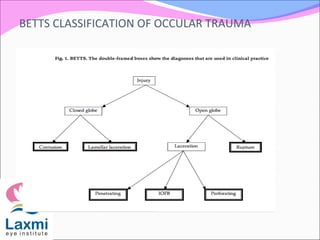
Penetrating injuries are divided into various subcategories
based on specific types of injuries .
Intraocular foreign bodies may complicate penetrating injury
BETTS CLASSIFICATION OF OCCULAR TRAUMA
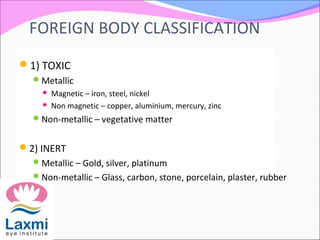
FOREIGN BODY CLASSIFICATION
1) TOXIC
Metallic
 Magnetic – iron, steel, nickel
 Non magnetic – copper, aluminium, mercury, zinc
Non-metallic – vegetative matter
2) INERT
Metallic – Gold, silver, platinum
Non-metallic – Glass, carbon, stone, porcelain, plaster, rubber
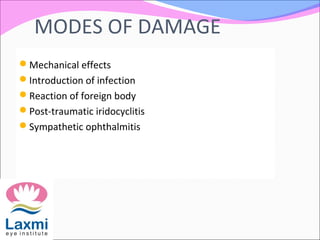
MODES OF DAMAGE
Mechanical effects
Introduction of infection
Reaction of foreign body
Post-traumatic iridocyclitis
Sympathetic ophthalmitis
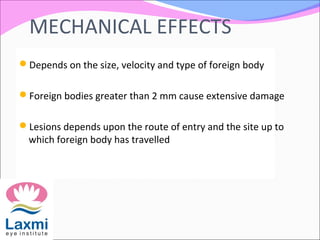
MECHANICAL EFFECTS
Depends on the size, velocity and type of foreign body
Foreign bodies greater than 2 mm cause extensive damage
Lesions depends upon the route of entry and the site up to
which foreign body has travelled
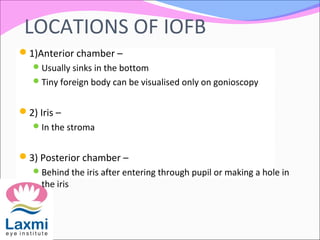
LOCATIONS OF IOFB
1)Anterior chamber –
Usually sinks in the bottom
Tiny foreign body can be visualised only on gonioscopy
2) Iris –
In the stroma
3) Posterior chamber –
Behind the iris after entering through pupil or making a hole in
the iris
Lens –
On anterior surface or inside the lens (either an opaque tract
may be seen in lens or may become cataractous)
Vitreous cavity
Retina , choroid and sclera
Orbital cavity
INTRODUCTION OF INFECTION
Metallic foreign are usually sterile due to heat generated
by them
Wood and stones carry a great chance of infection
Usually ends in endophthalmitis and panophthalmitis
REACTION OF FOREIGN BODY
Inorganic foreign body
No reaction by inert substances which includes glass,
porcelain, gold, silver and platinum
Local irritative reaction leading to encapsulation of
foreign body occurs with lead and aluminium particles .
Suppurative reaction excited by pure copper, zinc, nickel
and mercury particles .
Specific reactions by iron (siderosis) and copper alloys
(chalcosis)
SIDEROSIS BULBI
Degenerative changes produced by an iron foreign body
Usually occurs 2 months to 2 years of the injury
MECHANISM –
The iron particle undergo electrolytic dissociation by the
current of rest and its ions are disseminated throughout
the eye.
These ions combine with intracellular protein and produce
degenerative changes
 Epithelial structures of the eye are most affected
CLINICAL MANIFESTATIONS
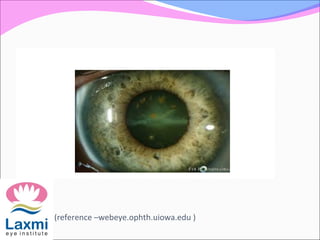
Anterior epithelium and capsule of lens are involved first.
Rusty deposits are arranged radially in a ring; later cataract
develops
Iris first stained greenish and latter on reddish brown
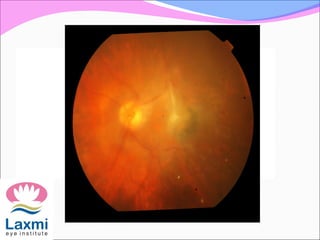
Retinal pigmentary changes can resemble retinitis pigmentosa
ERG shows progressive attenuation of b wave over time
Secondary open angle type of glaucoma due to degenerative
changes in trabecular meshwork
(reference –webeye.ophth.uiowa.edu )
CHALCOSIS
Specific changes produced by alloys of copper in the eye
IOFB with high copper content involves violent
endophthalmitis often with progression to phthisis bulbi
Alloys with low copper content like brass and bronze results in
chalcosis
CLINICAL MANIFESTATIONS
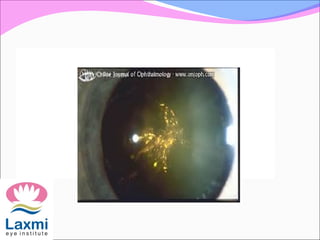
Kayser-Fleischer ring is golden brown ring which occurs
due to deposition of copper under peripheral part of
Descemet’s membrane of the cornea
Sunflower cataract produced by deposition of the
capsule under posterior capsule of the lens
Brilliant golden green in colour
Retina – deposition of golden plaques at the posterior
pole which reflects light with a metallic sheen
Degenerative retinopathy does not develop as it is
less retinotoxic compared to iron
REACTION OF ORGANIC FOREIGN BODY
E.g. wood and other vegetative material produce proliferative
reaction characterised by formation of giant cells
Caterpillar hair produces ophthalmia nodosum ,which is
characterised by severe granulomatous iridocyclitis with
nodule formation .
SYMPATHETIC OPHTHALMITIS
Serious bilateral granulomatous panuveitis which follows
penetrating ocular trauma
Injured eye is exciting eye and fellow eye is sympathizing
eye .
A)Predisposing factor
Follows penetrating wound
Wounds in the ciliary region (dangerous zone ) are more
prone to it
more common in children than adults
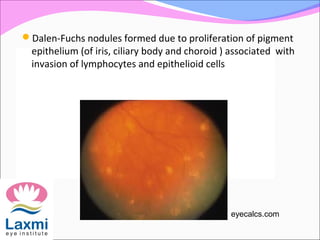
Dalen-Fuchs nodules formed due to proliferation of pigment
epithelium (of iris, ciliary body and choroid ) associated with
invasion of lymphocytes and epithelioid cells
eyecalcs.com
CLINICAL PICTURE
1)Exciting ( injured eye ) –
Shows clinical feature of persistent low grade plastic uveitis
Ciliary congestion , lacrimation and tenderness
Keratic precipitates may be present at the back of the cornea
2) Sympathizing ( sound eye ) –
Usually involves 4 -8 weeks of injury in the other eye
Manifest as acute iridocyclitis
TREATMENT
Prophylaxis
meticulous repair of the wound using microsurgical technique
taking great care that uveal tissue is not incarcerated in the
wound .
Corticosteroids (topical + sytemic), immunosuppressants
COMPLICATIONS – In Summary
Rust ring on cornea at entry point
Persistent inflammation
Corneal defects
Infection – endophthalmitis
Secondary glaucoma
Lens damage –traumatic cataracts
Retinal/vitreous damage
Sympathetic ophthalmia
MANAGEMENT OF RETAINED IOFB
DIAGNOSIS –
History – a careful history about the mode of injury may
give clue about the type of IOFB
Time elapsed since injury
Ocular examination –A thorough ocular examination
including slit lamp examination. Gonioscopy in select
cases
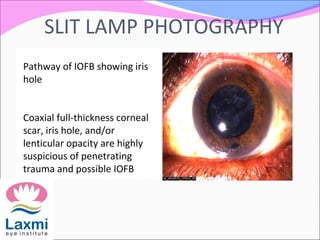
SLIT LAMP PHOTOGRAPHY
Pathway of IOFB showing iris
hole
Coaxial full-thickness corneal
scar, iris hole, and/or
lenticular opacity are highly
suspicious of penetrating
trauma and possible IOFB
LOCALISATION OF IOFB
X-Ray
Plain X rays orbit Anterio-posterior and lateral views
as most foreign bodies are opaque .
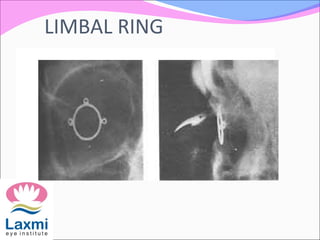
Limbal Ring Method–
Obsolete
Metallic ring of corneal diameter stiched at limbus and x
ray taken in three exposures one while patient looking
straight , upwards and downwards .
LIMBAL RING
USG
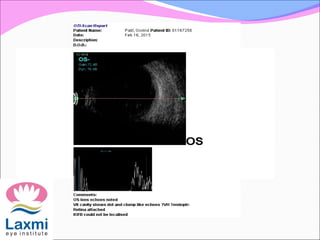
Features of IOFB on A scan
Steeply rising wide echo spike seen
The reflectivity of the spike is extremely high (100% ) which
persists on low gain
Sound attenuation is very strong
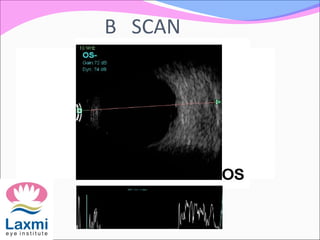
Features of B scan
Appears hyperechoic in contrast to clear vitreous
Sound attenuation is very strong . IOFB causes shadowing
of ocular and orbital structure behind it .
Associated ocular damage like vitreous haemorrhage,
retinal detachment can be assessed
USG localisation can tell position of even radiolucent
foreign body
B SCAN
CT SCAN-
Best method of localising IOFB
Axial and coronal cut of < 1.5 mm are advised
MRI
Contraindicated in case of metallic foreign body
MANAGEMENT
Requires immediate closure of wound and removal of
IOFB .
Delay> 24 hrs produces four fold increase risk of
endophthalmitis and vision loss
Prompt removal before encapsulation facilitates removal and
prevents IOFB toxicity
Eyes should be protected with eye shield
IV broad spectrum antibiotic
Tetanus prophylaxis
 ( Thomson JT et al . Infectious endophthalmitis after retained IOFB .
 Principles and practice of vitreo retinal surgery . 1993 , 1468-1474 . )

TREATMENT
IOFB should always be removed unless inert, sterile
Foreign body in anterior chamber removed through
corresponding corneal incision directed straight towards the
foreign body
3 mm incision internal to limbus is taken
Magnetic foreign removed with hand held magnet and
nonmagnetic foreign body picked with toothless forceps .
Viscoelastic protects delicate structures
Foreign body entangled in iris tissue –
Sector iridectomy of part containing magnetic and non
magnetic foreign body .
Foreign body in lens
Lens extraction with IOL implant
Forceps removal with a pars plana vitrectomy –
Use of intraocular magnet or forceps, via sclerotomy or
limbal route in aphakes
PROGNOSIS
Depends on
Initial BCVA
Time of surgery
Initially attached retina
Scleral entry site
Presence of afferent pupillary defect
Mechanism of injury
Vitreous hemorrhage
(Akesbi J et al . IOFB of posterior segment : retrospective analysis and management of
57 cases . J Fr Ophtalmol 2011 Nov ;34 (9) 634- 640 .
CASE
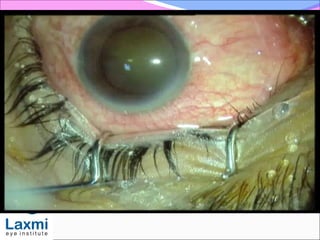
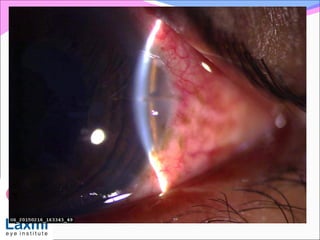
42 /M came with c/o DOV , pain ,redness in LE since one
day
H /O foreign body (steel) particle entry in LE one day
back
BCVA RE: 6/9, LE: HM
THANK YOU

INTRAOCULAR FOREIGN BODY

  • 1.
    INTRAOCULAR FOREIGN BODY PRESENTERDR SANIL SAWANT MODERATOR DR DEVENDRA VENKATRAMANI
  • 2.
    Ocular trauma constitutesone of the important cause of visual loss and subsequent disability. Penetrating injuries are divided into various subcategories based on specific types of injuries . Intraocular foreign bodies may complicate penetrating injury
  • 3.
  • 4.
    FOREIGN BODY CLASSIFICATION 1)TOXIC Metallic  Magnetic – iron, steel, nickel  Non magnetic – copper, aluminium, mercury, zinc Non-metallic – vegetative matter 2) INERT Metallic – Gold, silver, platinum Non-metallic – Glass, carbon, stone, porcelain, plaster, rubber
  • 5.
    MODES OF DAMAGE Mechanicaleffects Introduction of infection Reaction of foreign body Post-traumatic iridocyclitis Sympathetic ophthalmitis
  • 6.
    MECHANICAL EFFECTS Depends onthe size, velocity and type of foreign body Foreign bodies greater than 2 mm cause extensive damage Lesions depends upon the route of entry and the site up to which foreign body has travelled
  • 7.
    LOCATIONS OF IOFB 1)Anteriorchamber – Usually sinks in the bottom Tiny foreign body can be visualised only on gonioscopy 2) Iris – In the stroma 3) Posterior chamber – Behind the iris after entering through pupil or making a hole in the iris
  • 8.
    Lens – On anteriorsurface or inside the lens (either an opaque tract may be seen in lens or may become cataractous) Vitreous cavity Retina , choroid and sclera Orbital cavity
  • 9.
    INTRODUCTION OF INFECTION Metallicforeign are usually sterile due to heat generated by them Wood and stones carry a great chance of infection Usually ends in endophthalmitis and panophthalmitis
  • 10.
    REACTION OF FOREIGNBODY Inorganic foreign body No reaction by inert substances which includes glass, porcelain, gold, silver and platinum Local irritative reaction leading to encapsulation of foreign body occurs with lead and aluminium particles . Suppurative reaction excited by pure copper, zinc, nickel and mercury particles . Specific reactions by iron (siderosis) and copper alloys (chalcosis)
  • 11.
    SIDEROSIS BULBI Degenerative changesproduced by an iron foreign body Usually occurs 2 months to 2 years of the injury MECHANISM – The iron particle undergo electrolytic dissociation by the current of rest and its ions are disseminated throughout the eye. These ions combine with intracellular protein and produce degenerative changes  Epithelial structures of the eye are most affected
  • 12.
    CLINICAL MANIFESTATIONS Anterior epitheliumand capsule of lens are involved first. Rusty deposits are arranged radially in a ring; later cataract develops Iris first stained greenish and latter on reddish brown Retinal pigmentary changes can resemble retinitis pigmentosa ERG shows progressive attenuation of b wave over time Secondary open angle type of glaucoma due to degenerative changes in trabecular meshwork
  • 13.
  • 15.
    CHALCOSIS Specific changes producedby alloys of copper in the eye IOFB with high copper content involves violent endophthalmitis often with progression to phthisis bulbi Alloys with low copper content like brass and bronze results in chalcosis
  • 16.
    CLINICAL MANIFESTATIONS Kayser-Fleischer ringis golden brown ring which occurs due to deposition of copper under peripheral part of Descemet’s membrane of the cornea Sunflower cataract produced by deposition of the capsule under posterior capsule of the lens Brilliant golden green in colour Retina – deposition of golden plaques at the posterior pole which reflects light with a metallic sheen Degenerative retinopathy does not develop as it is less retinotoxic compared to iron
  • 18.
    REACTION OF ORGANICFOREIGN BODY E.g. wood and other vegetative material produce proliferative reaction characterised by formation of giant cells Caterpillar hair produces ophthalmia nodosum ,which is characterised by severe granulomatous iridocyclitis with nodule formation .
  • 19.
    SYMPATHETIC OPHTHALMITIS Serious bilateralgranulomatous panuveitis which follows penetrating ocular trauma Injured eye is exciting eye and fellow eye is sympathizing eye . A)Predisposing factor Follows penetrating wound Wounds in the ciliary region (dangerous zone ) are more prone to it more common in children than adults
  • 20.
    Dalen-Fuchs nodules formeddue to proliferation of pigment epithelium (of iris, ciliary body and choroid ) associated with invasion of lymphocytes and epithelioid cells eyecalcs.com
  • 21.
    CLINICAL PICTURE 1)Exciting (injured eye ) – Shows clinical feature of persistent low grade plastic uveitis Ciliary congestion , lacrimation and tenderness Keratic precipitates may be present at the back of the cornea 2) Sympathizing ( sound eye ) – Usually involves 4 -8 weeks of injury in the other eye Manifest as acute iridocyclitis
  • 22.
    TREATMENT Prophylaxis meticulous repair ofthe wound using microsurgical technique taking great care that uveal tissue is not incarcerated in the wound . Corticosteroids (topical + sytemic), immunosuppressants
  • 23.
    COMPLICATIONS – InSummary Rust ring on cornea at entry point Persistent inflammation Corneal defects Infection – endophthalmitis Secondary glaucoma Lens damage –traumatic cataracts Retinal/vitreous damage Sympathetic ophthalmia
  • 24.
    MANAGEMENT OF RETAINEDIOFB DIAGNOSIS – History – a careful history about the mode of injury may give clue about the type of IOFB Time elapsed since injury Ocular examination –A thorough ocular examination including slit lamp examination. Gonioscopy in select cases
  • 25.
    SLIT LAMP PHOTOGRAPHY Pathwayof IOFB showing iris hole Coaxial full-thickness corneal scar, iris hole, and/or lenticular opacity are highly suspicious of penetrating trauma and possible IOFB
  • 26.
    LOCALISATION OF IOFB X-Ray PlainX rays orbit Anterio-posterior and lateral views as most foreign bodies are opaque . Limbal Ring Method– Obsolete Metallic ring of corneal diameter stiched at limbus and x ray taken in three exposures one while patient looking straight , upwards and downwards .
  • 27.
  • 28.
    USG Features of IOFBon A scan Steeply rising wide echo spike seen The reflectivity of the spike is extremely high (100% ) which persists on low gain Sound attenuation is very strong
  • 29.
    Features of Bscan Appears hyperechoic in contrast to clear vitreous Sound attenuation is very strong . IOFB causes shadowing of ocular and orbital structure behind it . Associated ocular damage like vitreous haemorrhage, retinal detachment can be assessed USG localisation can tell position of even radiolucent foreign body
  • 30.
  • 31.
    CT SCAN- Best methodof localising IOFB Axial and coronal cut of < 1.5 mm are advised MRI Contraindicated in case of metallic foreign body
  • 32.
    MANAGEMENT Requires immediate closureof wound and removal of IOFB . Delay> 24 hrs produces four fold increase risk of endophthalmitis and vision loss Prompt removal before encapsulation facilitates removal and prevents IOFB toxicity Eyes should be protected with eye shield IV broad spectrum antibiotic Tetanus prophylaxis  ( Thomson JT et al . Infectious endophthalmitis after retained IOFB .  Principles and practice of vitreo retinal surgery . 1993 , 1468-1474 . ) 
  • 33.
    TREATMENT IOFB should alwaysbe removed unless inert, sterile Foreign body in anterior chamber removed through corresponding corneal incision directed straight towards the foreign body 3 mm incision internal to limbus is taken Magnetic foreign removed with hand held magnet and nonmagnetic foreign body picked with toothless forceps . Viscoelastic protects delicate structures
  • 34.
    Foreign body entangledin iris tissue – Sector iridectomy of part containing magnetic and non magnetic foreign body . Foreign body in lens Lens extraction with IOL implant Forceps removal with a pars plana vitrectomy – Use of intraocular magnet or forceps, via sclerotomy or limbal route in aphakes
  • 35.
    PROGNOSIS Depends on Initial BCVA Timeof surgery Initially attached retina Scleral entry site Presence of afferent pupillary defect Mechanism of injury Vitreous hemorrhage (Akesbi J et al . IOFB of posterior segment : retrospective analysis and management of 57 cases . J Fr Ophtalmol 2011 Nov ;34 (9) 634- 640 .
  • 36.
    CASE 42 /M camewith c/o DOV , pain ,redness in LE since one day H /O foreign body (steel) particle entry in LE one day back BCVA RE: 6/9, LE: HM
  • 40.

Editor's Notes

  • #33 DOS JULY 2010 ARTICLE .