CASE PRESENTATION
PRESENTER- DR ANKITA LAKHOTIYA
MODERATOR- DR ABHISHEK HOSHING
Case 1
Age: 17 yrs
Sex: Female
Resident of Panvel
Date Of Visit: 15/11/2015
History
 Left eye – pricking sensation – 1 ½ years
 No H/O diminution of vision
 No H/O photophobia
 No H/O redness
No H/O glasses
 No H/O any systemic illness
 Drug history-Nil
Examination
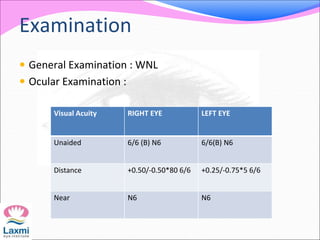
 General Examination : WNL
 Ocular Examination :
Visual Acuity RIGHT EYE LEFT EYE
Unaided 6/6 (B) N6 6/6(B) N6
Distance +0.50/-0.50*80 6/6 +0.25/-0.75*5 6/6
Near N6 N6
Ocular Examination
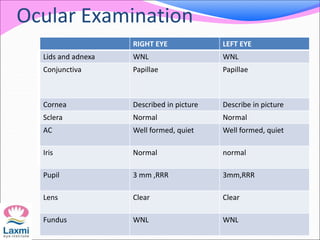
RIGHT EYE LEFT EYE
Lids and adnexa WNL WNL
Conjunctiva Papillae Papillae
Cornea Described in picture Describe in picture
Sclera Normal Normal
AC Well formed, quiet Well formed, quiet
Iris Normal normal
Pupil 3 mm ,RRR 3mm,RRR
Lens Clear Clear
Fundus WNL WNL
CLINICAL PHOTOS
Case 2
Age: 29
Sex: Female
Resident of Uran
Date Of Visit: 05/01/16
History
 Both eyes - Gradual diminution of vision since 5 years
 Both eyes – Pain and pricking sensation
 No H/O redness
 No H/O watering in both eyes
 No H/O glasses
 No H/O trauma
Examination
Visual acuity Right eye Left eye
Unaided FC 1 ½ meter FC 1 ½ meter
BCVA +3.00/-2.0 *170°6/36 +2.0/-2.0*110°6/36
Near N18 N18
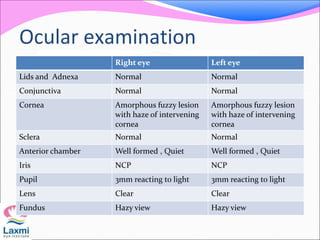
Ocular examination
Right eye Left eye
Lids and Adnexa Normal Normal
Conjunctiva Normal Normal
Cornea Amorphous fuzzy lesion
with haze of intervening
cornea
Amorphous fuzzy lesion
with haze of intervening
cornea
Sclera Normal Normal
Anterior chamber Well formed , Quiet Well formed , Quiet
Iris NCP NCP
Pupil 3mm reacting to light 3mm reacting to light
Lens Clear Clear
Fundus Hazy view Hazy view
Clinical photos
Case 3
Age: 40
Sex: Female
Resident of New Panvel
Date Of Visit: 22/08/15
History
 Both Eyes - diminition of vision since 1-2 years
 Both Eyes - pricking sensation sometimes since 1 year
 H/o Corneal Laser done 10 years back
Examination
Right eye Left eye
Unaided FC 2 ½ meter FC 2 ½ meter
BCVA NIG FC 2.5 meter NIG FC 2.5 meter
Near +1.0 - N12 +1.0 - N12
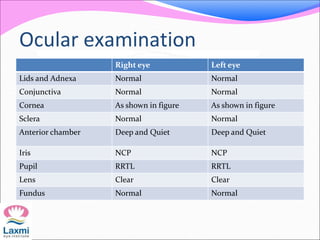
Ocular examination
Right eye Left eye
Lids and Adnexa Normal Normal
Conjunctiva Normal Normal
Cornea As shown in figure As shown in figure
Sclera Normal Normal
Anterior chamber Deep and Quiet Deep and Quiet
Iris NCP NCP
Pupil RRTL RRTL
Lens Clear Clear
Fundus Normal Normal
Clinical photos
SUMMARY
 Corneal Opacities
 All cases are bilateral symmetrical,
 All have central corneal opacity
 No signs of inflammation
 No vascularisation
CORNEAL DYSTROPHY
INTRODUCTION
A Corneal Dystrophy is defined as a corneal opacity or
alteration , which is most often bilateral and
progressive, occurs after birth, and is not
inflammatory .
Anatomical classification
1. Epithelial Basement Dystrophy
2. Bowmans Dystrophy
3. Stromal Dystrophy
4. Endothelium Dystrophy
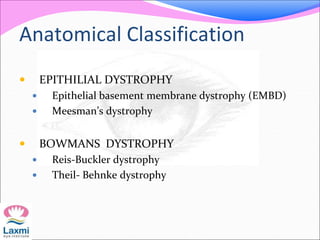
 EPITHILIAL DYSTROPHY
 Epithelial basement membrane dystrophy (EMBD)
 Meesman’s dystrophy
 BOWMANS DYSTROPHY
 Reis-Buckler dystrophy
 Theil- Behnke dystrophy
Anatomical Classification
 STROMAL DYSTROPHY
 Granular dystrophy
 Lattice dystrophy
 Avellino corneal dystrophy
 Macular dystrophy
 Gelatinous drop like dystrophy
 Schnyder crystalline corneal dystrophy
 Fleck dystrophy
 Central cloudy dystrophy of Francois
 Congenital hereditary stromal dystrophy
Anatomical Classification
 ENDOTHELIAL DYSTROPHY
 Posterior Polymorphous Dystrophy
 Fuchs Hereditary Endothelial Dystrophy
 Congenital Hereditary Endothelial Dystrophy
Granular Dystrophy
 Autosomal Dominant
 Bilaterally symmetric affecting central cornea.
 Central and peripheral cornea clear
 Accumulation of phospholipid material
 Characterized by discrete white dense round to oval
granular opacities lie in the relatively clear stroma
forming variety of patterns
 Patterns - Arcuate chains
 - straight lines
 Staining –bright red- Masson’s trichome
weak stain -PAS
peripheral stain with congo red
 Clinical features - vision not affected early
- photophobia
- recurrent erosions
ADVICE – Glasses
Cromal Forte eye drop QID
Macular Dystrophy
 Autosomal recessive
 Often occurs in pedigrees with consanguility
 Accumulation of glyocosoaminoglycans intra and
extra cellularly
 Diffuse fine superficial clouding extending to the
periphery
 Involvement of central and peripheral cornea with all
layers of cornea
 Often associated with thin cornea
 Staining with Alcian blue, colloidal iron,
metachromatic dyes and PAS
 Clinical features – Progressive vision loss with irritation
Photophobia
2nd case had similar clinical features and was hence
advised,
ADVICE - Phototherapeutic Keratectomy
LATTICE DYSTROPHY
 Autosomal dominant
 Accumulation of amyloid in the stroma often
arranged in the branching pattern
 Possible source for amyloid- leakage from serum,
extracellular breakdown of corneal collagen and
localized intracellular production
 Clinical features – recurrent erosions
- decrease in visual acuity
Stains with – orange red with congo red
- PAS, masson’s trichome, thioflavin T
Lattice corneal dystrophy
Avellino Dystrophy
 Lattice deposits with granular deposits
 The disease causing gene of lattice type 1, granular
dystrophy and Avellino dystrophy have been all
mapped to chromosome 5 q
 Main 3 clinical signs –
1. Anterior stromal discrete gray white granular
deposits
2. Mid to posterior stromal lattice lesions
3. Anterior stromal haze
Avellino Dystropy
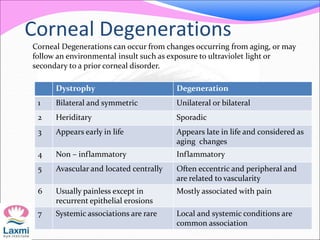
Corneal Degenerations
Dystrophy Degeneration
1 Bilateral and symmetric Unilateral or bilateral
2 Heriditary Sporadic
3 Appears early in life Appears late in life and considered as
aging changes
4 Non – inflammatory Inflammatory
5 Avascular and located centrally Often eccentric and peripheral and
are related to vascularity
6 Usually painless except in
recurrent epithelial erosions
Mostly associated with pain
7 Systemic associations are rare Local and systemic conditions are
common association
Corneal Degenerations can occur from changes occurring from aging, or may
follow an environmental insult such as exposure to ultraviolet light or
secondary to a prior corneal disorder.
Drawbacks of anatomical
classification
 Based only on the pathological and clinical findings
 Disputes were seen for clinical diagnosis
 No correct diagnosis could be made because some
dystrophies would involve multiple layers of cornea
and not just a single layer
 AIM- To develop a new classification system for the
corneal dystrophies , integrating up to –date information
on phenotype description, pathologic examination, and
genetic analysis.
IC3D CLASSIFICATION
 Category 1 – the gene has been mapped and identified
and specific mutations are known
 Category 2 –specific chromosomal loci are mapped ,
but genes remain to be identified
 Category 3 – chromosomal loci not mapped
 Category 4 – suspected new corneal dystrophies
Inheritance pattern : Recessive and
X linked
MODE OF
INHERITANCE
IC3D
CATEGORY
Gelatinous drop like corneal opacity AR 1
Macular corneal dystrophy AR 1
Congenital endothelial dystrophy type 2 AR 2
Lisch epithelial dystrophy XR 2
X linked corneal endothelium dystrophy XR 2
Inheritance pattern :Dominant
MODE OF
INHERITANCE
IC3D CATEGORY
Meesman’s corneal dystrophy AD 1
Stocker Holt dystrophy AD 1
Reis – Buckler dystrophy AD 1
Thiel – Behnke dystrophy AD 5q31 1
Thiel – Behnke dystrophy AD 10q23-q24 1
Subepithelial mucinous corneal
dystrophy
AD 4
MODE OF
INHERITANCE
IC3D
CATEGORY
Epithelial recurrent erosion dystrophy AD 2
Granular corneal dystrophy 1 AD 1
Avellino dystrophy AD 1
Lattice corneal dystrophy 1 AD 1
Lattice Corneal dystrophy 2 AD 1
Fleck dystrophy AD 1
Schnyder corneal dystrophy AD 1
Posterior amorphous corneal dystrophy AD 3
Congenital stromal dystrophy AD 1
Inheritance pattern: Dominant
MODE OF
INHERITANCE
IC3D
CATEGORY
Fuchs dystrophy (early onset) AD Ip34.3 1
Fuchs dystrophy(late onset) AD 13pTel-13q12.13 2
Fuchs dystrophy (late onset) AD 18q21.2-q21.32 2
Fuchs dystrophy (late onset) ? 20p13-p12 1
Posterior polymorphous dystrophy type 1 AD 2
Posterior polymorphous dystrophy type 2 AD 1
Posterior polymorphous dystrophy type 3 AD 1
Congenital endothelial dystrophy type 1 AD 2
Inheritance pattern : Dominant
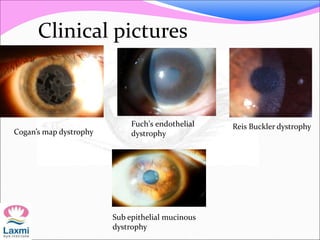
Fuch’s endothelial
dystrophy
Reis Buckler dystrophy
Sub epithelial mucinous
dystrophy
Clinical pictures
Cogan’s map dystrophy
TAKE HOME MESSAGE
 Corneal dystrophy is a wide spectrum of diseases
with overlapping clinical presentations
 Morphologic features may not be able to differentiate
one from another
 Patients may be symptom free or may have recurrent
corneal erosions or diminution of vision
 Treatment will be tailored according to the patients
requirement
Thank you

Corneal dystrophy

  • 1.
    CASE PRESENTATION PRESENTER- DRANKITA LAKHOTIYA MODERATOR- DR ABHISHEK HOSHING
  • 2.
    Case 1 Age: 17yrs Sex: Female Resident of Panvel Date Of Visit: 15/11/2015
  • 3.
    History  Left eye– pricking sensation – 1 ½ years  No H/O diminution of vision  No H/O photophobia  No H/O redness No H/O glasses  No H/O any systemic illness  Drug history-Nil
  • 4.
    Examination  General Examination: WNL  Ocular Examination : Visual Acuity RIGHT EYE LEFT EYE Unaided 6/6 (B) N6 6/6(B) N6 Distance +0.50/-0.50*80 6/6 +0.25/-0.75*5 6/6 Near N6 N6
  • 5.
    Ocular Examination RIGHT EYELEFT EYE Lids and adnexa WNL WNL Conjunctiva Papillae Papillae Cornea Described in picture Describe in picture Sclera Normal Normal AC Well formed, quiet Well formed, quiet Iris Normal normal Pupil 3 mm ,RRR 3mm,RRR Lens Clear Clear Fundus WNL WNL
  • 6.
  • 7.
    Case 2 Age: 29 Sex:Female Resident of Uran Date Of Visit: 05/01/16
  • 8.
    History  Both eyes- Gradual diminution of vision since 5 years  Both eyes – Pain and pricking sensation  No H/O redness  No H/O watering in both eyes  No H/O glasses  No H/O trauma
  • 9.
    Examination Visual acuity Righteye Left eye Unaided FC 1 ½ meter FC 1 ½ meter BCVA +3.00/-2.0 *170°6/36 +2.0/-2.0*110°6/36 Near N18 N18
  • 10.
    Ocular examination Right eyeLeft eye Lids and Adnexa Normal Normal Conjunctiva Normal Normal Cornea Amorphous fuzzy lesion with haze of intervening cornea Amorphous fuzzy lesion with haze of intervening cornea Sclera Normal Normal Anterior chamber Well formed , Quiet Well formed , Quiet Iris NCP NCP Pupil 3mm reacting to light 3mm reacting to light Lens Clear Clear Fundus Hazy view Hazy view
  • 11.
  • 12.
    Case 3 Age: 40 Sex:Female Resident of New Panvel Date Of Visit: 22/08/15
  • 13.
    History  Both Eyes- diminition of vision since 1-2 years  Both Eyes - pricking sensation sometimes since 1 year  H/o Corneal Laser done 10 years back
  • 14.
    Examination Right eye Lefteye Unaided FC 2 ½ meter FC 2 ½ meter BCVA NIG FC 2.5 meter NIG FC 2.5 meter Near +1.0 - N12 +1.0 - N12
  • 15.
    Ocular examination Right eyeLeft eye Lids and Adnexa Normal Normal Conjunctiva Normal Normal Cornea As shown in figure As shown in figure Sclera Normal Normal Anterior chamber Deep and Quiet Deep and Quiet Iris NCP NCP Pupil RRTL RRTL Lens Clear Clear Fundus Normal Normal
  • 16.
  • 17.
    SUMMARY  Corneal Opacities All cases are bilateral symmetrical,  All have central corneal opacity  No signs of inflammation  No vascularisation CORNEAL DYSTROPHY
  • 18.
    INTRODUCTION A Corneal Dystrophyis defined as a corneal opacity or alteration , which is most often bilateral and progressive, occurs after birth, and is not inflammatory .
  • 19.
    Anatomical classification 1. EpithelialBasement Dystrophy 2. Bowmans Dystrophy 3. Stromal Dystrophy 4. Endothelium Dystrophy
  • 20.
     EPITHILIAL DYSTROPHY Epithelial basement membrane dystrophy (EMBD)  Meesman’s dystrophy  BOWMANS DYSTROPHY  Reis-Buckler dystrophy  Theil- Behnke dystrophy Anatomical Classification
  • 21.
     STROMAL DYSTROPHY Granular dystrophy  Lattice dystrophy  Avellino corneal dystrophy  Macular dystrophy  Gelatinous drop like dystrophy  Schnyder crystalline corneal dystrophy  Fleck dystrophy  Central cloudy dystrophy of Francois  Congenital hereditary stromal dystrophy Anatomical Classification
  • 22.
    Anatomical Classification  ENDOTHELIALDYSTROPHY  Posterior Polymorphous Dystrophy  Fuchs Hereditary Endothelial Dystrophy  Congenital Hereditary Endothelial Dystrophy
  • 23.
    Granular Dystrophy  AutosomalDominant  Bilaterally symmetric affecting central cornea.  Central and peripheral cornea clear  Accumulation of phospholipid material  Characterized by discrete white dense round to oval granular opacities lie in the relatively clear stroma forming variety of patterns  Patterns - Arcuate chains  - straight lines
  • 24.
     Staining –brightred- Masson’s trichome weak stain -PAS peripheral stain with congo red  Clinical features - vision not affected early - photophobia - recurrent erosions ADVICE – Glasses Cromal Forte eye drop QID
  • 25.
    Macular Dystrophy  Autosomalrecessive  Often occurs in pedigrees with consanguility  Accumulation of glyocosoaminoglycans intra and extra cellularly  Diffuse fine superficial clouding extending to the periphery  Involvement of central and peripheral cornea with all layers of cornea  Often associated with thin cornea
  • 26.
     Staining withAlcian blue, colloidal iron, metachromatic dyes and PAS  Clinical features – Progressive vision loss with irritation Photophobia 2nd case had similar clinical features and was hence advised, ADVICE - Phototherapeutic Keratectomy
  • 27.
    LATTICE DYSTROPHY  Autosomaldominant  Accumulation of amyloid in the stroma often arranged in the branching pattern  Possible source for amyloid- leakage from serum, extracellular breakdown of corneal collagen and localized intracellular production  Clinical features – recurrent erosions - decrease in visual acuity Stains with – orange red with congo red - PAS, masson’s trichome, thioflavin T
  • 28.
  • 29.
    Avellino Dystrophy  Latticedeposits with granular deposits  The disease causing gene of lattice type 1, granular dystrophy and Avellino dystrophy have been all mapped to chromosome 5 q  Main 3 clinical signs – 1. Anterior stromal discrete gray white granular deposits 2. Mid to posterior stromal lattice lesions 3. Anterior stromal haze
  • 30.
  • 31.
    Corneal Degenerations Dystrophy Degeneration 1Bilateral and symmetric Unilateral or bilateral 2 Heriditary Sporadic 3 Appears early in life Appears late in life and considered as aging changes 4 Non – inflammatory Inflammatory 5 Avascular and located centrally Often eccentric and peripheral and are related to vascularity 6 Usually painless except in recurrent epithelial erosions Mostly associated with pain 7 Systemic associations are rare Local and systemic conditions are common association Corneal Degenerations can occur from changes occurring from aging, or may follow an environmental insult such as exposure to ultraviolet light or secondary to a prior corneal disorder.
  • 32.
    Drawbacks of anatomical classification Based only on the pathological and clinical findings  Disputes were seen for clinical diagnosis  No correct diagnosis could be made because some dystrophies would involve multiple layers of cornea and not just a single layer
  • 33.
     AIM- Todevelop a new classification system for the corneal dystrophies , integrating up to –date information on phenotype description, pathologic examination, and genetic analysis.
  • 34.
    IC3D CLASSIFICATION  Category1 – the gene has been mapped and identified and specific mutations are known  Category 2 –specific chromosomal loci are mapped , but genes remain to be identified  Category 3 – chromosomal loci not mapped  Category 4 – suspected new corneal dystrophies
  • 35.
    Inheritance pattern :Recessive and X linked MODE OF INHERITANCE IC3D CATEGORY Gelatinous drop like corneal opacity AR 1 Macular corneal dystrophy AR 1 Congenital endothelial dystrophy type 2 AR 2 Lisch epithelial dystrophy XR 2 X linked corneal endothelium dystrophy XR 2
  • 36.
    Inheritance pattern :Dominant MODEOF INHERITANCE IC3D CATEGORY Meesman’s corneal dystrophy AD 1 Stocker Holt dystrophy AD 1 Reis – Buckler dystrophy AD 1 Thiel – Behnke dystrophy AD 5q31 1 Thiel – Behnke dystrophy AD 10q23-q24 1 Subepithelial mucinous corneal dystrophy AD 4
  • 37.
    MODE OF INHERITANCE IC3D CATEGORY Epithelial recurrenterosion dystrophy AD 2 Granular corneal dystrophy 1 AD 1 Avellino dystrophy AD 1 Lattice corneal dystrophy 1 AD 1 Lattice Corneal dystrophy 2 AD 1 Fleck dystrophy AD 1 Schnyder corneal dystrophy AD 1 Posterior amorphous corneal dystrophy AD 3 Congenital stromal dystrophy AD 1 Inheritance pattern: Dominant
  • 38.
    MODE OF INHERITANCE IC3D CATEGORY Fuchs dystrophy(early onset) AD Ip34.3 1 Fuchs dystrophy(late onset) AD 13pTel-13q12.13 2 Fuchs dystrophy (late onset) AD 18q21.2-q21.32 2 Fuchs dystrophy (late onset) ? 20p13-p12 1 Posterior polymorphous dystrophy type 1 AD 2 Posterior polymorphous dystrophy type 2 AD 1 Posterior polymorphous dystrophy type 3 AD 1 Congenital endothelial dystrophy type 1 AD 2 Inheritance pattern : Dominant
  • 39.
    Fuch’s endothelial dystrophy Reis Bucklerdystrophy Sub epithelial mucinous dystrophy Clinical pictures Cogan’s map dystrophy
  • 40.
    TAKE HOME MESSAGE Corneal dystrophy is a wide spectrum of diseases with overlapping clinical presentations  Morphologic features may not be able to differentiate one from another  Patients may be symptom free or may have recurrent corneal erosions or diminution of vision  Treatment will be tailored according to the patients requirement
  • 41.