CYCLODESTRUCTIVE
PROCEDURES
DR.ARINO JOHN
MS OPHTHALMOLOGY
CYCLODESTRUCTIVE
PROCEDURES
INTRODUCTION
 Decrease IOP by destroying the ciliary processes and
non pigmented ciliary body epithelium which produces
the aqueous fluid.
Last line management and a reserved procedure.
 Because the ciliary epithelium can regenerate,
multiple treatments are necessary in some patients to
achieve the desired long term IOP lowering effect.
INDICATIONS
 Refractory ocular pain in absolute glaucoma.
Uncontrolled IOP despite max medicat t/t.
Multiple failed filtrations or shunt surgery.
Cases with severly scarred conjunctiva and
poor visual prognosis.
NVG
Aphakia and pseudophakic glaucoma
Glaucoma following PK
Traumatic glaucoma
Post uveitic glaucoma
Congenital glaucoma (failed t/t)
INDICATIONS
CONTRAINDICATIONS
1. Thin sclera
2. Limbal deformation
3. Scleritis
4. Phakic eyes with good vision.
TYPES OF CYCLODESTRUCTIVE
PROCEDURES
Cyclocryotherapy
Laser cycloablations
Cycloelectrolysis
Diathermy
Beta irradiations
Therapeuctic ultrasound.
CYCLOCRYOTHERAPY
 Ideal for a painful blind eye.
Destroys the ciliary epithelium with a
cryoprobe through intact conjunctiva and
sclera.
Good pain relief and success rates
But high complication rate.
EFFECTS OF CRYOTHERAPY
•Ischemia caused by
vascular stasis and
the destruction of small caliber blood vessels
•Ice crystal formation inside cells leading to cell wall rupture
•Denaturing of lipid- protein complexes
•Osmotic stress
•Tissue necrosis
•Cellular apoptosis after freezing injury by the buildup of toxic
concentrations of solutes inside cells
September 09, 2015 Department of Ophthalmology, JNMC, Belagavi 7
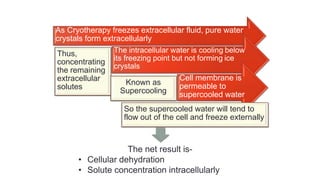
Thus,
concentrating
the remaining
extracellular
solutes
As Cryotherapy freezes extracellular fluid, pure water
crystals form extracellularly
The intracellular water is cooling below
its freezing point but not forming ice
crystals
Known as
Supercooling
Cell membrane is
permeable to
supercooled water
So the supercooled water will tend to
flow out of the cell and freeze externally
The net result is-
• Cellular dehydration
• Solute concentration intracellularly
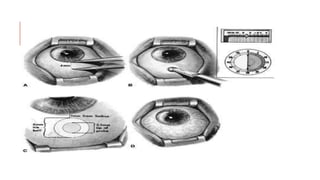
PROCEDURE
•Under peribulbar/retrobulbar anesthesia
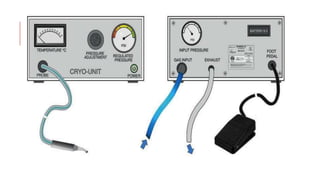
•A cryoprobe of 2.5mm is used.
• Cryoconsole
•Tank of gas (cryogen)
•Foot pedal
•A circular and convex retinal cryoprobe (3mm or 4mm
tip) is applied directly on the intact conjunctival
surface.
•The edge of the tip is placed 1-1.5mm from the limbus
for 1 minute, thus bringing the center of tip directly
over cilliary body
•Cryotip temp at -80 degree Celsius.
•180 degree is treated at one session.
•The ice-ball is allowed to thaw slowly, rather than
using irrigation, to allow maximal effect.
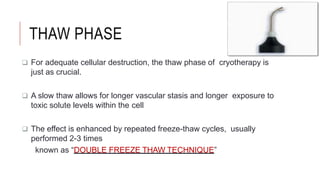
 For adequate cellular destruction, the thaw phase of cryotherapy is
just as crucial.
 A slow thaw allows for longer vascular stasis and longer exposure to
toxic solute levels within the cell
 The effect is enhanced by repeated freeze-thaw cycles, usually
performed 2-3 times
known as “DOUBLE FREEZE THAW TECHNIQUE”
September 09, 2015 Department of Ophthalmology, JNMC, Belagavi 8
THAW PHASE
VARIOUS CRYOGENS
• Freon (boiling point = −29.8 ̊Cto −40.8 ̊C)
• Nitrous oxide (boiling point = −88.5 ̊C)
• Solid carbon dioxide (melting point = −79 C̊ )
• Liquid nitrogen (boiling point = −195.6 C̊ )
Boiling point of liquid nitrogen is by far the lowest,
making it the most effective in cell destruction.
POSTOPERATI
VE CARE
COMPLICATIO
NS
CYCLOABALTION
Procedure by which laser energy is used to destroy te
cilry epithelium,stroma and vascular supply.
Types
 Transcleral cyclophotocoagulation
contact & non-contact method.
Transpupillary endolaser
Endoscopic endolaser
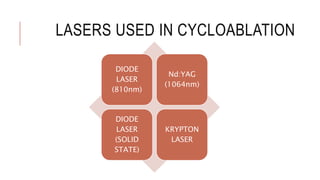
LASERS USED IN CYCLOABLATION
DIODE
LASER
(810nm)
Nd:YAG
(1064nm)
DIODE
LASER
(SOLID
STATE)
KRYPTON
LASER
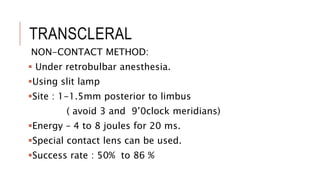
TRANSCLERAL
NON-CONTACT METHOD:
 Under retrobulbar anesthesia.
Using slit lamp
Site : 1-1.5mm posterior to limbus
( avoid 3 and 9’0clock meridians)
Energy – 4 to 8 joules for 20 ms.
Special contact lens can be used.
Success rate : 50% to 86 %
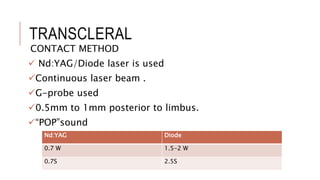
CONTACT METHOD
 Nd:YAG/Diode laser is used
Continuous laser beam .
G-probe used
0.5mm to 1mm posterior to limbus.
“POP”sound
TRANSCLERAL
Nd:YAG Diode
0.7 W 1.5-2 W
0.7S 2.5S
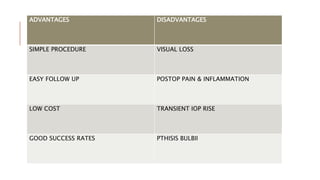
ADVANTAGES DISADVANTAGES
SIMPLE PROCEDURE VISUAL LOSS
EASY FOLLOW UP POSTOP PAIN & INFLAMMATION
LOW COST TRANSIENT IOP RISE
GOOD SUCCESS RATES PTHISIS BULBII
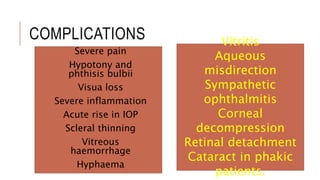
COMPLICATIONS
Severe pain
Hypotony and
phthisis bulbii
Visua loss
Severe inflammation
Acute rise in IOP
Scleral thinning
Vitreous
haemorrhage
Hyphaema
Vitritis
Aqueous
misdirection
Sympathetic
ophthalmitis
Corneal
decompression
Retinal detachment
Cataract in phakic
patients.
Cyclocryo

Cyclocryo

  • 1.
  • 2.
  • 3.
    INTRODUCTION  Decrease IOPby destroying the ciliary processes and non pigmented ciliary body epithelium which produces the aqueous fluid. Last line management and a reserved procedure.  Because the ciliary epithelium can regenerate, multiple treatments are necessary in some patients to achieve the desired long term IOP lowering effect.
  • 4.
    INDICATIONS  Refractory ocularpain in absolute glaucoma. Uncontrolled IOP despite max medicat t/t. Multiple failed filtrations or shunt surgery. Cases with severly scarred conjunctiva and poor visual prognosis. NVG
  • 5.
    Aphakia and pseudophakicglaucoma Glaucoma following PK Traumatic glaucoma Post uveitic glaucoma Congenital glaucoma (failed t/t) INDICATIONS
  • 6.
    CONTRAINDICATIONS 1. Thin sclera 2.Limbal deformation 3. Scleritis 4. Phakic eyes with good vision.
  • 7.
    TYPES OF CYCLODESTRUCTIVE PROCEDURES Cyclocryotherapy Lasercycloablations Cycloelectrolysis Diathermy Beta irradiations Therapeuctic ultrasound.
  • 8.
    CYCLOCRYOTHERAPY  Ideal fora painful blind eye. Destroys the ciliary epithelium with a cryoprobe through intact conjunctiva and sclera. Good pain relief and success rates But high complication rate.
  • 9.
    EFFECTS OF CRYOTHERAPY •Ischemiacaused by vascular stasis and the destruction of small caliber blood vessels •Ice crystal formation inside cells leading to cell wall rupture •Denaturing of lipid- protein complexes •Osmotic stress •Tissue necrosis •Cellular apoptosis after freezing injury by the buildup of toxic concentrations of solutes inside cells
  • 10.
    September 09, 2015Department of Ophthalmology, JNMC, Belagavi 7 Thus, concentrating the remaining extracellular solutes As Cryotherapy freezes extracellular fluid, pure water crystals form extracellularly The intracellular water is cooling below its freezing point but not forming ice crystals Known as Supercooling Cell membrane is permeable to supercooled water So the supercooled water will tend to flow out of the cell and freeze externally The net result is- • Cellular dehydration • Solute concentration intracellularly
  • 11.
    PROCEDURE •Under peribulbar/retrobulbar anesthesia •Acryoprobe of 2.5mm is used. • Cryoconsole •Tank of gas (cryogen) •Foot pedal
  • 12.
    •A circular andconvex retinal cryoprobe (3mm or 4mm tip) is applied directly on the intact conjunctival surface. •The edge of the tip is placed 1-1.5mm from the limbus for 1 minute, thus bringing the center of tip directly over cilliary body •Cryotip temp at -80 degree Celsius. •180 degree is treated at one session. •The ice-ball is allowed to thaw slowly, rather than using irrigation, to allow maximal effect.
  • 13.
     For adequatecellular destruction, the thaw phase of cryotherapy is just as crucial.  A slow thaw allows for longer vascular stasis and longer exposure to toxic solute levels within the cell  The effect is enhanced by repeated freeze-thaw cycles, usually performed 2-3 times known as “DOUBLE FREEZE THAW TECHNIQUE” September 09, 2015 Department of Ophthalmology, JNMC, Belagavi 8 THAW PHASE
  • 16.
    VARIOUS CRYOGENS • Freon(boiling point = −29.8 ̊Cto −40.8 ̊C) • Nitrous oxide (boiling point = −88.5 ̊C) • Solid carbon dioxide (melting point = −79 C̊ ) • Liquid nitrogen (boiling point = −195.6 C̊ ) Boiling point of liquid nitrogen is by far the lowest, making it the most effective in cell destruction.
  • 17.
  • 18.
    CYCLOABALTION Procedure by whichlaser energy is used to destroy te cilry epithelium,stroma and vascular supply. Types  Transcleral cyclophotocoagulation contact & non-contact method. Transpupillary endolaser Endoscopic endolaser
  • 19.
    LASERS USED INCYCLOABLATION DIODE LASER (810nm) Nd:YAG (1064nm) DIODE LASER (SOLID STATE) KRYPTON LASER
  • 20.
    TRANSCLERAL NON-CONTACT METHOD:  Underretrobulbar anesthesia. Using slit lamp Site : 1-1.5mm posterior to limbus ( avoid 3 and 9’0clock meridians) Energy – 4 to 8 joules for 20 ms. Special contact lens can be used. Success rate : 50% to 86 %
  • 21.
    CONTACT METHOD  Nd:YAG/Diodelaser is used Continuous laser beam . G-probe used 0.5mm to 1mm posterior to limbus. “POP”sound TRANSCLERAL Nd:YAG Diode 0.7 W 1.5-2 W 0.7S 2.5S
  • 22.
    ADVANTAGES DISADVANTAGES SIMPLE PROCEDUREVISUAL LOSS EASY FOLLOW UP POSTOP PAIN & INFLAMMATION LOW COST TRANSIENT IOP RISE GOOD SUCCESS RATES PTHISIS BULBII
  • 23.
    COMPLICATIONS Severe pain Hypotony and phthisisbulbii Visua loss Severe inflammation Acute rise in IOP Scleral thinning Vitreous haemorrhage Hyphaema Vitritis Aqueous misdirection Sympathetic ophthalmitis Corneal decompression Retinal detachment Cataract in phakic patients.