Nature 0f amniotic membrane
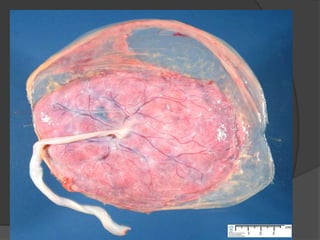
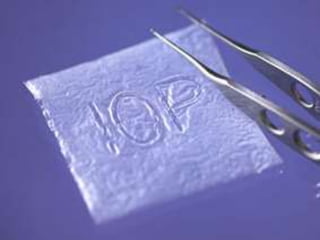
The amniotic membrane (AM) is the inner
avascular layer of the three-layered foetal
membrane
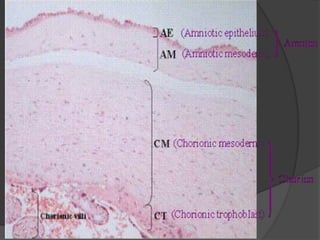
Layers of amniotic membrane:
1- Epithelium.
2- Basement membrane
3- Stroma.
Nature of amniotic membrane
The structure of the membrane, which
presents a single layer of metabolically
very active cuboidal to columnar epithelium
firmly attached to a basement membrane
and an avascular and relatively sparsely
populated stroma, makes it an easy-to-
handle and resilient tissue. The epithelium
and stroma are endowed with a number of
cytokines and growth factors, key among
which are transforming growth factor β and
epidermal growth factor
Properties of amniotic
:membrane
1) Antiadhesive effects
effects2) Bacteriostatic
3) Epithelialisation effects.
•4) The lack of
immunogenicity
Principles that govern the manner in
which the membrane is applied to
the eye.
1 ) Graft or inlay technique. The AM is
intended to act as a substrate or
scaffold for epithelial cells to grow and
is therefore incorporated into the host
tissue (cornea or conjunctiva). The
AM is usually placed basement
membrane side up.
Principles that govern the manner in which
the membrane is applied to the eye.
2 ) Patch or overlay technique. Here the
AM functions essentially as a cover or a
biological bandage ‘contact lens,’
protecting the underlying healing
epithelial surface. The intention is for the
membrane to fall off or be removed over
a period of time.
Principles that govern the manner in
which the membrane is applied to the
eye.
3 ) Layered or fill in technique. In this
maneuver , the AM is used in multiple
small pieces to fill the entire depth of a
corneal ulcer or crater. A relatively larger
‘graft’ of membrane is applied to the
surface over which the epithelium is
expected to grow.
Uses in ophthalmology :
1) Conjunctival reconstruction
A ) Pterygium
B ) Conjunctival and corneal tumours
Uses in ophthalmology :
2 ) Persistent corneal epithelial
defects and perforations
3 ) Limbal stem cell deficiency
E,g : Cicatrising diseases such as
Stevens–Johnson syndrome, chemical
or thermal burns, and ocular cicatricial
pemphigoid (OCP).
Uses in ophthalmology :
4) Pseudophakic bullous
keratopathy
5 ) Symblepharon
Uses in ophthalmology :
6 ) Glaucoma
7 ) Oculoplastics and orbits
:New uncommon uses
1- Amniotic membrane transplantation is
successful anti-inflammatory treatment
in proven ulcerative herpetic keratitis.
2 - Amniotic membrane grafts for
nontraumatic corneal perforations,
descemetoceles, and deep ulcers.
:New uncommon uses
3- Amniotic membrane transplantation for
persistent corneal ulcers and
perforations in acute fungal keratitis.
4- Amniotic membrane transplantation
for severe neurotrophic corneal ulcers
5- Amniotic membrane transplantation in
infectious corneal ulcer
:New uncommon uses
6- Amniotic membrane transplantation in
severe bacterial keratitis.
7- Amniotic membrane transplantation in
the management of conjunctival
malignant melanoma and primary
acquired melanosis with atypia
:New uncommon uses
8- Use of Amniotic Membrane Graft
Combined With Intraoperative Mitomycin
C to Prevent Recurrence After Excision
of Recurrent Pterygia.
How to be prepared ?
The donor is screened to exclude risk of transmissible
infections such as human immunodeficiency virus
(HIV), hepatitis B virus, hepatitis C virus, and
Treponema pallidum infections. Ideally, the media
and washing solutions needed for the preparation of
amniotic membrane are prepared only a week to 10
days prior to use and not stored in the freezer weeks
ahead. The AM obtained under sterile conditions
after elective caesarian section is washed free of
blood clots and chorion. With the epithelial surface
up, amniotic membrane is spread uniformly without
folds or tears on individually sterilized 0.22 μm
nitrocellulose membranes of the required sizes.
How to be preserved ?
Less popular “”First method :
Freezing of cleaned fresh
membrane at −80 °C in either
phosphate-buffered saline in
dimethylsulphoxide (PBS DMSO)
or in Eagle's Minimum Essential
Medium (MEM) with glycerol.
How to be preserved ?
Second method : “ more popular “
Freeze drying of the membrane and
rehydration before use. Fresh
unpreserved membrane is also used
quite commonly in the developing world
but not in the Western countries
Limitations of AM
The AM in its early use was portrayed as
a
potential ‘miracle’ cure but it is found that
it
has limitations
Limitations of AM
* In pterygium surgery :
Amniotic membrane graft had a higher
recurrence rate than conjunctival
autograft
Limitations of AM
* In acute alkali burns :
AMT did not convey any benefit in visual
improvement. However, there was a
reduction in acute pain and more rapid
epithelisation in moderate burns. No
benefit was conferred in severe burns.
Limitations of AM
* In the treatment of leaking
trabeculectomy blebs:
AMT did not offer an effective
alternative to conjunctival
advancement
:Case presentation 1
A 43 ys old male referred to
ophthalmology department in Sohag
:university hospital presented with
Lt. central corneal melting
Bil. Posterior blephritis with severe dry eye
Treatment was in the form of :
1- Topical tear substitutes .
2- Topical antibioticies .
3 – Mydriatics cycloplegics .
4 – Systemic doxycycline .
Is amniotic membrane effective
in this case ?
Amniotic membrane was used in this
patient
Freeze dried membrane was sutured to
The conjuctiva by vicryil (8-0) covering the
corneal defect as one layer .
Follow up :
First day Postoperative :
Anterior chamber became formed and still
formed for about 3 days
Fourth day postoperative :
Amniotic membrane had dissolved with
loss of AC again .
Another trial !!!!!!
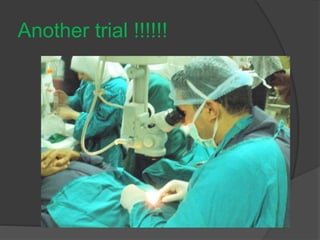
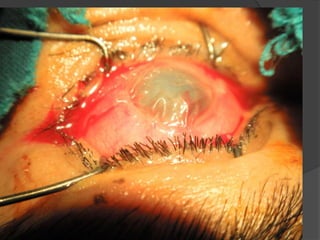
At another trial , amniotic membrane was
used as multi layer cover to the corneal
Perforation.
Follow up :
AC still lost for about a week and the
membrane had dissolved ,
The patient was discharged after bandage
contact lens instillation and the same
medical treatment with follow up at out
patient clinic
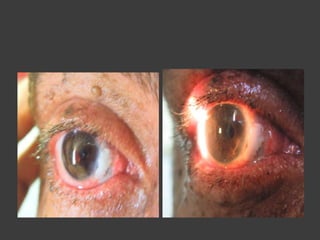
Case presentation 2 :
History:
· Male – 22 y
· Xeroderma pigmentosa with
conjunctival CIN
· Excised with application of MMC 3
years ago.
· After surgery, he complaint from
chronic ocular irritation and diminution of
vision.
Examination:
· Scleral thinning at the site of
previously excised mass.
· Signs of old Anterior uveitis
· Complicated cataract
Treatment:
· Autologous scleral graft with amniotic
membrane inlay graft
Conclusion :
Amniotic membrane is not a magic-1
therapy.
2- Amniotic has many limitations.
3-Case selection is mandatory.
Amniotic membrane in ophthalmology

Amniotic membrane in ophthalmology

  • 2.
    Nature 0f amnioticmembrane The amniotic membrane (AM) is the inner avascular layer of the three-layered foetal membrane
  • 5.
    Layers of amnioticmembrane: 1- Epithelium. 2- Basement membrane 3- Stroma.
  • 7.
    Nature of amnioticmembrane The structure of the membrane, which presents a single layer of metabolically very active cuboidal to columnar epithelium firmly attached to a basement membrane and an avascular and relatively sparsely populated stroma, makes it an easy-to- handle and resilient tissue. The epithelium and stroma are endowed with a number of cytokines and growth factors, key among which are transforming growth factor β and epidermal growth factor
  • 8.
    Properties of amniotic :membrane 1)Antiadhesive effects effects2) Bacteriostatic 3) Epithelialisation effects. •4) The lack of immunogenicity
  • 9.
    Principles that governthe manner in which the membrane is applied to the eye. 1 ) Graft or inlay technique. The AM is intended to act as a substrate or scaffold for epithelial cells to grow and is therefore incorporated into the host tissue (cornea or conjunctiva). The AM is usually placed basement membrane side up.
  • 10.
    Principles that governthe manner in which the membrane is applied to the eye. 2 ) Patch or overlay technique. Here the AM functions essentially as a cover or a biological bandage ‘contact lens,’ protecting the underlying healing epithelial surface. The intention is for the membrane to fall off or be removed over a period of time.
  • 11.
    Principles that governthe manner in which the membrane is applied to the eye. 3 ) Layered or fill in technique. In this maneuver , the AM is used in multiple small pieces to fill the entire depth of a corneal ulcer or crater. A relatively larger ‘graft’ of membrane is applied to the surface over which the epithelium is expected to grow.
  • 12.
    Uses in ophthalmology: 1) Conjunctival reconstruction A ) Pterygium B ) Conjunctival and corneal tumours
  • 13.
    Uses in ophthalmology: 2 ) Persistent corneal epithelial defects and perforations 3 ) Limbal stem cell deficiency E,g : Cicatrising diseases such as Stevens–Johnson syndrome, chemical or thermal burns, and ocular cicatricial pemphigoid (OCP).
  • 14.
    Uses in ophthalmology: 4) Pseudophakic bullous keratopathy 5 ) Symblepharon
  • 15.
    Uses in ophthalmology: 6 ) Glaucoma 7 ) Oculoplastics and orbits
  • 16.
    :New uncommon uses 1-Amniotic membrane transplantation is successful anti-inflammatory treatment in proven ulcerative herpetic keratitis. 2 - Amniotic membrane grafts for nontraumatic corneal perforations, descemetoceles, and deep ulcers.
  • 17.
    :New uncommon uses 3-Amniotic membrane transplantation for persistent corneal ulcers and perforations in acute fungal keratitis. 4- Amniotic membrane transplantation for severe neurotrophic corneal ulcers 5- Amniotic membrane transplantation in infectious corneal ulcer
  • 18.
    :New uncommon uses 6-Amniotic membrane transplantation in severe bacterial keratitis. 7- Amniotic membrane transplantation in the management of conjunctival malignant melanoma and primary acquired melanosis with atypia
  • 19.
    :New uncommon uses 8-Use of Amniotic Membrane Graft Combined With Intraoperative Mitomycin C to Prevent Recurrence After Excision of Recurrent Pterygia.
  • 20.
    How to beprepared ? The donor is screened to exclude risk of transmissible infections such as human immunodeficiency virus (HIV), hepatitis B virus, hepatitis C virus, and Treponema pallidum infections. Ideally, the media and washing solutions needed for the preparation of amniotic membrane are prepared only a week to 10 days prior to use and not stored in the freezer weeks ahead. The AM obtained under sterile conditions after elective caesarian section is washed free of blood clots and chorion. With the epithelial surface up, amniotic membrane is spread uniformly without folds or tears on individually sterilized 0.22 μm nitrocellulose membranes of the required sizes.
  • 21.
    How to bepreserved ? Less popular “”First method : Freezing of cleaned fresh membrane at −80 °C in either phosphate-buffered saline in dimethylsulphoxide (PBS DMSO) or in Eagle's Minimum Essential Medium (MEM) with glycerol.
  • 22.
    How to bepreserved ? Second method : “ more popular “ Freeze drying of the membrane and rehydration before use. Fresh unpreserved membrane is also used quite commonly in the developing world but not in the Western countries
  • 24.
    Limitations of AM TheAM in its early use was portrayed as a potential ‘miracle’ cure but it is found that it has limitations
  • 25.
    Limitations of AM *In pterygium surgery : Amniotic membrane graft had a higher recurrence rate than conjunctival autograft
  • 26.
    Limitations of AM *In acute alkali burns : AMT did not convey any benefit in visual improvement. However, there was a reduction in acute pain and more rapid epithelisation in moderate burns. No benefit was conferred in severe burns.
  • 27.
    Limitations of AM *In the treatment of leaking trabeculectomy blebs: AMT did not offer an effective alternative to conjunctival advancement
  • 28.
    :Case presentation 1 A43 ys old male referred to ophthalmology department in Sohag :university hospital presented with Lt. central corneal melting Bil. Posterior blephritis with severe dry eye
  • 29.
    Treatment was inthe form of : 1- Topical tear substitutes . 2- Topical antibioticies . 3 – Mydriatics cycloplegics . 4 – Systemic doxycycline .
  • 30.
    Is amniotic membraneeffective in this case ? Amniotic membrane was used in this patient Freeze dried membrane was sutured to The conjuctiva by vicryil (8-0) covering the corneal defect as one layer .
  • 31.
    Follow up : Firstday Postoperative : Anterior chamber became formed and still formed for about 3 days Fourth day postoperative : Amniotic membrane had dissolved with loss of AC again .
  • 32.
  • 33.
    Another trial !!!!!! Atanother trial , amniotic membrane was used as multi layer cover to the corneal Perforation.
  • 35.
    Follow up : ACstill lost for about a week and the membrane had dissolved , The patient was discharged after bandage contact lens instillation and the same medical treatment with follow up at out patient clinic
  • 36.
    Case presentation 2: History: · Male – 22 y · Xeroderma pigmentosa with conjunctival CIN · Excised with application of MMC 3 years ago. · After surgery, he complaint from chronic ocular irritation and diminution of vision.
  • 37.
    Examination: · Scleral thinningat the site of previously excised mass. · Signs of old Anterior uveitis · Complicated cataract Treatment: · Autologous scleral graft with amniotic membrane inlay graft
  • 39.
    Conclusion : Amniotic membraneis not a magic-1 therapy. 2- Amniotic has many limitations. 3-Case selection is mandatory.