Normal Tension Glaucoma
Presenter: Dr. Niket Gandhi
Moderator: Dr.Vijay Shetty
Introduction
 Normal-tension glaucoma (NTG) is a form of open-
angle glaucoma characterized by glaucomatous optic
neuropathy and corresponding visual field defects in
patients with IOP measurements consistently lower
than 21 mmHg
Case Presentation
 47 Year old, female
 Teacher
 Mumbai
 Visited our institute with primarily for a squint
opinion
History
 H/o of using glasses
 She reported as being a hypotensive patient
 Family h/o: Mother – High myopia, ? Glaucoma
Examination
 BCVA:
1. (RE): -6.00/-0.75x30 add +1.50ds 6/6,N6
2. (LE): -5.00/-1.00x130 add +1.50ds 6/6,N6
 (LE) Exotropia
 On PBCT: 70 pd base in deviation for distance and
near with good fusion
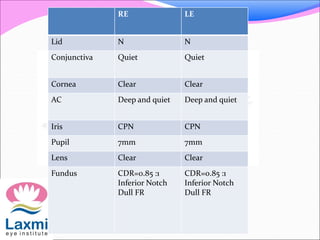
RE LE
Lid N N
Conjunctiva Quiet Quiet
Cornea Clear Clear
AC Deep and quiet Deep and quiet
Iris CPN CPN
Pupil 7mm 7mm
Lens Clear Clear
Fundus CDR=0.85 :1
Inferior Notch
Dull FR
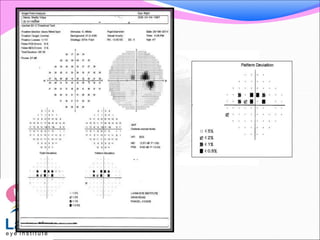
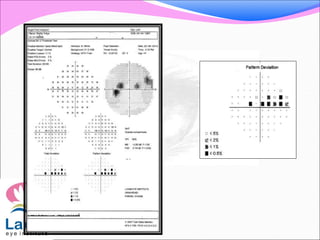
CDR=0.85 :1
Inferior Notch
Dull FR
Investigation
 Perimetry
 Gonioscopy
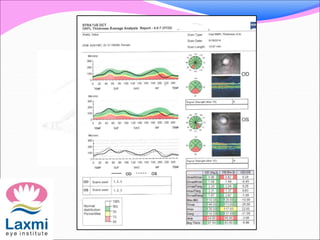
 OCT
 DVT
 Pachymetry - (RE) 509 u
(LE) 505 u
Gonioscopy
 BE- PTM seen in all quadrants
 Hence, wide open angles were observed.
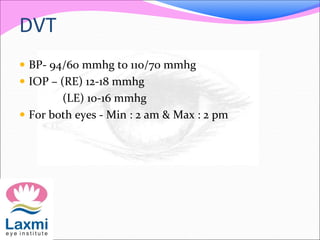
DVT
 BP- 94/60 mmhg to 110/70 mmhg
 IOP – (RE) 12-18 mmhg
(LE) 10-16 mmhg
 For both eyes - Min : 2 am & Max : 2 pm
Management
 Diagnosed as NTG
 Started on e/d Travaprost hs
 She underwent B/L Lateral Rectus recession and MR
resection on 24/06/2014
Epidemiology
 NTG is a disease of the elderly.
 Beaver Dam Eye Study:
 The prevalence of likely NTG increased from 0.2% in the 43–54
years age group to 1.6% in those over 75 years of age
 Below 50 years - 11% to 30% of all glaucoma cases
 More prevalent in the female population
 Positive family history - 5% to 40% *
 Higher prevalence in Japanese population
*1.Miglior M. Low critical tension glaucoma: present problems. Glaucoma 1987;9:77.
*2.Geijssen HC. Studies on normal pressure glaucoma. Amsterdam: Kugler, 1991;1:1.
Pathogenesis
Pressure dependent Pressure independent
groups
Factors involved in the etiology of
glaucomatous optic neuropathy
Pressure dependent factors
 IOP in NTG : A “risk factor” for the development and
progression of the disease
 Impaired optic nerve blood flow or a structurally abnormal
lamina cribrosa, which cannot withstand a normal range
of IOP.
 The effectiveness of intraocular pressure reduction in the
treatment of normal-tension glaucoma was studied by:
Collaborative Normal-Tension Glaucoma Study Group
Collaborative Normal-Tension Glaucoma Study
Group
 PURPOSE: To determine if intraocular pressure plays a
part in the pathogenic process of normal-tension
glaucoma.
 METHODS:
1. One eye of each eligible subject was randomized either to be
untreated as a control or to have intraocular pressure lowered by
30% from baseline.
2. Eyes were randomized if they met criteria for diagnosis of
normal-tension glaucoma and showed documented progression
or high-risk field defects that threatened fixation or the
appearance of a new disk hemorrhage.
RESULTS:
 Sample size: 140 eyes of 140 patients
 Groups : Treatment group : 61
Untreated control: 79
 Patients reaching end points (specifically defined criteria
of glaucomatous optic disk progression or visual field loss)
1. 28 (35%) of the control eyes
2. 7 (12%) of the treated eyes
 Of 34 cataracts developed during the study, 11 (14%)
occurred in the control group and 23 (38%) in the treated
group (P = .0075), with the highest incidence in those
whose treatment included filtration surgery.
CONCLUSIONS
 Intraocular pressure is part of the pathogenic process in
normal-tension glaucoma.
 Therapy that is effective in lowering intraocular pressure
and free of adverse effects would be expected to be
beneficial in patients who are at a risk of progression
Pressure independent factors
 Abnormal blood flow
 Systemic hypotension
 Abnormal blood coagulability,
 Misc.
Systemic Hypotension
Various study show the role of systemic hypotension in
the pathogenesis of the optic neuropathy in NTG :
1. Greater nocturnal decrease and a lower level of diastolic
BP
2. In both NTG and HTG groups, lower BP at night
resulted in pts having progressive disease
3. Overall glaucoma pts, those on antihypertensives who
had a larger nocturnal decrease in systolic pressure
tended to have deteriorating visual fields
Abnormal Blood flow
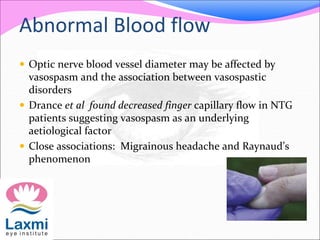
 Optic nerve blood vessel diameter may be affected by
vasospasm and the association between vasospastic
disorders
 Drance et al found decreased finger capillary flow in NTG
patients suggesting vasospasm as an underlying
aetiological factor
 Close associations: Migrainous headache and Raynaud’s
phenomenon
Mean Ocular Perfusion Pressure
 Ocular perfusion pressure (OPP), the relationship
between systemic blood pressure and IOP
 Mean ocular perfusion pressure(MOPP)
MOPP = 2/3 [DBP + 1/3(SBP – DBP)] – IOP
 Risk factor for open-angle glaucoma.
 Because low blood pressure lets OPP drop, and low OPP is
similar to elevated IOP,hence it has consistently and
strongly been associated with OAG.
Misc factors
Other factors include:
 Abnormal blood coaguability
 Endothelin (ET1), a potent and continuous vasoacting
peptide is associated with NTG.
 Obstructive sleep apnea/hypopnea syndrome
(OSAHS)- Prevalence overall : 5.7% & In severe: 7.1%
Systemic Associations
Patients with normal-tension glaucoma have been noted to have
 A higher prevalence of hemodynamic crises
 Hypercoagulability;
 Hypertension/Hypotension
 Increased blood viscosity
 Elevated blood cholesterol and lipids
 Carotid artery disease
 Slowed parapapillary, choroidal, and retinal circulations
 Peripheral vasospasm
 Migraine.
Main Criteria
 A mean IOP off treatment <=21 mm Hg on diurnal testing,
with no single measurement greater than 24 mm Hg
 Open drainage angles on gonioscopy
 Absence of any secondary cause for a glaucomatous optic
neuropathy
 Typical optic disc damage with glaucomatous cupping and
loss of neuroretinal rim
 Visual field defect compatible with the glaucomatous
cupping (disc/field correlation)
 Progression of glaucomatous damage.
Work Up for NTG
 History
 Physical Examination
 Diagnostic Procedures
 DDx
 Manangement
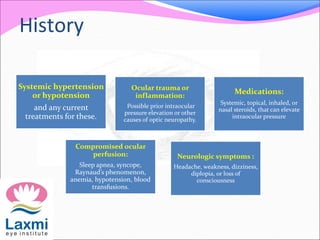
History
Neurologic symptoms :
Headache, weakness, dizziness,
diplopia, or loss of
consciousness
Ocular trauma or
inflammation:
Possible prior intraocular
pressure elevation or other
causes of optic neuropathy.
Medications:
Systemic, topical, inhaled, or
nasal steroids, that can elevate
intraocular pressure
Compromised ocular
perfusion:
Sleep apnea, syncope,
Raynaud’s phenomenon,
anemia, hypotension, blood
transfusions.
Systemic hypertension
or hypotension
and any current
treatments for these.
Examination
 Visual acuity
 Color vision testing (to help differentiate from non-glaucomatous
optic neuropathies)
 IOP measurement also Diurnal and if possible supine
 Pachymetry
 Afferent pupillary response testing
 Gonioscopy
 Complete slit lamp examination of the anterior segment
 Dilated fundus examination with optic nerve head and retinal nerve
fiber layer (RNFL) assessment
Signs
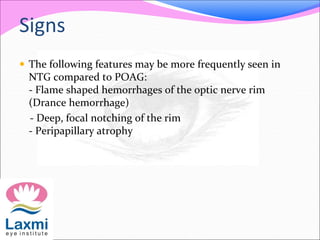
 The following features may be more frequently seen in
NTG compared to POAG:
- Flame shaped hemorrhages of the optic nerve rim
(Drance hemorrhage)
- Deep, focal notching of the rim
- Peripapillary atrophy
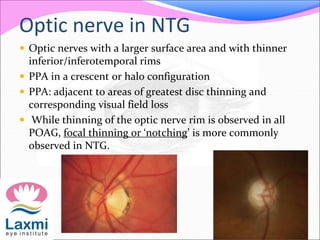
Optic nerve in NTG
 Optic nerves with a larger surface area and with thinner
inferior/inferotemporal rims
 PPA in a crescent or halo configuration
 PPA: adjacent to areas of greatest disc thinning and
corresponding visual field loss
 While thinning of the optic nerve rim is observed in all
POAG, focal thinning or ‘notching’ is more commonly
observed in NTG.
Acquired pits of optic nerve
 Acquired pits of optic nerve [APON] which are
thought to be due to focal loss of neuroretinal rim
tissue and shown as localised excavations of the
lamina cribrosa, are more frequent in NTG.
 More prevalent in lower pressure glaucoma than in
higher pressure glaucoma.
 Inferior part of disc> Superior
Acquired pits of the optic nerve in glaucoma: prevalence and associated visual field loss.
Nduaguba C1, Ugurlu S, Caprioli J.
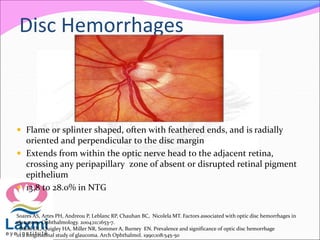
Disc Hemorrhages
 Flame or splinter shaped, often with feathered ends, and is radially
oriented and perpendicular to the disc margin
 Extends from within the optic nerve head to the adjacent retina,
crossing any peripapillary zone of absent or disrupted retinal pigment
epithelium
 13.8 to 28.0% in NTG
Soares AS, Artes PH, Andreou P, Leblanc RP, Chauhan BC, Nicolela MT. Factors associated with optic disc hemorrhages in
glaucoma. Ophthalmology. 2004;111:1653-7.
. Diehl DL, Quigley HA, Miller NR, Sommer A, Burney EN. Prevalence and significance of optic disc hemorrhage
in a longitudinal study of glaucoma. Arch Ophthalmol. 1990;108:545-50
Disc Hemorrhages
 Nerve fiber layer hemorrhage and arteriolar narrowing
were found more frequently
 Optic disk hemorrhages showed significantly higher
percentages of progressed points within the 10-degree
area compared with the group without optic disk
hemorrhage
Comparative optic disc analysis in normal pressure glaucoma, primary open-angle glaucoma, and
ocular hypertension.
Tezel G1, Kass MA, Kolker AE, Wax MB.
Disk hemorrhage is a significantly negative prognostic factor in normal-tension glaucoma.
Ishida K1, Yamamoto T, Sugiyama K, Kitazawa Y
Symptoms
 Asymptomatic until very advanced.
 Subjective scotoma near fixation as these defects can
occur early on in the disease process of NTG
Diagnostic Tests
 Visual Field testing
 Pachymetry
 Optic Disc imaging
 OCT
 24 Hr IOP evaluation
Visual field testing
 Visual field defects may include those common to
POAG including nasal step and arcuate scotoma.
 However, defects noted in NTG tend to be more focal
and occur closer to fixation early in the disease
 Dense paracentral scotomas may characteristically be
noted at initial diagnosis
Role of Corneal Thickness in NTG
 Patients with NTG have a thinner CCT than do patients
with POAG or controls.
 Underestimation of the IOP in patients with POAG who
have thin corneas may lead to a misdiagnosis of NTG,
while overestimation of the IOP in normal subjects who
have thick corneas may lead to a misdiagnosis of OHT.
Corneal Thickness in Ocular Hypertension, Primary Open-angle Glaucoma, and Normal
Tension Glaucoma
René-Pierre Copt, MD; Ravi Thomas, MD; André Mermoud, MD
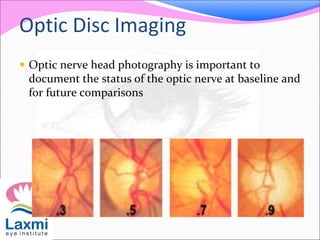
Optic Disc Imaging
 Optic nerve head photography is important to
document the status of the optic nerve at baseline and
for future comparisons
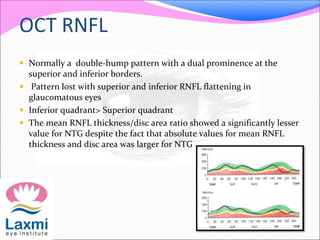
OCT RNFL
 Normally a double-hump pattern with a dual prominence at the
superior and inferior borders.
 Pattern lost with superior and inferior RNFL flattening in
glaucomatous eyes
 Inferior quadrant> Superior quadrant
 The mean RNFL thickness/disc area ratio showed a significantly lesser
value for NTG despite the fact that absolute values for mean RNFL
thickness and disc area was larger for NTG
24 Hr IOP evaluation
 24 Hour IOP evaluation helps to determine the
pressure spikes
 Normal eyes : between 3 and 6 mmHg and the
variation may increase in glaucomatous eyes
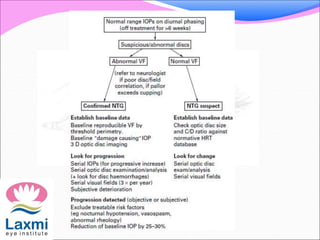
Progression
Signs:
 Increased disc cupping
 Optic nerve disc hemorrahges
 Increased peripapillary atrophy
 Visual field loss
Monitoring:
 Optic nerve head photos
 Visual field testing
 OCT
Neurological Work up
 Marked asymmetry or unilateral optic nerve involvement
 Unexplained visual acuity loss
 Color vision deficits in the absence of visual field deficits
 Visual field defects not corresponding or out of
proportion to optic nerve damage
 Vertically aligned visual field defects
 Atypical neurologic symptoms for glaucoma
 Optic nerve pallor in excess of cupping
 Age less than 50 years
Differential Diagnosis
Glaucomatous etiology
 Primary open angle glaucoma with diurnal fluctuation
between normal and elevated IOP
 Diurnal Variation Test helps in detecting pressure spikes
throughout the day
 Intermittent acute angle closure glaucoma – r/o via
Gonioscopy
 Tonometric underestimation of actual IOP (e.g. thin
central corneas) - Pachymetry
 Resolved corticosteroid-induced, uveitic, or traumatic
glaucoma
 Uveitic glaucoma/glaucomatocyclitic crisis (Posner-
Schlossman)
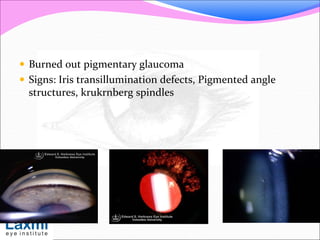
 Burned out pigmentary glaucoma
 Signs: Iris transillumination defects, Pigmented angle
structures, krukrnberg spindles
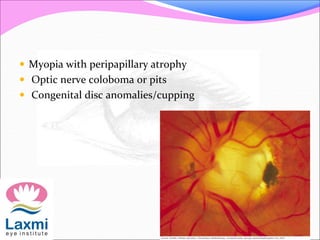
 Myopia with peripapillary atrophy
 Optic nerve coloboma or pits
 Congenital disc anomalies/cupping
Compressive, metabolic, toxic, inflammatory or
infectious optic neuropathy
- Pituitary Adenoma
- Meningioma
- Empty sella syndrome
- Leber’s optic atrophy
- Methanol optic neuropathy
- Optic neuritis
- Syphilis
Vascular injuries
- Giant cell arteritis
- Non-arteritic anterior ischemic optic neuropathy
- Posterior ischemic optic neuropathy
- Central retinal artery occlusion
- Carotid/ophthalmic artery occlusion
Managment
 The main focus for treating NTG is on lowering the
INTRAOCULAR PRESSURE
 It can be achieved by:
1. Medical Therapy
2. Surgery
Medical Rx
 Studies suggest a 25%-30% reduction in IOP
 Topical Prostaglandin analogues are the preferred
drug
 Adjuntive use of Carbonic anhydrase inhibitors and B-
blockers
 Though use of B-blockers should be avoided at night
 Studies show brimonidine showed less visual field
progression than twice daily use of timolol Low-
Pressure Glaucoma Treatment Study.
A randomized trial of brimonidine versus timolol in preserving visual function: results from the
Low-Pressure Glaucoma Treatment Study.
Krupin T1, Liebmann JM, Greenfield DS, Ritch R, Gardiner S; Low-Pressure Glaucoma Study Group.
Surgery
 Filteration surgeries with peri/intra operative use of
anti- metabloites like MMC and 5-FU show enhanced
success of surgery
Non IOP related Rx
 The role of different neuroprotective agents still
remains controversial
 Agents under study include
1. Memantine (NMDA blocker)
2. Unoprostone( Prostanoid and synthetic docasanoid)
3. -Statins (HMG-CoA reductase inhibitor)
4. Ginkgo Biloba
5. Resveratrol
 Calcium channel blockers use remains doubtful in
cases where vasospasm is a factor
Thank You

Normal tension glaucoma

  • 1.
    Normal Tension Glaucoma Presenter:Dr. Niket Gandhi Moderator: Dr.Vijay Shetty
  • 2.
    Introduction  Normal-tension glaucoma(NTG) is a form of open- angle glaucoma characterized by glaucomatous optic neuropathy and corresponding visual field defects in patients with IOP measurements consistently lower than 21 mmHg
  • 3.
    Case Presentation  47Year old, female  Teacher  Mumbai  Visited our institute with primarily for a squint opinion
  • 4.
    History  H/o ofusing glasses  She reported as being a hypotensive patient  Family h/o: Mother – High myopia, ? Glaucoma
  • 5.
    Examination  BCVA: 1. (RE):-6.00/-0.75x30 add +1.50ds 6/6,N6 2. (LE): -5.00/-1.00x130 add +1.50ds 6/6,N6  (LE) Exotropia  On PBCT: 70 pd base in deviation for distance and near with good fusion
  • 6.
    RE LE Lid NN Conjunctiva Quiet Quiet Cornea Clear Clear AC Deep and quiet Deep and quiet Iris CPN CPN Pupil 7mm 7mm Lens Clear Clear Fundus CDR=0.85 :1 Inferior Notch Dull FR CDR=0.85 :1 Inferior Notch Dull FR
  • 7.
    Investigation  Perimetry  Gonioscopy OCT  DVT  Pachymetry - (RE) 509 u (LE) 505 u
  • 8.
    Gonioscopy  BE- PTMseen in all quadrants  Hence, wide open angles were observed.
  • 12.
    DVT  BP- 94/60mmhg to 110/70 mmhg  IOP – (RE) 12-18 mmhg (LE) 10-16 mmhg  For both eyes - Min : 2 am & Max : 2 pm
  • 13.
    Management  Diagnosed asNTG  Started on e/d Travaprost hs  She underwent B/L Lateral Rectus recession and MR resection on 24/06/2014
  • 14.
    Epidemiology  NTG isa disease of the elderly.  Beaver Dam Eye Study:  The prevalence of likely NTG increased from 0.2% in the 43–54 years age group to 1.6% in those over 75 years of age  Below 50 years - 11% to 30% of all glaucoma cases  More prevalent in the female population  Positive family history - 5% to 40% *  Higher prevalence in Japanese population *1.Miglior M. Low critical tension glaucoma: present problems. Glaucoma 1987;9:77. *2.Geijssen HC. Studies on normal pressure glaucoma. Amsterdam: Kugler, 1991;1:1.
  • 15.
    Pathogenesis Pressure dependent Pressureindependent groups Factors involved in the etiology of glaucomatous optic neuropathy
  • 16.
    Pressure dependent factors IOP in NTG : A “risk factor” for the development and progression of the disease  Impaired optic nerve blood flow or a structurally abnormal lamina cribrosa, which cannot withstand a normal range of IOP.  The effectiveness of intraocular pressure reduction in the treatment of normal-tension glaucoma was studied by: Collaborative Normal-Tension Glaucoma Study Group
  • 17.
    Collaborative Normal-Tension GlaucomaStudy Group  PURPOSE: To determine if intraocular pressure plays a part in the pathogenic process of normal-tension glaucoma.  METHODS: 1. One eye of each eligible subject was randomized either to be untreated as a control or to have intraocular pressure lowered by 30% from baseline. 2. Eyes were randomized if they met criteria for diagnosis of normal-tension glaucoma and showed documented progression or high-risk field defects that threatened fixation or the appearance of a new disk hemorrhage.
  • 18.
    RESULTS:  Sample size:140 eyes of 140 patients  Groups : Treatment group : 61 Untreated control: 79  Patients reaching end points (specifically defined criteria of glaucomatous optic disk progression or visual field loss) 1. 28 (35%) of the control eyes 2. 7 (12%) of the treated eyes  Of 34 cataracts developed during the study, 11 (14%) occurred in the control group and 23 (38%) in the treated group (P = .0075), with the highest incidence in those whose treatment included filtration surgery.
  • 19.
    CONCLUSIONS  Intraocular pressureis part of the pathogenic process in normal-tension glaucoma.  Therapy that is effective in lowering intraocular pressure and free of adverse effects would be expected to be beneficial in patients who are at a risk of progression
  • 20.
    Pressure independent factors Abnormal blood flow  Systemic hypotension  Abnormal blood coagulability,  Misc.
  • 21.
    Systemic Hypotension Various studyshow the role of systemic hypotension in the pathogenesis of the optic neuropathy in NTG : 1. Greater nocturnal decrease and a lower level of diastolic BP 2. In both NTG and HTG groups, lower BP at night resulted in pts having progressive disease 3. Overall glaucoma pts, those on antihypertensives who had a larger nocturnal decrease in systolic pressure tended to have deteriorating visual fields
  • 22.
    Abnormal Blood flow Optic nerve blood vessel diameter may be affected by vasospasm and the association between vasospastic disorders  Drance et al found decreased finger capillary flow in NTG patients suggesting vasospasm as an underlying aetiological factor  Close associations: Migrainous headache and Raynaud’s phenomenon
  • 23.
    Mean Ocular PerfusionPressure  Ocular perfusion pressure (OPP), the relationship between systemic blood pressure and IOP  Mean ocular perfusion pressure(MOPP) MOPP = 2/3 [DBP + 1/3(SBP – DBP)] – IOP  Risk factor for open-angle glaucoma.  Because low blood pressure lets OPP drop, and low OPP is similar to elevated IOP,hence it has consistently and strongly been associated with OAG.
  • 24.
    Misc factors Other factorsinclude:  Abnormal blood coaguability  Endothelin (ET1), a potent and continuous vasoacting peptide is associated with NTG.  Obstructive sleep apnea/hypopnea syndrome (OSAHS)- Prevalence overall : 5.7% & In severe: 7.1%
  • 25.
    Systemic Associations Patients withnormal-tension glaucoma have been noted to have  A higher prevalence of hemodynamic crises  Hypercoagulability;  Hypertension/Hypotension  Increased blood viscosity  Elevated blood cholesterol and lipids  Carotid artery disease  Slowed parapapillary, choroidal, and retinal circulations  Peripheral vasospasm  Migraine.
  • 26.
    Main Criteria  Amean IOP off treatment <=21 mm Hg on diurnal testing, with no single measurement greater than 24 mm Hg  Open drainage angles on gonioscopy  Absence of any secondary cause for a glaucomatous optic neuropathy  Typical optic disc damage with glaucomatous cupping and loss of neuroretinal rim  Visual field defect compatible with the glaucomatous cupping (disc/field correlation)  Progression of glaucomatous damage.
  • 27.
    Work Up forNTG  History  Physical Examination  Diagnostic Procedures  DDx  Manangement
  • 28.
    History Neurologic symptoms : Headache,weakness, dizziness, diplopia, or loss of consciousness Ocular trauma or inflammation: Possible prior intraocular pressure elevation or other causes of optic neuropathy. Medications: Systemic, topical, inhaled, or nasal steroids, that can elevate intraocular pressure Compromised ocular perfusion: Sleep apnea, syncope, Raynaud’s phenomenon, anemia, hypotension, blood transfusions. Systemic hypertension or hypotension and any current treatments for these.
  • 29.
    Examination  Visual acuity Color vision testing (to help differentiate from non-glaucomatous optic neuropathies)  IOP measurement also Diurnal and if possible supine  Pachymetry  Afferent pupillary response testing  Gonioscopy  Complete slit lamp examination of the anterior segment  Dilated fundus examination with optic nerve head and retinal nerve fiber layer (RNFL) assessment
  • 30.
    Signs  The followingfeatures may be more frequently seen in NTG compared to POAG: - Flame shaped hemorrhages of the optic nerve rim (Drance hemorrhage) - Deep, focal notching of the rim - Peripapillary atrophy
  • 31.
    Optic nerve inNTG  Optic nerves with a larger surface area and with thinner inferior/inferotemporal rims  PPA in a crescent or halo configuration  PPA: adjacent to areas of greatest disc thinning and corresponding visual field loss  While thinning of the optic nerve rim is observed in all POAG, focal thinning or ‘notching’ is more commonly observed in NTG.
  • 32.
    Acquired pits ofoptic nerve  Acquired pits of optic nerve [APON] which are thought to be due to focal loss of neuroretinal rim tissue and shown as localised excavations of the lamina cribrosa, are more frequent in NTG.  More prevalent in lower pressure glaucoma than in higher pressure glaucoma.  Inferior part of disc> Superior Acquired pits of the optic nerve in glaucoma: prevalence and associated visual field loss. Nduaguba C1, Ugurlu S, Caprioli J.
  • 33.
    Disc Hemorrhages  Flameor splinter shaped, often with feathered ends, and is radially oriented and perpendicular to the disc margin  Extends from within the optic nerve head to the adjacent retina, crossing any peripapillary zone of absent or disrupted retinal pigment epithelium  13.8 to 28.0% in NTG Soares AS, Artes PH, Andreou P, Leblanc RP, Chauhan BC, Nicolela MT. Factors associated with optic disc hemorrhages in glaucoma. Ophthalmology. 2004;111:1653-7. . Diehl DL, Quigley HA, Miller NR, Sommer A, Burney EN. Prevalence and significance of optic disc hemorrhage in a longitudinal study of glaucoma. Arch Ophthalmol. 1990;108:545-50
  • 34.
    Disc Hemorrhages  Nervefiber layer hemorrhage and arteriolar narrowing were found more frequently  Optic disk hemorrhages showed significantly higher percentages of progressed points within the 10-degree area compared with the group without optic disk hemorrhage Comparative optic disc analysis in normal pressure glaucoma, primary open-angle glaucoma, and ocular hypertension. Tezel G1, Kass MA, Kolker AE, Wax MB. Disk hemorrhage is a significantly negative prognostic factor in normal-tension glaucoma. Ishida K1, Yamamoto T, Sugiyama K, Kitazawa Y
  • 35.
    Symptoms  Asymptomatic untilvery advanced.  Subjective scotoma near fixation as these defects can occur early on in the disease process of NTG
  • 36.
    Diagnostic Tests  VisualField testing  Pachymetry  Optic Disc imaging  OCT  24 Hr IOP evaluation
  • 37.
    Visual field testing Visual field defects may include those common to POAG including nasal step and arcuate scotoma.  However, defects noted in NTG tend to be more focal and occur closer to fixation early in the disease  Dense paracentral scotomas may characteristically be noted at initial diagnosis
  • 38.
    Role of CornealThickness in NTG  Patients with NTG have a thinner CCT than do patients with POAG or controls.  Underestimation of the IOP in patients with POAG who have thin corneas may lead to a misdiagnosis of NTG, while overestimation of the IOP in normal subjects who have thick corneas may lead to a misdiagnosis of OHT. Corneal Thickness in Ocular Hypertension, Primary Open-angle Glaucoma, and Normal Tension Glaucoma René-Pierre Copt, MD; Ravi Thomas, MD; André Mermoud, MD
  • 39.
    Optic Disc Imaging Optic nerve head photography is important to document the status of the optic nerve at baseline and for future comparisons
  • 40.
    OCT RNFL  Normallya double-hump pattern with a dual prominence at the superior and inferior borders.  Pattern lost with superior and inferior RNFL flattening in glaucomatous eyes  Inferior quadrant> Superior quadrant  The mean RNFL thickness/disc area ratio showed a significantly lesser value for NTG despite the fact that absolute values for mean RNFL thickness and disc area was larger for NTG
  • 41.
    24 Hr IOPevaluation  24 Hour IOP evaluation helps to determine the pressure spikes  Normal eyes : between 3 and 6 mmHg and the variation may increase in glaucomatous eyes
  • 42.
    Progression Signs:  Increased disccupping  Optic nerve disc hemorrahges  Increased peripapillary atrophy  Visual field loss Monitoring:  Optic nerve head photos  Visual field testing  OCT
  • 43.
    Neurological Work up Marked asymmetry or unilateral optic nerve involvement  Unexplained visual acuity loss  Color vision deficits in the absence of visual field deficits  Visual field defects not corresponding or out of proportion to optic nerve damage  Vertically aligned visual field defects  Atypical neurologic symptoms for glaucoma  Optic nerve pallor in excess of cupping  Age less than 50 years
  • 44.
    Differential Diagnosis Glaucomatous etiology Primary open angle glaucoma with diurnal fluctuation between normal and elevated IOP  Diurnal Variation Test helps in detecting pressure spikes throughout the day
  • 45.
     Intermittent acuteangle closure glaucoma – r/o via Gonioscopy  Tonometric underestimation of actual IOP (e.g. thin central corneas) - Pachymetry  Resolved corticosteroid-induced, uveitic, or traumatic glaucoma  Uveitic glaucoma/glaucomatocyclitic crisis (Posner- Schlossman)
  • 46.
     Burned outpigmentary glaucoma  Signs: Iris transillumination defects, Pigmented angle structures, krukrnberg spindles
  • 47.
     Myopia withperipapillary atrophy  Optic nerve coloboma or pits  Congenital disc anomalies/cupping
  • 48.
    Compressive, metabolic, toxic,inflammatory or infectious optic neuropathy - Pituitary Adenoma - Meningioma - Empty sella syndrome - Leber’s optic atrophy - Methanol optic neuropathy - Optic neuritis - Syphilis
  • 49.
    Vascular injuries - Giantcell arteritis - Non-arteritic anterior ischemic optic neuropathy - Posterior ischemic optic neuropathy - Central retinal artery occlusion - Carotid/ophthalmic artery occlusion
  • 50.
    Managment  The mainfocus for treating NTG is on lowering the INTRAOCULAR PRESSURE  It can be achieved by: 1. Medical Therapy 2. Surgery
  • 51.
    Medical Rx  Studiessuggest a 25%-30% reduction in IOP  Topical Prostaglandin analogues are the preferred drug  Adjuntive use of Carbonic anhydrase inhibitors and B- blockers  Though use of B-blockers should be avoided at night  Studies show brimonidine showed less visual field progression than twice daily use of timolol Low- Pressure Glaucoma Treatment Study. A randomized trial of brimonidine versus timolol in preserving visual function: results from the Low-Pressure Glaucoma Treatment Study. Krupin T1, Liebmann JM, Greenfield DS, Ritch R, Gardiner S; Low-Pressure Glaucoma Study Group.
  • 52.
    Surgery  Filteration surgerieswith peri/intra operative use of anti- metabloites like MMC and 5-FU show enhanced success of surgery
  • 53.
    Non IOP relatedRx  The role of different neuroprotective agents still remains controversial  Agents under study include 1. Memantine (NMDA blocker) 2. Unoprostone( Prostanoid and synthetic docasanoid) 3. -Statins (HMG-CoA reductase inhibitor) 4. Ginkgo Biloba 5. Resveratrol  Calcium channel blockers use remains doubtful in cases where vasospasm is a factor
  • 55.

Editor's Notes

  • #11 Defect in superior hemifield almost paracentral defects close to fixation was consistent over 2 perimetries
  • #17 enhanced sensitivity to what would otherwise be physiologic IOP, resulting in glaucomatous damage of the optic nerve
  • #24 The perfusion pressure changes during the day, but the tissue blood flow should remain stable, to maintain metabolic activity
  • #25 The relationship between systemic hypertension and hypotension, ocular vascular perfusion pressure, and local regulation of ocular blood flow by vascular tone mediators such as endothelin seem to play a role in maintenance of a constant perfusion of optic nerve tissues. The implication is that whenever the IOP of an individual is high enough to start the disease, the cascade of pathophysiologic events is the same (such as ischemia, interruption of rapid orthograde and retrograde axonal transport, excessive free radicals, triggering of apoptosis, and collapse of support provided by the lamina cribrosa). the ischemia in glaucoma does not result from simple inadequacy of blood flow, but is due to inadequate regulation of blood flow hypothetically with episodes of transient ischemia and re-perfusion injury
  • #27 for example, a previously raised IOP following trauma, a period of steroid administration, or an episode of uveitis
  • #29 A thorough history is important in the evaluation of the glaucoma suspect patient to uncover evidence of the condition, but also to detect other neurologic conditions that may be masquerading as NTG
  • #41 Retinal Nerve Fiber Layer Analysis by OCT a. RNFL is measured in the peripapilary region with circular scans of 3.4 mm diameter centered around the optic nerve head b. Measurements of RNFL thickness are shown in a TSNIT orientation and are compared to age-matched controlled individuals. c. The Green area is the 5th -95th percentile by age, Yellow Area is 1st-5th percentile, and Red Area is below the 1st percentile.