MIVS
(Instrumentation,Technique,Outcome)
Vitrectomy
• Surgery to remove some or all of the vitreous humor from the eye
Anterior vitrectomy
Pars plana vitrectomy
• Kasner (1962)- Open Sky Approach
• Robert Machmer - a 17-gauge VISC (1971),through small opening in pars plana
- “father of modern vitreous surgery”
• Connor O’Malley(1975) – Split function system (conventional) 20-gauge
“bimanual” vitrectomy using 3 ports
• Chen (1996)- self-sealing sutureless sclerotomy for the 20-gauge
• Eugene de Juan (1990)- invent the 25-gauge with transconjunctival sutureless
vitrectomy (TSV)
• Eckardt - a 23-gauge system & Oshima et al – a 27-gauge system
MIVS ( Microincisional Vitrectomy Surgery )
Defined as 23 or 25 gauge surgery using smaller probes & using a
transconjunctival scleral incision
• The 20 G - considered the “gold standard” since 1974
• First complete 23 G - introduced (2005) & judged to be safe & efficient
• The 23 G - combines the benefits of the 25 G & 20 G
• 23 G - potential to become the future “gold standard”
20 G 23 G 25 G
1) Size 0.9 mm 0.7 mm 0.5 mm
2)Need for suture Yes No literature data No
3) Angled instruments Yes No literature data No
4) Instr. Stiffness (grams per 4
mm)
130 g 35 g 14 g
5) Intraocular maneuvers Easy Easy Not Easy
6) Flow rate High High Low
7) Oil injection Easy, all oil viscosities Slow, all oil viscosities Very slow, only 1,000 cS
8) Vitrectomy time Fast Fast Slow
9) Post-op inflammation Yes Poor Poor
10) Post-op astigmatism Yes No No
11) Risk of post-op hypotony No No literature data Low
12) Risk of endophthalmitis Very Low No literature data No literature data
13) Use of fragmetome Yes No No
14) Change of cannula position Cumbersome Easy Easy
15) Vitreous incarceration No Possible Possible
16) Endo-illumination Good Good Good with chandelier
17) Oil removal Fast Slow Very Slow
18) Use of endolaser Yes Yes Yes
19) Vitrector cutting rate Up to 2,500 cpm Up to 2,500 cpm Up to 1,500 cpm
20)Current Indications still better for the treatment
of eyes with
poor visual prognosis,
such as
advanced PVR
and severe trauma
treatment of MH
(ovelapping with 25 G),
complicated retinal
detachment requiring
standard or heavy silicone
oil endotamponade,
for complications
of severe diabetic
retinopathy
And in Topical anaesthesia
treatment of all
macular pathologies e.g
MH,ERM, vitreous opacity,
mild vitreous hemorrhage,
proliferative diabetic
retinopathy
and cataract surgery
complications
• Bausch & Lomb’s Millennium system –
INSTRUMENTATION & FLUIDICS IN MIVS
• Size OF Cutter – Rigidity of 23 G vitrectome below that of a 20-gauge,but is
double that of a 25-gauge
The 23 G entry port – CPU –
closer to the tip of 20G- 100-2500
Instrument than 20- or 25 G 23G- 100-2500
25G- 100-1500
• Currently available cutter are High-speed guillotine-style cutter
• Cutter tip smaller aspiration dia.than infusion cannula
• Cutter Parts – Outer housing (25G) & Inner cannula (30G)
• Drive Mechanism – Three 1) guillotine electric 2) guillotine pneumatic
3) Reciprocating rotatory pneumatic
Electric – CPM , Duty cycle remain constant 50% i.e FR, CPM independant
Pneumatic – CPM , Duty cycle i.e FR, CPM dependant
Dual Pneumatic Cutter – Maintain a constant Duty Cycle(50%) at High CPM
• Microcannula System -
Entry Site Alignment system (ESA) is the key to 25-gauge instrumentation
The ESA system components include: the 25-gauge trocar-mounted
microcannulas, cannula plugs, and infusion line
Microcannula consist of two components – Polyimide cannula & polymer cannula
hub with distal end cut by 30 degree angle
23 G Trocar – solid stiletto with a trapezoidal cutting section & a cutting
diameter of 0.74 mm compared with 0.61 mm for the 25 G
Length of the stiletto is 9.6 mm compared with 9 mm for the 25 G
The trocar is in titanium & not in polyamide as is the case for the 25 G
Subdivided - part out of the sclera, block length 1.5 mm,& a bulbar
part of 4 mm compared with 3.51 mm in the 25-gauge,facilitates a safer oblique
insertion
Some System contain Integrated Scleral Marker
Infusion cannula has an internal diameter of 0.56 mm in 23 G &
0.42 mm in the 25 G
Infusion line has a female Luer-lock connector for precise sliding fit within the
microcannula
• Flow Rate - Diameter – critical changes at Infusion line & Aspiration tip
- Volume FR R4 , pressure differential & 1/Fluid vis. & L of tube
- So infusion pressure from 30-40 in 20 G to 40-50 mmHg in 25 G
( 50-60 during Dynamic state & 35-45 during Static state)
- Also Aspiration Vaccum raises as 150 in 20 G to 250 & 500 mmHg in
23 & 25 G
- Port Based flow limiting advantagenous in High cutter rates & 25 G by
increasing fluidic Stability & reducing cutter induced motion of detached Retina
- Differences between 20,23,25 G Alcon Pneumatic Vitrectome
• Duty Cycle - % of time port open in entire cycle of cutter
• T/C Delta – Diff between Outer Dia of Trochar & Inner Dia of Cannula
- One metric that impacts cannula insertion into Trocar wound, as well
as Cannula performance
- A large T/C delta – risk of tissue caught between Trochar & Cannula
- Too Small T/C delta – Removal of Trochar could be difficult &
inadvertent cannula removal
• Illumination System –
Consist of Five basic building blocks
Efficiency of the illumination system - depends on its coupling efficiency
(measure of the power emitted from the optical source coupled into the fiber)
HID lamps - metal halide and highpressure sodium
Xenon lamps currently in Accurus System from Alcon
Reducing the diameter of a light pipe by 20% theoretically reduces the
amount of illumination by ∼35%
Wide-angle diffuse illumination preferred - visualizing transparent ILM, clear
vitreous, and “glassy” epiretinal membranes
Colorless tissue best seen with white light
Brighter light, xenon & mercury vapor improve visualization with small fibers
Two Categories of Fibres used 1) Glass fibre , 2) Plastic ( PMMA )
ANSI spectrum consideration for light source range from 420-690 nm
Chandelier-style illuminator – To permit 4-port Vitrectomy for Bimanual
Surgery
- Its handsfree & self-retaining design
25 G Chandelinear style endoilluminator compatible with Xenon
1) tip for trans-scleral insertion 2) for insertion through transscleral
microcannula
• In addition to the chandelier systems, another
exciting new advance is a combined fiber optic
light/laser probe made by Synergetics in 25G surgery
Allow to use the laser and light
simultaneously
Synergetics 25 G , 1) Endoilluminator
2) Wide Field monofiber
for Scissors/Forceps
• 25-gauge instruments –
a) Tano asymmetric micro forceps for ERM or ILM
peeling
b) Eckardt micro forceps for epiretinal ERM or
ILM peeling
c) Vertical scissors for membrane dissection
d) Silicone-tipped backflash brush needle
e) Diamond-dusted membrane scraper for
removal of PVD
f) Rice ILM elevator for ILM peeling or posterior
vitreous hyaloid separation
g) Extendable endo-laser probe
• 23-gauge instruments –
23G trocar kit
23G vitrectomy probes –
23G system -Details –
3.5mm 1mm central opening
• Visualization – Wide-angle ( Panoramic ) viewing System
-For removing peripheral VRT in rhegmatogenous RD, PVR, and
giant break cases
-Decreases lateral and axial (depth) resolution so should
not be used for macular surgery or most diabetic traction RD
– Most surgeon prefer (Lander’s) Contact lens for Macular Surgery
– Contact based wide-angle systems, have a greater field of view
than non-contact systems, eliminate corneal asphericity
Wide-angle View reduces need for turning eyeball so benefit flexible tool of 25G
• Cut Rate –
-High CPM safer than Low CPM in Vitrectomy
- Low CPM traction on Vitreous & Retina
- High CPM enable to work close to retina with iatrogenic breaks
- ‘Shaving Mode’ can be used with Low Suction & High CPM
• Port Location –
Port Closer to Tip of shaft permits to cut membranes very close to
retinal surface
Reducing dependence on scissors during Vitrectomy for PVR
20 G 23 G 25 G
Port Distance to end 0.457 mm 0.229 mm 0.356 mm
Port Area (mm2) 0.254 0.183 0.083
• Cannula with Valves – Prevent leakage of fluid when instrument removed
Maintain IOP & avoid Hypotony related complication
Require precaution in injecting Silicon Oil
Valve cannula (DORC). A cap-like silicone membrane is mounted on the head of the microcannula. A slot in the membrane
allows the insertion of instruments
• Sclerotomies – 4.0 mm posterior to the limbus
- Positions : Inferotemporal - Just below 3 or 9 O’clock meridian away from lower
eyelid as possible, For infusion microcannula
Superonasal - on virtual line from the lowest point of the bridge of the
nose extending through the center of the pupil
Superotemporal - virtual line extending from the lowest point of the
supraorbital rim through the center if the pupil
- Methods : Transconjunctival Oblique-parallel Scleral tunnel incision is favoured
Varous Techniques are -
Two-step procedure , Steve Charles Technique ,
Radially Oriented versus Circumferentially Oriented blade entery.
The scleral tunnels can either run parallel to the corneoscleral limbus (a), or in an
anterior–posterior direction (b)
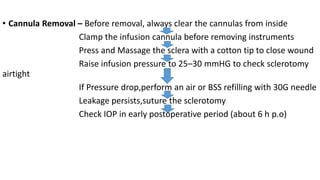
• Cannula Removal – Before removal, always clear the cannulas from inside
Clamp the infusion cannula before removing instruments
Press and Massage the sclera with a cotton tip to close wound
Raise infusion pressure to 25–30 mmHG to check sclerotomy
airtight
If Pressure drop,perform an air or BSS refilling with 30G needle
Leakage persists,suture the sclerotomy
Check IOP in early postoperative period (about 6 h p.o)
• Advantage of MIVS – Reduced the risk of retial breaks related to sclerotomy
- Reative lack of conjunctival Scarring
- 20 G PPV total sclerotomy 3mm Vs 1.5mm in 25 G PPV
- Low patient Discomfort
- Better & sooner Vision recovery time d/t less induced
astigmatism & tear film disturbance
- Less vitreous removal in 25 G may protection for cataract
rate after vitrectomy ( diabetic vitrectomy < Epimacular memb vitrectomy )
- Benefits in “Shaving” off retinal surface & cutting of “Pegs”
- Combo Surgery in Presbyopic patients
• Indication of MIVS –
Posterior hyloid
Peeling in PDR can be
Done by 3 approach
with by bimanual
maneuver as
1)Segmentation
2)Delamination
3)en-Block dissection
1) Macular diseases - — Epiretinal membrane proliferation
— Idiopathic or secondary macular hole
— Macular traction syndrome
— Macular edema associated with
- diabetic retinopathy
- retinal vein occlusion
- uveitis
— Persistent pseudophakic cystoid macular edema
— Submacular haemorrhage
2) Simple vitreous haemorrhage, Persistent Vitreous Floators
3) Vitreous biopsy
4) Primary rhegmatogenous retinal detachment
5) Proliferative diabetic retinopathy with or without tractional
retinal detachment, Nonclearing VH & eye with refractory CSDME (NPDR)
6) Dislocated crystalline lens fragment
Adult Pediatric ( For primary post pole disease)
ERM Peel Zone 1 ROP with low lying RD
Macular Hole Vitreous hemorrhage
Posteriorly Subluxed Lens Cataract extraction
Tractional RD Endophthalmitis
Silicone Oil Injection ERM Peel
Vitreous Hemorrhage Traumatic Paediatric Macular hole
Rhegatogenous RD Persistent fetal vasculature ( wherein PP is well formed)
Uveal/ Vitreous Biopsy Retained lens fragments
IOFB Removal FEVR
Endophthalmitis Paediatric macular pucker ( Combined Hamartoma)
• Advantages of small-gauge vitrectomy over scleral buckle:
Less trauma to the conjunctiva and sclera, no need for conjunctival peritomy
No manipulation of extraocular muscles,therefore less risk of postoperative
strabismus
None of the risks of draining subretinal fluid through the sclera
No effects on refraction
Better control of intraoperative tone
Elimination of vitreous traction and opacity,with less risk of macular pucker
• Disadvantages of small gauge vitrectomy compared to scleral buckle:
Greater risk of cataract
Greater risk of PVR (though not yet demonstrated)
More costly materials
• Complicated Rhegmatogenous Retinal Detachment
23-gauge vitrectomy is better than 25-gauge for complicated RD
1) Advantages of 23-gauge over 20-gauge vitrectomy for complicated RD:
Less trauma to the conjunctiva and sclera
Better stabilization of the detached retina because of the smaller vitrectome mouth
The possibility of shifting the position of the instruments and the infusion cannula,
for an easier approach to the superior sectors
2) Disadvantages of 23-gauge compared to 20-gauge vitrectomy for complicated RD:
Vitrectomy times are longer
Difficult to inject high-viscosity silicone oil, if needed, because of the size of the
cannula
Impossible to use an angled instrument
More costly materials
• Limitation Of MIVS –
Hard dislocated cataractous lens would need a 20 G
fragmatome
Severe Diabetic Retinopathies & extensive traction or
combined RD
Silicon oil injection ,but with use of machine injectors, even
5000 centistokes oil can be injected through fine port
Even with MIVS ,sclerotomies suture in case of silicon oil inj
• Problem With MIVS –
1) Unsutured infusion cannula –
Risk of Cannula Slipping especially in eye with deep orbital socket
Complication caused will depend on Infusate as –
A) With Fluid – Serous Choroidal Detachment
B) With Air – Subretinal air, Suprachoroidal air, Suprachoroidal
Haemorrhage
2) Accidental Withdrawal of Cannula –
May Conjunctiva balloons out d/t fluid seepage from patent
Sclerotomy , requiring Conjunctival incision to locate Sclerotomy site & suturing
3) Problem with Protruding Cannulas –
Cause problem in placing Sclerotomies in Non- standard
locations e.g closer to vertical meridian
in cases as eye with severe trauma, extensive scleral wounds,
Presence of glaucoma drainage valves or filtering blebs
4) Suturing Of Sclerotomy –
Potential reasons for persistent leakage of Sclerotomy may
require suturings are A) Thin Sclera as in High Myopia
B) Sclerotomy manipulated vigorously
C) Aggressive Vitreous base excision
D) Open Conjunctiva as in Combined Vitrectomy & Buckling
E) Eye filled with Silicon Oil to prevent formation of large
conjunctival cysts post-operatively
• Complications of small gauge vitrectomy –
Intraoperative Postoperative
Hypotony Hypotony
Intraocular Dislocation of Cannula Endophthalmitis
Intrument Breakage Retinal Detachment
THANK YOU

Mivs

  • 1.
  • 2.
    Vitrectomy • Surgery toremove some or all of the vitreous humor from the eye Anterior vitrectomy Pars plana vitrectomy • Kasner (1962)- Open Sky Approach • Robert Machmer - a 17-gauge VISC (1971),through small opening in pars plana - “father of modern vitreous surgery” • Connor O’Malley(1975) – Split function system (conventional) 20-gauge “bimanual” vitrectomy using 3 ports
  • 3.
    • Chen (1996)-self-sealing sutureless sclerotomy for the 20-gauge • Eugene de Juan (1990)- invent the 25-gauge with transconjunctival sutureless vitrectomy (TSV) • Eckardt - a 23-gauge system & Oshima et al – a 27-gauge system
  • 4.
    MIVS ( MicroincisionalVitrectomy Surgery ) Defined as 23 or 25 gauge surgery using smaller probes & using a transconjunctival scleral incision • The 20 G - considered the “gold standard” since 1974 • First complete 23 G - introduced (2005) & judged to be safe & efficient • The 23 G - combines the benefits of the 25 G & 20 G • 23 G - potential to become the future “gold standard”
  • 5.
    20 G 23G 25 G 1) Size 0.9 mm 0.7 mm 0.5 mm 2)Need for suture Yes No literature data No 3) Angled instruments Yes No literature data No 4) Instr. Stiffness (grams per 4 mm) 130 g 35 g 14 g 5) Intraocular maneuvers Easy Easy Not Easy 6) Flow rate High High Low 7) Oil injection Easy, all oil viscosities Slow, all oil viscosities Very slow, only 1,000 cS 8) Vitrectomy time Fast Fast Slow 9) Post-op inflammation Yes Poor Poor 10) Post-op astigmatism Yes No No 11) Risk of post-op hypotony No No literature data Low 12) Risk of endophthalmitis Very Low No literature data No literature data
  • 6.
    13) Use offragmetome Yes No No 14) Change of cannula position Cumbersome Easy Easy 15) Vitreous incarceration No Possible Possible 16) Endo-illumination Good Good Good with chandelier 17) Oil removal Fast Slow Very Slow 18) Use of endolaser Yes Yes Yes 19) Vitrector cutting rate Up to 2,500 cpm Up to 2,500 cpm Up to 1,500 cpm 20)Current Indications still better for the treatment of eyes with poor visual prognosis, such as advanced PVR and severe trauma treatment of MH (ovelapping with 25 G), complicated retinal detachment requiring standard or heavy silicone oil endotamponade, for complications of severe diabetic retinopathy And in Topical anaesthesia treatment of all macular pathologies e.g MH,ERM, vitreous opacity, mild vitreous hemorrhage, proliferative diabetic retinopathy and cataract surgery complications
  • 8.
    • Bausch &Lomb’s Millennium system –
  • 9.
    INSTRUMENTATION & FLUIDICSIN MIVS • Size OF Cutter – Rigidity of 23 G vitrectome below that of a 20-gauge,but is double that of a 25-gauge The 23 G entry port – CPU – closer to the tip of 20G- 100-2500 Instrument than 20- or 25 G 23G- 100-2500 25G- 100-1500
  • 10.
    • Currently availablecutter are High-speed guillotine-style cutter • Cutter tip smaller aspiration dia.than infusion cannula • Cutter Parts – Outer housing (25G) & Inner cannula (30G) • Drive Mechanism – Three 1) guillotine electric 2) guillotine pneumatic 3) Reciprocating rotatory pneumatic Electric – CPM , Duty cycle remain constant 50% i.e FR, CPM independant Pneumatic – CPM , Duty cycle i.e FR, CPM dependant Dual Pneumatic Cutter – Maintain a constant Duty Cycle(50%) at High CPM
  • 11.
    • Microcannula System- Entry Site Alignment system (ESA) is the key to 25-gauge instrumentation The ESA system components include: the 25-gauge trocar-mounted microcannulas, cannula plugs, and infusion line Microcannula consist of two components – Polyimide cannula & polymer cannula hub with distal end cut by 30 degree angle
  • 12.
    23 G Trocar– solid stiletto with a trapezoidal cutting section & a cutting diameter of 0.74 mm compared with 0.61 mm for the 25 G Length of the stiletto is 9.6 mm compared with 9 mm for the 25 G The trocar is in titanium & not in polyamide as is the case for the 25 G Subdivided - part out of the sclera, block length 1.5 mm,& a bulbar part of 4 mm compared with 3.51 mm in the 25-gauge,facilitates a safer oblique insertion Some System contain Integrated Scleral Marker
  • 14.
    Infusion cannula hasan internal diameter of 0.56 mm in 23 G & 0.42 mm in the 25 G Infusion line has a female Luer-lock connector for precise sliding fit within the microcannula
  • 15.
    • Flow Rate- Diameter – critical changes at Infusion line & Aspiration tip - Volume FR R4 , pressure differential & 1/Fluid vis. & L of tube - So infusion pressure from 30-40 in 20 G to 40-50 mmHg in 25 G ( 50-60 during Dynamic state & 35-45 during Static state) - Also Aspiration Vaccum raises as 150 in 20 G to 250 & 500 mmHg in 23 & 25 G - Port Based flow limiting advantagenous in High cutter rates & 25 G by increasing fluidic Stability & reducing cutter induced motion of detached Retina
  • 16.
    - Differences between20,23,25 G Alcon Pneumatic Vitrectome
  • 17.
    • Duty Cycle- % of time port open in entire cycle of cutter • T/C Delta – Diff between Outer Dia of Trochar & Inner Dia of Cannula - One metric that impacts cannula insertion into Trocar wound, as well as Cannula performance - A large T/C delta – risk of tissue caught between Trochar & Cannula - Too Small T/C delta – Removal of Trochar could be difficult & inadvertent cannula removal
  • 18.
    • Illumination System– Consist of Five basic building blocks Efficiency of the illumination system - depends on its coupling efficiency (measure of the power emitted from the optical source coupled into the fiber) HID lamps - metal halide and highpressure sodium Xenon lamps currently in Accurus System from Alcon
  • 19.
    Reducing the diameterof a light pipe by 20% theoretically reduces the amount of illumination by ∼35% Wide-angle diffuse illumination preferred - visualizing transparent ILM, clear vitreous, and “glassy” epiretinal membranes Colorless tissue best seen with white light Brighter light, xenon & mercury vapor improve visualization with small fibers Two Categories of Fibres used 1) Glass fibre , 2) Plastic ( PMMA ) ANSI spectrum consideration for light source range from 420-690 nm
  • 20.
    Chandelier-style illuminator –To permit 4-port Vitrectomy for Bimanual Surgery - Its handsfree & self-retaining design 25 G Chandelinear style endoilluminator compatible with Xenon 1) tip for trans-scleral insertion 2) for insertion through transscleral microcannula
  • 21.
    • In additionto the chandelier systems, another exciting new advance is a combined fiber optic light/laser probe made by Synergetics in 25G surgery Allow to use the laser and light simultaneously Synergetics 25 G , 1) Endoilluminator 2) Wide Field monofiber for Scissors/Forceps
  • 22.
    • 25-gauge instruments– a) Tano asymmetric micro forceps for ERM or ILM peeling b) Eckardt micro forceps for epiretinal ERM or ILM peeling c) Vertical scissors for membrane dissection d) Silicone-tipped backflash brush needle e) Diamond-dusted membrane scraper for removal of PVD f) Rice ILM elevator for ILM peeling or posterior vitreous hyaloid separation g) Extendable endo-laser probe
  • 23.
    • 23-gauge instruments– 23G trocar kit
  • 24.
  • 25.
    23G system -Details– 3.5mm 1mm central opening
  • 26.
    • Visualization –Wide-angle ( Panoramic ) viewing System -For removing peripheral VRT in rhegmatogenous RD, PVR, and giant break cases -Decreases lateral and axial (depth) resolution so should not be used for macular surgery or most diabetic traction RD – Most surgeon prefer (Lander’s) Contact lens for Macular Surgery – Contact based wide-angle systems, have a greater field of view than non-contact systems, eliminate corneal asphericity Wide-angle View reduces need for turning eyeball so benefit flexible tool of 25G
  • 27.
    • Cut Rate– -High CPM safer than Low CPM in Vitrectomy - Low CPM traction on Vitreous & Retina - High CPM enable to work close to retina with iatrogenic breaks - ‘Shaving Mode’ can be used with Low Suction & High CPM
  • 28.
    • Port Location– Port Closer to Tip of shaft permits to cut membranes very close to retinal surface Reducing dependence on scissors during Vitrectomy for PVR 20 G 23 G 25 G Port Distance to end 0.457 mm 0.229 mm 0.356 mm Port Area (mm2) 0.254 0.183 0.083
  • 29.
    • Cannula withValves – Prevent leakage of fluid when instrument removed Maintain IOP & avoid Hypotony related complication Require precaution in injecting Silicon Oil Valve cannula (DORC). A cap-like silicone membrane is mounted on the head of the microcannula. A slot in the membrane allows the insertion of instruments
  • 30.
    • Sclerotomies –4.0 mm posterior to the limbus - Positions : Inferotemporal - Just below 3 or 9 O’clock meridian away from lower eyelid as possible, For infusion microcannula Superonasal - on virtual line from the lowest point of the bridge of the nose extending through the center of the pupil Superotemporal - virtual line extending from the lowest point of the supraorbital rim through the center if the pupil - Methods : Transconjunctival Oblique-parallel Scleral tunnel incision is favoured Varous Techniques are - Two-step procedure , Steve Charles Technique , Radially Oriented versus Circumferentially Oriented blade entery.
  • 31.
    The scleral tunnelscan either run parallel to the corneoscleral limbus (a), or in an anterior–posterior direction (b)
  • 33.
    • Cannula Removal– Before removal, always clear the cannulas from inside Clamp the infusion cannula before removing instruments Press and Massage the sclera with a cotton tip to close wound Raise infusion pressure to 25–30 mmHG to check sclerotomy airtight If Pressure drop,perform an air or BSS refilling with 30G needle Leakage persists,suture the sclerotomy Check IOP in early postoperative period (about 6 h p.o)
  • 34.
    • Advantage ofMIVS – Reduced the risk of retial breaks related to sclerotomy - Reative lack of conjunctival Scarring - 20 G PPV total sclerotomy 3mm Vs 1.5mm in 25 G PPV - Low patient Discomfort - Better & sooner Vision recovery time d/t less induced astigmatism & tear film disturbance - Less vitreous removal in 25 G may protection for cataract rate after vitrectomy ( diabetic vitrectomy < Epimacular memb vitrectomy ) - Benefits in “Shaving” off retinal surface & cutting of “Pegs” - Combo Surgery in Presbyopic patients
  • 35.
    • Indication ofMIVS – Posterior hyloid Peeling in PDR can be Done by 3 approach with by bimanual maneuver as 1)Segmentation 2)Delamination 3)en-Block dissection 1) Macular diseases - — Epiretinal membrane proliferation — Idiopathic or secondary macular hole — Macular traction syndrome — Macular edema associated with - diabetic retinopathy - retinal vein occlusion - uveitis — Persistent pseudophakic cystoid macular edema — Submacular haemorrhage 2) Simple vitreous haemorrhage, Persistent Vitreous Floators 3) Vitreous biopsy 4) Primary rhegmatogenous retinal detachment 5) Proliferative diabetic retinopathy with or without tractional retinal detachment, Nonclearing VH & eye with refractory CSDME (NPDR) 6) Dislocated crystalline lens fragment
  • 36.
    Adult Pediatric (For primary post pole disease) ERM Peel Zone 1 ROP with low lying RD Macular Hole Vitreous hemorrhage Posteriorly Subluxed Lens Cataract extraction Tractional RD Endophthalmitis Silicone Oil Injection ERM Peel Vitreous Hemorrhage Traumatic Paediatric Macular hole Rhegatogenous RD Persistent fetal vasculature ( wherein PP is well formed) Uveal/ Vitreous Biopsy Retained lens fragments IOFB Removal FEVR Endophthalmitis Paediatric macular pucker ( Combined Hamartoma)
  • 37.
    • Advantages ofsmall-gauge vitrectomy over scleral buckle: Less trauma to the conjunctiva and sclera, no need for conjunctival peritomy No manipulation of extraocular muscles,therefore less risk of postoperative strabismus None of the risks of draining subretinal fluid through the sclera No effects on refraction Better control of intraoperative tone Elimination of vitreous traction and opacity,with less risk of macular pucker • Disadvantages of small gauge vitrectomy compared to scleral buckle: Greater risk of cataract Greater risk of PVR (though not yet demonstrated) More costly materials
  • 38.
    • Complicated RhegmatogenousRetinal Detachment 23-gauge vitrectomy is better than 25-gauge for complicated RD 1) Advantages of 23-gauge over 20-gauge vitrectomy for complicated RD: Less trauma to the conjunctiva and sclera Better stabilization of the detached retina because of the smaller vitrectome mouth The possibility of shifting the position of the instruments and the infusion cannula, for an easier approach to the superior sectors 2) Disadvantages of 23-gauge compared to 20-gauge vitrectomy for complicated RD: Vitrectomy times are longer Difficult to inject high-viscosity silicone oil, if needed, because of the size of the cannula Impossible to use an angled instrument More costly materials
  • 39.
    • Limitation OfMIVS – Hard dislocated cataractous lens would need a 20 G fragmatome Severe Diabetic Retinopathies & extensive traction or combined RD Silicon oil injection ,but with use of machine injectors, even 5000 centistokes oil can be injected through fine port Even with MIVS ,sclerotomies suture in case of silicon oil inj
  • 40.
    • Problem WithMIVS – 1) Unsutured infusion cannula – Risk of Cannula Slipping especially in eye with deep orbital socket Complication caused will depend on Infusate as – A) With Fluid – Serous Choroidal Detachment B) With Air – Subretinal air, Suprachoroidal air, Suprachoroidal Haemorrhage 2) Accidental Withdrawal of Cannula – May Conjunctiva balloons out d/t fluid seepage from patent Sclerotomy , requiring Conjunctival incision to locate Sclerotomy site & suturing
  • 41.
    3) Problem withProtruding Cannulas – Cause problem in placing Sclerotomies in Non- standard locations e.g closer to vertical meridian in cases as eye with severe trauma, extensive scleral wounds, Presence of glaucoma drainage valves or filtering blebs 4) Suturing Of Sclerotomy – Potential reasons for persistent leakage of Sclerotomy may require suturings are A) Thin Sclera as in High Myopia B) Sclerotomy manipulated vigorously C) Aggressive Vitreous base excision D) Open Conjunctiva as in Combined Vitrectomy & Buckling
  • 42.
    E) Eye filledwith Silicon Oil to prevent formation of large conjunctival cysts post-operatively
  • 43.
    • Complications ofsmall gauge vitrectomy – Intraoperative Postoperative Hypotony Hypotony Intraocular Dislocation of Cannula Endophthalmitis Intrument Breakage Retinal Detachment
  • 44.