ENGINEERING MATHEMATICS-I
MAT 1151
Dr. Shobha M E
Assistant Prof. Snr Scale
Dept of Mathematics, MIT Manipal
Joint Secretary, Sports Council MAHE
Mob:8050238237
Email: shobha.me@manipal.edu
First Semester-4 credits
Second Semester -4 credits
First Semester Chapters:
Matrix Algebra
Linear Algebra
Differential equations and applications.
Numerical Methods
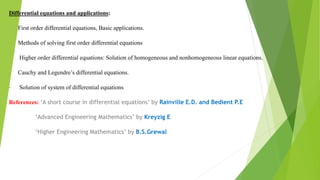
Differential equations and applications:
• First order differential equations, Basic applications.
• Methods of solving first order differential equations
• Higher order differential equations: Solution of homogeneous and nonhomogeneous linear equations.
• Cauchy and Legendre’s differential equations.
• Solution of system of differential equations
References: ‘A short course in differential equations’ by Rainville E.D. and Bedient P.E
‘Advanced Engineering Mathematics’ by Kreyzig E
‘Higher Engineering Mathematics’ by B.S.Grewal
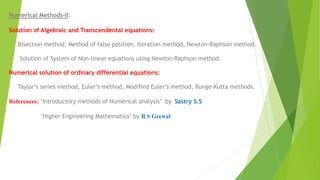
Numerical Methods-II:
Solution of Algebraic and Transcendental equations:
• Bisection method, Method of false position, Iteration method, Newton-Raphson method.
• Solution of System of Non-linear equations using Newton-Raphson method.
Numerical solution of ordinary differential equations:
• Taylor’s series method, Euler’s method, Modified Euler’s method, Runge-Kutta methods.
References: ‘Introductory methods of Numerical analysis’ by Sastry S.S
‘Higher Engineering Mathematics’ by B S Grewal
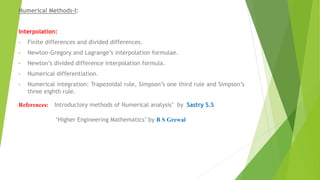
Numerical Methods-I:
Interpolation:
• Finite differences and divided differences.
• Newton-Gregory and Lagrange’s interpolation formulae.
• Newton’s divided difference interpolation formula.
• Numerical differentiation.
• Numerical integration: Trapezoidal rule, Simpson’s one third rule and Simpson’s
three eighth rule.
References: Introductory methods of Numerical analysis’ by Sastry S.S
‘Higher Engineering Mathematics’ by B S Grewal
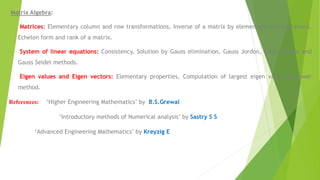
Matrix Algebra:
• Matrices: Elementary column and row transformations, Inverse of a matrix by elementary row operations,
Echelon form and rank of a matrix.
• System of linear equations: Consistency, Solution by Gauss elimination, Gauss Jordon, Gauss Jacobi and
Gauss Seidel methods.
• Eigen values and Eigen vectors: Elementary properties, Computation of largest eigen value by power
method.
References: ‘Higher Engineering Mathematics’ by B.S.Grewal
‘Introductory methods of Numerical analysis’ by Sastry S S
‘Advanced Engineering Mathematics’ by Kreyzig E
LIST OF FORMLAE
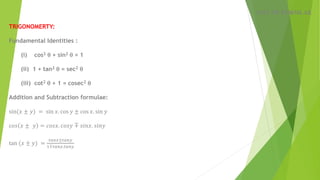
TRIGONOMERTY:
Fundamental Identities :
(i) cos2  + sin2  = 1
(ii) 1 + tan2  = sec2 
(iii) cot2  + 1 = cosec2 
Addition and Subtraction formulae:
sin(𝑥 ± 𝑦) = sin 𝑥. cos 𝑦 ± cos 𝑥. sin 𝑦
c𝑜𝑠 𝑥 ± 𝑦 = 𝑐𝑜𝑠𝑥. 𝑐𝑜𝑠𝑦 ∓ 𝑠𝑖𝑛𝑥. 𝑠𝑖𝑛𝑦
tan (𝑥 ± 𝑦) =
𝑡𝑎𝑛𝑥±𝑡𝑎𝑛𝑦
1∓𝑡𝑎𝑛𝑥.𝑡𝑎𝑛𝑦
Linear Algebra:
• Generalization of vector concept to higher dimensions, Generalized vector operations, Vector spaces and
sub spaces, Linear independence and dependence, Basis.
• Gram- Schmidt process of orthogonalization.
References: ‘Linear Algebra’ by G. Hadley
Transforming product into sum :
sin x. cos y = ½ [sin (x + y) + sin (x – y)] cos x. sin y = ½ [sin (x + y) – sin (x – y)]
cos x. cos y = ½ [cos (x + y) + cos (x – y)] sin x. sin y = ½ [cos (x – y) – cos (x + y)]
Transforming sum into product:
sin 𝐶 + sin 𝐷 = 2 sin
𝐶+𝐷
2
𝑐𝑜𝑠
𝐶−𝐷
2
sin 𝐶 − sin 𝐷 = 2 cos
𝐶+𝐷
2
𝑠𝑖𝑛
𝐶−𝐷
2
cos 𝐶 + cos 𝐷 = 2 cos
𝐶+𝐷
2
𝑐𝑜𝑠
𝐶−𝐷
2
cos 𝐶 − 𝑐𝑜𝑠 𝐷 = −2 sin
𝐶+𝐷
2
𝑠𝑖𝑛
𝐶−𝐷
2
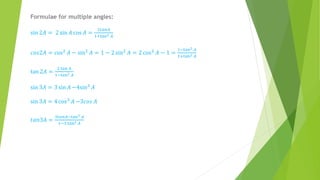
Formulae for multiple angles:
sin 2𝐴 = 2 sin 𝐴 cos 𝐴 =
2𝑡𝑎𝑛𝐴
1+tan2 𝐴
𝑐𝑜𝑠2𝐴 = cos2
𝐴 − sin2
𝐴 = 1 − 2 sin2
𝐴 = 2 cos2
𝐴 − 1 =
1−tan2 𝐴
1+tan2 𝐴
tan 2𝐴 =
2 tan 𝐴
1−tan2 𝐴
sin 3𝐴 = 3 sin 𝐴 −4sin3
𝐴
sin 3𝐴 = 4 cos3
𝐴 −3𝑐𝑜𝑠 𝐴
𝑡𝑎𝑛3𝐴 =
3𝑡𝑎𝑛𝐴−tan3 𝐴
1−3 tan2 𝐴
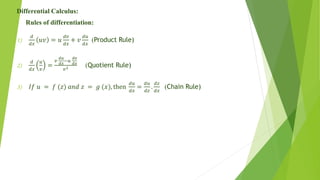
Differential Calculus:
• Rules of differentiation:
1)
𝑑
𝑑𝑥
𝑢𝑣 = 𝑢
𝑑𝑣
𝑑𝑥
+ 𝑣
𝑑𝑢
𝑑𝑥
(Product Rule)
2)
𝑑
𝑑𝑥
𝑢
𝑣
=
𝑣
𝑑𝑢
𝑑𝑥
−𝑢
𝑑𝑣
𝑑𝑥
𝑣2 (Quotient Rule)
3) 𝐼𝑓 𝑢 = 𝑓 (𝑧) 𝑎𝑛𝑑 𝑧 = 𝑔 (𝑥), then
𝑑𝑢
𝑑𝑥
=
𝑑𝑢
𝑑𝑧
.
𝑑𝑧
𝑑𝑥
(Chain Rule)
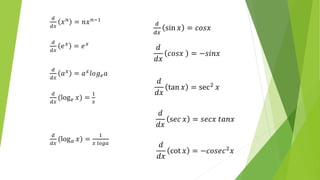
𝑑
𝑑𝑥
𝑥𝑛 = 𝑛𝑥𝑛−1
𝑑
𝑑𝑥
𝑒𝑥
= 𝑒𝑥
𝑑
𝑑𝑥
𝑎𝑥
= 𝑎𝑥
𝑙𝑜𝑔𝑒𝑎
𝑑
𝑑𝑥
(log𝑒 𝑥) =
1
𝑥
𝑑
𝑑𝑥
(log𝑎 𝑥) =
1
𝑥 𝑙𝑜𝑔𝑎
𝑑
𝑑𝑥
sin 𝑥 = 𝑐𝑜𝑠𝑥
𝑑
𝑑𝑥
tan 𝑥 = sec2 𝑥
𝑑
𝑑𝑥
𝑐𝑜𝑠𝑥 = −𝑠𝑖𝑛𝑥
𝑑
𝑑𝑥
cot 𝑥 = −𝑐𝑜𝑠𝑒𝑐2𝑥
𝑑
𝑑𝑥
s𝑒𝑐 𝑥 = 𝑠𝑒𝑐𝑥 𝑡𝑎𝑛𝑥
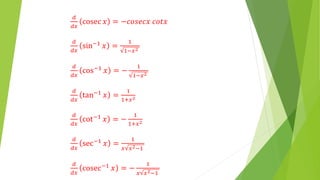
𝑑
𝑑𝑥
cosec 𝑥 = −𝑐𝑜𝑠𝑒𝑐𝑥 𝑐𝑜𝑡𝑥
𝑑
𝑑𝑥
sin−1 𝑥 =
1
1−𝑥2
𝑑
𝑑𝑥
cos−1 𝑥 = −
1
1−𝑥2
𝑑
𝑑𝑥
tan−1 𝑥 =
1
1+𝑥2
𝑑
𝑑𝑥
cot−1 𝑥 = −
1
1+𝑥2
𝑑
𝑑𝑥
sec−1 𝑥 =
1
𝑥 𝑥2−1
𝑑
𝑑𝑥
cosec−1 𝑥 = −
1
𝑥 𝑥2−1
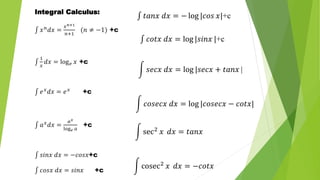
Integral Calculus:
𝑥𝑛𝑑𝑥 =
𝑥𝑛+1
𝑛+1
(𝑛 ≠ −1) +c
1
𝑥
𝑑𝑥 = log𝑒 𝑥 +c
𝑒𝑥𝑑𝑥 = 𝑒𝑥 +c
𝑎𝑥
𝑑𝑥 =
𝑎𝑥
log𝑒 𝑎
+c
𝑠𝑖𝑛𝑥 𝑑𝑥 = −𝑐𝑜𝑠𝑥+c
𝑐𝑜𝑠𝑥 𝑑𝑥 = 𝑠𝑖𝑛𝑥 +c
𝑐𝑜𝑡𝑥 𝑑𝑥 = log |𝑠𝑖𝑛𝑥 |+c
𝑠𝑒𝑐𝑥 𝑑𝑥 = log |𝑠𝑒𝑐𝑥 + 𝑡𝑎𝑛𝑥 |
𝑐𝑜𝑠𝑒𝑐𝑥 𝑑𝑥 = log |𝑐𝑜𝑠𝑒𝑐𝑥 − 𝑐𝑜𝑡𝑥|
sec2
𝑥 𝑑𝑥 = 𝑡𝑎𝑛𝑥
cosec2 𝑥 𝑑𝑥 = −𝑐𝑜𝑡𝑥
𝑡𝑎𝑛𝑥 𝑑𝑥 = − log |𝑐𝑜𝑠 𝑥|+c
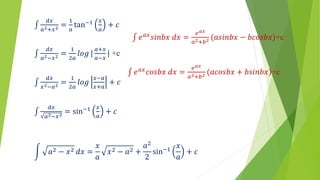
𝑑𝑥
𝑎2+𝑥2 =
1
𝑎
tan−1 𝑥
𝑎
+ 𝑐
𝑑𝑥
𝑎2−𝑥2 =
1
2𝑎
𝑙𝑜𝑔 |
𝑎+𝑥
𝑎−𝑥
| +c
𝑑𝑥
𝑥2−𝑎2 =
1
2𝑎
𝑙𝑜𝑔
𝑥−𝑎
𝑥+𝑎
+ 𝑐
𝑑𝑥
𝑎2−𝑥2
= sin−1 𝑥
𝑎
+ 𝑐
𝑎2 − 𝑥2 𝑑𝑥 =
𝑥
𝑎
𝑥2 − 𝑎2 +
𝑎2
2
sin−1
𝑥
𝑎
+ 𝑐
𝑒𝑎𝑥𝑠𝑖𝑛𝑏𝑥 𝑑𝑥 =
𝑒𝑎𝑥
𝑎2+𝑏2 (𝑎𝑠𝑖𝑛𝑏𝑥 − 𝑏𝑐𝑜𝑠𝑏𝑥)+c
𝑒𝑎𝑥𝑐𝑜𝑠𝑏𝑥 𝑑𝑥 =
𝑒𝑎𝑥
𝑎2+𝑏2 (𝑎𝑐𝑜𝑠𝑏𝑥 + 𝑏𝑠𝑖𝑛𝑏𝑥)+c

Math ppt.pptx ,

  • 1.
    ENGINEERING MATHEMATICS-I MAT 1151 Dr.Shobha M E Assistant Prof. Snr Scale Dept of Mathematics, MIT Manipal Joint Secretary, Sports Council MAHE Mob:8050238237 Email: shobha.me@manipal.edu
  • 2.
    First Semester-4 credits SecondSemester -4 credits First Semester Chapters: Matrix Algebra Linear Algebra Differential equations and applications. Numerical Methods
  • 3.
    Differential equations andapplications: • First order differential equations, Basic applications. • Methods of solving first order differential equations • Higher order differential equations: Solution of homogeneous and nonhomogeneous linear equations. • Cauchy and Legendre’s differential equations. • Solution of system of differential equations References: ‘A short course in differential equations’ by Rainville E.D. and Bedient P.E ‘Advanced Engineering Mathematics’ by Kreyzig E ‘Higher Engineering Mathematics’ by B.S.Grewal
  • 4.
    Numerical Methods-II: Solution ofAlgebraic and Transcendental equations: • Bisection method, Method of false position, Iteration method, Newton-Raphson method. • Solution of System of Non-linear equations using Newton-Raphson method. Numerical solution of ordinary differential equations: • Taylor’s series method, Euler’s method, Modified Euler’s method, Runge-Kutta methods. References: ‘Introductory methods of Numerical analysis’ by Sastry S.S ‘Higher Engineering Mathematics’ by B S Grewal
  • 5.
    Numerical Methods-I: Interpolation: • Finitedifferences and divided differences. • Newton-Gregory and Lagrange’s interpolation formulae. • Newton’s divided difference interpolation formula. • Numerical differentiation. • Numerical integration: Trapezoidal rule, Simpson’s one third rule and Simpson’s three eighth rule. References: Introductory methods of Numerical analysis’ by Sastry S.S ‘Higher Engineering Mathematics’ by B S Grewal
  • 6.
    Matrix Algebra: • Matrices:Elementary column and row transformations, Inverse of a matrix by elementary row operations, Echelon form and rank of a matrix. • System of linear equations: Consistency, Solution by Gauss elimination, Gauss Jordon, Gauss Jacobi and Gauss Seidel methods. • Eigen values and Eigen vectors: Elementary properties, Computation of largest eigen value by power method. References: ‘Higher Engineering Mathematics’ by B.S.Grewal ‘Introductory methods of Numerical analysis’ by Sastry S S ‘Advanced Engineering Mathematics’ by Kreyzig E
  • 7.
    LIST OF FORMLAE TRIGONOMERTY: FundamentalIdentities : (i) cos2  + sin2  = 1 (ii) 1 + tan2  = sec2  (iii) cot2  + 1 = cosec2  Addition and Subtraction formulae: sin(𝑥 ± 𝑦) = sin 𝑥. cos 𝑦 ± cos 𝑥. sin 𝑦 c𝑜𝑠 𝑥 ± 𝑦 = 𝑐𝑜𝑠𝑥. 𝑐𝑜𝑠𝑦 ∓ 𝑠𝑖𝑛𝑥. 𝑠𝑖𝑛𝑦 tan (𝑥 ± 𝑦) = 𝑡𝑎𝑛𝑥±𝑡𝑎𝑛𝑦 1∓𝑡𝑎𝑛𝑥.𝑡𝑎𝑛𝑦
  • 8.
    Linear Algebra: • Generalizationof vector concept to higher dimensions, Generalized vector operations, Vector spaces and sub spaces, Linear independence and dependence, Basis. • Gram- Schmidt process of orthogonalization. References: ‘Linear Algebra’ by G. Hadley
  • 9.
    Transforming product intosum : sin x. cos y = ½ [sin (x + y) + sin (x – y)] cos x. sin y = ½ [sin (x + y) – sin (x – y)] cos x. cos y = ½ [cos (x + y) + cos (x – y)] sin x. sin y = ½ [cos (x – y) – cos (x + y)] Transforming sum into product: sin 𝐶 + sin 𝐷 = 2 sin 𝐶+𝐷 2 𝑐𝑜𝑠 𝐶−𝐷 2 sin 𝐶 − sin 𝐷 = 2 cos 𝐶+𝐷 2 𝑠𝑖𝑛 𝐶−𝐷 2 cos 𝐶 + cos 𝐷 = 2 cos 𝐶+𝐷 2 𝑐𝑜𝑠 𝐶−𝐷 2 cos 𝐶 − 𝑐𝑜𝑠 𝐷 = −2 sin 𝐶+𝐷 2 𝑠𝑖𝑛 𝐶−𝐷 2
  • 10.
    Formulae for multipleangles: sin 2𝐴 = 2 sin 𝐴 cos 𝐴 = 2𝑡𝑎𝑛𝐴 1+tan2 𝐴 𝑐𝑜𝑠2𝐴 = cos2 𝐴 − sin2 𝐴 = 1 − 2 sin2 𝐴 = 2 cos2 𝐴 − 1 = 1−tan2 𝐴 1+tan2 𝐴 tan 2𝐴 = 2 tan 𝐴 1−tan2 𝐴 sin 3𝐴 = 3 sin 𝐴 −4sin3 𝐴 sin 3𝐴 = 4 cos3 𝐴 −3𝑐𝑜𝑠 𝐴 𝑡𝑎𝑛3𝐴 = 3𝑡𝑎𝑛𝐴−tan3 𝐴 1−3 tan2 𝐴
  • 11.
    Differential Calculus: • Rulesof differentiation: 1) 𝑑 𝑑𝑥 𝑢𝑣 = 𝑢 𝑑𝑣 𝑑𝑥 + 𝑣 𝑑𝑢 𝑑𝑥 (Product Rule) 2) 𝑑 𝑑𝑥 𝑢 𝑣 = 𝑣 𝑑𝑢 𝑑𝑥 −𝑢 𝑑𝑣 𝑑𝑥 𝑣2 (Quotient Rule) 3) 𝐼𝑓 𝑢 = 𝑓 (𝑧) 𝑎𝑛𝑑 𝑧 = 𝑔 (𝑥), then 𝑑𝑢 𝑑𝑥 = 𝑑𝑢 𝑑𝑧 . 𝑑𝑧 𝑑𝑥 (Chain Rule)
  • 12.
    𝑑 𝑑𝑥 𝑥𝑛 = 𝑛𝑥𝑛−1 𝑑 𝑑𝑥 𝑒𝑥 =𝑒𝑥 𝑑 𝑑𝑥 𝑎𝑥 = 𝑎𝑥 𝑙𝑜𝑔𝑒𝑎 𝑑 𝑑𝑥 (log𝑒 𝑥) = 1 𝑥 𝑑 𝑑𝑥 (log𝑎 𝑥) = 1 𝑥 𝑙𝑜𝑔𝑎 𝑑 𝑑𝑥 sin 𝑥 = 𝑐𝑜𝑠𝑥 𝑑 𝑑𝑥 tan 𝑥 = sec2 𝑥 𝑑 𝑑𝑥 𝑐𝑜𝑠𝑥 = −𝑠𝑖𝑛𝑥 𝑑 𝑑𝑥 cot 𝑥 = −𝑐𝑜𝑠𝑒𝑐2𝑥 𝑑 𝑑𝑥 s𝑒𝑐 𝑥 = 𝑠𝑒𝑐𝑥 𝑡𝑎𝑛𝑥
  • 13.
    𝑑 𝑑𝑥 cosec 𝑥 =−𝑐𝑜𝑠𝑒𝑐𝑥 𝑐𝑜𝑡𝑥 𝑑 𝑑𝑥 sin−1 𝑥 = 1 1−𝑥2 𝑑 𝑑𝑥 cos−1 𝑥 = − 1 1−𝑥2 𝑑 𝑑𝑥 tan−1 𝑥 = 1 1+𝑥2 𝑑 𝑑𝑥 cot−1 𝑥 = − 1 1+𝑥2 𝑑 𝑑𝑥 sec−1 𝑥 = 1 𝑥 𝑥2−1 𝑑 𝑑𝑥 cosec−1 𝑥 = − 1 𝑥 𝑥2−1
  • 14.
    Integral Calculus: 𝑥𝑛𝑑𝑥 = 𝑥𝑛+1 𝑛+1 (𝑛≠ −1) +c 1 𝑥 𝑑𝑥 = log𝑒 𝑥 +c 𝑒𝑥𝑑𝑥 = 𝑒𝑥 +c 𝑎𝑥 𝑑𝑥 = 𝑎𝑥 log𝑒 𝑎 +c 𝑠𝑖𝑛𝑥 𝑑𝑥 = −𝑐𝑜𝑠𝑥+c 𝑐𝑜𝑠𝑥 𝑑𝑥 = 𝑠𝑖𝑛𝑥 +c 𝑐𝑜𝑡𝑥 𝑑𝑥 = log |𝑠𝑖𝑛𝑥 |+c 𝑠𝑒𝑐𝑥 𝑑𝑥 = log |𝑠𝑒𝑐𝑥 + 𝑡𝑎𝑛𝑥 | 𝑐𝑜𝑠𝑒𝑐𝑥 𝑑𝑥 = log |𝑐𝑜𝑠𝑒𝑐𝑥 − 𝑐𝑜𝑡𝑥| sec2 𝑥 𝑑𝑥 = 𝑡𝑎𝑛𝑥 cosec2 𝑥 𝑑𝑥 = −𝑐𝑜𝑡𝑥 𝑡𝑎𝑛𝑥 𝑑𝑥 = − log |𝑐𝑜𝑠 𝑥|+c
  • 15.
    𝑑𝑥 𝑎2+𝑥2 = 1 𝑎 tan−1 𝑥 𝑎 +𝑐 𝑑𝑥 𝑎2−𝑥2 = 1 2𝑎 𝑙𝑜𝑔 | 𝑎+𝑥 𝑎−𝑥 | +c 𝑑𝑥 𝑥2−𝑎2 = 1 2𝑎 𝑙𝑜𝑔 𝑥−𝑎 𝑥+𝑎 + 𝑐 𝑑𝑥 𝑎2−𝑥2 = sin−1 𝑥 𝑎 + 𝑐 𝑎2 − 𝑥2 𝑑𝑥 = 𝑥 𝑎 𝑥2 − 𝑎2 + 𝑎2 2 sin−1 𝑥 𝑎 + 𝑐 𝑒𝑎𝑥𝑠𝑖𝑛𝑏𝑥 𝑑𝑥 = 𝑒𝑎𝑥 𝑎2+𝑏2 (𝑎𝑠𝑖𝑛𝑏𝑥 − 𝑏𝑐𝑜𝑠𝑏𝑥)+c 𝑒𝑎𝑥𝑐𝑜𝑠𝑏𝑥 𝑑𝑥 = 𝑒𝑎𝑥 𝑎2+𝑏2 (𝑎𝑐𝑜𝑠𝑏𝑥 + 𝑏𝑠𝑖𝑛𝑏𝑥)+c