ISBN:
Copyright Notice:

Lecture Notes on
Differential Equations

Emre Sermutlu
˙
To my wife Nurten and my daughters Ilayda and Alara
vi

CONTENTS
5.2

Differential Operators . . . . . . . . . . . . . . . . . . . . . . . 34

5.3

Homogeneous Equations . . . . . . . . . . . . . . . . . . . . . 35

5.4

Nonhomogeneous Equations . . . . . . . . . . . . . . . . . . . 37

6 Series Solutions

Contents

41

6.1
6.2

1 First Order ODE
1.1 Definitions . . . . . . . .
1.2 Mathematical Modeling
1.3 Separable Equations . .
1.4 Transformations . . . . .

ix

.
.
.
.

.
.
.
.

.
.
.
.

2 Exact Equations
2.1 Exact Equations . . . . . . .
2.2 Integrating Factors . . . . . .
2.3 Linear First Order Equations
2.4 Bernoulli Equation . . . . . .

.
.
.
.

.
.
.
.

.
.
.
.

.
.
.
.

.
.
.
.

.
.
.
.

.
.
.
.

.
.
.
.

.
.
.
.

.
.
.
.

.
.
.
.

.
.
.
.

.
.
.
.

.
.
.
.

.
.
.
.

.
.
.
.

.
.
.
.

.
.
.
.

.
.
.
.

.
.
.
.

.
.
.
.

.
.
.
.

.
.
.
.

.
.
.
.

.
.
.
.

.
.
.
.

.
.
.
.

.
.
.
.

.
.
.
.

.
.
.
.

.
.
.
.

.
.
.
.

.
.
.
.

.
.
.
.

.
.
.
.

1
1
3
3
5

.
.
.
.

9
9
11
13
14

Classification of Points . . . . . . . . . . . . . . . . . . . . . . 43

6.3
Preface

Power Series . . . . . . . . . . . . . . . . . . . . . . . . . . . . 41
Power Series Method . . . . . . . . . . . . . . . . . . . . . . . 43

7 Frobenius’ Method

49

7.1

An Extension of Power Series Method . . . . . . . . . . . . . . 49

7.2

Examples . . . . . . . . . . . . . . . . . . . . . . . . . . . . . 50

8 Laplace Transform I

57

8.1

Definition . . . . . . . . . . . . . . . . . . . . . . . . . . . . . 57

8.2

Properties . . . . . . . . . . . . . . . . . . . . . . . . . . . . . 59

8.3

Initial Value Problems . . . . . . . . . . . . . . . . . . . . . . 61

9 Laplace Transform II

69

.
.
.
.

.
.
.
.

.
.
.
.

.
.
.
.

.
.
.
.

.
.
.
.

.
.
.
.

.
.
.
.

.
.
.
.

.
.
.
.

.
.
.
.

.
.
.
.

.
.
.
.

.
.
.
.

.
.
.
.

.
.
.
.

.
.
.
.

.
.
.
.

17
17
19
20
22

4 Nonhomogeneous Equations
25
4.1 General and Particular Solutions . . . . . . . . . . . . . . . . 25
4.2 Method of Undetermined Coefficients . . . . . . . . . . . . . . 27
4.3 Method of Variation of Parameters . . . . . . . . . . . . . . . 29
5 Higher Order Equations
33
5.1 Linear Equations of Order n . . . . . . . . . . . . . . . . . . . 33
v

Convolution . . . . . . . . . . . . . . . . . . . . . . . . . . . . 69

9.2

Unit Step Function . . . . . . . . . . . . . . . . . . . . . . . . 72

9.3
3 Second Order Equations
3.1 Linear Differential Equations .
3.2 Reduction of Order . . . . . .
3.3 Constant Coefficients . . . . .
3.4 Cauchy-Euler Equation . . . .

9.1

Differentiation of Transforms . . . . . . . . . . . . . . . . . . . 73

9.4

Partial Fractions Expansion . . . . . . . . . . . . . . . . . . . 74

9.5

Applications . . . . . . . . . . . . . . . . . . . . . . . . . . . . 75

10 Fourier Analysis I

81

10.1 Fourier Series . . . . . . . . . . . . . . . . . . . . . . . . . . . 81
10.2 Convergence of Fourier Series . . . . . . . . . . . . . . . . . . 84
10.3 Parseval’s Identity . . . . . . . . . . . . . . . . . . . . . . . . 85
11 Fourier Analysis II

91

11.1 Fourier Cosine and Sine Series . . . . . . . . . . . . . . . . . . 91
11.2 Complex Fourier Series . . . . . . . . . . . . . . . . . . . . . . 94
11.3 Fourier Integral Representation . . . . . . . . . . . . . . . . . 96
CONTENTS

vii

12 Partial Differential Equations
12.1 Introduction . . . . . . . . . . . . . . . . . . . . . . . . . . .
12.2 Modeling a Vibrating String . . . . . . . . . . . . . . . . . .
12.3 Method of Separation of Variables . . . . . . . . . . . . . . .

101
. 101
. 103
. 104

13 Heat Equation
13.1 Modeling Heat Flow . . . . . . . .
13.2 Homogeneous Boundary Conditions
13.3 Nonzero Boundary Conditions . . .
13.4 Two Dimensional Problems . . . .

111
. 111
. 113
. 115
. 117

.
.
.
.

.
.
.
.

.
.
.
.

.
.
.
.

.
.
.
.

.
.
.
.

.
.
.
.

.
.
.
.

.
.
.
.

.
.
.
.

.
.
.
.

.
.
.
.

.
.
.
.

.
.
.
.

14 Laplace Equation
121
14.1 Rectangular Coordinates . . . . . . . . . . . . . . . . . . . . . 121
14.2 Polar Coordinates . . . . . . . . . . . . . . . . . . . . . . . . . 126
To the Student

133

References

135

Index

137
Preface
This set of lecture notes for ordinary and partial differential equations grew
out of the course Engineering Mathematics I have taught at Cankaya Univer¸
sity since 1999. It is a one-semester course for second year students. The main
audience for this text, of course, is students. Presentation is user-friendly.
There are more examples and fewer theorems than usual.
The material is based on a solid background in calculus. The student
is assumed to be familiar with algebra, trigonometry, functions and graphs,
series, differentiation, and most importantly, integration techniques of various kinds. It is my (and my students’) sad experience that if you cannot
differentiate and integrate, you cannot solve differential equations. Knowledge of Linear Algebra, except for the determinants of a simple nature, is
not assumed.
There are 14 chapters. Each chapter can be covered in one week. After
a summary of methods and solved exercises, there are a number of end of
chapter exercises with answers. The exercises that take exceptionally longer
times are marked with a star. ( ) Nobody can learn how to solve problems
by watching someone else solve problems. So I advise the students to try
each problem on their own.
I would like to thank all my students who helped me write this book
by the valuable feedback they provided. In particular, special thanks are for
˙
Nuh Co¸kun, Nevrez Imamo˜lu, Nilg¨n Din¸arslan and I¸ıl Lelo˜lu who have
s
g
u
c
s
g
made a very extensive and meticulous check of the whole manuscript.
You may send all kinds of comments, suggestions and error reports to
sermutlu@cankaya.edu.tr.
Assist. Prof. Dr. Emre Sermutlu
ix
2

CHAPTER 1. FIRST ORDER ODE

are partial differential equations. (Partial Differential Equations are usually
much more difficult)
Order: The order of a differential equation is the order of the highest derivative that occurs in the equation.
A first order differential equation contains y , y and x so it is of the form
F (x, y, y ) = 0 or y = f (x, y).
For example, the following differential equations are first order:

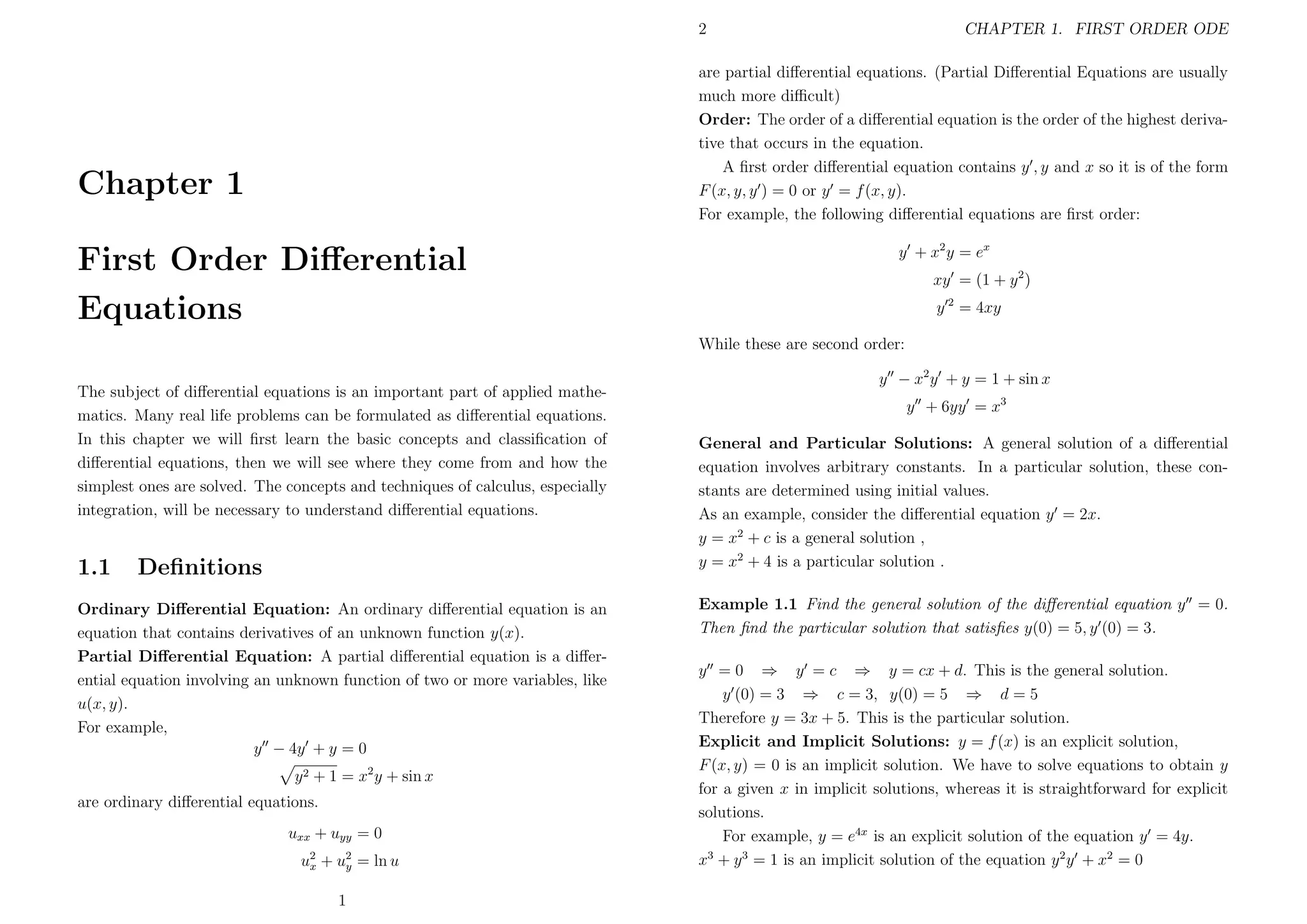
Chapter 1
First Order Differential
Equations

y + x2 y = ex
xy = (1 + y 2 )
y 2 = 4xy
While these are second order:

The subject of differential equations is an important part of applied mathematics. Many real life problems can be formulated as differential equations.
In this chapter we will first learn the basic concepts and classification of
differential equations, then we will see where they come from and how the
simplest ones are solved. The concepts and techniques of calculus, especially
integration, will be necessary to understand differential equations.

1.1

Definitions

Ordinary Differential Equation: An ordinary differential equation is an
equation that contains derivatives of an unknown function y(x).
Partial Differential Equation: A partial differential equation is a differential equation involving an unknown function of two or more variables, like
u(x, y).
For example,
y − 4y + y = 0
y 2 + 1 = x2 y + sin x
are ordinary differential equations.
uxx + uyy = 0
u2 + u2 = ln u
x
y
1

y − x2 y + y = 1 + sin x
y + 6yy = x3
General and Particular Solutions: A general solution of a differential
equation involves arbitrary constants. In a particular solution, these constants are determined using initial values.
As an example, consider the differential equation y = 2x.
y = x2 + c is a general solution ,
y = x2 + 4 is a particular solution .
Example 1.1 Find the general solution of the differential equation y = 0.
Then find the particular solution that satisfies y(0) = 5, y (0) = 3.
y = 0 ⇒ y = c ⇒ y = cx + d. This is the general solution.
y (0) = 3 ⇒ c = 3, y(0) = 5 ⇒ d = 5
Therefore y = 3x + 5. This is the particular solution.
Explicit and Implicit Solutions: y = f (x) is an explicit solution,
F (x, y) = 0 is an implicit solution. We have to solve equations to obtain y
for a given x in implicit solutions, whereas it is straightforward for explicit
solutions.
For example, y = e4x is an explicit solution of the equation y = 4y.
x3 + y 3 = 1 is an implicit solution of the equation y 2 y + x2 = 0
1.2. MATHEMATICAL MODELING

1.2

3

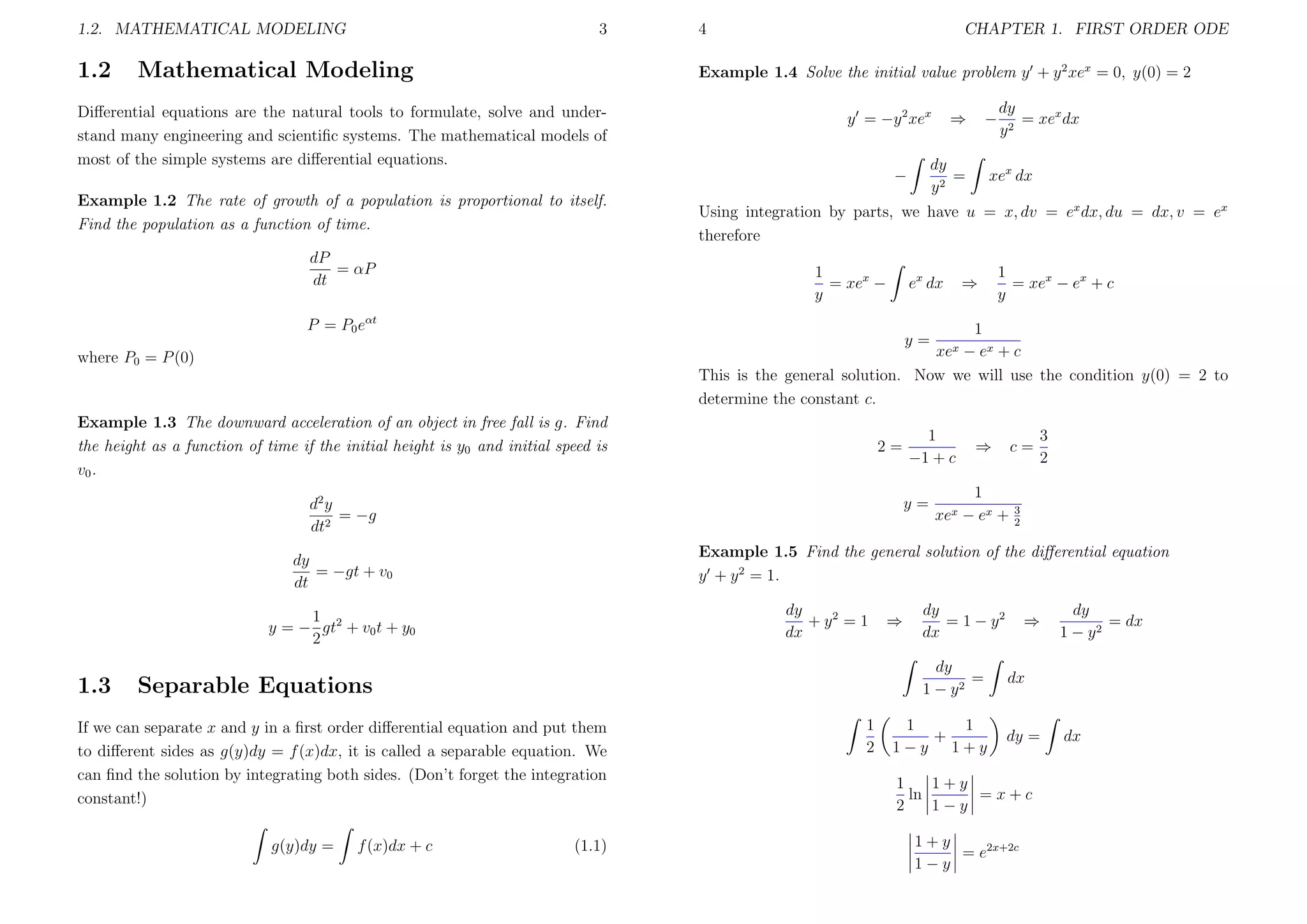
Mathematical Modeling

4

CHAPTER 1. FIRST ORDER ODE

Example 1.4 Solve the initial value problem y + y 2 xex = 0, y(0) = 2

Differential equations are the natural tools to formulate, solve and understand many engineering and scientific systems. The mathematical models of
most of the simple systems are differential equations.

y = −y 2 xex

dP
= αP
dt

ex dx

Example 1.3 The downward acceleration of an object in free fall is g. Find
the height as a function of time if the initial height is y0 and initial speed is
v0 .

2=

d2 y
= −g
dt2

1
= xex − ex + c
y

⇒

c=

1
xex − ex +

3
2

3
2

Example 1.5 Find the general solution of the differential equation
y + y 2 = 1.
dy
+ y2 = 1
dx

1
y = − gt2 + v0 t + y0
2

⇒

dy
= 1 − y2
dx
dy
=
1 − y2

Separable Equations

If we can separate x and y in a first order differential equation and put them
to different sides as g(y)dy = f (x)dx, it is called a separable equation. We
can find the solution by integrating both sides. (Don’t forget the integration
constant!)
f (x)dx + c

⇒

xex

1
−1 + c
y=

dy
= −gt + v0
dt

g(y)dy =

xex dx

1
− ex + c
This is the general solution. Now we will use the condition y(0) = 2 to
determine the constant c.
y=

where P0 = P (0)

1.3

dy
= xex dx
y2

Using integration by parts, we have u = x, dv = ex dx, du = dx, v = ex
therefore
1
= xex −
y

P = P0 eαt

−

dy
=
y2

−
Example 1.2 The rate of growth of a population is proportional to itself.
Find the population as a function of time.

⇒

(1.1)

1
2

1
1
+
1−y 1+y

⇒

dy
= dx
1 − y2

dx

dy =

1
1+y
ln
=x+c
2
1−y
1+y
= e2x+2c
1−y

dx
1.4. TRANSFORMATIONS

5

6

CHAPTER 1. FIRST ORDER ODE

After some algebra, we obtain
y=

u3/2
= 3 ln x + c
3/2

ke2x − 1
ke2x + 1

where k = e2c

u=

Example 1.6 Solve the initial value problem y = x3 e−y , y(1) = 0.
ey dy =
ey =

9
ln x + c1
2

e0 =

Let’s use the substitution u = x + y. Then,

1
+c
4

y = u − x, ⇒

1.4

x4 3
+
4
4

(u + 6)dx = (−u − 3)(du − dx)
3dx = (−u − 3)du

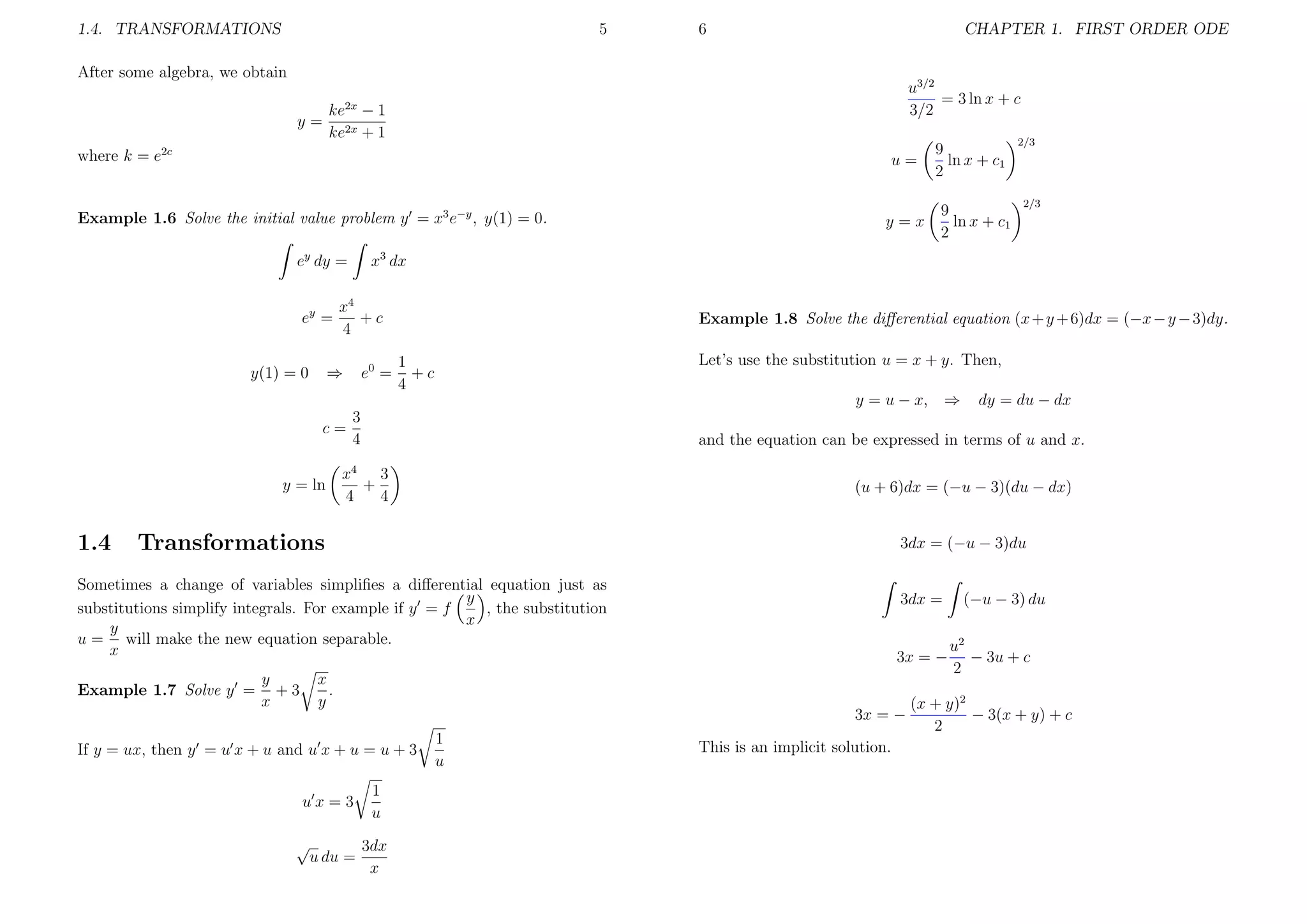
Sometimes a change of variables simplifies a differential equation just as
y
substitutions simplify integrals. For example if y = f
, the substitution
x
y
u = will make the new equation separable.
x
y
+3
x

x
.
y

√

u du =

3dx =

3x = −

3x = −

If y = ux, then y = u x + u and u x + u = u + 3
ux=3

dy = du − dx

and the equation can be expressed in terms of u and x.

Transformations

Example 1.7 Solve y =

2/3

Example 1.8 Solve the differential equation (x + y + 6)dx = (−x − y − 3)dy.

3
c=
4
y = ln

2/3

x3 dx

x4
+c
4

⇒

y(1) = 0

y=x

9
ln x + c1
2

1
u
3dx
x

1
u

This is an implicit solution.

(−u − 3) du
u2
− 3u + c
2

(x + y)2
− 3(x + y) + c
2
EXERCISES

7

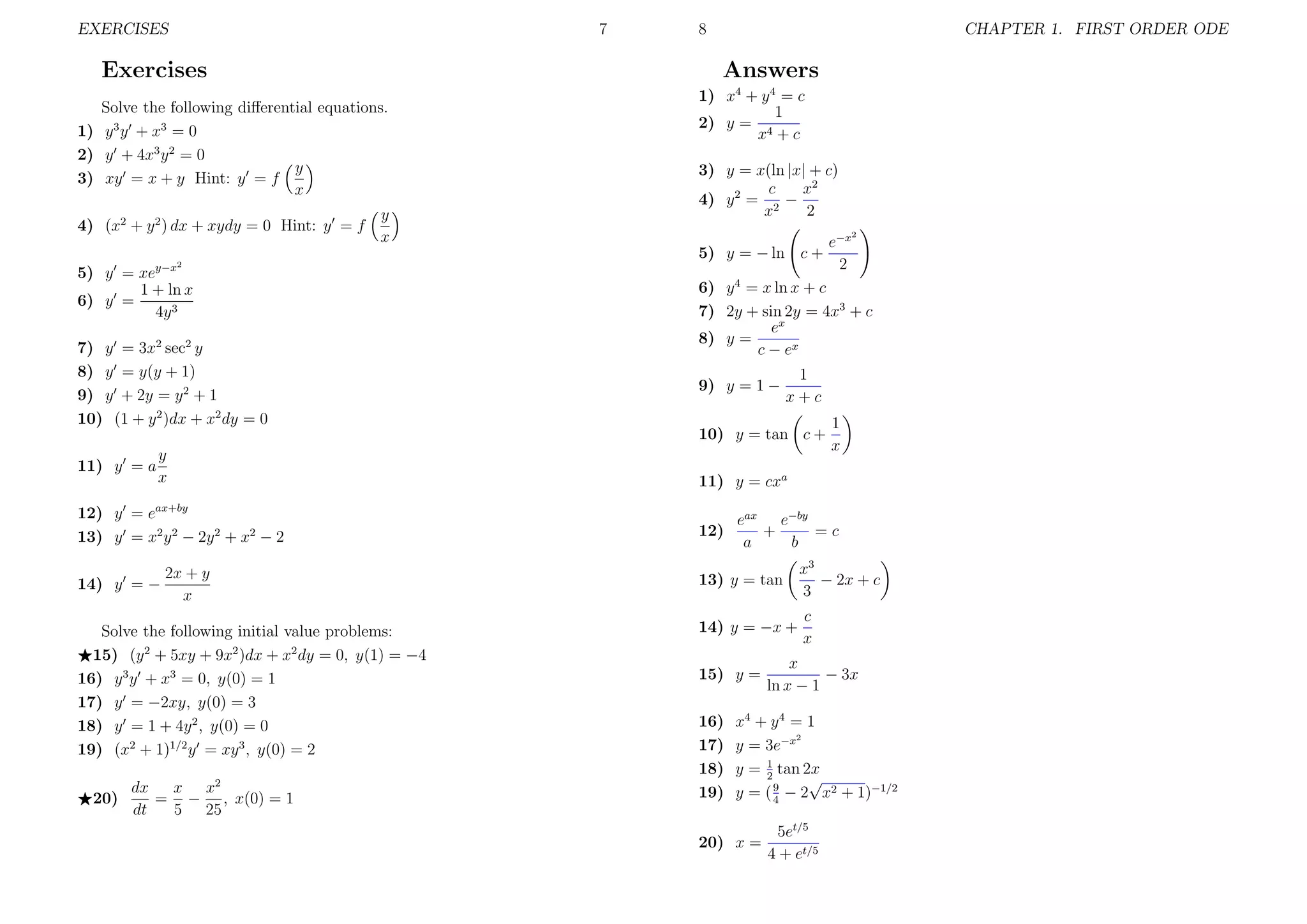
Exercises

CHAPTER 1. FIRST ORDER ODE

Answers

Solve the following differential equations.
1) y 3 y + x3 = 0
2) y + 4x3 y 2 = 0
y
3) xy = x + y Hint: y = f
x
4) (x2 + y 2 ) dx + xydy = 0 Hint: y = f

8

y
x

1) x4 + y 4 = c
1
2) y = 4
x +c
3) y = x(ln |x| + c)
c
x2
4) y 2 = 2 −
x
2
5) y = − ln c +

2

5) y = xey−x
1 + ln x
6) y =
4y 3
7) y = 3x2 sec2 y
8) y = y(y + 1)
9) y + 2y = y 2 + 1
10) (1 + y 2 )dx + x2 dy = 0
y
x

12) y = eax+by
13) y = x2 y 2 − 2y 2 + x2 − 2
14) y = −

2x + y
x

Solve the following initial value problems:
15) (y 2 + 5xy + 9x2 )dx + x2 dy = 0, y(1) = −4
16) y 3 y + x3 = 0, y(0) = 1
17) y = −2xy, y(0) = 3
18) y = 1 + 4y 2 , y(0) = 0
19) (x2 + 1)1/2 y = xy 3 , y(0) = 2
20)

dx
x x2
= − , x(0) = 1
dt
5 25

2

6) y 4 = x ln x + c
7) 2y + sin 2y = 4x3 + c
ex
8) y =
c − ex
9) y = 1 −

1
x+c

10) y = tan c +
11) y = a

e−x
2

1
x

11) y = cxa
12)

eax e−by
+
=c
a
b

13) y = tan

x3
− 2x + c
3

14) y = −x +

c
x

15) y =
16)
17)
18)
19)

x
− 3x
ln x − 1

x4 + y 4 = 1
2
y = 3e−x
1
y = 2 tan 2x
√
y = ( 9 − 2 x2 + 1)−1/2
4

20) x =

5et/5
4 + et/5
10

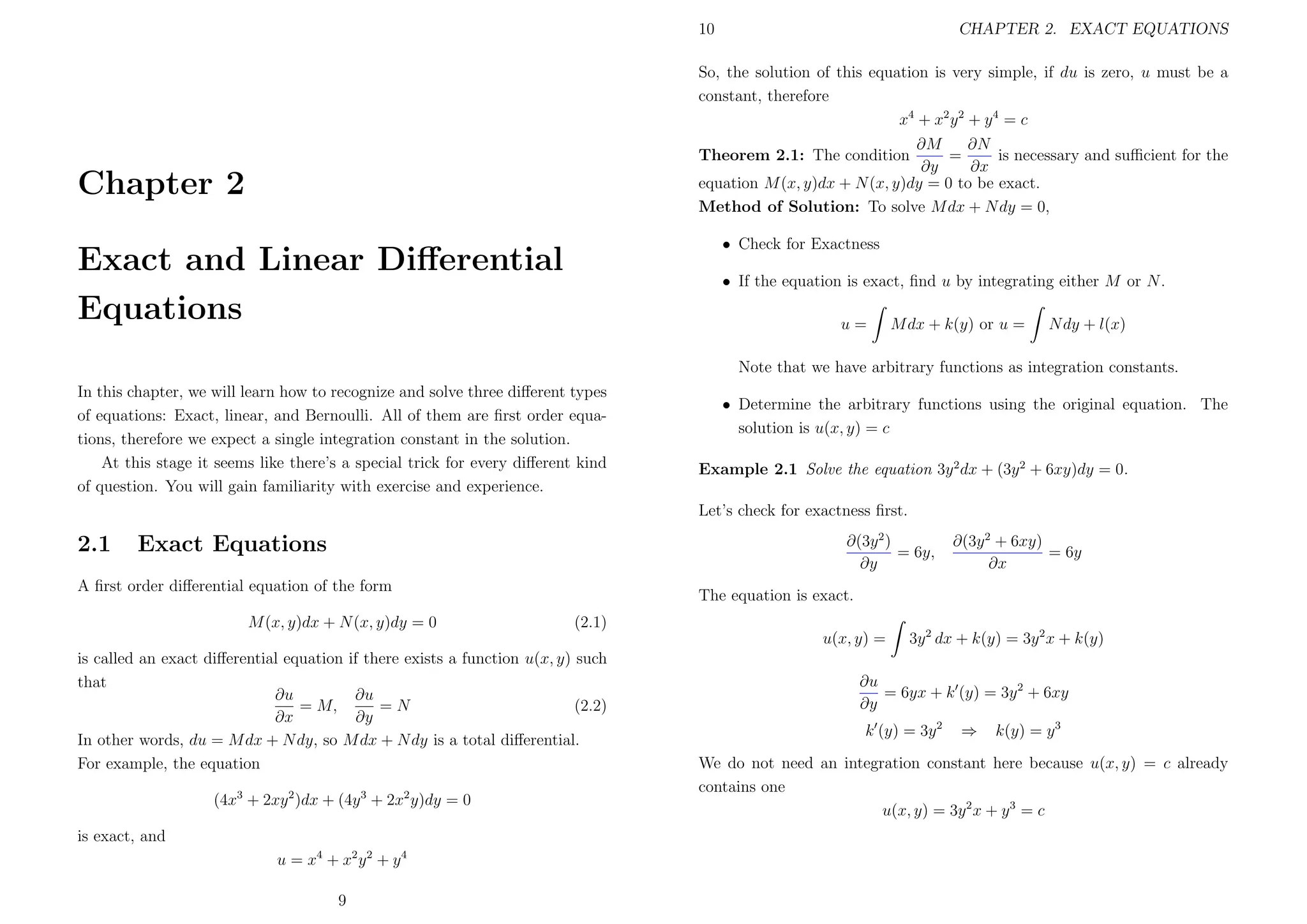
CHAPTER 2. EXACT EQUATIONS

So, the solution of this equation is very simple, if du is zero, u must be a
constant, therefore
x4 + x2 y 2 + y 4 = c
∂N
∂M
=
is necessary and sufficient for the
∂y
∂x
equation M (x, y)dx + N (x, y)dy = 0 to be exact.
Method of Solution: To solve M dx + N dy = 0,
Theorem 2.1: The condition

Chapter 2

• Check for Exactness

Exact and Linear Differential
Equations

• If the equation is exact, find u by integrating either M or N .
u=

M dx + k(y) or u =

N dy + l(x)

Note that we have arbitrary functions as integration constants.
In this chapter, we will learn how to recognize and solve three different types
of equations: Exact, linear, and Bernoulli. All of them are first order equations, therefore we expect a single integration constant in the solution.
At this stage it seems like there’s a special trick for every different kind
of question. You will gain familiarity with exercise and experience.

• Determine the arbitrary functions using the original equation. The
solution is u(x, y) = c
Example 2.1 Solve the equation 3y 2 dx + (3y 2 + 6xy)dy = 0.
Let’s check for exactness first.

2.1

∂(3y 2 )
= 6y,
∂y

Exact Equations

A first order differential equation of the form
M (x, y)dx + N (x, y)dy = 0

The equation is exact.
(2.1)
u(x, y) =

is called an exact differential equation if there exists a function u(x, y) such
that
∂u
∂u
= M,
=N
(2.2)
∂x
∂y
In other words, du = M dx + N dy, so M dx + N dy is a total differential.
For example, the equation
(4x3 + 2xy 2 )dx + (4y 3 + 2x2 y)dy = 0
is exact, and
u = x4 + x2 y 2 + y 4
9

∂(3y 2 + 6xy)
= 6y
∂x

3y 2 dx + k(y) = 3y 2 x + k(y)

∂u
= 6yx + k (y) = 3y 2 + 6xy
∂y
k (y) = 3y 2

⇒

k(y) = y 3

We do not need an integration constant here because u(x, y) = c already
contains one
u(x, y) = 3y 2 x + y 3 = c
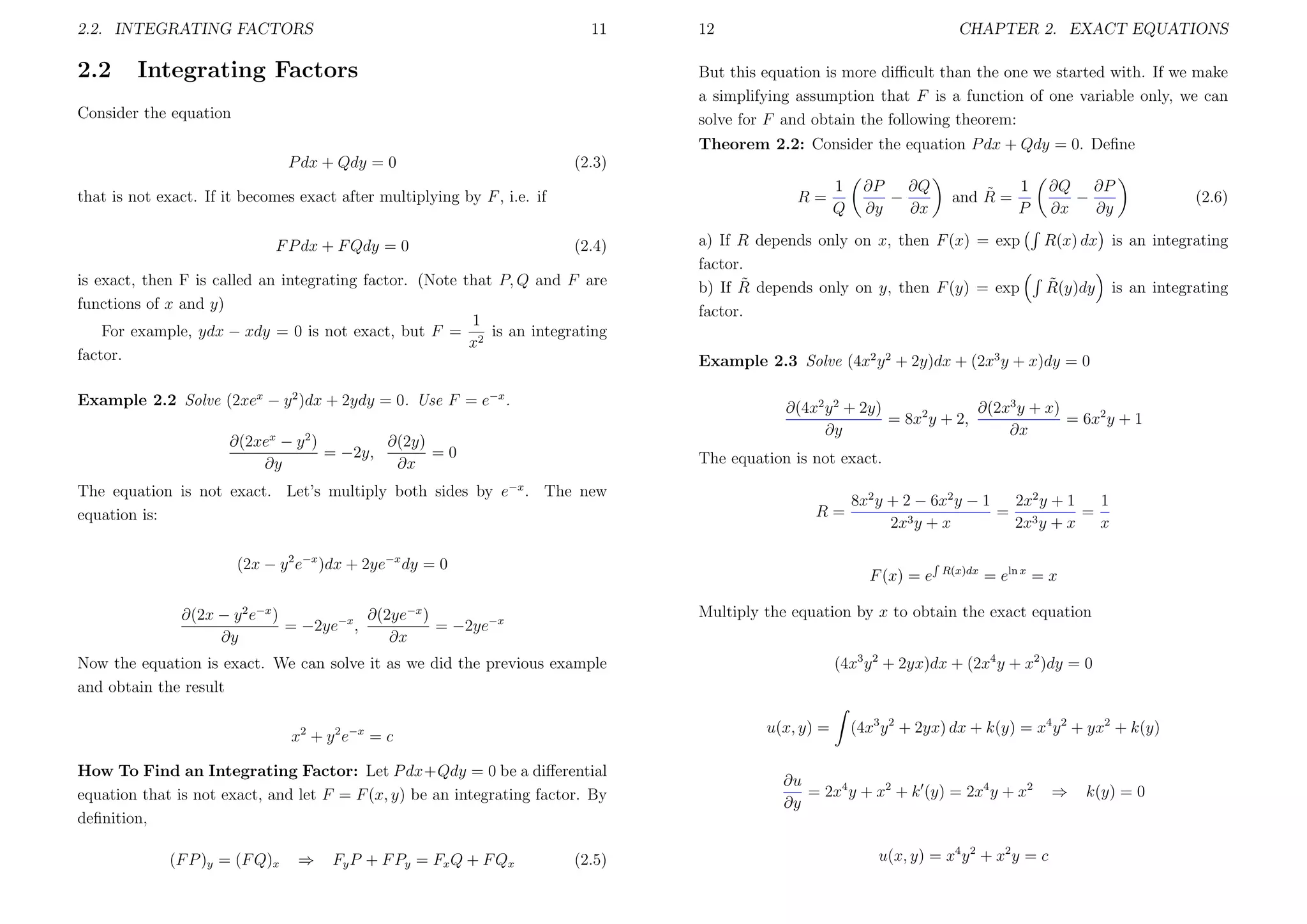
2.2. INTEGRATING FACTORS

2.2

11

Integrating Factors

12

CHAPTER 2. EXACT EQUATIONS

But this equation is more difficult than the one we started with. If we make
a simplifying assumption that F is a function of one variable only, we can
solve for F and obtain the following theorem:

Consider the equation

Theorem 2.2: Consider the equation P dx + Qdy = 0. Define
P dx + Qdy = 0

(2.3)

that is not exact. If it becomes exact after multiplying by F , i.e. if
F P dx + F Qdy = 0

R=
(2.4)

is exact, then F is called an integrating factor. (Note that P, Q and F are
functions of x and y)
1
For example, ydx − xdy = 0 is not exact, but F = 2 is an integrating
x
factor.
Example 2.2 Solve (2xex − y 2 )dx + 2ydy = 0. Use F = e−x .

a) If R depends only on x, then F (x) = exp
factor.
˜
b) If R depends only on y, then F (y) = exp
factor.

∂Q ∂P
−
∂x
∂y

R=

˜
R(y)dy

is an integrating

8x2 y + 2 − 6x2 y − 1
2x2 y + 1
1
= 3
=
3y + x
2x
2x y + x
x
F (x) = e

R(x)dx

= eln x = x

Multiply the equation by x to obtain the exact equation

∂(2x − y 2 e−x )
∂(2ye−x )
= −2ye−x ,
= −2ye−x
∂y
∂x

(4x3 y 2 + 2yx)dx + (2x4 y + x2 )dy = 0

Now the equation is exact. We can solve it as we did the previous example
and obtain the result
u(x, y) =

x2 + y 2 e−x = c
How To Find an Integrating Factor: Let P dx+Qdy = 0 be a differential
equation that is not exact, and let F = F (x, y) be an integrating factor. By
definition,
(2.5)

(2.6)

R(x) dx is an integrating

Example 2.3 Solve (4x2 y 2 + 2y)dx + (2x3 y + x)dy = 0

(2x − y 2 e−x )dx + 2ye−x dy = 0

Fy P + F P y = Fx Q + F Qx

1
˜
and R =
P

The equation is not exact.

The equation is not exact. Let’s multiply both sides by e−x . The new
equation is:

⇒

∂P
∂Q
−
∂y
∂x

∂(2x3 y + x)
∂(4x2 y 2 + 2y)
= 8x2 y + 2,
= 6x2 y + 1
∂y
∂x

∂(2y)
∂(2xex − y 2 )
= −2y,
=0
∂y
∂x

(F P )y = (F Q)x

1
Q

(4x3 y 2 + 2yx) dx + k(y) = x4 y 2 + yx2 + k(y)

∂u
= 2x4 y + x2 + k (y) = 2x4 y + x2
∂y
u(x, y) = x4 y 2 + x2 y = c

⇒

k(y) = 0
2.3. LINEAR FIRST ORDER EQUATIONS

2.3

13

Linear First Order Equations

2.4

If a first order differential equation can be written in the form
y + p(x)y = r(x)

CHAPTER 2. EXACT EQUATIONS

Bernoulli Equation

The equation
y + p(x)y = g(x)y a

(2.7)

it is called a linear differential equation. If r(x) = 0, the equation is homogeneous, otherwise it is nonhomogeneous.
We can express the equation (2.7) as [p(x)y − r(x)]dx + dy = 0. This is
not exact but it has an integrating factor:
R = p(x), F = e

14

p dx

is called Bernoulli equation. It is nonlinear. Nonlinear equations are usually
much more difficult than linear ones, but Bernoulli equation is an exception.
It can be linearized by the substitution
u(x) = [y(x)]1−a

(2.14)

(2.8)
Then, we can solve it as other linear equations.

Method of Solution:
• Given a first order linear equation, express it in the following form:
y + p(x)y = r(x)

p dx

y +e

p dx

py = re

2

p dx

y −

ex
2x
y=
3
3xy 2

p(x) dx to

obtain
e

Example 2.5 Solve the equation

(2.9)

• Multiply both sides by the integrating factor F (x) = exp

(2.10)

Here a = −2 therefore u = y 1−(−2) = y 3 ⇒ u = 3y 2 y
Multiplying both sides of the equation by 3y 2 we obtain
2

• Express the left hand side as a single parenthesis.
e

p dx

y

= re

p dx

3y 2 y − 2xy 3 =
(2.11)

y(x) = e−h

eh r dx + c

(2.12)

2

ex
x

⇒

u − 2xu =

e

−2x dx

= e−x

2

2

Multiplying both sides by e−x , we get
2

p dx.

2

e−x u − 2xe−x u =

Example 2.4 Solve y + 4y = 1
2

The integrating factor is F = e
equation by e4x to obtain

4 dx

(e−x u) =

4x

= e . Multiply both sides of the
2

e4x y + 4e4x y =e4x

e−x u = ln x + c

⇒

⇒

1
y = + ce−4x
4

1
x

1
x

u = (ln x + c)ex

(e4x y) =e4x
e4x
e4x y =
+c
4

ex
x

This equation is linear. Its integrating factor is

• Integrate both sides. Don’t forget the integration constant. The solution is:

where h =

(2.13)

y = (ln x + c)ex

2

1/3

2
EXERCISES

15

16

Exercises

Answers

Solve the following differential equations. (Find an integrating factor if
necessary)
1) (yex + xyex + 1)dx + xex dy = 0
2) (2r + 2 cos θ)dr − 2r sin θdθ = 0
3) (sin xy + xy cos xy)dx + (x2 cos xy)dy = 0
4) 2 cos ydx = sin ydy
5) 5dx − ey−x dy = 0
6) (2xy + 3x2 y 6 ) dx + (4x2 + 9x3 y 5 ) dy = 0
7) (3xey + 2y) dx + (x2 ey + x) dy = 0
1
5
8) y + y =
x
x
9) y +

1
1
y=
x ln x
ln x

c
− 1 e−x
x
r2 + 2r cos θ = c
x sin xy = c
F = e2x , e2x cos y = c
F = ex , 5ex − ey = c
F = y 3 , x 2 y 4 + x3 y 9 = c
F = x, x3 ey + x2 y = c
c
1
y= + 5
5 x

1) y =
2)
3)
4)
5)
6)
7)
8)

9) y =

x+c
ln x

10) y = −1 +

x4

12) y = 4 − 5e− 4

Reduce to linear form and solve the following equations:
2 sin x 1/2
13) y − 4y tan x =
y
cos3 x
x
y
5 ln x 4/5
25
y=
y
15) y +
x
x5

13) y =
14) y =

c − ln cos x
cos2 x
1
2

2

− x + ce−2x

15) y =

y
1
=− 9 3
x
xy

x ln x − x + c
x5

16) y =

14) y + y = −

1
c
+ 4
8
x
x

19) x = y −2
2

1/4

1
3

cosh 3y + c

Hint: x ↔ y
20) y =

20) 2xyy + (x − 1)y 2 = x2 ex

5

17) y = arcsin[c(x − 1)]
1
c
+ 3
18) F = y, x =
2y y

tan y
17) y =
x−1
18) y 2 dx + (3xy − 1)dy = 0
19) y (sinh 3y − 2xy) = y

c
cos x

11) y = x4 cos x + c cos x

10) y − y tan x = tan x
11) y + y tan x = 4x3 cos x
12) y + x3 y = 4x3 , y(0) = −1

16) y +

CHAPTER 2. EXACT EQUATIONS

Hint: z = y 2

cxe−x + 1 xex
2
18

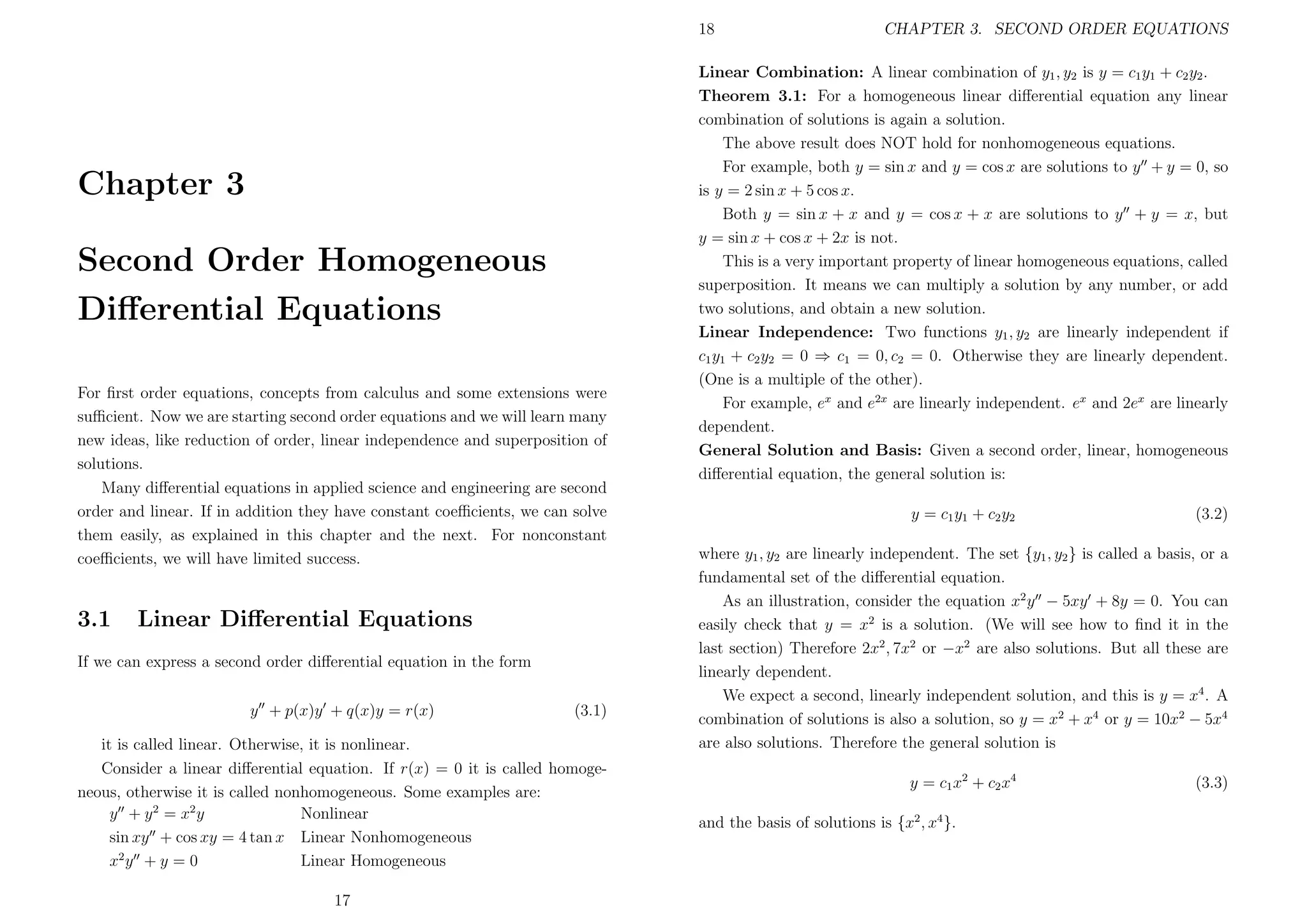
Chapter 3
Second Order Homogeneous
Differential Equations
For first order equations, concepts from calculus and some extensions were
sufficient. Now we are starting second order equations and we will learn many
new ideas, like reduction of order, linear independence and superposition of
solutions.
Many differential equations in applied science and engineering are second
order and linear. If in addition they have constant coefficients, we can solve
them easily, as explained in this chapter and the next. For nonconstant
coefficients, we will have limited success.

3.1

Linear Differential Equations

If we can express a second order differential equation in the form
y + p(x)y + q(x)y = r(x)

(3.1)

it is called linear. Otherwise, it is nonlinear.
Consider a linear differential equation. If r(x) = 0 it is called homogeneous, otherwise it is called nonhomogeneous. Some examples are:
y + y 2 = x2 y
Nonlinear
sin xy + cos xy = 4 tan x Linear Nonhomogeneous
x2 y + y = 0
Linear Homogeneous
17

CHAPTER 3. SECOND ORDER EQUATIONS

Linear Combination: A linear combination of y1 , y2 is y = c1 y1 + c2 y2 .
Theorem 3.1: For a homogeneous linear differential equation any linear
combination of solutions is again a solution.
The above result does NOT hold for nonhomogeneous equations.
For example, both y = sin x and y = cos x are solutions to y + y = 0, so
is y = 2 sin x + 5 cos x.
Both y = sin x + x and y = cos x + x are solutions to y + y = x, but
y = sin x + cos x + 2x is not.
This is a very important property of linear homogeneous equations, called
superposition. It means we can multiply a solution by any number, or add
two solutions, and obtain a new solution.
Linear Independence: Two functions y1 , y2 are linearly independent if
c1 y1 + c2 y2 = 0 ⇒ c1 = 0, c2 = 0. Otherwise they are linearly dependent.
(One is a multiple of the other).
For example, ex and e2x are linearly independent. ex and 2ex are linearly
dependent.
General Solution and Basis: Given a second order, linear, homogeneous
differential equation, the general solution is:
y = c1 y1 + c2 y2

(3.2)

where y1 , y2 are linearly independent. The set {y1 , y2 } is called a basis, or a
fundamental set of the differential equation.
As an illustration, consider the equation x2 y − 5xy + 8y = 0. You can
easily check that y = x2 is a solution. (We will see how to find it in the
last section) Therefore 2x2 , 7x2 or −x2 are also solutions. But all these are
linearly dependent.
We expect a second, linearly independent solution, and this is y = x4 . A
combination of solutions is also a solution, so y = x2 + x4 or y = 10x2 − 5x4
are also solutions. Therefore the general solution is
y = c1 x 2 + c2 x 4
and the basis of solutions is {x2 , x4 }.

(3.3)
3.2. REDUCTION OF ORDER

3.2

19

Reduction of Order

3.3

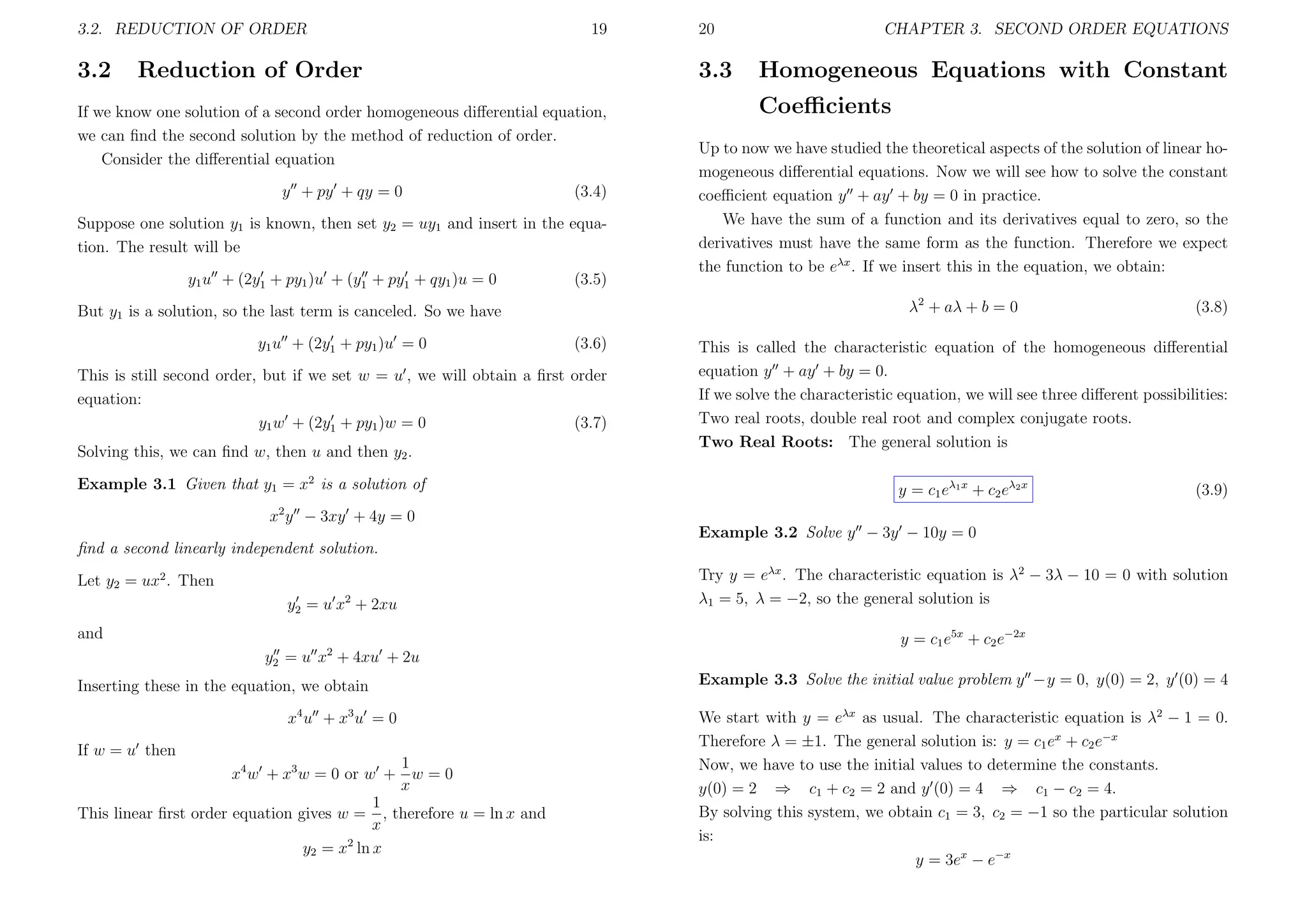
If we know one solution of a second order homogeneous differential equation,
we can find the second solution by the method of reduction of order.
Consider the differential equation
y + py + qy = 0

(3.4)

Suppose one solution y1 is known, then set y2 = uy1 and insert in the equation. The result will be
y1 u + (2y1 + py1 )u + (y1 + py1 + qy1 )u = 0

(3.5)

(3.6)

This is still second order, but if we set w = u , we will obtain a first order
equation:
y1 w + (2y1 + py1 )w = 0
(3.7)
Solving this, we can find w, then u and then y2 .
Example 3.1 Given that y1 = x2 is a solution of

CHAPTER 3. SECOND ORDER EQUATIONS

Homogeneous Equations with Constant
Coefficients

Up to now we have studied the theoretical aspects of the solution of linear homogeneous differential equations. Now we will see how to solve the constant
coefficient equation y + ay + by = 0 in practice.
We have the sum of a function and its derivatives equal to zero, so the
derivatives must have the same form as the function. Therefore we expect
the function to be eλx . If we insert this in the equation, we obtain:
λ2 + aλ + b = 0

But y1 is a solution, so the last term is canceled. So we have
y1 u + (2y1 + py1 )u = 0

20

(3.8)

This is called the characteristic equation of the homogeneous differential
equation y + ay + by = 0.
If we solve the characteristic equation, we will see three different possibilities:
Two real roots, double real root and complex conjugate roots.
Two Real Roots: The general solution is
y = c1 eλ1 x + c2 eλ2 x

(3.9)

2

x y − 3xy + 4y = 0
Example 3.2 Solve y − 3y − 10y = 0
find a second linearly independent solution.
Let y2 = ux2 . Then
y2 = u x2 + 2xu
and
2

Try y = eλx . The characteristic equation is λ2 − 3λ − 10 = 0 with solution
λ1 = 5, λ = −2, so the general solution is
y = c1 e5x + c2 e−2x

y2 = u x + 4xu + 2u
Inserting these in the equation, we obtain
x4 u + x3 u = 0
If w = u then

1
x4 w + x3 w = 0 or w + w = 0
x
1
This linear first order equation gives w = , therefore u = ln x and
x
2
y2 = x ln x

Example 3.3 Solve the initial value problem y −y = 0, y(0) = 2, y (0) = 4
We start with y = eλx as usual. The characteristic equation is λ2 − 1 = 0.
Therefore λ = ±1. The general solution is: y = c1 ex + c2 e−x
Now, we have to use the initial values to determine the constants.
y(0) = 2 ⇒ c1 + c2 = 2 and y (0) = 4 ⇒ c1 − c2 = 4.
By solving this system, we obtain c1 = 3, c2 = −1 so the particular solution
is:
y = 3ex − e−x
3.3. CONSTANT COEFFICIENTS

21

Double Real Root: One solution is eλx but we know that a second order
equation must have two independent solutions. Let’s use the method of
reduction of order to find the second solution.
y − 2ay + a2 y = 0

⇒

y1 = eax

(3.10)

22

CHAPTER 3. SECOND ORDER EQUATIONS

3.4

Cauchy-Euler Equation

The equation x2 y + axy + by = 0 is called the Cauchy-Euler equation. By
inspection, we can easily see that the solution must be a power of x. Let’s
substitute y = xr in the equation and try to determine r. We will obtain

Let’s insert y2 = ueax in the equation.

r(r − 1)xr + arxr + bxr = 0

ax

ax

e u + (2a − 2a)e u = 0
Obviously, u = 0 therefore u = c1 + c2 x. The general solution is
y = c1 eλx + c2 xeλx

(3.12)

Example 3.4 Solve y + 2y + y = 0
λx

r2 + (a − 1)r + b = 0

(3.11)

(3.17)
(3.18)

This is called the auxiliary equation. Once again, we have three different
cases according to the types of roots. The general solution is given as follows:
• Two real roots

2

y = e . The characteristic equation is λ + 2λ + 1 = 0. Its solution is the
double root λ = −1, therefore the general solution is
y = c1 e−x + c2 xe−x

(3.13)

This can be proved using Taylor series expansions.
If the solution of the characteristic equation is
λ1 = α + iβ, λ2 = α − iβ

y = c1 e

(cos βx + i sin βx) + c2 e

αx

(cos βx − i sin βx)

(3.14)

(3.15)

By choosing new constants A, B, we can express this as
y=e

αx

(A cos βx + B sin βx)

y = c1 xr + c2 xr ln x

(3.20)

• Complex conjugate roots where r1 , r2 = r ± si
y = xr [c1 cos(s ln x) + c2 sin(s ln x)]

then the general solution of the differential equation will be
αx

(3.19)

• Double real root

Complex Conjugate Roots: We need the complex exponentials for this
case. Euler’s formula is
eix = cos x + i sin x

y = c1 xr1 + c2 xr2

(3.21)

Example 3.6 Solve x2 y + 2xy − 6y = 0
Insert y = xr . Auxiliary equation is r2 + r − 6 = 0. The roots are
r = 2, r = −3 therefore
y = c1 x2 + c2 x−3

(3.16)

Example 3.5 Solve y − 4y + 29y = 0.

Example 3.7 Solve x2 y − 9xy + 25y = 0

y = eλx . The characteristic equation is λ2 −4λ+29 = 0. Therefore λ = 2±5i.
The general solution is

Insert y = xr . Auxiliary equation is r2 − 10r + 25 = 0. Auxiliary equation
has the double root r = 5 therefore the general solution is

y = e2x (A cos 5x + B sin 5x)

y = c1 x5 + c2 x5 ln x
EXERCISES

23

24

Exercises

CHAPTER 3. SECOND ORDER EQUATIONS

Answers
1)
2)
3)
4)
5)

Are the following sets linearly independent?
1) {x4 , x8 }
2) {sin x, sin2 x}
3) {ln(x5 ), ln x}
Use reduction of order to find a second linearly independent solution:
4) x2 (ln x − 1) y − xy + y = 0,
y1 = x
1
5) x2 ln x y + (2x ln x − x)y − y = 0,
y1 =
x
6) y + 3 tan x y + (3 tan2 x + 1)y = 0,
y1 = cos x

Yes
Yes
No
y2 = ln x
y2 = ln x − 1

6) y2 = sin x cos x
7) y = (1 + x)e−x
1

8) y = c1 e−2x + c2 e− 2 x
Solve the following equations:
7) y + 2y + y = 0, y(0) = 1, y (0) = 0

9) y = e8x

5
8) y + y + y = 0
2

10) y = c1 e−12x + c2 xe−12x

9) y − 64y = 0, y(0) = 1,
10) y + 24y + 144y = 0

y (0) = 8

11) y = 4e−x + 3xe−x

7
11) y + 2y + y = 0, y(−1) = e, y(1) =
e
12) 5y − 8y + 5y = 0
π2
13) y + 2y + 1 +
y = 0, y(0) = 1, y (0) = −1
4
14) y − 2y + 2y = 0, y(π) = 0, y(−π) = 0
15) xy + y = 0
16) x2 y − 3xy + 5y = 0
17) x2 y − 10xy + 18y = 0
18) x2 y − 13xy + 49y = 0
19) Show that y1 = u and y2 = u
y −

v
u
+2
v
u

y +

12) y = e0.8x [A cos(0.6x) + B sin(0.6x)]
13) y = e−x cos
14) y = ex sin x
15) y = c1 + c2 ln x
16) y = x2 [c1 cos(ln x) + c2 sin(ln x)]

vdx are solutions of the equation
vu
u2 u
+2 2 −
vu
u
u

π
x
2

y=0

20) Show that y1 = u and y2 = v are solutions of the equation
(uv − vu )y + (vu − uv )y + (u v − v u )y = 0

17) y = c1 x2 + c2 x9
18) y = c1 x7 + c2 x7 ln x
26

CHAPTER 4. NONHOMOGENEOUS EQUATIONS

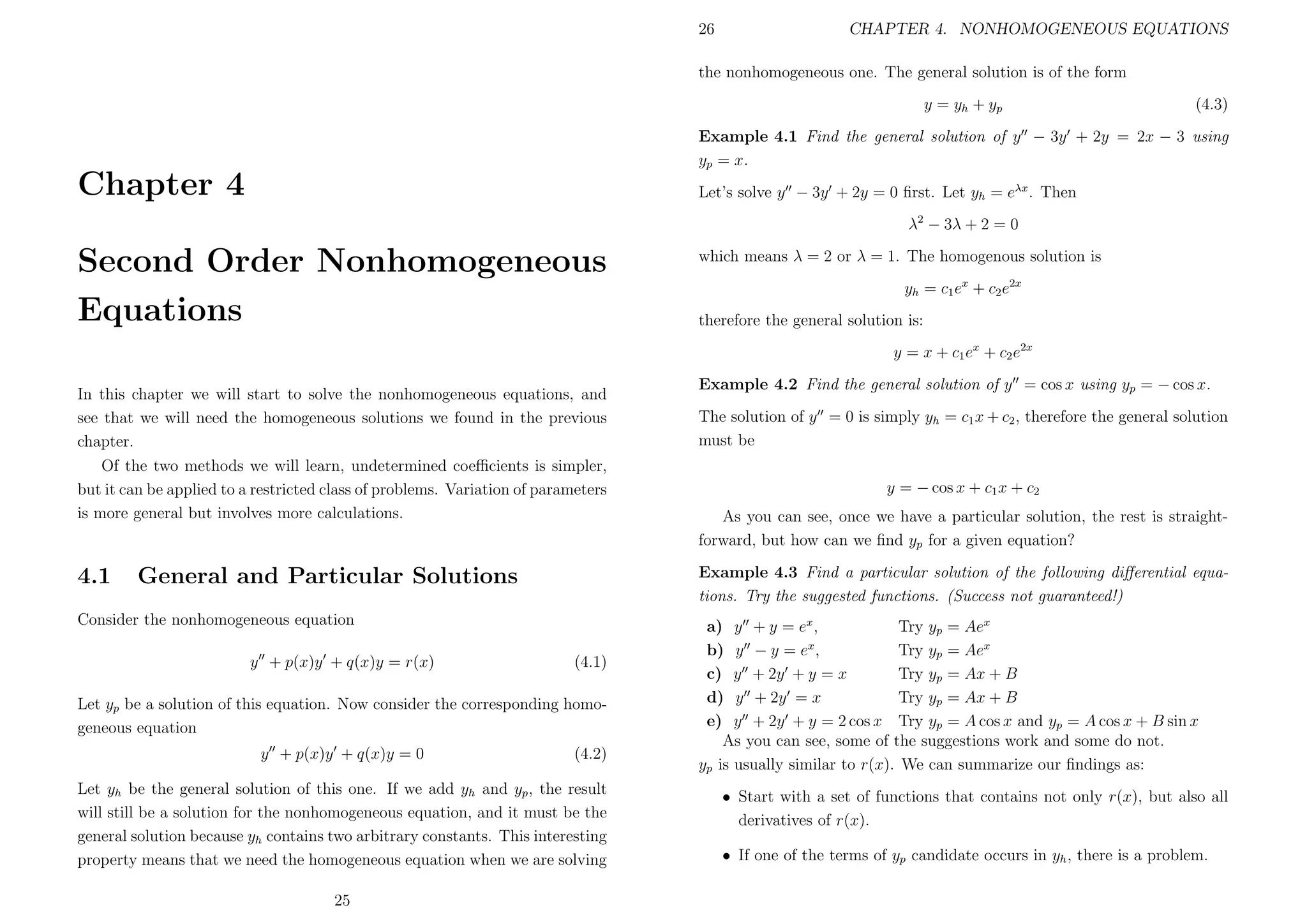
the nonhomogeneous one. The general solution is of the form
y = yh + yp

(4.3)

Example 4.1 Find the general solution of y − 3y + 2y = 2x − 3 using
yp = x.

Chapter 4

Let’s solve y − 3y + 2y = 0 first. Let yh = eλx . Then
λ2 − 3λ + 2 = 0

Second Order Nonhomogeneous
Equations

which means λ = 2 or λ = 1. The homogenous solution is
yh = c1 ex + c2 e2x
therefore the general solution is:
y = x + c1 ex + c2 e2x

In this chapter we will start to solve the nonhomogeneous equations, and
see that we will need the homogeneous solutions we found in the previous
chapter.
Of the two methods we will learn, undetermined coefficients is simpler,
but it can be applied to a restricted class of problems. Variation of parameters
is more general but involves more calculations.

4.1

Consider the nonhomogeneous equation
(4.1)

Let yp be a solution of this equation. Now consider the corresponding homogeneous equation
y + p(x)y + q(x)y = 0

(4.2)

Let yh be the general solution of this one. If we add yh and yp , the result
will still be a solution for the nonhomogeneous equation, and it must be the
general solution because yh contains two arbitrary constants. This interesting
property means that we need the homogeneous equation when we are solving
25

The solution of y = 0 is simply yh = c1 x + c2 , therefore the general solution
must be
y = − cos x + c1 x + c2
As you can see, once we have a particular solution, the rest is straightforward, but how can we find yp for a given equation?
Example 4.3 Find a particular solution of the following differential equations. Try the suggested functions. (Success not guaranteed!)

General and Particular Solutions

y + p(x)y + q(x)y = r(x)

Example 4.2 Find the general solution of y = cos x using yp = − cos x.

a) y + y = ex ,
Try yp = Aex
b) y − y = ex ,
Try yp = Aex
c) y + 2y + y = x
Try yp = Ax + B
d) y + 2y = x
Try yp = Ax + B
e) y + 2y + y = 2 cos x Try yp = A cos x and yp = A cos x + B sin x
As you can see, some of the suggestions work and some do not.
yp is usually similar to r(x). We can summarize our findings as:
• Start with a set of functions that contains not only r(x), but also all
derivatives of r(x).
• If one of the terms of yp candidate occurs in yh , there is a problem.
4.2. METHOD OF UNDETERMINED COEFFICIENTS

4.2

27

Method of Undetermined Coefficients

28

CHAPTER 4. NONHOMOGENEOUS EQUATIONS

The homogeneous equation is
3y + 10y + 3y = 0

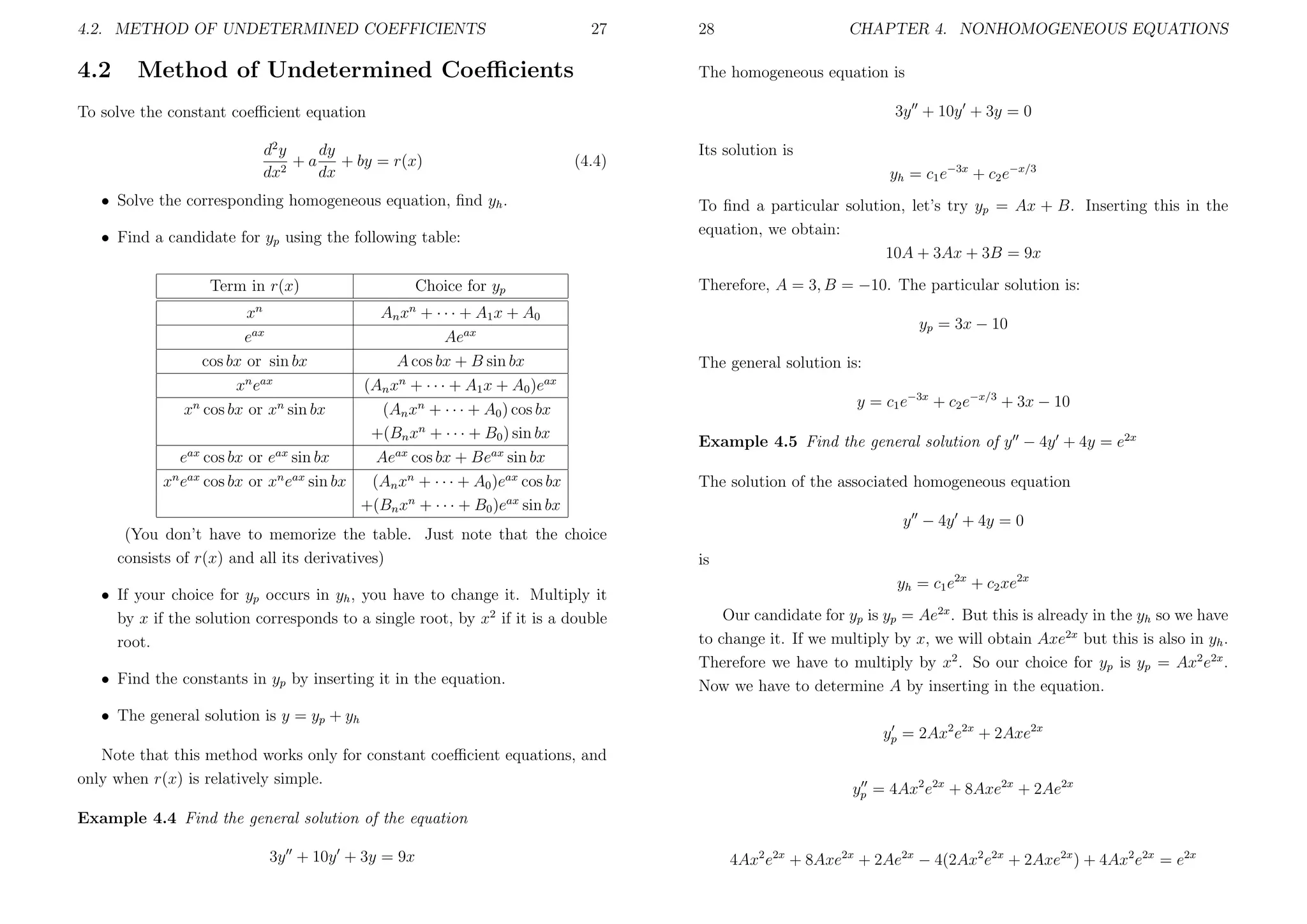
To solve the constant coefficient equation
d2 y
dy
+ a + by = r(x)
2
dx
dx

(4.4)

• Solve the corresponding homogeneous equation, find yh .
• Find a candidate for yp using the following table:
Term in r(x)

Choice for yp

xn
eax
cos bx or sin bx
xn eax
xn cos bx or xn sin bx

An xn + · · · + A1 x + A0
Aeax
A cos bx + B sin bx
(An xn + · · · + A1 x + A0 )eax
(An xn + · · · + A0 ) cos bx
+(Bn xn + · · · + B0 ) sin bx
eax cos bx or eax sin bx
Aeax cos bx + Beax sin bx
xn eax cos bx or xn eax sin bx
(An xn + · · · + A0 )eax cos bx
+(Bn xn + · · · + B0 )eax sin bx
(You don’t have to memorize the table. Just note that the choice
consists of r(x) and all its derivatives)
• If your choice for yp occurs in yh , you have to change it. Multiply it
by x if the solution corresponds to a single root, by x2 if it is a double
root.
• Find the constants in yp by inserting it in the equation.
• The general solution is y = yp + yh
Note that this method works only for constant coefficient equations, and
only when r(x) is relatively simple.

Its solution is
yh = c1 e−3x + c2 e−x/3
To find a particular solution, let’s try yp = Ax + B. Inserting this in the
equation, we obtain:
10A + 3Ax + 3B = 9x
Therefore, A = 3, B = −10. The particular solution is:
yp = 3x − 10
The general solution is:
y = c1 e−3x + c2 e−x/3 + 3x − 10
Example 4.5 Find the general solution of y − 4y + 4y = e2x
The solution of the associated homogeneous equation
y − 4y + 4y = 0
is
yh = c1 e2x + c2 xe2x
Our candidate for yp is yp = Ae2x . But this is already in the yh so we have
to change it. If we multiply by x, we will obtain Axe2x but this is also in yh .
Therefore we have to multiply by x2 . So our choice for yp is yp = Ax2 e2x .
Now we have to determine A by inserting in the equation.
yp = 2Ax2 e2x + 2Axe2x
yp = 4Ax2 e2x + 8Axe2x + 2Ae2x

Example 4.4 Find the general solution of the equation
3y + 10y + 3y = 9x

4Ax2 e2x + 8Axe2x + 2Ae2x − 4(2Ax2 e2x + 2Axe2x ) + 4Ax2 e2x = e2x
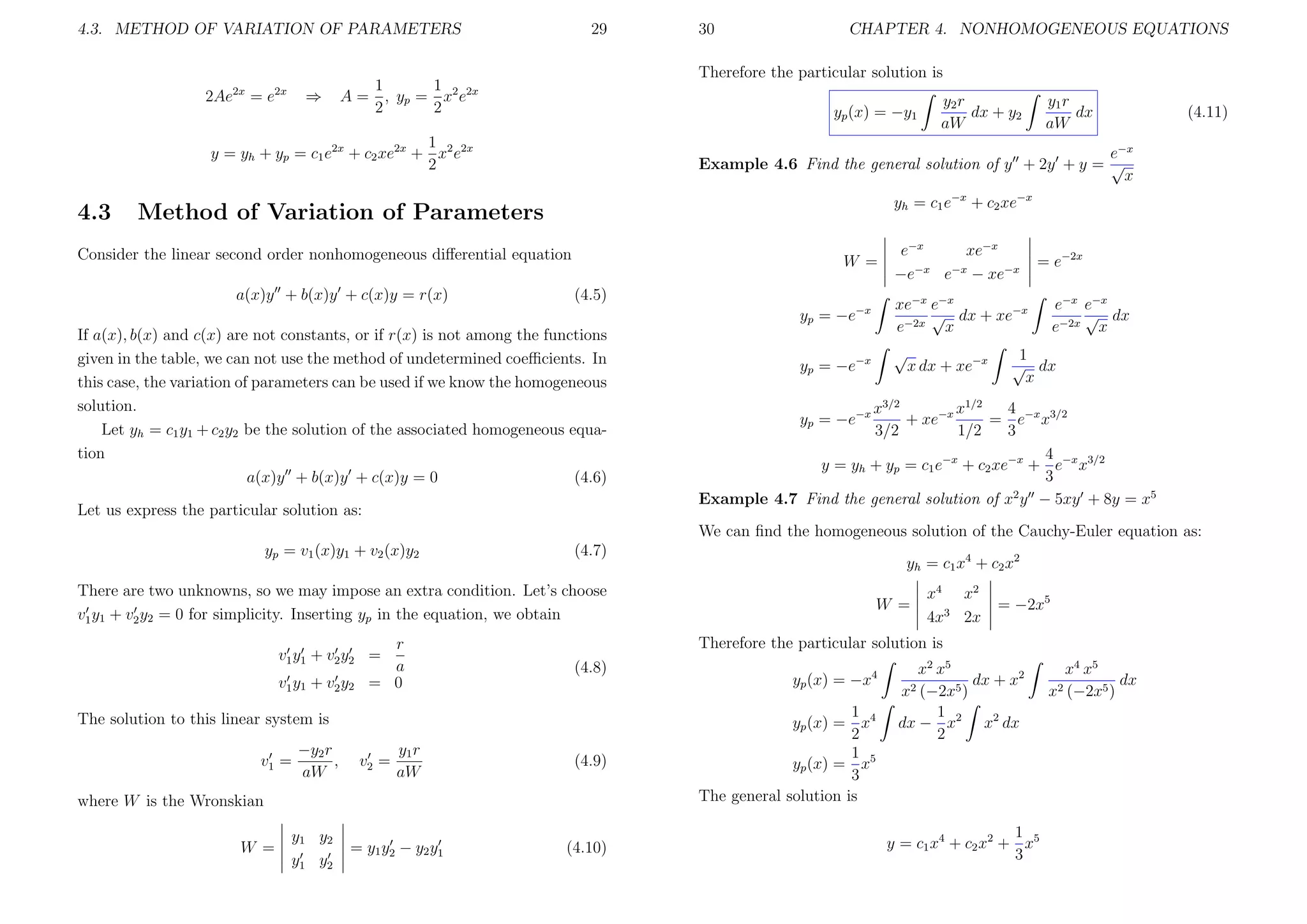
4.3. METHOD OF VARIATION OF PARAMETERS

2Ae

2x

=e

2x

⇒

29

CHAPTER 4. NONHOMOGENEOUS EQUATIONS

Therefore the particular solution is

1
1
A = , yp = x2 e2x
2
2

yp (x) = −y1

1
y = yh + yp = c1 e2x + c2 xe2x + x2 e2x
2

4.3

30

y1 r
dx
aW

(4.11)

e−x
Example 4.6 Find the general solution of y + 2y + y = √
x
yh = c1 e−x + c2 xe−x

Method of Variation of Parameters

Consider the linear second order nonhomogeneous differential equation
a(x)y + b(x)y + c(x)y = r(x)

y2 r
dx + y2
aW

W =
(4.5)

e−x
xe−x
−x
−x
−e
e − xe−x

yp = −e−x
If a(x), b(x) and c(x) are not constants, or if r(x) is not among the functions
given in the table, we can not use the method of undetermined coefficients. In
this case, the variation of parameters can be used if we know the homogeneous
solution.
Let yh = c1 y1 + c2 y2 be the solution of the associated homogeneous equation
a(x)y + b(x)y + c(x)y = 0
(4.6)
Let us express the particular solution as:

xe−x e−x
√ dx + xe−x
e−2x x

yp = −e−x

√
x dx + xe−x

= e−2x
e−x e−x
√ dx
e−2x x

1
√ dx
x

4
x3/2
x1/2
+ xe−x
= e−x x3/2
3/2
1/2
3
4
y = yh + yp = c1 e−x + c2 xe−x + e−x x3/2
3
2
Example 4.7 Find the general solution of x y − 5xy + 8y = x5
yp = −e−x

We can find the homogeneous solution of the Cauchy-Euler equation as:
yp = v1 (x)y1 + v2 (x)y2

(4.7)

yh = c1 x4 + c2 x2

There are two unknowns, so we may impose an extra condition. Let’s choose
v1 y1 + v2 y2 = 0 for simplicity. Inserting yp in the equation, we obtain
r
a
= 0

v1 y1 + v2 y2 =
v1 y1 + v2 y2

−y2 r
,
aW

v2 =

y1 r
aW

(4.8)

(4.9)

where W is the Wronskian
W =

y1 y2
y1 y2

= y1 y2 − y2 y1

x4 x 2
4x3 2x

= −2x5

Therefore the particular solution is

The solution to this linear system is
v1 =

W =

(4.10)

yp (x) = −x4
1
yp (x) = x4
2
1 5
yp (x) = x
3
The general solution is

x2 x5
dx + x2
x2 (−2x5 )
1
dx − x2 x2 dx
2

1
y = c1 x 4 + c2 x 2 + x 5
3

x4 x5
dx
x2 (−2x5 )
EXERCISES

31

Exercises
1)
2)
3)
4)
5)
6)

32

CHAPTER 4. NONHOMOGENEOUS EQUATIONS

Answers

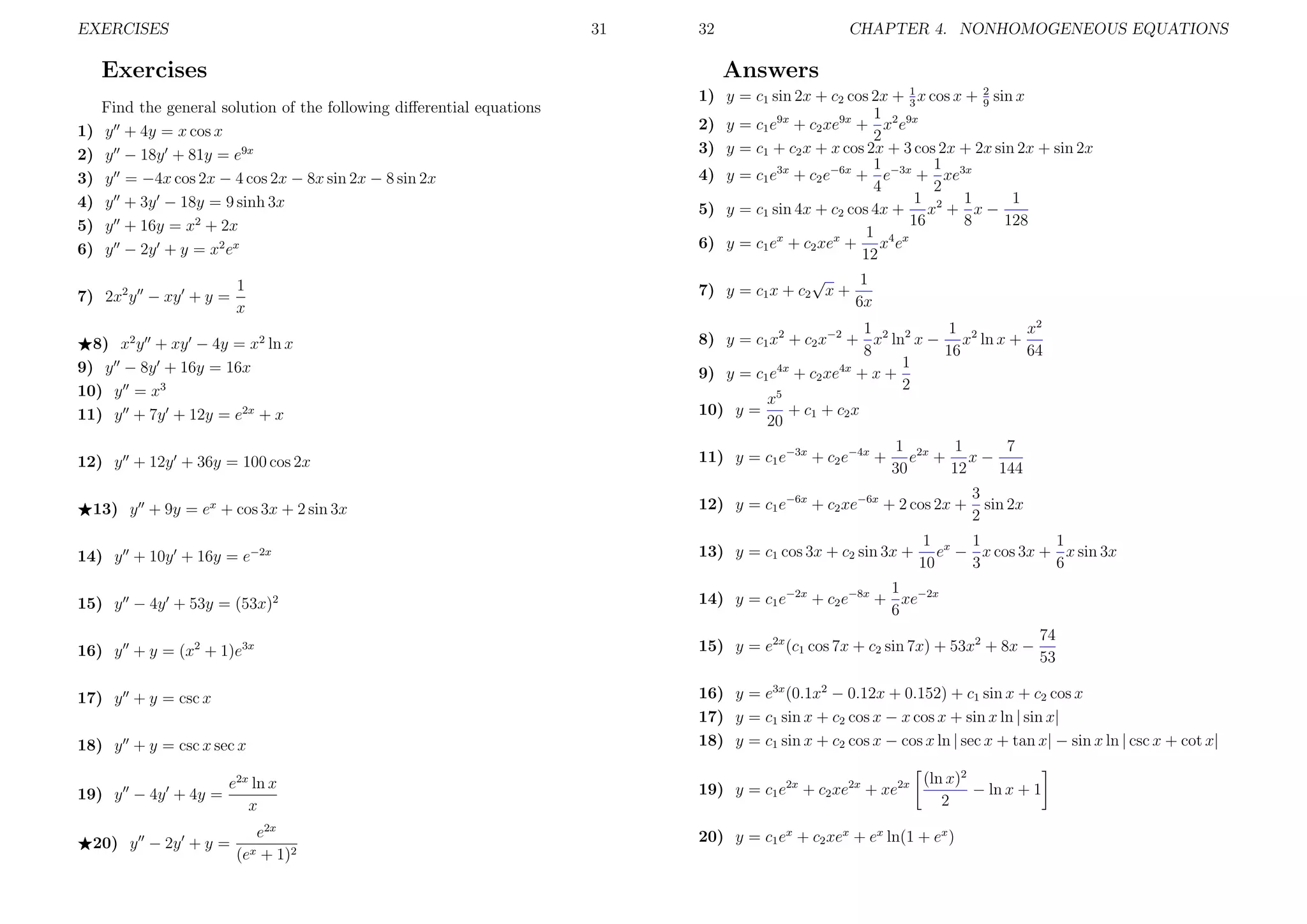
Find the general solution of the following differential equations
y + 4y = x cos x
y − 18y + 81y = e9x
y = −4x cos 2x − 4 cos 2x − 8x sin 2x − 8 sin 2x
y + 3y − 18y = 9 sinh 3x
y + 16y = x2 + 2x
y − 2y + y = x2 ex

7) 2x2 y − xy + y =

1
x

1) y = c1 sin 2x + c2 cos 2x + 1 x cos x + 2 sin x
3
9
1
2) y = c1 e9x + c2 xe9x + x2 e9x
2
3) y = c1 + c2 x + x cos 2x + 3 cos 2x + 2x sin 2x + sin 2x
1
1
4) y = c1 e3x + c2 e−6x + e−3x + xe3x
4
2
1 2 1
1
5) y = c1 sin 4x + c2 cos 4x + x + x −
16
8
128
1
6) y = c1 ex + c2 xex + x4 ex
12
√
1
7) y = c1 x + c2 x +
6x

8) x y + xy − 4y = x ln x
9) y − 8y + 16y = 16x
10) y = x3
11) y + 7y + 12y = e2x + x

1
1
x2
8) y = c1 x2 + c2 x−2 + x2 ln2 x − x2 ln x +
8
16
64
1
9) y = c1 e4x + c2 xe4x + x +
2
x5
10) y =
+ c1 + c2 x
20

12) y + 12y + 36y = 100 cos 2x

11) y = c1 e−3x + c2 e−4x +

2

2

13) y + 9y = ex + cos 3x + 2 sin 3x

1
7
1 2x
e + x−
30
12
144

12) y = c1 e−6x + c2 xe−6x + 2 cos 2x +

3
sin 2x
2

1 x 1
1
e − x cos 3x + x sin 3x
10
3
6

14) y + 10y + 16y = e−2x

13) y = c1 cos 3x + c2 sin 3x +

15) y − 4y + 53y = (53x)2

1
14) y = c1 e−2x + c2 e−8x + xe−2x
6

16) y + y = (x2 + 1)e3x

15) y = e2x (c1 cos 7x + c2 sin 7x) + 53x2 + 8x −

17) y + y = csc x

16) y = e3x (0.1x2 − 0.12x + 0.152) + c1 sin x + c2 cos x
17) y = c1 sin x + c2 cos x − x cos x + sin x ln | sin x|
18) y = c1 sin x + c2 cos x − cos x ln | sec x + tan x| − sin x ln | csc x + cot x|

18) y + y = csc x sec x
19) y − 4y + 4y =

e2x ln x
x

20) y − 2y + y =

e2x
(ex + 1)2

19) y = c1 e2x + c2 xe2x + xe2x

74
53

(ln x)2
− ln x + 1
2

20) y = c1 ex + c2 xex + ex ln(1 + ex )
34

CHAPTER 5. HIGHER ORDER EQUATIONS

means that all the constants c1 , c2 , . . . , cn are zero, then this set of functions
is linearly independent. Otherwise, they are dependent.
For example, the functions x, x2 , x3 are linearly independent. The functions cos2 x, sin2 x, cos 2x are not.
Given n functions, we can check their linear dependence by calculating
the Wronskian. The Wronskian is defined as

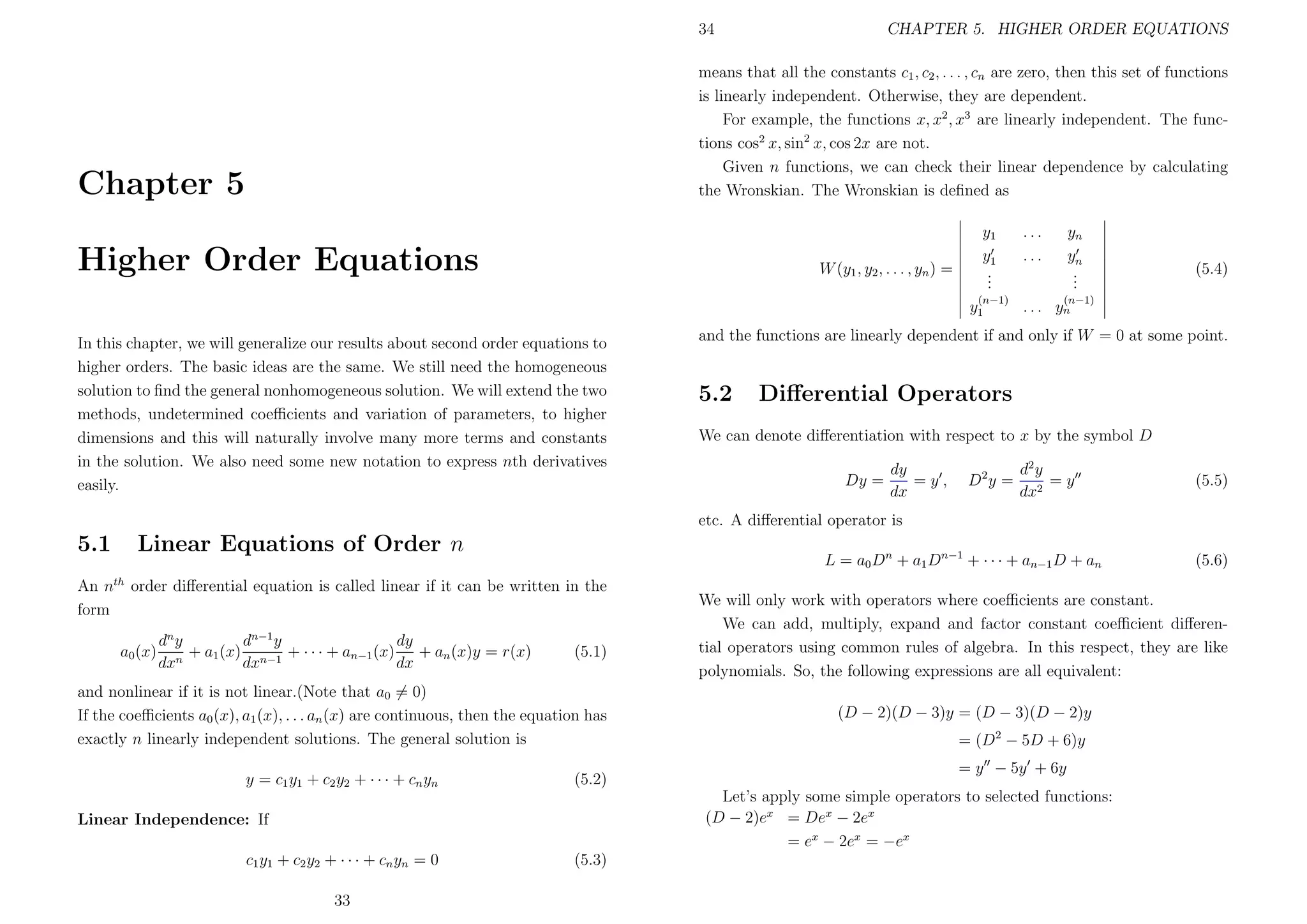
Chapter 5
Higher Order Equations

W (y1 , y2 , . . . , yn ) =

y1
y1
.
.
.
(n−1)

y1
In this chapter, we will generalize our results about second order equations to
higher orders. The basic ideas are the same. We still need the homogeneous
solution to find the general nonhomogeneous solution. We will extend the two
methods, undetermined coefficients and variation of parameters, to higher
dimensions and this will naturally involve many more terms and constants
in the solution. We also need some new notation to express nth derivatives
easily.

...
...

yn
yn
.
.
.

(5.4)

(n−1)

. . . yn

and the functions are linearly dependent if and only if W = 0 at some point.

5.2

Differential Operators

We can denote differentiation with respect to x by the symbol D
Dy =

dy
=y,
dx

D2 y =

d2 y
=y
dx2

(5.5)

etc. A differential operator is

5.1
An n
form

Linear Equations of Order n
th

L = a0 Dn + a1 Dn−1 + · · · + an−1 D + an

order differential equation is called linear if it can be written in the

a0 (x)

dn y
dn−1 y
dy
+ a1 (x) n−1 + · · · + an−1 (x) + an (x)y = r(x)
n
dx
dx
dx

(5.1)

and nonlinear if it is not linear.(Note that a0 = 0)
If the coefficients a0 (x), a1 (x), . . . an (x) are continuous, then the equation has
exactly n linearly independent solutions. The general solution is
y = c1 y1 + c2 y2 + · · · + cn yn

(5.2)

We will only work with operators where coefficients are constant.
We can add, multiply, expand and factor constant coefficient differential operators using common rules of algebra. In this respect, they are like
polynomials. So, the following expressions are all equivalent:
(D − 2)(D − 3)y = (D − 3)(D − 2)y
= (D2 − 5D + 6)y
= y − 5y + 6y
Let’s apply some simple operators to selected functions:
(D − 2)ex = Dex − 2ex
= ex − 2ex = −ex

Linear Independence: If
c1 y1 + c2 y2 + · · · + cn yn = 0
33

(5.3)

(5.6)
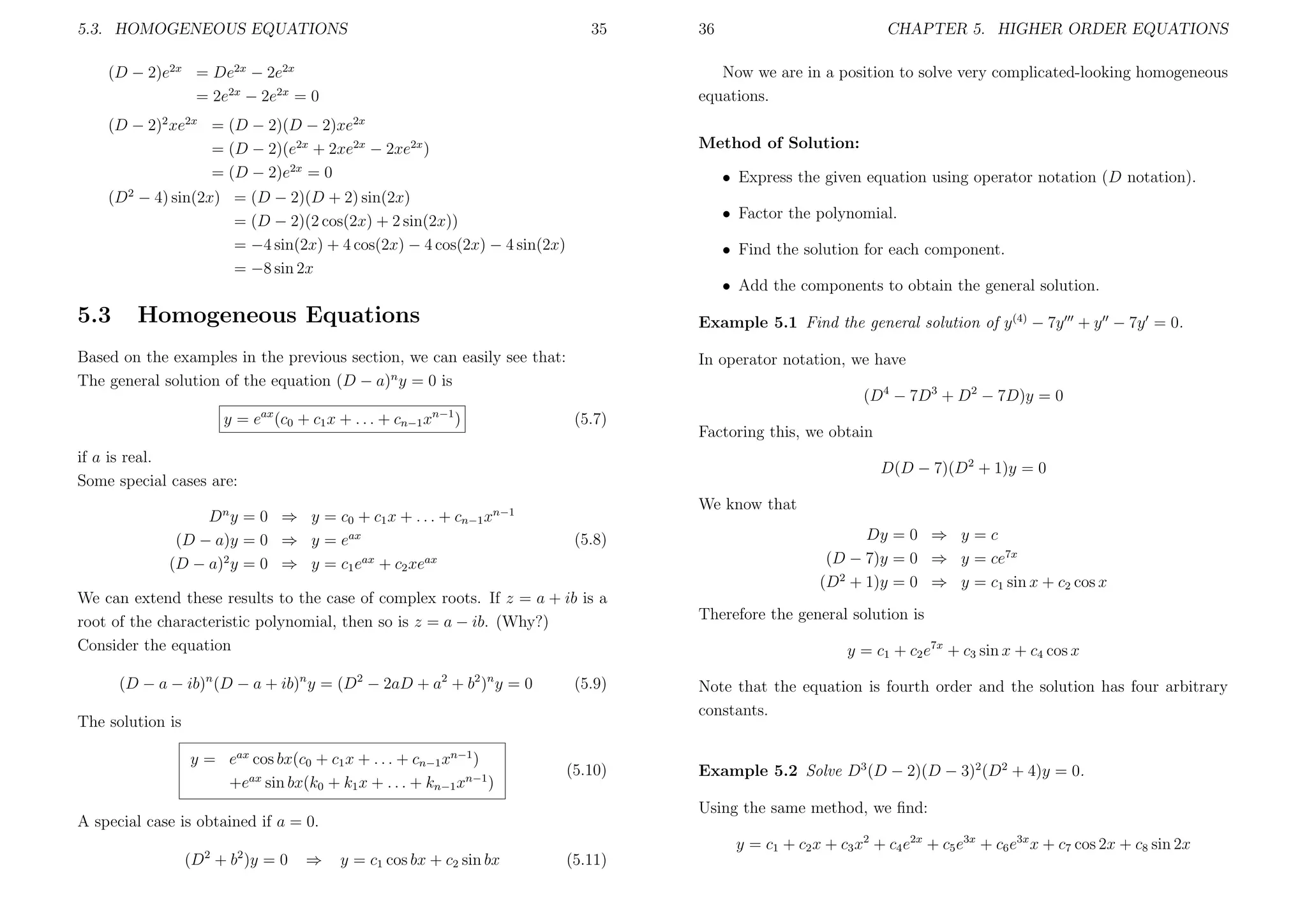
5.3. HOMOGENEOUS EQUATIONS

35

36

CHAPTER 5. HIGHER ORDER EQUATIONS

(D − 2)e2x = De2x − 2e2x
= 2e2x − 2e2x = 0

Now we are in a position to solve very complicated-looking homogeneous
equations.

(D − 2)2 xe2x = (D − 2)(D − 2)xe2x
= (D − 2)(e2x + 2xe2x − 2xe2x )
= (D − 2)e2x = 0

Method of Solution:
• Express the given equation using operator notation (D notation).

(D2 − 4) sin(2x) = (D − 2)(D + 2) sin(2x)
= (D − 2)(2 cos(2x) + 2 sin(2x))
= −4 sin(2x) + 4 cos(2x) − 4 cos(2x) − 4 sin(2x)
= −8 sin 2x

• Factor the polynomial.
• Find the solution for each component.
• Add the components to obtain the general solution.

5.3

Homogeneous Equations

Example 5.1 Find the general solution of y (4) − 7y + y − 7y = 0.

Based on the examples in the previous section, we can easily see that:
The general solution of the equation (D − a)n y = 0 is
y = eax (c0 + c1 x + . . . + cn−1 xn−1 )

In operator notation, we have
(D4 − 7D3 + D2 − 7D)y = 0
(5.7)

Factoring this, we obtain

if a is real.
Some special cases are:

D(D − 7)(D2 + 1)y = 0

Dn y = 0 ⇒ y = c0 + c1 x + . . . + cn−1 xn−1
(D − a)y = 0 ⇒ y = eax
(D − a)2 y = 0 ⇒ y = c1 eax + c2 xeax

We know that
(5.8)

We can extend these results to the case of complex roots. If z = a + ib is a
root of the characteristic polynomial, then so is z = a − ib. (Why?)
Consider the equation
(D − a − ib)n (D − a + ib)n y = (D2 − 2aD + a2 + b2 )n y = 0

(5.9)

The solution is
y = eax cos bx(c0 + c1 x + . . . + cn−1 xn−1 )
+eax sin bx(k0 + k1 x + . . . + kn−1 xn−1 )

(5.10)

2

(D + b )y = 0

⇒

Therefore the general solution is
y = c1 + c2 e7x + c3 sin x + c4 cos x
Note that the equation is fourth order and the solution has four arbitrary
constants.

Example 5.2 Solve D3 (D − 2)(D − 3)2 (D2 + 4)y = 0.
Using the same method, we find:

A special case is obtained if a = 0.
2

Dy = 0 ⇒ y = c
(D − 7)y = 0 ⇒ y = ce7x
(D2 + 1)y = 0 ⇒ y = c1 sin x + c2 cos x

y = c1 cos bx + c2 sin bx

(5.11)

y = c1 + c2 x + c3 x2 + c4 e2x + c5 e3x + c6 e3x x + c7 cos 2x + c8 sin 2x
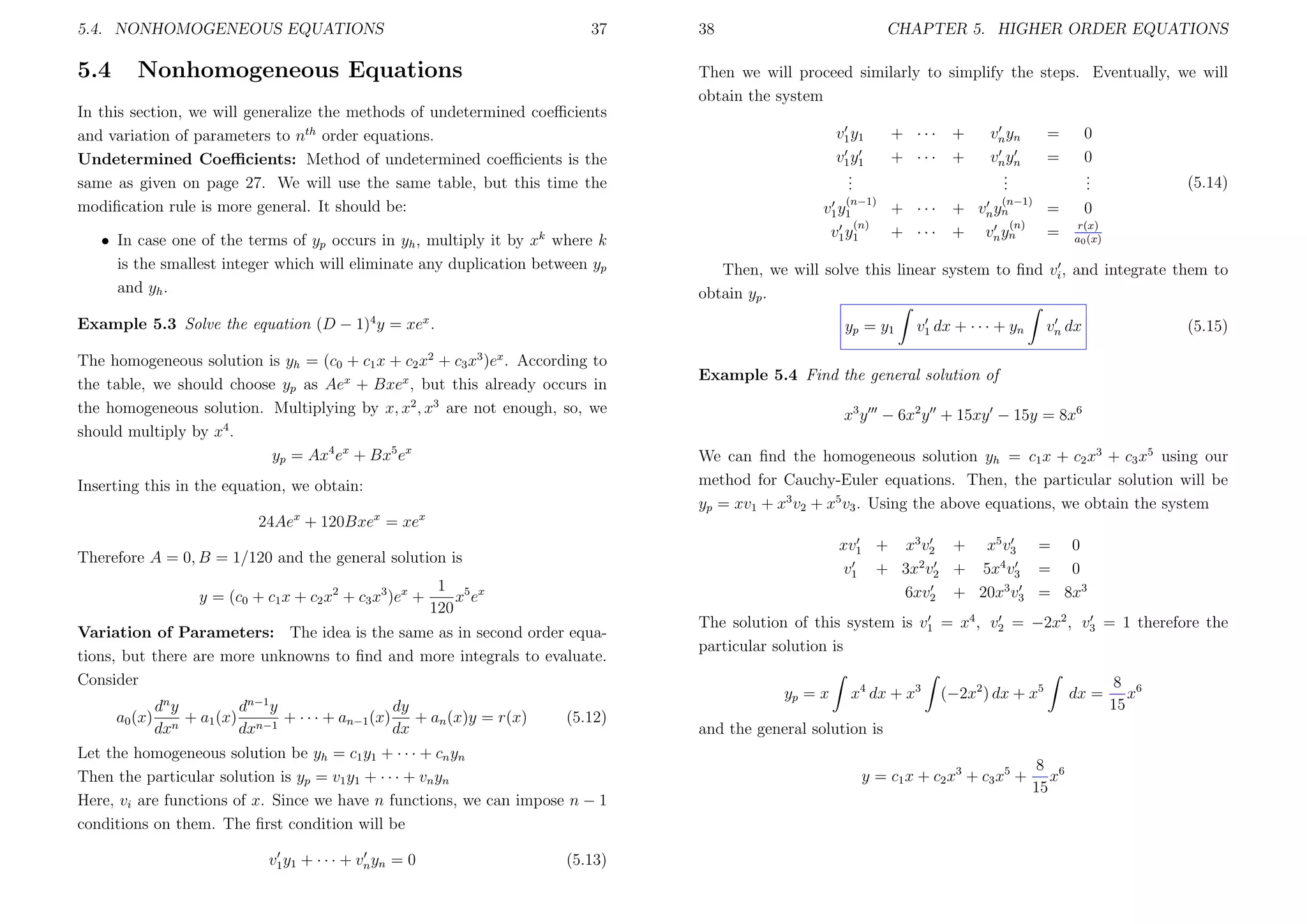
5.4. NONHOMOGENEOUS EQUATIONS

5.4

37

Nonhomogeneous Equations

38

CHAPTER 5. HIGHER ORDER EQUATIONS

Then we will proceed similarly to simplify the steps. Eventually, we will
obtain the system

In this section, we will generalize the methods of undetermined coefficients
and variation of parameters to nth order equations.
Undetermined Coefficients: Method of undetermined coefficients is the
same as given on page 27. We will use the same table, but this time the
modification rule is more general. It should be:
• In case one of the terms of yp occurs in yh , multiply it by xk where k
is the smallest integer which will eliminate any duplication between yp
and yh .

v1 y1
v1 y1
.
.
.
(n−1)
v1 y1
(n)
v1 y1

yp = y1

The homogeneous solution is yh = (c0 + c1 x + c2 x2 + c3 x3 )ex . According to
the table, we should choose yp as Aex + Bxex , but this already occurs in
the homogeneous solution. Multiplying by x, x2 , x3 are not enough, so, we
should multiply by x4 .
yp = Ax4 ex + Bx5 ex
Inserting this in the equation, we obtain:
24Aex + 120Bxex = xex

1 5 x
xe
120

n−1

d y
d y
dy
+ a1 (x) n−1 + · · · + an−1 (x) + an (x)y = r(x)
n
dx
dx
dx

(5.12)

Let the homogeneous solution be yh = c1 y1 + · · · + cn yn
Then the particular solution is yp = v1 y1 + · · · + vn yn
Here, vi are functions of x. Since we have n functions, we can impose n − 1
conditions on them. The first condition will be
v1 y1 + · · · + vn yn = 0

=
=

+
+

(n−1)
vn y n
(n)
vn yn

=
=

0
0
.
.
.

(5.14)

0
r(x)
a0 (x)

v1 dx + · · · + yn

vn dx

(5.15)

x3 y − 6x2 y + 15xy − 15y = 8x6
We can find the homogeneous solution yh = c1 x + c2 x3 + c3 x5 using our
method for Cauchy-Euler equations. Then, the particular solution will be
yp = xv1 + x3 v2 + x5 v3 . Using the above equations, we obtain the system
xv1 + x3 v2 + x5 v3 = 0
v1 + 3x2 v2 + 5x4 v3 = 0
6xv2 + 20x3 v3 = 8x3

Variation of Parameters: The idea is the same as in second order equations, but there are more unknowns to find and more integrals to evaluate.
Consider
a0 (x)

vn yn
vn yn
.
.
.

Example 5.4 Find the general solution of

Therefore A = 0, B = 1/120 and the general solution is

n

+ ···
+ ···

+
+

Then, we will solve this linear system to find vi , and integrate them to
obtain yp .

Example 5.3 Solve the equation (D − 1)4 y = xex .

y = (c0 + c1 x + c2 x2 + c3 x3 )ex +

+ ···
+ ···

(5.13)

The solution of this system is v1 = x4 , v2 = −2x2 , v3 = 1 therefore the
particular solution is
yp = x

x4 dx + x3

(−2x2 ) dx + x5

and the general solution is
y = c1 x + c2 x 3 + c3 x 5 +

8 6
x
15

dx =

8 6
x
15
EXERCISES

39

Exercises

CHAPTER 5. HIGHER ORDER EQUATIONS

Answers
1) y = c0 + c1 x + c2 x2 + c3 x3 + c4 x4

1) D5 y = 0

2) y = c1 ex + c2 xex + c3 x2 ex

2) (D − 1)3 y = 0
3) y − 4y + 13y = 0
4) (D − 2)2 (D + 3)3 y = 0
5) (D2 + 2)3 y = 0
d4 y
d2 y
+ 5 2 + 4y = 0
dx4
dx
7) (D2 + 9)2 (D2 − 9)2 y = 0

6)

4

40

3

2

dy
dy
dy
−2 3 +2 2 =0
4
dx
dx
dx
9) y − 3y + 12y − 10y = 0
8)

3) y = c1 e2x cos 3x + c2 e2x sin 3x + c3
4) y = c1 e2x + c2 xe2x + c3 e−3x + c4 xe−3x + c5 x2 e−3x
√
√
√
√
5) y = c1 cos 2x + c2 sin 2x + c3 x cos 2x + c4 x sin 2x
√
√
+ c5 x2 cos 2x + c6 x2 sin 2x
6) y = c1 cos 2x + c2 sin 2x + c3 cos x + c4 sin x
7) y = c1 e3x + c2 xe3x + c3 e−3x + c4 xe−3x + c5 cos 3x + c6 sin 3x
+ c7 x cos 3x + c8 x sin 3x
8) y = c1 + c2 x + c3 ex cos x + c4 ex sin x

10) (D2 + 2D + 17)2 y = 0

9) y = c1 ex + c2 ex cos 3x + c3 ex sin 3x

11) (D4 + 2D2 + 1)y = x2

10) y = c1 e−x sin 4x + c2 e−x cos 4x + c3 xe−x sin 4x + c4 xe−x cos 4x

12) (D3 + 2D2 − D − 2)y = 1 − 4x3

11) y = c1 cos x + c2 sin x + c3 x cos x + c4 x sin x + x2 − 4

√
√
√
13) (2D4 + 4D3 + 8D2 )y = 40e−x [ 3 sin( 3x) + 3 cos( 3x)]
14) (D3 − 4D2 + 5D − 2)y = 4 cos x + sin x
15) (D3 − 9D)y = 8xex

12) y = c1 ex + c2 e−x + c3 e−2x + 2x3 − 3x2 + 15x − 8
√
√
√
13) y = c1 + c2 x + c3 e−x cos 3x + c4 e−x sin 3x + 5xe−x cos 3x
14) y = c1 ex + c2 xex + c3 e2x + 0.2 cos x + 0.9 sin x
3
15) y = c1 + c2 e3x + c3 e−3x + ex − xex
4
42

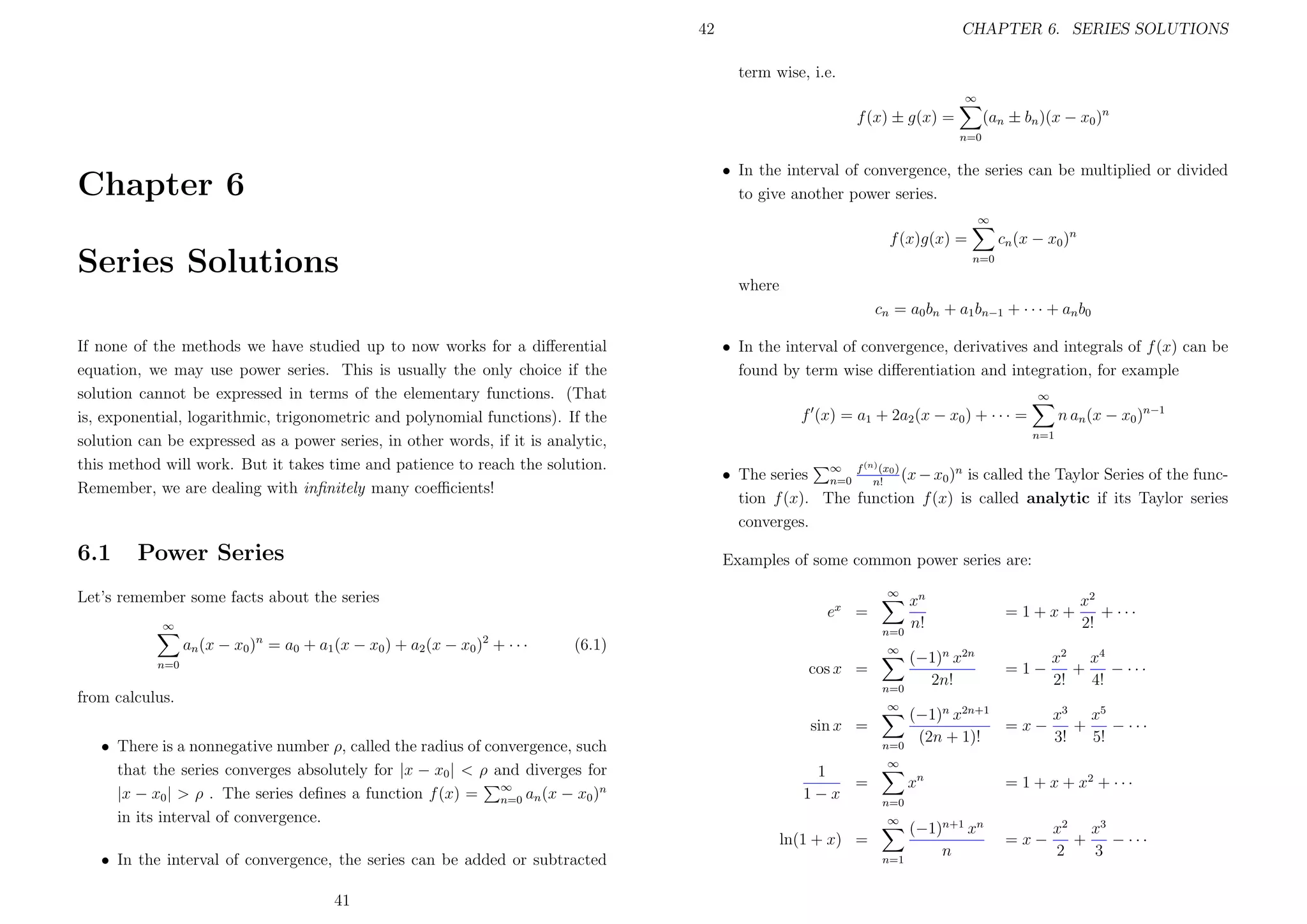
CHAPTER 6. SERIES SOLUTIONS
term wise, i.e.
∞

(an ± bn )(x − x0 )n

f (x) ± g(x) =
n=0

• In the interval of convergence, the series can be multiplied or divided
to give another power series.

Chapter 6

∞

cn (x − x0 )n

f (x)g(x) =

Series Solutions

n=0

where
cn = a0 bn + a1 bn−1 + · · · + an b0
If none of the methods we have studied up to now works for a differential
equation, we may use power series. This is usually the only choice if the
solution cannot be expressed in terms of the elementary functions. (That
is, exponential, logarithmic, trigonometric and polynomial functions). If the
solution can be expressed as a power series, in other words, if it is analytic,
this method will work. But it takes time and patience to reach the solution.
Remember, we are dealing with infinitely many coefficients!

6.1

Power Series

• In the interval of convergence, derivatives and integrals of f (x) can be
found by term wise differentiation and integration, for example
∞

n an (x − x0 )n−1

f (x) = a1 + 2a2 (x − x0 ) + · · · =
n=1
(n)

(x
• The series ∞ f n! 0 ) (x − x0 )n is called the Taylor Series of the funcn=0
tion f (x). The function f (x) is called analytic if its Taylor series
converges.

Examples of some common power series are:
∞

Let’s remember some facts about the series

ex =

∞

an (x − x0 )n = a0 + a1 (x − x0 ) + a2 (x − x0 )2 + · · ·

n=0

(6.1)

n=0

∞

cos x =
n=0

from calculus.

∞

sin x =
• There is a nonnegative number ρ, called the radius of convergence, such
that the series converges absolutely for |x − x0 | < ρ and diverges for
|x − x0 | > ρ . The series defines a function f (x) = ∞ an (x − x0 )n
n=0
in its interval of convergence.

n=0

1
=
1−x

41

=1+x+

(−1)n x2n
2n!

=1−

x2
+ ···
2!

x2 x4
+
− ···
2!
4!

(−1)n x2n+1
x3 x5
=x−
+
− ···
(2n + 1)!
3!
5!

∞

xn

= 1 + x + x2 + · · ·

(−1)n+1 xn
n

=x−

n=0
∞

ln(1 + x) =
• In the interval of convergence, the series can be added or subtracted

xn
n!

n=1

x2 x3
+
− ···
2
3
6.2. CLASSIFICATION OF POINTS

6.2

43

Classification of Points

44

CHAPTER 6. SERIES SOLUTIONS

Example 6.1 Solve y + 2xy + 2y = 0 around x0 = 0.
First we should classify the point. Obviously, x = 0 is an ordinary point, so
we can use power series method.

Consider the equation
R(x)y + P (x)y + Q(x)y = 0

(6.2)

∞

∞
n

y=
If both of the functions

P (x)
,
R(x)

Q(x)
R(x)

an x , y =
n=0

(6.3)

are analytic at x = x0 , then the point x0 is an ordinary point. Otherwise, x0
is a singular point.
Suppose that x0 is a singular point of the above equation. If both of the
functions
Q(x)
P (x)
, (x − x0 )2
(6.4)
(x − x0 )
R(x)
R(x)
are analytic at x = x0 , then the point x0 is called a regular singular point.
Otherwise, x0 is an irregular singular point.
For example, the functions 1+x+x2 , sin x, ex (1+x4 ) cos x are all analytic
cos x 1 ex 1 + x2
at x = 0. But, the functions
, ,
,
are not.
x
x x
x3
We will use power series method around ordinary points and Frobenius’
method around regular singular points. We will not consider irregular singular points.

∞

nan x

n−1

n(n − 1)an xn−2

, y =

n=1

n=2

Inserting these in the equation, we obtain
∞

∞

n(n − 1)an x

n−2

∞

+ 2x

n=2

nan x

n−1

an x n = 0

+2

n=1

∞

n=0

∞

∞

n(n − 1)an xn−2 +
n=2

2nan xn +
n=1

2an xn = 0
n=0

To equate the powers of x, let us replace n by n + 2 in the first sigma.
(n → n + 2)
∞

∞

∞

n=1

n=0

2an xn = 0

2nan xn +

(n + 2)(n + 1)an+2 xn +

n=0

Now we can express the equation using a single sigma, but we should start
the index from n = 1. Therefore we have to write n = 0 terms separately.
∞

[(n + 2)(n + 1)an+2 + (2n + 2)an ] xn = 0

2a2 + 2a0 +
n=1

6.3

Power Series Method

If x0 is an ordinary point of the equation R(x)y + P (x)y + Q(x)y = 0, then
the general solution is
∞

an (x − x0 )n

y=

−2(n + 1)
−2
an =
an
(n + 2)(n + 1)
(n + 2)
This is called the recursion relation. Using it, we can find all the constants
in terms of a0 and a1 .
a2 = −a0 , an+2 =

(6.5)

2
1
a4 = − a2 = a0
4
2

2
1
a6 = − a4 = − a0
6
6

2
a3 = − a1 ,
3

2
4
a 5 = − a3 = a1
5
15

n=0

The coefficients an can be found by inserting y in the equation and setting
the coefficients of all powers to zero. Two coefficients (Usually a0 and a1 )
must be arbitrary, others must be defined in terms of them. We expect two
linearly independent solutions because the equation is second order linear.

We can find as many coefficients as we want in this way. Collecting them
together, the solution is :
1
1
y = a0 1 − x 2 + x 4 − x 6 + · · ·
2
6

2
4
+ a1 x − x 3 + x 5 + · · ·
3
15
6.3. POWER SERIES METHOD

45

In most applications, we want a solution close to 0, therefore we can neglect
the higher order terms of the series.
Remark: Sometimes we can express the solution in closed form (in terms
of elementary functions rather than an infinite summation) as in the next
example:
Example 6.2 Solve (x − 1)y + 2y = 0 around x0 = 0.
Once again, first we should classify the given point. The function
analytic at x = 0, therefore x = 0 is an ordinary point.
∞

∞

∞

an x n , y =

y=
n=0

2
is
x−1

nan xn−1 , y =
n=1

n(n − 1)an xn−2
n=2

Inserting these in the equation, we obtain
∞

(x − 1)

∞

n(n − 1)an x

n−2

nan xn−1 = 0

+2

n=2

n=1
∞

∞

∞

n(n − 1)an xn−2 +

n(n − 1)an xn−1 −

n=1

n=2

n=2

2nan xn−1 = 0

46

CHAPTER 6. SERIES SOLUTIONS

Exercises
Find the general solution of the following differential equations in the
form of series. Find solutions around the origin (use x0 = 0). Write the
solution in closed form if possible.
1) (1 − x2 )y − 2xy = 0
2) y + x4 y + 4x3 y = 0
3) (2 + x3 )y + 6x2 y + 6xy = 0
4) (1 + x2 )y − xy − 3y = 0
5) (1 + 2x2 )y + xy + 2y = 0
6) y − xy + ky = 0
7) (1 + x2 )y − 4xy + 6y = 0
8) (1 − 2x2 )y + (2x + 4x3 )y − (2 + 4x2 )y = 0
9) (1 + 8x2 )y − 16y = 0
10) y + x2 y = 0
The following equations give certain special functions that are very important in applications. Solve them for n = 1, 2, 3 around origin. Find
polynomial solutions only.

To equate the powers of x, let us replace n by n+1 in the second summation.
∞

∞

n(n − 1)an x

n−1

−

n=2

∞

(n + 1)nan+1 x

n−1

+

n=1

2nan x

n−1

=0

n=1

Now we can express the equation using a single sigma.

11)
12)
13)
14)

(1 − x2 )y − 2xy + n(n + 1)y = 0
y − 2xy + 2ny = 0
xy + (1 − x)y + ny = 0
(1 − x2 )y − xy + n2 y = 0

(Legendre’s Equation)
(Hermite’s Equation)
(Laguerre’s Equation)
(Chebyshev’s Equation)

∞

[(n(n − 1) + 2n)an − n(n + 1)an+1 ] xn−1 = 0

(−2a2 + 2a1 ) +
n=2

a2 = a1 , an+1 =

n2 − n + 2n
an for n
n(n + 1)

2

So the recursion relation is:
an+1 = an
All the coefficients are equal to a1 , except a0 . We have no information about
it, so it must be arbitrary. Therefore, the solution is:
y = a0 + a1 x + x 2 + x 3 + · · ·
x
y = a0 + a1
1−x

Solve the following initial value problems. Find the solution around the
point where initial conditions are given.

15)
16)
17)
18)

xy + (x + 1)y − 2y = 0,
y + 2xy − 4y = 0,
4y + 3xy − 6y = 0,
(x2 − 4x + 7)y + y = 0,

x0
x0
x0
x0

= −1,
= 0,
=0
=2

y(−1) = 1,
y(0) = 1,
y(0) = 4,
y(2) = 4,

y (−1) = 0
y (0) = 0
y (0) = 0
y (2) = 10

19) Find the recursion relation for (p + x2 )y + (1 − q − r)xy + qry = 0
around x = 0. (Here p, q, r are real numbers, p = 0)
20) Solve (1 + ax2 )y + bxy + cy = 0 around x0 = 0
EXERCISES

47

Answers
x3 x5
+
+ ···
3
5

n=3

x3 x6 x9
+
−
+ ···
2
4
8
a1 x
+
3
1+ x
2

3) y = a0 1 −
a0
3
1+ x
2

3
1
3
4) y = a0 1 + x2 + x4 − x6 + · · ·
2
8
16
2
2
5) y = a0 1 − x2 + x4 − x6 + · · ·
3
3
6) y = a0 1 −
+a1 x −

2
+ a1 x + x3
3

17
1
+ a1 x − x 3 + x 5 + · · ·
2
40

k − 1 3 (k − 1)(k − 3) 5 (k − 1)(k − 3)(k − 5) 7
x +
x −
x + ···
3!
5!
7!
x3
3

x4 x6
1+x +
+
+ ···
2
6
2

10) y = a0 1 −
⇒
⇒

n=3

⇒

x8
x4
+
+ ···
12 672

+ a1 x

y = a1 x
y = a0 (1 − 3x2 )
5
y = a1 (x − x3 )
3

+ a1 x −

⇒

14) n = 1
n=2

⇒
⇒
⇒

x5
x9
+
+ ···
20 1440

y = a1 x
y = a0 (1 − 2x2 )
2
y = a1 (x − x3 )
3
y = a0 (1 − x)
1
y = a0 (1 − 2x + x2 )
2
3
1
y = a0 (1 − 3x + x2 − x3 )
2
6
y = a1 x
y = a0 (1 − 2x2 )
4
y = a1 (x − x3 )
3

1
1
15) y = 1 − (x + 1)2 − (x + 1)3 − (x + 1)4 − · · ·
3
6
16) y = 1 + 2x2
17) y = 4 + 3x2
1
1
18) y = 4 1 − (x − 2)2 + (x − 2)4 + · · ·
6
72
1
7
+ 10 (x − 2) − (x − 2)3 +
(x − 2)5 + · · ·
18
1080
19) an+2 = −

8
64
9) y = a0 (1 + 8x2 ) + a1 x + x3 − x5 + · · ·
3
15

11) n = 1
n=2

OR

k 2 k(k − 2) 4 k(k − 2)(k − 4) 6
x +
x −
x + ···
2!
4!
6!

7) y = a0 (1 − 3x2 ) + a1 x −

8) y = a0

x4 x7 x10
+
−
+ ···
2
4
8

⇒

n=3

+ a1 x −

⇒

n=3

x5
x10
x15
+
−
+ ···
5
5 · 10 5 · 10 · 15
x11
x16
x6
+
−
+ ···
x−
6
6 · 11 6 · 11 · 16

⇒

n=2

1 1+x
ln
2 1−x

⇒
⇒

13) n = 1

OR y = a0 + a1

2) y = a0 1 −

y=

CHAPTER 6. SERIES SOLUTIONS

12) n = 1
n=2

1) y = a0 + a1 x +

+a1

48

(n − q)(n − r)
an
p(n + 2)(n + 1)

x4
x2
+ c(2a + 2b + c)
2
4!
x6
+ ···
− c(2a + 2b + c)(12a + 4b + c)
6!
x3
x5
+ a1 x − (b + c)
+ (b + c)(6a + 3b + c)
3!
5!
x7
−(b + c)(6a + 3b + c)(20a + 5b + c)
+ ···
7!

20) y = a0 1 − c
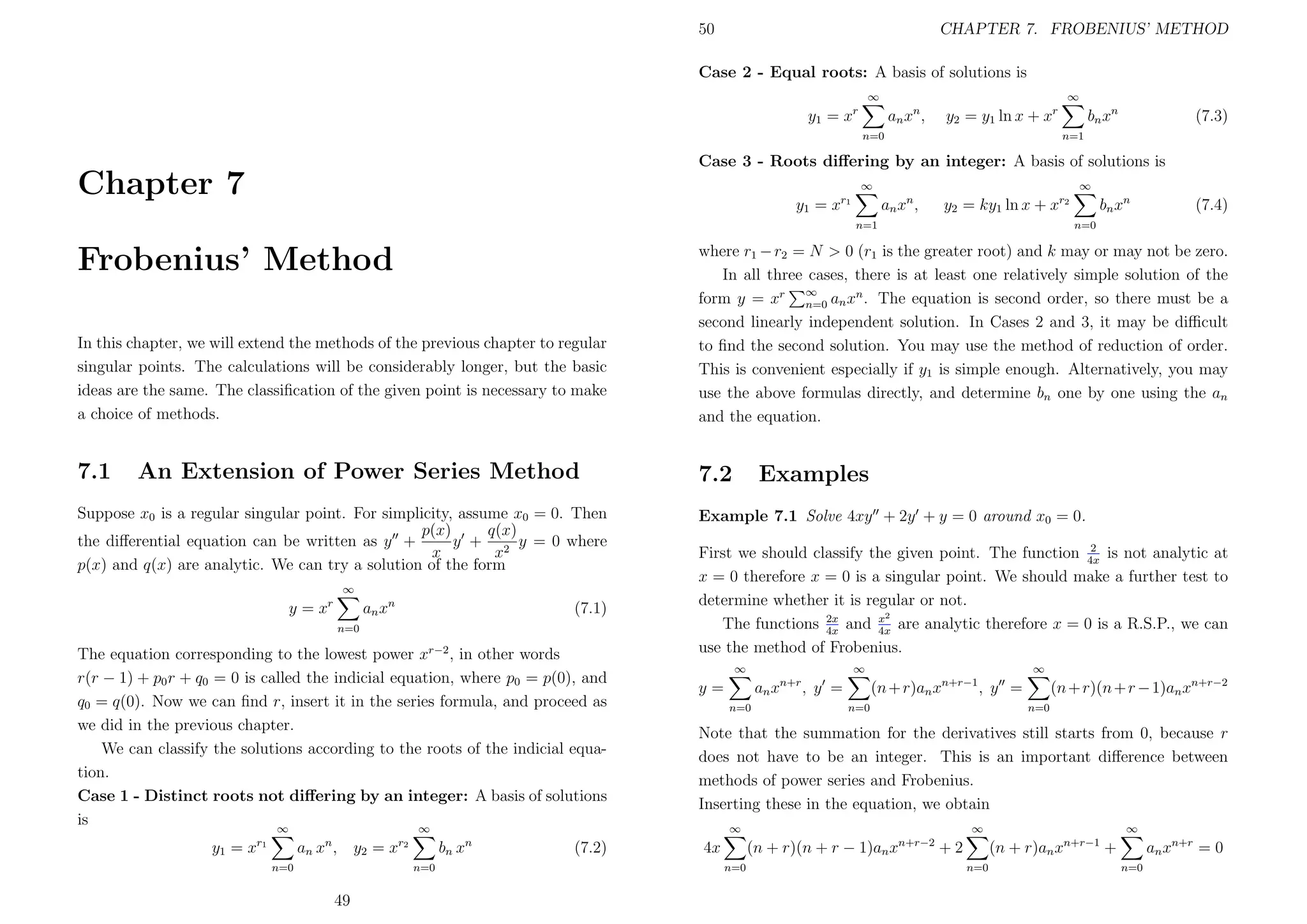
50

CHAPTER 7. FROBENIUS’ METHOD

Case 2 - Equal roots: A basis of solutions is
∞

∞

an x n ,

y 1 = xr

y2 = y1 ln x + xr

bn x n

(7.3)

n=1

n=0

Case 3 - Roots differing by an integer: A basis of solutions is

Chapter 7

∞

∞

an xn ,

y 1 = xr 1

bn x n

y2 = ky1 ln x + xr2

n=1

(7.4)

n=0

In this chapter, we will extend the methods of the previous chapter to regular
singular points. The calculations will be considerably longer, but the basic
ideas are the same. The classification of the given point is necessary to make
a choice of methods.

where r1 − r2 = N > 0 (r1 is the greater root) and k may or may not be zero.
In all three cases, there is at least one relatively simple solution of the
form y = xr ∞ an xn . The equation is second order, so there must be a
n=0
second linearly independent solution. In Cases 2 and 3, it may be difficult
to find the second solution. You may use the method of reduction of order.
This is convenient especially if y1 is simple enough. Alternatively, you may
use the above formulas directly, and determine bn one by one using the an
and the equation.

7.1

7.2

Frobenius’ Method

An Extension of Power Series Method

Suppose x0 is a regular singular point. For simplicity, assume x0 = 0. Then
p(x)
q(x)
the differential equation can be written as y +
y + 2 y = 0 where
x
x
p(x) and q(x) are analytic. We can try a solution of the form
∞

y = xr

an x n

(7.1)

n=0

The equation corresponding to the lowest power xr−2 , in other words
r(r − 1) + p0 r + q0 = 0 is called the indicial equation, where p0 = p(0), and
q0 = q(0). Now we can find r, insert it in the series formula, and proceed as
we did in the previous chapter.
We can classify the solutions according to the roots of the indicial equation.
Case 1 - Distinct roots not differing by an integer: A basis of solutions
is
∞
∞
y 1 = xr 1

an x n ,

y2 = xr2

bn x n
n=0

n=0

49

(7.2)

Examples

Example 7.1 Solve 4xy + 2y + y = 0 around x0 = 0.
2
First we should classify the given point. The function 4x is not analytic at
x = 0 therefore x = 0 is a singular point. We should make a further test to
determine whether it is regular or not.
x2
The functions 2x and 4x are analytic therefore x = 0 is a R.S.P., we can
4x
use the method of Frobenius.
∞

∞

an xn+r , y =

y=
n=0

∞

(n + r)an xn+r−1 , y =
n=0

(n + r)(n + r − 1)an xn+r−2
n=0

Note that the summation for the derivatives still starts from 0, because r
does not have to be an integer. This is an important difference between
methods of power series and Frobenius.
Inserting these in the equation, we obtain
∞

∞

(n + r)(n + r − 1)an xn+r−2 + 2

4x
n=0

∞

(n + r)an xn+r−1 +
n=0

an xn+r = 0
n=0
7.2. EXAMPLES

51

∞

∞

4(n + r)(n + r − 1)an x

n+r−1

∞

+

n=0

2(n + r)an x
n=0

n+r−1

an xn+r = 0

+

52

CHAPTER 7. FROBENIUS’ METHOD

For simplicity, we may choose a0 = 1. Then
an =

We want to equate the powers of x, so n → n + 1 in the first two terms.
∞

∞

∞

4(n + r + 1)(n + r)an+1 xn+r +
n=−1

2(n + r + 1)an+1 xn+r +
n=−1

an xn+r = 0

Therefore the second solution is :
∞

n=0

Now we can express the equation using a single sigma, but the index of the
common sigma must start from n = 0. Therefore we have to write n = −1
terms separately.
[4r(r−1)+2r]a0 xr−1 +

{[4(n + r + 1)(n + r) + 2(n + r + 1)]an+1 + an } xn+r = 0
n=0

We know that a0 = 0, therefore 4r2 − 2r = 0. This is the indicial equation.
Its solutions are r = 0, r = 1 . Therefore this is Case 1.
2
If r = 0, the recursion relation is

n=0

The general solution is y = c1 y1 + c2 y2

2

First we should classify the given point. The function x x−x is not analytic
2
at x = 0 therefore x = 0 is a singular point. The functions x − 1 and
1 + x are analytic at x = 0 therefore x = 0 is a R.S.P., we can use the
method of Frobenius. Evaluating the derivatives of y and inserting them in
the equation, we obtain

−1
1 an
4(n + 1)(n + 2 )

an+1 =

∞

For simplicity, we may choose a0 = 1. Then

n=0
∞

−

(n + r)an x

(−1)
2n!

y1 =
n=0

n=0

+

an x

n+r

∞

an xn+r+1 = 0

+

n=0

n=0

∞

∞

(n + r)(n + r − 1)an x
n=0
∞

n n

(n + r)an xn+r+1

+

Let’s replace n by n − 1 in the second and fifth terms.

Therefore the first solution is:
∞

n+r

∞
n+r

n=0

n

an =

∞

(n + r)(n + r − 1)an x

a0
a1
a0
a2
a0
a1 = − , a 2 = −
, a3 = −
,...
3 =
5 = −
2
4!
6!
4.2. 2
4.3. 2

−

√

(−1) x
= cos x
2n!

1
If r = , the recursion relation is
2

a1 = −

√
(−1)n xn
= sin x
(2n + 1)!

y2 = x1/2

Example 7.2 Solve x2 y + (x2 − x)y + (1 + x)y = 0 around x0 = 0.

∞

an+1 =

(−1)n
(2n + 1)!

n=0

−1
−an
an =
(2n + 3)(2n + 2)
4(n + 3 )(n + 1)
2

a0
a1
a0
a2
a0
, a2 = −
= , a3 = −
= − ,...
3.2
5.4
5!
7.6
7!

n+r

n=1

∞

(n + r)an x
n=0

n+r

an x

+
n=0

(n + r − 1)an−1 xn+r

+
n+r

∞

an−1 xn+r = 0

+
n=1

[r2 − 2r + 1]a0 xr +
∞

{[(n + r)(n + r − 1) − (n + r) + 1]an + [(n + r − 1) + 1]an−1 } xn+r = 0
n=1

The indicial equation is r2 − 2r + 1 = 0 ⇒ r = 1 (double root). Therefore
this is Case 2. The recursion relation is
an = −

n+1
an−1
n2
7.2. EXAMPLES

53

54

CHAPTER 7. FROBENIUS’ METHOD

Exercises

For simplicity, let a0 = 1. Then
3
3
4
2
a1 = −2, a2 = − a1 = , a3 = − a2 = −
4
2
9
3

Find two linearly independent solutions of the following differential equations in the form of series. Find solutions around the origin (use x0 = 0).
Write the solution in closed form if possible.
1) 2x2 y − xy + (1 + x)y = 0

Therefore the first solution is :
3
2
y1 = x 1 − 2x + x2 − x3 + · · ·
2
3

2) 2xy + (1 + x)y − 2y = 0

To find the second solution, we will use reduction of order. Let y2 = uy1 .
Inserting y2 in the equation, we obtain

3) (x2 + 2x)y + (3x + 1)y + y = 0
4) xy − y − 4x3 y = 0

2

2

2

x y1 u + (2x y1 − xy1 + x y1 )u = 0
Let w = u then

−2

To evaluate the integral u =

1−x+
w=
u=

1
x

⇒

w=

8) (2x2 + 2x)y − y − 4y = 0
xe−x
2
y1

9) 2x2 y + (2x2 − x)y + y = 0

1
w dx we need to find 2 . This is also a series.
y1

3
2
1 − 2x + x2 − x3 + · · ·
2
3

xe−x
=x
2
y1

7) x2 y + (x2 − x)y + y = 0

y1 1
+ − 1 dx
y1 x

ln w = −2 ln y1 + ln x − x

w=

6) 3x2 y + (−10x − 3x2 )y + (14 + 4x)y = 0

1
y
w + 2 1 − +1 w =0
y1 x
dw
=
w

1
1
= 2
2
y1
x

5) xy + y − xy = 0

−2

=

x2 x3
−
+ ···
2!
3!
1 + 3x +

1
x2

1
x2

1 + 4x + 9x2 +
1 + 4x + 9x2 +

11 2 13 3
x + x + ···
2
6

w dx = ln x + 3x +

11 2 13 3
x + x + ···
4
18

13
3
y2 = uy1 = y1 ln x + x 3x − x2 + x3 + · · ·
4
2

46 3
x + ···
3

46 3
x + ···
3

10) 4x2 y + (2x2 − 10x)y + (12 − x)y = 0
11) (x2 + 2x)y + (4x + 1)y + 2y = 0
Use Frobenius’ method to solve the following differential equations around
origin. Find the roots of the indicial equation, find the recursion relation,
and two linearly independent solutions.
12) (x2 + cx)y + [(2 + b)x + c(1 − d)]y + by = 0
(b = 0, c = 0, d is not an integer).
13) x2 y + [(1 − b − d)x + cx2 ]y + [bd + (1 − b)cx]y = 0
(c = 0, b − d is not an integer).
14) x2 y + [(1 − 2d)x + cx2 ]y + (d2 + (1 − d)cx)y = 0
(c = 0)
15) xy + [1 − d + cx2 ]y + 2cxy = 0
(c = 0, d is not an integer).
EXERCISES

55

∞

n=1

(−1)n xn
n! · 3 · 5 · 7 · · · (2n + 1)

1

1+
n=1

2) y = c1

(−1)n xn
n! · 1 · 3 · 5 · · · (2n − 1)

1
1 + 2x + x2
3

∞

+ c2 x

1
2

4) y = a0
n=0

1+
n=1

6
2
3) y1 = 1−x+ x2 − x3 +· · · ,
3
15
∞

n+b
an
c (n + 1 − d)
b
b(b + 1)
y1 = 1 −
x+ 2
x2 − · · ·
c(1 − d)
c (1 − d)(2 − d)

12) r = 0

∞

+ c2 x 2

(−1)n 3xn
2n n!(2n − 3)(2n − 1)(2n + 1)

3
15
35 3
y2 = x1/2 1 − x + x2 −
x + ···
4
32
128
2

x4
x6
x2
+
+
+ ···
22 (2 · 4)2 (2 · 4 · 6)2
x2
3x4
11x6
y2 = y1 ln x −
−
−
− ···
4
8 · 16 64 · 6 · 36

9
27 3
3
6) y1 = x7/3 1 + x + x2 +
x + ···
4
28
280
x2 x3
y 2 = x2 1 + x +
+
+ · · · = x2 e x
2!
3!
x
x
−
+ · · · = xe−x
2!
3!
x2
x3
y2 = xe−x ln x + xe−x x +
+
+ ···
2 · 2! 3 · 3!
1
1
1
y2 = x3/2 1 + x − x2 + x3 − · · ·
2
8
16
∞

y2 = x 1 +
n=1

(−1)n (2x)n
1 · 3 · 5 · · · (2n + 1)
∞

10) y1 = x2 e−x/2 ,

⇒

an+1 = −

y2 = x3/2 1 +
n=1

(−1)n xn
1 · 3 · 5 · · · (2n − 1)

an+1 = −

⇒

an = −

n+b+d
an
c (n + 1)
d+b
(d + b)(d + b + 1) 2
1−
x+
x − ···
c
2! c2

y 2 = xd

c
an−1
n+b−d

c2
c
x+
x2 − · · ·
1+b−d
(1 + b − d)(2 + b − d)
c
r = d ⇒ an = − an−1
n
c2 2 c3 3
y2 = xd 1 − c x + x − x + · · · = xd e−cx
2!
3!
y 1 = xb 1 −

c
an−1
n
c3
c2
1 − c x + x2 − x3 + · · ·
2!
3!

14) r = d (double root) an = −
y 1 = xd

3

7) y1 = x 1 − x +

8) y1 = 1 − 4x − 8x2 ,

r=d

2

OR y = c1 ex + c2 e−x

5) y1 = 1 +

2

⇒

13) r = b

∞

x4n
x4n+2
+ a2
,
(2n)!
(2n + 1)!
n=0

9) y1 = x1/2 e−x ,

CHAPTER 7. FROBENIUS’ METHOD

8
11) y1 = 1 − 2x + 2x2 − x3 + · · ·
5
5
35 2 105 3
1/2
1− x+
y2 = x
x −
x + ···
4
32
128

Answers
1) y = c1 x 1 +

56

y2 = xd e−cx

ecx
dx
x

y2 = xd e−cx ln x + xd e−cx cx +
15) r = 0

⇒

= xd e−cx

an+2 = −

c2 2
c3 3
x +
x + ···
2 · 2!
3 · 3!

c
an
(n + 2 − d)

c
c2
c3
x2 +
x4 −
x6 + · · ·
2−d
(2 − d)(4 − d)
(2 − d)(4 − d)(6 − d)
c
r = d ⇒ an+2 = −
an
n+2
c
c2 4
c3
y 2 = xd 1 − x2 +
x −
x6 + · · ·
2
2·4
2·4·6
y1 = 1 −
58

CHAPTER 8. LAPLACE TRANSFORM I

Example 8.1 Evaluate the Laplace transform of the following functions:
a) f (t) = 1
∞
0

Chapter 8

0

1
= ,
s

s>0

b) f (t) = eat
∞

Laplace Transform I

0

c) f (t) =
Laplace transform provides an alternative method for many equations. We
first transform the differential equation to an algebraic equation, then solve
it, and then make an inverse transform. Laplace transform has a lot of
interesting properties that make these operations easy. In this chapter, we
will see the definition and the basic properties. We will also compare this
method to the method of undetermined coefficients, and see in what ways
Laplace transform is more convenient.

0
1

if
if

∞
1

∞

e−st f (t)dt

(8.1)

0

then, the inverse transform will be
f (t) = L−1 {F (s)}

(8.2)

Note that we use lowercase letters for functions and capital letters for their
transforms.

57

=
0

1
, s>a
s−a

∞

=
1

e−s
,
s

s>0

d) f (t) = t
∞

te−st dt

L {t} =
0

Using integration by parts, we obtain

L {t} = −

The Laplace transform of a function f (t) is defined as:

e−st
−s

e−st dt =

L {f } =

Definition, Existence and Inverse of Laplace
Transform

∞

0<t<1
1 t

L {t} = −t

F (s) = L {f (t)} =

e(a−s)t
a−s

eat e−st dt =

L eat =

8.1

∞

e−st
−s

e−st dt =

L {1} =

e−st
s

∞

e−st
s2

∞

∞

+
0

0

=
0

e−st
dt
s

1
, s>0
s2

The integral that defines the Laplace transform is an improper integral,
it may or may not converge. In the above examples, the transform is defined
for a certain range of s.
In practice, we can use Laplace transform on most of the functions we
encounter in differential equations. The following definitions and the theorem
answer the question Which functions have a Laplace transform?
Piecewise Continuous Functions: A function f (t) is piecewise continuous
on [a, b] if the interval can be subdivided into subintervals [ti , tj ],
a = t0 < t1 < t2 · · · < tn = b such that f (t) is continuous on each interval
and has finite one-sided limits at the endpoints (from the interior).
An example can be seen on Figure 8.1.
8.2. PROPERTIES

59

60

CHAPTER 8. LAPLACE TRANSFORM I
• Transform of Derivatives
L {f }
L {f }
L f (n)

= sL {f } − f (0)
= s2 L {f } − sf (0) − f (0)
= sn L {f } − sn−1 f (0) − sn−2 f (0) − · · · − f (n−1) (0)

• Transform of Integrals
t

L

f (x) dx

=

0

F (s)
s

Example 8.2 Find the Laplace transform of sin at and cos at. Hint: Use
Euler’s formula eix = cos x + i sin x and linearity.
Figure 8.1: A piecewise continuous function
Exponential Order: f (t) is of exponential order as t → ∞ if there exist
real constants M, c, T such that |f (t)| M ect for all t T . In other words,
a function is of exponential order if it does not grow faster than ect .
Theorem 8.1: If f (t) is of exponential order and piecewise continuous on
[0, k] for all k > 0, then its Laplace transform exists for all s > c.
For example, all the polynomials have a Laplace transform. The function
t2
e does NOT have a Laplace transform.

8.2

Basic Properties of Laplace Transforms

It is difficult to evaluate the Laplace transform of each function by performing an integration. Instead of this, we use various properties of Laplace
transform.
Let L {f (t)} = F (s), then, some basic properties are: (assuming these
transforms exists)
• Linearity
L {af + bg} = aL {f } + bL {g}
• Shifting

L {eiat } − L {e−iat }
2i
1
1
1
a
L {sin at} =
−
= 2
2i s − ia s + ia
s + a2
Similarly, we can show that the transform of f (t) = cos at is
s
F (s) = 2
s + a2
1
Example 8.3 Find the inverse Laplace transform of F (s) =
.
(s + 5)2
Hint: Use shifting.
sin at =

eiat − e−iat
2i

We know that L−1

1
s2

L−1 {F (s − a)} = eat f (t)

L {sin at} =

= t. Therefore
1
(s + 5)2

L−1

= te−5t

Example 8.4 Find the Laplace transform of f (t) = t2 . Hint: Use Derivatives.
Using L {f } = sL {f } − f (0), we obtain
L {2t}
2
= 3
s
s
Example 8.5 Find the Laplace transform of f (t) = t3 . Hint: Use Integrals.
L {2t} = sL t2 − 0

⇒

L t2 =

Using the integral rule, we see that
L

L eat f (t) = F (s − a)

⇒

L {t2 }
2
= 4
s
s
6
L t3 = 4
s

t3
3

=
8.3. INITIAL VALUE PROBLEMS

8.3

61

Initial Value Problems

Consider the constant-coefficient equation
y + ay + by = r(t)

(8.3)

y(0) = p, y (0) = q

62

CHAPTER 8. LAPLACE TRANSFORM I

The only disadvantage is that, sometimes finding the inverse Laplace
transform is too difficult.
We have to find roots of the polynomial s2 + as + b, which is the same as
the characteristic polynomial we would encounter if we were using method
of undetermined coefficients.

(8.4)

with initial values

Here y is a function of t (y = y(t)). We can solve it by the method of undetermined coefficients. The method of Laplace transform will be an alternative
that is more efficient in certain cases. It also works for discontinuous r(t).
Let us evaluate the Laplace transform of both sides.

Example 8.6 Solve the initial value problem
y + 4y = 0, y(0) = 5, y (0) = 3.
Let’s start by finding the transform of the equation.
L {y } + 4L {y} = 0

L {y } + aL {y } + bL {y} = L {r(t)}

(8.5)

Using L {y} = Y (s) and L {r(t)} = R(s)
s2 Y − sp − q + a(sY − p) + bY = R

(8.6)

(s2 + as + b)Y = R + (s + a)p + q

s2 Y − 5s − 3 + 4Y = 0

⇒ (s2 + 4)Y = 5s + 3
5s + 3
Y = 2
s +4
Now, we have to find the inverse transform of Y to obtain y(t).

(8.7)

Y =
y = L−1

R + (s + a)p + q
s2 + as + b
R + sp + ap + q
s2 + as + b

(8.8)
(8.9)

Y =

5s
3 2
+
+ 4 2 s2 + 4

s2

3
sin 2t
2
Note that we did not first find the general solution containing arbitrary constants. We directly found the result.
y(t) = L−1 {Y } = 5 cos 2t +

Note that this method can be generalized to higher order equations. The
advantages compared to the method of undetermined coefficients are:
Example 8.7 Solve the initial value problem
• The initial conditions are built in the solution, we don’t need to determine constants after obtaining the general solution.
• There is no distinction between homogeneous and nonhomogeneous
equations, or single and multiple roots. The same method works in all
cases the same way.

y − 4y + 3y = 1,

y(0) = 0,

y (0) = −

Transform both sides:
L {y − 4y + 3y} = L {1}
Use the derivative rule

• The function on the right hand side r(t) belongs to a wider class. For
example, it can be discontinuous.

s2 Y − s.0 +

1
1
− 4(sY − 0) + 3Y =
3
s

1
3
8.3. INITIAL VALUE PROBLEMS
Isolate Y

63

3−s
1 1
− =
s 3
3s
s−3
(s − 1)(s − 3)Y = −
3s
1
1 1
1
=
−
Y =−
3s(s − 1)
3 s s−1

64

CHAPTER 8. LAPLACE TRANSFORM I

(s2 − 4s + 3)Y =

f (t)

F (s)

f (t)

F (s)

1

1
s

eat − ebt
a−b

1
(s − a)(s − b)

t

1
s2

aeat − bebt
a−b

s
(s − a)(s − b)

n!

eat sin bt

b
(s − a)2 + b2
s−a
(s − a)2 + b2

Find the inverse transform
y(t) = L−1 {Y } =

1 1 t
− e
3 3

As you can see, there’s no difference between homogeneous and nonhomogeneous equations. Laplace transform works for both types in the same way.

tn

sn+1

eat

Example 8.8 Solve the initial value problem
y + 4y + 4y = 42te−2t , y(0) = 0, y (0) = 0

1
s−a

eat cos bt

teat

1
(s − a)2
a
s 2 + a2
s
s 2 + a2

tn eat

−2t

L {y } + 4L {y } + 4L {y} = 42L te
1
s2 Y + 4sY + 4Y = 42 ·
(s + 2)2
42
(s2 + 4s + 4)Y =
(s + 2)2
42
Y =
(s + 2)4

sin at
cos at

sinh at
cosh at

n!
(s − a)n+1
a
s 2 − a2
s
s 2 − a2

42 3 −2t
te
3!

2as
(s2 + a2 )2

t sinh at

2as
(s2 − a2 )2

t cos at

s 2 − a2
(s2 + a2 )2

t cosh at

s 2 + a2
(s2 − a2 )2

sin at − at cos at

y(t) = L−1 {Y (s)} =

t sin at

2a3
(s2 + a2 )2

sin at + at cos at

2as2
(s2 + a2 )2

y(t) = 7t3 e−2t
If you try the method of undetermined coefficients on this problem, you will
appreciate the efficiency of Laplace transforms better.

Table 8.1: A Table of Laplace Transforms
EXERCISES

65

Exercises

3) f (t) = 2e−t cos2 t

4) f (t) = (t + 1)2 et

5) f (t) = t3 e3t

6) f (t) =

7) f (t) =

CHAPTER 8. LAPLACE TRANSFORM I

Answers

Find the Laplace transform of the following functions:
t
2) f (t) = et sin 3t
1) f (t) = cos2 2

t 0<t<a
0
a<t

66

1 0<t<a
0
a<t


 t 0<t<a

8) f (t) =
1 a<t<b


0
b<t

1) F (s) =
2) F (s) =
3) F (s) =
4) F (s) =
5) F (s) =

1
s
+ 2
2s 2s + 2
3
(s − 1)2 + 9
1
s+1
+
s + 1 s2 + 2s + 5
2
2
1
+
+
(s − 1)3 (s − 1)2 s − 1
6
(s − 3)4

1 − e−as
s
1
ae−as e−as
7) F (s) = 2 −
− 2
s
s
s
−as
−as
1−e
e
− ae−as − e−bs
8) F (s) =
+
s2
s
9) f (t) = cosh 2t − 2 sinh 2t
6) F (s) =

Find the inverse Laplace transform of the following functions:
s−4
9) F (s) = 2
s −4
3
10) F (s) =
(s − 2)2
6
11) F (s) =
s(s + 4)
1
12) F (s) =
s(s2 + 9)
1
13) F (s) = 2
s (s + 1)
5s + 1
14) F (s) = 2
s +4
15) F (s) =

1
s+8

1
16) F (s) =
(s − a)n
Solve the following initial value problems using Laplace transform:
17) y − 2y + y = 0,
y(0) = 4, y (0) = −3
18) y − 2y + 2y = 0, y(0) = 0, y (0) = 1
19) y + 2y = 4t2 + 12, y(0) = 4, y (0) = 0
20) y + 6y + 9y = e−3t , y(0) = 0, y (0) = 0

10) f (t) = 3te2t
11) f (t) = (3 − 3e−4t )/2
12) f (t) = (1 − cos 3t)/9
13) f (t) = e−t + t − 1
1
14) f (t) = 5 cos 2t + sin 2t
2
−8t
15) f (t) = e
16) f (t) =

tn−1 eat
(n − 1)!

17) y(t) = 4et − 7tet
18) y(t) = et sin t
19) y(t) = 4 + 2t2
1
20) y(t) = e−3t t2
2
68

CHAPTER 9. LAPLACE TRANSFORM II

Reversing the order of integration, we obtain:
∞

∞

f (x) g(t − x)e−st dt dx

=
0

x

Making the substitution u = t − x, we obtain:
∞

∞

f (x) g(u)e−su−sx dudx

L {f ∗ g} =

Chapter 9

0

∞

0

∞
0

0

Laplace Transform II

g(u)e−su du

f (x)e−sx dx

=

=F (s) G(s)
Example 9.1 Find the inverse Laplace transform of F (s) =

In this chapter, we will study more advanced properties of Laplace transform.
At the end, we will be able to find transform and inverse transform of a wider
range of functions. This will enable us to solve almost any linear constant
coefficient equation, including discontinuous inputs.

9.1

L−1

1
s2

1
s+4

= t, L−1

t

(9.1)

0

The convolution operation is commutative, in other words f ∗ g = g ∗ f
Theorem 9.1: The transform of convolution of two functions is equal to
the product of their transforms, i.e.
L {f ∗ g} = F (s) · G(s)
−1

L

{F (s) · G(s)} = f ∗ g

where L {f } = F (s) and L {g} = G(s).
Proof: Using the definitions of convolution and Laplace transform,
t

L {f ∗ g} =L

f (x) g(t − x) dx
0
∞

t

f (x) g(t − x)e−st dx dt

=
0

0

67

L−1

1
1
·
2 s+4
s

(9.2)
(9.3)

= t ∗ e−4t

xe−4(t−x) dx
0

xe4x e4x
−
4
16
−4t
t
1
e
= −
+
4 16
16

t

= e−4t

0

Example 9.2 Find the inverse Laplace transform of F (s) =

The convolution of two functions f and g is defined as
f (x)g(t − x) dx

⇒

1
.
+ 4s2

t

f (t) = t ∗ e−4t =

Convolution

h(t) = (f ∗ g)(t) =

= e−4t

s3

s
.
(s2 + 1)2

s
1
· 2
= L {cos t} · L {sin t},
+ 1) (s + 1)
we will see that f (t) = L−1 {F } = cos t ∗ sin t.
If we express F as F (s) =

(s2

t

cos(x) sin(t − x) dx

f (t) =
0
t

=
0

1
=
2
=

1
[sin(t − x + x) + sin(t − x − x)] dx
2
t

[sin(t) + sin(t − 2x)] dx
0

1
cos(t − 2x)
x sin t +
2
2

t
0

1
1
= t sin t + (cos t − cos t)
2
2
1
= t sin t
2
9.2. UNIT STEP FUNCTION

9.2

69

70

CHAPTER 9. LAPLACE TRANSFORM II

Unit Step Function

∞

e−st f (t)dt

F (s) =
The Heaviside step function (or unit step function) is defined as

0

F (s) =
ua (t) = u(t − a) =

0
1

if
if

t<a
t a

(9.4)

This is a simple on off function. It is especially useful to express discontinuous inputs.

Theorem 9.2: [t−shifting] Let L {f (t)} = F (s), then
(9.5)

Proof: Using the definition,
∞

e−st f (t − a) u(t − a) dt
∞

e−st f (t − a) dt
a

∞

e−sa−sx f (x) dx

=
0
−as

=e

( where x = t − a)

F (s)

Example 9.3 Find the Laplace transform of g(t) =

0
t

if
if

t<5
t 5

We can express g(t) as g(t) = u(t − 5)f (t − 5) where f (t) = (t + 5). Then
F (s) = L {f (t)} =

9.3

In other words
L {tf (t)} = −F (s)

5
1
+
2
s
s

⇒

(9.7)

Repeating this procedure n times, we obtain:
dn
F (s)
dsn

Using the derivative formula, we find
L {t sin t} = −

=

f (t)dt

0

Example 9.4 Find the Laplace transform of f (t) = t sin t.

L {f (t − a) u(t − a)} = e−as F (s)

0

(−t)e

−st

L {tn f (t)} = (−1)n

Figure 9.1: u(t − a) and its effect on f (t)

L {f (t − a) u(t − a)} =

(9.6)

∞

L {g(t)} = e−5s

1
5
+
2
s
s

Differentiation of Transforms

If f (t) is piecewise continuous and of exponential order, then we can differentiate its Laplace transform integral.

d
ds

1
1 + s2

=

2s
(1 + s2 )2

(9.8)
9.4. PARTIAL FRACTIONS EXPANSION

9.4

71

Partial Fractions Expansion

CHAPTER 9. LAPLACE TRANSFORM II

9.5

In many applications of Laplace transform, we need to expand a rational
function in partial fractions. Here, we will review this technique by examples.
2x + 1
A
B
C
=
+
+
(x − 2)(x + 3)(x − 1)
x−2 x+3 x−1
2
x + 4x − 5
B
C
A
D
+
+
=
+
(x − 2)(x − 1)3
x − 2 x − 1 (x − 1)2 (x − 1)3
x3 + 1
Dx + E
A Bx + C
+ 2
+ 2
=
2 + 4)2
x(x
x
x +4
(x + 4)2
3
A
B
x3 − 4x2 + x + 9
= x+1+ 2
=x+1+
+
x2 − 5x + 6
x − 5x + 6
x−2 x−3
• We can express any polynomial as a product of first and second order
polynomials.
• For second order polynomials in the expansion, we have to use Ax + B
(not simply a constant) in the numerator.
• If numerator’s degree is greater or equal to the denominator, we should
first divide them using polynomial division.
2

Example 9.5 Find the inverse Laplace transform of F (s) =

72

−s + 7s − 1
.
(s − 2)(s − 5)2

Applications

Now we are in a position to solve a wider class of differential equations using
Laplace transform.

Example 9.6 Solve the initial value problem
y − 6y + 8y = 2e2t , y(0) = 11, y (0) = 37
We will first find the Laplace transform of both sides, then find Y (s)
L {y } − 6L {y } + 8L {y} = L 2e2t

s2 Y − 11s − 37 − 6(sY − 11) + 8Y =
(s2 − 6s + 8)Y =

−s2 + 7s − 1 = A(s − 5)2 + B(s − 2)(s − 5) + C(s − 2)
Inserting s = 2, we see that 9 = 9A ⇒ A = 1.
Inserting s = 5, we see that 9 = 3C ⇒ C = 3.
The coefficient of s2 : A + B = −1 therefore B = −2. So
1
−s2 + 7s − 1
2
3
=
−
+
2
(s − 2)(s − 5)
s − 2 s − 5 (s − 5)2
Now we can easily find the inverse Laplace transform:
L−1 {F (s)} = e2t − 2e5t + 3te5t

2
+ 11s − 29
s−2

The factors of s2 − 6s + 8 are (s − 2) and (s − 4), so
Y =

2
11s − 29
+
(s − 2)(s − 2)(s − 4) (s − 2)(s − 4)
Y =

First, we have to express F (s) in terms of simpler fractions:
−s2 + 7s − 1
A
B
C
=
+
+
(s − 2)(s − 5)2
s − 2 s − 5 (s − 5)2

2
s−2

11s2 − 51s + 60
(s − 2)2 (s − 4)

Now we need to find the inverse Laplace transform. Using partial fractions
expansion
Y =

A
C
B
+
+
2
s − 2 (s − 2)
s−4

After some algebra we find that A = 3, B = −1, C = 8 so
Y (s) =

8
1
3
−
+
2
s − 2 (s − 2)
s−4

y(t) = L−1 {Y (s)} = 3e2t − te2t + 8e4t
9.5. APPLICATIONS

73

Example 9.7 Solve the initial value problem

74

CHAPTER 9. LAPLACE TRANSFORM II

Example 9.8 Solve the initial value problem

y + y = f (t), y(0) = 0, y (0) = 3
where f (t) =

0
2 cos t

if
if

0 < t < 5π
5π < t

y + 2y + y = r(t), y(0) = 0, y (0) = 0
where r(t) =

As you can see, the input function is discontinuous, but this makes no
difference for Laplace transform.
L {y } + L {y} = L {f }

t
0

if
if

0<t<1
1<t

Once again we have a discontinuous input. This time we will use unit
step function. First, we have to express r(t) with a single formula.
r(t) = t − u(t − 1)t = t − u(t − 1)(t − 1) − u(t − 1)

2

s Y −3+Y =F
F +3
Y = 2
s +1
1
Using the fact that L {sin t} = 2
, we can obtain y(t) by convolution:
s +1
y(t) = L−1 {Y } = f (t) ∗ sin t + 3 sin t

Its Laplace transform is
R(s) = L {r(t)} =

Finding the Laplace transform of the equation, we obtain
(s2 + 2s + 1)Y = R

Using the definition of convolution,
t

f ∗ sin t =

Y =

f (x) sin(t − x) dx
0

If t < 5π, f = 0 therefore this integral is also zero. If t > 5π we have

Y =

t

f ∗ sin t =

1
e−s e−s
− 2 −
2
s
s
s

2 cos x sin(t − x) dx

s2 (s

R
(s + 1)2

1
e−s
− 2
2
+ 1)
s (s + 1)

Using partial fractions expansion

5π

Using the trigonometric identity 2 sin A cos B = sin(A + B) + sin(A − B) we
obtain
t
f ∗ sin t =

sin t + sin(t − 2x) dx

2
1
2
1
1
1
1
Y =− + 2 +
+
− e−s − + 2 +
s s
s + 1 (s + 1)2
s s
s+1
Using the fact that L−1 {e−as F (s)} = f (t − a)u(t − a), we obtain

5π

=

x sin t +

cos(t − 2x)
2

t
5π

= (t − 5π) sin t
Therefore

y(t) = −2 + t + 2e−t + te−t − u(t − 1) −1 + (t − 1) + e−(t−1)
We know that u(t − 1) = 0 for t > 1 and u(t − 1) = 1 for t > 1 so
y(t) =

y(t) =

3 sin t
(t − 5π + 3) sin t

if
if

0 < t < 5π
5π < t

−2 + t + 2e−t + te−t
(2 − e)e−t + te−t

if
if

0<t<1
1<t
EXERCISES

75

Exercises

1) F (s) =

3

s+3
(s2 + 4)2

8) F (s) =

2

2) F (s) =

s
s4 + 4a4

10) F (s) =

sin 4t − 4t cos 4t
128
4t sin 2t + 3 sin 2t − 6t cos 2t
7) f (t) =
16
1
t
9) f (t) = sin 2t + cos 2t
4
2
5) f (t) =

6) f (t) =

10) f (t) = e2t + 2 cos 3t +

12) y = 3 cos t + (4 + t) sin t
13) y = −25 + 8t2

Solve the following initial value problems : (where y = y(t))

1 −t
e − et cos t + 7et sin t
5
15) y = t − sin t
14) y =

11) y − y − 2y = 0, y(0) = 8, y (0) = 7
12) y + y = 2 cos t, y(0) = 3, y (0) = 4
13) y + 0.64y = 5.12t2 , y(0) = −25, y (0) = 0

1
0 < t < 2π
cos t
2π < t

16) y =

14) y − 2y + 2y = e−t , y(0) = 0, y (0) = 1
15) y + y = t, y(0) = 0, y (0) = 0
16) y + y = r(t), y(0) = 1, y (0) = 0 where r(t) =

1
0

if
if

0 < t < 2π
2π < t

5
0

if
if

17) y + y = e−2t sin t, y(0) = 0, y (0) = 0
18) y +2y +5y = r(t), y(0) = 0, y (0) = 0 where r(t) =

0<t<π
π<t

19) 4y + 4y + 17y = g(t), y(0) = 0, y (0) = 0
sin t
0

if
if

0 < t < 3π
1
7
, y(0) = , y (0) = −
50
50
3π < t

1
1
17) y = (sin t − cos t) + e−2t (sin t + cos t)
8
8


 1 − e−t cos 2t + sin 2t , 0 < t < π

2
18) y =
 −t π
 e (e − 1) cos 2t + sin 2t
π<t

2
19) y =

1
8




t

1

e− 2 (t−x) sin 2(t − x)g(x) dx
0

1
(cos t − 7 sin t)
50
20) y =
1 −9π 3t
2


e e − e6π e−2t
50
50

1 e−t e−3t
−
+
3
2
6

8) f (t) = cosh at cos at

11) y = 3e−t + 5e2t

3s − 2s + 5
(s − 2)(s2 + 9)

12s2 − 16
(s2 + 4)3

4) f (t) = u(t − 1) cos(2t − 2)

2

s
(s2 + 4)2

20) y − y − 6y =

s2 + 2s
(s2 + 2s + 2)2

3) f (t) = u(t − 3) sin(t − 3)

Find the inverse Laplace transform transform of the following functions:
se−s
e−3s
4) F (s) = 2
3) F (s) = 2
s +1
s +4
1
1
5) F (s) = 2
6) F (s) = 3
2
(s + 16)
s + 4s2 + 3s

9) F (s) =

CHAPTER 9. LAPLACE TRANSFORM II

Answers

Find the Laplace transform transform of the following functions:
1) f (t) = te−t cos t
2) f (t) = t2 sin 2t

7) F (s) =

76

if

0 < t < 3π

if

3π < t

2
sin 3t
3
78

CHAPTER 10. FOURIER ANALYSIS I

L

cos

nπx
mπx
cos
dx = 0 (m = n)
L
L

(10.3)

sin

nπx
mπx
sin
dx = 0 (m = n)
L
L

(10.4)

−L
L

Chapter 10

−L
L

cos2

Fourier Analysis I

−L

−L

nπx
mπx
sin
dx = 0 (for all m, n)
L
L
77

kπx
dx =
L

L

a0 cos
−L
∞

+
+

(10.1)

(10.2)

kπx
dx
L

L

cos

nπx
kπx
cos
dx
L
L

sin

an

nπx
kπx
cos
dx
L
L

−L

n=1
∞

∞

If possible, this expansion would be very useful in all kinds of applications.
Once we solve a question for sine and cosine functions, we will be able to
solve it for any periodic f . Here, an and bn are the coordinates of f in the
space of sine and cosine functions. But then how can we find an and bn ? The
following identities will help us:

(10.6)

Now, suppose the expansion (10.1) exists. To find ak , we will multiply
both sides by cos kπx and then integrate from −L to L.
L
L

nπx
nπx
f (x) = a0 +
an cos
+
bn sin
L
L
n=1
n=1

−L

(10.5)

2 cos A sin B = sin(A + B) − sin(A − B)

Let f (x) be a periodic function with period 2L. It is sufficient that f be
defined on [−L, L]. Is it possible to express f as a linear combination of sine
and cosine functions?

cos

−L

nπx
dx = L
L

2 sin A sin B = cos(A − B) − cos(A + B)

f (x) cos

L

sin2

2 cos A cos B = cos(A − B) + cos(A + B)

Fourier Series

∞

L

In the terminology of linear algebra, the trigonometric functions form
an orthogonal coordinate basis. We can easily prove these formulas if we
remember the following trigonometric identities:

The trigonometric functions sine and cosine are the simplest periodic functions. If we can express an arbitrary periodic function in terms of these,
many problems would be simplified. In this chapter, we will see how to
find the Fourier series of a periodic function. Fourier series is important in
many applications. We will also need them when we solve partial differential
equations.

10.1

nπx
dx =
L

L

bn
n=1

−L

(10.7)

Using the property of orthogonality, we can see that all those integrals
are zero, except the kth one. Therefore

L

f (x) cos
−L

kπx
dx = ak L
L

⇒

ak =

1
L

L

f (x) cos
−L

kπx
dx
L

(10.8)

We can apply the same procedure to find a0 and bn . In the end, we will
obtain the following formulas for a function f defined on [−L, L].
10.1. FOURIER SERIES

79

a0 =
Fourier coefficients:

an =
bn =

1
2L
1
L
1
L

CHAPTER 10. FOURIER ANALYSIS I

L

f (x) dx
−L
L

f (x) cos

nπx
dx
L

f (x) sin

nπx
dx
L

−L
L
−L

(10.9)

∞

∞

Fourier series: f (x) = a0 +

80

an cos
n=1

nπx
nπx
+
bn sin
L
L
n=1

(10.10)

Example 10.1 Find the Fourier series of the periodic function
f (x) = x2 , −L x L having period= 2L.

a0 =
=

1
2L

L

x2 dx
−L
3 L

1 x
2L 3

=
−L

L2
3

Using integration by parts two times we find:
an =

=
bn =

1
L

L

x2 cos
−L

nπx
dx
L

4L2 cos nπ
n2 π 2
1
L

L

x2 sin
−L

nπx
dx = 0
L

Therefore the Fourier series is:
∞

x2 =

4L2
nπx
L2
+
(−1)n 2 2 cos
3
nπ
L
n=1

The plot of the Fourier series up to n = 1, 2 and 3 is given in Figure 10.1.
Figure 10.1: Fourier Series of f = x2 for n = 1, 2, 3
10.2. CONVERGENCE OF FOURIER SERIES

10.2

81

82

CHAPTER 10. FOURIER ANALYSIS I

Convergence of Fourier Series

Like any infinite series, Fourier series is of no use if it is divergent. But
most functions that we are interested in have Fourier series that converge
and converge to the function.
Theorem 10.1: Let f be periodic with period 2L and let f and f be
piecewise continuous on the interval [−L, L]. Then the Fourier expansion of
f converges to:
• f (x) if f is continuous at x.
f (x+ ) + f (x− )
if f is discontinuous at x.
2
Example 10.2 Find the Fourier series of the periodic function
•

a
b

f (x) =

Figure 10.2: Convergence at a discontinuity

10.3

Theorem 10.2: Let f be continuous on [−L, L], f (L) = f (−L) and let f
be piecewise continuous. Then the Fourier coefficients of f satisfy:
∞

2a2 +
0

having period= 2L. Then evaluate the series at x = L.

a0 =

1
2L

a dx +
−L

1
2L

L

b dx =
0

a+b
2

L

1
L

f (x)2 dx

∞

f 2 (x) = a0 f (x) +

∞

L

f 2 (x) dx = a0

f (x) dx +
−L

∞
n=1

an cos nπx +
L

bn =

1
L

0

nπx
1
a cos
dx +
L
L
−L
0

a sin
−L

nπx
1
dx +
L
L

a L
nπx
=−
cos
L nπ
L

0

L
0

n=1

∞

L

an

f (x) cos
−L

nπx
bn
dx +
L
n=1

b sin
0

L
0

b−a
=
(1 − (−1)n )
nπ

Therefore the Fourier series is:
∞
a+b
b−a
nπx
+
[1 − (−1)n ] sin
f (x) =
2
nπ
L
n=1
a + b 2(b − a)
+
2
π

πx 1
3πx 1
5πx
+ sin
+ sin
+ ···
L
3
L
5
L
a+b
If we insert x = L in that series, we obtain f (L) =
. Thus the value at
2
discontinuity is the average of left and right limits. The summation of the
series up to n = 1, 5 and 9 is plotted on Figure 10.2.
=

f (x) sin
−L

1
1
1
= 1 + 4 + 4 + ···
4
n
2
3
n=1
2
(Hint: Use the Fourier series of f (x) = x on the interval −π < x < π)

Example 10.3 Find the sum of the series S =

nπx
dx
L

b L
nπx
−
cos
L nπ
L
−L

L

Using equation (10.9) to evaluate these integrals, we can obtain the result.

nπx
b cos
dx = 0
L

L

sin nπx .
L

nπx
nπx
+
bn f (x) sin
L
L
n=1

∞

1
an =
L

∞
n=1 bn

∞

an f (x) cos
n=1

L

(10.11)

−L

Proof: We can express f (x) as f (x) = a0 +
Now multiply both sides by f and integrate

−L
0

(a2 + b2 ) =
n
n
n=1

−L < x < 0
0<x<L

if
if

Parseval’s Identity

Evaluating the integrals in (10.9) for f (x) = x2 we obtain
π2
4(−1)n
and bn = 0 so
a0 = , a n =
3
n2
f (x) =

1
π2
1
− 4 cos x − cos 2x + cos 3x − · · ·
3
4
9

Using Parseval’s theorem, we have

sin

1
2π 4
1
+ 16 1 + 4 + 4 + · · ·
9
2
3

Therefore

1 π 4
x dx
π −π
2
= π4
5

=

nπx
d
L
10.3. PARSEVAL’S IDENTITY

1
1
2 2
−
16 1 + 4 + 4 + · · · = π 4
2
3
5 9
1
1
π4
S = 1 + 4 + 4 + ··· =
2
3
90

83

84

CHAPTER 10. FOURIER ANALYSIS I

Exercises
Find the Fourier series of the periodic function f (x) defined on the given
interval

1) f (x) = x, −π < x < π
3) f (x) =

0
1

2) f (x) = x, 0 < x < 2π

−π < x < 0
0<x<π

if
if

5) f (x) = sin2 x, −π < x < π
7) f (x) =

−π/4
π/4

if
if

−1 < x < 0
0<x<1

9) f (x) = |x|, −2 < x < 2
11) f (x) =

x
1−x

if
if

4) f (x) = x2 , 0 < x < 2π
6) f (x) = x + |x|, −π < x < π
8) f (x) =

π
x

if
if

10) f (x) = | sin x|, −π < x < π
0<x<1
1<x<2

13) f (x) = ax + b, −L < x < L
15) f (x) = x3 , −π < x < π

12) f (x) =

−a
a

1
π2
1
+
+ ··· = .
9 25
8

−L < x < 0
0<x<L

16) f (x) = ex , −π < x < π

x sin ax cos ax
+
a
a2
x cos ax sin ax
+
x sin ax dx = −
a
a2
2
x sin ax 2x cos ax 2 sin ax
x2 cos ax dx =
+
−
a
a2
a3
2
x cos ax 2x sin ax 2 cos ax
x2 sin ax dx = −
+
+
a
a2
a3
x cos ax dx =

if
if

14) f (x) = 1 − x2 , −1 < x < 1

17) Using integration by parts, show that:

18) Show that 1 +

−π < x < 0
0<x<π
EXERCISES

85

Answers
1
1
sin 2x + sin 3x − · · ·
2
3

2) f (x) = π − 2 sin x +

1
1
sin 2x + sin 3x + · · ·
2
3
1
1
sin x + sin 3x + sin 5x + · · ·
3
5

4π 2
1
1
+ 4 cos x + cos 2x + cos 3x + · · ·
3
4
9
−4π sin x +

5) f (x) =
6) f (x) =

π
4
−
2 π

1
1
sin 2x + sin 3x + · · ·
2
3

1 1
− cos 2x
2 2
cos x +

+2 sin x −
7) f (x) = sin πx +

1
1
cos 3x +
cos 5x + · · ·
9
25

1
1
1
sin 2x + sin 3x − sin 4x + · · ·
2
3
4

1
1
sin 3πx + sin 5πx + · · ·
3
5

∞

3π
(−1)n − 1
1
+
cos nx − sin nx
2
4
πn
n
n=1

9) f (x) = 1 −
10) f (x) =

8
π2

cos

2
4
−
π π

11) f (x) = −
+

4
π2
2
π

sin

13) f (x) = b +

2aL
π

14) f (x) =

2
4
+ 2
3 π

πx 1
3πx 1
5πx
+ sin
+ sin
+ ···
L
3
L
5
L
sin

∞

n=1

3πx
1
5πx
πx 1
+ cos
+
cos
+ ···
2
9
2
25
2
cos 2nx
4n2 − 1

cos πx +
sin πx +

1
1
cos 3πx +
cos 5πx + · · ·
9
25

1
sin 3πx + · · ·
3

(−1)n+1

15) f (x) = 2
n=1

πx
1
2πx 1
3πx
− sin
+ sin
− ···
L
2
L
3
L

cos πx −

∞

∞

1 − (−1)n
1 2
1
sin nx = +
3) f (x) = +
2 n=1
nπ
2 π

8) f (x) =

CHAPTER 10. FOURIER ANALYSIS I
4a
π

12) f (x) =

1) f (x) = 2π sin x −

4) f (x) =

86

1
1
cos 2πx + cos 3πx + · · ·
4
9

(nπ)2 − 6
sin nx
n3
∞

16) f (x) =

2 sinh π 1
(−1)n
+
(cos nx − n sin nx)
π
2 n=1 1 + n2

18) Use the function in exercise 12 in Parseval’s identity
88

CHAPTER 11. FOURIER ANALYSIS II
Figure 11.1: Plots of Some Even and Odd Functions

Chapter 11
Fourier Analysis II
In this chapter, we will study more advanced properties of Fourier series. We
will find the even and odd periodic extensions of a given function, we will
express the series using complex notation and finally, we will extend the idea
of Fourier series to nonperiodic functions in the form of a Fourier integral.

As you can see in Figure 11.1, an even function is symmetric with respect
to y−axis, an odd function is symmetric with respect to origin.
Half Range Extensions: Let f be a function defined on [0, L]. If we want
to expand it in terms of sine and cosine functions, we can think of it as
periodic with period 2L. Now we need to define f on the interval [−L, 0].
There are infinitely many possibilities, but for simplicity, we are interested
in making f an even or an odd function. If we define f for negative x
values as f (x) = f (−x), we obtain the even periodic extension of f , which
is represented by a Fourier cosine series. If we define f for negative x values
as f (x) = −f (−x), we obtain the odd periodic extension of f , which is
represented by a Fourier sine series.
Half-Range Cosine Expansion: (or Fourier cosine series)
∞

f (x) = a0 +

11.1

n=1

Fourier Cosine and Sine Series

If f (−x) = f (x), f is an even function. If f (−x) = −f (x), f is an odd
function. We can easily see that, for functions:
even × even = even,

odd × odd = even,

even × odd = odd

For example |x|, x2 , x4 , cos x, cos nx, cosh x are even functions. x, x3 , sin x, sin nx, sinh x
are odd functions. ex is neither even nor odd.
L

L

If f is even:

f (x) dx

f (x) dx = 2
−L
L

If f is odd:

(11.1)

0

f (x) dx = 0

(11.2)

−L

Using the above equations, we can see that in the Fourier expansion of an
even function, bn = 0, and in the expansion of an odd function, an = 0. This
will cut our work in half if we can recognize the given function as odd or
even.
87

an cos

where a0 =

1
L

nπx
, (0 < x < L)
L

L

f (x) dx,
0

an =

2
L

L

f (x) cos
0

nπx
dx
L

(11.3)

(11.4)
11.1. FOURIER COSINE AND SINE SERIES

89

∞

bn sin
n=1

nπx
, (0 < x < L)
L

CHAPTER 11. FOURIER ANALYSIS II

11.2

Half-Range Sine Expansion: (or Fourier sine series)
f (x) =

90

(11.5)

Complex Fourier Series

Consider the Fourier series of f (x):
∞

∞

f (x) = a0 +

where

L

2
L

bn =

f (x) sin
0

nπx
dx
L

0

f (x) =

bn sin nx

(11.7)

n=1

Using Euler’s formula eix = cos x + i sin x we can express the sine and cosine
functions as:

0<x< π
2
π
<x<π
2

if
if

π
2

n=1

(11.6)

Example 11.1 Find the half-range cosine and sine expansions of

an cos nx +

cos nx =

einx + e−inx
,
2

sin nx =

einx − e−inx
2i

(11.8)

an + ibn
2

(11.9)

Therefore
Here, L = π, therefore
1
a0 =
π
2
π

an =

π
π
2

π
π
2

sin nx
=
n

π
2

einx +

e−inx

If we define c0 = a0 and

π
cos nx dx
2
π

an − ibn
2

an cos nx + bn sin nx =

π
π
dx =
2
4

cn =

nπ
2

sin
=−
n

an + ibn
an − ibn
, c−n =
, n = 1, 2, 3, . . .
2
2

(11.10)

We will obtain
∞

cn einx

(11.11)

f (x)e−inx dx n = 0, ±1, ±2, . . .

(11.12)

f (x) =

Therefore half-range cosine series of f is

n=−∞
∞

sin nπ
π
π
1
1
2
f (x) = −
cos nx = − cos x − cos 3x + cos 5x − · · ·
4 n=1 n
4
3
5

where
cn =

On the other hand,
2
bn =
π

π
π
2

π
sin nx dx
2

− cos nx
=
n

π
π
2

cos nπ − cos nπ
2
=
n

Therefore half-range sine series of f is
∞

f (x) =
n=1

cos nπ − cos nπ
1
1
2
sin nx = sin x − sin 2x + sin 3x + sin 5x + · · ·
n
3
5

1
2π

π
−π

For a function of period 2L we have
∞

cn einπx/L ,

f (x) =

cn =

n=−∞

1
2L

L

f (x)e−inπx/L dx
−L

Example 11.2 Find the complex Fourier series of
f (x) = x if −π < x < π and f (x + 2π) = f (x).
We have to evaluate the integral
cn =

1
2π

π

xe−inx dx
−π

(11.13)
11.2. COMPLEX FOURIER SERIES

91

For n = 0 this integral is zero, so we have c0 = 0. For n = 0
cn =

−inx π

xe
−in

1
2π

π

−
−π
inπ

−π

1
2π

Therefore

CHAPTER 11. FOURIER ANALYSIS II

11.3

Fourier Integral Representation

−inx

e
dx
−in

πe−inπ + πe
−0
−in
1 einπ + e−inπ
cos nπ
=−
=−
in
2
in
i
n
= (−1)
n

=

92

In this section, we will apply the basic idea of the Fourier series to nonperiodic functions.
Consider a periodic function with period= 2L and its Fourier series. In
the limit L → ∞, the summation will be an integral, and f will be a nonperiodic function. Then we will obtain the Fourier integral representation:
∞

i
(−1)n einx ,
n
n=−∞

n=0

where
A(u) =

Note that we can obtain the real Fourier series from the complex one. If we
add nth and −nth terms we get
cos nx + i sin nx
cos(−nx) + i sin(−nx)
sin nx
i(−1)
+ i(−1)−n
= (−1)n+1
n
−n
n

B(u) =

n

∞

n+1 sin nx

(−1)

x=

n

n=1

1
π
1
π

∞

f (x) cos ux dx

(11.15)

f (x) sin ux dx

(11.16)

−∞
∞
−∞

Like the Fourier series, we have A(u) = 0 for odd functions and B(u) = 0 for
even functions.
Theorem 11.1: If f and f are piecewise continuous in every finite interval
∞

This is the real Fourier series.

|f | dx is convergent, then the Fourier integral of f converges to:

and if
−∞

Example 11.3 Find the complex Fourier series of f (x) = k

• f (x) if f is continuous at x.
π

1
ke−inx dx
2π −π
π
k e−inx
=
(n = 0)
2π −in −π

cn =

inπ

•

f (x+) + f (x−)
if f is discontinuous at x.
2

Example 11.4 Find the Fourier integral representation of

−inπ

k e −e
nπ
2i
k
=
sin nπ
nπ
=0
=

If n = 0 we have

(11.14)

0

∞

x=

[A(u) cos ux + B(u) sin ux] du

f (x) =

1
c0 =
2π
=k

f (x) =

π/2
0

if
if

|x| < 1
1 < |x|

Note that f is even therefore B(u) = 0

π

k dx

A(u) =

−π

∞

1
π

f (x) cos ux dx =
−∞
1

=

cos ux dx =
0

sin ux
u

1
π

1

=
0

1
−1

π
cos ux dx
2

sin u
u
11.3. FOURIER INTEGRAL REPRESENTATION

93

Therefore, Fourier integral representation of f is
∞

f (x) =
0

sin u
cos ux du
u

94

CHAPTER 11. FOURIER ANALYSIS II

Exercises
For the following functions defined on 0 < x < L, find the half-range
cosine and half-range sine expansions:

Example 11.5 Prove the following formulas using two different methods:
eax
e cos bx dx = 2
(a cos bx + b sin bx)
a + b2
eax
eax sin bx dx = 2
(a sin bx − b cos bx)
a + b2
We can obtain the formulas using integration by parts, but this is the
long way. A better method is to express the integrals as a single complex
integral using eibx = cos bx + i sin bx, then evaluate it at one step, and then
separate the real and imaginary parts.
ax

Example 11.6 Find the Fourier integral representation of
f (x) =

−ex cos x
e−x cos x

if
if

x<0
0<x

This function is odd therefore A(u) = 0.
2 ∞ −x
1 ∞
f (x) sin ux dx =
e cos x sin ux dx
π −∞
π 0
2 ∞ −x sin(ux + x) + sin(ux − x)
e
dx
=
π 0
2
∞
1
e−x
=
[− sin(u + 1)x − (u + 1) cos(u + 1)x]
π 1 + (u + 1)2
0
∞
e−x
1
[− sin(u − 1)x − (u − 1) cos(u − 1)x]
+
π 1 + (u − 1)2
0
1
u−1
u+1
=
+
π 1 + (u + 1)2 1 + (u − 1)2
2 u3
=
π u4 + 4

B(u) =

So
f (x) =

2
π

∞
0

u3
sin ux du
+4

u4

1) f (x) =

2kx/L
2k(L − x)/L

if
if

0 < x < L/2
2) f (x) = ex
L/2 < x < L

3) f (x) = k

4) f (x) = x4

5) f (x) = cos 2x 0 < x < π

6) f (x) =

0
k

if
if

0 < x < L/2
L/2 < x < L

Find the complex Fourier series of the following functions:
7) f (x) =

0
1

if
if

−π < x < 0
0<x<π

9) f (x) = sin x

8) f (x) = x2 , −L < x < L
10) f (x) = cos 2x

Find the Fourier integral representations of the following functions:
 π
π
 cos x, |x| <

π − x, 0 < x < π
2
2
11) f (x) =
(f odd)
12) f (x) =
π

0,
π<x

0,
|x| >
2
13) f (x) =

e−x , 0 < x
ex , x < 0

π
0

14) f (x) =

Prove the following formulas. (Hint: Define a suitable
then find its Fourier integral representation.)

 πx2 /2,



∞
2
cos ux
2
15)
1 − 2 sin u + cos u
du =
π/4,

u
u
u
0



0,

 0,
x<0

∞
cos ux + u sin ux
16)
du =
π/2, x = 0
 −x
1 + u2
0

πe , x > 0

if
if

0<x<1
Otherwise

function f and
0

x<1

x=1
1<x
EXERCISES

95

f (x) =

16k
k
− 2
2
π
8k
π2

CHAPTER 11. FOURIER ANALYSIS II

i
i
9) f (x) = − eix + e−ix
2
2
1 2ix 1 −2ix
10) f (x) = e + e
2
2

Answers
1) f (x) =

96

1
1
2πx
6πx
+ 2 cos
+ ···
cos
2
2
L
6
L

1
1
1
πx
3πx
5πx
sin
− 2 sin
+ 2 sin
− ···
2
1
L
3
L
5
L

11) f (x) =

2
π

∞

2L
1
nπx
2) f (x) = (eL − 1) +
[(−1)n eL − 1] cos
2 + n2 π 2
L
L
L
n=1
∞

2nπ
nπx
[1 − (−1)n eL ] sin
2 + n2 π 2
L
L

f (x) =
n=1

∞
0
∞

12) f (x) =
2
π

∞
0
∞

3) f (x) = k

14) f (x) =

4k
f (x) =
π

0

3πx 1
5πx
πx 1
+ sin
+ sin
+ ···
sin
L
3
L
5
L
∞

L4
4) f (x) =
+ 8L4
(−1)n
5
n=1
∞

f (x) = 2L4

(−1)n+1
n=1

6
1
− 4 4
n2 π 2
nπ

cos

12
24
1
− 3 3+ 5 5
nπ
nπ
nπ

nπx
L
+

24
nπx
sin
5π5
n
L

5) f (x) = cos 2x
4
2
f (x) = −
sin x +
3π
π
6) f (x) =

f (x) =

k
2k
−
2
π
2k
π

∞

n=1

∞

n=1

∞

[1 − (−1)n ]
n=3

n
sin nx
n2 − 4

sin nπ
nπx
2
cos
n
L

cos nπ − cos nπ
nπx
2
sin
n
L

∞

1
i
[(−1)n − 1]einx , n = 0
7) f (x) = +
2 n=−∞ 2πn
8) f (x) =

L2 2L2
+ 2
3
π

∞

(−1)n inπx/L
e
, n=0
n2
n=−∞

cos

0

13) f (x) =

πu − sin πu
sin xu du
u2
πu
2

cos xu
du
1 − u2

cos xu
du
1 + u2
1 − cos u
u

sin ux +

sin u
cos ux du
u
98

Chapter 12
Partial Differential Equations,
Wave Equation

CHAPTER 12. PARTIAL DIFFERENTIAL EQUATIONS

where the unknown function is u and the two independent variables are x and
y. Here A, B, . . . , G are functions that may depend on x and y but not on u.
If G is zero, the equation is homogeneous, otherwise it is nonhomogeneous.
We can generalize these concepts into higher order PDE’s, but we will
work with second order equations in the remainder of this book. A lot of
problems in elastic vibrations, heat conduction, potential theory, wave propagation and quantum mechanics can be formulated by second order linear
PDE’s.
Examples: All of the following are linear and homogeneous equations:

Wave equation in one dimension
Wave equation in three dimensions

utt − c2 uxx = 0
utt − c

Heat equation in one dimension
All the differential equations we have seen up to now were ordinary, that is,
they had one independent variable. In real life, almost any problem has more
than one independent variables. Therefore the subject of partial differential
equations is vast and complicated. In this chapter we will see how to model
a physical situation to set up an equation. We will obtain a solution using
the method of separation of variables. Fourier series and ODE solutions will
be necessary in this process.

12.1

2

(12.2)

u=0

(12.3)

ut − κuxx = 0

(12.4)

Laplace equation in Cartesian coordinates:
2

u = uxx + uyy + uzz = 0

(12.5)

Laplace equation in cylindrical coordinates: (x = ρ cos θ, y = ρ sin θ)
uρρ +

uρ uθθ
+ 2 + uzz = 0
ρ
ρ

(12.6)

Solutions: Many different functions may solve a given PDE, for example
the functions
u(x, t) = cos ct sin x

Introduction

An equation involving partial derivatives of an unknown function is called a
partial differential equation, or PDE for short. Mathematical formulation of problems where there are more than one independent variables require
PDE’s and they are usually much more complicated than ODE’s. (Ordinary
Differential Equations)
The definition of linear, nonlinear, homogeneous and nonhomogeneous
equations are similar to that of ODE’s. So, a general second order linear
partial differential equation is:
A

2

∂ 2u
∂ 2u
∂ 2u
∂u
∂u
+B
+C 2 +D
+E
+ Fu = G
2
∂x
∂x∂y
∂y
∂x
∂y
97

(12.1)

u(x, t) = 4ect e−x
u(x, t) = (4x − 6)(10t + 1)

(12.7)

u(x, t) = (x − ct)5
are all solutions to equation 12.2. (Please verify.)
Initial and Boundary Conditions: If the unknown function is specified
at a certain time, this is called an Initial Condition (IC). If it is specified at
the boundary of a region, it is called a Boundary Condition (BC).
Superposition of Solutions: If u1 and u2 satisfy a linear homogeneous
PDE, then a linear combination of them (i.e. c1 u1 + c2 u2 ) also satisfies the
same equation.
12.2. MODELING A VIBRATING STRING

12.2

99

Modeling a Vibrating String

100

CHAPTER 12. PARTIAL DIFFERENTIAL EQUATIONS

• Solve the ODE’s. Then, superpose all the solutions.
• Find the solutions that satisfy the given boundary and initial conditions

Figure 12.1: A piece of a vibrating string
Consider a small part of a string with linear mass density ρ and the
length of the undeflected string ∆x. (Figure 12.1) There’s no motion in the
horizontal direction, so the net force must be zero in this direction:
T1 cos θ1 = T2 cos θ2 = T

T (tan θ2 − tan θ1 ) = ρ∆x utt

(12.9)

We know that tan θ is the same thing as the value of the derivative at that
point, therefore:
∂u
∂u
−
∂x x+∆x ∂x x
ρ
= utt
(12.10)
∆x
T
In the limit ∆x → 0 the expression on the left becomes the second derivative
at x. Using c2 = T we obtain the one-dimensional wave equation:
ρ
utt = c2 uxx

(12.11)

Here c is the wave velocity. As you can see, the velocity depends on tension
and linear density of the string.

12.3

Example 12.1 Formulate and solve the problem of motion of a guitar string
that is initially given a shape as seen in Figure 12.2 and no initial velocity.

(12.8)

Here T denotes the horizontal component of tension. The net force is mass
times acceleration by Newton’s second law, so
T2 sin θ2 − T1 sin θ1 = ρ∆x utt

There are a lot of tricks and details in the process that are best explained
on an example:

Method of Separation of Variables

This is the basic method we will use in the solution of PDE’s. The idea is as
follows:
• Assume that the solution u(x, t) is u(x, t) = F (x)G(t).
• Insert this in the equation. Transform the PDE into two ODE’s.

Figure 12.2: The initial shape of a guitar string
We know that the PDE satisfied by a vibrating string is:
utt = c2 uxx
The string is fixed at the points x = 0 and x = L therefore the Boundary
Conditions are
u(0, t) = 0, u(L, t) = 0
The initial displacement is given in the figure, and the initial velocity is zero,
therefore

2h
L


x
if 0 < x <
L
2
u(x, 0) =
 2h (L − x) if L < x < L

L
2
∂u(x, t)
=0
∂t
t=0
This is the typical formulation of a PDE together with BC and IC. Now we
start the method of separation of variables by assuming u(x, t) = F (x)G(t),
then
utt = F G , uxx = F G ⇒ F G = c2 F G
G
F
=
2G
c
F
Note that the left hand side depends on t only and the right hand side
depends on x only, so this equality is possible only if both are equal to a
constant. Therefore
G
F
=
=k
c2 G
F
12.3. METHOD OF SEPARATION OF VARIABLES

101

102

CHAPTER 12. PARTIAL DIFFERENTIAL EQUATIONS

Case 1) k > 0, k = p2 , F = Aepx + Be−px , using the BC we find
A + B = 0,

Figure 12.3: The vibrating string

AepL + Be−pL = 0
The only condition we did not use is the IC u(x, 0) = f (x). This gives

Inserting B = −A in the second equation, we get
A(e

pL

−e

−pL

) = 0, p = 0

⇒

∞

Bn sin

A = 0, B = 0
n=1

therefore F = 0 and u = F G = 0 so the solution is trivial.
Case 2) k = 0, F = 0, F = Ax + B, using the BC we find
B = 0,

AL + B = 0

therefore A = 0 and F = 0, u = F G = 0 so the solution is again trivial.
Case 3) k < 0, k = −p2 , F = A cos px + B sin px, using the BC we find
A = 0,

A cos pL + B sin pL = 0

Therefore B sin pL = 0.
At this point, one possibility is to choose B = 0, but this would again give
the trivial solution u = 0. An alternative is to make sin pL = 0, which is
possible if pL = nπ. Therefore
nπ
p=
, (n = 1, 2, 3 . . .)
L
Now we have infinitely many different F s, so let’s denote them by Fn .
Fn = Bn sin
G =−
The IC

∂u(x,t)
∂t

n 2 π 2 c2
G
L2
t=0

⇒

nπx
L

Gn = Kn cos

nπct
nπct
+ Ln sin
L
L

nπx
= f (x)
L

Therefore Bn are the Fourier sine coefficients of f (x). So
2
L
2
=
L

L

Bn =

nπx
dx
L
2hx
nπx
2
sin
dx +
L
L
L

f (x) sin
0
L/2
0

L

2h −
L/2

2hx
L

sin

nπx
dx
L

Performing the integration, we find
Bn =

8h
nπ
sin
n2 π 2
2

So the solution is
u(x, t) =

8h
π2

sin

πct
1
3πx
3πct
πx
cos
− 2 sin
cos
+ ···
L
L
3
L
L

The plot of the solution u(x, t) for selected times is given in Figure 12.3.
Example 12.2 Solve the PDE utt = c2 uxx , with
BC: u(0, t) = u(L, t) = 0
∂u(x, 0)
IC: u(x, 0) = 0,
= g(x)
∂t

= 0 gives Ln = 0 so un can be written as
un (x, t) = Bn Kn sin

nπct
nπx
cos
L
L

Without loss of generality, we can choose Kn = 1, because we do not need
two arbitrary constants. Using the superposition principle, we have to add
all the solutions to obtain the general solution:
∞

u(x, t) =

∞

un (x, t) =
n=1

Bn sin
n=1

nπct
nπx
cos
L
L

This question is very similar to the previous one, but this time initial
deflection is zero and the initial velocity is nonzero.
Following the same steps as we did, we obtain
Fn = Bn sin
G =−

nπx
L

n 2 π 2 c2
G
L2
12.3. METHOD OF SEPARATION OF VARIABLES

nπct
nπct
+ Ln sin
Gn = Kn cos
L
L
The IC u(x, 0) = 0 gives Kn = 0 so un can be written as
nπx
nπct
sin
L
L
We choose Ln = 1 and superpose all the solutions to obtain
un (x, t) = Bn Ln sin

∞

u(x, t) =

∞

un (x, t) =
n=1

Bn sin
n=1

nπct
nπx
sin
L
L

The only condition we did not use is the IC
∂u(x, 0)
= g(x)
∂t
This gives
∞

n=1

nπc
nπx
Bn sin
= g(x)
L
L

nπc
Therefore
Bn are the Fourier sine coefficients of g(x), so
L
Bn =

2
nπc

L

g(x) sin
0

nπx
dx
L

103

104

CHAPTER 12. PARTIAL DIFFERENTIAL EQUATIONS

Exercises
1) Solve the PDE utt = 4uxx on 0 < x < π, 0 < t, with
BC: u(0, t) = u(π, t) = 0
∂u(x, 0)
=0
IC: u(x, 0) = sin(2x),
∂t
2) Solve the PDE utt = uxx on 0 < x < 1, 0 < t, with
BC: u(0, t) = u(1, t) = 0
∂u(x, 0)
IC: u(x, 0) = x(1 − x),
=0
∂t
3) Solve the PDE utt = 1 uxx on 0 < x < 2, 0 < t, with
9
BC: u(0, t) = u(2, t) = 0
∂u(x, 0)
IC: u(x, 0) = 5 sin(πx) − 3 sin(2πx),
=0
∂t
4) Solve the PDE utt = c2 uxx on 0 < x < L, 0 < t, with
BC: u(0, t) = u(L, t) = 0
IC: u(x, 0) =

hx
a
h(L−x)
L−a

if
if

0<x<a
,
a<x<L

∂u(x, 0)
=0
∂t

5) Solve the PDE utt = uxx on 0 < x < π, 0 < t, with
BC: u(0, t) = u(π, t) = 0
∂u(x, 0)
IC: u(x, 0) = 0,
= x(π − x)
∂t
6) Solve the PDE utt = 12uxx on 0 < x < 3, 0 < t, with
BC: u(0, t) = u(3, t) = 0
∂u(x, 0)
= sin(πx)
IC: u(x, 0) = 0,
∂t
7) Solve the PDE utt = uxx on 0 < x < π, 0 < t, with
BC: u(0, t) = u(π, t) = 0
IC: u(x, 0) = 0,

∂u(x, 0)
=
∂t

0.1x
0.1(π − x)

8) Solve the PDE utt = 4uxx on 0 < x < 5, 0 < t, with
BC: u(0, t) = u(5, t) = 0
∂u(x, 0)
IC: u(x, 0) = 0,
=1
∂t

if
if

0 < x < π/2
π/2 < x < π
EXERCISES

105

Answers
1) u(x, t) = sin(2x) cos(4t)
∞

2) u(x, t) =
n=1

=

4
n3 π 3

[1 − (−1)n ] sin(nπx) cos(nπt)

1
8
sin(πx) cos(πt) +
sin(3πx) cos(3πt) + · · ·
π3
27

3) u(x, t) = 5 sin(πx) cos
∞

4) u(x, t) =
n=1
∞

5) u(x, t) =
n=1

=
6) u(x, t) =

πt
3

− 3 sin(2πx) cos

2πt
3

2hL2
nπa
nπx
sin
sin
cos
− a)
L
L

n2 π 2 a(L

nπct
L

4
[1 − (−1)n ] sin(nx) sin(nt)
n4 π

8
1
sin(πx) sin(πt) +
sin(3πx) sin(3πt) + · · ·
π
81
√
1
√ sin(πx) sin(2π 3t)
2π 3
∞

7) u(x, t) =
n=1
∞

8) u(x, t) =
n=1

0.4
nπ
sin
sin(nx) sin(nt)
3π
n
2
5
nπx
[1 − (−1)n ] sin
sin
n2 π 2
5

2nπt
5

106

CHAPTER 12. PARTIAL DIFFERENTIAL EQUATIONS
108

CHAPTER 13. HEAT EQUATION

∆Q = −KS
=

Chapter 13

∂u
∂x

∂u
∂x

− −KS
x

−
x+∆x

∂u
∂x

∂u
∂x

∆t
x+∆x

(13.2)

KS∆t
x

We know that when a material receives heat, its temperature rises proportionally:
∆Q = mµ∆u

Heat Equation

= S∆xρµ u|t+∆t − u|t

(13.3)

where µ is the specific heat and ρ is the density of the material. If we set
these two ∆Q values equal to each other, and rearrange, we will obtain
In this chapter, we will set up and solve heat equation. Although it is very
similar to wave equation in form, the solutions will be quite different. We will
generalize our methods to nonzero boundary conditions and two-dimensional
problems.

13.1

x+∆x

∆x

∂u
∂x

x

= Sρµ

u|t+∆t − u|t
∆t

(13.4)

If we define the diffusivity as k = K/(ρµ)

Figure 13.1: Heat Flow in One Dimension
Consider a long thin bar of length L on x-axis. It has uniform density
and cross section. The lateral surface is perfectly isolated, so the heat flow
is in x-direction only. Experiments show that the amount of heat flow is
proportional to the temperature gradient:
(13.1)

where Q is the heat, u is the temperature, S is the cross sectional area and
K is the thermal conductivity. The minus sign means that heat flows from
higher to lower temperatures as we expect. A piece of the material of length
∆x has two neighbours, so the change in its temperature is determined by
the net difference of heat flows:
107

−

In the limit ∆x → 0 and ∆t → 0 we will obtain second and first partial
derivatives of u(x, t), so
K ∂ 2u
∂u
=
(13.5)
2
ρµ ∂x
∂t

Modeling Heat Flow

dQ
du
= −KS
dt
dx

KS

∂u
∂x

ut = k uxx

(13.6)

This is the heat equation in one dimension. Its form is remarkably similar
to wave equation, yet the solutions are different. This time, we will have
only one Initial Condition u(x, 0) = f (x) which is the initial temperature
distribution of the bar.
If the ends of the bar are kept at fixed temperatures, we have Boundary
Conditions u(0, t) = T1 , u(L, t) = T2 where L is the length of the bar.
If the ends of the bar are isolated, the BC will be ux (0, t) = ux (L, t) = 0
A similar analysis shows that, in 2-dimensions, the heat equation is:
ut = k(uxx + uyy )

(13.7)
13.2. HOMOGENEOUS BOUNDARY CONDITIONS

13.2

109

Homogeneous Boundary Conditions

110

CHAPTER 13. HEAT EQUATION

and because of the superposition principle
∞

Example 13.1 Solve the one dimensional heat equation ut = kuxx on a bar
of length L with:
BC: u(0, t) = u(L, t) = 0

L

 x
if 0 < x <
2
IC: u(x, 0) = f (x) =
 L − x if L < x < L

2

u(x, t) =

un (x, t) =
n=1

G
F
=
kG
F
This is possible only if both sides are equal to a constant. Therefore
F
G
=
=c
kG
F
Once again we have three cases. If c > 0, or c = 0, the solution is trivial.
(Please verify!) Therefore
c < 0, c = −p2 , ⇒

F = A cos px + B sin px

p=
So

nπ
, (n = 1, 2, 3 . . .)
L

L

2
L

f (x) sin
0

So the solution is
4L
π2

sin

1
3πx −λ3 t
πx −λ1 t
e
− 2 sin
e
+ ···
L
3
L

Example 13.2 Solve the PDE ut = kuxx with:
BC: ux (0, t) = ux (L, t) = 0
πx
IC: u(x, 0) = cos
L
This is a bar with insulated ends. The solution is exactly the same as
before up to the step
⇒

F = A cos px + B sin px

F = −Ap sin(px) + Bp cos(px)

Using the BC we find B = 0, Ap sin(pL) = 0
nπx
L

⇒

u(x, t) =

⇒

p=

Gn (x, t) = exp −
∞

∞

An cos

un (x, t) =
n=1

An =

2 2

nπ k
G =−
G
L2

un (x, t) = Bn sin

4L
nπ
sin
2π2
n
2

Bn =

n=1

Gn = e−λn t where λn =

nπx
dx
L

nπ
L

n2 π 2 kt
L2

nπx
n2 π 2 kt
exp −
L
L2

Using the IC we see that

nπx
Fn = Bn sin
L

therefore

nπx −λn t
e
L

Performing the integration, (Please verify) we find

Fn = An cos

Using the BC we find A = 0 and

n=1

Bn =

u(x, t) =

Then F G = kF G or

Bn sin

Bn can be determined as the Fourier sine coefficients of f (x). So

Using separation of variables, we may write u(x, t) as
u(x, t) = F (x)G(t)

∞

n2 π 2 k
L2

nπx −λn t
e
L

2
L

L

cos
0

πx
nπx
cos
dx
L
L

Using the orthogonality of trigonometric functions, we see that A1 = 1 and
all others are zero, so
u(x, t) = cos

πx
π 2 kt
exp − 2
L
L
13.3. NONZERO BOUNDARY CONDITIONS

13.3

111

112

CHAPTER 13. HEAT EQUATION

Nonzero Boundary Conditions

Steady State Solution: The temperature distribution we get as t → ∞
must be time independent. So we call it steady state solution.
d2 u
∂u
We expect
= 0 which means
= 0 therefore the steady state
∂t
dx2
solution must be
u(x) = Ax + B
Example 13.3 Solve the steady state heat equation ut = kuxx on 0 < x < L
with BC: u(0) = T1 , u(L) = T2

BC: u2 (0, t) = 0, u2 (π, t) = 0, t > 0
x
, 0<x<π
π
This is a new problem with homogeneous BC, so we can solve it as before.
IC: u2 (x, 0) = 40 1 −

u2 (x, t) = F (x)G(t)
After similar steps,
Fn = Bn sin nx
and

We know that u(x) = Ax + B so

2t

Gn = e−n
∞

B = T1 , AL + T1 = T2

2t

Bn sin nx e−n

u2 (x, t) =
n=1

T2 − T1
x + T1
u(x) =
L

If we insert t = 0, we see that
∞

Example 13.4 Solve the heat equation

n=1

∂ 2u
∂u
=
, 0 < x < π, t > 0
∂t
∂x2
with BC: u(0, t) = 0, u(π, t) = 40, t > 0
and IC: u(x, 0) = 40, 0 < x < π
First, we will find the steady state solution u1 . Obviously,
u1 (x) =

40
x
π

Now we will express the solution u as a combination of two functions u1 , u2 .
Here, u1 is the steady state solution, and u2 is the answer to a homogeneous
BC problem:
u(x, t) = u1 (x) + u2 (x, t)
Let’s obtain the BC and IC for u2

Bn sin nx = 40 1 −

u2 (x, 0) =

x
π

So, we can obtain Bn as the Fourier sine coefficients of the right hand side.
x
2 π
40 1 −
sin nx dx
Bn =
π 0
π
2
40
40 cos nx
x cos nx sin nx
−
+
−
−
π
n
π
n
n2
2
1
cos nπ
40
π cos nπ
=
−
−
+0
40
−
π
n
n
π
n
40
2 40
(1 − (−1)n ) + (−1)n
=
π n
π
80
=
nπ
∞
sin nx −n2 t
80
u2 (x, t) =
e
π n=1 n

π

Bn =

Therefore the solution is
40
80
u(x, t) =
x+
π
π

∞

n=1

sin nx −n2 t
e
n

0
13.4. TWO DIMENSIONAL PROBLEMS

13.4

113

114

Two Dimensional Problems

Figure 13.2: The Temperature on a Rectangular Plate

We can generalize these methods to higher dimensions. Consider the temperature distribution on a rectangular plate of dimensions 2 × 3.

Exercises

Example 13.5 Solve the PDE ut = k(uxx + uyy ) where u = u(x, y, t) with:
BC: u(0, y, t) = u(2, y, t) = 0
u(x, 0, t) = u(x, 3, t) = 0
IC: u(x, y, 0) = x(4 − x2 )y(9 − y 2 )

1) Solve the PDE ut = uxx on 0 < x < π, 0 < t, with
BC: u(0, t) = u(π, t) = 0,
IC: u(x, 0) = sin 2x
2) Solve the PDE ut = 5uxx on 0 < x < 4, 0 < t, with
πx
− sin πx
BC: u(0, t) = u(4, t) = 0,
IC: u(x, 0) = sin
2

This time we will apply the method of separation of variables to a threevariable function u(x, y, t), therefore

3) Solve the PDE ut = kuxx on 0 < x < L, 0 < t, with
BC: u(0, t) = u(L, t) = 0,
IC: u(x, 0) = x(L − x)

u(x, y, t) = F (x)G(y)H(t)

4) Solve the PDE ut = uxx on 0 < x < π, 0 < t, with
BC: ux (0, t) = ux (π, t) = 0,
IC: u(x, 0) = x

After the usual steps, we obtain

Fn (x) = sin

mπy
nπx
, Gm = sin
, Hnm = Anm exp −
2
3

n2 π 2 m 2 π 2
+
4
9

kt

5) Solve the PDE ut = 3uxx on 0 < x < 10, 0 < t, with
BC: ux (0, t) = ux (10, t) = 0,
IC: u(x, 0) = cos 0.3πx

Therefore
∞

∞

nπx
mπy
Anm sin
sin
exp −
u(x, y, t) =
2
3
n=1 m=1

n2 π 2 m2 π 2
+
4
9

6) Solve the PDE ut = kuxx on 0 < x < L, 0 < t, with
x
BC: ux (0, t) = ux (L, t) = 0,
IC: u(x, 0) = 1 −
L

kt

Using the initial condition

7) Solve the PDE ut = uxx with nonhomogeneous boundary conditions
BC : u(0, t) = 1, u(1, t) = 0, IC: u(x, 0) = sin(πx)
∞

∞

u(x, y, 0) = x(4 − x2 )y(9 − y 2 ) =

Anm sin
n=1 m=1

Anm =
=

u(x, y, t) =

2
2

2

nπx
2
dx
2
3
324(−1)m+1
m3 π 3

0

31104
π6

∞

∞

nπx
mπy
sin
2
3

3

x(4 − x2 ) sin
96(−1)n+1
n3 π 3

CHAPTER 13. HEAT EQUATION

y(9 − y 2 ) sin
0

(−1)n+m
nπx
mπy
sin
sin
exp −
3 m3
n
2
3
n=1 m=1

8) Solve the PDE ut = kuxx with nonhomogeneous boundary conditions
0 if 0 < x < L
2
BC : u(0, t) = 0, u(L, t) = T , IC: u(x, 0) =
T if L < x < L
2

mπy
dx
3

n2 π 2 m2 π 2
+
4
9

The results are plotted on Figure 13.2 for three different t values. We can
easily see that u → 0 as time increases.

kt

9) Solve the PDE ut = 8 (uxx + uyy ) on 0 < x < 2, 0 < y < 5, 0 < t, with
BC: u(0, y, t) = u(2, y, t) = 0, u(x, 0, t) = u(x, 5, t) = 0
πx
πy
IC: u(x, y, 0) = sin
sin
2
5
10) Solve the PDE ut = k (uxx + uyy ) on 0 < x < a, 0 < y < b, 0 < t, with
BC: u(0, y, t) = u(a, y, t) = 0, u(x, 0, t) = u(x, b, t) = 0
IC: u(x, y, 0) = T
EXERCISES

115

Answers
1) u(x, t) = sin 2x e−4t

2) u(x, t) = sin
∞

3) u(x, t) =
n=1

πx − 5 π2 t
2
e 4 − sin(πx) e−5π t
2
4L2
n2 π 2 kt
nπx
exp −
[1 − (−1)n ] sin
n3 π 3
L
L2
∞

4) u(x, t) =

2
π
2
+
[(−1)n − 1] cos nx e−n t
2 n=1 n2 π

5) u(x, t) = cos(0.3πx) e−0.27π

2t

∞

6) u(x, t) =

1
2
nπx
n2 π 2 kt
+
[1 − (−1)n ] cos
exp −
2 n=1 n2 π 2
L
L2
2

7) u(x, t) = 1 − x + e−π t sin πx −

2
π

∞

n=1

sin nπx −n2 π2 t
e
n

∞

8) u(x, t) =
=

Tx
2T
nπ
nπx −n2 π2 kt/L2
+
cos
sin
e
L
nπ
2
L
n=1
2T
Tx
−
L
π

9) u(x, y, t) = sin

πx
πy −2.32π2 t
sin
e
2
5

4T
10) u(x, y, t) = 2
π
Where Anm =

1
2πx −4π2 kt/L2
1
4πx −16π2 kt/L2
sin
e
− sin
e
+ ···
2
L
4
L

∞

∞

Anm sin
n=1 m=1

nπx
mπy −kπ2
sin
e
a
b

(1 − (−1)n ) (1 − (−1)m )
nm

2
n2
+m
a2
b2

t

116

CHAPTER 13. HEAT EQUATION
118

CHAPTER 14. LAPLACE EQUATION
Figure 14.1: Laplace Equation on a rectangle

Let’s consider a Dirichlet problem on the rectangle shown in Figure 14.1.
uxx + uyy = 0

Chapter 14

on

0 < x < a, 0 < y < b

(14.2)

with BC:
u(0, y) = 0, u(a, y) = 0, u(x, 0) = 0,

Laplace Equation

u(x, b) = f (x)

(14.3)

Using the method of separation of variables, we start with the assumption
u(x, y) = F (x)G(y) and inserting in equation, we obtain
Laplace equation is the last PDE we will consider. It is different from the
wave and heat equations in that, time is not a variable. We can also think
of Laplace equation as the equilibrium configuration of heat and wave equations. It is possible to express these equations in any coordinate system that
suits the geometry of the problem. As an example, we will consider polar
coordinates in this chapter.

14.1

Rectangular Coordinates

G
F
=−
=k
F
G

(14.4)

Depending on the sign of k, we have three different cases:
Case 1) k = 0, u = (Ax + B)(Cy + D),
Case 2) k > 0, k = p2 , u = (Aepx + Be−px )(C cos py + D sin py),
Case 3) k < 0, k = −p2 , u = (A cos px + B sin px)(Cepy + De−py ),
Using the BC x = 0 ⇒ u = 0 and x = a ⇒ u = 0 we can easily see that
the first two cases give trivial solutions. Using the same conditions on the
third case, we obtain A = 0, p = nπ as we did in the previous chapters.
a

Laplace equation in two dimensions is
uxx + uyy = 0

(14.1)

un (x, y) = Bn sin

nπy
nπy
nπx
(Ce a + De− a )
a

(14.5)

The third BC y = 0 ⇒ u = 0 gives
where u = u(x, y). The potential function for gravitational force in free space
satisfies Laplace equation. Similarly, the electrostatic potential also satisfies
the same equation. Therefore Laplace equation is sometimes called Potential
Equation.
There are no time derivatives in Laplace Equation, therefore there are no
initial conditions. We just have the boundary conditions. If the values of u
are given on the boundary, the problem is called a Dirichlet problem, if the
values of the normal derivative are given on boundary, it is called a Neumann
problem. It is also possible to set up mixed problems. In this book, we will
only consider Dirichlet problems.
117

C + D = 0 ⇒ D = −C

(14.6)

Remember the hyperbolic sine function, which is defined as
ey − e−y
(14.7)
2
Now we can express the solution in terms of trigonometric and hyperbolic
functions as:
sinh y =

un (x, y) = Bn sin

nπy
nπx
sinh
a
a

(14.8)
14.1. RECTANGULAR COORDINATES

119

Superposition of these solutions give

CHAPTER 14. LAPLACE EQUATION

Example 14.1 Solve uxx + uyy = 0 on 0 < x < 2, 0 < y < 1, with
BC: u(0, y) = 0, u(2, y) = 0, u(x, 0) = 0, u(x, 1) = 1

∞

u(x, y) =

120

Bn sin
n=1

nπy
nπx
sinh
a
a

(14.9)

Using the steps above, we find
∞

We have only the fourth boundary condition left: y = b ⇒ u = f (x)

u(x, y) =
n=1

∞

nπb
nπx
sinh
= f (x)
u(x, b) =
Bn sin
a
a
n=1

(14.10)

nπb
2
=
a
a

a

f (x) sin
0

nπx
dx
a

Bn sinh
(14.11)

Remark: If two sides have nonzero BC, we can consider them as two separate problems having zero BC on 3 sides, find the solutions and then add
them to obtain the result, as you can see on Figure 14.2.

nπy
nπx
sinh
2
2

where

Obviously, Bn sinh nπb are the Fourier sine coefficients of f (x), so
a
Bn sinh

Bn sin

∞

u(x, y) =
n=1

2

nπx
dx
2
0
2[1 − (−1)n ]
Bn =
nπ sinh nπ
2

nπ
=
2

sin

2[1 − (−1)n ]
nπx
nπy
sin
sinh
nπ sinh nπ
2
2
2

You can see the solution on Figure 14.3 (up).
Example 14.2 Solve uxx + uyy = 0 on 0 < x < 1, 0 < y < 1, with
BC: u(x, 0) = 0, u(x, 1) = 0, u(0, y) = 0, u(1, y) = 3y(1 − y)
The solution satisfying the first three boundary conditions is:
∞

cn sinh(nπx) sin(nπy)

u(x, y) =
n=1

Inserting x = 1 and using the fourth boundary condition, we obtain
Figure 14.2: Nonzero Boundary Conditions on two sides

1

3y(1 − y) sin(nπy) dy

sinh(nπ) cn = 2
0

sinh(nπ) cn = 6 −

y cos nπy sin nπy y 2 cos nπy
2 cos nπy
2y sin nπy
+ 2 2 +
−
−
2π2
nπ
nπ
nπ
n
n3 π 3
cn =

12
u(x, y) = 3
π

∞

n=1

12[1 − (−1)n ]
n3 π 3 sinh(nπ)

[1 − (−1)n ]
sinh(nπx) sin(nπy)
n3 sinh(nπ)

Figure 14.3 (down) gives the plot.

1
0
14.1. RECTANGULAR COORDINATES

121

122

CHAPTER 14. LAPLACE EQUATION
Figure 14.4: Polar Coordinates

14.2

Polar Coordinates

If the region of interest is circular, we have to express the Laplace Equation
in polar coordinates to be able to use the boundary conditions.
We will start with x = r cos θ, y = r sin θ and use chain rule to express
the derivatives of u with respect to r and θ.
∂u ∂r ∂u ∂θ
∂u
=
+
∂x
∂r ∂x ∂θ ∂x

(14.12)

r 2 = x2 + y 2

(14.13)

∂r
∂r
x
= 2x ⇒
=
(14.14)
∂x
∂x
r
If you complete this derivation, (which is a nice exercise in calculus) you will
obtain the Laplace equation in polar coordinates:
2r

ur uθθ
+ 2 =0
(14.15)
r
r
To solve the Laplace equation inside a circle of radius a together with the
boundary condition u(a, θ) = f (θ), we start the method of separation of
variables with the assumption u(r, θ) = F (r)G(θ).
Inserting this in (14.15) we obtain
uxx + uyy = urr +

F G+

Figure 14.3: Solution of the Dirichlet Problem

F G FG
+ 2 =0
r
r

(14.16)

r2 F
rF
G
+
=−
=k
(14.17)
F
F
G
where k is the separation constant. Once again we have three possibilities:
Case 1) k = 0, u = (A ln r + B)(Cθ + D),
Case 2) k > 0, k = p2 , u = (Arp + Br−p )(C cos pθ + D sin pθ),
Case 3) k < 0, k = −p2 , u = [A cos(p ln r) + B sin(p ln r)](Cepθ + De−pθ )
We expect the solution to be periodic in θ with period 2π. Case 3 does
not satisfy this, so we eliminate this case.
14.2. POLAR COORDINATES

123

In Case 1, we have to choose C = 0 for periodicity. Besides, ln r is
undefined at r = 0. So A = 0. Therefore the contribution of Case 1 is only
a constant.
In Case 2, r−p is undefined at r = 0, so we choose B = 0. The resulting
separated solution is:

124

CHAPTER 14. LAPLACE EQUATION

Example 14.3 Solve Laplace equation in the region 0
−1 if −π < θ < 0
BC: u(5, θ) =
1
if 0 < θ < π

r < 5, with

We know that the general solution in this case is
∞

un (r, θ) = rn (Cn cos nθ + Dn sin nθ)

rn (Cn cos nθ + Dn sin nθ)

u(r, θ) = C0 +

(14.18)

n=1

The boundary condition gives

Note that n must be an integer for periodicity.
After superposition, we obtain the general solution as

∞

5n (Cn cos nθ + Dn sin nθ) = f (θ)

u(5, θ) = C0 +
n=1

∞

rn (Cn cos nθ + Dn sin nθ)

u(r, θ) = C0 +

(14.19)

The Fourier coefficients of f are

n=1

The boundary condition is: u(a, θ) = f (θ), we can find Cn and Dn using the
Fourier expansion of f .
1
C0 =
2π
1
Cn = n
a π
1
Dn = n
a π

2
u(r, θ) =
π

π

f (θ) dθ
−π
π

f (θ) cos nθ dθ

(14.20)

−π
π

2
[1 − (−1)n ]
nπ5n

∞

[1 − (−1)n ]
n=1

r
5

n

sin nθ
n

The solution is plotted on Figure 14.5 (up).
Example 14.4 Solve Laplace equation in the region 0
BC: u(2, θ) = sin(3θ)

f (θ) sin nθ dθ
−π

Remark: If the region is outside the circle, the same ideas apply. We have
to eliminate ln r because it is not finite at infinity. The only difference is that
we should have the negative powers of r, because they will be bounded as
r → ∞. So

r < 2, with

Inserting r = 2 in the solution
∞

rn (Cn cos nθ + Dn sin nθ)

u(r, θ) = C0 +
n=1

we obtain

∞

u(r, θ) = C0 +

C0 = 0, Cn = 0, Dn =

r

−n

(Cn cos nθ + Dn sin nθ)

(14.21)

n=1

Remark: If we have a region between two circles as a < r < b, we need
both the positive and negative powers of r as well as the logarithmic term.

∞

2n (Cn cos nθ + Dn sin nθ) = sin 3θ

u(2, θ) = C0 +
n=1

We can easily see that the only nonzero Fourier coefficient is D3
23 D3 = 1

⇒

D3 =

1 3
r sin 3θ
8
The solution is plotted on Figure 14.5 (down).
u(r, θ) =

1
8
14.2. POLAR COORDINATES

125

126

CHAPTER 14. LAPLACE EQUATION

Example 14.5 Solve Laplace equation in the region 3
BC: u(3, θ) = cos2 θ

r, with

This time the region is outside the circle so the general solution is
∞

r−n (Cn cos nθ + Dn sin nθ)

u(r, θ) = C0 +
n=1

The boundary condition gives
∞

3−n (Cn cos nθ + Dn sin nθ) = cos2 θ

u(3, θ) = C0 +
n=1

1 + cos 2θ
, so
We know that cos2 θ =
2
u(r, θ) =

1
2

1+

9
cos 2θ
r2

Example 14.6 Solve Laplace equation in the region 1
BC: u(1, θ) = 5 sin 3θ,
u(2, θ) = 3 ln 2 + 40 sin 3θ

r

2, with

The region is between two circles, so the general solution is
∞

∞

r−n (Cn cos nθ+Dn sin nθ)

rn (An cos nθ+Bn sin nθ)+

u(r, θ) = A0 +B0 ln r+
n=1

n=1

We can directly see that all the coefficients except A0 , B0 , B3 , D3 must be
zero, therefore
sin 3θ
u(r, θ) = A0 + B0 ln r + B3 sin 3θ r3 + D3 3
r
Using the boundary conditions at r = 1 and r = 2, we obtain
A0 = 0, B0 = 3, B3 = 5, D3 = 0, so
u(r, θ) = 3 log r + 5r3 sin 3θ

Figure 14.5: Potential on a Circle

Remark: We will state without proof that if u satisfies Laplace equation in
a region, then its value at any point is equal to the average values around
any circle (within that region).
Using this principle, we can easily derive the result that maximum and
minimum values of u must occur on the boundary.
The given solution plots illustrate these principles.
EXERCISES

127

128

CHAPTER 14. LAPLACE EQUATION

Exercises
Answers

1) Solve the PDE uxx + uyy = 0, on 0 < x < 2, 0 < y < 2, with
3πy
BC: u(x, 0) = 0, u(x, 2) = 0, u(0, y) = 0, u(2, y) = sin
2

1) u(x, y) =

1
3πx
3πy
sinh
sin
sinh 3π
2
2

2) Solve the PDE uxx + uyy = 0, on 0 < x < 5, 0 < y < 1, with
BC: u(x, 0) = sin πx, u(x, 1) = 0, u(0, y) = 0, u(5, y) = 0

2) u(x, y) =

1
sin πx sinh π(1 − y)
sinh π

3) Solve the PDE uxx + uyy = 0, on 0 < x < 2, 0 < y < 8, with

2
3) u(x, y) =
π

BC: u(x, 0) = 0, u(x, 8) = 0, u(0, y) = 0, u(2, y) =

1
−1

if
if

0<y<4
4<y<8

4) Solve the PDE uxx + uyy = 0, on 0 < x < 2, 0 < y < 2, with
πx
πy
BC: u(x, 0) = 0, u(x, 2) = sin
, u(0, y) = 0, u(2, y) = sin
2
2
5) Solve the PDE uxx + uyy = 0, on 0 < x < 3, 0 < y < 2, with
5πy
7πy
BC: u(x, 0) = 0, u(x, 2) = 0, u(0, y) = sin
, u(3, y) = sin
2
2
ur uθθ
6) Solve the PDE urr +
+ 2 = 0 on 0
r
r
BC: u(1, θ) = cos 4θ

r < 4, with

1 + (−1)n − 2 cos nπ
nπx
nπy
2
sinh
sin
n sinh nπ
8
8
4

n=1

4) u(x, y) =

1
sinh π

5) u(x, y) =

7πy
7πx
1
5πy
5π(x − 3)
1
sin
sinh
−
sin
sinh
2
2
2
2
sinh 21π
sinh 15π
2
2

sin

7) u(r, θ) = 2

r
4

8) u(r, θ) = 5 − 5

ur uθθ
+ 2 = 0 on 3 < r, with
r
r
BC: u(3, θ) = 5 − 5 cos 3θ

8) Solve the PDE urr +

ur uθθ
+ 2 = 0 on 3 < r < 5, with
r
r
BC: u(3, θ) = 4, u(5, θ) = 12

9) Solve the PDE urr +

ur uθθ
+ 2 = 0 on 2 < r < 3, with
r
r
BC: u(2, θ) = −5 sin 2θ, u(3, θ) = 10 cos 2θ

10) Solve the PDE urr +

πx
πy
πy
πx
sinh
+ sin
sinh
2
2
2
2

6) u(r, θ) = r4 cos 4θ
2

sin 2θ − 7

r < 1, with

ur uθθ
7) Solve the PDE urr +
+ 2 = 0 on 0
r
r
BC: u(4, θ) = 2 sin 2θ − 7 cos 3θ

∞

9) u(r, θ) =

3
r

r
4

3

cos 3θ

3

cos 3θ

4 ln 5 − 12 ln 3 + 8 ln r
ln 5 − ln 3

10) u(r, θ) =

9
13

2r2 −

32
r2

cos 2θ +

4
13

r2 −

81
r2

sin 2θ
To the Student
If you have reached this point after solving all (or most) of the exercises,
you must have covered a lot of ground. But there’s no end to differential
equations. This was just a brief introduction. For further study, you may
consult the books listed in the references.
[6, 8] and [9] are big and useful books that contain all topics covered here
and many other ones besides.
For ordinary differential equations, [2, 11, 12, 14] give a complete treatment with a large number of exercises.
For partial differential equations, [1] and [7] are good introductory books
that illustrate main ideas.
Detailed information on Fourier Series can be found on [3].
There are many aspects of differential equations that we did not even
touch in this book.
For a history of this subject, you may consult [13].
For nonlinear equations and dynamical systems, which is a vast subject
requiring another book even for the introduction, [10] and [15] will be a good
starting point.
For numerical methods, you may read the relevant chapters of [4] and [5].

129
132

REFERENCES

[11] Rainville, E.D., Bedient, P.E. and Bedient, R.E. Elementary Differential
Equations, 8th edition. Prentice Hall, 1997.
[12] Ross, S.L. Introduction to Ordinary Differential Equations, 4th edition.
Wiley, 1989.

References

[13] Simmons, G.F. Differential Equations with Applications and Historical
Notes, 2nd edition. McGraw–Hill, 1991.

[1] Asmar, N.H. Partial Differential Equations and Boundary Value Problems. Prentice Hall, 2000.
[2] Boyce, W.E. and DiPrima, R.C. Elementary Differential Equations and
Boundary Value Problems, 6th edition. Wiley, 1997.
[3] Churchill, R.V. and Brown, J.W. Fourier Series and Boundary Value
Problems, 6th edition. McGraw–Hill, 2000.
[4] Fausett, L.V. Numerical Methods: Algorithms and Applications. Prentice Hall, 2003.
[5] Gerald, C.F. and Wheatley, P.O. Applied Numerical Analysis, 7th edition. Prentice Hall, 2004.
[6] Greenberg, M.D. Advanced Engineering Mathematics, 2nd edition. Prentice Hall, 1998.
[7] Keane, M.K. A Very Applied First Course in Partial Differential Equations. Prentice Hall, 2002.
[8] Kreyszig, E. Advanced Engineering Mathematics, 8th edition. Wiley,
1998.
[9] O’Neil, P.V. Advanced Engineering Mathematics, 5th edition. Thomson,
2003.
[10] Perko, L. Differential Equations and Dynamical Systems, 3rd edition.
Springer, 2001.
131

[14] Trench, W.F. Elementary Differential Equations with Boundary Value
Problems. Brooks/Cole, 2001.
[15] Williamson, R.E. Introduction to Differential Equations and Dynamical
Systems, 2nd edition. McGraw–Hill, 2000.
134

Index
Analytic function, 42
Auxiliary equation, 22
Basis of solutions, 18
Bernoulli equation, 14
Boundary condition, 98
Boundary value problem, 117

Fourier series, 77–91
coefficients, 79
complex form of, 90
convergence, 81
half range extensions, 87
Frobenius’ method, 49–56
General solution, 2, 18, 25, 33

Cauchy-Euler equation, 22
Characteristic equation, 20
Chebyshev equation, 46
Closed form, 45
Complex conjugate roots, 21, 22
Complex exponentials, 21
Complex Fourier series, 90
Constant coefficient equations, 20
Convergence of Fourier series, 81
Convolution, 67
Differential operator, 34
Discontinuous input, 73, 74
Dirichlet problem, 117, 120
Euler’s formula, 21
Even function, 87
Exact equation, 9
Explicit solution, 2
Exponential order, 58
Fourier integral, 92

Half-range cosine expansion, 88
Half-range sine expansion, 89
Heat equation, 107–116
nonzero boundary conditions, 111
two dimensional problems, 113
Heaviside step function, 69
Hermite equation, 46
Higher order equations, 33–40
Homogeneous differential equations, 17,
35

Laplace transform, 57–76
convolution, 67
definition, 57
existence, 59
initial value problems, 61
table of, 64
Legendre equation, 46
Linear differential equations, 17, 33
Linear first order equations, 13
Linear independence, 18, 33
Modeling, 3, 99, 107

Second order homogeneous equations,
17–24
Second order nonhomogeneous equations, 25–32
Separable equations, 3
Separation of variables, 100
Series solutions, 43, 49
Shifting, 59
Singular point, 43
Steady state solution, 111
Substitution, 5
Superposition, 18, 98

Table of Laplace transforms, 64
Neumann problem, 117
Nonhomogeneous differential equations,Taylor series, 42
Transformations, 5
25, 37
Odd functions, 87
Order, 2
Ordinary point, 43

Implicit solution, 2
Indicial equation, 49
Initial condition, 98
Initial value problems, 61
Integrating factor, 11

Parseval’s identity, 83
Partial differential equations, 97
Partial fractions, 71
Particular solution, 2, 25
Piecewise continuous functions, 58
Polar coordinates, 122
Potential equation, 117
Power series, 41, 42
Power series method, 43

Laguerre equation, 46
Laplace equation, 117–128
rectangular coordinates, 117
polar coordinates, 122

Rectangular coordinates, 117
Recursion relation, 44
Reduction of order, 19
Regular singular point, 43

133

INDEX

Undetermined coefficients, 27, 37
Unit step function, 69
Variation of parameters, 29, 37
Vibrating string, 99, 103
Wave equation, 99–106
Wronskian, 34
Corrections of

Lecture Notes on Differential Equations
by Emre Sermutlu

Page

Question

Error

Correction

23

14

y(π) = 0, y(−π) = 0

y(0) = 0, y (0) = 1

85

1

2π(sin x − · · · )

2(sin x − · · · )

91

11.2 Result

∞

(−1)n+1
n=1

sin nx
n

∞

(−1)n+1

2
n=1

sin nx
n

258 lecnot2

  • 1.
    ISBN: Copyright Notice: Lecture Noteson Differential Equations Emre Sermutlu
  • 2.
    ˙ To my wifeNurten and my daughters Ilayda and Alara
  • 3.
    vi CONTENTS 5.2 Differential Operators .. . . . . . . . . . . . . . . . . . . . . . 34 5.3 Homogeneous Equations . . . . . . . . . . . . . . . . . . . . . 35 5.4 Nonhomogeneous Equations . . . . . . . . . . . . . . . . . . . 37 6 Series Solutions Contents 41 6.1 6.2 1 First Order ODE 1.1 Definitions . . . . . . . . 1.2 Mathematical Modeling 1.3 Separable Equations . . 1.4 Transformations . . . . . ix . . . . . . . . . . . . 2 Exact Equations 2.1 Exact Equations . . . . . . . 2.2 Integrating Factors . . . . . . 2.3 Linear First Order Equations 2.4 Bernoulli Equation . . . . . . . . . . . . . . . . . . . . . . . . . . . . . . . . . . . . . . . . . . . . . . . . . . . . . . . . . . . . . . . . . . . . . . . . . . . . . . . . . . . . . . . . . . . . . . . . . . . . . . . . . . . . . . . . . . . . . . . . . . . . . . . . . . . . . . . . . . . . . . . . . . 1 1 3 3 5 . . . . 9 9 11 13 14 Classification of Points . . . . . . . . . . . . . . . . . . . . . . 43 6.3 Preface Power Series . . . . . . . . . . . . . . . . . . . . . . . . . . . . 41 Power Series Method . . . . . . . . . . . . . . . . . . . . . . . 43 7 Frobenius’ Method 49 7.1 An Extension of Power Series Method . . . . . . . . . . . . . . 49 7.2 Examples . . . . . . . . . . . . . . . . . . . . . . . . . . . . . 50 8 Laplace Transform I 57 8.1 Definition . . . . . . . . . . . . . . . . . . . . . . . . . . . . . 57 8.2 Properties . . . . . . . . . . . . . . . . . . . . . . . . . . . . . 59 8.3 Initial Value Problems . . . . . . . . . . . . . . . . . . . . . . 61 9 Laplace Transform II 69 . . . . . . . . . . . . . . . . . . . . . . . . . . . . . . . . . . . . . . . . . . . . . . . . . . . . . . . . . . . . . . . . . . . . . . . . 17 17 19 20 22 4 Nonhomogeneous Equations 25 4.1 General and Particular Solutions . . . . . . . . . . . . . . . . 25 4.2 Method of Undetermined Coefficients . . . . . . . . . . . . . . 27 4.3 Method of Variation of Parameters . . . . . . . . . . . . . . . 29 5 Higher Order Equations 33 5.1 Linear Equations of Order n . . . . . . . . . . . . . . . . . . . 33 v Convolution . . . . . . . . . . . . . . . . . . . . . . . . . . . . 69 9.2 Unit Step Function . . . . . . . . . . . . . . . . . . . . . . . . 72 9.3 3 Second Order Equations 3.1 Linear Differential Equations . 3.2 Reduction of Order . . . . . . 3.3 Constant Coefficients . . . . . 3.4 Cauchy-Euler Equation . . . . 9.1 Differentiation of Transforms . . . . . . . . . . . . . . . . . . . 73 9.4 Partial Fractions Expansion . . . . . . . . . . . . . . . . . . . 74 9.5 Applications . . . . . . . . . . . . . . . . . . . . . . . . . . . . 75 10 Fourier Analysis I 81 10.1 Fourier Series . . . . . . . . . . . . . . . . . . . . . . . . . . . 81 10.2 Convergence of Fourier Series . . . . . . . . . . . . . . . . . . 84 10.3 Parseval’s Identity . . . . . . . . . . . . . . . . . . . . . . . . 85 11 Fourier Analysis II 91 11.1 Fourier Cosine and Sine Series . . . . . . . . . . . . . . . . . . 91 11.2 Complex Fourier Series . . . . . . . . . . . . . . . . . . . . . . 94 11.3 Fourier Integral Representation . . . . . . . . . . . . . . . . . 96
  • 4.
    CONTENTS vii 12 Partial DifferentialEquations 12.1 Introduction . . . . . . . . . . . . . . . . . . . . . . . . . . . 12.2 Modeling a Vibrating String . . . . . . . . . . . . . . . . . . 12.3 Method of Separation of Variables . . . . . . . . . . . . . . . 101 . 101 . 103 . 104 13 Heat Equation 13.1 Modeling Heat Flow . . . . . . . . 13.2 Homogeneous Boundary Conditions 13.3 Nonzero Boundary Conditions . . . 13.4 Two Dimensional Problems . . . . 111 . 111 . 113 . 115 . 117 . . . . . . . . . . . . . . . . . . . . . . . . . . . . . . . . . . . . . . . . . . . . . . . . . . . . . . . . 14 Laplace Equation 121 14.1 Rectangular Coordinates . . . . . . . . . . . . . . . . . . . . . 121 14.2 Polar Coordinates . . . . . . . . . . . . . . . . . . . . . . . . . 126 To the Student 133 References 135 Index 137
  • 5.
    Preface This set oflecture notes for ordinary and partial differential equations grew out of the course Engineering Mathematics I have taught at Cankaya Univer¸ sity since 1999. It is a one-semester course for second year students. The main audience for this text, of course, is students. Presentation is user-friendly. There are more examples and fewer theorems than usual. The material is based on a solid background in calculus. The student is assumed to be familiar with algebra, trigonometry, functions and graphs, series, differentiation, and most importantly, integration techniques of various kinds. It is my (and my students’) sad experience that if you cannot differentiate and integrate, you cannot solve differential equations. Knowledge of Linear Algebra, except for the determinants of a simple nature, is not assumed. There are 14 chapters. Each chapter can be covered in one week. After a summary of methods and solved exercises, there are a number of end of chapter exercises with answers. The exercises that take exceptionally longer times are marked with a star. ( ) Nobody can learn how to solve problems by watching someone else solve problems. So I advise the students to try each problem on their own. I would like to thank all my students who helped me write this book by the valuable feedback they provided. In particular, special thanks are for ˙ Nuh Co¸kun, Nevrez Imamo˜lu, Nilg¨n Din¸arslan and I¸ıl Lelo˜lu who have s g u c s g made a very extensive and meticulous check of the whole manuscript. You may send all kinds of comments, suggestions and error reports to sermutlu@cankaya.edu.tr. Assist. Prof. Dr. Emre Sermutlu ix
  • 6.
    2 CHAPTER 1. FIRSTORDER ODE are partial differential equations. (Partial Differential Equations are usually much more difficult) Order: The order of a differential equation is the order of the highest derivative that occurs in the equation. A first order differential equation contains y , y and x so it is of the form F (x, y, y ) = 0 or y = f (x, y). For example, the following differential equations are first order: Chapter 1 First Order Differential Equations y + x2 y = ex xy = (1 + y 2 ) y 2 = 4xy While these are second order: The subject of differential equations is an important part of applied mathematics. Many real life problems can be formulated as differential equations. In this chapter we will first learn the basic concepts and classification of differential equations, then we will see where they come from and how the simplest ones are solved. The concepts and techniques of calculus, especially integration, will be necessary to understand differential equations. 1.1 Definitions Ordinary Differential Equation: An ordinary differential equation is an equation that contains derivatives of an unknown function y(x). Partial Differential Equation: A partial differential equation is a differential equation involving an unknown function of two or more variables, like u(x, y). For example, y − 4y + y = 0 y 2 + 1 = x2 y + sin x are ordinary differential equations. uxx + uyy = 0 u2 + u2 = ln u x y 1 y − x2 y + y = 1 + sin x y + 6yy = x3 General and Particular Solutions: A general solution of a differential equation involves arbitrary constants. In a particular solution, these constants are determined using initial values. As an example, consider the differential equation y = 2x. y = x2 + c is a general solution , y = x2 + 4 is a particular solution . Example 1.1 Find the general solution of the differential equation y = 0. Then find the particular solution that satisfies y(0) = 5, y (0) = 3. y = 0 ⇒ y = c ⇒ y = cx + d. This is the general solution. y (0) = 3 ⇒ c = 3, y(0) = 5 ⇒ d = 5 Therefore y = 3x + 5. This is the particular solution. Explicit and Implicit Solutions: y = f (x) is an explicit solution, F (x, y) = 0 is an implicit solution. We have to solve equations to obtain y for a given x in implicit solutions, whereas it is straightforward for explicit solutions. For example, y = e4x is an explicit solution of the equation y = 4y. x3 + y 3 = 1 is an implicit solution of the equation y 2 y + x2 = 0
  • 7.
    1.2. MATHEMATICAL MODELING 1.2 3 MathematicalModeling 4 CHAPTER 1. FIRST ORDER ODE Example 1.4 Solve the initial value problem y + y 2 xex = 0, y(0) = 2 Differential equations are the natural tools to formulate, solve and understand many engineering and scientific systems. The mathematical models of most of the simple systems are differential equations. y = −y 2 xex dP = αP dt ex dx Example 1.3 The downward acceleration of an object in free fall is g. Find the height as a function of time if the initial height is y0 and initial speed is v0 . 2= d2 y = −g dt2 1 = xex − ex + c y ⇒ c= 1 xex − ex + 3 2 3 2 Example 1.5 Find the general solution of the differential equation y + y 2 = 1. dy + y2 = 1 dx 1 y = − gt2 + v0 t + y0 2 ⇒ dy = 1 − y2 dx dy = 1 − y2 Separable Equations If we can separate x and y in a first order differential equation and put them to different sides as g(y)dy = f (x)dx, it is called a separable equation. We can find the solution by integrating both sides. (Don’t forget the integration constant!) f (x)dx + c ⇒ xex 1 −1 + c y= dy = −gt + v0 dt g(y)dy = xex dx 1 − ex + c This is the general solution. Now we will use the condition y(0) = 2 to determine the constant c. y= where P0 = P (0) 1.3 dy = xex dx y2 Using integration by parts, we have u = x, dv = ex dx, du = dx, v = ex therefore 1 = xex − y P = P0 eαt − dy = y2 − Example 1.2 The rate of growth of a population is proportional to itself. Find the population as a function of time. ⇒ (1.1) 1 2 1 1 + 1−y 1+y ⇒ dy = dx 1 − y2 dx dy = 1 1+y ln =x+c 2 1−y 1+y = e2x+2c 1−y dx
  • 8.
    1.4. TRANSFORMATIONS 5 6 CHAPTER 1.FIRST ORDER ODE After some algebra, we obtain y= u3/2 = 3 ln x + c 3/2 ke2x − 1 ke2x + 1 where k = e2c u= Example 1.6 Solve the initial value problem y = x3 e−y , y(1) = 0. ey dy = ey = 9 ln x + c1 2 e0 = Let’s use the substitution u = x + y. Then, 1 +c 4 y = u − x, ⇒ 1.4 x4 3 + 4 4 (u + 6)dx = (−u − 3)(du − dx) 3dx = (−u − 3)du Sometimes a change of variables simplifies a differential equation just as y substitutions simplify integrals. For example if y = f , the substitution x y u = will make the new equation separable. x y +3 x x . y √ u du = 3dx = 3x = − 3x = − If y = ux, then y = u x + u and u x + u = u + 3 ux=3 dy = du − dx and the equation can be expressed in terms of u and x. Transformations Example 1.7 Solve y = 2/3 Example 1.8 Solve the differential equation (x + y + 6)dx = (−x − y − 3)dy. 3 c= 4 y = ln 2/3 x3 dx x4 +c 4 ⇒ y(1) = 0 y=x 9 ln x + c1 2 1 u 3dx x 1 u This is an implicit solution. (−u − 3) du u2 − 3u + c 2 (x + y)2 − 3(x + y) + c 2
  • 9.
    EXERCISES 7 Exercises CHAPTER 1. FIRSTORDER ODE Answers Solve the following differential equations. 1) y 3 y + x3 = 0 2) y + 4x3 y 2 = 0 y 3) xy = x + y Hint: y = f x 4) (x2 + y 2 ) dx + xydy = 0 Hint: y = f 8 y x 1) x4 + y 4 = c 1 2) y = 4 x +c 3) y = x(ln |x| + c) c x2 4) y 2 = 2 − x 2 5) y = − ln c + 2 5) y = xey−x 1 + ln x 6) y = 4y 3 7) y = 3x2 sec2 y 8) y = y(y + 1) 9) y + 2y = y 2 + 1 10) (1 + y 2 )dx + x2 dy = 0 y x 12) y = eax+by 13) y = x2 y 2 − 2y 2 + x2 − 2 14) y = − 2x + y x Solve the following initial value problems: 15) (y 2 + 5xy + 9x2 )dx + x2 dy = 0, y(1) = −4 16) y 3 y + x3 = 0, y(0) = 1 17) y = −2xy, y(0) = 3 18) y = 1 + 4y 2 , y(0) = 0 19) (x2 + 1)1/2 y = xy 3 , y(0) = 2 20) dx x x2 = − , x(0) = 1 dt 5 25 2 6) y 4 = x ln x + c 7) 2y + sin 2y = 4x3 + c ex 8) y = c − ex 9) y = 1 − 1 x+c 10) y = tan c + 11) y = a e−x 2 1 x 11) y = cxa 12) eax e−by + =c a b 13) y = tan x3 − 2x + c 3 14) y = −x + c x 15) y = 16) 17) 18) 19) x − 3x ln x − 1 x4 + y 4 = 1 2 y = 3e−x 1 y = 2 tan 2x √ y = ( 9 − 2 x2 + 1)−1/2 4 20) x = 5et/5 4 + et/5
  • 10.
    10 CHAPTER 2. EXACTEQUATIONS So, the solution of this equation is very simple, if du is zero, u must be a constant, therefore x4 + x2 y 2 + y 4 = c ∂N ∂M = is necessary and sufficient for the ∂y ∂x equation M (x, y)dx + N (x, y)dy = 0 to be exact. Method of Solution: To solve M dx + N dy = 0, Theorem 2.1: The condition Chapter 2 • Check for Exactness Exact and Linear Differential Equations • If the equation is exact, find u by integrating either M or N . u= M dx + k(y) or u = N dy + l(x) Note that we have arbitrary functions as integration constants. In this chapter, we will learn how to recognize and solve three different types of equations: Exact, linear, and Bernoulli. All of them are first order equations, therefore we expect a single integration constant in the solution. At this stage it seems like there’s a special trick for every different kind of question. You will gain familiarity with exercise and experience. • Determine the arbitrary functions using the original equation. The solution is u(x, y) = c Example 2.1 Solve the equation 3y 2 dx + (3y 2 + 6xy)dy = 0. Let’s check for exactness first. 2.1 ∂(3y 2 ) = 6y, ∂y Exact Equations A first order differential equation of the form M (x, y)dx + N (x, y)dy = 0 The equation is exact. (2.1) u(x, y) = is called an exact differential equation if there exists a function u(x, y) such that ∂u ∂u = M, =N (2.2) ∂x ∂y In other words, du = M dx + N dy, so M dx + N dy is a total differential. For example, the equation (4x3 + 2xy 2 )dx + (4y 3 + 2x2 y)dy = 0 is exact, and u = x4 + x2 y 2 + y 4 9 ∂(3y 2 + 6xy) = 6y ∂x 3y 2 dx + k(y) = 3y 2 x + k(y) ∂u = 6yx + k (y) = 3y 2 + 6xy ∂y k (y) = 3y 2 ⇒ k(y) = y 3 We do not need an integration constant here because u(x, y) = c already contains one u(x, y) = 3y 2 x + y 3 = c
  • 11.
    2.2. INTEGRATING FACTORS 2.2 11 IntegratingFactors 12 CHAPTER 2. EXACT EQUATIONS But this equation is more difficult than the one we started with. If we make a simplifying assumption that F is a function of one variable only, we can solve for F and obtain the following theorem: Consider the equation Theorem 2.2: Consider the equation P dx + Qdy = 0. Define P dx + Qdy = 0 (2.3) that is not exact. If it becomes exact after multiplying by F , i.e. if F P dx + F Qdy = 0 R= (2.4) is exact, then F is called an integrating factor. (Note that P, Q and F are functions of x and y) 1 For example, ydx − xdy = 0 is not exact, but F = 2 is an integrating x factor. Example 2.2 Solve (2xex − y 2 )dx + 2ydy = 0. Use F = e−x . a) If R depends only on x, then F (x) = exp factor. ˜ b) If R depends only on y, then F (y) = exp factor. ∂Q ∂P − ∂x ∂y R= ˜ R(y)dy is an integrating 8x2 y + 2 − 6x2 y − 1 2x2 y + 1 1 = 3 = 3y + x 2x 2x y + x x F (x) = e R(x)dx = eln x = x Multiply the equation by x to obtain the exact equation ∂(2x − y 2 e−x ) ∂(2ye−x ) = −2ye−x , = −2ye−x ∂y ∂x (4x3 y 2 + 2yx)dx + (2x4 y + x2 )dy = 0 Now the equation is exact. We can solve it as we did the previous example and obtain the result u(x, y) = x2 + y 2 e−x = c How To Find an Integrating Factor: Let P dx+Qdy = 0 be a differential equation that is not exact, and let F = F (x, y) be an integrating factor. By definition, (2.5) (2.6) R(x) dx is an integrating Example 2.3 Solve (4x2 y 2 + 2y)dx + (2x3 y + x)dy = 0 (2x − y 2 e−x )dx + 2ye−x dy = 0 Fy P + F P y = Fx Q + F Qx 1 ˜ and R = P The equation is not exact. The equation is not exact. Let’s multiply both sides by e−x . The new equation is: ⇒ ∂P ∂Q − ∂y ∂x ∂(2x3 y + x) ∂(4x2 y 2 + 2y) = 8x2 y + 2, = 6x2 y + 1 ∂y ∂x ∂(2y) ∂(2xex − y 2 ) = −2y, =0 ∂y ∂x (F P )y = (F Q)x 1 Q (4x3 y 2 + 2yx) dx + k(y) = x4 y 2 + yx2 + k(y) ∂u = 2x4 y + x2 + k (y) = 2x4 y + x2 ∂y u(x, y) = x4 y 2 + x2 y = c ⇒ k(y) = 0
  • 12.
    2.3. LINEAR FIRSTORDER EQUATIONS 2.3 13 Linear First Order Equations 2.4 If a first order differential equation can be written in the form y + p(x)y = r(x) CHAPTER 2. EXACT EQUATIONS Bernoulli Equation The equation y + p(x)y = g(x)y a (2.7) it is called a linear differential equation. If r(x) = 0, the equation is homogeneous, otherwise it is nonhomogeneous. We can express the equation (2.7) as [p(x)y − r(x)]dx + dy = 0. This is not exact but it has an integrating factor: R = p(x), F = e 14 p dx is called Bernoulli equation. It is nonlinear. Nonlinear equations are usually much more difficult than linear ones, but Bernoulli equation is an exception. It can be linearized by the substitution u(x) = [y(x)]1−a (2.14) (2.8) Then, we can solve it as other linear equations. Method of Solution: • Given a first order linear equation, express it in the following form: y + p(x)y = r(x) p dx y +e p dx py = re 2 p dx y − ex 2x y= 3 3xy 2 p(x) dx to obtain e Example 2.5 Solve the equation (2.9) • Multiply both sides by the integrating factor F (x) = exp (2.10) Here a = −2 therefore u = y 1−(−2) = y 3 ⇒ u = 3y 2 y Multiplying both sides of the equation by 3y 2 we obtain 2 • Express the left hand side as a single parenthesis. e p dx y = re p dx 3y 2 y − 2xy 3 = (2.11) y(x) = e−h eh r dx + c (2.12) 2 ex x ⇒ u − 2xu = e −2x dx = e−x 2 2 Multiplying both sides by e−x , we get 2 p dx. 2 e−x u − 2xe−x u = Example 2.4 Solve y + 4y = 1 2 The integrating factor is F = e equation by e4x to obtain 4 dx (e−x u) = 4x = e . Multiply both sides of the 2 e4x y + 4e4x y =e4x e−x u = ln x + c ⇒ ⇒ 1 y = + ce−4x 4 1 x 1 x u = (ln x + c)ex (e4x y) =e4x e4x e4x y = +c 4 ex x This equation is linear. Its integrating factor is • Integrate both sides. Don’t forget the integration constant. The solution is: where h = (2.13) y = (ln x + c)ex 2 1/3 2
  • 13.
    EXERCISES 15 16 Exercises Answers Solve the followingdifferential equations. (Find an integrating factor if necessary) 1) (yex + xyex + 1)dx + xex dy = 0 2) (2r + 2 cos θ)dr − 2r sin θdθ = 0 3) (sin xy + xy cos xy)dx + (x2 cos xy)dy = 0 4) 2 cos ydx = sin ydy 5) 5dx − ey−x dy = 0 6) (2xy + 3x2 y 6 ) dx + (4x2 + 9x3 y 5 ) dy = 0 7) (3xey + 2y) dx + (x2 ey + x) dy = 0 1 5 8) y + y = x x 9) y + 1 1 y= x ln x ln x c − 1 e−x x r2 + 2r cos θ = c x sin xy = c F = e2x , e2x cos y = c F = ex , 5ex − ey = c F = y 3 , x 2 y 4 + x3 y 9 = c F = x, x3 ey + x2 y = c c 1 y= + 5 5 x 1) y = 2) 3) 4) 5) 6) 7) 8) 9) y = x+c ln x 10) y = −1 + x4 12) y = 4 − 5e− 4 Reduce to linear form and solve the following equations: 2 sin x 1/2 13) y − 4y tan x = y cos3 x x y 5 ln x 4/5 25 y= y 15) y + x x5 13) y = 14) y = c − ln cos x cos2 x 1 2 2 − x + ce−2x 15) y = y 1 =− 9 3 x xy x ln x − x + c x5 16) y = 14) y + y = − 1 c + 4 8 x x 19) x = y −2 2 1/4 1 3 cosh 3y + c Hint: x ↔ y 20) y = 20) 2xyy + (x − 1)y 2 = x2 ex 5 17) y = arcsin[c(x − 1)] 1 c + 3 18) F = y, x = 2y y tan y 17) y = x−1 18) y 2 dx + (3xy − 1)dy = 0 19) y (sinh 3y − 2xy) = y c cos x 11) y = x4 cos x + c cos x 10) y − y tan x = tan x 11) y + y tan x = 4x3 cos x 12) y + x3 y = 4x3 , y(0) = −1 16) y + CHAPTER 2. EXACT EQUATIONS Hint: z = y 2 cxe−x + 1 xex 2
  • 14.
    18 Chapter 3 Second OrderHomogeneous Differential Equations For first order equations, concepts from calculus and some extensions were sufficient. Now we are starting second order equations and we will learn many new ideas, like reduction of order, linear independence and superposition of solutions. Many differential equations in applied science and engineering are second order and linear. If in addition they have constant coefficients, we can solve them easily, as explained in this chapter and the next. For nonconstant coefficients, we will have limited success. 3.1 Linear Differential Equations If we can express a second order differential equation in the form y + p(x)y + q(x)y = r(x) (3.1) it is called linear. Otherwise, it is nonlinear. Consider a linear differential equation. If r(x) = 0 it is called homogeneous, otherwise it is called nonhomogeneous. Some examples are: y + y 2 = x2 y Nonlinear sin xy + cos xy = 4 tan x Linear Nonhomogeneous x2 y + y = 0 Linear Homogeneous 17 CHAPTER 3. SECOND ORDER EQUATIONS Linear Combination: A linear combination of y1 , y2 is y = c1 y1 + c2 y2 . Theorem 3.1: For a homogeneous linear differential equation any linear combination of solutions is again a solution. The above result does NOT hold for nonhomogeneous equations. For example, both y = sin x and y = cos x are solutions to y + y = 0, so is y = 2 sin x + 5 cos x. Both y = sin x + x and y = cos x + x are solutions to y + y = x, but y = sin x + cos x + 2x is not. This is a very important property of linear homogeneous equations, called superposition. It means we can multiply a solution by any number, or add two solutions, and obtain a new solution. Linear Independence: Two functions y1 , y2 are linearly independent if c1 y1 + c2 y2 = 0 ⇒ c1 = 0, c2 = 0. Otherwise they are linearly dependent. (One is a multiple of the other). For example, ex and e2x are linearly independent. ex and 2ex are linearly dependent. General Solution and Basis: Given a second order, linear, homogeneous differential equation, the general solution is: y = c1 y1 + c2 y2 (3.2) where y1 , y2 are linearly independent. The set {y1 , y2 } is called a basis, or a fundamental set of the differential equation. As an illustration, consider the equation x2 y − 5xy + 8y = 0. You can easily check that y = x2 is a solution. (We will see how to find it in the last section) Therefore 2x2 , 7x2 or −x2 are also solutions. But all these are linearly dependent. We expect a second, linearly independent solution, and this is y = x4 . A combination of solutions is also a solution, so y = x2 + x4 or y = 10x2 − 5x4 are also solutions. Therefore the general solution is y = c1 x 2 + c2 x 4 and the basis of solutions is {x2 , x4 }. (3.3)
  • 15.
    3.2. REDUCTION OFORDER 3.2 19 Reduction of Order 3.3 If we know one solution of a second order homogeneous differential equation, we can find the second solution by the method of reduction of order. Consider the differential equation y + py + qy = 0 (3.4) Suppose one solution y1 is known, then set y2 = uy1 and insert in the equation. The result will be y1 u + (2y1 + py1 )u + (y1 + py1 + qy1 )u = 0 (3.5) (3.6) This is still second order, but if we set w = u , we will obtain a first order equation: y1 w + (2y1 + py1 )w = 0 (3.7) Solving this, we can find w, then u and then y2 . Example 3.1 Given that y1 = x2 is a solution of CHAPTER 3. SECOND ORDER EQUATIONS Homogeneous Equations with Constant Coefficients Up to now we have studied the theoretical aspects of the solution of linear homogeneous differential equations. Now we will see how to solve the constant coefficient equation y + ay + by = 0 in practice. We have the sum of a function and its derivatives equal to zero, so the derivatives must have the same form as the function. Therefore we expect the function to be eλx . If we insert this in the equation, we obtain: λ2 + aλ + b = 0 But y1 is a solution, so the last term is canceled. So we have y1 u + (2y1 + py1 )u = 0 20 (3.8) This is called the characteristic equation of the homogeneous differential equation y + ay + by = 0. If we solve the characteristic equation, we will see three different possibilities: Two real roots, double real root and complex conjugate roots. Two Real Roots: The general solution is y = c1 eλ1 x + c2 eλ2 x (3.9) 2 x y − 3xy + 4y = 0 Example 3.2 Solve y − 3y − 10y = 0 find a second linearly independent solution. Let y2 = ux2 . Then y2 = u x2 + 2xu and 2 Try y = eλx . The characteristic equation is λ2 − 3λ − 10 = 0 with solution λ1 = 5, λ = −2, so the general solution is y = c1 e5x + c2 e−2x y2 = u x + 4xu + 2u Inserting these in the equation, we obtain x4 u + x3 u = 0 If w = u then 1 x4 w + x3 w = 0 or w + w = 0 x 1 This linear first order equation gives w = , therefore u = ln x and x 2 y2 = x ln x Example 3.3 Solve the initial value problem y −y = 0, y(0) = 2, y (0) = 4 We start with y = eλx as usual. The characteristic equation is λ2 − 1 = 0. Therefore λ = ±1. The general solution is: y = c1 ex + c2 e−x Now, we have to use the initial values to determine the constants. y(0) = 2 ⇒ c1 + c2 = 2 and y (0) = 4 ⇒ c1 − c2 = 4. By solving this system, we obtain c1 = 3, c2 = −1 so the particular solution is: y = 3ex − e−x
  • 16.
    3.3. CONSTANT COEFFICIENTS 21 DoubleReal Root: One solution is eλx but we know that a second order equation must have two independent solutions. Let’s use the method of reduction of order to find the second solution. y − 2ay + a2 y = 0 ⇒ y1 = eax (3.10) 22 CHAPTER 3. SECOND ORDER EQUATIONS 3.4 Cauchy-Euler Equation The equation x2 y + axy + by = 0 is called the Cauchy-Euler equation. By inspection, we can easily see that the solution must be a power of x. Let’s substitute y = xr in the equation and try to determine r. We will obtain Let’s insert y2 = ueax in the equation. r(r − 1)xr + arxr + bxr = 0 ax ax e u + (2a − 2a)e u = 0 Obviously, u = 0 therefore u = c1 + c2 x. The general solution is y = c1 eλx + c2 xeλx (3.12) Example 3.4 Solve y + 2y + y = 0 λx r2 + (a − 1)r + b = 0 (3.11) (3.17) (3.18) This is called the auxiliary equation. Once again, we have three different cases according to the types of roots. The general solution is given as follows: • Two real roots 2 y = e . The characteristic equation is λ + 2λ + 1 = 0. Its solution is the double root λ = −1, therefore the general solution is y = c1 e−x + c2 xe−x (3.13) This can be proved using Taylor series expansions. If the solution of the characteristic equation is λ1 = α + iβ, λ2 = α − iβ y = c1 e (cos βx + i sin βx) + c2 e αx (cos βx − i sin βx) (3.14) (3.15) By choosing new constants A, B, we can express this as y=e αx (A cos βx + B sin βx) y = c1 xr + c2 xr ln x (3.20) • Complex conjugate roots where r1 , r2 = r ± si y = xr [c1 cos(s ln x) + c2 sin(s ln x)] then the general solution of the differential equation will be αx (3.19) • Double real root Complex Conjugate Roots: We need the complex exponentials for this case. Euler’s formula is eix = cos x + i sin x y = c1 xr1 + c2 xr2 (3.21) Example 3.6 Solve x2 y + 2xy − 6y = 0 Insert y = xr . Auxiliary equation is r2 + r − 6 = 0. The roots are r = 2, r = −3 therefore y = c1 x2 + c2 x−3 (3.16) Example 3.5 Solve y − 4y + 29y = 0. Example 3.7 Solve x2 y − 9xy + 25y = 0 y = eλx . The characteristic equation is λ2 −4λ+29 = 0. Therefore λ = 2±5i. The general solution is Insert y = xr . Auxiliary equation is r2 − 10r + 25 = 0. Auxiliary equation has the double root r = 5 therefore the general solution is y = e2x (A cos 5x + B sin 5x) y = c1 x5 + c2 x5 ln x
  • 17.
    EXERCISES 23 24 Exercises CHAPTER 3. SECONDORDER EQUATIONS Answers 1) 2) 3) 4) 5) Are the following sets linearly independent? 1) {x4 , x8 } 2) {sin x, sin2 x} 3) {ln(x5 ), ln x} Use reduction of order to find a second linearly independent solution: 4) x2 (ln x − 1) y − xy + y = 0, y1 = x 1 5) x2 ln x y + (2x ln x − x)y − y = 0, y1 = x 6) y + 3 tan x y + (3 tan2 x + 1)y = 0, y1 = cos x Yes Yes No y2 = ln x y2 = ln x − 1 6) y2 = sin x cos x 7) y = (1 + x)e−x 1 8) y = c1 e−2x + c2 e− 2 x Solve the following equations: 7) y + 2y + y = 0, y(0) = 1, y (0) = 0 9) y = e8x 5 8) y + y + y = 0 2 10) y = c1 e−12x + c2 xe−12x 9) y − 64y = 0, y(0) = 1, 10) y + 24y + 144y = 0 y (0) = 8 11) y = 4e−x + 3xe−x 7 11) y + 2y + y = 0, y(−1) = e, y(1) = e 12) 5y − 8y + 5y = 0 π2 13) y + 2y + 1 + y = 0, y(0) = 1, y (0) = −1 4 14) y − 2y + 2y = 0, y(π) = 0, y(−π) = 0 15) xy + y = 0 16) x2 y − 3xy + 5y = 0 17) x2 y − 10xy + 18y = 0 18) x2 y − 13xy + 49y = 0 19) Show that y1 = u and y2 = u y − v u +2 v u y + 12) y = e0.8x [A cos(0.6x) + B sin(0.6x)] 13) y = e−x cos 14) y = ex sin x 15) y = c1 + c2 ln x 16) y = x2 [c1 cos(ln x) + c2 sin(ln x)] vdx are solutions of the equation vu u2 u +2 2 − vu u u π x 2 y=0 20) Show that y1 = u and y2 = v are solutions of the equation (uv − vu )y + (vu − uv )y + (u v − v u )y = 0 17) y = c1 x2 + c2 x9 18) y = c1 x7 + c2 x7 ln x
  • 18.
    26 CHAPTER 4. NONHOMOGENEOUSEQUATIONS the nonhomogeneous one. The general solution is of the form y = yh + yp (4.3) Example 4.1 Find the general solution of y − 3y + 2y = 2x − 3 using yp = x. Chapter 4 Let’s solve y − 3y + 2y = 0 first. Let yh = eλx . Then λ2 − 3λ + 2 = 0 Second Order Nonhomogeneous Equations which means λ = 2 or λ = 1. The homogenous solution is yh = c1 ex + c2 e2x therefore the general solution is: y = x + c1 ex + c2 e2x In this chapter we will start to solve the nonhomogeneous equations, and see that we will need the homogeneous solutions we found in the previous chapter. Of the two methods we will learn, undetermined coefficients is simpler, but it can be applied to a restricted class of problems. Variation of parameters is more general but involves more calculations. 4.1 Consider the nonhomogeneous equation (4.1) Let yp be a solution of this equation. Now consider the corresponding homogeneous equation y + p(x)y + q(x)y = 0 (4.2) Let yh be the general solution of this one. If we add yh and yp , the result will still be a solution for the nonhomogeneous equation, and it must be the general solution because yh contains two arbitrary constants. This interesting property means that we need the homogeneous equation when we are solving 25 The solution of y = 0 is simply yh = c1 x + c2 , therefore the general solution must be y = − cos x + c1 x + c2 As you can see, once we have a particular solution, the rest is straightforward, but how can we find yp for a given equation? Example 4.3 Find a particular solution of the following differential equations. Try the suggested functions. (Success not guaranteed!) General and Particular Solutions y + p(x)y + q(x)y = r(x) Example 4.2 Find the general solution of y = cos x using yp = − cos x. a) y + y = ex , Try yp = Aex b) y − y = ex , Try yp = Aex c) y + 2y + y = x Try yp = Ax + B d) y + 2y = x Try yp = Ax + B e) y + 2y + y = 2 cos x Try yp = A cos x and yp = A cos x + B sin x As you can see, some of the suggestions work and some do not. yp is usually similar to r(x). We can summarize our findings as: • Start with a set of functions that contains not only r(x), but also all derivatives of r(x). • If one of the terms of yp candidate occurs in yh , there is a problem.
  • 19.
    4.2. METHOD OFUNDETERMINED COEFFICIENTS 4.2 27 Method of Undetermined Coefficients 28 CHAPTER 4. NONHOMOGENEOUS EQUATIONS The homogeneous equation is 3y + 10y + 3y = 0 To solve the constant coefficient equation d2 y dy + a + by = r(x) 2 dx dx (4.4) • Solve the corresponding homogeneous equation, find yh . • Find a candidate for yp using the following table: Term in r(x) Choice for yp xn eax cos bx or sin bx xn eax xn cos bx or xn sin bx An xn + · · · + A1 x + A0 Aeax A cos bx + B sin bx (An xn + · · · + A1 x + A0 )eax (An xn + · · · + A0 ) cos bx +(Bn xn + · · · + B0 ) sin bx eax cos bx or eax sin bx Aeax cos bx + Beax sin bx xn eax cos bx or xn eax sin bx (An xn + · · · + A0 )eax cos bx +(Bn xn + · · · + B0 )eax sin bx (You don’t have to memorize the table. Just note that the choice consists of r(x) and all its derivatives) • If your choice for yp occurs in yh , you have to change it. Multiply it by x if the solution corresponds to a single root, by x2 if it is a double root. • Find the constants in yp by inserting it in the equation. • The general solution is y = yp + yh Note that this method works only for constant coefficient equations, and only when r(x) is relatively simple. Its solution is yh = c1 e−3x + c2 e−x/3 To find a particular solution, let’s try yp = Ax + B. Inserting this in the equation, we obtain: 10A + 3Ax + 3B = 9x Therefore, A = 3, B = −10. The particular solution is: yp = 3x − 10 The general solution is: y = c1 e−3x + c2 e−x/3 + 3x − 10 Example 4.5 Find the general solution of y − 4y + 4y = e2x The solution of the associated homogeneous equation y − 4y + 4y = 0 is yh = c1 e2x + c2 xe2x Our candidate for yp is yp = Ae2x . But this is already in the yh so we have to change it. If we multiply by x, we will obtain Axe2x but this is also in yh . Therefore we have to multiply by x2 . So our choice for yp is yp = Ax2 e2x . Now we have to determine A by inserting in the equation. yp = 2Ax2 e2x + 2Axe2x yp = 4Ax2 e2x + 8Axe2x + 2Ae2x Example 4.4 Find the general solution of the equation 3y + 10y + 3y = 9x 4Ax2 e2x + 8Axe2x + 2Ae2x − 4(2Ax2 e2x + 2Axe2x ) + 4Ax2 e2x = e2x
  • 20.
    4.3. METHOD OFVARIATION OF PARAMETERS 2Ae 2x =e 2x ⇒ 29 CHAPTER 4. NONHOMOGENEOUS EQUATIONS Therefore the particular solution is 1 1 A = , yp = x2 e2x 2 2 yp (x) = −y1 1 y = yh + yp = c1 e2x + c2 xe2x + x2 e2x 2 4.3 30 y1 r dx aW (4.11) e−x Example 4.6 Find the general solution of y + 2y + y = √ x yh = c1 e−x + c2 xe−x Method of Variation of Parameters Consider the linear second order nonhomogeneous differential equation a(x)y + b(x)y + c(x)y = r(x) y2 r dx + y2 aW W = (4.5) e−x xe−x −x −x −e e − xe−x yp = −e−x If a(x), b(x) and c(x) are not constants, or if r(x) is not among the functions given in the table, we can not use the method of undetermined coefficients. In this case, the variation of parameters can be used if we know the homogeneous solution. Let yh = c1 y1 + c2 y2 be the solution of the associated homogeneous equation a(x)y + b(x)y + c(x)y = 0 (4.6) Let us express the particular solution as: xe−x e−x √ dx + xe−x e−2x x yp = −e−x √ x dx + xe−x = e−2x e−x e−x √ dx e−2x x 1 √ dx x 4 x3/2 x1/2 + xe−x = e−x x3/2 3/2 1/2 3 4 y = yh + yp = c1 e−x + c2 xe−x + e−x x3/2 3 2 Example 4.7 Find the general solution of x y − 5xy + 8y = x5 yp = −e−x We can find the homogeneous solution of the Cauchy-Euler equation as: yp = v1 (x)y1 + v2 (x)y2 (4.7) yh = c1 x4 + c2 x2 There are two unknowns, so we may impose an extra condition. Let’s choose v1 y1 + v2 y2 = 0 for simplicity. Inserting yp in the equation, we obtain r a = 0 v1 y1 + v2 y2 = v1 y1 + v2 y2 −y2 r , aW v2 = y1 r aW (4.8) (4.9) where W is the Wronskian W = y1 y2 y1 y2 = y1 y2 − y2 y1 x4 x 2 4x3 2x = −2x5 Therefore the particular solution is The solution to this linear system is v1 = W = (4.10) yp (x) = −x4 1 yp (x) = x4 2 1 5 yp (x) = x 3 The general solution is x2 x5 dx + x2 x2 (−2x5 ) 1 dx − x2 x2 dx 2 1 y = c1 x 4 + c2 x 2 + x 5 3 x4 x5 dx x2 (−2x5 )
  • 21.
    EXERCISES 31 Exercises 1) 2) 3) 4) 5) 6) 32 CHAPTER 4. NONHOMOGENEOUSEQUATIONS Answers Find the general solution of the following differential equations y + 4y = x cos x y − 18y + 81y = e9x y = −4x cos 2x − 4 cos 2x − 8x sin 2x − 8 sin 2x y + 3y − 18y = 9 sinh 3x y + 16y = x2 + 2x y − 2y + y = x2 ex 7) 2x2 y − xy + y = 1 x 1) y = c1 sin 2x + c2 cos 2x + 1 x cos x + 2 sin x 3 9 1 2) y = c1 e9x + c2 xe9x + x2 e9x 2 3) y = c1 + c2 x + x cos 2x + 3 cos 2x + 2x sin 2x + sin 2x 1 1 4) y = c1 e3x + c2 e−6x + e−3x + xe3x 4 2 1 2 1 1 5) y = c1 sin 4x + c2 cos 4x + x + x − 16 8 128 1 6) y = c1 ex + c2 xex + x4 ex 12 √ 1 7) y = c1 x + c2 x + 6x 8) x y + xy − 4y = x ln x 9) y − 8y + 16y = 16x 10) y = x3 11) y + 7y + 12y = e2x + x 1 1 x2 8) y = c1 x2 + c2 x−2 + x2 ln2 x − x2 ln x + 8 16 64 1 9) y = c1 e4x + c2 xe4x + x + 2 x5 10) y = + c1 + c2 x 20 12) y + 12y + 36y = 100 cos 2x 11) y = c1 e−3x + c2 e−4x + 2 2 13) y + 9y = ex + cos 3x + 2 sin 3x 1 7 1 2x e + x− 30 12 144 12) y = c1 e−6x + c2 xe−6x + 2 cos 2x + 3 sin 2x 2 1 x 1 1 e − x cos 3x + x sin 3x 10 3 6 14) y + 10y + 16y = e−2x 13) y = c1 cos 3x + c2 sin 3x + 15) y − 4y + 53y = (53x)2 1 14) y = c1 e−2x + c2 e−8x + xe−2x 6 16) y + y = (x2 + 1)e3x 15) y = e2x (c1 cos 7x + c2 sin 7x) + 53x2 + 8x − 17) y + y = csc x 16) y = e3x (0.1x2 − 0.12x + 0.152) + c1 sin x + c2 cos x 17) y = c1 sin x + c2 cos x − x cos x + sin x ln | sin x| 18) y = c1 sin x + c2 cos x − cos x ln | sec x + tan x| − sin x ln | csc x + cot x| 18) y + y = csc x sec x 19) y − 4y + 4y = e2x ln x x 20) y − 2y + y = e2x (ex + 1)2 19) y = c1 e2x + c2 xe2x + xe2x 74 53 (ln x)2 − ln x + 1 2 20) y = c1 ex + c2 xex + ex ln(1 + ex )
  • 22.
    34 CHAPTER 5. HIGHERORDER EQUATIONS means that all the constants c1 , c2 , . . . , cn are zero, then this set of functions is linearly independent. Otherwise, they are dependent. For example, the functions x, x2 , x3 are linearly independent. The functions cos2 x, sin2 x, cos 2x are not. Given n functions, we can check their linear dependence by calculating the Wronskian. The Wronskian is defined as Chapter 5 Higher Order Equations W (y1 , y2 , . . . , yn ) = y1 y1 . . . (n−1) y1 In this chapter, we will generalize our results about second order equations to higher orders. The basic ideas are the same. We still need the homogeneous solution to find the general nonhomogeneous solution. We will extend the two methods, undetermined coefficients and variation of parameters, to higher dimensions and this will naturally involve many more terms and constants in the solution. We also need some new notation to express nth derivatives easily. ... ... yn yn . . . (5.4) (n−1) . . . yn and the functions are linearly dependent if and only if W = 0 at some point. 5.2 Differential Operators We can denote differentiation with respect to x by the symbol D Dy = dy =y, dx D2 y = d2 y =y dx2 (5.5) etc. A differential operator is 5.1 An n form Linear Equations of Order n th L = a0 Dn + a1 Dn−1 + · · · + an−1 D + an order differential equation is called linear if it can be written in the a0 (x) dn y dn−1 y dy + a1 (x) n−1 + · · · + an−1 (x) + an (x)y = r(x) n dx dx dx (5.1) and nonlinear if it is not linear.(Note that a0 = 0) If the coefficients a0 (x), a1 (x), . . . an (x) are continuous, then the equation has exactly n linearly independent solutions. The general solution is y = c1 y1 + c2 y2 + · · · + cn yn (5.2) We will only work with operators where coefficients are constant. We can add, multiply, expand and factor constant coefficient differential operators using common rules of algebra. In this respect, they are like polynomials. So, the following expressions are all equivalent: (D − 2)(D − 3)y = (D − 3)(D − 2)y = (D2 − 5D + 6)y = y − 5y + 6y Let’s apply some simple operators to selected functions: (D − 2)ex = Dex − 2ex = ex − 2ex = −ex Linear Independence: If c1 y1 + c2 y2 + · · · + cn yn = 0 33 (5.3) (5.6)
  • 23.
    5.3. HOMOGENEOUS EQUATIONS 35 36 CHAPTER5. HIGHER ORDER EQUATIONS (D − 2)e2x = De2x − 2e2x = 2e2x − 2e2x = 0 Now we are in a position to solve very complicated-looking homogeneous equations. (D − 2)2 xe2x = (D − 2)(D − 2)xe2x = (D − 2)(e2x + 2xe2x − 2xe2x ) = (D − 2)e2x = 0 Method of Solution: • Express the given equation using operator notation (D notation). (D2 − 4) sin(2x) = (D − 2)(D + 2) sin(2x) = (D − 2)(2 cos(2x) + 2 sin(2x)) = −4 sin(2x) + 4 cos(2x) − 4 cos(2x) − 4 sin(2x) = −8 sin 2x • Factor the polynomial. • Find the solution for each component. • Add the components to obtain the general solution. 5.3 Homogeneous Equations Example 5.1 Find the general solution of y (4) − 7y + y − 7y = 0. Based on the examples in the previous section, we can easily see that: The general solution of the equation (D − a)n y = 0 is y = eax (c0 + c1 x + . . . + cn−1 xn−1 ) In operator notation, we have (D4 − 7D3 + D2 − 7D)y = 0 (5.7) Factoring this, we obtain if a is real. Some special cases are: D(D − 7)(D2 + 1)y = 0 Dn y = 0 ⇒ y = c0 + c1 x + . . . + cn−1 xn−1 (D − a)y = 0 ⇒ y = eax (D − a)2 y = 0 ⇒ y = c1 eax + c2 xeax We know that (5.8) We can extend these results to the case of complex roots. If z = a + ib is a root of the characteristic polynomial, then so is z = a − ib. (Why?) Consider the equation (D − a − ib)n (D − a + ib)n y = (D2 − 2aD + a2 + b2 )n y = 0 (5.9) The solution is y = eax cos bx(c0 + c1 x + . . . + cn−1 xn−1 ) +eax sin bx(k0 + k1 x + . . . + kn−1 xn−1 ) (5.10) 2 (D + b )y = 0 ⇒ Therefore the general solution is y = c1 + c2 e7x + c3 sin x + c4 cos x Note that the equation is fourth order and the solution has four arbitrary constants. Example 5.2 Solve D3 (D − 2)(D − 3)2 (D2 + 4)y = 0. Using the same method, we find: A special case is obtained if a = 0. 2 Dy = 0 ⇒ y = c (D − 7)y = 0 ⇒ y = ce7x (D2 + 1)y = 0 ⇒ y = c1 sin x + c2 cos x y = c1 cos bx + c2 sin bx (5.11) y = c1 + c2 x + c3 x2 + c4 e2x + c5 e3x + c6 e3x x + c7 cos 2x + c8 sin 2x
  • 24.
    5.4. NONHOMOGENEOUS EQUATIONS 5.4 37 NonhomogeneousEquations 38 CHAPTER 5. HIGHER ORDER EQUATIONS Then we will proceed similarly to simplify the steps. Eventually, we will obtain the system In this section, we will generalize the methods of undetermined coefficients and variation of parameters to nth order equations. Undetermined Coefficients: Method of undetermined coefficients is the same as given on page 27. We will use the same table, but this time the modification rule is more general. It should be: • In case one of the terms of yp occurs in yh , multiply it by xk where k is the smallest integer which will eliminate any duplication between yp and yh . v1 y1 v1 y1 . . . (n−1) v1 y1 (n) v1 y1 yp = y1 The homogeneous solution is yh = (c0 + c1 x + c2 x2 + c3 x3 )ex . According to the table, we should choose yp as Aex + Bxex , but this already occurs in the homogeneous solution. Multiplying by x, x2 , x3 are not enough, so, we should multiply by x4 . yp = Ax4 ex + Bx5 ex Inserting this in the equation, we obtain: 24Aex + 120Bxex = xex 1 5 x xe 120 n−1 d y d y dy + a1 (x) n−1 + · · · + an−1 (x) + an (x)y = r(x) n dx dx dx (5.12) Let the homogeneous solution be yh = c1 y1 + · · · + cn yn Then the particular solution is yp = v1 y1 + · · · + vn yn Here, vi are functions of x. Since we have n functions, we can impose n − 1 conditions on them. The first condition will be v1 y1 + · · · + vn yn = 0 = = + + (n−1) vn y n (n) vn yn = = 0 0 . . . (5.14) 0 r(x) a0 (x) v1 dx + · · · + yn vn dx (5.15) x3 y − 6x2 y + 15xy − 15y = 8x6 We can find the homogeneous solution yh = c1 x + c2 x3 + c3 x5 using our method for Cauchy-Euler equations. Then, the particular solution will be yp = xv1 + x3 v2 + x5 v3 . Using the above equations, we obtain the system xv1 + x3 v2 + x5 v3 = 0 v1 + 3x2 v2 + 5x4 v3 = 0 6xv2 + 20x3 v3 = 8x3 Variation of Parameters: The idea is the same as in second order equations, but there are more unknowns to find and more integrals to evaluate. Consider a0 (x) vn yn vn yn . . . Example 5.4 Find the general solution of Therefore A = 0, B = 1/120 and the general solution is n + ··· + ··· + + Then, we will solve this linear system to find vi , and integrate them to obtain yp . Example 5.3 Solve the equation (D − 1)4 y = xex . y = (c0 + c1 x + c2 x2 + c3 x3 )ex + + ··· + ··· (5.13) The solution of this system is v1 = x4 , v2 = −2x2 , v3 = 1 therefore the particular solution is yp = x x4 dx + x3 (−2x2 ) dx + x5 and the general solution is y = c1 x + c2 x 3 + c3 x 5 + 8 6 x 15 dx = 8 6 x 15
  • 25.
    EXERCISES 39 Exercises CHAPTER 5. HIGHERORDER EQUATIONS Answers 1) y = c0 + c1 x + c2 x2 + c3 x3 + c4 x4 1) D5 y = 0 2) y = c1 ex + c2 xex + c3 x2 ex 2) (D − 1)3 y = 0 3) y − 4y + 13y = 0 4) (D − 2)2 (D + 3)3 y = 0 5) (D2 + 2)3 y = 0 d4 y d2 y + 5 2 + 4y = 0 dx4 dx 7) (D2 + 9)2 (D2 − 9)2 y = 0 6) 4 40 3 2 dy dy dy −2 3 +2 2 =0 4 dx dx dx 9) y − 3y + 12y − 10y = 0 8) 3) y = c1 e2x cos 3x + c2 e2x sin 3x + c3 4) y = c1 e2x + c2 xe2x + c3 e−3x + c4 xe−3x + c5 x2 e−3x √ √ √ √ 5) y = c1 cos 2x + c2 sin 2x + c3 x cos 2x + c4 x sin 2x √ √ + c5 x2 cos 2x + c6 x2 sin 2x 6) y = c1 cos 2x + c2 sin 2x + c3 cos x + c4 sin x 7) y = c1 e3x + c2 xe3x + c3 e−3x + c4 xe−3x + c5 cos 3x + c6 sin 3x + c7 x cos 3x + c8 x sin 3x 8) y = c1 + c2 x + c3 ex cos x + c4 ex sin x 10) (D2 + 2D + 17)2 y = 0 9) y = c1 ex + c2 ex cos 3x + c3 ex sin 3x 11) (D4 + 2D2 + 1)y = x2 10) y = c1 e−x sin 4x + c2 e−x cos 4x + c3 xe−x sin 4x + c4 xe−x cos 4x 12) (D3 + 2D2 − D − 2)y = 1 − 4x3 11) y = c1 cos x + c2 sin x + c3 x cos x + c4 x sin x + x2 − 4 √ √ √ 13) (2D4 + 4D3 + 8D2 )y = 40e−x [ 3 sin( 3x) + 3 cos( 3x)] 14) (D3 − 4D2 + 5D − 2)y = 4 cos x + sin x 15) (D3 − 9D)y = 8xex 12) y = c1 ex + c2 e−x + c3 e−2x + 2x3 − 3x2 + 15x − 8 √ √ √ 13) y = c1 + c2 x + c3 e−x cos 3x + c4 e−x sin 3x + 5xe−x cos 3x 14) y = c1 ex + c2 xex + c3 e2x + 0.2 cos x + 0.9 sin x 3 15) y = c1 + c2 e3x + c3 e−3x + ex − xex 4
  • 26.
    42 CHAPTER 6. SERIESSOLUTIONS term wise, i.e. ∞ (an ± bn )(x − x0 )n f (x) ± g(x) = n=0 • In the interval of convergence, the series can be multiplied or divided to give another power series. Chapter 6 ∞ cn (x − x0 )n f (x)g(x) = Series Solutions n=0 where cn = a0 bn + a1 bn−1 + · · · + an b0 If none of the methods we have studied up to now works for a differential equation, we may use power series. This is usually the only choice if the solution cannot be expressed in terms of the elementary functions. (That is, exponential, logarithmic, trigonometric and polynomial functions). If the solution can be expressed as a power series, in other words, if it is analytic, this method will work. But it takes time and patience to reach the solution. Remember, we are dealing with infinitely many coefficients! 6.1 Power Series • In the interval of convergence, derivatives and integrals of f (x) can be found by term wise differentiation and integration, for example ∞ n an (x − x0 )n−1 f (x) = a1 + 2a2 (x − x0 ) + · · · = n=1 (n) (x • The series ∞ f n! 0 ) (x − x0 )n is called the Taylor Series of the funcn=0 tion f (x). The function f (x) is called analytic if its Taylor series converges. Examples of some common power series are: ∞ Let’s remember some facts about the series ex = ∞ an (x − x0 )n = a0 + a1 (x − x0 ) + a2 (x − x0 )2 + · · · n=0 (6.1) n=0 ∞ cos x = n=0 from calculus. ∞ sin x = • There is a nonnegative number ρ, called the radius of convergence, such that the series converges absolutely for |x − x0 | < ρ and diverges for |x − x0 | > ρ . The series defines a function f (x) = ∞ an (x − x0 )n n=0 in its interval of convergence. n=0 1 = 1−x 41 =1+x+ (−1)n x2n 2n! =1− x2 + ··· 2! x2 x4 + − ··· 2! 4! (−1)n x2n+1 x3 x5 =x− + − ··· (2n + 1)! 3! 5! ∞ xn = 1 + x + x2 + · · · (−1)n+1 xn n =x− n=0 ∞ ln(1 + x) = • In the interval of convergence, the series can be added or subtracted xn n! n=1 x2 x3 + − ··· 2 3
  • 27.
    6.2. CLASSIFICATION OFPOINTS 6.2 43 Classification of Points 44 CHAPTER 6. SERIES SOLUTIONS Example 6.1 Solve y + 2xy + 2y = 0 around x0 = 0. First we should classify the point. Obviously, x = 0 is an ordinary point, so we can use power series method. Consider the equation R(x)y + P (x)y + Q(x)y = 0 (6.2) ∞ ∞ n y= If both of the functions P (x) , R(x) Q(x) R(x) an x , y = n=0 (6.3) are analytic at x = x0 , then the point x0 is an ordinary point. Otherwise, x0 is a singular point. Suppose that x0 is a singular point of the above equation. If both of the functions Q(x) P (x) , (x − x0 )2 (6.4) (x − x0 ) R(x) R(x) are analytic at x = x0 , then the point x0 is called a regular singular point. Otherwise, x0 is an irregular singular point. For example, the functions 1+x+x2 , sin x, ex (1+x4 ) cos x are all analytic cos x 1 ex 1 + x2 at x = 0. But, the functions , , , are not. x x x x3 We will use power series method around ordinary points and Frobenius’ method around regular singular points. We will not consider irregular singular points. ∞ nan x n−1 n(n − 1)an xn−2 , y = n=1 n=2 Inserting these in the equation, we obtain ∞ ∞ n(n − 1)an x n−2 ∞ + 2x n=2 nan x n−1 an x n = 0 +2 n=1 ∞ n=0 ∞ ∞ n(n − 1)an xn−2 + n=2 2nan xn + n=1 2an xn = 0 n=0 To equate the powers of x, let us replace n by n + 2 in the first sigma. (n → n + 2) ∞ ∞ ∞ n=1 n=0 2an xn = 0 2nan xn + (n + 2)(n + 1)an+2 xn + n=0 Now we can express the equation using a single sigma, but we should start the index from n = 1. Therefore we have to write n = 0 terms separately. ∞ [(n + 2)(n + 1)an+2 + (2n + 2)an ] xn = 0 2a2 + 2a0 + n=1 6.3 Power Series Method If x0 is an ordinary point of the equation R(x)y + P (x)y + Q(x)y = 0, then the general solution is ∞ an (x − x0 )n y= −2(n + 1) −2 an = an (n + 2)(n + 1) (n + 2) This is called the recursion relation. Using it, we can find all the constants in terms of a0 and a1 . a2 = −a0 , an+2 = (6.5) 2 1 a4 = − a2 = a0 4 2 2 1 a6 = − a4 = − a0 6 6 2 a3 = − a1 , 3 2 4 a 5 = − a3 = a1 5 15 n=0 The coefficients an can be found by inserting y in the equation and setting the coefficients of all powers to zero. Two coefficients (Usually a0 and a1 ) must be arbitrary, others must be defined in terms of them. We expect two linearly independent solutions because the equation is second order linear. We can find as many coefficients as we want in this way. Collecting them together, the solution is : 1 1 y = a0 1 − x 2 + x 4 − x 6 + · · · 2 6 2 4 + a1 x − x 3 + x 5 + · · · 3 15
  • 28.
    6.3. POWER SERIESMETHOD 45 In most applications, we want a solution close to 0, therefore we can neglect the higher order terms of the series. Remark: Sometimes we can express the solution in closed form (in terms of elementary functions rather than an infinite summation) as in the next example: Example 6.2 Solve (x − 1)y + 2y = 0 around x0 = 0. Once again, first we should classify the given point. The function analytic at x = 0, therefore x = 0 is an ordinary point. ∞ ∞ ∞ an x n , y = y= n=0 2 is x−1 nan xn−1 , y = n=1 n(n − 1)an xn−2 n=2 Inserting these in the equation, we obtain ∞ (x − 1) ∞ n(n − 1)an x n−2 nan xn−1 = 0 +2 n=2 n=1 ∞ ∞ ∞ n(n − 1)an xn−2 + n(n − 1)an xn−1 − n=1 n=2 n=2 2nan xn−1 = 0 46 CHAPTER 6. SERIES SOLUTIONS Exercises Find the general solution of the following differential equations in the form of series. Find solutions around the origin (use x0 = 0). Write the solution in closed form if possible. 1) (1 − x2 )y − 2xy = 0 2) y + x4 y + 4x3 y = 0 3) (2 + x3 )y + 6x2 y + 6xy = 0 4) (1 + x2 )y − xy − 3y = 0 5) (1 + 2x2 )y + xy + 2y = 0 6) y − xy + ky = 0 7) (1 + x2 )y − 4xy + 6y = 0 8) (1 − 2x2 )y + (2x + 4x3 )y − (2 + 4x2 )y = 0 9) (1 + 8x2 )y − 16y = 0 10) y + x2 y = 0 The following equations give certain special functions that are very important in applications. Solve them for n = 1, 2, 3 around origin. Find polynomial solutions only. To equate the powers of x, let us replace n by n+1 in the second summation. ∞ ∞ n(n − 1)an x n−1 − n=2 ∞ (n + 1)nan+1 x n−1 + n=1 2nan x n−1 =0 n=1 Now we can express the equation using a single sigma. 11) 12) 13) 14) (1 − x2 )y − 2xy + n(n + 1)y = 0 y − 2xy + 2ny = 0 xy + (1 − x)y + ny = 0 (1 − x2 )y − xy + n2 y = 0 (Legendre’s Equation) (Hermite’s Equation) (Laguerre’s Equation) (Chebyshev’s Equation) ∞ [(n(n − 1) + 2n)an − n(n + 1)an+1 ] xn−1 = 0 (−2a2 + 2a1 ) + n=2 a2 = a1 , an+1 = n2 − n + 2n an for n n(n + 1) 2 So the recursion relation is: an+1 = an All the coefficients are equal to a1 , except a0 . We have no information about it, so it must be arbitrary. Therefore, the solution is: y = a0 + a1 x + x 2 + x 3 + · · · x y = a0 + a1 1−x Solve the following initial value problems. Find the solution around the point where initial conditions are given. 15) 16) 17) 18) xy + (x + 1)y − 2y = 0, y + 2xy − 4y = 0, 4y + 3xy − 6y = 0, (x2 − 4x + 7)y + y = 0, x0 x0 x0 x0 = −1, = 0, =0 =2 y(−1) = 1, y(0) = 1, y(0) = 4, y(2) = 4, y (−1) = 0 y (0) = 0 y (0) = 0 y (2) = 10 19) Find the recursion relation for (p + x2 )y + (1 − q − r)xy + qry = 0 around x = 0. (Here p, q, r are real numbers, p = 0) 20) Solve (1 + ax2 )y + bxy + cy = 0 around x0 = 0
  • 29.
    EXERCISES 47 Answers x3 x5 + + ··· 3 5 n=3 x3x6 x9 + − + ··· 2 4 8 a1 x + 3 1+ x 2 3) y = a0 1 − a0 3 1+ x 2 3 1 3 4) y = a0 1 + x2 + x4 − x6 + · · · 2 8 16 2 2 5) y = a0 1 − x2 + x4 − x6 + · · · 3 3 6) y = a0 1 − +a1 x − 2 + a1 x + x3 3 17 1 + a1 x − x 3 + x 5 + · · · 2 40 k − 1 3 (k − 1)(k − 3) 5 (k − 1)(k − 3)(k − 5) 7 x + x − x + ··· 3! 5! 7! x3 3 x4 x6 1+x + + + ··· 2 6 2 10) y = a0 1 − ⇒ ⇒ n=3 ⇒ x8 x4 + + ··· 12 672 + a1 x y = a1 x y = a0 (1 − 3x2 ) 5 y = a1 (x − x3 ) 3 + a1 x − ⇒ 14) n = 1 n=2 ⇒ ⇒ ⇒ x5 x9 + + ··· 20 1440 y = a1 x y = a0 (1 − 2x2 ) 2 y = a1 (x − x3 ) 3 y = a0 (1 − x) 1 y = a0 (1 − 2x + x2 ) 2 3 1 y = a0 (1 − 3x + x2 − x3 ) 2 6 y = a1 x y = a0 (1 − 2x2 ) 4 y = a1 (x − x3 ) 3 1 1 15) y = 1 − (x + 1)2 − (x + 1)3 − (x + 1)4 − · · · 3 6 16) y = 1 + 2x2 17) y = 4 + 3x2 1 1 18) y = 4 1 − (x − 2)2 + (x − 2)4 + · · · 6 72 1 7 + 10 (x − 2) − (x − 2)3 + (x − 2)5 + · · · 18 1080 19) an+2 = − 8 64 9) y = a0 (1 + 8x2 ) + a1 x + x3 − x5 + · · · 3 15 11) n = 1 n=2 OR k 2 k(k − 2) 4 k(k − 2)(k − 4) 6 x + x − x + ··· 2! 4! 6! 7) y = a0 (1 − 3x2 ) + a1 x − 8) y = a0 x4 x7 x10 + − + ··· 2 4 8 ⇒ n=3 + a1 x − ⇒ n=3 x5 x10 x15 + − + ··· 5 5 · 10 5 · 10 · 15 x11 x16 x6 + − + ··· x− 6 6 · 11 6 · 11 · 16 ⇒ n=2 1 1+x ln 2 1−x ⇒ ⇒ 13) n = 1 OR y = a0 + a1 2) y = a0 1 − y= CHAPTER 6. SERIES SOLUTIONS 12) n = 1 n=2 1) y = a0 + a1 x + +a1 48 (n − q)(n − r) an p(n + 2)(n + 1) x4 x2 + c(2a + 2b + c) 2 4! x6 + ··· − c(2a + 2b + c)(12a + 4b + c) 6! x3 x5 + a1 x − (b + c) + (b + c)(6a + 3b + c) 3! 5! x7 −(b + c)(6a + 3b + c)(20a + 5b + c) + ··· 7! 20) y = a0 1 − c
  • 30.
    50 CHAPTER 7. FROBENIUS’METHOD Case 2 - Equal roots: A basis of solutions is ∞ ∞ an x n , y 1 = xr y2 = y1 ln x + xr bn x n (7.3) n=1 n=0 Case 3 - Roots differing by an integer: A basis of solutions is Chapter 7 ∞ ∞ an xn , y 1 = xr 1 bn x n y2 = ky1 ln x + xr2 n=1 (7.4) n=0 In this chapter, we will extend the methods of the previous chapter to regular singular points. The calculations will be considerably longer, but the basic ideas are the same. The classification of the given point is necessary to make a choice of methods. where r1 − r2 = N > 0 (r1 is the greater root) and k may or may not be zero. In all three cases, there is at least one relatively simple solution of the form y = xr ∞ an xn . The equation is second order, so there must be a n=0 second linearly independent solution. In Cases 2 and 3, it may be difficult to find the second solution. You may use the method of reduction of order. This is convenient especially if y1 is simple enough. Alternatively, you may use the above formulas directly, and determine bn one by one using the an and the equation. 7.1 7.2 Frobenius’ Method An Extension of Power Series Method Suppose x0 is a regular singular point. For simplicity, assume x0 = 0. Then p(x) q(x) the differential equation can be written as y + y + 2 y = 0 where x x p(x) and q(x) are analytic. We can try a solution of the form ∞ y = xr an x n (7.1) n=0 The equation corresponding to the lowest power xr−2 , in other words r(r − 1) + p0 r + q0 = 0 is called the indicial equation, where p0 = p(0), and q0 = q(0). Now we can find r, insert it in the series formula, and proceed as we did in the previous chapter. We can classify the solutions according to the roots of the indicial equation. Case 1 - Distinct roots not differing by an integer: A basis of solutions is ∞ ∞ y 1 = xr 1 an x n , y2 = xr2 bn x n n=0 n=0 49 (7.2) Examples Example 7.1 Solve 4xy + 2y + y = 0 around x0 = 0. 2 First we should classify the given point. The function 4x is not analytic at x = 0 therefore x = 0 is a singular point. We should make a further test to determine whether it is regular or not. x2 The functions 2x and 4x are analytic therefore x = 0 is a R.S.P., we can 4x use the method of Frobenius. ∞ ∞ an xn+r , y = y= n=0 ∞ (n + r)an xn+r−1 , y = n=0 (n + r)(n + r − 1)an xn+r−2 n=0 Note that the summation for the derivatives still starts from 0, because r does not have to be an integer. This is an important difference between methods of power series and Frobenius. Inserting these in the equation, we obtain ∞ ∞ (n + r)(n + r − 1)an xn+r−2 + 2 4x n=0 ∞ (n + r)an xn+r−1 + n=0 an xn+r = 0 n=0
  • 31.
    7.2. EXAMPLES 51 ∞ ∞ 4(n +r)(n + r − 1)an x n+r−1 ∞ + n=0 2(n + r)an x n=0 n+r−1 an xn+r = 0 + 52 CHAPTER 7. FROBENIUS’ METHOD For simplicity, we may choose a0 = 1. Then an = We want to equate the powers of x, so n → n + 1 in the first two terms. ∞ ∞ ∞ 4(n + r + 1)(n + r)an+1 xn+r + n=−1 2(n + r + 1)an+1 xn+r + n=−1 an xn+r = 0 Therefore the second solution is : ∞ n=0 Now we can express the equation using a single sigma, but the index of the common sigma must start from n = 0. Therefore we have to write n = −1 terms separately. [4r(r−1)+2r]a0 xr−1 + {[4(n + r + 1)(n + r) + 2(n + r + 1)]an+1 + an } xn+r = 0 n=0 We know that a0 = 0, therefore 4r2 − 2r = 0. This is the indicial equation. Its solutions are r = 0, r = 1 . Therefore this is Case 1. 2 If r = 0, the recursion relation is n=0 The general solution is y = c1 y1 + c2 y2 2 First we should classify the given point. The function x x−x is not analytic 2 at x = 0 therefore x = 0 is a singular point. The functions x − 1 and 1 + x are analytic at x = 0 therefore x = 0 is a R.S.P., we can use the method of Frobenius. Evaluating the derivatives of y and inserting them in the equation, we obtain −1 1 an 4(n + 1)(n + 2 ) an+1 = ∞ For simplicity, we may choose a0 = 1. Then n=0 ∞ − (n + r)an x (−1) 2n! y1 = n=0 n=0 + an x n+r ∞ an xn+r+1 = 0 + n=0 n=0 ∞ ∞ (n + r)(n + r − 1)an x n=0 ∞ n n (n + r)an xn+r+1 + Let’s replace n by n − 1 in the second and fifth terms. Therefore the first solution is: ∞ n+r ∞ n+r n=0 n an = ∞ (n + r)(n + r − 1)an x a0 a1 a0 a2 a0 a1 = − , a 2 = − , a3 = − ,... 3 = 5 = − 2 4! 6! 4.2. 2 4.3. 2 − √ (−1) x = cos x 2n! 1 If r = , the recursion relation is 2 a1 = − √ (−1)n xn = sin x (2n + 1)! y2 = x1/2 Example 7.2 Solve x2 y + (x2 − x)y + (1 + x)y = 0 around x0 = 0. ∞ an+1 = (−1)n (2n + 1)! n=0 −1 −an an = (2n + 3)(2n + 2) 4(n + 3 )(n + 1) 2 a0 a1 a0 a2 a0 , a2 = − = , a3 = − = − ,... 3.2 5.4 5! 7.6 7! n+r n=1 ∞ (n + r)an x n=0 n+r an x + n=0 (n + r − 1)an−1 xn+r + n+r ∞ an−1 xn+r = 0 + n=1 [r2 − 2r + 1]a0 xr + ∞ {[(n + r)(n + r − 1) − (n + r) + 1]an + [(n + r − 1) + 1]an−1 } xn+r = 0 n=1 The indicial equation is r2 − 2r + 1 = 0 ⇒ r = 1 (double root). Therefore this is Case 2. The recursion relation is an = − n+1 an−1 n2
  • 32.
    7.2. EXAMPLES 53 54 CHAPTER 7.FROBENIUS’ METHOD Exercises For simplicity, let a0 = 1. Then 3 3 4 2 a1 = −2, a2 = − a1 = , a3 = − a2 = − 4 2 9 3 Find two linearly independent solutions of the following differential equations in the form of series. Find solutions around the origin (use x0 = 0). Write the solution in closed form if possible. 1) 2x2 y − xy + (1 + x)y = 0 Therefore the first solution is : 3 2 y1 = x 1 − 2x + x2 − x3 + · · · 2 3 2) 2xy + (1 + x)y − 2y = 0 To find the second solution, we will use reduction of order. Let y2 = uy1 . Inserting y2 in the equation, we obtain 3) (x2 + 2x)y + (3x + 1)y + y = 0 4) xy − y − 4x3 y = 0 2 2 2 x y1 u + (2x y1 − xy1 + x y1 )u = 0 Let w = u then −2 To evaluate the integral u = 1−x+ w= u= 1 x ⇒ w= 8) (2x2 + 2x)y − y − 4y = 0 xe−x 2 y1 9) 2x2 y + (2x2 − x)y + y = 0 1 w dx we need to find 2 . This is also a series. y1 3 2 1 − 2x + x2 − x3 + · · · 2 3 xe−x =x 2 y1 7) x2 y + (x2 − x)y + y = 0 y1 1 + − 1 dx y1 x ln w = −2 ln y1 + ln x − x w= 6) 3x2 y + (−10x − 3x2 )y + (14 + 4x)y = 0 1 y w + 2 1 − +1 w =0 y1 x dw = w 1 1 = 2 2 y1 x 5) xy + y − xy = 0 −2 = x2 x3 − + ··· 2! 3! 1 + 3x + 1 x2 1 x2 1 + 4x + 9x2 + 1 + 4x + 9x2 + 11 2 13 3 x + x + ··· 2 6 w dx = ln x + 3x + 11 2 13 3 x + x + ··· 4 18 13 3 y2 = uy1 = y1 ln x + x 3x − x2 + x3 + · · · 4 2 46 3 x + ··· 3 46 3 x + ··· 3 10) 4x2 y + (2x2 − 10x)y + (12 − x)y = 0 11) (x2 + 2x)y + (4x + 1)y + 2y = 0 Use Frobenius’ method to solve the following differential equations around origin. Find the roots of the indicial equation, find the recursion relation, and two linearly independent solutions. 12) (x2 + cx)y + [(2 + b)x + c(1 − d)]y + by = 0 (b = 0, c = 0, d is not an integer). 13) x2 y + [(1 − b − d)x + cx2 ]y + [bd + (1 − b)cx]y = 0 (c = 0, b − d is not an integer). 14) x2 y + [(1 − 2d)x + cx2 ]y + (d2 + (1 − d)cx)y = 0 (c = 0) 15) xy + [1 − d + cx2 ]y + 2cxy = 0 (c = 0, d is not an integer).
  • 33.
    EXERCISES 55 ∞ n=1 (−1)n xn n! ·3 · 5 · 7 · · · (2n + 1) 1 1+ n=1 2) y = c1 (−1)n xn n! · 1 · 3 · 5 · · · (2n − 1) 1 1 + 2x + x2 3 ∞ + c2 x 1 2 4) y = a0 n=0 1+ n=1 6 2 3) y1 = 1−x+ x2 − x3 +· · · , 3 15 ∞ n+b an c (n + 1 − d) b b(b + 1) y1 = 1 − x+ 2 x2 − · · · c(1 − d) c (1 − d)(2 − d) 12) r = 0 ∞ + c2 x 2 (−1)n 3xn 2n n!(2n − 3)(2n − 1)(2n + 1) 3 15 35 3 y2 = x1/2 1 − x + x2 − x + ··· 4 32 128 2 x4 x6 x2 + + + ··· 22 (2 · 4)2 (2 · 4 · 6)2 x2 3x4 11x6 y2 = y1 ln x − − − − ··· 4 8 · 16 64 · 6 · 36 9 27 3 3 6) y1 = x7/3 1 + x + x2 + x + ··· 4 28 280 x2 x3 y 2 = x2 1 + x + + + · · · = x2 e x 2! 3! x x − + · · · = xe−x 2! 3! x2 x3 y2 = xe−x ln x + xe−x x + + + ··· 2 · 2! 3 · 3! 1 1 1 y2 = x3/2 1 + x − x2 + x3 − · · · 2 8 16 ∞ y2 = x 1 + n=1 (−1)n (2x)n 1 · 3 · 5 · · · (2n + 1) ∞ 10) y1 = x2 e−x/2 , ⇒ an+1 = − y2 = x3/2 1 + n=1 (−1)n xn 1 · 3 · 5 · · · (2n − 1) an+1 = − ⇒ an = − n+b+d an c (n + 1) d+b (d + b)(d + b + 1) 2 1− x+ x − ··· c 2! c2 y 2 = xd c an−1 n+b−d c2 c x+ x2 − · · · 1+b−d (1 + b − d)(2 + b − d) c r = d ⇒ an = − an−1 n c2 2 c3 3 y2 = xd 1 − c x + x − x + · · · = xd e−cx 2! 3! y 1 = xb 1 − c an−1 n c3 c2 1 − c x + x2 − x3 + · · · 2! 3! 14) r = d (double root) an = − y 1 = xd 3 7) y1 = x 1 − x + 8) y1 = 1 − 4x − 8x2 , r=d 2 OR y = c1 ex + c2 e−x 5) y1 = 1 + 2 ⇒ 13) r = b ∞ x4n x4n+2 + a2 , (2n)! (2n + 1)! n=0 9) y1 = x1/2 e−x , CHAPTER 7. FROBENIUS’ METHOD 8 11) y1 = 1 − 2x + 2x2 − x3 + · · · 5 5 35 2 105 3 1/2 1− x+ y2 = x x − x + ··· 4 32 128 Answers 1) y = c1 x 1 + 56 y2 = xd e−cx ecx dx x y2 = xd e−cx ln x + xd e−cx cx + 15) r = 0 ⇒ = xd e−cx an+2 = − c2 2 c3 3 x + x + ··· 2 · 2! 3 · 3! c an (n + 2 − d) c c2 c3 x2 + x4 − x6 + · · · 2−d (2 − d)(4 − d) (2 − d)(4 − d)(6 − d) c r = d ⇒ an+2 = − an n+2 c c2 4 c3 y 2 = xd 1 − x2 + x − x6 + · · · 2 2·4 2·4·6 y1 = 1 −
  • 34.
    58 CHAPTER 8. LAPLACETRANSFORM I Example 8.1 Evaluate the Laplace transform of the following functions: a) f (t) = 1 ∞ 0 Chapter 8 0 1 = , s s>0 b) f (t) = eat ∞ Laplace Transform I 0 c) f (t) = Laplace transform provides an alternative method for many equations. We first transform the differential equation to an algebraic equation, then solve it, and then make an inverse transform. Laplace transform has a lot of interesting properties that make these operations easy. In this chapter, we will see the definition and the basic properties. We will also compare this method to the method of undetermined coefficients, and see in what ways Laplace transform is more convenient. 0 1 if if ∞ 1 ∞ e−st f (t)dt (8.1) 0 then, the inverse transform will be f (t) = L−1 {F (s)} (8.2) Note that we use lowercase letters for functions and capital letters for their transforms. 57 = 0 1 , s>a s−a ∞ = 1 e−s , s s>0 d) f (t) = t ∞ te−st dt L {t} = 0 Using integration by parts, we obtain L {t} = − The Laplace transform of a function f (t) is defined as: e−st −s e−st dt = L {f } = Definition, Existence and Inverse of Laplace Transform ∞ 0<t<1 1 t L {t} = −t F (s) = L {f (t)} = e(a−s)t a−s eat e−st dt = L eat = 8.1 ∞ e−st −s e−st dt = L {1} = e−st s ∞ e−st s2 ∞ ∞ + 0 0 = 0 e−st dt s 1 , s>0 s2 The integral that defines the Laplace transform is an improper integral, it may or may not converge. In the above examples, the transform is defined for a certain range of s. In practice, we can use Laplace transform on most of the functions we encounter in differential equations. The following definitions and the theorem answer the question Which functions have a Laplace transform? Piecewise Continuous Functions: A function f (t) is piecewise continuous on [a, b] if the interval can be subdivided into subintervals [ti , tj ], a = t0 < t1 < t2 · · · < tn = b such that f (t) is continuous on each interval and has finite one-sided limits at the endpoints (from the interior). An example can be seen on Figure 8.1.
  • 35.
    8.2. PROPERTIES 59 60 CHAPTER 8.LAPLACE TRANSFORM I • Transform of Derivatives L {f } L {f } L f (n) = sL {f } − f (0) = s2 L {f } − sf (0) − f (0) = sn L {f } − sn−1 f (0) − sn−2 f (0) − · · · − f (n−1) (0) • Transform of Integrals t L f (x) dx = 0 F (s) s Example 8.2 Find the Laplace transform of sin at and cos at. Hint: Use Euler’s formula eix = cos x + i sin x and linearity. Figure 8.1: A piecewise continuous function Exponential Order: f (t) is of exponential order as t → ∞ if there exist real constants M, c, T such that |f (t)| M ect for all t T . In other words, a function is of exponential order if it does not grow faster than ect . Theorem 8.1: If f (t) is of exponential order and piecewise continuous on [0, k] for all k > 0, then its Laplace transform exists for all s > c. For example, all the polynomials have a Laplace transform. The function t2 e does NOT have a Laplace transform. 8.2 Basic Properties of Laplace Transforms It is difficult to evaluate the Laplace transform of each function by performing an integration. Instead of this, we use various properties of Laplace transform. Let L {f (t)} = F (s), then, some basic properties are: (assuming these transforms exists) • Linearity L {af + bg} = aL {f } + bL {g} • Shifting L {eiat } − L {e−iat } 2i 1 1 1 a L {sin at} = − = 2 2i s − ia s + ia s + a2 Similarly, we can show that the transform of f (t) = cos at is s F (s) = 2 s + a2 1 Example 8.3 Find the inverse Laplace transform of F (s) = . (s + 5)2 Hint: Use shifting. sin at = eiat − e−iat 2i We know that L−1 1 s2 L−1 {F (s − a)} = eat f (t) L {sin at} = = t. Therefore 1 (s + 5)2 L−1 = te−5t Example 8.4 Find the Laplace transform of f (t) = t2 . Hint: Use Derivatives. Using L {f } = sL {f } − f (0), we obtain L {2t} 2 = 3 s s Example 8.5 Find the Laplace transform of f (t) = t3 . Hint: Use Integrals. L {2t} = sL t2 − 0 ⇒ L t2 = Using the integral rule, we see that L L eat f (t) = F (s − a) ⇒ L {t2 } 2 = 4 s s 6 L t3 = 4 s t3 3 =
  • 36.
    8.3. INITIAL VALUEPROBLEMS 8.3 61 Initial Value Problems Consider the constant-coefficient equation y + ay + by = r(t) (8.3) y(0) = p, y (0) = q 62 CHAPTER 8. LAPLACE TRANSFORM I The only disadvantage is that, sometimes finding the inverse Laplace transform is too difficult. We have to find roots of the polynomial s2 + as + b, which is the same as the characteristic polynomial we would encounter if we were using method of undetermined coefficients. (8.4) with initial values Here y is a function of t (y = y(t)). We can solve it by the method of undetermined coefficients. The method of Laplace transform will be an alternative that is more efficient in certain cases. It also works for discontinuous r(t). Let us evaluate the Laplace transform of both sides. Example 8.6 Solve the initial value problem y + 4y = 0, y(0) = 5, y (0) = 3. Let’s start by finding the transform of the equation. L {y } + 4L {y} = 0 L {y } + aL {y } + bL {y} = L {r(t)} (8.5) Using L {y} = Y (s) and L {r(t)} = R(s) s2 Y − sp − q + a(sY − p) + bY = R (8.6) (s2 + as + b)Y = R + (s + a)p + q s2 Y − 5s − 3 + 4Y = 0 ⇒ (s2 + 4)Y = 5s + 3 5s + 3 Y = 2 s +4 Now, we have to find the inverse transform of Y to obtain y(t). (8.7) Y = y = L−1 R + (s + a)p + q s2 + as + b R + sp + ap + q s2 + as + b (8.8) (8.9) Y = 5s 3 2 + + 4 2 s2 + 4 s2 3 sin 2t 2 Note that we did not first find the general solution containing arbitrary constants. We directly found the result. y(t) = L−1 {Y } = 5 cos 2t + Note that this method can be generalized to higher order equations. The advantages compared to the method of undetermined coefficients are: Example 8.7 Solve the initial value problem • The initial conditions are built in the solution, we don’t need to determine constants after obtaining the general solution. • There is no distinction between homogeneous and nonhomogeneous equations, or single and multiple roots. The same method works in all cases the same way. y − 4y + 3y = 1, y(0) = 0, y (0) = − Transform both sides: L {y − 4y + 3y} = L {1} Use the derivative rule • The function on the right hand side r(t) belongs to a wider class. For example, it can be discontinuous. s2 Y − s.0 + 1 1 − 4(sY − 0) + 3Y = 3 s 1 3
  • 37.
    8.3. INITIAL VALUEPROBLEMS Isolate Y 63 3−s 1 1 − = s 3 3s s−3 (s − 1)(s − 3)Y = − 3s 1 1 1 1 = − Y =− 3s(s − 1) 3 s s−1 64 CHAPTER 8. LAPLACE TRANSFORM I (s2 − 4s + 3)Y = f (t) F (s) f (t) F (s) 1 1 s eat − ebt a−b 1 (s − a)(s − b) t 1 s2 aeat − bebt a−b s (s − a)(s − b) n! eat sin bt b (s − a)2 + b2 s−a (s − a)2 + b2 Find the inverse transform y(t) = L−1 {Y } = 1 1 t − e 3 3 As you can see, there’s no difference between homogeneous and nonhomogeneous equations. Laplace transform works for both types in the same way. tn sn+1 eat Example 8.8 Solve the initial value problem y + 4y + 4y = 42te−2t , y(0) = 0, y (0) = 0 1 s−a eat cos bt teat 1 (s − a)2 a s 2 + a2 s s 2 + a2 tn eat −2t L {y } + 4L {y } + 4L {y} = 42L te 1 s2 Y + 4sY + 4Y = 42 · (s + 2)2 42 (s2 + 4s + 4)Y = (s + 2)2 42 Y = (s + 2)4 sin at cos at sinh at cosh at n! (s − a)n+1 a s 2 − a2 s s 2 − a2 42 3 −2t te 3! 2as (s2 + a2 )2 t sinh at 2as (s2 − a2 )2 t cos at s 2 − a2 (s2 + a2 )2 t cosh at s 2 + a2 (s2 − a2 )2 sin at − at cos at y(t) = L−1 {Y (s)} = t sin at 2a3 (s2 + a2 )2 sin at + at cos at 2as2 (s2 + a2 )2 y(t) = 7t3 e−2t If you try the method of undetermined coefficients on this problem, you will appreciate the efficiency of Laplace transforms better. Table 8.1: A Table of Laplace Transforms
  • 38.
    EXERCISES 65 Exercises 3) f (t)= 2e−t cos2 t 4) f (t) = (t + 1)2 et 5) f (t) = t3 e3t 6) f (t) = 7) f (t) = CHAPTER 8. LAPLACE TRANSFORM I Answers Find the Laplace transform of the following functions: t 2) f (t) = et sin 3t 1) f (t) = cos2 2 t 0<t<a 0 a<t 66 1 0<t<a 0 a<t   t 0<t<a  8) f (t) = 1 a<t<b   0 b<t 1) F (s) = 2) F (s) = 3) F (s) = 4) F (s) = 5) F (s) = 1 s + 2 2s 2s + 2 3 (s − 1)2 + 9 1 s+1 + s + 1 s2 + 2s + 5 2 2 1 + + (s − 1)3 (s − 1)2 s − 1 6 (s − 3)4 1 − e−as s 1 ae−as e−as 7) F (s) = 2 − − 2 s s s −as −as 1−e e − ae−as − e−bs 8) F (s) = + s2 s 9) f (t) = cosh 2t − 2 sinh 2t 6) F (s) = Find the inverse Laplace transform of the following functions: s−4 9) F (s) = 2 s −4 3 10) F (s) = (s − 2)2 6 11) F (s) = s(s + 4) 1 12) F (s) = s(s2 + 9) 1 13) F (s) = 2 s (s + 1) 5s + 1 14) F (s) = 2 s +4 15) F (s) = 1 s+8 1 16) F (s) = (s − a)n Solve the following initial value problems using Laplace transform: 17) y − 2y + y = 0, y(0) = 4, y (0) = −3 18) y − 2y + 2y = 0, y(0) = 0, y (0) = 1 19) y + 2y = 4t2 + 12, y(0) = 4, y (0) = 0 20) y + 6y + 9y = e−3t , y(0) = 0, y (0) = 0 10) f (t) = 3te2t 11) f (t) = (3 − 3e−4t )/2 12) f (t) = (1 − cos 3t)/9 13) f (t) = e−t + t − 1 1 14) f (t) = 5 cos 2t + sin 2t 2 −8t 15) f (t) = e 16) f (t) = tn−1 eat (n − 1)! 17) y(t) = 4et − 7tet 18) y(t) = et sin t 19) y(t) = 4 + 2t2 1 20) y(t) = e−3t t2 2
  • 39.
    68 CHAPTER 9. LAPLACETRANSFORM II Reversing the order of integration, we obtain: ∞ ∞ f (x) g(t − x)e−st dt dx = 0 x Making the substitution u = t − x, we obtain: ∞ ∞ f (x) g(u)e−su−sx dudx L {f ∗ g} = Chapter 9 0 ∞ 0 ∞ 0 0 Laplace Transform II g(u)e−su du f (x)e−sx dx = =F (s) G(s) Example 9.1 Find the inverse Laplace transform of F (s) = In this chapter, we will study more advanced properties of Laplace transform. At the end, we will be able to find transform and inverse transform of a wider range of functions. This will enable us to solve almost any linear constant coefficient equation, including discontinuous inputs. 9.1 L−1 1 s2 1 s+4 = t, L−1 t (9.1) 0 The convolution operation is commutative, in other words f ∗ g = g ∗ f Theorem 9.1: The transform of convolution of two functions is equal to the product of their transforms, i.e. L {f ∗ g} = F (s) · G(s) −1 L {F (s) · G(s)} = f ∗ g where L {f } = F (s) and L {g} = G(s). Proof: Using the definitions of convolution and Laplace transform, t L {f ∗ g} =L f (x) g(t − x) dx 0 ∞ t f (x) g(t − x)e−st dx dt = 0 0 67 L−1 1 1 · 2 s+4 s (9.2) (9.3) = t ∗ e−4t xe−4(t−x) dx 0 xe4x e4x − 4 16 −4t t 1 e = − + 4 16 16 t = e−4t 0 Example 9.2 Find the inverse Laplace transform of F (s) = The convolution of two functions f and g is defined as f (x)g(t − x) dx ⇒ 1 . + 4s2 t f (t) = t ∗ e−4t = Convolution h(t) = (f ∗ g)(t) = = e−4t s3 s . (s2 + 1)2 s 1 · 2 = L {cos t} · L {sin t}, + 1) (s + 1) we will see that f (t) = L−1 {F } = cos t ∗ sin t. If we express F as F (s) = (s2 t cos(x) sin(t − x) dx f (t) = 0 t = 0 1 = 2 = 1 [sin(t − x + x) + sin(t − x − x)] dx 2 t [sin(t) + sin(t − 2x)] dx 0 1 cos(t − 2x) x sin t + 2 2 t 0 1 1 = t sin t + (cos t − cos t) 2 2 1 = t sin t 2
  • 40.
    9.2. UNIT STEPFUNCTION 9.2 69 70 CHAPTER 9. LAPLACE TRANSFORM II Unit Step Function ∞ e−st f (t)dt F (s) = The Heaviside step function (or unit step function) is defined as 0 F (s) = ua (t) = u(t − a) = 0 1 if if t<a t a (9.4) This is a simple on off function. It is especially useful to express discontinuous inputs. Theorem 9.2: [t−shifting] Let L {f (t)} = F (s), then (9.5) Proof: Using the definition, ∞ e−st f (t − a) u(t − a) dt ∞ e−st f (t − a) dt a ∞ e−sa−sx f (x) dx = 0 −as =e ( where x = t − a) F (s) Example 9.3 Find the Laplace transform of g(t) = 0 t if if t<5 t 5 We can express g(t) as g(t) = u(t − 5)f (t − 5) where f (t) = (t + 5). Then F (s) = L {f (t)} = 9.3 In other words L {tf (t)} = −F (s) 5 1 + 2 s s ⇒ (9.7) Repeating this procedure n times, we obtain: dn F (s) dsn Using the derivative formula, we find L {t sin t} = − = f (t)dt 0 Example 9.4 Find the Laplace transform of f (t) = t sin t. L {f (t − a) u(t − a)} = e−as F (s) 0 (−t)e −st L {tn f (t)} = (−1)n Figure 9.1: u(t − a) and its effect on f (t) L {f (t − a) u(t − a)} = (9.6) ∞ L {g(t)} = e−5s 1 5 + 2 s s Differentiation of Transforms If f (t) is piecewise continuous and of exponential order, then we can differentiate its Laplace transform integral. d ds 1 1 + s2 = 2s (1 + s2 )2 (9.8)
  • 41.
    9.4. PARTIAL FRACTIONSEXPANSION 9.4 71 Partial Fractions Expansion CHAPTER 9. LAPLACE TRANSFORM II 9.5 In many applications of Laplace transform, we need to expand a rational function in partial fractions. Here, we will review this technique by examples. 2x + 1 A B C = + + (x − 2)(x + 3)(x − 1) x−2 x+3 x−1 2 x + 4x − 5 B C A D + + = + (x − 2)(x − 1)3 x − 2 x − 1 (x − 1)2 (x − 1)3 x3 + 1 Dx + E A Bx + C + 2 + 2 = 2 + 4)2 x(x x x +4 (x + 4)2 3 A B x3 − 4x2 + x + 9 = x+1+ 2 =x+1+ + x2 − 5x + 6 x − 5x + 6 x−2 x−3 • We can express any polynomial as a product of first and second order polynomials. • For second order polynomials in the expansion, we have to use Ax + B (not simply a constant) in the numerator. • If numerator’s degree is greater or equal to the denominator, we should first divide them using polynomial division. 2 Example 9.5 Find the inverse Laplace transform of F (s) = 72 −s + 7s − 1 . (s − 2)(s − 5)2 Applications Now we are in a position to solve a wider class of differential equations using Laplace transform. Example 9.6 Solve the initial value problem y − 6y + 8y = 2e2t , y(0) = 11, y (0) = 37 We will first find the Laplace transform of both sides, then find Y (s) L {y } − 6L {y } + 8L {y} = L 2e2t s2 Y − 11s − 37 − 6(sY − 11) + 8Y = (s2 − 6s + 8)Y = −s2 + 7s − 1 = A(s − 5)2 + B(s − 2)(s − 5) + C(s − 2) Inserting s = 2, we see that 9 = 9A ⇒ A = 1. Inserting s = 5, we see that 9 = 3C ⇒ C = 3. The coefficient of s2 : A + B = −1 therefore B = −2. So 1 −s2 + 7s − 1 2 3 = − + 2 (s − 2)(s − 5) s − 2 s − 5 (s − 5)2 Now we can easily find the inverse Laplace transform: L−1 {F (s)} = e2t − 2e5t + 3te5t 2 + 11s − 29 s−2 The factors of s2 − 6s + 8 are (s − 2) and (s − 4), so Y = 2 11s − 29 + (s − 2)(s − 2)(s − 4) (s − 2)(s − 4) Y = First, we have to express F (s) in terms of simpler fractions: −s2 + 7s − 1 A B C = + + (s − 2)(s − 5)2 s − 2 s − 5 (s − 5)2 2 s−2 11s2 − 51s + 60 (s − 2)2 (s − 4) Now we need to find the inverse Laplace transform. Using partial fractions expansion Y = A C B + + 2 s − 2 (s − 2) s−4 After some algebra we find that A = 3, B = −1, C = 8 so Y (s) = 8 1 3 − + 2 s − 2 (s − 2) s−4 y(t) = L−1 {Y (s)} = 3e2t − te2t + 8e4t
  • 42.
    9.5. APPLICATIONS 73 Example 9.7Solve the initial value problem 74 CHAPTER 9. LAPLACE TRANSFORM II Example 9.8 Solve the initial value problem y + y = f (t), y(0) = 0, y (0) = 3 where f (t) = 0 2 cos t if if 0 < t < 5π 5π < t y + 2y + y = r(t), y(0) = 0, y (0) = 0 where r(t) = As you can see, the input function is discontinuous, but this makes no difference for Laplace transform. L {y } + L {y} = L {f } t 0 if if 0<t<1 1<t Once again we have a discontinuous input. This time we will use unit step function. First, we have to express r(t) with a single formula. r(t) = t − u(t − 1)t = t − u(t − 1)(t − 1) − u(t − 1) 2 s Y −3+Y =F F +3 Y = 2 s +1 1 Using the fact that L {sin t} = 2 , we can obtain y(t) by convolution: s +1 y(t) = L−1 {Y } = f (t) ∗ sin t + 3 sin t Its Laplace transform is R(s) = L {r(t)} = Finding the Laplace transform of the equation, we obtain (s2 + 2s + 1)Y = R Using the definition of convolution, t f ∗ sin t = Y = f (x) sin(t − x) dx 0 If t < 5π, f = 0 therefore this integral is also zero. If t > 5π we have Y = t f ∗ sin t = 1 e−s e−s − 2 − 2 s s s 2 cos x sin(t − x) dx s2 (s R (s + 1)2 1 e−s − 2 2 + 1) s (s + 1) Using partial fractions expansion 5π Using the trigonometric identity 2 sin A cos B = sin(A + B) + sin(A − B) we obtain t f ∗ sin t = sin t + sin(t − 2x) dx 2 1 2 1 1 1 1 Y =− + 2 + + − e−s − + 2 + s s s + 1 (s + 1)2 s s s+1 Using the fact that L−1 {e−as F (s)} = f (t − a)u(t − a), we obtain 5π = x sin t + cos(t − 2x) 2 t 5π = (t − 5π) sin t Therefore y(t) = −2 + t + 2e−t + te−t − u(t − 1) −1 + (t − 1) + e−(t−1) We know that u(t − 1) = 0 for t > 1 and u(t − 1) = 1 for t > 1 so y(t) = y(t) = 3 sin t (t − 5π + 3) sin t if if 0 < t < 5π 5π < t −2 + t + 2e−t + te−t (2 − e)e−t + te−t if if 0<t<1 1<t
  • 43.
    EXERCISES 75 Exercises 1) F (s)= 3 s+3 (s2 + 4)2 8) F (s) = 2 2) F (s) = s s4 + 4a4 10) F (s) = sin 4t − 4t cos 4t 128 4t sin 2t + 3 sin 2t − 6t cos 2t 7) f (t) = 16 1 t 9) f (t) = sin 2t + cos 2t 4 2 5) f (t) = 6) f (t) = 10) f (t) = e2t + 2 cos 3t + 12) y = 3 cos t + (4 + t) sin t 13) y = −25 + 8t2 Solve the following initial value problems : (where y = y(t)) 1 −t e − et cos t + 7et sin t 5 15) y = t − sin t 14) y = 11) y − y − 2y = 0, y(0) = 8, y (0) = 7 12) y + y = 2 cos t, y(0) = 3, y (0) = 4 13) y + 0.64y = 5.12t2 , y(0) = −25, y (0) = 0 1 0 < t < 2π cos t 2π < t 16) y = 14) y − 2y + 2y = e−t , y(0) = 0, y (0) = 1 15) y + y = t, y(0) = 0, y (0) = 0 16) y + y = r(t), y(0) = 1, y (0) = 0 where r(t) = 1 0 if if 0 < t < 2π 2π < t 5 0 if if 17) y + y = e−2t sin t, y(0) = 0, y (0) = 0 18) y +2y +5y = r(t), y(0) = 0, y (0) = 0 where r(t) = 0<t<π π<t 19) 4y + 4y + 17y = g(t), y(0) = 0, y (0) = 0 sin t 0 if if 0 < t < 3π 1 7 , y(0) = , y (0) = − 50 50 3π < t 1 1 17) y = (sin t − cos t) + e−2t (sin t + cos t) 8 8    1 − e−t cos 2t + sin 2t , 0 < t < π  2 18) y =  −t π  e (e − 1) cos 2t + sin 2t π<t  2 19) y = 1 8    t 1 e− 2 (t−x) sin 2(t − x)g(x) dx 0 1 (cos t − 7 sin t) 50 20) y = 1 −9π 3t 2   e e − e6π e−2t 50 50 1 e−t e−3t − + 3 2 6 8) f (t) = cosh at cos at 11) y = 3e−t + 5e2t 3s − 2s + 5 (s − 2)(s2 + 9) 12s2 − 16 (s2 + 4)3 4) f (t) = u(t − 1) cos(2t − 2) 2 s (s2 + 4)2 20) y − y − 6y = s2 + 2s (s2 + 2s + 2)2 3) f (t) = u(t − 3) sin(t − 3) Find the inverse Laplace transform transform of the following functions: se−s e−3s 4) F (s) = 2 3) F (s) = 2 s +1 s +4 1 1 5) F (s) = 2 6) F (s) = 3 2 (s + 16) s + 4s2 + 3s 9) F (s) = CHAPTER 9. LAPLACE TRANSFORM II Answers Find the Laplace transform transform of the following functions: 1) f (t) = te−t cos t 2) f (t) = t2 sin 2t 7) F (s) = 76 if 0 < t < 3π if 3π < t 2 sin 3t 3
  • 44.
    78 CHAPTER 10. FOURIERANALYSIS I L cos nπx mπx cos dx = 0 (m = n) L L (10.3) sin nπx mπx sin dx = 0 (m = n) L L (10.4) −L L Chapter 10 −L L cos2 Fourier Analysis I −L −L nπx mπx sin dx = 0 (for all m, n) L L 77 kπx dx = L L a0 cos −L ∞ + + (10.1) (10.2) kπx dx L L cos nπx kπx cos dx L L sin an nπx kπx cos dx L L −L n=1 ∞ ∞ If possible, this expansion would be very useful in all kinds of applications. Once we solve a question for sine and cosine functions, we will be able to solve it for any periodic f . Here, an and bn are the coordinates of f in the space of sine and cosine functions. But then how can we find an and bn ? The following identities will help us: (10.6) Now, suppose the expansion (10.1) exists. To find ak , we will multiply both sides by cos kπx and then integrate from −L to L. L L nπx nπx f (x) = a0 + an cos + bn sin L L n=1 n=1 −L (10.5) 2 cos A sin B = sin(A + B) − sin(A − B) Let f (x) be a periodic function with period 2L. It is sufficient that f be defined on [−L, L]. Is it possible to express f as a linear combination of sine and cosine functions? cos −L nπx dx = L L 2 sin A sin B = cos(A − B) − cos(A + B) f (x) cos L sin2 2 cos A cos B = cos(A − B) + cos(A + B) Fourier Series ∞ L In the terminology of linear algebra, the trigonometric functions form an orthogonal coordinate basis. We can easily prove these formulas if we remember the following trigonometric identities: The trigonometric functions sine and cosine are the simplest periodic functions. If we can express an arbitrary periodic function in terms of these, many problems would be simplified. In this chapter, we will see how to find the Fourier series of a periodic function. Fourier series is important in many applications. We will also need them when we solve partial differential equations. 10.1 nπx dx = L L bn n=1 −L (10.7) Using the property of orthogonality, we can see that all those integrals are zero, except the kth one. Therefore L f (x) cos −L kπx dx = ak L L ⇒ ak = 1 L L f (x) cos −L kπx dx L (10.8) We can apply the same procedure to find a0 and bn . In the end, we will obtain the following formulas for a function f defined on [−L, L].
  • 45.
    10.1. FOURIER SERIES 79 a0= Fourier coefficients: an = bn = 1 2L 1 L 1 L CHAPTER 10. FOURIER ANALYSIS I L f (x) dx −L L f (x) cos nπx dx L f (x) sin nπx dx L −L L −L (10.9) ∞ ∞ Fourier series: f (x) = a0 + 80 an cos n=1 nπx nπx + bn sin L L n=1 (10.10) Example 10.1 Find the Fourier series of the periodic function f (x) = x2 , −L x L having period= 2L. a0 = = 1 2L L x2 dx −L 3 L 1 x 2L 3 = −L L2 3 Using integration by parts two times we find: an = = bn = 1 L L x2 cos −L nπx dx L 4L2 cos nπ n2 π 2 1 L L x2 sin −L nπx dx = 0 L Therefore the Fourier series is: ∞ x2 = 4L2 nπx L2 + (−1)n 2 2 cos 3 nπ L n=1 The plot of the Fourier series up to n = 1, 2 and 3 is given in Figure 10.1. Figure 10.1: Fourier Series of f = x2 for n = 1, 2, 3
  • 46.
    10.2. CONVERGENCE OFFOURIER SERIES 10.2 81 82 CHAPTER 10. FOURIER ANALYSIS I Convergence of Fourier Series Like any infinite series, Fourier series is of no use if it is divergent. But most functions that we are interested in have Fourier series that converge and converge to the function. Theorem 10.1: Let f be periodic with period 2L and let f and f be piecewise continuous on the interval [−L, L]. Then the Fourier expansion of f converges to: • f (x) if f is continuous at x. f (x+ ) + f (x− ) if f is discontinuous at x. 2 Example 10.2 Find the Fourier series of the periodic function • a b f (x) = Figure 10.2: Convergence at a discontinuity 10.3 Theorem 10.2: Let f be continuous on [−L, L], f (L) = f (−L) and let f be piecewise continuous. Then the Fourier coefficients of f satisfy: ∞ 2a2 + 0 having period= 2L. Then evaluate the series at x = L. a0 = 1 2L a dx + −L 1 2L L b dx = 0 a+b 2 L 1 L f (x)2 dx ∞ f 2 (x) = a0 f (x) + ∞ L f 2 (x) dx = a0 f (x) dx + −L ∞ n=1 an cos nπx + L bn = 1 L 0 nπx 1 a cos dx + L L −L 0 a sin −L nπx 1 dx + L L a L nπx =− cos L nπ L 0 L 0 n=1 ∞ L an f (x) cos −L nπx bn dx + L n=1 b sin 0 L 0 b−a = (1 − (−1)n ) nπ Therefore the Fourier series is: ∞ a+b b−a nπx + [1 − (−1)n ] sin f (x) = 2 nπ L n=1 a + b 2(b − a) + 2 π πx 1 3πx 1 5πx + sin + sin + ··· L 3 L 5 L a+b If we insert x = L in that series, we obtain f (L) = . Thus the value at 2 discontinuity is the average of left and right limits. The summation of the series up to n = 1, 5 and 9 is plotted on Figure 10.2. = f (x) sin −L 1 1 1 = 1 + 4 + 4 + ··· 4 n 2 3 n=1 2 (Hint: Use the Fourier series of f (x) = x on the interval −π < x < π) Example 10.3 Find the sum of the series S = nπx dx L b L nπx − cos L nπ L −L L Using equation (10.9) to evaluate these integrals, we can obtain the result. nπx b cos dx = 0 L L sin nπx . L nπx nπx + bn f (x) sin L L n=1 ∞ 1 an = L ∞ n=1 bn ∞ an f (x) cos n=1 L (10.11) −L Proof: We can express f (x) as f (x) = a0 + Now multiply both sides by f and integrate −L 0 (a2 + b2 ) = n n n=1 −L < x < 0 0<x<L if if Parseval’s Identity Evaluating the integrals in (10.9) for f (x) = x2 we obtain π2 4(−1)n and bn = 0 so a0 = , a n = 3 n2 f (x) = 1 π2 1 − 4 cos x − cos 2x + cos 3x − · · · 3 4 9 Using Parseval’s theorem, we have sin 1 2π 4 1 + 16 1 + 4 + 4 + · · · 9 2 3 Therefore 1 π 4 x dx π −π 2 = π4 5 = nπx d L
  • 47.
    10.3. PARSEVAL’S IDENTITY 1 1 22 − 16 1 + 4 + 4 + · · · = π 4 2 3 5 9 1 1 π4 S = 1 + 4 + 4 + ··· = 2 3 90 83 84 CHAPTER 10. FOURIER ANALYSIS I Exercises Find the Fourier series of the periodic function f (x) defined on the given interval 1) f (x) = x, −π < x < π 3) f (x) = 0 1 2) f (x) = x, 0 < x < 2π −π < x < 0 0<x<π if if 5) f (x) = sin2 x, −π < x < π 7) f (x) = −π/4 π/4 if if −1 < x < 0 0<x<1 9) f (x) = |x|, −2 < x < 2 11) f (x) = x 1−x if if 4) f (x) = x2 , 0 < x < 2π 6) f (x) = x + |x|, −π < x < π 8) f (x) = π x if if 10) f (x) = | sin x|, −π < x < π 0<x<1 1<x<2 13) f (x) = ax + b, −L < x < L 15) f (x) = x3 , −π < x < π 12) f (x) = −a a 1 π2 1 + + ··· = . 9 25 8 −L < x < 0 0<x<L 16) f (x) = ex , −π < x < π x sin ax cos ax + a a2 x cos ax sin ax + x sin ax dx = − a a2 2 x sin ax 2x cos ax 2 sin ax x2 cos ax dx = + − a a2 a3 2 x cos ax 2x sin ax 2 cos ax x2 sin ax dx = − + + a a2 a3 x cos ax dx = if if 14) f (x) = 1 − x2 , −1 < x < 1 17) Using integration by parts, show that: 18) Show that 1 + −π < x < 0 0<x<π
  • 48.
    EXERCISES 85 Answers 1 1 sin 2x +sin 3x − · · · 2 3 2) f (x) = π − 2 sin x + 1 1 sin 2x + sin 3x + · · · 2 3 1 1 sin x + sin 3x + sin 5x + · · · 3 5 4π 2 1 1 + 4 cos x + cos 2x + cos 3x + · · · 3 4 9 −4π sin x + 5) f (x) = 6) f (x) = π 4 − 2 π 1 1 sin 2x + sin 3x + · · · 2 3 1 1 − cos 2x 2 2 cos x + +2 sin x − 7) f (x) = sin πx + 1 1 cos 3x + cos 5x + · · · 9 25 1 1 1 sin 2x + sin 3x − sin 4x + · · · 2 3 4 1 1 sin 3πx + sin 5πx + · · · 3 5 ∞ 3π (−1)n − 1 1 + cos nx − sin nx 2 4 πn n n=1 9) f (x) = 1 − 10) f (x) = 8 π2 cos 2 4 − π π 11) f (x) = − + 4 π2 2 π sin 13) f (x) = b + 2aL π 14) f (x) = 2 4 + 2 3 π πx 1 3πx 1 5πx + sin + sin + ··· L 3 L 5 L sin ∞ n=1 3πx 1 5πx πx 1 + cos + cos + ··· 2 9 2 25 2 cos 2nx 4n2 − 1 cos πx + sin πx + 1 1 cos 3πx + cos 5πx + · · · 9 25 1 sin 3πx + · · · 3 (−1)n+1 15) f (x) = 2 n=1 πx 1 2πx 1 3πx − sin + sin − ··· L 2 L 3 L cos πx − ∞ ∞ 1 − (−1)n 1 2 1 sin nx = + 3) f (x) = + 2 n=1 nπ 2 π 8) f (x) = CHAPTER 10. FOURIER ANALYSIS I 4a π 12) f (x) = 1) f (x) = 2π sin x − 4) f (x) = 86 1 1 cos 2πx + cos 3πx + · · · 4 9 (nπ)2 − 6 sin nx n3 ∞ 16) f (x) = 2 sinh π 1 (−1)n + (cos nx − n sin nx) π 2 n=1 1 + n2 18) Use the function in exercise 12 in Parseval’s identity
  • 49.
    88 CHAPTER 11. FOURIERANALYSIS II Figure 11.1: Plots of Some Even and Odd Functions Chapter 11 Fourier Analysis II In this chapter, we will study more advanced properties of Fourier series. We will find the even and odd periodic extensions of a given function, we will express the series using complex notation and finally, we will extend the idea of Fourier series to nonperiodic functions in the form of a Fourier integral. As you can see in Figure 11.1, an even function is symmetric with respect to y−axis, an odd function is symmetric with respect to origin. Half Range Extensions: Let f be a function defined on [0, L]. If we want to expand it in terms of sine and cosine functions, we can think of it as periodic with period 2L. Now we need to define f on the interval [−L, 0]. There are infinitely many possibilities, but for simplicity, we are interested in making f an even or an odd function. If we define f for negative x values as f (x) = f (−x), we obtain the even periodic extension of f , which is represented by a Fourier cosine series. If we define f for negative x values as f (x) = −f (−x), we obtain the odd periodic extension of f , which is represented by a Fourier sine series. Half-Range Cosine Expansion: (or Fourier cosine series) ∞ f (x) = a0 + 11.1 n=1 Fourier Cosine and Sine Series If f (−x) = f (x), f is an even function. If f (−x) = −f (x), f is an odd function. We can easily see that, for functions: even × even = even, odd × odd = even, even × odd = odd For example |x|, x2 , x4 , cos x, cos nx, cosh x are even functions. x, x3 , sin x, sin nx, sinh x are odd functions. ex is neither even nor odd. L L If f is even: f (x) dx f (x) dx = 2 −L L If f is odd: (11.1) 0 f (x) dx = 0 (11.2) −L Using the above equations, we can see that in the Fourier expansion of an even function, bn = 0, and in the expansion of an odd function, an = 0. This will cut our work in half if we can recognize the given function as odd or even. 87 an cos where a0 = 1 L nπx , (0 < x < L) L L f (x) dx, 0 an = 2 L L f (x) cos 0 nπx dx L (11.3) (11.4)
  • 50.
    11.1. FOURIER COSINEAND SINE SERIES 89 ∞ bn sin n=1 nπx , (0 < x < L) L CHAPTER 11. FOURIER ANALYSIS II 11.2 Half-Range Sine Expansion: (or Fourier sine series) f (x) = 90 (11.5) Complex Fourier Series Consider the Fourier series of f (x): ∞ ∞ f (x) = a0 + where L 2 L bn = f (x) sin 0 nπx dx L 0 f (x) = bn sin nx (11.7) n=1 Using Euler’s formula eix = cos x + i sin x we can express the sine and cosine functions as: 0<x< π 2 π <x<π 2 if if π 2 n=1 (11.6) Example 11.1 Find the half-range cosine and sine expansions of an cos nx + cos nx = einx + e−inx , 2 sin nx = einx − e−inx 2i (11.8) an + ibn 2 (11.9) Therefore Here, L = π, therefore 1 a0 = π 2 π an = π π 2 π π 2 sin nx = n π 2 einx + e−inx If we define c0 = a0 and π cos nx dx 2 π an − ibn 2 an cos nx + bn sin nx = π π dx = 2 4 cn = nπ 2 sin =− n an + ibn an − ibn , c−n = , n = 1, 2, 3, . . . 2 2 (11.10) We will obtain ∞ cn einx (11.11) f (x)e−inx dx n = 0, ±1, ±2, . . . (11.12) f (x) = Therefore half-range cosine series of f is n=−∞ ∞ sin nπ π π 1 1 2 f (x) = − cos nx = − cos x − cos 3x + cos 5x − · · · 4 n=1 n 4 3 5 where cn = On the other hand, 2 bn = π π π 2 π sin nx dx 2 − cos nx = n π π 2 cos nπ − cos nπ 2 = n Therefore half-range sine series of f is ∞ f (x) = n=1 cos nπ − cos nπ 1 1 2 sin nx = sin x − sin 2x + sin 3x + sin 5x + · · · n 3 5 1 2π π −π For a function of period 2L we have ∞ cn einπx/L , f (x) = cn = n=−∞ 1 2L L f (x)e−inπx/L dx −L Example 11.2 Find the complex Fourier series of f (x) = x if −π < x < π and f (x + 2π) = f (x). We have to evaluate the integral cn = 1 2π π xe−inx dx −π (11.13)
  • 51.
    11.2. COMPLEX FOURIERSERIES 91 For n = 0 this integral is zero, so we have c0 = 0. For n = 0 cn = −inx π xe −in 1 2π π − −π inπ −π 1 2π Therefore CHAPTER 11. FOURIER ANALYSIS II 11.3 Fourier Integral Representation −inx e dx −in πe−inπ + πe −0 −in 1 einπ + e−inπ cos nπ =− =− in 2 in i n = (−1) n = 92 In this section, we will apply the basic idea of the Fourier series to nonperiodic functions. Consider a periodic function with period= 2L and its Fourier series. In the limit L → ∞, the summation will be an integral, and f will be a nonperiodic function. Then we will obtain the Fourier integral representation: ∞ i (−1)n einx , n n=−∞ n=0 where A(u) = Note that we can obtain the real Fourier series from the complex one. If we add nth and −nth terms we get cos nx + i sin nx cos(−nx) + i sin(−nx) sin nx i(−1) + i(−1)−n = (−1)n+1 n −n n B(u) = n ∞ n+1 sin nx (−1) x= n n=1 1 π 1 π ∞ f (x) cos ux dx (11.15) f (x) sin ux dx (11.16) −∞ ∞ −∞ Like the Fourier series, we have A(u) = 0 for odd functions and B(u) = 0 for even functions. Theorem 11.1: If f and f are piecewise continuous in every finite interval ∞ This is the real Fourier series. |f | dx is convergent, then the Fourier integral of f converges to: and if −∞ Example 11.3 Find the complex Fourier series of f (x) = k • f (x) if f is continuous at x. π 1 ke−inx dx 2π −π π k e−inx = (n = 0) 2π −in −π cn = inπ • f (x+) + f (x−) if f is discontinuous at x. 2 Example 11.4 Find the Fourier integral representation of −inπ k e −e nπ 2i k = sin nπ nπ =0 = If n = 0 we have (11.14) 0 ∞ x= [A(u) cos ux + B(u) sin ux] du f (x) = 1 c0 = 2π =k f (x) = π/2 0 if if |x| < 1 1 < |x| Note that f is even therefore B(u) = 0 π k dx A(u) = −π ∞ 1 π f (x) cos ux dx = −∞ 1 = cos ux dx = 0 sin ux u 1 π 1 = 0 1 −1 π cos ux dx 2 sin u u
  • 52.
    11.3. FOURIER INTEGRALREPRESENTATION 93 Therefore, Fourier integral representation of f is ∞ f (x) = 0 sin u cos ux du u 94 CHAPTER 11. FOURIER ANALYSIS II Exercises For the following functions defined on 0 < x < L, find the half-range cosine and half-range sine expansions: Example 11.5 Prove the following formulas using two different methods: eax e cos bx dx = 2 (a cos bx + b sin bx) a + b2 eax eax sin bx dx = 2 (a sin bx − b cos bx) a + b2 We can obtain the formulas using integration by parts, but this is the long way. A better method is to express the integrals as a single complex integral using eibx = cos bx + i sin bx, then evaluate it at one step, and then separate the real and imaginary parts. ax Example 11.6 Find the Fourier integral representation of f (x) = −ex cos x e−x cos x if if x<0 0<x This function is odd therefore A(u) = 0. 2 ∞ −x 1 ∞ f (x) sin ux dx = e cos x sin ux dx π −∞ π 0 2 ∞ −x sin(ux + x) + sin(ux − x) e dx = π 0 2 ∞ 1 e−x = [− sin(u + 1)x − (u + 1) cos(u + 1)x] π 1 + (u + 1)2 0 ∞ e−x 1 [− sin(u − 1)x − (u − 1) cos(u − 1)x] + π 1 + (u − 1)2 0 1 u−1 u+1 = + π 1 + (u + 1)2 1 + (u − 1)2 2 u3 = π u4 + 4 B(u) = So f (x) = 2 π ∞ 0 u3 sin ux du +4 u4 1) f (x) = 2kx/L 2k(L − x)/L if if 0 < x < L/2 2) f (x) = ex L/2 < x < L 3) f (x) = k 4) f (x) = x4 5) f (x) = cos 2x 0 < x < π 6) f (x) = 0 k if if 0 < x < L/2 L/2 < x < L Find the complex Fourier series of the following functions: 7) f (x) = 0 1 if if −π < x < 0 0<x<π 9) f (x) = sin x 8) f (x) = x2 , −L < x < L 10) f (x) = cos 2x Find the Fourier integral representations of the following functions:  π π  cos x, |x| <  π − x, 0 < x < π 2 2 11) f (x) = (f odd) 12) f (x) = π  0, π<x  0, |x| > 2 13) f (x) = e−x , 0 < x ex , x < 0 π 0 14) f (x) = Prove the following formulas. (Hint: Define a suitable then find its Fourier integral representation.)   πx2 /2,    ∞ 2 cos ux 2 15) 1 − 2 sin u + cos u du = π/4,  u u u 0    0,   0, x<0  ∞ cos ux + u sin ux 16) du = π/2, x = 0  −x 1 + u2 0  πe , x > 0 if if 0<x<1 Otherwise function f and 0 x<1 x=1 1<x
  • 53.
    EXERCISES 95 f (x) = 16k k −2 2 π 8k π2 CHAPTER 11. FOURIER ANALYSIS II i i 9) f (x) = − eix + e−ix 2 2 1 2ix 1 −2ix 10) f (x) = e + e 2 2 Answers 1) f (x) = 96 1 1 2πx 6πx + 2 cos + ··· cos 2 2 L 6 L 1 1 1 πx 3πx 5πx sin − 2 sin + 2 sin − ··· 2 1 L 3 L 5 L 11) f (x) = 2 π ∞ 2L 1 nπx 2) f (x) = (eL − 1) + [(−1)n eL − 1] cos 2 + n2 π 2 L L L n=1 ∞ 2nπ nπx [1 − (−1)n eL ] sin 2 + n2 π 2 L L f (x) = n=1 ∞ 0 ∞ 12) f (x) = 2 π ∞ 0 ∞ 3) f (x) = k 14) f (x) = 4k f (x) = π 0 3πx 1 5πx πx 1 + sin + sin + ··· sin L 3 L 5 L ∞ L4 4) f (x) = + 8L4 (−1)n 5 n=1 ∞ f (x) = 2L4 (−1)n+1 n=1 6 1 − 4 4 n2 π 2 nπ cos 12 24 1 − 3 3+ 5 5 nπ nπ nπ nπx L + 24 nπx sin 5π5 n L 5) f (x) = cos 2x 4 2 f (x) = − sin x + 3π π 6) f (x) = f (x) = k 2k − 2 π 2k π ∞ n=1 ∞ n=1 ∞ [1 − (−1)n ] n=3 n sin nx n2 − 4 sin nπ nπx 2 cos n L cos nπ − cos nπ nπx 2 sin n L ∞ 1 i [(−1)n − 1]einx , n = 0 7) f (x) = + 2 n=−∞ 2πn 8) f (x) = L2 2L2 + 2 3 π ∞ (−1)n inπx/L e , n=0 n2 n=−∞ cos 0 13) f (x) = πu − sin πu sin xu du u2 πu 2 cos xu du 1 − u2 cos xu du 1 + u2 1 − cos u u sin ux + sin u cos ux du u
  • 54.
    98 Chapter 12 Partial DifferentialEquations, Wave Equation CHAPTER 12. PARTIAL DIFFERENTIAL EQUATIONS where the unknown function is u and the two independent variables are x and y. Here A, B, . . . , G are functions that may depend on x and y but not on u. If G is zero, the equation is homogeneous, otherwise it is nonhomogeneous. We can generalize these concepts into higher order PDE’s, but we will work with second order equations in the remainder of this book. A lot of problems in elastic vibrations, heat conduction, potential theory, wave propagation and quantum mechanics can be formulated by second order linear PDE’s. Examples: All of the following are linear and homogeneous equations: Wave equation in one dimension Wave equation in three dimensions utt − c2 uxx = 0 utt − c Heat equation in one dimension All the differential equations we have seen up to now were ordinary, that is, they had one independent variable. In real life, almost any problem has more than one independent variables. Therefore the subject of partial differential equations is vast and complicated. In this chapter we will see how to model a physical situation to set up an equation. We will obtain a solution using the method of separation of variables. Fourier series and ODE solutions will be necessary in this process. 12.1 2 (12.2) u=0 (12.3) ut − κuxx = 0 (12.4) Laplace equation in Cartesian coordinates: 2 u = uxx + uyy + uzz = 0 (12.5) Laplace equation in cylindrical coordinates: (x = ρ cos θ, y = ρ sin θ) uρρ + uρ uθθ + 2 + uzz = 0 ρ ρ (12.6) Solutions: Many different functions may solve a given PDE, for example the functions u(x, t) = cos ct sin x Introduction An equation involving partial derivatives of an unknown function is called a partial differential equation, or PDE for short. Mathematical formulation of problems where there are more than one independent variables require PDE’s and they are usually much more complicated than ODE’s. (Ordinary Differential Equations) The definition of linear, nonlinear, homogeneous and nonhomogeneous equations are similar to that of ODE’s. So, a general second order linear partial differential equation is: A 2 ∂ 2u ∂ 2u ∂ 2u ∂u ∂u +B +C 2 +D +E + Fu = G 2 ∂x ∂x∂y ∂y ∂x ∂y 97 (12.1) u(x, t) = 4ect e−x u(x, t) = (4x − 6)(10t + 1) (12.7) u(x, t) = (x − ct)5 are all solutions to equation 12.2. (Please verify.) Initial and Boundary Conditions: If the unknown function is specified at a certain time, this is called an Initial Condition (IC). If it is specified at the boundary of a region, it is called a Boundary Condition (BC). Superposition of Solutions: If u1 and u2 satisfy a linear homogeneous PDE, then a linear combination of them (i.e. c1 u1 + c2 u2 ) also satisfies the same equation.
  • 55.
    12.2. MODELING AVIBRATING STRING 12.2 99 Modeling a Vibrating String 100 CHAPTER 12. PARTIAL DIFFERENTIAL EQUATIONS • Solve the ODE’s. Then, superpose all the solutions. • Find the solutions that satisfy the given boundary and initial conditions Figure 12.1: A piece of a vibrating string Consider a small part of a string with linear mass density ρ and the length of the undeflected string ∆x. (Figure 12.1) There’s no motion in the horizontal direction, so the net force must be zero in this direction: T1 cos θ1 = T2 cos θ2 = T T (tan θ2 − tan θ1 ) = ρ∆x utt (12.9) We know that tan θ is the same thing as the value of the derivative at that point, therefore: ∂u ∂u − ∂x x+∆x ∂x x ρ = utt (12.10) ∆x T In the limit ∆x → 0 the expression on the left becomes the second derivative at x. Using c2 = T we obtain the one-dimensional wave equation: ρ utt = c2 uxx (12.11) Here c is the wave velocity. As you can see, the velocity depends on tension and linear density of the string. 12.3 Example 12.1 Formulate and solve the problem of motion of a guitar string that is initially given a shape as seen in Figure 12.2 and no initial velocity. (12.8) Here T denotes the horizontal component of tension. The net force is mass times acceleration by Newton’s second law, so T2 sin θ2 − T1 sin θ1 = ρ∆x utt There are a lot of tricks and details in the process that are best explained on an example: Method of Separation of Variables This is the basic method we will use in the solution of PDE’s. The idea is as follows: • Assume that the solution u(x, t) is u(x, t) = F (x)G(t). • Insert this in the equation. Transform the PDE into two ODE’s. Figure 12.2: The initial shape of a guitar string We know that the PDE satisfied by a vibrating string is: utt = c2 uxx The string is fixed at the points x = 0 and x = L therefore the Boundary Conditions are u(0, t) = 0, u(L, t) = 0 The initial displacement is given in the figure, and the initial velocity is zero, therefore  2h L   x if 0 < x < L 2 u(x, 0) =  2h (L − x) if L < x < L  L 2 ∂u(x, t) =0 ∂t t=0 This is the typical formulation of a PDE together with BC and IC. Now we start the method of separation of variables by assuming u(x, t) = F (x)G(t), then utt = F G , uxx = F G ⇒ F G = c2 F G G F = 2G c F Note that the left hand side depends on t only and the right hand side depends on x only, so this equality is possible only if both are equal to a constant. Therefore G F = =k c2 G F
  • 56.
    12.3. METHOD OFSEPARATION OF VARIABLES 101 102 CHAPTER 12. PARTIAL DIFFERENTIAL EQUATIONS Case 1) k > 0, k = p2 , F = Aepx + Be−px , using the BC we find A + B = 0, Figure 12.3: The vibrating string AepL + Be−pL = 0 The only condition we did not use is the IC u(x, 0) = f (x). This gives Inserting B = −A in the second equation, we get A(e pL −e −pL ) = 0, p = 0 ⇒ ∞ Bn sin A = 0, B = 0 n=1 therefore F = 0 and u = F G = 0 so the solution is trivial. Case 2) k = 0, F = 0, F = Ax + B, using the BC we find B = 0, AL + B = 0 therefore A = 0 and F = 0, u = F G = 0 so the solution is again trivial. Case 3) k < 0, k = −p2 , F = A cos px + B sin px, using the BC we find A = 0, A cos pL + B sin pL = 0 Therefore B sin pL = 0. At this point, one possibility is to choose B = 0, but this would again give the trivial solution u = 0. An alternative is to make sin pL = 0, which is possible if pL = nπ. Therefore nπ p= , (n = 1, 2, 3 . . .) L Now we have infinitely many different F s, so let’s denote them by Fn . Fn = Bn sin G =− The IC ∂u(x,t) ∂t n 2 π 2 c2 G L2 t=0 ⇒ nπx L Gn = Kn cos nπct nπct + Ln sin L L nπx = f (x) L Therefore Bn are the Fourier sine coefficients of f (x). So 2 L 2 = L L Bn = nπx dx L 2hx nπx 2 sin dx + L L L f (x) sin 0 L/2 0 L 2h − L/2 2hx L sin nπx dx L Performing the integration, we find Bn = 8h nπ sin n2 π 2 2 So the solution is u(x, t) = 8h π2 sin πct 1 3πx 3πct πx cos − 2 sin cos + ··· L L 3 L L The plot of the solution u(x, t) for selected times is given in Figure 12.3. Example 12.2 Solve the PDE utt = c2 uxx , with BC: u(0, t) = u(L, t) = 0 ∂u(x, 0) IC: u(x, 0) = 0, = g(x) ∂t = 0 gives Ln = 0 so un can be written as un (x, t) = Bn Kn sin nπct nπx cos L L Without loss of generality, we can choose Kn = 1, because we do not need two arbitrary constants. Using the superposition principle, we have to add all the solutions to obtain the general solution: ∞ u(x, t) = ∞ un (x, t) = n=1 Bn sin n=1 nπct nπx cos L L This question is very similar to the previous one, but this time initial deflection is zero and the initial velocity is nonzero. Following the same steps as we did, we obtain Fn = Bn sin G =− nπx L n 2 π 2 c2 G L2
  • 57.
    12.3. METHOD OFSEPARATION OF VARIABLES nπct nπct + Ln sin Gn = Kn cos L L The IC u(x, 0) = 0 gives Kn = 0 so un can be written as nπx nπct sin L L We choose Ln = 1 and superpose all the solutions to obtain un (x, t) = Bn Ln sin ∞ u(x, t) = ∞ un (x, t) = n=1 Bn sin n=1 nπct nπx sin L L The only condition we did not use is the IC ∂u(x, 0) = g(x) ∂t This gives ∞ n=1 nπc nπx Bn sin = g(x) L L nπc Therefore Bn are the Fourier sine coefficients of g(x), so L Bn = 2 nπc L g(x) sin 0 nπx dx L 103 104 CHAPTER 12. PARTIAL DIFFERENTIAL EQUATIONS Exercises 1) Solve the PDE utt = 4uxx on 0 < x < π, 0 < t, with BC: u(0, t) = u(π, t) = 0 ∂u(x, 0) =0 IC: u(x, 0) = sin(2x), ∂t 2) Solve the PDE utt = uxx on 0 < x < 1, 0 < t, with BC: u(0, t) = u(1, t) = 0 ∂u(x, 0) IC: u(x, 0) = x(1 − x), =0 ∂t 3) Solve the PDE utt = 1 uxx on 0 < x < 2, 0 < t, with 9 BC: u(0, t) = u(2, t) = 0 ∂u(x, 0) IC: u(x, 0) = 5 sin(πx) − 3 sin(2πx), =0 ∂t 4) Solve the PDE utt = c2 uxx on 0 < x < L, 0 < t, with BC: u(0, t) = u(L, t) = 0 IC: u(x, 0) = hx a h(L−x) L−a if if 0<x<a , a<x<L ∂u(x, 0) =0 ∂t 5) Solve the PDE utt = uxx on 0 < x < π, 0 < t, with BC: u(0, t) = u(π, t) = 0 ∂u(x, 0) IC: u(x, 0) = 0, = x(π − x) ∂t 6) Solve the PDE utt = 12uxx on 0 < x < 3, 0 < t, with BC: u(0, t) = u(3, t) = 0 ∂u(x, 0) = sin(πx) IC: u(x, 0) = 0, ∂t 7) Solve the PDE utt = uxx on 0 < x < π, 0 < t, with BC: u(0, t) = u(π, t) = 0 IC: u(x, 0) = 0, ∂u(x, 0) = ∂t 0.1x 0.1(π − x) 8) Solve the PDE utt = 4uxx on 0 < x < 5, 0 < t, with BC: u(0, t) = u(5, t) = 0 ∂u(x, 0) IC: u(x, 0) = 0, =1 ∂t if if 0 < x < π/2 π/2 < x < π
  • 58.
    EXERCISES 105 Answers 1) u(x, t)= sin(2x) cos(4t) ∞ 2) u(x, t) = n=1 = 4 n3 π 3 [1 − (−1)n ] sin(nπx) cos(nπt) 1 8 sin(πx) cos(πt) + sin(3πx) cos(3πt) + · · · π3 27 3) u(x, t) = 5 sin(πx) cos ∞ 4) u(x, t) = n=1 ∞ 5) u(x, t) = n=1 = 6) u(x, t) = πt 3 − 3 sin(2πx) cos 2πt 3 2hL2 nπa nπx sin sin cos − a) L L n2 π 2 a(L nπct L 4 [1 − (−1)n ] sin(nx) sin(nt) n4 π 8 1 sin(πx) sin(πt) + sin(3πx) sin(3πt) + · · · π 81 √ 1 √ sin(πx) sin(2π 3t) 2π 3 ∞ 7) u(x, t) = n=1 ∞ 8) u(x, t) = n=1 0.4 nπ sin sin(nx) sin(nt) 3π n 2 5 nπx [1 − (−1)n ] sin sin n2 π 2 5 2nπt 5 106 CHAPTER 12. PARTIAL DIFFERENTIAL EQUATIONS
  • 59.
    108 CHAPTER 13. HEATEQUATION ∆Q = −KS = Chapter 13 ∂u ∂x ∂u ∂x − −KS x − x+∆x ∂u ∂x ∂u ∂x ∆t x+∆x (13.2) KS∆t x We know that when a material receives heat, its temperature rises proportionally: ∆Q = mµ∆u Heat Equation = S∆xρµ u|t+∆t − u|t (13.3) where µ is the specific heat and ρ is the density of the material. If we set these two ∆Q values equal to each other, and rearrange, we will obtain In this chapter, we will set up and solve heat equation. Although it is very similar to wave equation in form, the solutions will be quite different. We will generalize our methods to nonzero boundary conditions and two-dimensional problems. 13.1 x+∆x ∆x ∂u ∂x x = Sρµ u|t+∆t − u|t ∆t (13.4) If we define the diffusivity as k = K/(ρµ) Figure 13.1: Heat Flow in One Dimension Consider a long thin bar of length L on x-axis. It has uniform density and cross section. The lateral surface is perfectly isolated, so the heat flow is in x-direction only. Experiments show that the amount of heat flow is proportional to the temperature gradient: (13.1) where Q is the heat, u is the temperature, S is the cross sectional area and K is the thermal conductivity. The minus sign means that heat flows from higher to lower temperatures as we expect. A piece of the material of length ∆x has two neighbours, so the change in its temperature is determined by the net difference of heat flows: 107 − In the limit ∆x → 0 and ∆t → 0 we will obtain second and first partial derivatives of u(x, t), so K ∂ 2u ∂u = (13.5) 2 ρµ ∂x ∂t Modeling Heat Flow dQ du = −KS dt dx KS ∂u ∂x ut = k uxx (13.6) This is the heat equation in one dimension. Its form is remarkably similar to wave equation, yet the solutions are different. This time, we will have only one Initial Condition u(x, 0) = f (x) which is the initial temperature distribution of the bar. If the ends of the bar are kept at fixed temperatures, we have Boundary Conditions u(0, t) = T1 , u(L, t) = T2 where L is the length of the bar. If the ends of the bar are isolated, the BC will be ux (0, t) = ux (L, t) = 0 A similar analysis shows that, in 2-dimensions, the heat equation is: ut = k(uxx + uyy ) (13.7)
  • 60.
    13.2. HOMOGENEOUS BOUNDARYCONDITIONS 13.2 109 Homogeneous Boundary Conditions 110 CHAPTER 13. HEAT EQUATION and because of the superposition principle ∞ Example 13.1 Solve the one dimensional heat equation ut = kuxx on a bar of length L with: BC: u(0, t) = u(L, t) = 0  L   x if 0 < x < 2 IC: u(x, 0) = f (x) =  L − x if L < x < L  2 u(x, t) = un (x, t) = n=1 G F = kG F This is possible only if both sides are equal to a constant. Therefore F G = =c kG F Once again we have three cases. If c > 0, or c = 0, the solution is trivial. (Please verify!) Therefore c < 0, c = −p2 , ⇒ F = A cos px + B sin px p= So nπ , (n = 1, 2, 3 . . .) L L 2 L f (x) sin 0 So the solution is 4L π2 sin 1 3πx −λ3 t πx −λ1 t e − 2 sin e + ··· L 3 L Example 13.2 Solve the PDE ut = kuxx with: BC: ux (0, t) = ux (L, t) = 0 πx IC: u(x, 0) = cos L This is a bar with insulated ends. The solution is exactly the same as before up to the step ⇒ F = A cos px + B sin px F = −Ap sin(px) + Bp cos(px) Using the BC we find B = 0, Ap sin(pL) = 0 nπx L ⇒ u(x, t) = ⇒ p= Gn (x, t) = exp − ∞ ∞ An cos un (x, t) = n=1 An = 2 2 nπ k G =− G L2 un (x, t) = Bn sin 4L nπ sin 2π2 n 2 Bn = n=1 Gn = e−λn t where λn = nπx dx L nπ L n2 π 2 kt L2 nπx n2 π 2 kt exp − L L2 Using the IC we see that nπx Fn = Bn sin L therefore nπx −λn t e L Performing the integration, (Please verify) we find Fn = An cos Using the BC we find A = 0 and n=1 Bn = u(x, t) = Then F G = kF G or Bn sin Bn can be determined as the Fourier sine coefficients of f (x). So Using separation of variables, we may write u(x, t) as u(x, t) = F (x)G(t) ∞ n2 π 2 k L2 nπx −λn t e L 2 L L cos 0 πx nπx cos dx L L Using the orthogonality of trigonometric functions, we see that A1 = 1 and all others are zero, so u(x, t) = cos πx π 2 kt exp − 2 L L
  • 61.
    13.3. NONZERO BOUNDARYCONDITIONS 13.3 111 112 CHAPTER 13. HEAT EQUATION Nonzero Boundary Conditions Steady State Solution: The temperature distribution we get as t → ∞ must be time independent. So we call it steady state solution. d2 u ∂u We expect = 0 which means = 0 therefore the steady state ∂t dx2 solution must be u(x) = Ax + B Example 13.3 Solve the steady state heat equation ut = kuxx on 0 < x < L with BC: u(0) = T1 , u(L) = T2 BC: u2 (0, t) = 0, u2 (π, t) = 0, t > 0 x , 0<x<π π This is a new problem with homogeneous BC, so we can solve it as before. IC: u2 (x, 0) = 40 1 − u2 (x, t) = F (x)G(t) After similar steps, Fn = Bn sin nx and We know that u(x) = Ax + B so 2t Gn = e−n ∞ B = T1 , AL + T1 = T2 2t Bn sin nx e−n u2 (x, t) = n=1 T2 − T1 x + T1 u(x) = L If we insert t = 0, we see that ∞ Example 13.4 Solve the heat equation n=1 ∂ 2u ∂u = , 0 < x < π, t > 0 ∂t ∂x2 with BC: u(0, t) = 0, u(π, t) = 40, t > 0 and IC: u(x, 0) = 40, 0 < x < π First, we will find the steady state solution u1 . Obviously, u1 (x) = 40 x π Now we will express the solution u as a combination of two functions u1 , u2 . Here, u1 is the steady state solution, and u2 is the answer to a homogeneous BC problem: u(x, t) = u1 (x) + u2 (x, t) Let’s obtain the BC and IC for u2 Bn sin nx = 40 1 − u2 (x, 0) = x π So, we can obtain Bn as the Fourier sine coefficients of the right hand side. x 2 π 40 1 − sin nx dx Bn = π 0 π 2 40 40 cos nx x cos nx sin nx − + − − π n π n n2 2 1 cos nπ 40 π cos nπ = − − +0 40 − π n n π n 40 2 40 (1 − (−1)n ) + (−1)n = π n π 80 = nπ ∞ sin nx −n2 t 80 u2 (x, t) = e π n=1 n π Bn = Therefore the solution is 40 80 u(x, t) = x+ π π ∞ n=1 sin nx −n2 t e n 0
  • 62.
    13.4. TWO DIMENSIONALPROBLEMS 13.4 113 114 Two Dimensional Problems Figure 13.2: The Temperature on a Rectangular Plate We can generalize these methods to higher dimensions. Consider the temperature distribution on a rectangular plate of dimensions 2 × 3. Exercises Example 13.5 Solve the PDE ut = k(uxx + uyy ) where u = u(x, y, t) with: BC: u(0, y, t) = u(2, y, t) = 0 u(x, 0, t) = u(x, 3, t) = 0 IC: u(x, y, 0) = x(4 − x2 )y(9 − y 2 ) 1) Solve the PDE ut = uxx on 0 < x < π, 0 < t, with BC: u(0, t) = u(π, t) = 0, IC: u(x, 0) = sin 2x 2) Solve the PDE ut = 5uxx on 0 < x < 4, 0 < t, with πx − sin πx BC: u(0, t) = u(4, t) = 0, IC: u(x, 0) = sin 2 This time we will apply the method of separation of variables to a threevariable function u(x, y, t), therefore 3) Solve the PDE ut = kuxx on 0 < x < L, 0 < t, with BC: u(0, t) = u(L, t) = 0, IC: u(x, 0) = x(L − x) u(x, y, t) = F (x)G(y)H(t) 4) Solve the PDE ut = uxx on 0 < x < π, 0 < t, with BC: ux (0, t) = ux (π, t) = 0, IC: u(x, 0) = x After the usual steps, we obtain Fn (x) = sin mπy nπx , Gm = sin , Hnm = Anm exp − 2 3 n2 π 2 m 2 π 2 + 4 9 kt 5) Solve the PDE ut = 3uxx on 0 < x < 10, 0 < t, with BC: ux (0, t) = ux (10, t) = 0, IC: u(x, 0) = cos 0.3πx Therefore ∞ ∞ nπx mπy Anm sin sin exp − u(x, y, t) = 2 3 n=1 m=1 n2 π 2 m2 π 2 + 4 9 6) Solve the PDE ut = kuxx on 0 < x < L, 0 < t, with x BC: ux (0, t) = ux (L, t) = 0, IC: u(x, 0) = 1 − L kt Using the initial condition 7) Solve the PDE ut = uxx with nonhomogeneous boundary conditions BC : u(0, t) = 1, u(1, t) = 0, IC: u(x, 0) = sin(πx) ∞ ∞ u(x, y, 0) = x(4 − x2 )y(9 − y 2 ) = Anm sin n=1 m=1 Anm = = u(x, y, t) = 2 2 2 nπx 2 dx 2 3 324(−1)m+1 m3 π 3 0 31104 π6 ∞ ∞ nπx mπy sin 2 3 3 x(4 − x2 ) sin 96(−1)n+1 n3 π 3 CHAPTER 13. HEAT EQUATION y(9 − y 2 ) sin 0 (−1)n+m nπx mπy sin sin exp − 3 m3 n 2 3 n=1 m=1 8) Solve the PDE ut = kuxx with nonhomogeneous boundary conditions 0 if 0 < x < L 2 BC : u(0, t) = 0, u(L, t) = T , IC: u(x, 0) = T if L < x < L 2 mπy dx 3 n2 π 2 m2 π 2 + 4 9 The results are plotted on Figure 13.2 for three different t values. We can easily see that u → 0 as time increases. kt 9) Solve the PDE ut = 8 (uxx + uyy ) on 0 < x < 2, 0 < y < 5, 0 < t, with BC: u(0, y, t) = u(2, y, t) = 0, u(x, 0, t) = u(x, 5, t) = 0 πx πy IC: u(x, y, 0) = sin sin 2 5 10) Solve the PDE ut = k (uxx + uyy ) on 0 < x < a, 0 < y < b, 0 < t, with BC: u(0, y, t) = u(a, y, t) = 0, u(x, 0, t) = u(x, b, t) = 0 IC: u(x, y, 0) = T
  • 63.
    EXERCISES 115 Answers 1) u(x, t)= sin 2x e−4t 2) u(x, t) = sin ∞ 3) u(x, t) = n=1 πx − 5 π2 t 2 e 4 − sin(πx) e−5π t 2 4L2 n2 π 2 kt nπx exp − [1 − (−1)n ] sin n3 π 3 L L2 ∞ 4) u(x, t) = 2 π 2 + [(−1)n − 1] cos nx e−n t 2 n=1 n2 π 5) u(x, t) = cos(0.3πx) e−0.27π 2t ∞ 6) u(x, t) = 1 2 nπx n2 π 2 kt + [1 − (−1)n ] cos exp − 2 n=1 n2 π 2 L L2 2 7) u(x, t) = 1 − x + e−π t sin πx − 2 π ∞ n=1 sin nπx −n2 π2 t e n ∞ 8) u(x, t) = = Tx 2T nπ nπx −n2 π2 kt/L2 + cos sin e L nπ 2 L n=1 2T Tx − L π 9) u(x, y, t) = sin πx πy −2.32π2 t sin e 2 5 4T 10) u(x, y, t) = 2 π Where Anm = 1 2πx −4π2 kt/L2 1 4πx −16π2 kt/L2 sin e − sin e + ··· 2 L 4 L ∞ ∞ Anm sin n=1 m=1 nπx mπy −kπ2 sin e a b (1 − (−1)n ) (1 − (−1)m ) nm 2 n2 +m a2 b2 t 116 CHAPTER 13. HEAT EQUATION
  • 64.
    118 CHAPTER 14. LAPLACEEQUATION Figure 14.1: Laplace Equation on a rectangle Let’s consider a Dirichlet problem on the rectangle shown in Figure 14.1. uxx + uyy = 0 Chapter 14 on 0 < x < a, 0 < y < b (14.2) with BC: u(0, y) = 0, u(a, y) = 0, u(x, 0) = 0, Laplace Equation u(x, b) = f (x) (14.3) Using the method of separation of variables, we start with the assumption u(x, y) = F (x)G(y) and inserting in equation, we obtain Laplace equation is the last PDE we will consider. It is different from the wave and heat equations in that, time is not a variable. We can also think of Laplace equation as the equilibrium configuration of heat and wave equations. It is possible to express these equations in any coordinate system that suits the geometry of the problem. As an example, we will consider polar coordinates in this chapter. 14.1 Rectangular Coordinates G F =− =k F G (14.4) Depending on the sign of k, we have three different cases: Case 1) k = 0, u = (Ax + B)(Cy + D), Case 2) k > 0, k = p2 , u = (Aepx + Be−px )(C cos py + D sin py), Case 3) k < 0, k = −p2 , u = (A cos px + B sin px)(Cepy + De−py ), Using the BC x = 0 ⇒ u = 0 and x = a ⇒ u = 0 we can easily see that the first two cases give trivial solutions. Using the same conditions on the third case, we obtain A = 0, p = nπ as we did in the previous chapters. a Laplace equation in two dimensions is uxx + uyy = 0 (14.1) un (x, y) = Bn sin nπy nπy nπx (Ce a + De− a ) a (14.5) The third BC y = 0 ⇒ u = 0 gives where u = u(x, y). The potential function for gravitational force in free space satisfies Laplace equation. Similarly, the electrostatic potential also satisfies the same equation. Therefore Laplace equation is sometimes called Potential Equation. There are no time derivatives in Laplace Equation, therefore there are no initial conditions. We just have the boundary conditions. If the values of u are given on the boundary, the problem is called a Dirichlet problem, if the values of the normal derivative are given on boundary, it is called a Neumann problem. It is also possible to set up mixed problems. In this book, we will only consider Dirichlet problems. 117 C + D = 0 ⇒ D = −C (14.6) Remember the hyperbolic sine function, which is defined as ey − e−y (14.7) 2 Now we can express the solution in terms of trigonometric and hyperbolic functions as: sinh y = un (x, y) = Bn sin nπy nπx sinh a a (14.8)
  • 65.
    14.1. RECTANGULAR COORDINATES 119 Superpositionof these solutions give CHAPTER 14. LAPLACE EQUATION Example 14.1 Solve uxx + uyy = 0 on 0 < x < 2, 0 < y < 1, with BC: u(0, y) = 0, u(2, y) = 0, u(x, 0) = 0, u(x, 1) = 1 ∞ u(x, y) = 120 Bn sin n=1 nπy nπx sinh a a (14.9) Using the steps above, we find ∞ We have only the fourth boundary condition left: y = b ⇒ u = f (x) u(x, y) = n=1 ∞ nπb nπx sinh = f (x) u(x, b) = Bn sin a a n=1 (14.10) nπb 2 = a a a f (x) sin 0 nπx dx a Bn sinh (14.11) Remark: If two sides have nonzero BC, we can consider them as two separate problems having zero BC on 3 sides, find the solutions and then add them to obtain the result, as you can see on Figure 14.2. nπy nπx sinh 2 2 where Obviously, Bn sinh nπb are the Fourier sine coefficients of f (x), so a Bn sinh Bn sin ∞ u(x, y) = n=1 2 nπx dx 2 0 2[1 − (−1)n ] Bn = nπ sinh nπ 2 nπ = 2 sin 2[1 − (−1)n ] nπx nπy sin sinh nπ sinh nπ 2 2 2 You can see the solution on Figure 14.3 (up). Example 14.2 Solve uxx + uyy = 0 on 0 < x < 1, 0 < y < 1, with BC: u(x, 0) = 0, u(x, 1) = 0, u(0, y) = 0, u(1, y) = 3y(1 − y) The solution satisfying the first three boundary conditions is: ∞ cn sinh(nπx) sin(nπy) u(x, y) = n=1 Inserting x = 1 and using the fourth boundary condition, we obtain Figure 14.2: Nonzero Boundary Conditions on two sides 1 3y(1 − y) sin(nπy) dy sinh(nπ) cn = 2 0 sinh(nπ) cn = 6 − y cos nπy sin nπy y 2 cos nπy 2 cos nπy 2y sin nπy + 2 2 + − − 2π2 nπ nπ nπ n n3 π 3 cn = 12 u(x, y) = 3 π ∞ n=1 12[1 − (−1)n ] n3 π 3 sinh(nπ) [1 − (−1)n ] sinh(nπx) sin(nπy) n3 sinh(nπ) Figure 14.3 (down) gives the plot. 1 0
  • 66.
    14.1. RECTANGULAR COORDINATES 121 122 CHAPTER14. LAPLACE EQUATION Figure 14.4: Polar Coordinates 14.2 Polar Coordinates If the region of interest is circular, we have to express the Laplace Equation in polar coordinates to be able to use the boundary conditions. We will start with x = r cos θ, y = r sin θ and use chain rule to express the derivatives of u with respect to r and θ. ∂u ∂r ∂u ∂θ ∂u = + ∂x ∂r ∂x ∂θ ∂x (14.12) r 2 = x2 + y 2 (14.13) ∂r ∂r x = 2x ⇒ = (14.14) ∂x ∂x r If you complete this derivation, (which is a nice exercise in calculus) you will obtain the Laplace equation in polar coordinates: 2r ur uθθ + 2 =0 (14.15) r r To solve the Laplace equation inside a circle of radius a together with the boundary condition u(a, θ) = f (θ), we start the method of separation of variables with the assumption u(r, θ) = F (r)G(θ). Inserting this in (14.15) we obtain uxx + uyy = urr + F G+ Figure 14.3: Solution of the Dirichlet Problem F G FG + 2 =0 r r (14.16) r2 F rF G + =− =k (14.17) F F G where k is the separation constant. Once again we have three possibilities: Case 1) k = 0, u = (A ln r + B)(Cθ + D), Case 2) k > 0, k = p2 , u = (Arp + Br−p )(C cos pθ + D sin pθ), Case 3) k < 0, k = −p2 , u = [A cos(p ln r) + B sin(p ln r)](Cepθ + De−pθ ) We expect the solution to be periodic in θ with period 2π. Case 3 does not satisfy this, so we eliminate this case.
  • 67.
    14.2. POLAR COORDINATES 123 InCase 1, we have to choose C = 0 for periodicity. Besides, ln r is undefined at r = 0. So A = 0. Therefore the contribution of Case 1 is only a constant. In Case 2, r−p is undefined at r = 0, so we choose B = 0. The resulting separated solution is: 124 CHAPTER 14. LAPLACE EQUATION Example 14.3 Solve Laplace equation in the region 0 −1 if −π < θ < 0 BC: u(5, θ) = 1 if 0 < θ < π r < 5, with We know that the general solution in this case is ∞ un (r, θ) = rn (Cn cos nθ + Dn sin nθ) rn (Cn cos nθ + Dn sin nθ) u(r, θ) = C0 + (14.18) n=1 The boundary condition gives Note that n must be an integer for periodicity. After superposition, we obtain the general solution as ∞ 5n (Cn cos nθ + Dn sin nθ) = f (θ) u(5, θ) = C0 + n=1 ∞ rn (Cn cos nθ + Dn sin nθ) u(r, θ) = C0 + (14.19) The Fourier coefficients of f are n=1 The boundary condition is: u(a, θ) = f (θ), we can find Cn and Dn using the Fourier expansion of f . 1 C0 = 2π 1 Cn = n a π 1 Dn = n a π 2 u(r, θ) = π π f (θ) dθ −π π f (θ) cos nθ dθ (14.20) −π π 2 [1 − (−1)n ] nπ5n ∞ [1 − (−1)n ] n=1 r 5 n sin nθ n The solution is plotted on Figure 14.5 (up). Example 14.4 Solve Laplace equation in the region 0 BC: u(2, θ) = sin(3θ) f (θ) sin nθ dθ −π Remark: If the region is outside the circle, the same ideas apply. We have to eliminate ln r because it is not finite at infinity. The only difference is that we should have the negative powers of r, because they will be bounded as r → ∞. So r < 2, with Inserting r = 2 in the solution ∞ rn (Cn cos nθ + Dn sin nθ) u(r, θ) = C0 + n=1 we obtain ∞ u(r, θ) = C0 + C0 = 0, Cn = 0, Dn = r −n (Cn cos nθ + Dn sin nθ) (14.21) n=1 Remark: If we have a region between two circles as a < r < b, we need both the positive and negative powers of r as well as the logarithmic term. ∞ 2n (Cn cos nθ + Dn sin nθ) = sin 3θ u(2, θ) = C0 + n=1 We can easily see that the only nonzero Fourier coefficient is D3 23 D3 = 1 ⇒ D3 = 1 3 r sin 3θ 8 The solution is plotted on Figure 14.5 (down). u(r, θ) = 1 8
  • 68.
    14.2. POLAR COORDINATES 125 126 CHAPTER14. LAPLACE EQUATION Example 14.5 Solve Laplace equation in the region 3 BC: u(3, θ) = cos2 θ r, with This time the region is outside the circle so the general solution is ∞ r−n (Cn cos nθ + Dn sin nθ) u(r, θ) = C0 + n=1 The boundary condition gives ∞ 3−n (Cn cos nθ + Dn sin nθ) = cos2 θ u(3, θ) = C0 + n=1 1 + cos 2θ , so We know that cos2 θ = 2 u(r, θ) = 1 2 1+ 9 cos 2θ r2 Example 14.6 Solve Laplace equation in the region 1 BC: u(1, θ) = 5 sin 3θ, u(2, θ) = 3 ln 2 + 40 sin 3θ r 2, with The region is between two circles, so the general solution is ∞ ∞ r−n (Cn cos nθ+Dn sin nθ) rn (An cos nθ+Bn sin nθ)+ u(r, θ) = A0 +B0 ln r+ n=1 n=1 We can directly see that all the coefficients except A0 , B0 , B3 , D3 must be zero, therefore sin 3θ u(r, θ) = A0 + B0 ln r + B3 sin 3θ r3 + D3 3 r Using the boundary conditions at r = 1 and r = 2, we obtain A0 = 0, B0 = 3, B3 = 5, D3 = 0, so u(r, θ) = 3 log r + 5r3 sin 3θ Figure 14.5: Potential on a Circle Remark: We will state without proof that if u satisfies Laplace equation in a region, then its value at any point is equal to the average values around any circle (within that region). Using this principle, we can easily derive the result that maximum and minimum values of u must occur on the boundary. The given solution plots illustrate these principles.
  • 69.
    EXERCISES 127 128 CHAPTER 14. LAPLACEEQUATION Exercises Answers 1) Solve the PDE uxx + uyy = 0, on 0 < x < 2, 0 < y < 2, with 3πy BC: u(x, 0) = 0, u(x, 2) = 0, u(0, y) = 0, u(2, y) = sin 2 1) u(x, y) = 1 3πx 3πy sinh sin sinh 3π 2 2 2) Solve the PDE uxx + uyy = 0, on 0 < x < 5, 0 < y < 1, with BC: u(x, 0) = sin πx, u(x, 1) = 0, u(0, y) = 0, u(5, y) = 0 2) u(x, y) = 1 sin πx sinh π(1 − y) sinh π 3) Solve the PDE uxx + uyy = 0, on 0 < x < 2, 0 < y < 8, with 2 3) u(x, y) = π BC: u(x, 0) = 0, u(x, 8) = 0, u(0, y) = 0, u(2, y) = 1 −1 if if 0<y<4 4<y<8 4) Solve the PDE uxx + uyy = 0, on 0 < x < 2, 0 < y < 2, with πx πy BC: u(x, 0) = 0, u(x, 2) = sin , u(0, y) = 0, u(2, y) = sin 2 2 5) Solve the PDE uxx + uyy = 0, on 0 < x < 3, 0 < y < 2, with 5πy 7πy BC: u(x, 0) = 0, u(x, 2) = 0, u(0, y) = sin , u(3, y) = sin 2 2 ur uθθ 6) Solve the PDE urr + + 2 = 0 on 0 r r BC: u(1, θ) = cos 4θ r < 4, with 1 + (−1)n − 2 cos nπ nπx nπy 2 sinh sin n sinh nπ 8 8 4 n=1 4) u(x, y) = 1 sinh π 5) u(x, y) = 7πy 7πx 1 5πy 5π(x − 3) 1 sin sinh − sin sinh 2 2 2 2 sinh 21π sinh 15π 2 2 sin 7) u(r, θ) = 2 r 4 8) u(r, θ) = 5 − 5 ur uθθ + 2 = 0 on 3 < r, with r r BC: u(3, θ) = 5 − 5 cos 3θ 8) Solve the PDE urr + ur uθθ + 2 = 0 on 3 < r < 5, with r r BC: u(3, θ) = 4, u(5, θ) = 12 9) Solve the PDE urr + ur uθθ + 2 = 0 on 2 < r < 3, with r r BC: u(2, θ) = −5 sin 2θ, u(3, θ) = 10 cos 2θ 10) Solve the PDE urr + πx πy πy πx sinh + sin sinh 2 2 2 2 6) u(r, θ) = r4 cos 4θ 2 sin 2θ − 7 r < 1, with ur uθθ 7) Solve the PDE urr + + 2 = 0 on 0 r r BC: u(4, θ) = 2 sin 2θ − 7 cos 3θ ∞ 9) u(r, θ) = 3 r r 4 3 cos 3θ 3 cos 3θ 4 ln 5 − 12 ln 3 + 8 ln r ln 5 − ln 3 10) u(r, θ) = 9 13 2r2 − 32 r2 cos 2θ + 4 13 r2 − 81 r2 sin 2θ
  • 70.
    To the Student Ifyou have reached this point after solving all (or most) of the exercises, you must have covered a lot of ground. But there’s no end to differential equations. This was just a brief introduction. For further study, you may consult the books listed in the references. [6, 8] and [9] are big and useful books that contain all topics covered here and many other ones besides. For ordinary differential equations, [2, 11, 12, 14] give a complete treatment with a large number of exercises. For partial differential equations, [1] and [7] are good introductory books that illustrate main ideas. Detailed information on Fourier Series can be found on [3]. There are many aspects of differential equations that we did not even touch in this book. For a history of this subject, you may consult [13]. For nonlinear equations and dynamical systems, which is a vast subject requiring another book even for the introduction, [10] and [15] will be a good starting point. For numerical methods, you may read the relevant chapters of [4] and [5]. 129
  • 71.
    132 REFERENCES [11] Rainville, E.D.,Bedient, P.E. and Bedient, R.E. Elementary Differential Equations, 8th edition. Prentice Hall, 1997. [12] Ross, S.L. Introduction to Ordinary Differential Equations, 4th edition. Wiley, 1989. References [13] Simmons, G.F. Differential Equations with Applications and Historical Notes, 2nd edition. McGraw–Hill, 1991. [1] Asmar, N.H. Partial Differential Equations and Boundary Value Problems. Prentice Hall, 2000. [2] Boyce, W.E. and DiPrima, R.C. Elementary Differential Equations and Boundary Value Problems, 6th edition. Wiley, 1997. [3] Churchill, R.V. and Brown, J.W. Fourier Series and Boundary Value Problems, 6th edition. McGraw–Hill, 2000. [4] Fausett, L.V. Numerical Methods: Algorithms and Applications. Prentice Hall, 2003. [5] Gerald, C.F. and Wheatley, P.O. Applied Numerical Analysis, 7th edition. Prentice Hall, 2004. [6] Greenberg, M.D. Advanced Engineering Mathematics, 2nd edition. Prentice Hall, 1998. [7] Keane, M.K. A Very Applied First Course in Partial Differential Equations. Prentice Hall, 2002. [8] Kreyszig, E. Advanced Engineering Mathematics, 8th edition. Wiley, 1998. [9] O’Neil, P.V. Advanced Engineering Mathematics, 5th edition. Thomson, 2003. [10] Perko, L. Differential Equations and Dynamical Systems, 3rd edition. Springer, 2001. 131 [14] Trench, W.F. Elementary Differential Equations with Boundary Value Problems. Brooks/Cole, 2001. [15] Williamson, R.E. Introduction to Differential Equations and Dynamical Systems, 2nd edition. McGraw–Hill, 2000.
  • 72.
    134 Index Analytic function, 42 Auxiliaryequation, 22 Basis of solutions, 18 Bernoulli equation, 14 Boundary condition, 98 Boundary value problem, 117 Fourier series, 77–91 coefficients, 79 complex form of, 90 convergence, 81 half range extensions, 87 Frobenius’ method, 49–56 General solution, 2, 18, 25, 33 Cauchy-Euler equation, 22 Characteristic equation, 20 Chebyshev equation, 46 Closed form, 45 Complex conjugate roots, 21, 22 Complex exponentials, 21 Complex Fourier series, 90 Constant coefficient equations, 20 Convergence of Fourier series, 81 Convolution, 67 Differential operator, 34 Discontinuous input, 73, 74 Dirichlet problem, 117, 120 Euler’s formula, 21 Even function, 87 Exact equation, 9 Explicit solution, 2 Exponential order, 58 Fourier integral, 92 Half-range cosine expansion, 88 Half-range sine expansion, 89 Heat equation, 107–116 nonzero boundary conditions, 111 two dimensional problems, 113 Heaviside step function, 69 Hermite equation, 46 Higher order equations, 33–40 Homogeneous differential equations, 17, 35 Laplace transform, 57–76 convolution, 67 definition, 57 existence, 59 initial value problems, 61 table of, 64 Legendre equation, 46 Linear differential equations, 17, 33 Linear first order equations, 13 Linear independence, 18, 33 Modeling, 3, 99, 107 Second order homogeneous equations, 17–24 Second order nonhomogeneous equations, 25–32 Separable equations, 3 Separation of variables, 100 Series solutions, 43, 49 Shifting, 59 Singular point, 43 Steady state solution, 111 Substitution, 5 Superposition, 18, 98 Table of Laplace transforms, 64 Neumann problem, 117 Nonhomogeneous differential equations,Taylor series, 42 Transformations, 5 25, 37 Odd functions, 87 Order, 2 Ordinary point, 43 Implicit solution, 2 Indicial equation, 49 Initial condition, 98 Initial value problems, 61 Integrating factor, 11 Parseval’s identity, 83 Partial differential equations, 97 Partial fractions, 71 Particular solution, 2, 25 Piecewise continuous functions, 58 Polar coordinates, 122 Potential equation, 117 Power series, 41, 42 Power series method, 43 Laguerre equation, 46 Laplace equation, 117–128 rectangular coordinates, 117 polar coordinates, 122 Rectangular coordinates, 117 Recursion relation, 44 Reduction of order, 19 Regular singular point, 43 133 INDEX Undetermined coefficients, 27, 37 Unit step function, 69 Variation of parameters, 29, 37 Vibrating string, 99, 103 Wave equation, 99–106 Wronskian, 34
  • 73.
    Corrections of Lecture Noteson Differential Equations by Emre Sermutlu Page Question Error Correction 23 14 y(π) = 0, y(−π) = 0 y(0) = 0, y (0) = 1 85 1 2π(sin x − · · · ) 2(sin x − · · · ) 91 11.2 Result ∞ (−1)n+1 n=1 sin nx n ∞ (−1)n+1 2 n=1 sin nx n