CROSSTALK
Reason for crosstalk
•As we progress in to deep sub micron
technologies , due to scaling of dimensions the
density of chip increases and so it is critical to
reach timing and functionality.
•So as design density increases coupling effect
between signal wires increases.
Crosstalk
•For modern technology,the aspect ratio is taken as 2
(T/W ratio)
•Here the thickness increases and width decreases.
•As the thickness increases the coupling capacitance
between adjacent nets increases which results in
coupling capacitance Cc.
•As the width decreases, the capacitance between
Between the substrate and the net decreases.
•The above statement implies that coupling
capacitance dominates the self capacitance.
Expressions
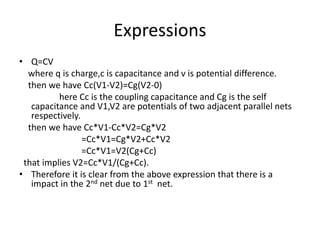
• Q=CV
where q is charge,c is capacitance and v is potential difference.
then we have Cc(V1-V2)=Cg(V2-0)
here Cc is the coupling capacitance and Cg is the self
capacitance and V1,V2 are potentials of two adjacent parallel nets
respectively.
then we have Cc*V1-Cc*V2=Cg*V2
=Cc*V1=Cg*V2+Cc*V2
=Cc*V1=V2(Cg+Cc)
that implies V2=Cc*V1/(Cg+Cc).
• Therefore it is clear from the above expression that there is a
impact in the 2nd net due to 1st net.
Effects of crosstalk
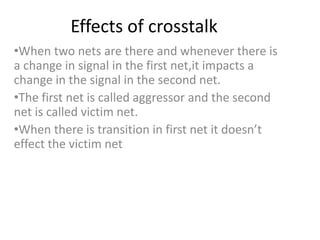
•When two nets are there and whenever there is
a change in signal in the first net,it impacts a
change in the signal in the second net.
•The first net is called aggressor and the second
net is called victim net.
•When there is transition in first net it doesn’t
effect the victim net
Crosstalk
• Crosstalk is mainly of two types.
Noise
Delay
Types of crosstalk
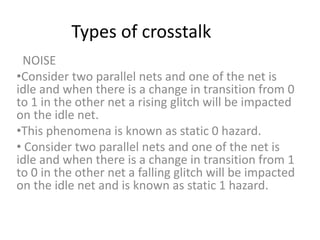
NOISE
•Consider two parallel nets and one of the net is
idle and when there is a change in transition from 0
to 1 in the other net a rising glitch will be impacted
on the idle net.
•This phenomena is known as static 0 hazard.
• Consider two parallel nets and one of the net is
idle and when there is a change in transition from 1
to 0 in the other net a falling glitch will be impacted
on the idle net and is known as static 1 hazard.
Types of crosstalk
DELAY
•When two parallel nets are considered and both
are in the same direction and there is a transition
at the same time .
•At that time there is no potential difference
which means less delay , as the delay is less which
means the setup margin benefits and the hold
margin becomes worse.
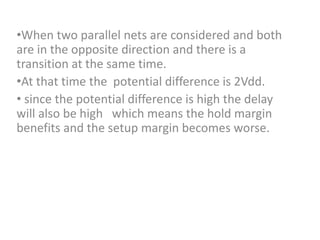
•When two parallel nets are considered and both
are in the opposite direction and there is a
transition at the same time.
•At that time the potential difference is 2Vdd.
• since the potential difference is high the delay
will also be high which means the hold margin
benefits and the setup margin becomes worse.
Methods to reduce crosstalk
• Decreasing the drive strength of the aggressor
net.
• Increasing the drive strength of victim net.
• Shielding of nets.
• By using schmitt trigger as buffer in the victim
net.

Crosstalk

  • 1.
  • 2.
    Reason for crosstalk •Aswe progress in to deep sub micron technologies , due to scaling of dimensions the density of chip increases and so it is critical to reach timing and functionality. •So as design density increases coupling effect between signal wires increases.
  • 3.
    Crosstalk •For modern technology,theaspect ratio is taken as 2 (T/W ratio) •Here the thickness increases and width decreases. •As the thickness increases the coupling capacitance between adjacent nets increases which results in coupling capacitance Cc. •As the width decreases, the capacitance between Between the substrate and the net decreases. •The above statement implies that coupling capacitance dominates the self capacitance.
  • 4.
    Expressions • Q=CV where qis charge,c is capacitance and v is potential difference. then we have Cc(V1-V2)=Cg(V2-0) here Cc is the coupling capacitance and Cg is the self capacitance and V1,V2 are potentials of two adjacent parallel nets respectively. then we have Cc*V1-Cc*V2=Cg*V2 =Cc*V1=Cg*V2+Cc*V2 =Cc*V1=V2(Cg+Cc) that implies V2=Cc*V1/(Cg+Cc). • Therefore it is clear from the above expression that there is a impact in the 2nd net due to 1st net.
  • 5.
    Effects of crosstalk •Whentwo nets are there and whenever there is a change in signal in the first net,it impacts a change in the signal in the second net. •The first net is called aggressor and the second net is called victim net. •When there is transition in first net it doesn’t effect the victim net
  • 6.
    Crosstalk • Crosstalk ismainly of two types. Noise Delay
  • 7.
    Types of crosstalk NOISE •Considertwo parallel nets and one of the net is idle and when there is a change in transition from 0 to 1 in the other net a rising glitch will be impacted on the idle net. •This phenomena is known as static 0 hazard. • Consider two parallel nets and one of the net is idle and when there is a change in transition from 1 to 0 in the other net a falling glitch will be impacted on the idle net and is known as static 1 hazard.
  • 8.
    Types of crosstalk DELAY •Whentwo parallel nets are considered and both are in the same direction and there is a transition at the same time . •At that time there is no potential difference which means less delay , as the delay is less which means the setup margin benefits and the hold margin becomes worse.
  • 9.
    •When two parallelnets are considered and both are in the opposite direction and there is a transition at the same time. •At that time the potential difference is 2Vdd. • since the potential difference is high the delay will also be high which means the hold margin benefits and the setup margin becomes worse.
  • 10.
    Methods to reducecrosstalk • Decreasing the drive strength of the aggressor net. • Increasing the drive strength of victim net. • Shielding of nets. • By using schmitt trigger as buffer in the victim net.