LEVERAGES
Capital Structure and Leverage
Leverage analysis is the technique,
which is used to quantify risk return
relationship of different alternatives
of capital structure
Risk
Business Risk vs. Financial Risk
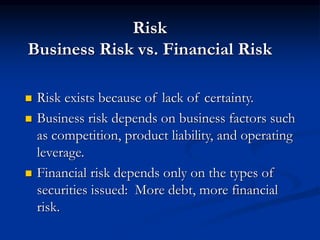
 Risk exists because of lack of certainty.
 Business risk depends on business factors such
as competition, product liability, and operating
leverage.
 Financial risk depends only on the types of
securities issued: More debt, more financial
risk.
LEVERAGE
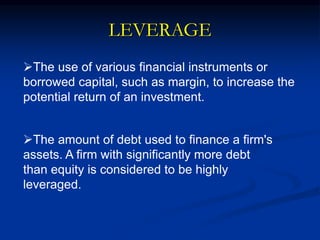
The use of various financial instruments or
borrowed capital, such as margin, to increase the
potential return of an investment.
The amount of debt used to finance a firm's
assets. A firm with significantly more debt
than equity is considered to be highly
leveraged.
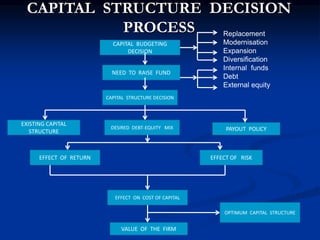
CAPITAL STRUCTURE DECISION
PROCESS
CAPITAL BUDGETING
DECISION
NEED TO RAISE FUND
CAPITAL STRUCTURE DECISION
DESIRED DEBT-EQUITY MIX
EXISTING CAPITAL
STRUCTURE PAYOUT POLICY
EFFECT OF RETURN EFFECT OF RISK
EFFECT ON COST OF CAPITAL
VALUE OF THE FIRM
OPTIMUM CAPITAL STRUCTURE
Replacement
Modernisation
Expansion
Diversification
Internal funds
Debt
External equity
TYPES OF LEVERAGE
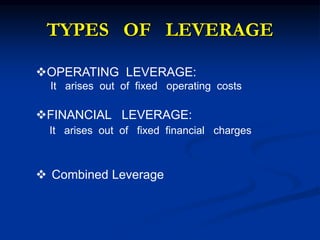
OPERATING LEVERAGE:
It arises out of fixed operating costs
FINANCIAL LEVERAGE:
It arises out of fixed financial charges
 Combined Leverage
Operating Leverage
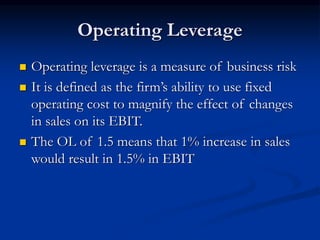
 Operating leverage is a measure of business risk
 It is defined as the firm’s ability to use fixed
operating cost to magnify the effect of changes
in sales on its EBIT.
 The OL of 1.5 means that 1% increase in sales
would result in 1.5% in EBIT
MEASURE OF OPERATING
LEVERAGE
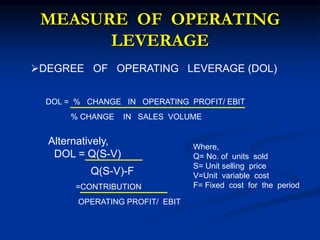
DEGREE OF OPERATING LEVERAGE (DOL)
DOL = % CHANGE IN OPERATING PROFIT/ EBIT
% CHANGE IN SALES VOLUME
Alternatively,
DOL = Q(S-V)
Q(S-V)-F
=CONTRIBUTION
OPERATING PROFIT/ EBIT
Where,
Q= No. of units sold
S= Unit selling price
V=Unit variable cost
F= Fixed cost for the period
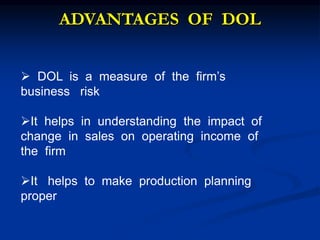
ADVANTAGES OF DOL
 DOL is a measure of the firm’s
business risk
It helps in understanding the impact of
change in sales on operating income of
the firm
It helps to make production planning
proper
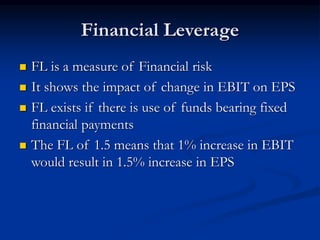
Financial Leverage
 FL is a measure of Financial risk
 It shows the impact of change in EBIT on EPS
 FL exists if there is use of funds bearing fixed
financial payments
 The FL of 1.5 means that 1% increase in EBIT
would result in 1.5% increase in EPS
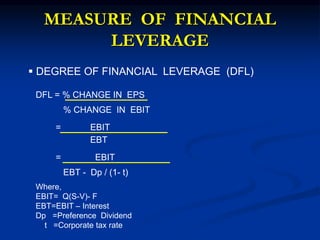
MEASURE OF FINANCIAL
LEVERAGE
 DEGREE OF FINANCIAL LEVERAGE (DFL)
DFL = % CHANGE IN EPS
% CHANGE IN EBIT
= EBIT
EBT
= EBIT
EBT - Dp / (1- t)
Where,
EBIT= Q(S-V)- F
EBT=EBIT – Interest
Dp =Preference Dividend
t =Corporate tax rate
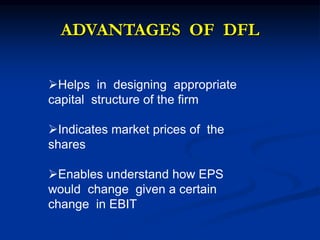
ADVANTAGES OF DFL
Helps in designing appropriate
capital structure of the firm
Indicates market prices of the
shares
Enables understand how EPS
would change given a certain
change in EBIT
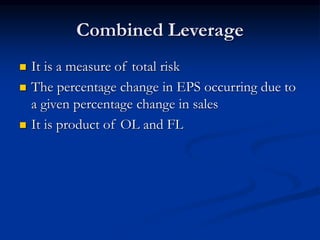
Combined Leverage
 It is a measure of total risk
 The percentage change in EPS occurring due to
a given percentage change in sales
 It is product of OL and FL
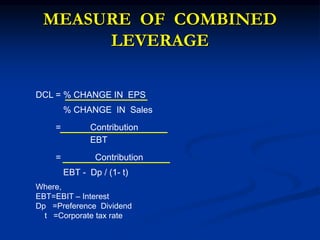
MEASURE OF COMBINED
LEVERAGE
DCL = % CHANGE IN EPS
% CHANGE IN Sales
= Contribution
EBT
= Contribution
EBT - Dp / (1- t)
Where,
EBT=EBIT – Interest
Dp =Preference Dividend
t =Corporate tax rate
Trading on Equity
 The use of the sources of funds with fixed cost,
such as debt and preference shares capital along
with the owner’s equity capital in the capital
structure is known as trading on equity.
 EBIT –EPS Analysis: To examine the impact of
leverage on the EPS. It shows the impact of
various alternative financial plans on EPS at
various levels of EBIT

LEVERAGE-PPT.ppt

  • 1.
  • 2.
    Capital Structure andLeverage Leverage analysis is the technique, which is used to quantify risk return relationship of different alternatives of capital structure
  • 3.
    Risk Business Risk vs.Financial Risk  Risk exists because of lack of certainty.  Business risk depends on business factors such as competition, product liability, and operating leverage.  Financial risk depends only on the types of securities issued: More debt, more financial risk.
  • 4.
    LEVERAGE The use ofvarious financial instruments or borrowed capital, such as margin, to increase the potential return of an investment. The amount of debt used to finance a firm's assets. A firm with significantly more debt than equity is considered to be highly leveraged.
  • 5.
    CAPITAL STRUCTURE DECISION PROCESS CAPITALBUDGETING DECISION NEED TO RAISE FUND CAPITAL STRUCTURE DECISION DESIRED DEBT-EQUITY MIX EXISTING CAPITAL STRUCTURE PAYOUT POLICY EFFECT OF RETURN EFFECT OF RISK EFFECT ON COST OF CAPITAL VALUE OF THE FIRM OPTIMUM CAPITAL STRUCTURE Replacement Modernisation Expansion Diversification Internal funds Debt External equity
  • 6.
    TYPES OF LEVERAGE OPERATINGLEVERAGE: It arises out of fixed operating costs FINANCIAL LEVERAGE: It arises out of fixed financial charges  Combined Leverage
  • 7.
    Operating Leverage  Operatingleverage is a measure of business risk  It is defined as the firm’s ability to use fixed operating cost to magnify the effect of changes in sales on its EBIT.  The OL of 1.5 means that 1% increase in sales would result in 1.5% in EBIT
  • 8.
    MEASURE OF OPERATING LEVERAGE DEGREEOF OPERATING LEVERAGE (DOL) DOL = % CHANGE IN OPERATING PROFIT/ EBIT % CHANGE IN SALES VOLUME Alternatively, DOL = Q(S-V) Q(S-V)-F =CONTRIBUTION OPERATING PROFIT/ EBIT Where, Q= No. of units sold S= Unit selling price V=Unit variable cost F= Fixed cost for the period
  • 9.
    ADVANTAGES OF DOL DOL is a measure of the firm’s business risk It helps in understanding the impact of change in sales on operating income of the firm It helps to make production planning proper
  • 10.
    Financial Leverage  FLis a measure of Financial risk  It shows the impact of change in EBIT on EPS  FL exists if there is use of funds bearing fixed financial payments  The FL of 1.5 means that 1% increase in EBIT would result in 1.5% increase in EPS
  • 11.
    MEASURE OF FINANCIAL LEVERAGE DEGREE OF FINANCIAL LEVERAGE (DFL) DFL = % CHANGE IN EPS % CHANGE IN EBIT = EBIT EBT = EBIT EBT - Dp / (1- t) Where, EBIT= Q(S-V)- F EBT=EBIT – Interest Dp =Preference Dividend t =Corporate tax rate
  • 12.
    ADVANTAGES OF DFL Helpsin designing appropriate capital structure of the firm Indicates market prices of the shares Enables understand how EPS would change given a certain change in EBIT
  • 13.
    Combined Leverage  Itis a measure of total risk  The percentage change in EPS occurring due to a given percentage change in sales  It is product of OL and FL
  • 14.
    MEASURE OF COMBINED LEVERAGE DCL= % CHANGE IN EPS % CHANGE IN Sales = Contribution EBT = Contribution EBT - Dp / (1- t) Where, EBT=EBIT – Interest Dp =Preference Dividend t =Corporate tax rate
  • 15.
    Trading on Equity The use of the sources of funds with fixed cost, such as debt and preference shares capital along with the owner’s equity capital in the capital structure is known as trading on equity.  EBIT –EPS Analysis: To examine the impact of leverage on the EPS. It shows the impact of various alternative financial plans on EPS at various levels of EBIT