Entrepreneurship
India is a developing country and its
development is truly the hard work of its
people.
India has produced many great scholars,
scientists, intellectuals and even
entrepreneurs.
The sense of achieving is deep rooted in
Indians and that’s the reason Indians are doing
great works in almost all countries.
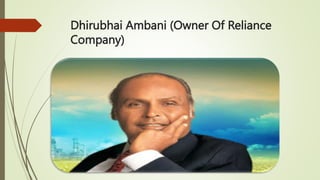
Dhirubhai Ambani (Owner Of Reliance
Company)
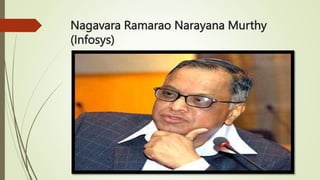
Nagavara Ramarao Narayana Murthy
(Infosys)
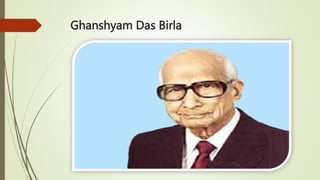
Ghanshyam Das Birla
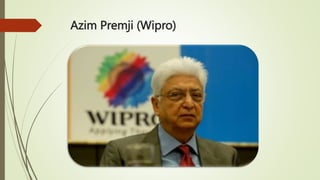
Azim Premji (Wipro)
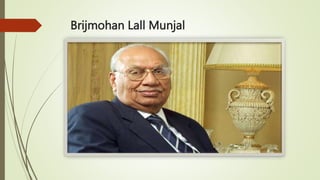
Brijmohan Lall Munjal
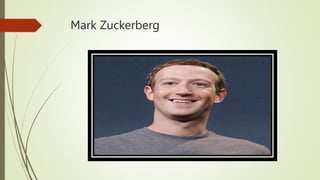
Mark Zuckerberg
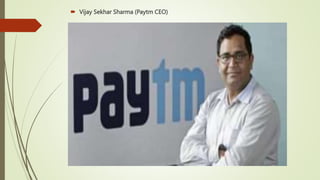
 Vijay Sekhar Sharma (Paytm CEO)
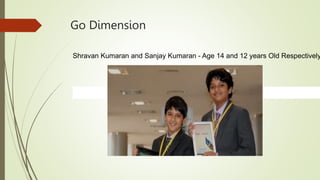
Go Dimension
Shravan Kumaran and Sanjay Kumaran - Age 14 and 12 years Old Respectively
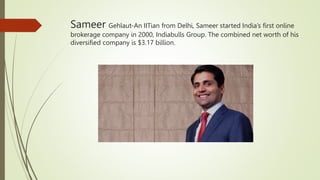
Sameer Gehlaut-An IITian from Delhi, Sameer started India’s first online
brokerage company in 2000, Indiabulls Group. The combined net worth of his
diversified company is $3.17 billion.
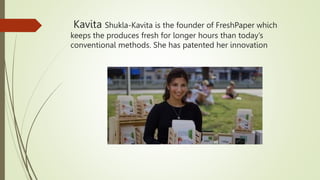
Kavita Shukla-Kavita is the founder of FreshPaper which
keeps the produces fresh for longer hours than today’s
conventional methods. She has patented her innovation
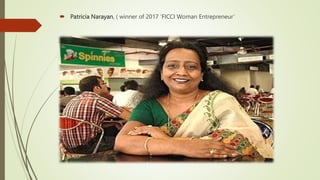
 Patricia Narayan, ( winner of 2017 ‘FICCI Woman Entrepreneur’
Our common understanding
The boss
The business owner
The risk taker
 One who starts a small business
The resourceful guy?
The word entrepreneurship is derived from French
word ‘Entependre’ which means An undertaker.
It means an entrepreneur is one who undertakes to
oraginse, manage, and assume risks associated
with business.
At present entrepreneur regarded as an economic
leader who is essentially an innovator.
He exerts enormous influence upon economic
development in general and business development
in particular.
Walt Disney’s definition “….to do things
and make things which will give pleasure
to people in new and amazing ways. ….It
is magic!
Definition
According to Prof. Knight,”Entrepreneurs
are a specialised group of persons who
bear risks and deal with uncertainty “.
Peter Drucker, defines an entrepreneur as
“one who always searching for change,
responds to it and exploits it as an
opportunity “.
Qualities of a Successful
Entrepreneur
QUALITIES OF ENTREPRENUERS
 Mental ability: intelligent person.
 Organising ability: good organisation.
 Hard work: ready to work for long hours.
Discipline: highly disciplined- everything to be
in order for them.
Clear objectives: regarding nature of business
& products to be produced.
 Need for high achievement- they have a strong desire for
achieving something great.
 Optimistic: highly optimistic- not disturbed by present
problems-hope favourable future.
 Risk taking: they like challenges.
 H.R. ability: maintain good relations with other people
(employee, vendors, customers, bankers).
 Emotional stability: have considerable amount of self-control-
business pressure can be handled.
Communication ability: good communication.
Self-confidence: tackle problems immediately
with self-confidence.
Adaptability: highly flexible- adapt themselves
for any conditions.
 Positive attitude: always think positively, they
they do not leave hopes even under difficult
conditions.
Entrepreneurship
Meaning and Definition of
Entrepreneurship
Entrepreneur = Individual
Entrepreneurship = Qualities of an
entrepreneur
Entrepreneurship is the end result of a
complex and varying combination of socio
economic, psychological and other variable.
Thus Entrepreneurship is a combination of various
qualities like organisation skills, innovativeness, risk-
bearing, managing uncertainty, ability to bring
together & use factor of production, analysing
market opportunities, observing the change taking
place in the market, methods & technologies &
studying the tastes & preferences of consumers.
According to Peter Drucker “Entrepreneurship is
neither a science nor an art.It is a practice. It is a
knowledge based. Knowledge in entrepreneurship
is means to an end. ...”.
According to Musseleman and Jackson,
“entrepreneurship is the investing and risking of
time, money, effort to start a business and make it
successful “.
Intrapreneurship
There are people working in company and holding key
positions.
They are quite innovative & bring many changes in
products & methods of production.
They possess all qualities of an entrepreneur. Top
managements in big organisations encourage people
holding key positions to come out with new ideas so that
they can bring some changes in products & services.
They are also known as enter corporate entrepreneurs or
intraprenuers. They serve as champions to others in the
organisation.
A classic case of entrepreneur is that of the founders
of Adobe, John Warnock and Charles Geschke.
They both were employees of Xerox. As employees of
Xerox, they were frustrated because their new
product ideas were not encouraged.
 They quit Xerox in the early 1980s to begin their
own business. Currently, Adobe has an annual
turnover of over $3 billion.
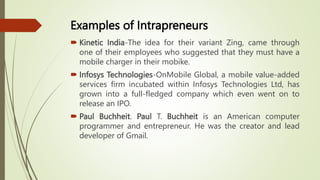
Examples of Intrapreneurs
 Kinetic India-The idea for their variant Zing, came through
one of their employees who suggested that they must have a
mobile charger in their mobike.
 Infosys Technologies-OnMobile Global, a mobile value-added
services firm incubated within Infosys Technologies Ltd, has
grown into a full-fledged company which even went on to
release an IPO.
 Paul Buchheit. Paul T. Buchheit is an American computer
programmer and entrepreneur. He was the creator and lead
developer of Gmail.
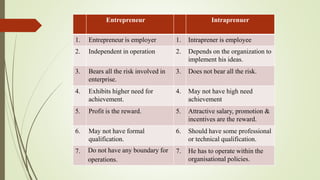
Entrepreneur Intraprenuer
1. Entrepreneur is employer 1. Intraprener is employee
2. Independent in operation 2. Depends on the organization to
implement his ideas.
3. Bears all the risk involved in
enterprise.
3. Does not bear all the risk.
4. Exhibits higher need for
achievement.
4. May not have high need
achievement
5. Profit is the reward. 5. Attractive salary, promotion &
incentives are the reward.
6. May not have formal
qualification.
6. Should have some professional
or technical qualification.
7. Do not have any boundary for
operations.
7. He has to operate within the
organisational policies.
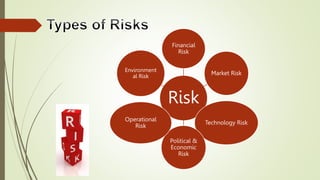
Risk
Financial
Risk
Market Risk
Technology Risk
Political &
Economic
Risk
Operational
Risk
Environment
al Risk
Risk faced by the Entrepreneur
 Financial risk
 Market Risk
 Strategic risk
 Economical risk
 Competition risk
 Technological risk
 Operational risk
 Personal risk
 Human resource risk
 Marketing risk
 Political and legal risk
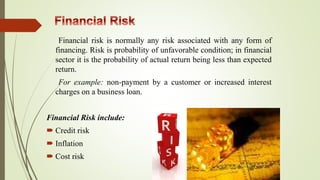
Financial risk is normally any risk associated with any form of
financing. Risk is probability of unfavorable condition; in financial
sector it is the probability of actual return being less than expected
return.
For example: non-payment by a customer or increased interest
charges on a business loan.
Financial Risk include:
 Credit risk
 Inflation
 Cost risk
Market risk is the risk that the value of an investment will
decrease due to moves in market factors. The four standard
market risk factors are:
 Interest rate risk (the risk that interest rate will
change)
 Equity risk (the risk that stock prices will change)
 Commodity risk (the risk that commodity prices (for
e.g. crude oil, copper, etc…) will change)
 Currency risk (The risk that foreign exchange rate
will change)
Strategic risk
It’s the risk that your company’s strategy becomes less
effective and your company struggles to reach its goals as
a result. It could be due to technological changes, a
powerful new competitor entering the market, shifts in
customer demand, spikes in the costs of raw materials, or
any number of other large-scale changes.
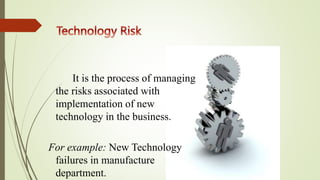
It is the process of managing
the risks associated with
implementation of new
technology in the business.
For example: New Technology
failures in manufacture
department.
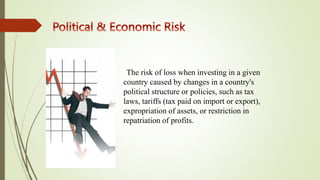
The risk of loss when investing in a given
country caused by changes in a country's
political structure or policies, such as tax
laws, tariffs (tax paid on import or export),
expropriation of assets, or restriction in
repatriation of profits.
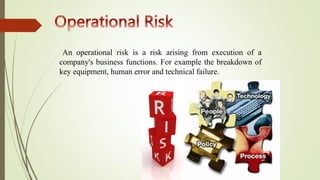
An operational risk is a risk arising from execution of a
company's business functions. For example the breakdown of
key equipment, human error and technical failure.
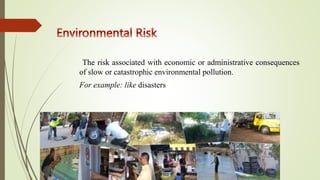
The risk associated with economic or administrative consequences
of slow or catastrophic environmental pollution.
For example: like disasters
Pros and cons of Entrepreneur
Advantage of being an Entrepreneur
Being his own boss
Satisfaction of creating and running a successful business
Opportunity to contribute to society
Learn and gain a variety of experience
Making money for himself
Opportunity to translate idea into practice
Enjoying a sense of independence
Joy of creating employment opportunities
Highly Successful Risk Takers In Business
 Donald Trump
Bill Gates
Henry Ford
Warren Buffett
Jeff Bezos

Entrepreneurship Types and Qualities required

  • 1.
  • 2.
    India is adeveloping country and its development is truly the hard work of its people. India has produced many great scholars, scientists, intellectuals and even entrepreneurs. The sense of achieving is deep rooted in Indians and that’s the reason Indians are doing great works in almost all countries.
  • 3.
    Dhirubhai Ambani (OwnerOf Reliance Company)
  • 4.
    Nagavara Ramarao NarayanaMurthy (Infosys)
  • 5.
  • 6.
  • 7.
  • 8.
  • 9.
     Vijay SekharSharma (Paytm CEO)
  • 10.
    Go Dimension Shravan Kumaranand Sanjay Kumaran - Age 14 and 12 years Old Respectively
  • 11.
    Sameer Gehlaut-An IITianfrom Delhi, Sameer started India’s first online brokerage company in 2000, Indiabulls Group. The combined net worth of his diversified company is $3.17 billion.
  • 12.
    Kavita Shukla-Kavita isthe founder of FreshPaper which keeps the produces fresh for longer hours than today’s conventional methods. She has patented her innovation
  • 13.
     Patricia Narayan,( winner of 2017 ‘FICCI Woman Entrepreneur’
  • 14.
    Our common understanding Theboss The business owner The risk taker  One who starts a small business The resourceful guy?
  • 15.
    The word entrepreneurshipis derived from French word ‘Entependre’ which means An undertaker. It means an entrepreneur is one who undertakes to oraginse, manage, and assume risks associated with business. At present entrepreneur regarded as an economic leader who is essentially an innovator. He exerts enormous influence upon economic development in general and business development in particular.
  • 16.
    Walt Disney’s definition“….to do things and make things which will give pleasure to people in new and amazing ways. ….It is magic!
  • 17.
    Definition According to Prof.Knight,”Entrepreneurs are a specialised group of persons who bear risks and deal with uncertainty “. Peter Drucker, defines an entrepreneur as “one who always searching for change, responds to it and exploits it as an opportunity “.
  • 18.
    Qualities of aSuccessful Entrepreneur
  • 19.
    QUALITIES OF ENTREPRENUERS Mental ability: intelligent person.  Organising ability: good organisation.  Hard work: ready to work for long hours. Discipline: highly disciplined- everything to be in order for them. Clear objectives: regarding nature of business & products to be produced.
  • 20.
     Need forhigh achievement- they have a strong desire for achieving something great.  Optimistic: highly optimistic- not disturbed by present problems-hope favourable future.  Risk taking: they like challenges.  H.R. ability: maintain good relations with other people (employee, vendors, customers, bankers).  Emotional stability: have considerable amount of self-control- business pressure can be handled.
  • 21.
    Communication ability: goodcommunication. Self-confidence: tackle problems immediately with self-confidence. Adaptability: highly flexible- adapt themselves for any conditions.  Positive attitude: always think positively, they they do not leave hopes even under difficult conditions.
  • 22.
  • 23.
    Meaning and Definitionof Entrepreneurship Entrepreneur = Individual Entrepreneurship = Qualities of an entrepreneur Entrepreneurship is the end result of a complex and varying combination of socio economic, psychological and other variable.
  • 24.
    Thus Entrepreneurship isa combination of various qualities like organisation skills, innovativeness, risk- bearing, managing uncertainty, ability to bring together & use factor of production, analysing market opportunities, observing the change taking place in the market, methods & technologies & studying the tastes & preferences of consumers.
  • 25.
    According to PeterDrucker “Entrepreneurship is neither a science nor an art.It is a practice. It is a knowledge based. Knowledge in entrepreneurship is means to an end. ...”. According to Musseleman and Jackson, “entrepreneurship is the investing and risking of time, money, effort to start a business and make it successful “.
  • 26.
    Intrapreneurship There are peopleworking in company and holding key positions. They are quite innovative & bring many changes in products & methods of production. They possess all qualities of an entrepreneur. Top managements in big organisations encourage people holding key positions to come out with new ideas so that they can bring some changes in products & services. They are also known as enter corporate entrepreneurs or intraprenuers. They serve as champions to others in the organisation.
  • 27.
    A classic caseof entrepreneur is that of the founders of Adobe, John Warnock and Charles Geschke. They both were employees of Xerox. As employees of Xerox, they were frustrated because their new product ideas were not encouraged.  They quit Xerox in the early 1980s to begin their own business. Currently, Adobe has an annual turnover of over $3 billion.
  • 28.
    Examples of Intrapreneurs Kinetic India-The idea for their variant Zing, came through one of their employees who suggested that they must have a mobile charger in their mobike.  Infosys Technologies-OnMobile Global, a mobile value-added services firm incubated within Infosys Technologies Ltd, has grown into a full-fledged company which even went on to release an IPO.  Paul Buchheit. Paul T. Buchheit is an American computer programmer and entrepreneur. He was the creator and lead developer of Gmail.
  • 29.
    Entrepreneur Intraprenuer 1. Entrepreneuris employer 1. Intraprener is employee 2. Independent in operation 2. Depends on the organization to implement his ideas. 3. Bears all the risk involved in enterprise. 3. Does not bear all the risk. 4. Exhibits higher need for achievement. 4. May not have high need achievement 5. Profit is the reward. 5. Attractive salary, promotion & incentives are the reward. 6. May not have formal qualification. 6. Should have some professional or technical qualification. 7. Do not have any boundary for operations. 7. He has to operate within the organisational policies.
  • 31.
    Risk Financial Risk Market Risk Technology Risk Political& Economic Risk Operational Risk Environment al Risk
  • 32.
    Risk faced bythe Entrepreneur  Financial risk  Market Risk  Strategic risk  Economical risk  Competition risk  Technological risk  Operational risk  Personal risk  Human resource risk  Marketing risk  Political and legal risk
  • 33.
    Financial risk isnormally any risk associated with any form of financing. Risk is probability of unfavorable condition; in financial sector it is the probability of actual return being less than expected return. For example: non-payment by a customer or increased interest charges on a business loan. Financial Risk include:  Credit risk  Inflation  Cost risk
  • 34.
    Market risk isthe risk that the value of an investment will decrease due to moves in market factors. The four standard market risk factors are:  Interest rate risk (the risk that interest rate will change)  Equity risk (the risk that stock prices will change)  Commodity risk (the risk that commodity prices (for e.g. crude oil, copper, etc…) will change)  Currency risk (The risk that foreign exchange rate will change)
  • 35.
    Strategic risk It’s therisk that your company’s strategy becomes less effective and your company struggles to reach its goals as a result. It could be due to technological changes, a powerful new competitor entering the market, shifts in customer demand, spikes in the costs of raw materials, or any number of other large-scale changes.
  • 36.
    It is theprocess of managing the risks associated with implementation of new technology in the business. For example: New Technology failures in manufacture department.
  • 37.
    The risk ofloss when investing in a given country caused by changes in a country's political structure or policies, such as tax laws, tariffs (tax paid on import or export), expropriation of assets, or restriction in repatriation of profits.
  • 38.
    An operational riskis a risk arising from execution of a company's business functions. For example the breakdown of key equipment, human error and technical failure.
  • 39.
    The risk associatedwith economic or administrative consequences of slow or catastrophic environmental pollution. For example: like disasters
  • 41.
    Pros and consof Entrepreneur Advantage of being an Entrepreneur Being his own boss Satisfaction of creating and running a successful business Opportunity to contribute to society Learn and gain a variety of experience Making money for himself Opportunity to translate idea into practice Enjoying a sense of independence Joy of creating employment opportunities
  • 42.
    Highly Successful RiskTakers In Business  Donald Trump Bill Gates Henry Ford Warren Buffett Jeff Bezos