CAPITAL STRUCTURE 
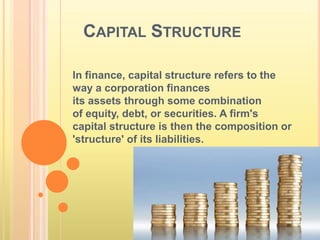
In finance, capital structure refers to the 
way a corporation finances 
its assets through some combination 
of equity, debt, or securities. A firm's 
capital structure is then the composition or 
'structure' of its liabilities.
EXAMPLE.. 
 For example, a firm that sells 200000 in 
debts and 800000 in equity is said to be 
20% debt-financed and 80% equity-financed. 
In reality, capital structure may be highly 
complex and include dozens of sources. 
Gearing Ratio is the proportion of the capital 
employed of the firm which come from 
outside of the business finance, e.g. by 
taking a short term loan etc.
SOURCES OF FINANCE.. 
 Equity shares- In simple Words, a share or 
stock is a document issued by a company, 
which entitles its holder to be one of the 
owners of the company. A share is issued by 
a company or can be purchased from the 
stock market.
ADVANTAGES OF EQUITY SHARES… 
 Equity shareholders are the real owners of the 
company. They have full voting rights. They elect 
directors to manage the company. 
 Equity shares are not a burden on the resources of 
the company. If the company has sufficient profits 
and the directors also recommend, dividend may be 
declared. 
 Since the equity shares are of small face value, 
even poor people can because members of big 
companies. This helps the capital formation of the 
country.
DISADVANTAGES OF EQUITY SHARES… 
 If there arises over capitalization because of 
wrongful equity share issues, the excess amount 
cannot be refunded. 
 Because of the uncertainty of the return on the 
equity shares, conservative investors hesitate to 
purchase them. 
 Since equity shares are not refundable they are 
treated as illiquid. 
 Rights issue may lead to concentration of control of 
the company in the hands of a few persons.
PREFERENCE SHARES… 
 a share which entitles the holder to a fixed 
dividend, whose payment takes priority over 
that of ordinary share dividends. 
 ADVANTAGES OF THESE SHARES:- 
 Redeemable, convertible and participating 
preference shareholders are more attractive. There 
are very helpful to investors and so they have ready 
market.
CNTD… 
 In case of debentures, generally a change (or) 
mortgage on the assets is created. But the issue of 
preference share require no such creation. 
 Equity shareholders will get good amount of 
dividend by issue of preference shares. 
 DISADVANTAGES OF THESE SHARES:- 
 Usually, preference shares carry a higher rate of 
dividend than the rate of interest on debentures. 
 Comparing to debentures, financing of preference 
shares in more costly.
DEBTS.. 
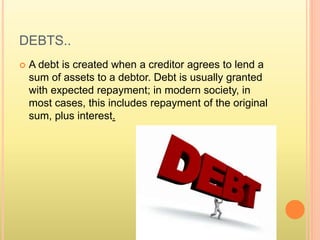
 A debt is created when a creditor agrees to lend a 
sum of assets to a debtor. Debt is usually granted 
with expected repayment; in modern society, in 
most cases, this includes repayment of the original 
sum, plus interest.
ADVANTAGES AND DISADVANTAGES 
OF DEBTS:- 
 Utilization of Resources – When a business use debt 
to finance its operation, they got no option than to fully 
utilize their resources because they will have to payback 
the debt and interest to their creditor. 
 Short Term Needs – Debt finance can easily be 
secured on a short term bases. This make it very 
advantageous to the small business as finance of this 
type can easily be secured for short term business 
needs. 
 Tax Advantage – Debt financing also offers tax 
advantage to business as interest is deductible for 
income tax purposes. 
 No Future Lender Claims - Lenders has no direct claim 
on future earnings
CNTD.. 
 The main disadvantage of this type of financing is 
that it requires a small business to make regular 
monthly payments of principal and interest.Because 
of shortage of cashflow experience by young 
business it is usually difficult to make regular 
payment of to creditors. 
 Most lenders provide severe penalties for late or 
missed payments, which may include charging late 
fees, taking possession of collateral, or calling the 
loan due early. 
 Failure to make payments on a loan, even 
temporarily, can adversely affect a small business’s 
credit rating and its ability to obtain future financing.
TRADE ON EQUITY- 
 Trading on equity occurs when a corporation uses 
bonds, other debt, and preferred stock to increase 
its earnings on common stock. For example, 
a corporation might use long term debt to purchase 
assets that are expected to earn more than the 
interest on the debt. The earnings in excess of the 
interest expense on the new debt will increase the 
earnings of the corporation’s common stockholders. 
The increase in earnings indicates that the 
corporation was successful in trading on equity.
RETAIN EARNINGS… 
 In accounting, retained earnings refers to 
the portion of net income of a corporation 
that is retained by the corporation rather 
than distributed 
to shareholders as dividends, or as the 
amount available to the corporation for 
distribution to shareholders.
OPTIMUM UTILIZATION OF RESOURCES 
 As a cost manager, I will choose equity 
shares more for capital structure then debts 
because debts are loan for the company. As 
my company is not new, it is a growing and 
well known company I will chose equity 
shares for capital structure because it has 
more benefits and people can easily trust 
the company and can buy shares.

Capital structure

  • 1.
    CAPITAL STRUCTURE Infinance, capital structure refers to the way a corporation finances its assets through some combination of equity, debt, or securities. A firm's capital structure is then the composition or 'structure' of its liabilities.
  • 2.
    EXAMPLE..  Forexample, a firm that sells 200000 in debts and 800000 in equity is said to be 20% debt-financed and 80% equity-financed. In reality, capital structure may be highly complex and include dozens of sources. Gearing Ratio is the proportion of the capital employed of the firm which come from outside of the business finance, e.g. by taking a short term loan etc.
  • 3.
    SOURCES OF FINANCE..  Equity shares- In simple Words, a share or stock is a document issued by a company, which entitles its holder to be one of the owners of the company. A share is issued by a company or can be purchased from the stock market.
  • 4.
    ADVANTAGES OF EQUITYSHARES…  Equity shareholders are the real owners of the company. They have full voting rights. They elect directors to manage the company.  Equity shares are not a burden on the resources of the company. If the company has sufficient profits and the directors also recommend, dividend may be declared.  Since the equity shares are of small face value, even poor people can because members of big companies. This helps the capital formation of the country.
  • 5.
    DISADVANTAGES OF EQUITYSHARES…  If there arises over capitalization because of wrongful equity share issues, the excess amount cannot be refunded.  Because of the uncertainty of the return on the equity shares, conservative investors hesitate to purchase them.  Since equity shares are not refundable they are treated as illiquid.  Rights issue may lead to concentration of control of the company in the hands of a few persons.
  • 6.
    PREFERENCE SHARES… a share which entitles the holder to a fixed dividend, whose payment takes priority over that of ordinary share dividends.  ADVANTAGES OF THESE SHARES:-  Redeemable, convertible and participating preference shareholders are more attractive. There are very helpful to investors and so they have ready market.
  • 7.
    CNTD…  Incase of debentures, generally a change (or) mortgage on the assets is created. But the issue of preference share require no such creation.  Equity shareholders will get good amount of dividend by issue of preference shares.  DISADVANTAGES OF THESE SHARES:-  Usually, preference shares carry a higher rate of dividend than the rate of interest on debentures.  Comparing to debentures, financing of preference shares in more costly.
  • 8.
    DEBTS..  Adebt is created when a creditor agrees to lend a sum of assets to a debtor. Debt is usually granted with expected repayment; in modern society, in most cases, this includes repayment of the original sum, plus interest.
  • 9.
    ADVANTAGES AND DISADVANTAGES OF DEBTS:-  Utilization of Resources – When a business use debt to finance its operation, they got no option than to fully utilize their resources because they will have to payback the debt and interest to their creditor.  Short Term Needs – Debt finance can easily be secured on a short term bases. This make it very advantageous to the small business as finance of this type can easily be secured for short term business needs.  Tax Advantage – Debt financing also offers tax advantage to business as interest is deductible for income tax purposes.  No Future Lender Claims - Lenders has no direct claim on future earnings
  • 10.
    CNTD..  Themain disadvantage of this type of financing is that it requires a small business to make regular monthly payments of principal and interest.Because of shortage of cashflow experience by young business it is usually difficult to make regular payment of to creditors.  Most lenders provide severe penalties for late or missed payments, which may include charging late fees, taking possession of collateral, or calling the loan due early.  Failure to make payments on a loan, even temporarily, can adversely affect a small business’s credit rating and its ability to obtain future financing.
  • 11.
    TRADE ON EQUITY-  Trading on equity occurs when a corporation uses bonds, other debt, and preferred stock to increase its earnings on common stock. For example, a corporation might use long term debt to purchase assets that are expected to earn more than the interest on the debt. The earnings in excess of the interest expense on the new debt will increase the earnings of the corporation’s common stockholders. The increase in earnings indicates that the corporation was successful in trading on equity.
  • 12.
    RETAIN EARNINGS… In accounting, retained earnings refers to the portion of net income of a corporation that is retained by the corporation rather than distributed to shareholders as dividends, or as the amount available to the corporation for distribution to shareholders.
  • 13.
    OPTIMUM UTILIZATION OFRESOURCES  As a cost manager, I will choose equity shares more for capital structure then debts because debts are loan for the company. As my company is not new, it is a growing and well known company I will chose equity shares for capital structure because it has more benefits and people can easily trust the company and can buy shares.