GORDON’S MODEL
ABHISHEK STEPHEN. F
DEFINITION
 According to Prof. Gordon, Dividend Policy almost
always affects the value of the firm. He Showed how
dividend policy can be used to maximize the wealth of
the shareholders.
 The main proposition of the model is that the value of a
share reflects the value of the future dividends accruing
to that share. Hence, the dividend payment and its
growth are relevant in valuation of shares.
 The model holds that the share’s market price is equal
to the sum of share’s discounted future dividend
payment.
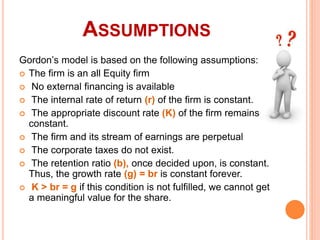
ASSUMPTIONS
Gordon’s model is based on the following assumptions:
 The firm is an all Equity firm
 No external financing is available
 The internal rate of return (r) of the firm is constant.
 The appropriate discount rate (K) of the firm remains
constant.
 The firm and its stream of earnings are perpetual
 The corporate taxes do not exist.
 The retention ratio (b), once decided upon, is constant.
Thus, the growth rate (g) = br is constant forever.
 K > br = g if this condition is not fulfilled, we cannot get
a meaningful value for the share.
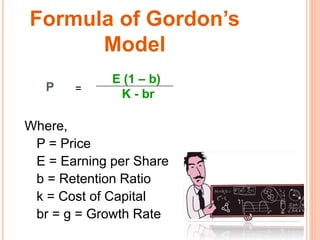
Formula of Gordon’s
Model
Where,
P = Price
E = Earning per Share
b = Retention Ratio
k = Cost of Capital
br = g = Growth Rate
P =
E (1 – b)
K - br
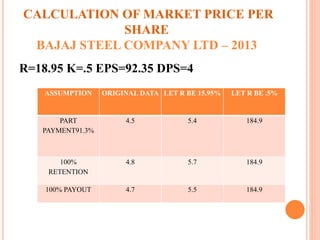
CALCULATION OF MARKET PRICE PER
SHARE
BAJAJ STEEL COMPANY LTD – 2013
R=18.95 K=.5 EPS=92.35 DPS=4
ASSUMPTION ORIGINAL DATA LET R BE 15.95% LET R BE .5%
PART
PAYMENT91.3%
4.5 5.4 184.9
100%
RETENTION
4.8 5.7 184.9
100% PAYOUT 4.7 5.5 184.9
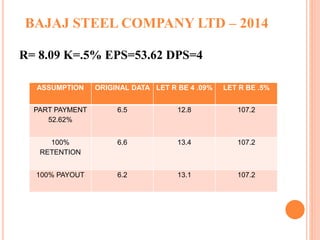
BAJAJ STEEL COMPANY LTD – 2014
R= 8.09 K=.5% EPS=53.62 DPS=4
ASSUMPTION ORIGINAL DATA LET R BE 4 .09% LET R BE .5%
PART PAYMENT
52.62%
6.5 12.8 107.2
100%
RETENTION
6.6 13.4 107.2
100% PAYOUT 6.2 13.1 107.2
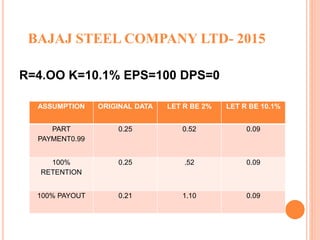
BAJAJ STEEL COMPANY LTD- 2015
R=4.OO K=10.1% EPS=100 DPS=0
ASSUMPTION ORIGINAL DATA LET R BE 2% LET R BE 10.1%
PART
PAYMENT0.99
0.25 0.52 0.09
100%
RETENTION
0.25 .52 0.09
100% PAYOUT 0.21 1.10 0.09
DATA INTERPRETATION
BAJAJ STEEL
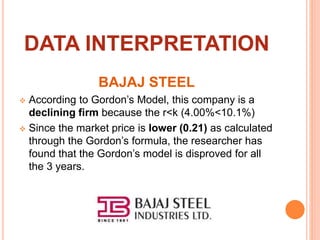
 According to Gordon’s Model, this company is a
declining firm because the r<k (4.00%<10.1%)
 Since the market price is lower (0.21) as calculated
through the Gordon’s formula, the researcher has
found that the Gordon’s model is disproved for all
the 3 years.
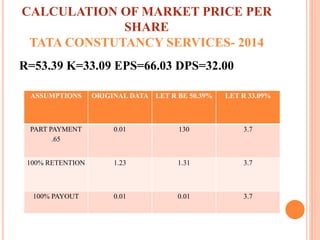
CALCULATION OF MARKET PRICE PER
SHARE
TATA CONSTUTANCY SERVICES- 2014
R=53.39 K=33.09 EPS=66.03 DPS=32.00
ASSUMPTIONS ORIGINAL DATA LET R BE 50.39% LET R 33.09%
PART PAYMENT
.65
0.01 130 3.7
100% RETENTION 1.23 1.31 3.7
100% PAYOUT 0.01 0.01 3.7
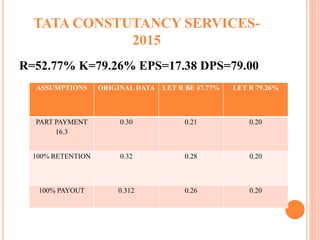
TATA CONSTUTANCY SERVICES-
2015
R=52.77% K=79.26% EPS=17.38 DPS=79.00
ASSUMPTIONS ORIGINAL DATA LET R BE 47.77% LET R 79.26%
PART PAYMENT
16.3
0.30 0.21 0.20
100% RETENTION 0.32 0.28 0.20
100% PAYOUT 0.312 0.26 0.20
TATA CONSTUTANCY SERVICES-
2016
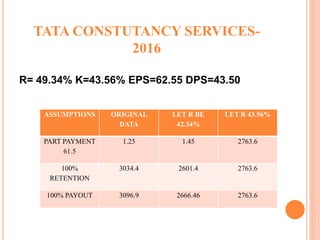
R= 49.34% K=43.56% EPS=62.55 DPS=43.50
ASSUMPTIONS ORIGINAL
DATA
LET R BE
42.34%
LET R 43.56%
PART PAYMENT
61.5
1.25 1.45 2763.6
100%
RETENTION
3034.4 2601.4 2763.6
100% PAYOUT 3096.9 2666.46 2763.6
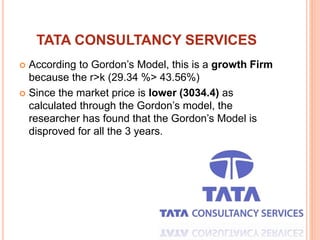
TATA CONSULTANCY SERVICES
 According to Gordon’s Model, this is a growth Firm
because the r>k (29.34 %> 43.56%)
 Since the market price is lower (3034.4) as
calculated through the Gordon’s model, the
researcher has found that the Gordon’s Model is
disproved for all the 3 years.
GORDON’S MODEL
CONCLUSION
Thus the researcher has found that the
assumptions of the Gordon’s Model are disproved
for BAJAJ STEEL and TATA CONSULTANCY
SERVICES for all the 3 years, i.e.
OUTCOME
 Able to test Gordon’s Model relevance for two
companies
 Can able to disprove Gordon’s Model for both the
companies
Gordon's model

Gordon's model

  • 1.
  • 2.
    DEFINITION  According toProf. Gordon, Dividend Policy almost always affects the value of the firm. He Showed how dividend policy can be used to maximize the wealth of the shareholders.  The main proposition of the model is that the value of a share reflects the value of the future dividends accruing to that share. Hence, the dividend payment and its growth are relevant in valuation of shares.  The model holds that the share’s market price is equal to the sum of share’s discounted future dividend payment.
  • 3.
    ASSUMPTIONS Gordon’s model isbased on the following assumptions:  The firm is an all Equity firm  No external financing is available  The internal rate of return (r) of the firm is constant.  The appropriate discount rate (K) of the firm remains constant.  The firm and its stream of earnings are perpetual  The corporate taxes do not exist.  The retention ratio (b), once decided upon, is constant. Thus, the growth rate (g) = br is constant forever.  K > br = g if this condition is not fulfilled, we cannot get a meaningful value for the share.
  • 4.
    Formula of Gordon’s Model Where, P= Price E = Earning per Share b = Retention Ratio k = Cost of Capital br = g = Growth Rate P = E (1 – b) K - br
  • 5.
    CALCULATION OF MARKETPRICE PER SHARE BAJAJ STEEL COMPANY LTD – 2013 R=18.95 K=.5 EPS=92.35 DPS=4 ASSUMPTION ORIGINAL DATA LET R BE 15.95% LET R BE .5% PART PAYMENT91.3% 4.5 5.4 184.9 100% RETENTION 4.8 5.7 184.9 100% PAYOUT 4.7 5.5 184.9
  • 6.
    BAJAJ STEEL COMPANYLTD – 2014 R= 8.09 K=.5% EPS=53.62 DPS=4 ASSUMPTION ORIGINAL DATA LET R BE 4 .09% LET R BE .5% PART PAYMENT 52.62% 6.5 12.8 107.2 100% RETENTION 6.6 13.4 107.2 100% PAYOUT 6.2 13.1 107.2
  • 7.
    BAJAJ STEEL COMPANYLTD- 2015 R=4.OO K=10.1% EPS=100 DPS=0 ASSUMPTION ORIGINAL DATA LET R BE 2% LET R BE 10.1% PART PAYMENT0.99 0.25 0.52 0.09 100% RETENTION 0.25 .52 0.09 100% PAYOUT 0.21 1.10 0.09
  • 8.
    DATA INTERPRETATION BAJAJ STEEL According to Gordon’s Model, this company is a declining firm because the r<k (4.00%<10.1%)  Since the market price is lower (0.21) as calculated through the Gordon’s formula, the researcher has found that the Gordon’s model is disproved for all the 3 years.
  • 9.
    CALCULATION OF MARKETPRICE PER SHARE TATA CONSTUTANCY SERVICES- 2014 R=53.39 K=33.09 EPS=66.03 DPS=32.00 ASSUMPTIONS ORIGINAL DATA LET R BE 50.39% LET R 33.09% PART PAYMENT .65 0.01 130 3.7 100% RETENTION 1.23 1.31 3.7 100% PAYOUT 0.01 0.01 3.7
  • 10.
    TATA CONSTUTANCY SERVICES- 2015 R=52.77%K=79.26% EPS=17.38 DPS=79.00 ASSUMPTIONS ORIGINAL DATA LET R BE 47.77% LET R 79.26% PART PAYMENT 16.3 0.30 0.21 0.20 100% RETENTION 0.32 0.28 0.20 100% PAYOUT 0.312 0.26 0.20
  • 11.
    TATA CONSTUTANCY SERVICES- 2016 R=49.34% K=43.56% EPS=62.55 DPS=43.50 ASSUMPTIONS ORIGINAL DATA LET R BE 42.34% LET R 43.56% PART PAYMENT 61.5 1.25 1.45 2763.6 100% RETENTION 3034.4 2601.4 2763.6 100% PAYOUT 3096.9 2666.46 2763.6
  • 12.
    TATA CONSULTANCY SERVICES According to Gordon’s Model, this is a growth Firm because the r>k (29.34 %> 43.56%)  Since the market price is lower (3034.4) as calculated through the Gordon’s model, the researcher has found that the Gordon’s Model is disproved for all the 3 years.
  • 13.
    GORDON’S MODEL CONCLUSION Thus theresearcher has found that the assumptions of the Gordon’s Model are disproved for BAJAJ STEEL and TATA CONSULTANCY SERVICES for all the 3 years, i.e. OUTCOME  Able to test Gordon’s Model relevance for two companies  Can able to disprove Gordon’s Model for both the companies