TYPES OF LEVERAGES
BY
ASWATHY JAYAN
LEVERAGE
‘Leverage’ means ‘effectiveness’ or ‘power’
A firm is said to be leveraged if it has fixed cost
Degree of leverage
-Measure of how much leverage the firm uses
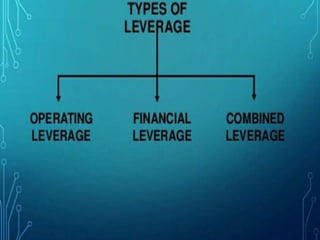
There are three types of leverages
-Operating leverages
-Financial leverages
-Combined leverages
Operating leverage
 Operating leverage is a measurement of the
degree to which a firm incurs a combination
of fixed and variable cost
 Operating leverage = contribution/EBIT
contribution = sales – variable cost
EBIT = contribution –fixed cost
Note : in case the contribution exceeds the
fixed cost,the operating leverage is favorable.
when C<F, the operating leverages is
unfavorable
Degree of operating leverage
 It measures how muchis the effect of change in
sales on operating profit.
 The degree of operating leverage at any level is
expressed in percentage change in operating profit
to percentage change in sales
 Degree of operating leverage= % change in EBIT
% change in sales
Importance of operating
leverages
 Profit planning
 Capital structure planning
 Risk analysis
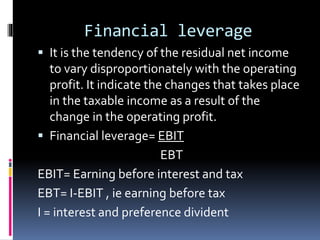
Financial leverage
 It is the tendency of the residual net income
to vary disproportionately with the operating
profit. It indicate the changes that takes place
in the taxable income as a result of the
change in the operating profit.
 Financial leverage= EBIT
EBT
EBIT= Earning before interest and tax
EBT= I-EBIT , ie earning before tax
I = interest and preference divident
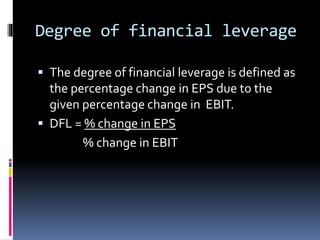
Degree of financial leverage
 The degree of financial leverage is defined as
the percentage change in EPS due to the
given percentage change in EBIT.
 DFL = % change in EPS
% change in EBIT
Limitations of financial
leverages
 Increases risk
 Beneficial only to companies having stable
earning
 Restrictions from financial institutions
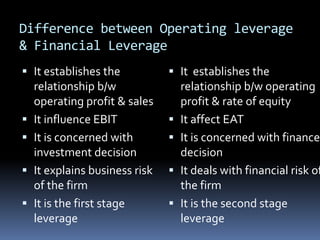
Difference between Operating leverage
& Financial Leverage
 It establishes the
relationship b/w
operating profit & sales
 It influence EBIT
 It is concerned with
investment decision
 It explains business risk
of the firm
 It is the first stage
leverage
 It establishes the
relationship b/w operating
profit & rate of equity
 It affect EAT
 It is concerned with finance
decision
 It deals with financial risk of
the firm
 It is the second stage
leverage
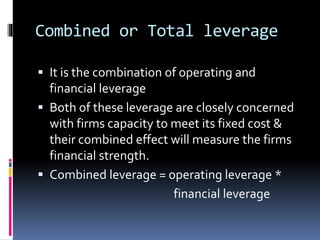
Combined or Total leverage
 It is the combination of operating and
financial leverage
 Both of these leverage are closely concerned
with firms capacity to meet its fixed cost &
their combined effect will measure the firms
financial strength.
 Combined leverage = operating leverage *
financial leverage
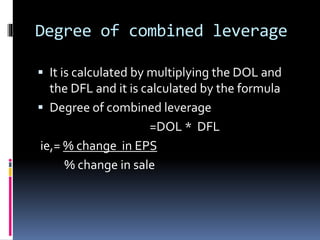
Degree of combined leverage
 It is calculated by multiplying the DOL and
the DFL and it is calculated by the formula
 Degree of combined leverage
=DOL * DFL
ie,= % change in EPS
% change in sale
Types of leverages

Types of leverages

  • 1.
  • 2.
    LEVERAGE ‘Leverage’ means ‘effectiveness’or ‘power’ A firm is said to be leveraged if it has fixed cost Degree of leverage -Measure of how much leverage the firm uses There are three types of leverages -Operating leverages -Financial leverages -Combined leverages
  • 4.
    Operating leverage  Operatingleverage is a measurement of the degree to which a firm incurs a combination of fixed and variable cost  Operating leverage = contribution/EBIT contribution = sales – variable cost EBIT = contribution –fixed cost Note : in case the contribution exceeds the fixed cost,the operating leverage is favorable. when C<F, the operating leverages is unfavorable
  • 5.
    Degree of operatingleverage  It measures how muchis the effect of change in sales on operating profit.  The degree of operating leverage at any level is expressed in percentage change in operating profit to percentage change in sales  Degree of operating leverage= % change in EBIT % change in sales
  • 6.
    Importance of operating leverages Profit planning  Capital structure planning  Risk analysis
  • 7.
    Financial leverage  Itis the tendency of the residual net income to vary disproportionately with the operating profit. It indicate the changes that takes place in the taxable income as a result of the change in the operating profit.  Financial leverage= EBIT EBT EBIT= Earning before interest and tax EBT= I-EBIT , ie earning before tax I = interest and preference divident
  • 8.
    Degree of financialleverage  The degree of financial leverage is defined as the percentage change in EPS due to the given percentage change in EBIT.  DFL = % change in EPS % change in EBIT
  • 9.
    Limitations of financial leverages Increases risk  Beneficial only to companies having stable earning  Restrictions from financial institutions
  • 10.
    Difference between Operatingleverage & Financial Leverage  It establishes the relationship b/w operating profit & sales  It influence EBIT  It is concerned with investment decision  It explains business risk of the firm  It is the first stage leverage  It establishes the relationship b/w operating profit & rate of equity  It affect EAT  It is concerned with finance decision  It deals with financial risk of the firm  It is the second stage leverage
  • 11.
    Combined or Totalleverage  It is the combination of operating and financial leverage  Both of these leverage are closely concerned with firms capacity to meet its fixed cost & their combined effect will measure the firms financial strength.  Combined leverage = operating leverage * financial leverage
  • 12.
    Degree of combinedleverage  It is calculated by multiplying the DOL and the DFL and it is calculated by the formula  Degree of combined leverage =DOL * DFL ie,= % change in EPS % change in sale