OPERATING, FINANCIAL &
COMBINED LEVERAGE
PRESENTED BY
SIMRAN KAUR
LEVERAGE
 Leverage is the employment of an
asset/source of finance for which firm
pays fixed cost/fixed return
 If earnings available to shareholders
less than variable cost exceed the
fixed cost, or earnings before interest
and taxes exceed the fixed return
requirement, the leverage is called
favourable
TYPES OF LEVERAGE
 OPERATING LEVERAGE : leverage
associated with investment (asset
acquisition) activities
 FINANCING LEVERAGE : leverage
associated with financing activities
OPERATING LEVERAGE
 Operating leverage may be defined as
the firm’s ability to use fixed operating
costs to magnify the effects of
changes in sales on its earning before
interest and taxes.
 It is determined by the relationship
between the firm’s sales revenues and
its earning before interest and taxes.
 It is caused due to fixed operating
expenses in a firm.
OPERATING LEVERAGE
The operating costs of a firm fall into
three categories:
1. Fixed costs : which don’t vary with
sales volume
2. Variable costs : which vary directly
with sales
3. Semi-variable or Semi-fixed costs :
which are partly fixed and partly
variable
DEGREE OF OPERATING
LEVERAGE (DOL)
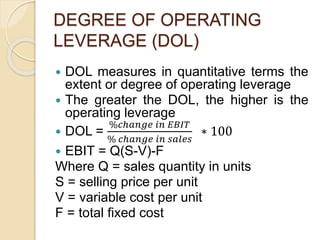
 DOL measures in quantitative terms the
extent or degree of operating leverage
 The greater the DOL, the higher is the
operating leverage
 DOL =
%𝑐ℎ𝑎𝑛𝑔𝑒 𝑖𝑛 𝐸𝐵𝐼𝑇
% 𝑐ℎ𝑎𝑛𝑔𝑒 𝑖𝑛 𝑠𝑎𝑙𝑒𝑠
∗ 100
 EBIT = Q(S-V)-F
Where Q = sales quantity in units
S = selling price per unit
V = variable cost per unit
F = total fixed cost
DEGREE OF OPERATING
LEVERAGE (DOL)
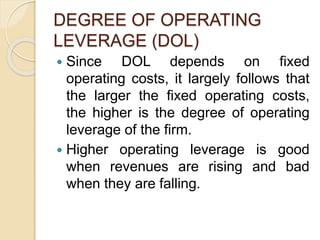
 Since DOL depends on fixed
operating costs, it largely follows that
the larger the fixed operating costs,
the higher is the degree of operating
leverage of the firm.
 Higher operating leverage is good
when revenues are rising and bad
when they are falling.
FINANCIAL LEVERAGE
 Financial leverage is defined as the
ability of a firm to use fixed financial
charges to magnify the effect of
changes in EBIT on EPS
 It is caused due to fixed financial costs
(interests) to the firm
 It represents the relationship between
the firm’s earnings before interest and
taxes (operating profits) and the
earnings available for ordinary
shareholders
FINANCIAL LEVERAGE
 Use of fixed interest source of funds
provides increased return on equity
investment without additional
requirements of funds from
shareholders. Thus, it is also called
“trading on equity”
 It measures the degree of the use of
debt and other fixed cost sources of
fund to finance the assets of the firm
has required
 It can be expressed in “Stock terms”
and “Flow terms”
STOCK TERMS OF FINANCIAL
LEVERAGE
 The financial leverage can be
measured either by (a) a simple ratio
of debt to equity, or (b) by the ratio of
long-term debt plus preference share
to total capitalization
 Each of these measures indicates the
relative proportion of the funds to total
funds of the firm on which it is to pay
fixed financial charges
FLOW TERMS OF FINANCIAL
LEVERAGE
 The financial leverage can be
measured either by (a) the ratio of
EBIT to interest payments or (b) the
ratio of cash flows to interest payment,
popularly called debt service
capacity/coverage.
 These coverage ratios are useful to
the suppliers of the funds as they
assess the degree of risk associated
with lending to the firm
DEGREE OF FINANCIAL
LEVERAGE (DFL)
 DFL =
%𝑐ℎ𝑎𝑛𝑔𝑒 𝑖𝑛 𝐸𝑃𝑆
% 𝑐ℎ𝑎𝑛𝑔𝑒 𝑖𝑛 𝐸𝐵𝐼𝑇
> 1
 DFL =
𝐸𝐵𝐼𝑇
(𝐸𝐵𝐼𝑇−𝐼)
, when debt is used
 DFL =
𝐸𝐵𝐼𝑇
(𝐸𝐵𝐼𝑇−𝐼−𝐷 𝑝) (1−𝑡)
, when debt
and preference capital is used
 DFL =
𝐸𝐵𝐼𝑇
[𝐸𝐵𝐼𝑇−𝐼−(𝐷 𝑝+𝐷𝑡) (1−𝑡)]
, when
dividends paid on preference share
capital are subject to dividend tax
COMBINED LEVERAGE
Combined leverage is the product of
operating leverage and financial
leverage
CL = OL * FL
DEGREE OF COMBINED
LEVERAGE
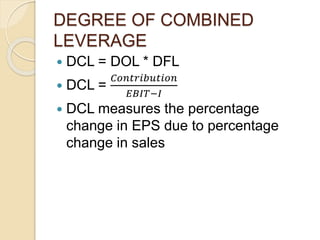
 DCL = DOL * DFL
 DCL =
𝐶𝑜𝑛𝑡𝑟𝑖𝑏𝑢𝑡𝑖𝑜𝑛
𝐸𝐵𝐼𝑇−𝐼
 DCL measures the percentage
change in EPS due to percentage
change in sales
IMPORTANT TERMS
 FINANCIAL RISK : risk of not being able
to cover fixed financial costs by a firm
 FINANCIAL BREAK-EVEN POINT : level
of EBIT which is equal to firm’s fixed
financial costs
 INDIFFERENCE POINT : EBIT level
beyond which benefits of financial
leverage accrue with respect to EPS
 EBIT-EPS ANALYSIS : comparison of
alternative methods of financing at
various levels of EBIT
INDIFFERENCE POINT FOR A
NEW COMPANY
 Equity shares versus Debentures
𝑋(1 − 𝑡)
𝑁1
=
(𝑋 − 𝐼)(1 − 𝑡)
𝑁2
 Equity shares versus Preference
shares
𝑋(1 − 𝑡)
𝑁1
=
𝑋 1 − 𝑡 − 𝐷 𝑝
𝑁3
 Equity shares versus Preference
shares with tax on Preference
dividend
𝑋(1 − 𝑡) 𝑋 1 − 𝑡 − 𝐷 𝑝(1 + 𝐷𝑡)
INDIFFERENCE POINT FOR A
NEW COMPANY
 Equity shares versus Preference
shares and Debentures
𝑋(1 − 𝑡)
𝑁1
=
𝑋 − 𝐼 1 − 𝑡 − 𝐷 𝑝
𝑁3
INDIFFERENCE POINT FOR AN
EXISTING COMPANY
If the debentures are already
outstanding, let us assume 𝐼1 =
𝑖𝑛𝑡𝑒𝑟𝑒𝑠𝑡 𝑝𝑎𝑖𝑑 𝑜𝑛 𝑒𝑥𝑖𝑠𝑡𝑖𝑛𝑔 𝑑𝑒𝑏𝑡 𝑎𝑛𝑑
𝐼2
= 𝑖𝑛𝑡𝑒𝑟𝑒𝑠𝑡 𝑝𝑎𝑦𝑎𝑏𝑙𝑒 𝑜𝑛 𝑎𝑑𝑑𝑖𝑡𝑖𝑜𝑛𝑎𝑙 𝑑𝑒𝑏𝑡,
Then indifference point would be
determined by
(𝑋 − 𝐼1)(1 − 𝑡)
𝑁1
=
(𝑋 − 𝐼1 − 𝐼2)(1 − 𝑡)
𝑁2
NOTATIONS IN INDIFFERENCE
POINT
 X = EBIT at indifference point
 𝑁1 = Number of equity shares
outstanding if only equity shares are
issued
 𝑁2 = Number of equity shares
outstanding if both debentures and
equity shares are issued
 𝑁3 = Number of equity shares
outstanding if both preference and
equity shares are issued
NOTATIONS IN INDIFFERENCE
POINT
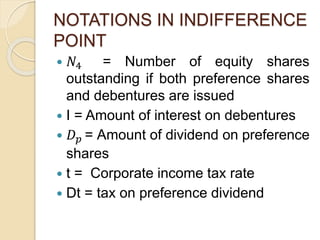
 𝑁4 = Number of equity shares
outstanding if both preference shares
and debentures are issued
 I = Amount of interest on debentures
 𝐷 𝑝 = Amount of dividend on preference
shares
 t = Corporate income tax rate
 Dt = tax on preference dividend
EBIT-EPS ANALYSIS
 If the expected level is to exceed the
indifference level of EBIT, the use of
fixed-charge source of funds (debt)
would be advantageous from the
viewpoint of EPS, that is, financial
leverage will be favourable and lead to
an increase in EPS available to
shareholders
 If the expected level of EBIT is less
than the indifference point, the
advantage of EPS would be available
from the use of equity capital
EBIT-EPS ANALYSIS
 The greater the likely level of EBIT
than the indifference point, the
stronger is the case for using levered
financial plans to maximize EPS
 The lower the likely level of EBIT in
relation to the indifference point, the
more useful the unlevered financial
plan would be from the viewpoint of
EPS
EBIT-EPS ANALYSIS
On the basis of level of EBIT which
ensures identical market price for
alternative financial plans, the
indifference point can be symbolically
computed by
𝑃 𝐸1
𝑋 1−𝑡
𝑁1
= 𝑃 𝐸2[
𝑋−𝐼 1−𝑡 −𝐷 𝑝
𝑁2
]
Where
𝑃 𝐸1= 𝑃 𝐸 ratio of unlevered plan
𝑃 𝐸2 = 𝑃 𝐸 ratio of levered plan
THANK YOU!!!

Operating, financial and combined leverage

  • 1.
    OPERATING, FINANCIAL & COMBINEDLEVERAGE PRESENTED BY SIMRAN KAUR
  • 2.
    LEVERAGE  Leverage isthe employment of an asset/source of finance for which firm pays fixed cost/fixed return  If earnings available to shareholders less than variable cost exceed the fixed cost, or earnings before interest and taxes exceed the fixed return requirement, the leverage is called favourable
  • 3.
    TYPES OF LEVERAGE OPERATING LEVERAGE : leverage associated with investment (asset acquisition) activities  FINANCING LEVERAGE : leverage associated with financing activities
  • 4.
    OPERATING LEVERAGE  Operatingleverage may be defined as the firm’s ability to use fixed operating costs to magnify the effects of changes in sales on its earning before interest and taxes.  It is determined by the relationship between the firm’s sales revenues and its earning before interest and taxes.  It is caused due to fixed operating expenses in a firm.
  • 5.
    OPERATING LEVERAGE The operatingcosts of a firm fall into three categories: 1. Fixed costs : which don’t vary with sales volume 2. Variable costs : which vary directly with sales 3. Semi-variable or Semi-fixed costs : which are partly fixed and partly variable
  • 6.
    DEGREE OF OPERATING LEVERAGE(DOL)  DOL measures in quantitative terms the extent or degree of operating leverage  The greater the DOL, the higher is the operating leverage  DOL = %𝑐ℎ𝑎𝑛𝑔𝑒 𝑖𝑛 𝐸𝐵𝐼𝑇 % 𝑐ℎ𝑎𝑛𝑔𝑒 𝑖𝑛 𝑠𝑎𝑙𝑒𝑠 ∗ 100  EBIT = Q(S-V)-F Where Q = sales quantity in units S = selling price per unit V = variable cost per unit F = total fixed cost
  • 7.
    DEGREE OF OPERATING LEVERAGE(DOL)  Since DOL depends on fixed operating costs, it largely follows that the larger the fixed operating costs, the higher is the degree of operating leverage of the firm.  Higher operating leverage is good when revenues are rising and bad when they are falling.
  • 8.
    FINANCIAL LEVERAGE  Financialleverage is defined as the ability of a firm to use fixed financial charges to magnify the effect of changes in EBIT on EPS  It is caused due to fixed financial costs (interests) to the firm  It represents the relationship between the firm’s earnings before interest and taxes (operating profits) and the earnings available for ordinary shareholders
  • 9.
    FINANCIAL LEVERAGE  Useof fixed interest source of funds provides increased return on equity investment without additional requirements of funds from shareholders. Thus, it is also called “trading on equity”  It measures the degree of the use of debt and other fixed cost sources of fund to finance the assets of the firm has required  It can be expressed in “Stock terms” and “Flow terms”
  • 10.
    STOCK TERMS OFFINANCIAL LEVERAGE  The financial leverage can be measured either by (a) a simple ratio of debt to equity, or (b) by the ratio of long-term debt plus preference share to total capitalization  Each of these measures indicates the relative proportion of the funds to total funds of the firm on which it is to pay fixed financial charges
  • 11.
    FLOW TERMS OFFINANCIAL LEVERAGE  The financial leverage can be measured either by (a) the ratio of EBIT to interest payments or (b) the ratio of cash flows to interest payment, popularly called debt service capacity/coverage.  These coverage ratios are useful to the suppliers of the funds as they assess the degree of risk associated with lending to the firm
  • 12.
    DEGREE OF FINANCIAL LEVERAGE(DFL)  DFL = %𝑐ℎ𝑎𝑛𝑔𝑒 𝑖𝑛 𝐸𝑃𝑆 % 𝑐ℎ𝑎𝑛𝑔𝑒 𝑖𝑛 𝐸𝐵𝐼𝑇 > 1  DFL = 𝐸𝐵𝐼𝑇 (𝐸𝐵𝐼𝑇−𝐼) , when debt is used  DFL = 𝐸𝐵𝐼𝑇 (𝐸𝐵𝐼𝑇−𝐼−𝐷 𝑝) (1−𝑡) , when debt and preference capital is used  DFL = 𝐸𝐵𝐼𝑇 [𝐸𝐵𝐼𝑇−𝐼−(𝐷 𝑝+𝐷𝑡) (1−𝑡)] , when dividends paid on preference share capital are subject to dividend tax
  • 13.
    COMBINED LEVERAGE Combined leverageis the product of operating leverage and financial leverage CL = OL * FL
  • 14.
    DEGREE OF COMBINED LEVERAGE DCL = DOL * DFL  DCL = 𝐶𝑜𝑛𝑡𝑟𝑖𝑏𝑢𝑡𝑖𝑜𝑛 𝐸𝐵𝐼𝑇−𝐼  DCL measures the percentage change in EPS due to percentage change in sales
  • 15.
    IMPORTANT TERMS  FINANCIALRISK : risk of not being able to cover fixed financial costs by a firm  FINANCIAL BREAK-EVEN POINT : level of EBIT which is equal to firm’s fixed financial costs  INDIFFERENCE POINT : EBIT level beyond which benefits of financial leverage accrue with respect to EPS  EBIT-EPS ANALYSIS : comparison of alternative methods of financing at various levels of EBIT
  • 16.
    INDIFFERENCE POINT FORA NEW COMPANY  Equity shares versus Debentures 𝑋(1 − 𝑡) 𝑁1 = (𝑋 − 𝐼)(1 − 𝑡) 𝑁2  Equity shares versus Preference shares 𝑋(1 − 𝑡) 𝑁1 = 𝑋 1 − 𝑡 − 𝐷 𝑝 𝑁3  Equity shares versus Preference shares with tax on Preference dividend 𝑋(1 − 𝑡) 𝑋 1 − 𝑡 − 𝐷 𝑝(1 + 𝐷𝑡)
  • 17.
    INDIFFERENCE POINT FORA NEW COMPANY  Equity shares versus Preference shares and Debentures 𝑋(1 − 𝑡) 𝑁1 = 𝑋 − 𝐼 1 − 𝑡 − 𝐷 𝑝 𝑁3
  • 18.
    INDIFFERENCE POINT FORAN EXISTING COMPANY If the debentures are already outstanding, let us assume 𝐼1 = 𝑖𝑛𝑡𝑒𝑟𝑒𝑠𝑡 𝑝𝑎𝑖𝑑 𝑜𝑛 𝑒𝑥𝑖𝑠𝑡𝑖𝑛𝑔 𝑑𝑒𝑏𝑡 𝑎𝑛𝑑 𝐼2 = 𝑖𝑛𝑡𝑒𝑟𝑒𝑠𝑡 𝑝𝑎𝑦𝑎𝑏𝑙𝑒 𝑜𝑛 𝑎𝑑𝑑𝑖𝑡𝑖𝑜𝑛𝑎𝑙 𝑑𝑒𝑏𝑡, Then indifference point would be determined by (𝑋 − 𝐼1)(1 − 𝑡) 𝑁1 = (𝑋 − 𝐼1 − 𝐼2)(1 − 𝑡) 𝑁2
  • 19.
    NOTATIONS IN INDIFFERENCE POINT X = EBIT at indifference point  𝑁1 = Number of equity shares outstanding if only equity shares are issued  𝑁2 = Number of equity shares outstanding if both debentures and equity shares are issued  𝑁3 = Number of equity shares outstanding if both preference and equity shares are issued
  • 20.
    NOTATIONS IN INDIFFERENCE POINT 𝑁4 = Number of equity shares outstanding if both preference shares and debentures are issued  I = Amount of interest on debentures  𝐷 𝑝 = Amount of dividend on preference shares  t = Corporate income tax rate  Dt = tax on preference dividend
  • 21.
    EBIT-EPS ANALYSIS  Ifthe expected level is to exceed the indifference level of EBIT, the use of fixed-charge source of funds (debt) would be advantageous from the viewpoint of EPS, that is, financial leverage will be favourable and lead to an increase in EPS available to shareholders  If the expected level of EBIT is less than the indifference point, the advantage of EPS would be available from the use of equity capital
  • 22.
    EBIT-EPS ANALYSIS  Thegreater the likely level of EBIT than the indifference point, the stronger is the case for using levered financial plans to maximize EPS  The lower the likely level of EBIT in relation to the indifference point, the more useful the unlevered financial plan would be from the viewpoint of EPS
  • 23.
    EBIT-EPS ANALYSIS On thebasis of level of EBIT which ensures identical market price for alternative financial plans, the indifference point can be symbolically computed by 𝑃 𝐸1 𝑋 1−𝑡 𝑁1 = 𝑃 𝐸2[ 𝑋−𝐼 1−𝑡 −𝐷 𝑝 𝑁2 ] Where 𝑃 𝐸1= 𝑃 𝐸 ratio of unlevered plan 𝑃 𝐸2 = 𝑃 𝐸 ratio of levered plan
  • 24.