DR. MOHAMED KUTTY
KAKKAKUNNAN
Associate Professor
P.G. Dept. of Commerce
N A M College Kallikkandy
KAMMUR –KERALA - INDIA
F i n a n c i a l L e v e r a g e
Sources of funds
 On the basis of time
– Short term
– Medium term
– Long term
 On the basis of ownership and control
• Ownership securities
• Creditorship securities
 On the basis of variability of return
– Fixed income bearing securities
– Variable income bearing securities
Management may issue any kind of securities
subject to the laws and regulations of the
country
May use any combination or any proportion
Own fund and borrowed fund
Trading on equity
 Using borrowed funds along with owned funds
 Lenders, lend to the company on the strength of
equity supplied by the owners
 Residual owners have only equity / claim or
interest on the business income
Trading on thick equity
when the portion of owned fund (equity) is
more than that of borrowed funds
Trading on thin equity (opposite of thick
equity)
Why do firms employ borrowed funds?
i. Fixed charges (Interest < ROI)
ii. Tax advantage (Tax deductible )
Advantageous to the owners
• Financial leverage refers to the employment of
funds obtained at a fixed charges
• It is the ratio of long term debt to total funds
employed
• Also known as ‘trading on equity’ and ‘capital
gearing’
• When the management decides to finance
investments in assets with debt involving fixed cost,
it can be described as the usage of financial
leverage
Can be defined as
• “the mix of debt and equity and is expressed in terms of
ratio of debt to total funds”
• “the ability of the firm to use fixed financial charges to
magnify the effects of changes in EBIT on the EPS”
• “is the process of using borrowings to produce gains for
the residual owners”
• It is introduced with the anticipation that the company
can earn more on funds invested than to be paid to the
funds
• Thus, financial leverage can be favorable or positive and
unfavorable or negative
• Favorable leverage enhances the earnings of residual
owners and may lead to magnify the value of shares
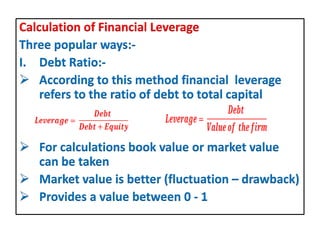
Calculation of Financial Leverage
Three popular ways:-
I. Debt Ratio:-
 According to this method financial leverage
refers to the ratio of debt to total capital
 For calculations book value or market value
can be taken
 Market value is better (fluctuation – drawback)
 Provides a value between 0 - 1
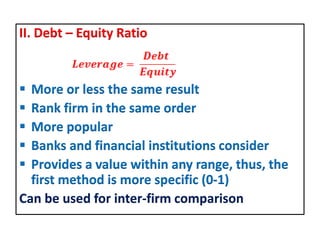
II. Debt – Equity Ratio
 More or less the same result
 Rank firm in the same order
 More popular
 Banks and financial institutions consider
 Provides a value within any range, thus, the
first method is more specific (0-1)
Can be used for inter-firm comparison
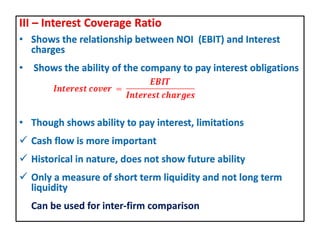
III – Interest Coverage Ratio
• Shows the relationship between NOI (EBIT) and Interest
charges
• Shows the ability of the company to pay interest obligations
• Though shows ability to pay interest, limitations
 Cash flow is more important
 Historical in nature, does not show future ability
 Only a measure of short term liquidity and not long term
liquidity
Can be used for inter-firm comparison
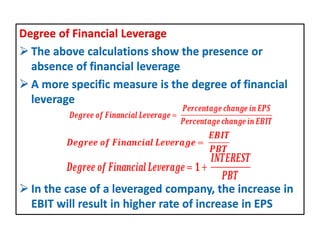
Degree of Financial Leverage
 The above calculations show the presence or
absence of financial leverage
 A more specific measure is the degree of financial
leverage
 In the case of a leveraged company, the increase in
EBIT will result in higher rate of increase in EPS
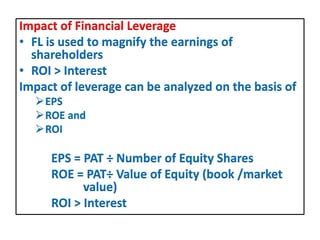
Impact of Financial Leverage
• FL is used to magnify the earnings of
shareholders
• ROI > Interest
Impact of leverage can be analyzed on the basis of
EPS
ROE and
ROI
EPS = PAT ÷ Number of Equity Shares
ROE = PAT÷ Value of Equity (book /market
value)
ROI > Interest
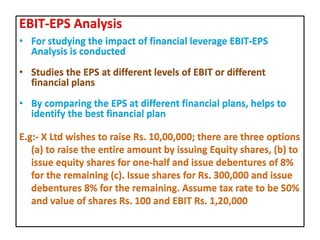
EBIT-EPS Analysis
• For studying the impact of financial leverage EBIT-EPS
Analysis is conducted
• Studies the EPS at different levels of EBIT or different
financial plans
• By comparing the EPS at different financial plans, helps to
identify the best financial plan
E.g:- X Ltd wishes to raise Rs. 10,00,000; there are three options
(a) to raise the entire amount by issuing Equity shares, (b) to
issue equity shares for one-half and issue debentures of 8%
for the remaining (c). Issue shares for Rs. 300,000 and issue
debentures 8% for the remaining. Assume tax rate to be 50%
and value of shares Rs. 100 and EBIT Rs. 1,20,000
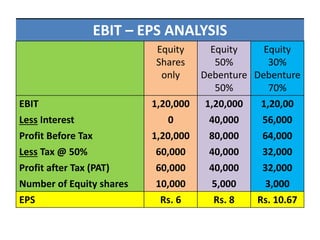
EBIT – EPS ANALYSIS
Equity
Shares
only
Equity
50%
Debenture
50%
Equity
30%
Debenture
70%
EBIT 1,20,000 1,20,000 1,20,00
Less Interest 0 40,000 56,000
Profit Before Tax 1,20,000 80,000 64,000
Less Tax @ 50% 60,000 40,000 32,000
Profit after Tax (PAT) 60,000 40,000 32,000
Number of Equity shares 10,000 5,000 3,000
EPS Rs. 6 Rs. 8 Rs. 10.67
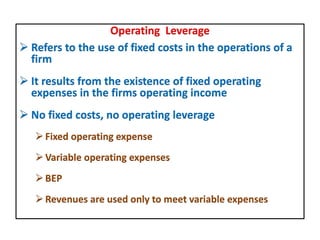
Operating Leverage
 Refers to the use of fixed costs in the operations of a
firm
 It results from the existence of fixed operating
expenses in the firms operating income
 No fixed costs, no operating leverage
Fixed operating expense
Variable operating expenses
BEP
Revenues are used only to meet variable expenses
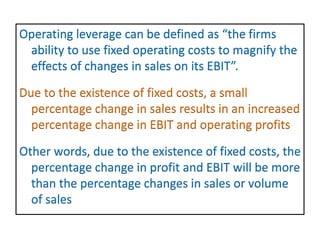
Operating leverage can be defined as “the firms
ability to use fixed operating costs to magnify the
effects of changes in sales on its EBIT”.
Due to the existence of fixed costs, a small
percentage change in sales results in an increased
percentage change in EBIT and operating profits
Other words, due to the existence of fixed costs, the
percentage change in profit and EBIT will be more
than the percentage changes in sales or volume
of sales
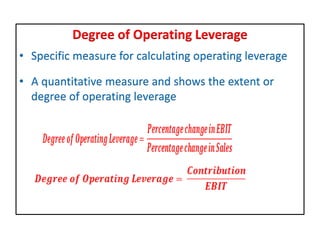
Degree of Operating Leverage
• Specific measure for calculating operating leverage
• A quantitative measure and shows the extent or
degree of operating leverage
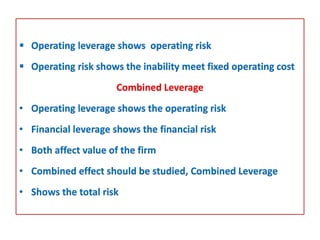
 Operating leverage shows operating risk
 Operating risk shows the inability meet fixed operating cost
Combined Leverage
• Operating leverage shows the operating risk
• Financial leverage shows the financial risk
• Both affect value of the firm
• Combined effect should be studied, Combined Leverage
• Shows the total risk
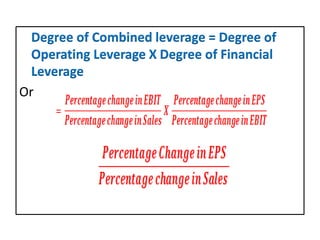
Degree of Combined leverage = Degree of
Operating Leverage X Degree of Financial
Leverage
Or

Leverage

  • 1.
    DR. MOHAMED KUTTY KAKKAKUNNAN AssociateProfessor P.G. Dept. of Commerce N A M College Kallikkandy KAMMUR –KERALA - INDIA
  • 3.
    F i na n c i a l L e v e r a g e Sources of funds  On the basis of time – Short term – Medium term – Long term  On the basis of ownership and control • Ownership securities • Creditorship securities  On the basis of variability of return – Fixed income bearing securities – Variable income bearing securities
  • 4.
    Management may issueany kind of securities subject to the laws and regulations of the country May use any combination or any proportion Own fund and borrowed fund Trading on equity  Using borrowed funds along with owned funds  Lenders, lend to the company on the strength of equity supplied by the owners  Residual owners have only equity / claim or interest on the business income
  • 5.
    Trading on thickequity when the portion of owned fund (equity) is more than that of borrowed funds Trading on thin equity (opposite of thick equity) Why do firms employ borrowed funds? i. Fixed charges (Interest < ROI) ii. Tax advantage (Tax deductible ) Advantageous to the owners
  • 6.
    • Financial leveragerefers to the employment of funds obtained at a fixed charges • It is the ratio of long term debt to total funds employed • Also known as ‘trading on equity’ and ‘capital gearing’ • When the management decides to finance investments in assets with debt involving fixed cost, it can be described as the usage of financial leverage
  • 7.
    Can be definedas • “the mix of debt and equity and is expressed in terms of ratio of debt to total funds” • “the ability of the firm to use fixed financial charges to magnify the effects of changes in EBIT on the EPS” • “is the process of using borrowings to produce gains for the residual owners” • It is introduced with the anticipation that the company can earn more on funds invested than to be paid to the funds • Thus, financial leverage can be favorable or positive and unfavorable or negative • Favorable leverage enhances the earnings of residual owners and may lead to magnify the value of shares
  • 8.
    Calculation of FinancialLeverage Three popular ways:- I. Debt Ratio:-  According to this method financial leverage refers to the ratio of debt to total capital  For calculations book value or market value can be taken  Market value is better (fluctuation – drawback)  Provides a value between 0 - 1
  • 9.
    II. Debt –Equity Ratio  More or less the same result  Rank firm in the same order  More popular  Banks and financial institutions consider  Provides a value within any range, thus, the first method is more specific (0-1) Can be used for inter-firm comparison
  • 10.
    III – InterestCoverage Ratio • Shows the relationship between NOI (EBIT) and Interest charges • Shows the ability of the company to pay interest obligations • Though shows ability to pay interest, limitations  Cash flow is more important  Historical in nature, does not show future ability  Only a measure of short term liquidity and not long term liquidity Can be used for inter-firm comparison
  • 11.
    Degree of FinancialLeverage  The above calculations show the presence or absence of financial leverage  A more specific measure is the degree of financial leverage  In the case of a leveraged company, the increase in EBIT will result in higher rate of increase in EPS
  • 12.
    Impact of FinancialLeverage • FL is used to magnify the earnings of shareholders • ROI > Interest Impact of leverage can be analyzed on the basis of EPS ROE and ROI EPS = PAT ÷ Number of Equity Shares ROE = PAT÷ Value of Equity (book /market value) ROI > Interest
  • 14.
    EBIT-EPS Analysis • Forstudying the impact of financial leverage EBIT-EPS Analysis is conducted • Studies the EPS at different levels of EBIT or different financial plans • By comparing the EPS at different financial plans, helps to identify the best financial plan E.g:- X Ltd wishes to raise Rs. 10,00,000; there are three options (a) to raise the entire amount by issuing Equity shares, (b) to issue equity shares for one-half and issue debentures of 8% for the remaining (c). Issue shares for Rs. 300,000 and issue debentures 8% for the remaining. Assume tax rate to be 50% and value of shares Rs. 100 and EBIT Rs. 1,20,000
  • 15.
    EBIT – EPSANALYSIS Equity Shares only Equity 50% Debenture 50% Equity 30% Debenture 70% EBIT 1,20,000 1,20,000 1,20,00 Less Interest 0 40,000 56,000 Profit Before Tax 1,20,000 80,000 64,000 Less Tax @ 50% 60,000 40,000 32,000 Profit after Tax (PAT) 60,000 40,000 32,000 Number of Equity shares 10,000 5,000 3,000 EPS Rs. 6 Rs. 8 Rs. 10.67
  • 16.
    Operating Leverage  Refersto the use of fixed costs in the operations of a firm  It results from the existence of fixed operating expenses in the firms operating income  No fixed costs, no operating leverage Fixed operating expense Variable operating expenses BEP Revenues are used only to meet variable expenses
  • 17.
    Operating leverage canbe defined as “the firms ability to use fixed operating costs to magnify the effects of changes in sales on its EBIT”. Due to the existence of fixed costs, a small percentage change in sales results in an increased percentage change in EBIT and operating profits Other words, due to the existence of fixed costs, the percentage change in profit and EBIT will be more than the percentage changes in sales or volume of sales
  • 18.
    Degree of OperatingLeverage • Specific measure for calculating operating leverage • A quantitative measure and shows the extent or degree of operating leverage
  • 19.
     Operating leverageshows operating risk  Operating risk shows the inability meet fixed operating cost Combined Leverage • Operating leverage shows the operating risk • Financial leverage shows the financial risk • Both affect value of the firm • Combined effect should be studied, Combined Leverage • Shows the total risk
  • 20.
    Degree of Combinedleverage = Degree of Operating Leverage X Degree of Financial Leverage Or