Leverages

PRESENTED BY
  DHEERAJ
Definition of 'Leverage'

1. The use of various financial instruments or
borrowed capital, such as margin, to increase
the potential return of an investment.

2. The amount of debt used to finance a firm's
assets. A firm with significantly more debt than
equity is considered to be highly leveraged.
Classification
• There are two types of leverage:
  – Operating leverage – fixed costs associated
    with running the firm.
  – Financial leverage – fixed costs associated
    with financing the firm.
• Degree of leverage
  – Measure of how much leverage the firm
    uses.
Operating Leverage
• Operating leverage is the ratio of
  a company's fixed costs to
  its variable costs.

• A firm with relatively high fixed
  operating costs will experience
  more variable operating income if
  sales change.
Effect of operating leverage
• More operating leverage leads to more
  business risk, for then a small sales decline
  causes a big profit decline.
        $         Rev.   $          Rev.
                      TC              } Profit
                                        TC
                                           FC
                      FC
            QBE    Sales      QBE    Sales
Degree of Operating Leverage
              (DOL)
• Operating leverage: by using fixed operating
  costs, a small change in sales revenue is
  magnified into a larger change in operating
  income.

• This “multiplier effect” is called the degree of
  operating leverage.
Degree of Operating Leverage
           from Sales Level (S)

• DOLs = % change in EBIT
         % change in sales

         = change in EBIT
               EBIT
           change in sales
              sales
Degree of Operating Leverage
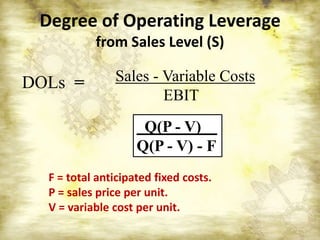
           from Sales Level (S)

DOLs =         Sales - Variable Costs
                       EBIT
                     Q(P - V)
                    Q(P - V) - F
  F = total anticipated fixed costs.
  P = sales price per unit.
  V = variable cost per unit.
What does this tell us?
• If DOL = 2, then a 1% increase in sales will
  result in a 2% increase in operating income
  (EBIT).


                                        Stock-
   Sales       EBIT          EPS        holders
What does this tell us?
• If DOL = 2, then a 1% increase in sales will
  result in a 2% increase in operating income
  (EBIT).


                                       Stock-
   Sales      EBIT           EPS       holders
Financial
               Leverage
The use of fixed-cost sources of financing
(debt, preferred stock) rather than variable-
cost sources (common stock).
Degree of Financial Leverage
            (DFL)
• Financial leverage: by using fixed cost
  financing, a small change in operating
  income is magnified into a larger change in
  earnings per share.

• This “multiplier effect” is called the degree
  of financial leverage.
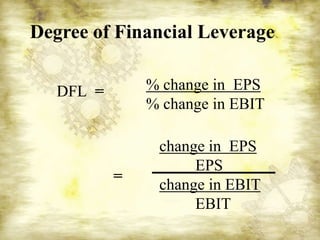
Degree of Financial Leverage

   DFL =       % change in EPS
               % change in EBIT

                change in EPS
                     EPS
           =
                change in EBIT
                     EBIT
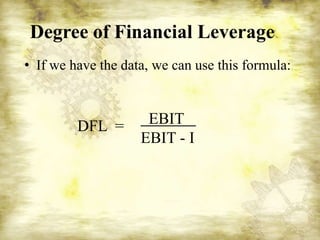
Degree of Financial Leverage
• If we have the data, we can use this formula:


         DFL =       EBIT
                    EBIT - I
What does this tell us?
• If DFL = 3, then a 1% increase in operating
  income will result in a 3% increase in earnings
  per share.


                                         Stock-
    Sales      EBIT           EPS        holders
What does this tell us?
• If DFL = 3, then a 1% increase in operating
  income will result in a 3% increase in earnings
  per share.


                                         Stock-
    Sales      EBIT           EPS        holders
Combined Leverage

• Combined leverage: by using operating leverage
  and financial leverage, a small change in sales is
  magnified into a larger change in earnings per
  share.

• This “multiplier effect” is called the degree of
  combined leverage.
Degree of Combined Leverage

 DCL = DOL x DFL

        % change in EPS
      =
        % change in Sales

           change in EPS
                EPS
       =
           change in Sales
                Sales
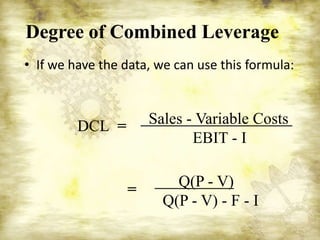
Degree of Combined Leverage
• If we have the data, we can use this formula:


         DCL =       Sales - Variable Costs
                            EBIT - I

                          Q(P - V)
                 =
                        Q(P - V) - F - I
What does this tell us?

• If DCL = 4, then a 1% increase in sales
  will result in a 4% increase in earnings
  per share.


                                    Stock-
   Sales      EBIT         EPS      holders
What does this tell us?

• If DCL = 4, then a 1% increase in sales
  will result in a 4% increase in earnings
  per share.


                                    Stock-
   Sales      EBIT         EPS      holders
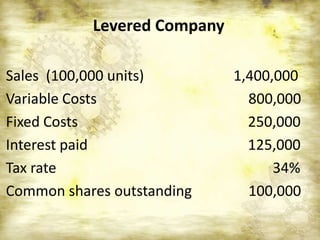
Levered Company

Sales (100,000 units)        1,400,000
Variable Costs                 800,000
Fixed Costs                    250,000
Interest paid                  125,000
Tax rate                           34%
Common shares outstanding      100,000
Degree of Operating Leverage from
            Sales Level (S)

              Sales - Variable Costs
 DOLs =
                      EBIT

               1,400,000 - 800,000
        =           350,000

              = 1.714
Degree of Financial Leverage

      DFL =    EBIT
              EBIT - I

               350,000
          =
               225,000

              = 1.556
Degree of Combined Leverage

DCL =     Sales - Variable Costs
                 EBIT - I

          1,400,000 - 800,000
    =
                225,000


        = 2.667
Leverages

Leverages

  • 1.
  • 2.
    Definition of 'Leverage' 1.The use of various financial instruments or borrowed capital, such as margin, to increase the potential return of an investment. 2. The amount of debt used to finance a firm's assets. A firm with significantly more debt than equity is considered to be highly leveraged.
  • 3.
    Classification • There aretwo types of leverage: – Operating leverage – fixed costs associated with running the firm. – Financial leverage – fixed costs associated with financing the firm. • Degree of leverage – Measure of how much leverage the firm uses.
  • 4.
    Operating Leverage • Operatingleverage is the ratio of a company's fixed costs to its variable costs. • A firm with relatively high fixed operating costs will experience more variable operating income if sales change.
  • 5.
    Effect of operatingleverage • More operating leverage leads to more business risk, for then a small sales decline causes a big profit decline. $ Rev. $ Rev. TC } Profit TC FC FC QBE Sales QBE Sales
  • 6.
    Degree of OperatingLeverage (DOL) • Operating leverage: by using fixed operating costs, a small change in sales revenue is magnified into a larger change in operating income. • This “multiplier effect” is called the degree of operating leverage.
  • 7.
    Degree of OperatingLeverage from Sales Level (S) • DOLs = % change in EBIT % change in sales = change in EBIT EBIT change in sales sales
  • 8.
    Degree of OperatingLeverage from Sales Level (S) DOLs = Sales - Variable Costs EBIT Q(P - V) Q(P - V) - F F = total anticipated fixed costs. P = sales price per unit. V = variable cost per unit.
  • 9.
    What does thistell us? • If DOL = 2, then a 1% increase in sales will result in a 2% increase in operating income (EBIT). Stock- Sales EBIT EPS holders
  • 10.
    What does thistell us? • If DOL = 2, then a 1% increase in sales will result in a 2% increase in operating income (EBIT). Stock- Sales EBIT EPS holders
  • 11.
    Financial Leverage The use of fixed-cost sources of financing (debt, preferred stock) rather than variable- cost sources (common stock).
  • 12.
    Degree of FinancialLeverage (DFL) • Financial leverage: by using fixed cost financing, a small change in operating income is magnified into a larger change in earnings per share. • This “multiplier effect” is called the degree of financial leverage.
  • 13.
    Degree of FinancialLeverage DFL = % change in EPS % change in EBIT change in EPS EPS = change in EBIT EBIT
  • 14.
    Degree of FinancialLeverage • If we have the data, we can use this formula: DFL = EBIT EBIT - I
  • 15.
    What does thistell us? • If DFL = 3, then a 1% increase in operating income will result in a 3% increase in earnings per share. Stock- Sales EBIT EPS holders
  • 16.
    What does thistell us? • If DFL = 3, then a 1% increase in operating income will result in a 3% increase in earnings per share. Stock- Sales EBIT EPS holders
  • 17.
    Combined Leverage • Combinedleverage: by using operating leverage and financial leverage, a small change in sales is magnified into a larger change in earnings per share. • This “multiplier effect” is called the degree of combined leverage.
  • 18.
    Degree of CombinedLeverage DCL = DOL x DFL % change in EPS = % change in Sales change in EPS EPS = change in Sales Sales
  • 19.
    Degree of CombinedLeverage • If we have the data, we can use this formula: DCL = Sales - Variable Costs EBIT - I Q(P - V) = Q(P - V) - F - I
  • 20.
    What does thistell us? • If DCL = 4, then a 1% increase in sales will result in a 4% increase in earnings per share. Stock- Sales EBIT EPS holders
  • 21.
    What does thistell us? • If DCL = 4, then a 1% increase in sales will result in a 4% increase in earnings per share. Stock- Sales EBIT EPS holders
  • 22.
    Levered Company Sales (100,000units) 1,400,000 Variable Costs 800,000 Fixed Costs 250,000 Interest paid 125,000 Tax rate 34% Common shares outstanding 100,000
  • 23.
    Degree of OperatingLeverage from Sales Level (S) Sales - Variable Costs DOLs = EBIT 1,400,000 - 800,000 = 350,000 = 1.714
  • 24.
    Degree of FinancialLeverage DFL = EBIT EBIT - I 350,000 = 225,000 = 1.556
  • 25.
    Degree of CombinedLeverage DCL = Sales - Variable Costs EBIT - I 1,400,000 - 800,000 = 225,000 = 2.667