CAPITAL STRUCTURE
DECISIONS
CAPITAL STRUCTURE
 Capital structure is the mix of the long-term sources of
funds used by a firm. It is made up of debt and equity
securities and refers to permanent financing of a firm. It
is composed of long-term debt, preference share capital
and shareholders’ funds.
 In simple words it refers to the particular distribution of
debt and equity that makes up the finances of a company.
Ideal capital structure
It should minimize cost of capital.
It should reduce risks.
It should give required flexibility.
It should provide required control to the owners.
It should enable the company to have adequate finance.
It should maximize the value of the firm
OPTIMUM CAPTIAL STRUCTURE
 Optimal capital structure refers to the combination of
debt and equity in total capital that maximizes the value
of the company.
 An optimal capital structure is designated as one at
which the average cost of capital is the lowest which
produces an income that leads to maximization of the
market value of the securities at that income.
 Optimal capital structure may be defined as that
relationship of debt and equity which maximizes the value
of company’s share in the stock exchange.
 Capital structure at which the weighted average cost of
capital is minimum and which maximizes value of the firm
Cont…
Capital structure decision: Type #1
I. Financial risk:
 The financial risk arises on account of the use of debt or fixed interest
bearing securities in its capital. A company with no debt financing has
no financial risk. The extent of financial risk depends on the leverage of
the firm’s capital structure.
 A firm using debt in its capital has to pay fixed interest charges and the
lack of ability to pay fixed interest increases the risk of liquidation. The
financial risk also implies the variability of earnings available to equity
shareholders.
Capital structure decision: Type #2
II. Non-Employment of Debt Capital (NEDC) Risk:
 If a firm does not use debt in its capital structure, it has
to face the risk arising out of non-employment of debt
capital.
 The NEDC risk has an inverse relationship with the ratio
of debt in its total capital. Higher the debt-equity ratio or
the leverage, lower is the NEDC risk and vice-versa.
 A firm that does not use debt cannot make use of
financial leverage to increase its earnings per share; it
may also lose control by issue of more and more equity;
the cost of floatation of equity may also be higher as
compared to costs of raising debt.
 Thus a firm reaches a balance (trade – off) between the
financial risk and risk of non-employment of debt capital
to increase its market value.
Cont…
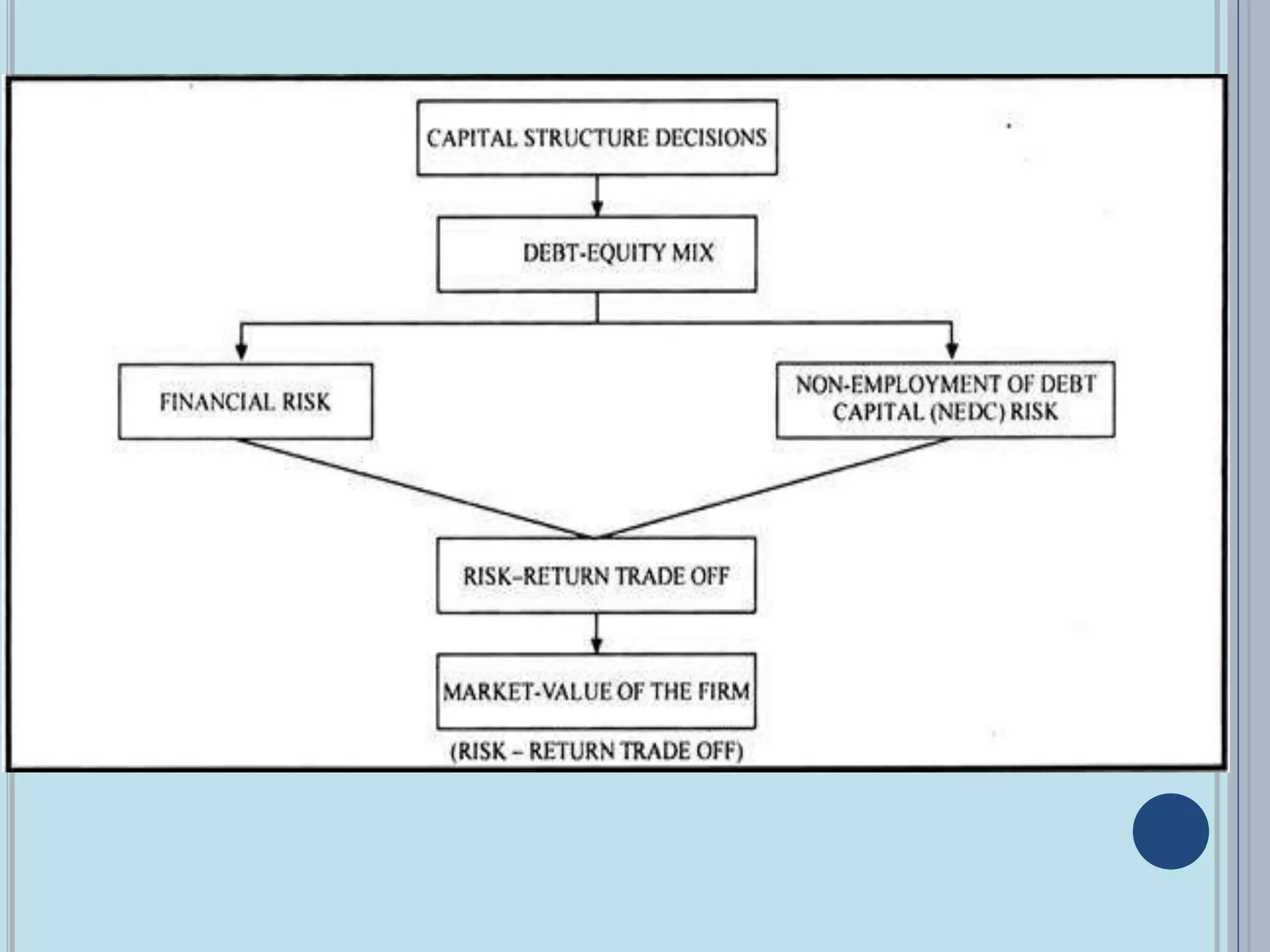
 The finance manager, in trying to achieve the optimal capital structure has
to determine the minimum overall total risk and maximize the possible
return to achieve the objective of higher market value of the firm. The
figure above depicts the financial risk, the NEDC risk and the optimal
capital structure.
RISK RETURN TRADE OFF
 Higher risk is associated with greater probability of
higher return and lower risk with a greater probability of
smaller return. This trade off which an investor faces
between risk and return while considering investment decisions
is called the risk return trade off.
MARKET VALUE OF THE FIRM
 Market value is the value of a company according to the stock
market. Market value is calculated by multiplying a company's
shares outstanding by its current market price.
THANK YOU!!
Done by:
Achla Anoop

Capital structure decisions

  • 1.
  • 2.
    CAPITAL STRUCTURE  Capitalstructure is the mix of the long-term sources of funds used by a firm. It is made up of debt and equity securities and refers to permanent financing of a firm. It is composed of long-term debt, preference share capital and shareholders’ funds.  In simple words it refers to the particular distribution of debt and equity that makes up the finances of a company.
  • 3.
    Ideal capital structure Itshould minimize cost of capital. It should reduce risks. It should give required flexibility. It should provide required control to the owners. It should enable the company to have adequate finance. It should maximize the value of the firm
  • 4.
    OPTIMUM CAPTIAL STRUCTURE Optimal capital structure refers to the combination of debt and equity in total capital that maximizes the value of the company.  An optimal capital structure is designated as one at which the average cost of capital is the lowest which produces an income that leads to maximization of the market value of the securities at that income.
  • 5.
     Optimal capitalstructure may be defined as that relationship of debt and equity which maximizes the value of company’s share in the stock exchange.  Capital structure at which the weighted average cost of capital is minimum and which maximizes value of the firm Cont…
  • 7.
    Capital structure decision:Type #1 I. Financial risk:  The financial risk arises on account of the use of debt or fixed interest bearing securities in its capital. A company with no debt financing has no financial risk. The extent of financial risk depends on the leverage of the firm’s capital structure.  A firm using debt in its capital has to pay fixed interest charges and the lack of ability to pay fixed interest increases the risk of liquidation. The financial risk also implies the variability of earnings available to equity shareholders.
  • 8.
    Capital structure decision:Type #2 II. Non-Employment of Debt Capital (NEDC) Risk:  If a firm does not use debt in its capital structure, it has to face the risk arising out of non-employment of debt capital.  The NEDC risk has an inverse relationship with the ratio of debt in its total capital. Higher the debt-equity ratio or the leverage, lower is the NEDC risk and vice-versa.
  • 9.
     A firmthat does not use debt cannot make use of financial leverage to increase its earnings per share; it may also lose control by issue of more and more equity; the cost of floatation of equity may also be higher as compared to costs of raising debt.  Thus a firm reaches a balance (trade – off) between the financial risk and risk of non-employment of debt capital to increase its market value. Cont…
  • 10.
     The financemanager, in trying to achieve the optimal capital structure has to determine the minimum overall total risk and maximize the possible return to achieve the objective of higher market value of the firm. The figure above depicts the financial risk, the NEDC risk and the optimal capital structure.
  • 11.
    RISK RETURN TRADEOFF  Higher risk is associated with greater probability of higher return and lower risk with a greater probability of smaller return. This trade off which an investor faces between risk and return while considering investment decisions is called the risk return trade off. MARKET VALUE OF THE FIRM  Market value is the value of a company according to the stock market. Market value is calculated by multiplying a company's shares outstanding by its current market price.
  • 13.

Editor's Notes

  • #11 Degree of leverage: A ratio that measures the sensitivity of a company’s earnings per share (EPS) to fluctuations in its operating income, as a result of changes in its capital structure. Degree of Financial Leverage (DFL) measures the percentage change in EPS for a unit change in earnings before interest and taxes (EBIT).