CHAPTER ONE
Capital Structure Policy and Leverage
OUTLINE
The capital structure question
Factors that influence capital structure
Business and Financial Risk
Determining the optimal capital structure
Introduction to the theory of capital structure
The capital structure question
 How should a firm go about choosing its debt-equity
ratio?
 Every company needs capital to support its operations.
Capital structure is a blend of various sources of finance.
 To be more specific, capital structure is a ratio of short-
term and long-term liabilities with equity.
 Depending on the sources of financing, we can classify
these as borrowed (or debt) capital and equity (owner’s)
capital. Together, they form the company’s employed
capital.
 Capital Restructuring
 Capital restructuring involves changing the amount of
leverage a firm has without changing the firm’s assets.
 The firm can increase leverage by issuing debt and
repurchasing outstanding shares.
 The firm can decrease leverage by issuing new shares
and retiring outstanding debt
Choosing a Capital Structure
 What is the primary goal of financial managers?
◦ Maximize stockholder wealth
 Stockholders’ wealth can be maximized by maximizing firm value or
minimizing WACC
 Factors Influencing Capital
Structure Decisions
• Business Risk
• Firm’s Tax Position
• Financial Flexibility
• Managerial Conservatism or Aggressiveness
• Operating Conditions – e.g. when Stock Price is not equal to
IntrinsicValue
• Cost of Equity Capital and Cost of Debt capital
• Regulatory Frameworks
The Effect of Leverage
 How does leverage affect the EPS and ROE of a firm?
◦ When we increase the amount of debt financing, we
increase the fixed interest expense.
◦ If we have a really good year, then we pay our fixed cost
and we have more left over for our stockholders.
◦ If we have a really bad year, we still have to pay our
fixed costs and we have less left over for our
stockholders.
 Leverage amplifies the variation in both EPS and ROE.
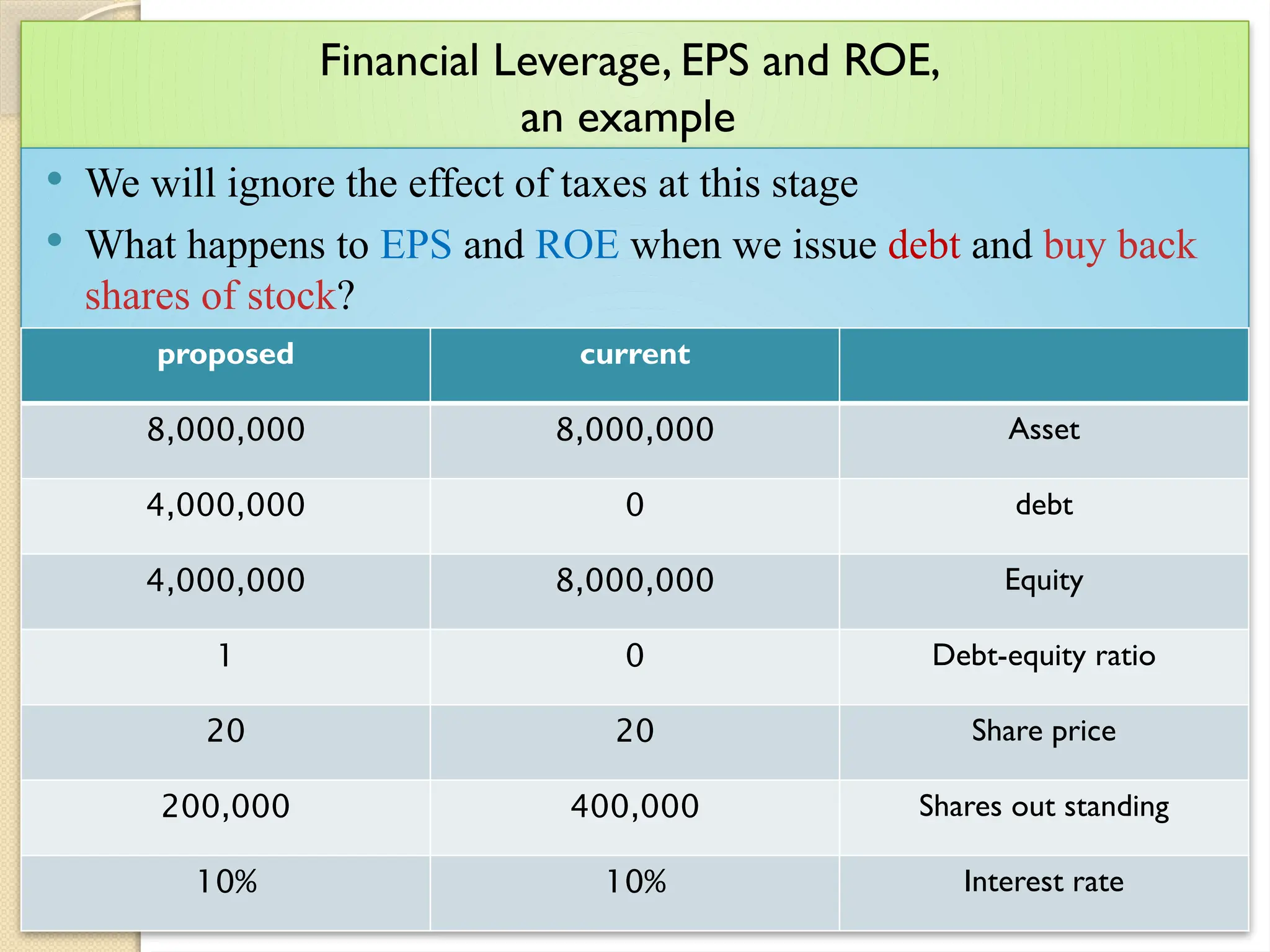
Financial Leverage, EPS and ROE,
an example
 We will ignore the effect of taxes at this stage
 What happens to EPS and ROE when we issue debt and buy back
shares of stock?
proposed current
8,000,000 8,000,000 Asset
4,000,000 0 debt
4,000,000 8,000,000 Equity
1 0 Debt-equity ratio
20 20 Share price
200,000 400,000 Shares out standing
10% 10% Interest rate
Current capital structure : No Debt
expansion expected Recession
1,500,000 1,000,000 500,000 EBIT
0 0 0 Interest
1,500,000 1,000,000 500,000 Net income
18.75% 12.5% 6.25% ROE
3.75 2.5 1.25 EPS
Proposed capital structure : debt= $ 4 million
1,500,000 1,000,000 500,000 EBIT
400,000 400,000 400,000 Interest
1,100,000 600,000 100,000 Net income
27.5% 15% 2.5% ROE
5.5 3 0.5 EPS
Cont….
 Variability in ROE
◦ Current: ROE ranges from 6.25% to 18.75%
◦ Proposed: ROE ranges from 2.50% to 27.50%
 Variability in EPS
◦ Current: EPS ranges from $1.25 to $3.75
◦ Proposed: EPS ranges from $0.50 to $5.50
 The variability in both ROE and EPS increases when financial
leverage is increased.
Business and Financial Risk
 What is business risk?
 Uncertainty about future operating income (EBIT), i.e.,
how well can we predict operating income?
 Note that business risk does not include financing effects.
 Business risk is affected primarily by:
Uncertainty about demand (sales).
Uncertainty about output prices.
Uncertainty about costs.
Product, other types of liability.
Operating leverage.
What is operating leverage, and how does it affect a
firm’s business risk?
 Operating leverage is the use of fixed costs rather than
variable costs.
 If most costs are fixed, hence do not decline when
demand falls, then the firm has high operating leverage.
 More operating leverage leads to more business risk, for
then a small sales decline causes a big profit decline.
What is financial leverage?
Financial risk?
 Financial leverage is the use of debt and preferred stock.
 Financial risk is the additional risk concentrated on
common stockholders as a result of financial leverage.
 Business Risk vs. Financial Risk
 Business risk depends on business factors such as
competition, product liability, and operating leverage.
 Financial risk depends only on the types of securities
issued: More debt, more financial risk. Concentrates
business risk on stockholders.
Meaning of leverage
 In business, leverage is the use of fixed costs in an attempt to
increase or (lever up) profitability. These fixed costs could be:
◦ fixed operating costs (e.g. depreciation) or
◦ fixed financing costs (e.g. interest) or in most cases both.
 It is the use of fixed costs with the intent of magnifying the returns of
the firm.
 Leverage magnifies profit as sales increases, and magnifies loses as
sales drops.
 Types of leverage
1. Operating Leverage:
 it is the use of fixed operating costs in the production activities or
operations of the firm.
 It is the use of fixed operating costs to magnify the effects of changes
in sales on the firm’s profits before interest and taxes (PBIT).
Degree of operating leverage (DOL)
 Degree of operating leverage is the numerical measure of the
firm’s operating leverage.
 It quantifies the responsiveness of operating income to changes in
the level of income.
 It is the variability of operating income (PBIT), due to the use of
fixed operating costs. It is the percentage change in operating profit
(PBIT) as a result of percentage change in sales.

Where,
DOL = Degree of operating leverage
PBIT = profit before interest and taxes (operating profit)
DOL = = Q = sales (units to be sold).
Cont…
 As long as DOL is greater than 1, there is operating leverage.
 A large DOL indicates that small change in the level of sales will
produce large changes in the level of operating profit.
 A firm with relatively high leverage level will experience more
variability in operating income if sales changes, thus, a higher level
of leverage can be associated with higher level of risk.
 Due to that decreases in sales results in a larger increase in lose if
the use of leverage is increased.
 Illustration: assume Lakew Company has the following income statement for the year
ended December 31, 2021.
Lakew Company
Income statement
For the year ended December 31, 2021
Sales (in units)…………………………………………………………1, 000
Sales revenue……………………………………………………..birr 10,000
Less: variable operating costs…………………………………………..5,000
Fixed operating costs……………………………………………2, 500
PBIT (Operating income)………………………………………….birr 2,500
Less: interest……………………………………………………………...500
Profit before tax……………………………………………………birr 2,000
Less: tax (40%)…………………………………………………………...800
Profit after tax……………………………………………………...birr 1,200
Ato Lakew is the owner manager of the company, and he is planning to increase the sales volume
to 1,500 units in the year 2022. He assumed the selling price per unit (SPU), VCU and the
total fixed costs would remain the same as they were in the year2021.
Projected operating leverage for the year 2022,
Sales (in units)………………………………………………………...1, 500
Sales revenue……………………………………………………..birr 15,000
Less: variable operating costs (1, 5000 x 5)……………………………7,500
Fixed operating costs……………………………………………2, 500
PBIT (profit before interest and tax)……………………………….birr 5,000
This indicates that as the company’s sales increases from 1,000 to
1,500, its PBIT will increase from birr 2,500 to birr 5,000. Or a 50%
change in sales results in a 100% increase in PBIT.
If DOL = 1, what does it imply? There is no fixed operating cost
employed and there will be 1% change in PBIT for a 1% change in
sales.
 DOL = = = = 2
Example:
Given amount percentage of sales
Sales………………….. birr 80,000……………………..100%
Less: variable costs …………32,000……………………...40%
Contribution margin……birr48, 000……………………..60%
Less: fixed costs…………..... 38, 000
Net operating income…birr 10,000
Required:
 Compute the company’s DOL.
 Using the DOL, estimate the impact on net operating income of a 5%
change in sales.
 Verify your estimate from the above by constructing a new
contribution; forget income statement for the company and assuming
a 5% increase in sales.
Operating leverage and risk
 Operating profits will rise and fall more rapidly for a firm with a higher degree
of operating leverage (high operating fixed costs).
 Business (operating risk) is the variability of earnings before interest and tax.
Variability of earnings before interest and tax is due to variability of sales or
variability of expenses (fixed and variable expenses). Or operating risk is the
variability of EBIT caused by the use of operating leverage.
 Firms with high DOL (i.e. relatively large fixed operating costs) are generally
riskier than firms with lower DOL (i.e. relatively lower fixed operating costs).
 The DOL shows how increase or decrease in the level of fixed operating costs
will affect the firm’s operating profits.
 Management needs to be aware of that an increase in fixed operating costs may
increase:
 Changes in operating profits as sales changes.
 The level of sales necessary for the firm to be profitable, and
 The level of business risk.
2. Financial Leverage
 Financial leverage is the use of fixed costs in the
financing of the firm’s assets such as interest costs and
preferred stock dividends.
 It is the use of fixed financing costs to magnify the effects
of changes in operating profit on the firm’s earnings per
share (EPS).
 The two fixed financing costs are:
 Interest on debt financing, and
 Preferred stock dividends – these costs must be paid
regardless of the amount of PBIT available to pay them.
Degree of financial leverage
 The Degree of Financial Leverage (DFL), like the DOL,
is a measure of responsiveness.
 It measures the responsiveness of EPS (Earning per
share) to changes in operating profits.
 It is the numerical measure of the firm’s financial
leverage.
DFL =
 Illustration:
Assume Nile Company has earned profit before interest and
tax of birr 10,000 in the current year. It has an interest cost of
birr 2,000 on its outstanding debt and 600 shares of birr 4
(annual preferred stock dividend per share) preferred stock
outstanding. The firm is in the 40% tax bracket.
Nile Company’s financial manager, Mr. Abel, wants to see the
effects of changes in operating profits on the company’s EPS.
Particularly, he is interested to see the effects of increase or
decrease the current operating profit by 40%.
 Preferred stock dividend = birr 4 x 600 = birr 2,400
 Common stock outstanding = 1,000 shares.
The EPS (earning per share) for various levels of PBIT for Nile company:
40% decrease in PBIT current year PBIT 40% increase in PBIT
PBIT…………..birr 6,000…….……...birr 10,000………….birr 14,000
Less: interest……....2,000………………….2, 000………………..2,000
Profit before tax…..4,000………………….8, 000………………12, 000
Less: tax (40%)……1,600………………….3, 200………………...4,800
Net profits after tax……………....2,400………………….4,800………………...7,
200
Less: preferred stock dividends.................2,400…………………
2,400………………...2,400
Earnings available for
common stock holders..birr 0…………birr 2,400…………...birr 4,800
 EPS…… = birr 0… = birr 2.40…. Br4.80
 When PBIT increases from birr 10,000 to birr 14,000, EPS increases from birr 2.4
to birr 4.8.
 Increase (change) in EPS = birr 4.8 – birr 2.4 = birr 2.4.
 Percentage increase (change) in EPS = x 100 = 100%
 So, when PBIT increases by 40%, EPS will increase by 100%.
Cont…
 When PBIT decreases from birr 10,000 to birr 6,000, EPS will
decrease from birr 2.4 to Br 0.
 Decrease (changes) in EPS = birr 0 – birr 2.4 = -birr 2.4.
 Percentage decrease in EPS = x 100 = -100%.
 Similarly, a 40% decrease in PBIT results in a 100% decrease in EPS.
 What is the DFL for Nile Company?
 DFL = = DFL = = 2.5
 The numerical value of DFL 2.5 means that a 40% change in the
firm’s operating profit results in a 100% change (i.e. 2.5 x40% =
100%) in earnings per share.
Cont…
 Alternative formula:
 DFL = where, I = interest
 PD = annual preferred stock dividend
 T = Tax rate
 Example: if PBIT = birr 10,000, I = birr 2,000, PD = birr 2,400, and
T = 40%
 DFL =
 DFL =
 DFL = = 2.5
Financial leverage and risk
 The use of financial leverage increases the owner’s rate
of return. When the firm’s degree of financial leverage
(DFL) increases, its financial risk also increases.
 Financial risk is the risk to a firm that it is unable to
cover required financial obligations as they become due.
The penalty for not meeting financial obligations is
bankruptcy.
 Financial risk is the variability of EPS (earning per
share) caused by the use of financial leverage. It is
avoidable risk if the firm decides to not to use any debt
in its capital structure.
TOTAL (COMBINED) LEVERAGE AND EFFECTS OF LEVERAGE
 The combined effect, or total leverage can be defined as
the potential use of fixed costs, both fixed operating costs
and fixed financial costs, to magnify the effect of changes
in sales on the firm’s EPS (Earning per share).
 It is viewed as the total impact of the fixed costs in the
operating and financial structure of the firm.
 DTL =
 DTL = DOL X DFL
Total leverage and risk
 The use of operating leverage increases business risk because the
firm must now meet higher fixed costs to be profitable.
 The use of financial leverage increases financial risk because the
firm must now meet costs (especially interest and preferred stock
dividend payments) associated with debt and preferred a stock
financing.
 It is generally not wise to use a large amount of both financial
and operating leverages.
 Any firm that has substantial amount of fixed equipment and is
financed with borrowed funds has both operating and financial
leverages. The use of both sources of leverages will certainly
increase the risk exposure of the firm.
 Both return on equity (ROE) and earning per share (EPS) decline as more debt
is used.
 The financial leverage will have a favorable impact on EPS and ROE only
when the firm’s return on investment (ROI) exceeds the interest cost of debt.
 Example: the firm is paying 15% on debt and earning a return of 24% on funds
employed.
 The financial leverage will have unfavorable impact on EPS and ROE only
when the firm’s return on investment (ROI) is less than the interest cost of debt.
 Example: the firm is paying 15% on debt and earning a return of 12% on funds
employed. The shareholders will have to meet the deficit 3%, as a result, EPS
and ROE decline.
 If the rate of return on assets were just equal to the cost of debt, the financial
leverage will have impact on the shareholders return. EPS and ROE would be
the same under all plans.
Effect of leverage on return on equity(ROE) and earning per share (EPS):
 Favorable……………………………………ROI> interest rate
 Unfavorable…………………………………ROI< i interest rate
 Neutral……………………………………...ROI =i interest rate
Determining the Optimal Capital Structure
What is the optimal capital structure in practice?
There does not seem to be any single method or technique that
enable a firm to ‘hit’ the optima capital structure. As you explore
capital structure Decision, you will realize that it is not agreeable
to a precise, structured solution.
A variety of analyses are done in practice to get a handle over the
capital structure decision.
 One analysis looks at how alternative capital structure influence
the earnings per share.
 A second analysis assesses the impact of alternative capital
structure on return on equity.
 A third analysis relies on certain leverage ratios.
 A fourth analysis determines the level of debt that can be
serviced by the expected cash flows of the firm.
 A fifth analysis relies on what comparable firms are doing.
Admittedly, each of these analyses are incomplete and
provides a partial answer to the question” what capital
structure maximize the value of the firm?”
In practice, Firms commonly use one or more of these
kinds of analysis along with qualitative guidelines to
address the capital structure issue.
 The target capital structure is the mix of debt, preferred
stock, and common equity with which the firm intends to
raise capital.
 The cost of debt is lower than the cost of other forms of
financing.
 Lenders demand relatively lower returns because they
take the least risk of any contributors of long-term capital.
 Lenders have a higher priority of claim against any earnings
or assets available for payment, and they can exert far
greater legal pressure against the company to make
payment than can owners of preferred or common stock.
 The tax deductibility of interest payments also lowers the
debt cost to the firm substantially.
 Unlike debt capital, which the firm must eventually repay,
equity capital remains invested in the firm indefinitely—it has
no maturity date.
 The two basic sources of equity capital are (1) preferred stock
and (2) common stock equity, which includes common stock
and retained earnings.
 Common stock is typically the most expensive form of equity,
followed by retained earnings and then preferred stock.
 Whether the firm borrows very little or a great deal, it is
always true that the claims of common stockholders are
riskier than those of lenders, so the cost of equity always
exceeds the cost of debt.
EBIT
-EPS Analysis
 The EBIT–EPS analysis is an approach for selecting the capital
structure that maximizes earnings per share (EPS) over the expected
range of earnings before interest and taxes (EBIT).
 To understand how the EBIT-EPS method works, first we must
understand the two primary metrics involved, EBIT and EPS.
 EBIT refers to a company's earnings before interest and taxes. This
metric strips out the impact of interest and taxes, showing an investor or
manager how a company is performing excluding the impacts of the
balance sheet's composition.
 In terms of EBIT, it doesn't matter if a company is overloaded with debt
or has no loans at all. EBIT will be the same either way.
Cont….
 EPS stands for earnings per share, which is the profit the company
generates including the impact of interest and tax obligations. EPS
is particularly helpful to investors because it measures profits on a
per share basis.
 If a company's total profit is soaring but its profit per share is
declining, that's a bad thing for the investor owning a fixed number
of shares. EPS captures this dynamic in a simple, easy to
understand the way.
 The ratio between these two metrics can show investors and
management how the bottom line results, the company's EPS,
relates to its performance independent of its capital structure, its
EBIT.
Cont…
 For example, let's say a company wants to maintain
stable EPS but is considering taking out a new loan to
grow its balance sheet. In order for EPS to remain stable,
the company's EBIT must also increase at least as much
as the new interest expense from the debt.
 If EBIT increases the same as the next interest expense,
then EPS should remain stable, assuming no change in
taxes.
Basic Relationship
(EBIT – i) (1 – t)
EPS =
n
Where,
i = interest
t = tax rate
n = number of equity share
When Preference dividend (Dp) is payable, the relationship becomes,
(EBIT – i) (1 – t) - Dp
EPS =
n
Problem:
Existing Capital Structure : 1 million equity shares of Tk. 10
each.
Tax rate : 50%.
Falcon Limited plans to raise additional capital of Tk. 10 million
for financing an expansion projects. In this context, it is evaluating
two alternatives financial plans: (1) issue of Equity shares ( 1
million Equity shares @ Tk. 10 each.) and (2) issue of debentures
carrying 14% interest.
Required: What will be the EPS under the two alternative financial
plans for two levels of EBIT, say Tk. 4 million & 2 million?
Equity Financing
EBIT 2000000 EBIT 4000000
Debt Financing
EBIT 2000000 EBIT 4000000
Interest 1,400,000 1,400,000
Profit Before
Taxes
2,000,000 4,000,000 600,000 2,600,000
Taxes 1,000,000 2,000,000 300,000 1,300,000
Profit after
Taxes
1,000,000 2,000,000 300,000 1,300,000
No. of Equity
Shares
2,000,000 2,000,000 1,000,000 1,000,000
EPS 0.50 1.00 0.30 1.30
Finding Optimal Capital Structure
 The firm’s optimal capital structure can be
determined in two ways:
◦ Minimizes WACC.
◦ Maximizes stock price.
 Both methods yield the same results.
Capital StructureTheory
 It is not yet possible to provide financial managers with a precise
methodology for determining a firm’s optimal capital structure.
 Nevertheless, financial theory does offer help in understanding how
a firm’s capital structure affects the firm’s value.
 In 1958, Franco Modigliani and Merton H. Miller (commonly
known as “M and M”) demonstrated algebraically that, assuming
perfect markets, the capital structure that a firm chooses does not
affect its value.
Modigliani and Miller (M&M)Theory of Capital Structure
 Proposition I – firm value
 Proposition II – WACC
◦ Proposition I: the value of the firm is independent of the firm’s capital
structure
◦ The value of the firm is NOT affected by changes in the capital structure.
◦ The cash flows of the firm do not change; therefore, value doesn’t
change.
 The value of the firm is determined by the cash flows to the firm and the
risk of the assets
 Changing firm value
 Change the risk of the cash flows
 Change the cash flows
Capital Structure Theory Under Three Special Cases
 Case I – Assumptions (M&M)
◦ No corporate or personal taxes
◦ No bankruptcy costs
 Case II – Assumptions (M&M)
◦ Corporate taxes but no personal taxes
◦ No bankruptcy costs
 Case III – Assumptions (Static Theory)
◦ Corporate taxes but no personal taxes
◦ Bankruptcy costs
Case I – No Taxes or Bankruptcy Costs
 M&M Proposition I
◦ The value of the firm is NOT affected by changes in the
capital structure
◦ The cash flows of the firm do not change, therefore
value doesn’t change
 Proposition II
◦ The WACC of the firm is NOT affected by capital
structure
Case I - Equations
 WACC = RA = (E/V)RE + (D/V)RD
 RE = RA + (RA – RD)(D/E)
◦ RA is the “cost” of the firm’s business risk, i.e., the
required return on the firm’s assets
◦ (RA – RD)(D/E) is the “cost” of the firm’s financial risk,
i.e., the additional return required by stockholders to
compensate for the risk of leverage
Cost of Equity and WACC (M&M without taxes)
Case I - Example
 Data
◦ Required return on assets = 16%, cost of debt = 10%;
percent of debt = 45%
 What is the cost of equity?
◦ RE = .16 + (.16 - .10)(.45/.55) = .2091 = 20.91%
 Suppose instead that the cost of equity is 25%, what is
the debt-to-equity ratio?
◦ .25 = .16 + (.16 - .10)(D/E)
◦ D/E = (.25 - .16) / (.16 - .10) = 1.5
 Based on this information, what is the percent of equity
in the firm?
◦ E/V = 1 / 2.5 = 40%
The CAPM, the SML and Proposition II
 How does financial leverage affect systematic risk?
 CAPM: RA = Rf + A(RM – Rf)
◦ Where A is the firm’s asset beta and measures the
systematic risk of the firm’s assets
 Proposition II
◦ Replace RA with the CAPM and assume that the debt is
riskless (RD = Rf)
◦ RE = Rf + A(1+D/E)(RM – Rf)
Business Risk and Financial Risk
 RE = Rf + A(1+D/E)(RM – Rf)
 CAPM: RE = Rf + E(RM – Rf)
◦ E = A(1 + D/E)
 Therefore, the systematic risk of the stock
depends on:
◦ Systematic risk of the assets, A, (Business risk)
◦ Level of leverage, D/E, (Financial risk)
Case II – With Corporate Taxes
 Interest is tax deductible
 Therefore, when a firm adds debt, it reduces
taxes, all else equal
 The reduction in taxes increases the cash flow of
the firm
 How should an increase in cash flows affect the
value of the firm?
Case II – Example 1
Unlevered Firm Levered Firm
EBIT 5000 5000
Interest 0 500
Taxable Income 5000 4500
Taxes (34%) 1700 1530
Net Income 3300 2970
CFFA 3300 3470
Example 1 continued
 Assume the company has $6,250, 8% coupon debt and
faces a 34% tax rate.
 Annual interest tax shield
◦ Tax rate times interest payment
◦ 6250 in 8% debt = 500 in interest expense
◦ Annual tax shield = .34(500) = 170
 Present value of annual interest tax shield
◦ Assume perpetual debt for simplicity
◦ PV = 170 / .08 = 2125
◦ PV = D(RD)(TC) / RD = DTC = 6250(.34) = 2125
Case II – Proposition I
 The value of the firm increases by the present
value of the annual interest tax shield
◦ Value of a levered firm = value of an unlevered firm +
PV of interest tax shield
◦ Value of equity = Value of the firm – Value of debt
 Assuming perpetual cash flows
◦ VU = EBIT(1-T) / RU
◦ VL =VU + DTC
Example 2 – Case II – Proposition I
 Data
◦ EBIT = $25 million;Tax rate = 35%; Debt = $75 million;
Cost of debt = 9%; Unlevered cost of capital = 12%
 VU = 25(1-.35) / .12 = $135.42 million
 VL = 135.42 + 75(.35) = $161.67 million
 E = 161.67 – 75 = $86.67 million
M&M Proposition I with Taxes
Case II – Proposition II
 The WACC decreases as D/E increases because
of the government subsidy on interest payments
◦ WACC = (E/V)RE + (D/V)(RD)(1-TC)
◦ RE = RU + (RU – RD)(D/E)(1-TC)
 Example
◦ RE = .12 + (.12-.09)(75/86.67)(1-.35) = 13.69%
◦ WACC = (86.67/161.67)(.1369) + (75/161.67)(.09)
(1-.35)
WACC = 10.05%
Example: Case II – Proposition II
 Suppose that the firm changes its capital structure
so that the debt-to-equity ratio becomes 1.
 What will happen to the cost of equity under the
new capital structure?
◦ RE = .12 + (.12 - .09)(1)(1-.35) = 13.95%
 What will happen to the weighted average cost of
capital?
◦ WACC = .5(.1395) + .5(.09)(1-.35) = 9.9%
Case III – With Bankruptcy Costs
 Now we add bankruptcy costs
 As the D/E ratio increases, the probability of
bankruptcy increases
 This increased probability will increase the expected
bankruptcy costs
 At some point, the additional value of the interest tax
shield will be offset by the expected bankruptcy cost
 At this point, the value of the firm will start to
decrease and the WACC will start to increase as
more debt is added
Bankruptcy Costs
 Direct costs
◦ Legal and administrative costs
◦ Ultimately cause bondholders to incur additional losses
◦ Disincentive to debt financing
 Financial distress
◦ Significant problems in meeting debt obligations
◦ Most firms that experience financial distress do not
ultimately file for bankruptcy
More Bankruptcy Costs
 Indirect bankruptcy costs
◦ Larger than direct costs, but more difficult to measure and
estimate
◦ Stockholders wish to avoid a formal bankruptcy filing
◦ Bondholders want to keep existing assets intact so they can
at least receive that money
◦ Assets lose value as management spends time worrying
about avoiding bankruptcy instead of running the business
◦ Also have lost sales, interrupted operations and loss of
valuable employees
Static Theory of Capital Structure
 So what is the optimal capital structure?
 A firm borrows up to the point where the tax
benefit from an extra dollar in debt is exactly
equal to the cost that comes from the increased
probability of financial distress
 This is the point where the firm’s WACC is
minimized.
Conclusions
 Case I – no taxes or bankruptcy costs
◦ No optimal capital structure
 Case II – corporate taxes but no bankruptcy costs
◦ Optimal capital structure is 100% debt
◦ Each additional dollar of debt increases the cash flow of the
firm
 Case III – corporate taxes and bankruptcy costs
◦ Optimal capital structure is part debt and part equity
◦ Occurs where the benefit from an additional dollar of debt
is just offset by the increase in expected bankruptcy costs
Managerial Recommendations
 The tax benefit is only important if the firm has a
large tax liability
 Risk of financial distress
◦ The greater the risk of financial distress, the less debt
will be optimal for the firm
◦ The cost of financial distress varies across firms and
industries. As a manager you need to understand the
cost for your industry
TheValue of the Firm
 Value of the firm = marketed claims + non-
marketed claims
◦ Marketed - claims of stockholders and bondholders
◦ Non-marketed - claims of the government and other
potential stakeholders
 The overall value of the firm is unaffected by
changes in capital structure
 The division of value between marketed claims
and non-marketed claims may be impacted by
capital structure decisions
Observed Capital Structures
 Capital structure differ by industry
 There is a connection between different industry’s
operating characteristics and capital structure
 Firms and lenders look at the industry’s
debt/equity ratio as a guide
Trade-offTheory
 MM theory ignores bankruptcy (financial
distress) costs, which increase as more leverage is
used.
 At low leverage levels, tax benefits outweigh
bankruptcy costs.
 At high levels, bankruptcy costs outweigh tax
benefits.
 An optimal capital structure exists that
balances these costs and benefits.
SIGNALING THEORY
 Signaling theory suggests firms should use less
debt than MM suggest.
 This unused debt capacity helps avoid stock sales,
which depress stock price because of signaling
effects
 Assumptions:
 Managers have better information about a firm’s
long-run value than outside investors.
 Managers act in the best interests of current
stockholders.
Cont….
Therefore, managers can be expected to:
 issue stock if they think stock is overvalued.
 issue debt if they think stock is undervalued.
As a result, investors view a common stock offering
as a negative signal-- managers think stock is
overvalued.
THE END
THANK YOU!!!

Fanancial management II Chapt. 1 PPT (2).pptx

  • 1.
    CHAPTER ONE Capital StructurePolicy and Leverage OUTLINE The capital structure question Factors that influence capital structure Business and Financial Risk Determining the optimal capital structure Introduction to the theory of capital structure
  • 2.
    The capital structurequestion  How should a firm go about choosing its debt-equity ratio?  Every company needs capital to support its operations. Capital structure is a blend of various sources of finance.  To be more specific, capital structure is a ratio of short- term and long-term liabilities with equity.  Depending on the sources of financing, we can classify these as borrowed (or debt) capital and equity (owner’s) capital. Together, they form the company’s employed capital.
  • 3.
     Capital Restructuring Capital restructuring involves changing the amount of leverage a firm has without changing the firm’s assets.  The firm can increase leverage by issuing debt and repurchasing outstanding shares.  The firm can decrease leverage by issuing new shares and retiring outstanding debt
  • 4.
    Choosing a CapitalStructure  What is the primary goal of financial managers? ◦ Maximize stockholder wealth  Stockholders’ wealth can be maximized by maximizing firm value or minimizing WACC  Factors Influencing Capital Structure Decisions • Business Risk • Firm’s Tax Position • Financial Flexibility • Managerial Conservatism or Aggressiveness • Operating Conditions – e.g. when Stock Price is not equal to IntrinsicValue • Cost of Equity Capital and Cost of Debt capital • Regulatory Frameworks
  • 5.
    The Effect ofLeverage  How does leverage affect the EPS and ROE of a firm? ◦ When we increase the amount of debt financing, we increase the fixed interest expense. ◦ If we have a really good year, then we pay our fixed cost and we have more left over for our stockholders. ◦ If we have a really bad year, we still have to pay our fixed costs and we have less left over for our stockholders.  Leverage amplifies the variation in both EPS and ROE.
  • 6.
    Financial Leverage, EPSand ROE, an example  We will ignore the effect of taxes at this stage  What happens to EPS and ROE when we issue debt and buy back shares of stock? proposed current 8,000,000 8,000,000 Asset 4,000,000 0 debt 4,000,000 8,000,000 Equity 1 0 Debt-equity ratio 20 20 Share price 200,000 400,000 Shares out standing 10% 10% Interest rate
  • 7.
    Current capital structure: No Debt expansion expected Recession 1,500,000 1,000,000 500,000 EBIT 0 0 0 Interest 1,500,000 1,000,000 500,000 Net income 18.75% 12.5% 6.25% ROE 3.75 2.5 1.25 EPS Proposed capital structure : debt= $ 4 million 1,500,000 1,000,000 500,000 EBIT 400,000 400,000 400,000 Interest 1,100,000 600,000 100,000 Net income 27.5% 15% 2.5% ROE 5.5 3 0.5 EPS
  • 8.
    Cont….  Variability inROE ◦ Current: ROE ranges from 6.25% to 18.75% ◦ Proposed: ROE ranges from 2.50% to 27.50%  Variability in EPS ◦ Current: EPS ranges from $1.25 to $3.75 ◦ Proposed: EPS ranges from $0.50 to $5.50  The variability in both ROE and EPS increases when financial leverage is increased.
  • 9.
    Business and FinancialRisk  What is business risk?  Uncertainty about future operating income (EBIT), i.e., how well can we predict operating income?  Note that business risk does not include financing effects.  Business risk is affected primarily by: Uncertainty about demand (sales). Uncertainty about output prices. Uncertainty about costs. Product, other types of liability. Operating leverage.
  • 10.
    What is operatingleverage, and how does it affect a firm’s business risk?  Operating leverage is the use of fixed costs rather than variable costs.  If most costs are fixed, hence do not decline when demand falls, then the firm has high operating leverage.  More operating leverage leads to more business risk, for then a small sales decline causes a big profit decline.
  • 11.
    What is financialleverage? Financial risk?  Financial leverage is the use of debt and preferred stock.  Financial risk is the additional risk concentrated on common stockholders as a result of financial leverage.  Business Risk vs. Financial Risk  Business risk depends on business factors such as competition, product liability, and operating leverage.  Financial risk depends only on the types of securities issued: More debt, more financial risk. Concentrates business risk on stockholders.
  • 12.
    Meaning of leverage In business, leverage is the use of fixed costs in an attempt to increase or (lever up) profitability. These fixed costs could be: ◦ fixed operating costs (e.g. depreciation) or ◦ fixed financing costs (e.g. interest) or in most cases both.  It is the use of fixed costs with the intent of magnifying the returns of the firm.  Leverage magnifies profit as sales increases, and magnifies loses as sales drops.  Types of leverage 1. Operating Leverage:  it is the use of fixed operating costs in the production activities or operations of the firm.  It is the use of fixed operating costs to magnify the effects of changes in sales on the firm’s profits before interest and taxes (PBIT).
  • 13.
    Degree of operatingleverage (DOL)  Degree of operating leverage is the numerical measure of the firm’s operating leverage.  It quantifies the responsiveness of operating income to changes in the level of income.  It is the variability of operating income (PBIT), due to the use of fixed operating costs. It is the percentage change in operating profit (PBIT) as a result of percentage change in sales.  Where, DOL = Degree of operating leverage PBIT = profit before interest and taxes (operating profit) DOL = = Q = sales (units to be sold).
  • 14.
    Cont…  As longas DOL is greater than 1, there is operating leverage.  A large DOL indicates that small change in the level of sales will produce large changes in the level of operating profit.  A firm with relatively high leverage level will experience more variability in operating income if sales changes, thus, a higher level of leverage can be associated with higher level of risk.  Due to that decreases in sales results in a larger increase in lose if the use of leverage is increased.
  • 15.
     Illustration: assumeLakew Company has the following income statement for the year ended December 31, 2021. Lakew Company Income statement For the year ended December 31, 2021 Sales (in units)…………………………………………………………1, 000 Sales revenue……………………………………………………..birr 10,000 Less: variable operating costs…………………………………………..5,000 Fixed operating costs……………………………………………2, 500 PBIT (Operating income)………………………………………….birr 2,500 Less: interest……………………………………………………………...500 Profit before tax……………………………………………………birr 2,000 Less: tax (40%)…………………………………………………………...800 Profit after tax……………………………………………………...birr 1,200 Ato Lakew is the owner manager of the company, and he is planning to increase the sales volume to 1,500 units in the year 2022. He assumed the selling price per unit (SPU), VCU and the total fixed costs would remain the same as they were in the year2021. Projected operating leverage for the year 2022, Sales (in units)………………………………………………………...1, 500 Sales revenue……………………………………………………..birr 15,000 Less: variable operating costs (1, 5000 x 5)……………………………7,500 Fixed operating costs……………………………………………2, 500 PBIT (profit before interest and tax)……………………………….birr 5,000
  • 16.
    This indicates thatas the company’s sales increases from 1,000 to 1,500, its PBIT will increase from birr 2,500 to birr 5,000. Or a 50% change in sales results in a 100% increase in PBIT. If DOL = 1, what does it imply? There is no fixed operating cost employed and there will be 1% change in PBIT for a 1% change in sales.  DOL = = = = 2
  • 17.
    Example: Given amount percentageof sales Sales………………….. birr 80,000……………………..100% Less: variable costs …………32,000……………………...40% Contribution margin……birr48, 000……………………..60% Less: fixed costs…………..... 38, 000 Net operating income…birr 10,000 Required:  Compute the company’s DOL.  Using the DOL, estimate the impact on net operating income of a 5% change in sales.  Verify your estimate from the above by constructing a new contribution; forget income statement for the company and assuming a 5% increase in sales.
  • 18.
    Operating leverage andrisk  Operating profits will rise and fall more rapidly for a firm with a higher degree of operating leverage (high operating fixed costs).  Business (operating risk) is the variability of earnings before interest and tax. Variability of earnings before interest and tax is due to variability of sales or variability of expenses (fixed and variable expenses). Or operating risk is the variability of EBIT caused by the use of operating leverage.  Firms with high DOL (i.e. relatively large fixed operating costs) are generally riskier than firms with lower DOL (i.e. relatively lower fixed operating costs).  The DOL shows how increase or decrease in the level of fixed operating costs will affect the firm’s operating profits.  Management needs to be aware of that an increase in fixed operating costs may increase:  Changes in operating profits as sales changes.  The level of sales necessary for the firm to be profitable, and  The level of business risk.
  • 19.
    2. Financial Leverage Financial leverage is the use of fixed costs in the financing of the firm’s assets such as interest costs and preferred stock dividends.  It is the use of fixed financing costs to magnify the effects of changes in operating profit on the firm’s earnings per share (EPS).  The two fixed financing costs are:  Interest on debt financing, and  Preferred stock dividends – these costs must be paid regardless of the amount of PBIT available to pay them.
  • 20.
    Degree of financialleverage  The Degree of Financial Leverage (DFL), like the DOL, is a measure of responsiveness.  It measures the responsiveness of EPS (Earning per share) to changes in operating profits.  It is the numerical measure of the firm’s financial leverage. DFL =
  • 21.
     Illustration: Assume NileCompany has earned profit before interest and tax of birr 10,000 in the current year. It has an interest cost of birr 2,000 on its outstanding debt and 600 shares of birr 4 (annual preferred stock dividend per share) preferred stock outstanding. The firm is in the 40% tax bracket. Nile Company’s financial manager, Mr. Abel, wants to see the effects of changes in operating profits on the company’s EPS. Particularly, he is interested to see the effects of increase or decrease the current operating profit by 40%.  Preferred stock dividend = birr 4 x 600 = birr 2,400  Common stock outstanding = 1,000 shares.
  • 22.
    The EPS (earningper share) for various levels of PBIT for Nile company: 40% decrease in PBIT current year PBIT 40% increase in PBIT PBIT…………..birr 6,000…….……...birr 10,000………….birr 14,000 Less: interest……....2,000………………….2, 000………………..2,000 Profit before tax…..4,000………………….8, 000………………12, 000 Less: tax (40%)……1,600………………….3, 200………………...4,800 Net profits after tax……………....2,400………………….4,800………………...7, 200 Less: preferred stock dividends.................2,400………………… 2,400………………...2,400 Earnings available for common stock holders..birr 0…………birr 2,400…………...birr 4,800  EPS…… = birr 0… = birr 2.40…. Br4.80  When PBIT increases from birr 10,000 to birr 14,000, EPS increases from birr 2.4 to birr 4.8.  Increase (change) in EPS = birr 4.8 – birr 2.4 = birr 2.4.  Percentage increase (change) in EPS = x 100 = 100%  So, when PBIT increases by 40%, EPS will increase by 100%.
  • 23.
    Cont…  When PBITdecreases from birr 10,000 to birr 6,000, EPS will decrease from birr 2.4 to Br 0.  Decrease (changes) in EPS = birr 0 – birr 2.4 = -birr 2.4.  Percentage decrease in EPS = x 100 = -100%.  Similarly, a 40% decrease in PBIT results in a 100% decrease in EPS.  What is the DFL for Nile Company?  DFL = = DFL = = 2.5  The numerical value of DFL 2.5 means that a 40% change in the firm’s operating profit results in a 100% change (i.e. 2.5 x40% = 100%) in earnings per share.
  • 24.
    Cont…  Alternative formula: DFL = where, I = interest  PD = annual preferred stock dividend  T = Tax rate  Example: if PBIT = birr 10,000, I = birr 2,000, PD = birr 2,400, and T = 40%  DFL =  DFL =  DFL = = 2.5
  • 25.
    Financial leverage andrisk  The use of financial leverage increases the owner’s rate of return. When the firm’s degree of financial leverage (DFL) increases, its financial risk also increases.  Financial risk is the risk to a firm that it is unable to cover required financial obligations as they become due. The penalty for not meeting financial obligations is bankruptcy.  Financial risk is the variability of EPS (earning per share) caused by the use of financial leverage. It is avoidable risk if the firm decides to not to use any debt in its capital structure.
  • 26.
    TOTAL (COMBINED) LEVERAGEAND EFFECTS OF LEVERAGE  The combined effect, or total leverage can be defined as the potential use of fixed costs, both fixed operating costs and fixed financial costs, to magnify the effect of changes in sales on the firm’s EPS (Earning per share).  It is viewed as the total impact of the fixed costs in the operating and financial structure of the firm.  DTL =  DTL = DOL X DFL
  • 27.
    Total leverage andrisk  The use of operating leverage increases business risk because the firm must now meet higher fixed costs to be profitable.  The use of financial leverage increases financial risk because the firm must now meet costs (especially interest and preferred stock dividend payments) associated with debt and preferred a stock financing.  It is generally not wise to use a large amount of both financial and operating leverages.  Any firm that has substantial amount of fixed equipment and is financed with borrowed funds has both operating and financial leverages. The use of both sources of leverages will certainly increase the risk exposure of the firm.
  • 29.
     Both returnon equity (ROE) and earning per share (EPS) decline as more debt is used.  The financial leverage will have a favorable impact on EPS and ROE only when the firm’s return on investment (ROI) exceeds the interest cost of debt.  Example: the firm is paying 15% on debt and earning a return of 24% on funds employed.  The financial leverage will have unfavorable impact on EPS and ROE only when the firm’s return on investment (ROI) is less than the interest cost of debt.  Example: the firm is paying 15% on debt and earning a return of 12% on funds employed. The shareholders will have to meet the deficit 3%, as a result, EPS and ROE decline.  If the rate of return on assets were just equal to the cost of debt, the financial leverage will have impact on the shareholders return. EPS and ROE would be the same under all plans. Effect of leverage on return on equity(ROE) and earning per share (EPS):  Favorable……………………………………ROI> interest rate  Unfavorable…………………………………ROI< i interest rate  Neutral……………………………………...ROI =i interest rate
  • 30.
    Determining the OptimalCapital Structure What is the optimal capital structure in practice? There does not seem to be any single method or technique that enable a firm to ‘hit’ the optima capital structure. As you explore capital structure Decision, you will realize that it is not agreeable to a precise, structured solution. A variety of analyses are done in practice to get a handle over the capital structure decision.  One analysis looks at how alternative capital structure influence the earnings per share.  A second analysis assesses the impact of alternative capital structure on return on equity.  A third analysis relies on certain leverage ratios.
  • 31.
     A fourthanalysis determines the level of debt that can be serviced by the expected cash flows of the firm.  A fifth analysis relies on what comparable firms are doing. Admittedly, each of these analyses are incomplete and provides a partial answer to the question” what capital structure maximize the value of the firm?” In practice, Firms commonly use one or more of these kinds of analysis along with qualitative guidelines to address the capital structure issue.  The target capital structure is the mix of debt, preferred stock, and common equity with which the firm intends to raise capital.
  • 32.
     The costof debt is lower than the cost of other forms of financing.  Lenders demand relatively lower returns because they take the least risk of any contributors of long-term capital.  Lenders have a higher priority of claim against any earnings or assets available for payment, and they can exert far greater legal pressure against the company to make payment than can owners of preferred or common stock.  The tax deductibility of interest payments also lowers the debt cost to the firm substantially.
  • 33.
     Unlike debtcapital, which the firm must eventually repay, equity capital remains invested in the firm indefinitely—it has no maturity date.  The two basic sources of equity capital are (1) preferred stock and (2) common stock equity, which includes common stock and retained earnings.  Common stock is typically the most expensive form of equity, followed by retained earnings and then preferred stock.  Whether the firm borrows very little or a great deal, it is always true that the claims of common stockholders are riskier than those of lenders, so the cost of equity always exceeds the cost of debt.
  • 34.
    EBIT -EPS Analysis  TheEBIT–EPS analysis is an approach for selecting the capital structure that maximizes earnings per share (EPS) over the expected range of earnings before interest and taxes (EBIT).  To understand how the EBIT-EPS method works, first we must understand the two primary metrics involved, EBIT and EPS.  EBIT refers to a company's earnings before interest and taxes. This metric strips out the impact of interest and taxes, showing an investor or manager how a company is performing excluding the impacts of the balance sheet's composition.  In terms of EBIT, it doesn't matter if a company is overloaded with debt or has no loans at all. EBIT will be the same either way.
  • 35.
    Cont….  EPS standsfor earnings per share, which is the profit the company generates including the impact of interest and tax obligations. EPS is particularly helpful to investors because it measures profits on a per share basis.  If a company's total profit is soaring but its profit per share is declining, that's a bad thing for the investor owning a fixed number of shares. EPS captures this dynamic in a simple, easy to understand the way.  The ratio between these two metrics can show investors and management how the bottom line results, the company's EPS, relates to its performance independent of its capital structure, its EBIT.
  • 36.
    Cont…  For example,let's say a company wants to maintain stable EPS but is considering taking out a new loan to grow its balance sheet. In order for EPS to remain stable, the company's EBIT must also increase at least as much as the new interest expense from the debt.  If EBIT increases the same as the next interest expense, then EPS should remain stable, assuming no change in taxes.
  • 37.
    Basic Relationship (EBIT –i) (1 – t) EPS = n Where, i = interest t = tax rate n = number of equity share When Preference dividend (Dp) is payable, the relationship becomes, (EBIT – i) (1 – t) - Dp EPS = n
  • 38.
    Problem: Existing Capital Structure: 1 million equity shares of Tk. 10 each. Tax rate : 50%. Falcon Limited plans to raise additional capital of Tk. 10 million for financing an expansion projects. In this context, it is evaluating two alternatives financial plans: (1) issue of Equity shares ( 1 million Equity shares @ Tk. 10 each.) and (2) issue of debentures carrying 14% interest. Required: What will be the EPS under the two alternative financial plans for two levels of EBIT, say Tk. 4 million & 2 million?
  • 39.
    Equity Financing EBIT 2000000EBIT 4000000 Debt Financing EBIT 2000000 EBIT 4000000 Interest 1,400,000 1,400,000 Profit Before Taxes 2,000,000 4,000,000 600,000 2,600,000 Taxes 1,000,000 2,000,000 300,000 1,300,000 Profit after Taxes 1,000,000 2,000,000 300,000 1,300,000 No. of Equity Shares 2,000,000 2,000,000 1,000,000 1,000,000 EPS 0.50 1.00 0.30 1.30
  • 40.
    Finding Optimal CapitalStructure  The firm’s optimal capital structure can be determined in two ways: ◦ Minimizes WACC. ◦ Maximizes stock price.  Both methods yield the same results.
  • 41.
    Capital StructureTheory  Itis not yet possible to provide financial managers with a precise methodology for determining a firm’s optimal capital structure.  Nevertheless, financial theory does offer help in understanding how a firm’s capital structure affects the firm’s value.  In 1958, Franco Modigliani and Merton H. Miller (commonly known as “M and M”) demonstrated algebraically that, assuming perfect markets, the capital structure that a firm chooses does not affect its value.
  • 42.
    Modigliani and Miller(M&M)Theory of Capital Structure  Proposition I – firm value  Proposition II – WACC ◦ Proposition I: the value of the firm is independent of the firm’s capital structure ◦ The value of the firm is NOT affected by changes in the capital structure. ◦ The cash flows of the firm do not change; therefore, value doesn’t change.  The value of the firm is determined by the cash flows to the firm and the risk of the assets  Changing firm value  Change the risk of the cash flows  Change the cash flows
  • 43.
    Capital Structure TheoryUnder Three Special Cases  Case I – Assumptions (M&M) ◦ No corporate or personal taxes ◦ No bankruptcy costs  Case II – Assumptions (M&M) ◦ Corporate taxes but no personal taxes ◦ No bankruptcy costs  Case III – Assumptions (Static Theory) ◦ Corporate taxes but no personal taxes ◦ Bankruptcy costs
  • 44.
    Case I –No Taxes or Bankruptcy Costs  M&M Proposition I ◦ The value of the firm is NOT affected by changes in the capital structure ◦ The cash flows of the firm do not change, therefore value doesn’t change  Proposition II ◦ The WACC of the firm is NOT affected by capital structure
  • 45.
    Case I -Equations  WACC = RA = (E/V)RE + (D/V)RD  RE = RA + (RA – RD)(D/E) ◦ RA is the “cost” of the firm’s business risk, i.e., the required return on the firm’s assets ◦ (RA – RD)(D/E) is the “cost” of the firm’s financial risk, i.e., the additional return required by stockholders to compensate for the risk of leverage
  • 46.
    Cost of Equityand WACC (M&M without taxes)
  • 47.
    Case I -Example  Data ◦ Required return on assets = 16%, cost of debt = 10%; percent of debt = 45%  What is the cost of equity? ◦ RE = .16 + (.16 - .10)(.45/.55) = .2091 = 20.91%  Suppose instead that the cost of equity is 25%, what is the debt-to-equity ratio? ◦ .25 = .16 + (.16 - .10)(D/E) ◦ D/E = (.25 - .16) / (.16 - .10) = 1.5  Based on this information, what is the percent of equity in the firm? ◦ E/V = 1 / 2.5 = 40%
  • 48.
    The CAPM, theSML and Proposition II  How does financial leverage affect systematic risk?  CAPM: RA = Rf + A(RM – Rf) ◦ Where A is the firm’s asset beta and measures the systematic risk of the firm’s assets  Proposition II ◦ Replace RA with the CAPM and assume that the debt is riskless (RD = Rf) ◦ RE = Rf + A(1+D/E)(RM – Rf)
  • 49.
    Business Risk andFinancial Risk  RE = Rf + A(1+D/E)(RM – Rf)  CAPM: RE = Rf + E(RM – Rf) ◦ E = A(1 + D/E)  Therefore, the systematic risk of the stock depends on: ◦ Systematic risk of the assets, A, (Business risk) ◦ Level of leverage, D/E, (Financial risk)
  • 50.
    Case II –With Corporate Taxes  Interest is tax deductible  Therefore, when a firm adds debt, it reduces taxes, all else equal  The reduction in taxes increases the cash flow of the firm  How should an increase in cash flows affect the value of the firm?
  • 51.
    Case II –Example 1 Unlevered Firm Levered Firm EBIT 5000 5000 Interest 0 500 Taxable Income 5000 4500 Taxes (34%) 1700 1530 Net Income 3300 2970 CFFA 3300 3470
  • 52.
    Example 1 continued Assume the company has $6,250, 8% coupon debt and faces a 34% tax rate.  Annual interest tax shield ◦ Tax rate times interest payment ◦ 6250 in 8% debt = 500 in interest expense ◦ Annual tax shield = .34(500) = 170  Present value of annual interest tax shield ◦ Assume perpetual debt for simplicity ◦ PV = 170 / .08 = 2125 ◦ PV = D(RD)(TC) / RD = DTC = 6250(.34) = 2125
  • 53.
    Case II –Proposition I  The value of the firm increases by the present value of the annual interest tax shield ◦ Value of a levered firm = value of an unlevered firm + PV of interest tax shield ◦ Value of equity = Value of the firm – Value of debt  Assuming perpetual cash flows ◦ VU = EBIT(1-T) / RU ◦ VL =VU + DTC
  • 54.
    Example 2 –Case II – Proposition I  Data ◦ EBIT = $25 million;Tax rate = 35%; Debt = $75 million; Cost of debt = 9%; Unlevered cost of capital = 12%  VU = 25(1-.35) / .12 = $135.42 million  VL = 135.42 + 75(.35) = $161.67 million  E = 161.67 – 75 = $86.67 million
  • 55.
  • 56.
    Case II –Proposition II  The WACC decreases as D/E increases because of the government subsidy on interest payments ◦ WACC = (E/V)RE + (D/V)(RD)(1-TC) ◦ RE = RU + (RU – RD)(D/E)(1-TC)  Example ◦ RE = .12 + (.12-.09)(75/86.67)(1-.35) = 13.69% ◦ WACC = (86.67/161.67)(.1369) + (75/161.67)(.09) (1-.35) WACC = 10.05%
  • 57.
    Example: Case II– Proposition II  Suppose that the firm changes its capital structure so that the debt-to-equity ratio becomes 1.  What will happen to the cost of equity under the new capital structure? ◦ RE = .12 + (.12 - .09)(1)(1-.35) = 13.95%  What will happen to the weighted average cost of capital? ◦ WACC = .5(.1395) + .5(.09)(1-.35) = 9.9%
  • 58.
    Case III –With Bankruptcy Costs  Now we add bankruptcy costs  As the D/E ratio increases, the probability of bankruptcy increases  This increased probability will increase the expected bankruptcy costs  At some point, the additional value of the interest tax shield will be offset by the expected bankruptcy cost  At this point, the value of the firm will start to decrease and the WACC will start to increase as more debt is added
  • 59.
    Bankruptcy Costs  Directcosts ◦ Legal and administrative costs ◦ Ultimately cause bondholders to incur additional losses ◦ Disincentive to debt financing  Financial distress ◦ Significant problems in meeting debt obligations ◦ Most firms that experience financial distress do not ultimately file for bankruptcy
  • 60.
    More Bankruptcy Costs Indirect bankruptcy costs ◦ Larger than direct costs, but more difficult to measure and estimate ◦ Stockholders wish to avoid a formal bankruptcy filing ◦ Bondholders want to keep existing assets intact so they can at least receive that money ◦ Assets lose value as management spends time worrying about avoiding bankruptcy instead of running the business ◦ Also have lost sales, interrupted operations and loss of valuable employees
  • 61.
    Static Theory ofCapital Structure  So what is the optimal capital structure?  A firm borrows up to the point where the tax benefit from an extra dollar in debt is exactly equal to the cost that comes from the increased probability of financial distress  This is the point where the firm’s WACC is minimized.
  • 62.
    Conclusions  Case I– no taxes or bankruptcy costs ◦ No optimal capital structure  Case II – corporate taxes but no bankruptcy costs ◦ Optimal capital structure is 100% debt ◦ Each additional dollar of debt increases the cash flow of the firm  Case III – corporate taxes and bankruptcy costs ◦ Optimal capital structure is part debt and part equity ◦ Occurs where the benefit from an additional dollar of debt is just offset by the increase in expected bankruptcy costs
  • 63.
    Managerial Recommendations  Thetax benefit is only important if the firm has a large tax liability  Risk of financial distress ◦ The greater the risk of financial distress, the less debt will be optimal for the firm ◦ The cost of financial distress varies across firms and industries. As a manager you need to understand the cost for your industry
  • 64.
    TheValue of theFirm  Value of the firm = marketed claims + non- marketed claims ◦ Marketed - claims of stockholders and bondholders ◦ Non-marketed - claims of the government and other potential stakeholders  The overall value of the firm is unaffected by changes in capital structure  The division of value between marketed claims and non-marketed claims may be impacted by capital structure decisions
  • 65.
    Observed Capital Structures Capital structure differ by industry  There is a connection between different industry’s operating characteristics and capital structure  Firms and lenders look at the industry’s debt/equity ratio as a guide
  • 66.
    Trade-offTheory  MM theoryignores bankruptcy (financial distress) costs, which increase as more leverage is used.  At low leverage levels, tax benefits outweigh bankruptcy costs.  At high levels, bankruptcy costs outweigh tax benefits.  An optimal capital structure exists that balances these costs and benefits.
  • 67.
    SIGNALING THEORY  Signalingtheory suggests firms should use less debt than MM suggest.  This unused debt capacity helps avoid stock sales, which depress stock price because of signaling effects  Assumptions:  Managers have better information about a firm’s long-run value than outside investors.  Managers act in the best interests of current stockholders.
  • 68.
    Cont…. Therefore, managers canbe expected to:  issue stock if they think stock is overvalued.  issue debt if they think stock is undervalued. As a result, investors view a common stock offering as a negative signal-- managers think stock is overvalued.
  • 69.