Elements of External environment
1. Micro environment
i) Suppliers
ii) Customers
iii) Competitors
iv) Marketing intermediaries
v) Public
2. Macro environment
i) Economic environment
ii) Political environment
iii) Legal environment
iv) Social environment
v) Demographic environment
vi) Natural environment
vii) Physical and technological environment
viii) International environment
Economic Environment
 Economic stages/nature that exists at a given time in a country
 Economic system that is adopted by a country for example.
Capitalistic, Socialistic or Mixed Economy
 Economic planning, such as five year plans, budgets, etc.
 Economic policies for example, monetary, industrial and fiscal
policies
 Economic Indices such as National Income, Per Capital
Income, Disposable Income, Rate of growth of GNP,
Distribution of Income, Rate of savings, Balance of Payments
etc.
 Economic Problems
 Structure of the Economy
 Economic conditions
Demographic Environment
Growth of population
Age Composition
Life Expectancy
Sex Ratio
Inter-state migration
Density of population
Level of literacy
Overview of political environment
 Meaning of Political
environment:
 The political
environment consists of
factors related to the
management of public
affairs and their impact
on the business of an
organization
Political Environment
Political environment also includes policies &
characteristics of political parties, political
ideologies, nature of constitution & govt.
system etc.
 Political system
 Laws
 Government agencies
 Political institutions
 Stability of the government
Mutual responsibility of business and
Government
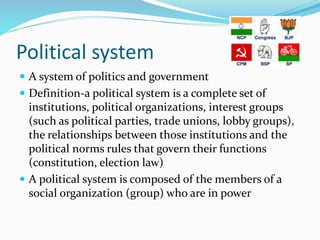
Political system
 A system of politics and government
 Definition-a political system is a complete set of
institutions, political organizations, interest groups
(such as political parties, trade unions, lobby groups),
the relationships between those institutions and the
political norms rules that govern their functions
(constitution, election law)
 A political system is composed of the members of a
social organization (group) who are in power
Types of political systems
1. Democracy
2. Republic
3. Monarchy
4. Communism
5. Dictatorship
Business responsibilities towards
government
 Payment of tax
 International business can bring the foreign exchange
 Employment can be provided
 Provide information “relevant during budget-source of
information”
 Information “in Policy formulation”
 For welfare of people, voluntary programs e.g. temple,
shopping complex
 Infrastructure development help government by
having contracts form government Eg. Dams
Government’s responsibility
towards business
 To reduce excise duty
 To provide loans and credits
 Infrastructural development for the business eg. Electricity,
road transportation
 Technology, right types and at right time should be
provided
 Govt. should take initiative in R & D
 Crumbling competition
 Restricting monopoly
 Encouraging small scale industries
 Increase export
Overview of socio-cultural
environment
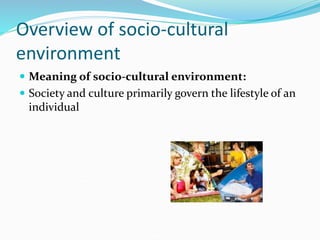
 Meaning of socio-cultural environment:
 Society and culture primarily govern the lifestyle of an
individual
Impact of Socio cultural
environment on business
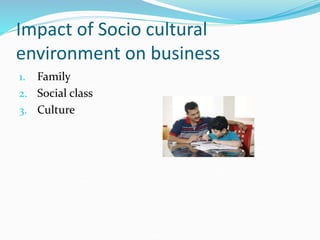
1. Family
2. Social class
3. Culture
1. Family
 Often called as basic social institution
 The minimal form of family consists of a husband, wife
and children
 “A family is a group of persons united by the ties of
marriage, blood or adoption constituting a single
household, interacting and inter-communicating, with
each other in their respective social role of husband
and wife, mother and father, son and daughter,
brother and sister, cradling and maintaining a
common culture”
- Burgess and Locke
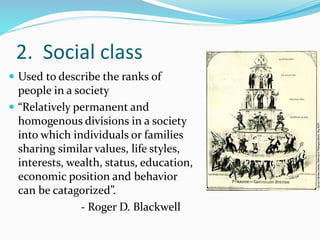
2. Social class
 Used to describe the ranks of
people in a society
 “Relatively permanent and
homogenous divisions in a society
into which individuals or families
sharing similar values, life styles,
interests, wealth, status, education,
economic position and behavior
can be catagorized”.
- Roger D. Blackwell
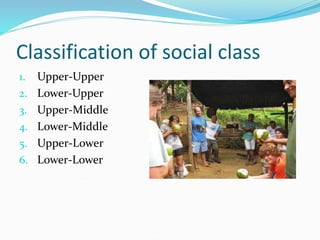
Classification of social class
1. Upper-Upper
2. Lower-Upper
3. Upper-Middle
4. Lower-Middle
5. Upper-Lower
6. Lower-Lower
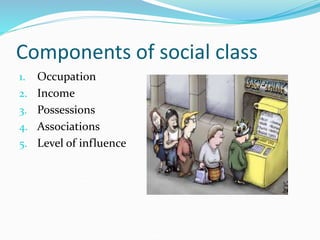
Components of social class
1. Occupation
2. Income
3. Possessions
4. Associations
5. Level of influence
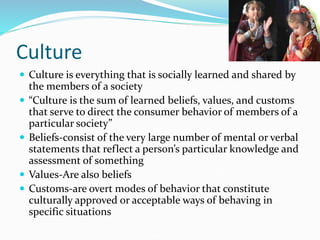
Culture
 Culture is everything that is socially learned and shared by
the members of a society
 “Culture is the sum of learned beliefs, values, and customs
that serve to direct the consumer behavior of members of a
particular society”
 Beliefs-consist of the very large number of mental or verbal
statements that reflect a person’s particular knowledge and
assessment of something
 Values-Are also beliefs
 Customs-are overt modes of behavior that constitute
culturally approved or acceptable ways of behaving in
specific situations
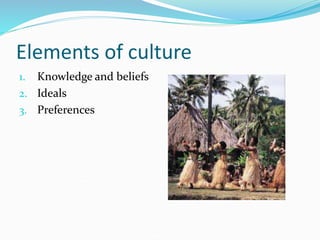
Elements of culture
1. Knowledge and beliefs
2. Ideals
3. Preferences
 Cultural Environment
Social Customs & Rituals and
practices
Language
Collectivism and Individualism
Education
Religion
Lifestyle patterns
Family structure
Role & position of men, women,
children and aged in family & society
Legal and Regulatory
Environment
RE refers to controlled environment which is
closely monitored by a body, usually the
govt.
Even in highly decontrolled & free market
economy, Govts. have certain regulations
which allow them to intervene in business.
Purpose of regulation is to ensure equality &
justice in society by framing Laws, Acts &
Regulation.
Overview of legal environment
 Opportunities that are created by government:
1. Governments are large purchasers of goods and
services
2. Governments subsidize firms and industries and
thus help them survive and prosper
3. Governments protect home industries against
“unfair” foreign competition
 To regulate the market power & minimize
exploitation, by way of framing industrial
policies, labor laws, pricing regulations,
licensing etc.
 To curb negative externalities – like
pollution, unemployment, greater disparity
between the rich & poor etc.
 To ensure welfare of various stakeholders in
the economic system
 To achieve balanced regional & economic
development in all parts of the country.
 Labour legislation
 Environmental laws
 Intellectual Property Rights
 Commercial, civil & criminal laws
 Tariffs and Quotas
 Non-tariff Barriers
 SEBI, FEMA
Legislations Passed by the Govt.
1. Industries act 1951
2. Indian companies Act 1956…..2015
3. Income tax act 1961
4. Competition Act 2002
5. Foreign exchange regulation act 1973
6. Sick industrial companies act 1985, and
7. Consumer Protection Act 1986
SEBI
 Constituted in 1988 and made statutory in 1992
 Objective/ Purpose of the SEBI Act :
 To protect the interest of the investors
 To promote the development of the securities market
 To regulate the securities market
 For matters connected there with or incidental there to
Overview of technological
environment
 Refers to the state of science and technology in the
country and related aspects such as rate of
technological progress, institutional arrangements for
development and application of new technology etc.
 “Systematic application of scientific or other organized
knowledge to practical tasks”
- J.K. Galbraith
Technology
 Knowledge of methods to perform certain tasks or
solve problems pertaining to products or services
 Provides information about Product design,
Production techniques, quality assurance measures,
human resource development and management
systems
Transfer of technology
 The process by which commercial technology is
disseminated
 May or may not be legally binding contract but
involves the communication, by the transferor, or the
relevant knowledge to the recipient
Impact of technology on
business
 Higher productivity
 Global competitiveness
 Changing job profile
 Need for multi skilling and multi tasking
 Difficulty in motivation
 Increasing need for capital
 Increasing Obsolescence
 Organizational restructuring
 Resistance to change
 Social implication
Physical/ Natural Environment
 Climate
 Natural resources
 Flora and fauna
 Soil
 Energy conservation
 Pollution
 Climatic change
International Environment
Important factors that operate at global level which have an impact on
organization are:
 Growth of world economy
 Distribution of world GDP
 International institutions IMF,WTO ILO
 Economic relations between nations
 Global human resource-nature and quality of skills, mobility of labor
 Global technology and quality standards
 Global demographic patterns
Techniques of environmental
analysis
1. SWOT analysis
2. ETOP analysis
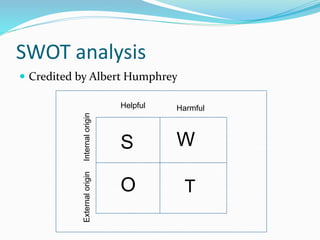
SWOT analysis
 Credited by Albert Humphrey
S W
O T
Helpful Harmful
Internal
origin
External
origin
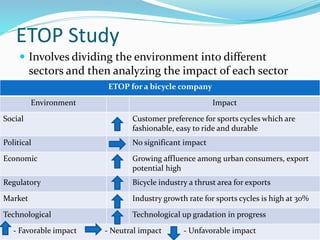
ETOP Study
 Involves dividing the environment into different
sectors and then analyzing the impact of each sector
ETOP for a bicycle company
Environment Impact
Social Customer preference for sports cycles which are
fashionable, easy to ride and durable
Political No significant impact
Economic Growing affluence among urban consumers, export
potential high
Regulatory Bicycle industry a thrust area for exports
Market Industry growth rate for sports cycles is high at 30%
Technological Technological up gradation in progress
- Favorable impact - Neutral impact - Unfavorable impact

External environmental factos.ppt

  • 1.
    Elements of Externalenvironment 1. Micro environment i) Suppliers ii) Customers iii) Competitors iv) Marketing intermediaries v) Public 2. Macro environment i) Economic environment ii) Political environment iii) Legal environment iv) Social environment v) Demographic environment vi) Natural environment vii) Physical and technological environment viii) International environment
  • 2.
    Economic Environment  Economicstages/nature that exists at a given time in a country  Economic system that is adopted by a country for example. Capitalistic, Socialistic or Mixed Economy  Economic planning, such as five year plans, budgets, etc.  Economic policies for example, monetary, industrial and fiscal policies  Economic Indices such as National Income, Per Capital Income, Disposable Income, Rate of growth of GNP, Distribution of Income, Rate of savings, Balance of Payments etc.  Economic Problems  Structure of the Economy  Economic conditions
  • 3.
    Demographic Environment Growth ofpopulation Age Composition Life Expectancy Sex Ratio Inter-state migration Density of population Level of literacy
  • 4.
    Overview of politicalenvironment  Meaning of Political environment:  The political environment consists of factors related to the management of public affairs and their impact on the business of an organization
  • 5.
    Political Environment Political environmentalso includes policies & characteristics of political parties, political ideologies, nature of constitution & govt. system etc.  Political system  Laws  Government agencies  Political institutions  Stability of the government Mutual responsibility of business and Government
  • 6.
    Political system  Asystem of politics and government  Definition-a political system is a complete set of institutions, political organizations, interest groups (such as political parties, trade unions, lobby groups), the relationships between those institutions and the political norms rules that govern their functions (constitution, election law)  A political system is composed of the members of a social organization (group) who are in power
  • 7.
    Types of politicalsystems 1. Democracy 2. Republic 3. Monarchy 4. Communism 5. Dictatorship
  • 8.
    Business responsibilities towards government Payment of tax  International business can bring the foreign exchange  Employment can be provided  Provide information “relevant during budget-source of information”  Information “in Policy formulation”  For welfare of people, voluntary programs e.g. temple, shopping complex  Infrastructure development help government by having contracts form government Eg. Dams
  • 9.
    Government’s responsibility towards business To reduce excise duty  To provide loans and credits  Infrastructural development for the business eg. Electricity, road transportation  Technology, right types and at right time should be provided  Govt. should take initiative in R & D  Crumbling competition  Restricting monopoly  Encouraging small scale industries  Increase export
  • 10.
    Overview of socio-cultural environment Meaning of socio-cultural environment:  Society and culture primarily govern the lifestyle of an individual
  • 11.
    Impact of Sociocultural environment on business 1. Family 2. Social class 3. Culture
  • 12.
    1. Family  Oftencalled as basic social institution  The minimal form of family consists of a husband, wife and children  “A family is a group of persons united by the ties of marriage, blood or adoption constituting a single household, interacting and inter-communicating, with each other in their respective social role of husband and wife, mother and father, son and daughter, brother and sister, cradling and maintaining a common culture” - Burgess and Locke
  • 13.
    2. Social class Used to describe the ranks of people in a society  “Relatively permanent and homogenous divisions in a society into which individuals or families sharing similar values, life styles, interests, wealth, status, education, economic position and behavior can be catagorized”. - Roger D. Blackwell
  • 14.
    Classification of socialclass 1. Upper-Upper 2. Lower-Upper 3. Upper-Middle 4. Lower-Middle 5. Upper-Lower 6. Lower-Lower
  • 15.
    Components of socialclass 1. Occupation 2. Income 3. Possessions 4. Associations 5. Level of influence
  • 16.
    Culture  Culture iseverything that is socially learned and shared by the members of a society  “Culture is the sum of learned beliefs, values, and customs that serve to direct the consumer behavior of members of a particular society”  Beliefs-consist of the very large number of mental or verbal statements that reflect a person’s particular knowledge and assessment of something  Values-Are also beliefs  Customs-are overt modes of behavior that constitute culturally approved or acceptable ways of behaving in specific situations
  • 17.
    Elements of culture 1.Knowledge and beliefs 2. Ideals 3. Preferences
  • 18.
     Cultural Environment SocialCustoms & Rituals and practices Language Collectivism and Individualism Education Religion Lifestyle patterns Family structure Role & position of men, women, children and aged in family & society
  • 19.
    Legal and Regulatory Environment RErefers to controlled environment which is closely monitored by a body, usually the govt. Even in highly decontrolled & free market economy, Govts. have certain regulations which allow them to intervene in business. Purpose of regulation is to ensure equality & justice in society by framing Laws, Acts & Regulation.
  • 20.
    Overview of legalenvironment  Opportunities that are created by government: 1. Governments are large purchasers of goods and services 2. Governments subsidize firms and industries and thus help them survive and prosper 3. Governments protect home industries against “unfair” foreign competition
  • 21.
     To regulatethe market power & minimize exploitation, by way of framing industrial policies, labor laws, pricing regulations, licensing etc.  To curb negative externalities – like pollution, unemployment, greater disparity between the rich & poor etc.  To ensure welfare of various stakeholders in the economic system  To achieve balanced regional & economic development in all parts of the country.
  • 22.
     Labour legislation Environmental laws  Intellectual Property Rights  Commercial, civil & criminal laws  Tariffs and Quotas  Non-tariff Barriers  SEBI, FEMA
  • 23.
    Legislations Passed bythe Govt. 1. Industries act 1951 2. Indian companies Act 1956…..2015 3. Income tax act 1961 4. Competition Act 2002 5. Foreign exchange regulation act 1973 6. Sick industrial companies act 1985, and 7. Consumer Protection Act 1986
  • 24.
    SEBI  Constituted in1988 and made statutory in 1992  Objective/ Purpose of the SEBI Act :  To protect the interest of the investors  To promote the development of the securities market  To regulate the securities market  For matters connected there with or incidental there to
  • 25.
    Overview of technological environment Refers to the state of science and technology in the country and related aspects such as rate of technological progress, institutional arrangements for development and application of new technology etc.  “Systematic application of scientific or other organized knowledge to practical tasks” - J.K. Galbraith
  • 26.
    Technology  Knowledge ofmethods to perform certain tasks or solve problems pertaining to products or services  Provides information about Product design, Production techniques, quality assurance measures, human resource development and management systems
  • 27.
    Transfer of technology The process by which commercial technology is disseminated  May or may not be legally binding contract but involves the communication, by the transferor, or the relevant knowledge to the recipient
  • 28.
    Impact of technologyon business  Higher productivity  Global competitiveness  Changing job profile  Need for multi skilling and multi tasking  Difficulty in motivation  Increasing need for capital  Increasing Obsolescence  Organizational restructuring  Resistance to change  Social implication
  • 29.
    Physical/ Natural Environment Climate  Natural resources  Flora and fauna  Soil  Energy conservation  Pollution  Climatic change
  • 30.
    International Environment Important factorsthat operate at global level which have an impact on organization are:  Growth of world economy  Distribution of world GDP  International institutions IMF,WTO ILO  Economic relations between nations  Global human resource-nature and quality of skills, mobility of labor  Global technology and quality standards  Global demographic patterns
  • 31.
    Techniques of environmental analysis 1.SWOT analysis 2. ETOP analysis
  • 32.
    SWOT analysis  Creditedby Albert Humphrey S W O T Helpful Harmful Internal origin External origin
  • 33.
    ETOP Study  Involvesdividing the environment into different sectors and then analyzing the impact of each sector ETOP for a bicycle company Environment Impact Social Customer preference for sports cycles which are fashionable, easy to ride and durable Political No significant impact Economic Growing affluence among urban consumers, export potential high Regulatory Bicycle industry a thrust area for exports Market Industry growth rate for sports cycles is high at 30% Technological Technological up gradation in progress - Favorable impact - Neutral impact - Unfavorable impact