
Prepared by: JIBUMON K G
Dividend Decision
Meaning ,Definition, Types of Dividend , Factors Determine Dividend
Policy and Dividend Theories
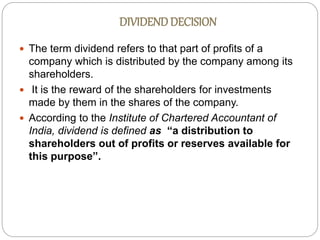
DIVIDEND DECISION
 The term dividend refers to that part of profits of a
company which is distributed by the company among its
shareholders.
 It is the reward of the shareholders for investments
made by them in the shares of the company.
 According to the Institute of Chartered Accountant of
India, dividend is defined as “a distribution to
shareholders out of profits or reserves available for
this purpose”.
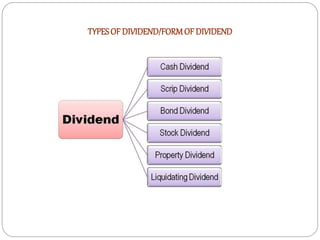
TYPESOF DIVIDEND/FORMOF DIVIDEND
.,
 Cash Dividend
If the dividend is paid in the form of cash to the shareholders, it is
called cash dividend. It is paid periodically out the business concerns
EAIT (Earnings after interest and tax).
Cash dividends are common and popular types followed by majority
of the business concerns.
 Scrip dividend.
A scrip dividend promises to pay shareholders at future specific date.
In case a company does not have sufficient funds to pay dividends in
cash, it may issue notes or bonds for amounts due to shareholders.
The objective of scrip dividend is to postpone the immediate
payment of cash. A scrip dividend bears interest and is accepted as a
collateral security.
 Bond Dividend
Bond dividend is also known as script dividend. If the company does
not have sufficient funds to pay cash dividend, the company
promises to pay the shareholder at a future specific date with the
help of issue of bond or notes.
.
 Stock Dividend
Stock dividend is paid in the form of the company stock due to
raising of more finance.
Under this type, cash is retained by the business concern. Stock
dividend may be bonus issue. This issue is given only to the existing
shareholders of the business concern.
 Property Dividend
Property dividends are paid in the form of some assets other than
cash. It will distributed under the exceptional circumstance. This type
of dividend is not published in India.
 Liquidating dividend.
When the board of directors wishes to return the capital originally
contributed by shareholders as a dividend, it is called a liquidating
dividend, and may be a precursor to shutting down the business.
Dividenddecision
 Dividend decision determines the amount of profit to be distributed
among shareholders and amount of profit to be treated as retained
earnings for financing its long term growth.
 Hence, dividend decision plays very important part in the financial
management.
 Dividend policy of a firm affects both the long-term financing and the
wealth of shareholders. As a result, the firm’s decision to pay
dividends must be reached in such a manner so as to equitably
apportion the distributed profits and retained earnings.
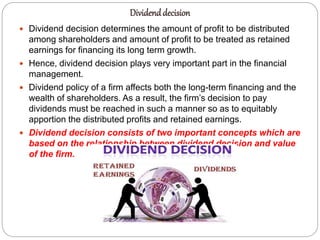
 Dividend decision consists of two important concepts which are
based on the relationship between dividend decision and value
of the firm.
Types of Dividend Decision
Regular Dividend Policy
Stable Dividend Policy
Irregular Dividend Policy
No Dividend Policy
Residual Dividend Policy
`
Regular Dividend Policy
 Payment of dividend at the usual rate is termed as regular
dividend.
 The investors such as retired persons, widows and other
economically weaker persons prefer to get regular dividends
.
Stable Dividend Policy
 Stabile dividends’ means consistency or lack of variability in the
stream of dividend payments.
 It means payment of certain minimum amount of dividend
regularly
.
Irregular Dividend Policy
The company does not pay regular dividend to the shareholders.
The company uses this practice due to following reasons:
 Due to uncertain earning of the company.
 Due to lack of liquid resources.
 The company sometime afraid of giving regular dividend.
 Due to un successful business
No dividend policy
 Under this policy company pays no dividend to its shareholders,
the reason for following this type of policy is that company
retains the profit and invest in the growth of the business.
 Companies which have ample growth opportunities follow this
type of policy and shareholders who are looking for growth invest
in these types of companies because there is plenty of scope of
capital appreciation in these stocks
Residual dividend policy
 Residual dividend policy is used by companies, which finance
new projects through equity that is internally generated.
 In this policy, the dividend payments are made from the equity
that remains after all the project capital needs are met.
 This equity is also known as residual equity
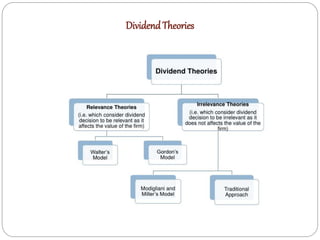
DividendTheories
Relevance theories of Dividend
Walter’s Model
 Prof. James E. Walter argues that the choice of dividend policies
almost always affect the value of the firm.
 According to him the dividend payment has definite impact on
the market value of shares of the companies and hence the total
value of the firm will be influenced by dividend payment.
 In his views the investment decision and dividend decision are
interrelated.
Walter model is based in the relationship between the following
important factors:
 Rate of return I
 Cost of capital (k)
 His model higlate the relationship between internal rate of return
(r) and its cost of capital (k) of the dividend policy and thereby
the wealth of the share holders
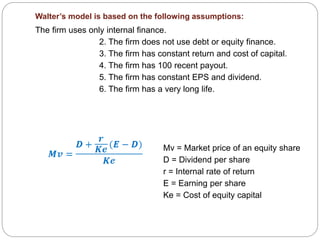
Walter’s model is based on the following assumptions:
The firm uses only internal finance.
2. The firm does not use debt or equity finance.
3. The firm has constant return and cost of capital.
4. The firm has 100 recent payout.
5. The firm has constant EPS and dividend.
6. The firm has a very long life.
Mv = Market price of an equity share
D = Dividend per share
r = Internal rate of return
E = Earning per share
Ke = Cost of equity capital
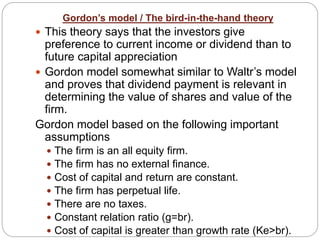
Gordon’s model / The bird-in-the-hand theory
 This theory says that the investors give
preference to current income or dividend than to
future capital appreciation
 Gordon model somewhat similar to Waltr’s model
and proves that dividend payment is relevant in
determining the value of shares and value of the
firm.
Gordon model based on the following important
assumptions
 The firm is an all equity firm.
 The firm has no external finance.
 Cost of capital and return are constant.
 The firm has perpetual life.
 There are no taxes.
 Constant relation ratio (g=br).
 Cost of capital is greater than growth rate (Ke>br).
“Bird in the hand”
 The bird in the hand argument because it is based on the proverb
that a bird in hand is better than two in the bushes
 It is implies that the shareholders always prefer to get immediate
dividend rather than better return from the firm in future.
 This attitude of the investors , the market price of shares of a
company which retain profit will be lower than that of company
which distribute dividend .
 The investors consider retained earnings as a Risky Promise
 Gordon argue that the value of one rupee dividend is more than the
equal amount of capital gain .
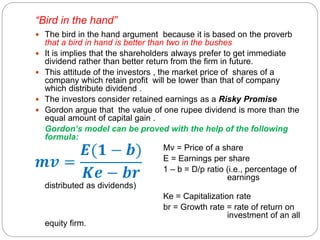
Gordon’s model can be proved with the help of the following
formula:
Mv = Price of a share
E = Earnings per share
1 – b = D/p ratio (i.e., percentage of
earnings
distributed as dividends)
Ke = Capitalization rate
br = Growth rate = rate of return on
investment of an all
equity firm.
irrelevance theories of Dividend
Modigliani and Miller (MM) Approach
 MM theory says that a firm’s dividend policy has no
effect either on the value of the firm or share holders
wealth.
 According to MM approach the value of the firm
depends solely on its earnings power and is not
influenced by the split of earning in to dividend
and retention.
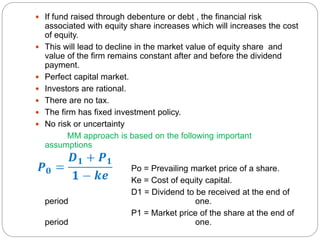
 This theory says that MV of share increase in
short run as a result of dividend payment.
 But as a result of dividend payment the company
is forced to rise additional fund to meet new
Projects
 If fund raised through equity , the MV of equity
,
 If fund raised through debenture or debt , the financial risk
associated with equity share increases which will increases the cost
of equity.
 This will lead to decline in the market value of equity share and
value of the firm remains constant after and before the dividend
payment.
 Perfect capital market.
 Investors are rational.
 There are no tax.
 The firm has fixed investment policy.
 No risk or uncertainty
MM approach is based on the following important
assumptions
Po = Prevailing market price of a share.
Ke = Cost of equity capital.
D1 = Dividend to be received at the end of
period one.
P1 = Market price of the share at the end of
period one.
Residual Approach
 According to this theory dividend decision has no effect on the
wealth of the shareholders or the MV of share .
 This theory regards dividend decision merely a part of finance
decision bcz ….
The firm require finance for new investment they will retain
,
if not required the will distribute it as dividend
 Thus the decision to pay or retain may be taken as a residual
decision
 If the firm has an investment opportunities giving a higher rate of
return than the cost of retained earnings the investors content
with firms investment decision
 But the is not in a position to find profitable investment
opportunities , the investor prefer to receive dividend.
 Therefore a firm should have a profitable investment opportunity
they will retain it , or otherwise distributed as dividend .
.
Factors determiningdividend policyof a firm
Future Growth Requirements
 Accumulation of profits becomes necessary to provide against
contingencies of the business,.
 To finance future- expansion of the business and to modernize or
replace equipments of the enterprise. The conflicting claims of
dividends and accumulations should be equitably settled by the
management.
Business Cycles:
 During the boom period the firms creates good reserves for
facing the crisis the in the future inflationary period.
 These higher rates of dividend are used as a tool for marketing
the securities in depressed market.
.
Age of Corporation:
 Newly established enterprises require most of their earning for
improvement and expansion, while old companies which have
attained a longer earning experience, can formulate clear cut
dividend policies and may even be liberal in the distribution of
dividends.
Type of Industry:
 Industries that are characterised by stability of earnings may
formulate a more consistent policy as to dividends than those
having an uneven flow of income.
 For example, public utilities concerns are in a much better
position to adopt a relatively fixed dividend rate than the
industrial concerns.
Types and desire of share holders
 Desire of the shareholder depend up on their economic status,
investors such as retired persons , widows and economically
weaker person view dividend as a source of income to meet their
day today living expenses.
 Wealthy investors who comes in to the high income tax bracket
may not benefit by high current dividend.
 such investors interested in lower dividend and high capital gain
Thank you

Dividend Decision

  • 1.
    Prepared by: JIBUMONK G Dividend Decision Meaning ,Definition, Types of Dividend , Factors Determine Dividend Policy and Dividend Theories
  • 2.
    DIVIDEND DECISION  Theterm dividend refers to that part of profits of a company which is distributed by the company among its shareholders.  It is the reward of the shareholders for investments made by them in the shares of the company.  According to the Institute of Chartered Accountant of India, dividend is defined as “a distribution to shareholders out of profits or reserves available for this purpose”.
  • 3.
  • 4.
    .,  Cash Dividend Ifthe dividend is paid in the form of cash to the shareholders, it is called cash dividend. It is paid periodically out the business concerns EAIT (Earnings after interest and tax). Cash dividends are common and popular types followed by majority of the business concerns.  Scrip dividend. A scrip dividend promises to pay shareholders at future specific date. In case a company does not have sufficient funds to pay dividends in cash, it may issue notes or bonds for amounts due to shareholders. The objective of scrip dividend is to postpone the immediate payment of cash. A scrip dividend bears interest and is accepted as a collateral security.  Bond Dividend Bond dividend is also known as script dividend. If the company does not have sufficient funds to pay cash dividend, the company promises to pay the shareholder at a future specific date with the help of issue of bond or notes.
  • 5.
    .  Stock Dividend Stockdividend is paid in the form of the company stock due to raising of more finance. Under this type, cash is retained by the business concern. Stock dividend may be bonus issue. This issue is given only to the existing shareholders of the business concern.  Property Dividend Property dividends are paid in the form of some assets other than cash. It will distributed under the exceptional circumstance. This type of dividend is not published in India.  Liquidating dividend. When the board of directors wishes to return the capital originally contributed by shareholders as a dividend, it is called a liquidating dividend, and may be a precursor to shutting down the business.
  • 6.
    Dividenddecision  Dividend decisiondetermines the amount of profit to be distributed among shareholders and amount of profit to be treated as retained earnings for financing its long term growth.  Hence, dividend decision plays very important part in the financial management.  Dividend policy of a firm affects both the long-term financing and the wealth of shareholders. As a result, the firm’s decision to pay dividends must be reached in such a manner so as to equitably apportion the distributed profits and retained earnings.  Dividend decision consists of two important concepts which are based on the relationship between dividend decision and value of the firm.
  • 7.
    Types of DividendDecision Regular Dividend Policy Stable Dividend Policy Irregular Dividend Policy No Dividend Policy Residual Dividend Policy ` Regular Dividend Policy  Payment of dividend at the usual rate is termed as regular dividend.  The investors such as retired persons, widows and other economically weaker persons prefer to get regular dividends . Stable Dividend Policy  Stabile dividends’ means consistency or lack of variability in the stream of dividend payments.  It means payment of certain minimum amount of dividend regularly
  • 8.
    . Irregular Dividend Policy Thecompany does not pay regular dividend to the shareholders. The company uses this practice due to following reasons:  Due to uncertain earning of the company.  Due to lack of liquid resources.  The company sometime afraid of giving regular dividend.  Due to un successful business No dividend policy  Under this policy company pays no dividend to its shareholders, the reason for following this type of policy is that company retains the profit and invest in the growth of the business.  Companies which have ample growth opportunities follow this type of policy and shareholders who are looking for growth invest in these types of companies because there is plenty of scope of capital appreciation in these stocks
  • 9.
    Residual dividend policy Residual dividend policy is used by companies, which finance new projects through equity that is internally generated.  In this policy, the dividend payments are made from the equity that remains after all the project capital needs are met.  This equity is also known as residual equity
  • 10.
  • 11.
    Relevance theories ofDividend Walter’s Model  Prof. James E. Walter argues that the choice of dividend policies almost always affect the value of the firm.  According to him the dividend payment has definite impact on the market value of shares of the companies and hence the total value of the firm will be influenced by dividend payment.  In his views the investment decision and dividend decision are interrelated. Walter model is based in the relationship between the following important factors:  Rate of return I  Cost of capital (k)  His model higlate the relationship between internal rate of return (r) and its cost of capital (k) of the dividend policy and thereby the wealth of the share holders
  • 12.
    Walter’s model isbased on the following assumptions: The firm uses only internal finance. 2. The firm does not use debt or equity finance. 3. The firm has constant return and cost of capital. 4. The firm has 100 recent payout. 5. The firm has constant EPS and dividend. 6. The firm has a very long life. Mv = Market price of an equity share D = Dividend per share r = Internal rate of return E = Earning per share Ke = Cost of equity capital
  • 13.
    Gordon’s model /The bird-in-the-hand theory  This theory says that the investors give preference to current income or dividend than to future capital appreciation  Gordon model somewhat similar to Waltr’s model and proves that dividend payment is relevant in determining the value of shares and value of the firm. Gordon model based on the following important assumptions  The firm is an all equity firm.  The firm has no external finance.  Cost of capital and return are constant.  The firm has perpetual life.  There are no taxes.  Constant relation ratio (g=br).  Cost of capital is greater than growth rate (Ke>br).
  • 14.
    “Bird in thehand”  The bird in the hand argument because it is based on the proverb that a bird in hand is better than two in the bushes  It is implies that the shareholders always prefer to get immediate dividend rather than better return from the firm in future.  This attitude of the investors , the market price of shares of a company which retain profit will be lower than that of company which distribute dividend .  The investors consider retained earnings as a Risky Promise  Gordon argue that the value of one rupee dividend is more than the equal amount of capital gain . Gordon’s model can be proved with the help of the following formula: Mv = Price of a share E = Earnings per share 1 – b = D/p ratio (i.e., percentage of earnings distributed as dividends) Ke = Capitalization rate br = Growth rate = rate of return on investment of an all equity firm.
  • 15.
    irrelevance theories ofDividend Modigliani and Miller (MM) Approach  MM theory says that a firm’s dividend policy has no effect either on the value of the firm or share holders wealth.  According to MM approach the value of the firm depends solely on its earnings power and is not influenced by the split of earning in to dividend and retention.  This theory says that MV of share increase in short run as a result of dividend payment.  But as a result of dividend payment the company is forced to rise additional fund to meet new Projects  If fund raised through equity , the MV of equity
  • 16.
    ,  If fundraised through debenture or debt , the financial risk associated with equity share increases which will increases the cost of equity.  This will lead to decline in the market value of equity share and value of the firm remains constant after and before the dividend payment.  Perfect capital market.  Investors are rational.  There are no tax.  The firm has fixed investment policy.  No risk or uncertainty MM approach is based on the following important assumptions Po = Prevailing market price of a share. Ke = Cost of equity capital. D1 = Dividend to be received at the end of period one. P1 = Market price of the share at the end of period one.
  • 17.
    Residual Approach  Accordingto this theory dividend decision has no effect on the wealth of the shareholders or the MV of share .  This theory regards dividend decision merely a part of finance decision bcz …. The firm require finance for new investment they will retain , if not required the will distribute it as dividend  Thus the decision to pay or retain may be taken as a residual decision  If the firm has an investment opportunities giving a higher rate of return than the cost of retained earnings the investors content with firms investment decision  But the is not in a position to find profitable investment opportunities , the investor prefer to receive dividend.  Therefore a firm should have a profitable investment opportunity they will retain it , or otherwise distributed as dividend .
  • 18.
    . Factors determiningdividend policyofa firm Future Growth Requirements  Accumulation of profits becomes necessary to provide against contingencies of the business,.  To finance future- expansion of the business and to modernize or replace equipments of the enterprise. The conflicting claims of dividends and accumulations should be equitably settled by the management. Business Cycles:  During the boom period the firms creates good reserves for facing the crisis the in the future inflationary period.  These higher rates of dividend are used as a tool for marketing the securities in depressed market.
  • 19.
    . Age of Corporation: Newly established enterprises require most of their earning for improvement and expansion, while old companies which have attained a longer earning experience, can formulate clear cut dividend policies and may even be liberal in the distribution of dividends. Type of Industry:  Industries that are characterised by stability of earnings may formulate a more consistent policy as to dividends than those having an uneven flow of income.  For example, public utilities concerns are in a much better position to adopt a relatively fixed dividend rate than the industrial concerns. Types and desire of share holders  Desire of the shareholder depend up on their economic status, investors such as retired persons , widows and economically weaker person view dividend as a source of income to meet their day today living expenses.  Wealthy investors who comes in to the high income tax bracket may not benefit by high current dividend.  such investors interested in lower dividend and high capital gain
  • 20.